


Judges 20:16
Bible text: King James Version (1769 Blayney text) · Public domain
Bible text: Berean Standard Bible · Public domain
Bible text: American Standard Version (1901) · Public domain
Bible text: World English Bible, Messianic edition · Public domain
Bible text: Geneva Bible (1599) · Public domain
Bible text: Young's Literal Translation · Public domain
- מִכֹּלmi·Kol[were] from allH3605Prep-m ¦ N-mscNoun Singular Masculine Constructמִ[were] fromכֹּלall
- הָעָםha·'Amthe peopleH5971Art ¦ N-msNoun Singular Masculine Absoluteהָtheעָםpeople
- הַזֶּהha·Zeh<the> thisH2088Art ¦ PrtParticle Demonstrativeהַ<the>זֶּהthis
- שְׁבַעshe·Va'sevenH7651N-cscNoun Singular common gender Construct
- מֵאוֹתme·'Othundred<s>H3967N-fpNoun Plural Feminine Absolute
- אִישׁ'ishmanH376N-msNoun Singular Masculine Absolute
- בָּחוּרba·ChurchosenH977V-Qal-PassPrtcpl-msVerb Qal Participle Passive Singular Masculine Absolute
- אִטֵּר'i·TerimpededH334Adj-msAdjective Singular Masculine Absolute
- יַדyad[the] hand ofH3027N-cscNoun Singular common gender Construct
- יְמִינוֹye·mi·Nohis rightH3225N-fsc ¦ 3msNoun Singular Feminine Constructיְמִינrightוֹhis
- כָּלkolallH3605N-mscNoun Singular Masculine Construct
- זֶהZehthisH2088PrtParticle Demonstrative
- קֹלֵעַko·Le·a'[was] slingingH7049V-Qal-Prtcpl-msVerb Qal Participle Singular Masculine Absolute
- בָּאֶבֶןba·'E·venwith the stoneH68Prep-b ¦ N-fsNoun Singular Feminine Absoluteבָּwith theאֶבֶןstone
- אֶל'eltoH413PrepPreposition
- הַשַּׂעֲרָהha·sa·'a·Rahthe single hairH8185Art ¦ N-fsNoun Singular Feminine Absoluteהַtheשַּׂעֲרָהsingle hair
- וְלֹאve·Lo'and notH3808Conj-w ¦ NegParticle Negativeוְandלֹאnot
- יַחֲטִאya·cha·Ti'he missedH2398V-Hiphil-Imperf-3msVerb Hiphil Imperfect 3rd Singular Masculine
English is a literal word-by-word gloss of the Hebrew, not the KJV's wording. Why?
This is the original text the KJV's translators worked from — each Hebrew word with its own literal English meaning in this verse, prepared by scholars at Tyndale House, Cambridge. The KJV translates whole sentences, not word by word, so its wording differs: one Hebrew word can become several English words, and the KJV may choose “the LORD” where the gloss reads “Yahweh”. Both are faithful — they answer different questions. For the KJV's own rendering, switch to the KJV text.
Details
See on the biblical-era maps
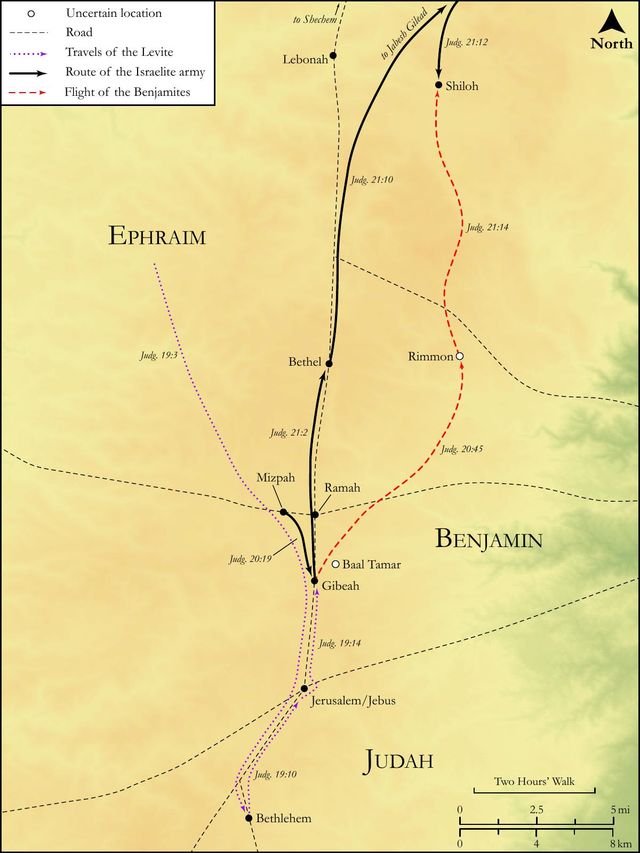
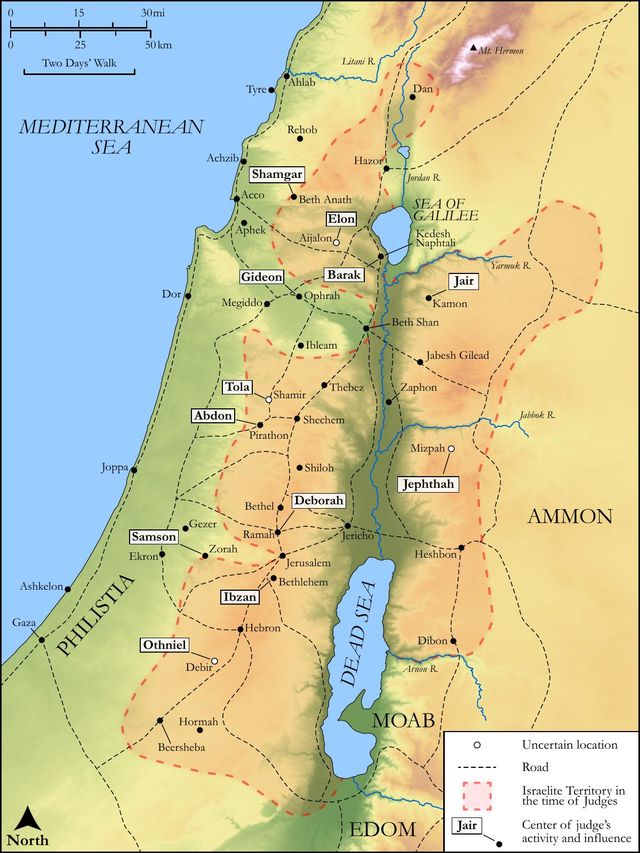
Study this verse
Public-domain commentary
Matthew Henry
From his Commentary on the Whole Bible. Henry comments on passages, not single verses — this entry covers Judges 20:12–17. His three-level outline is real structure in the source text, so it is rendered as structure.
Here is, I. The fair and just demand which the tribes of Israel, now encamped, sent to the tribe of Benjamin, to deliver up the malefactors of Gibeah to justice, Jdg 20:12, Jdg 20:13. If the tribe of Benjamin had come up, as they ought to have done, to the assembly, and agreed with them in their resolution, there would have been none to deal with but the men of Gibeah only, but they, by their absence, taking part with the criminals, application must be made to them all. The Israelites were zealous against the wickedness that was committed, yet they were discreet in their zeal, and did not think it would justify them in falling upon the whole tribe of Benjamin unless they, by refusing to give up the criminals, and protecting them against justice, should make themselves guilty, ex post facto - as accessaries after the fact. They desire them to consider how great the wickedness was that was committed (Jdg 20:12), and that it was done among them: and how necessary it was therefore that they should either punish the malefactors with death themselves, according to the law of Moses, or deliver them up to the general assembly, to be so much the more publicly and solemnly punished, that evil might be put away from Israel, the national guilt removed, the infection stopped by cutting off the gangrened part, and national judgments prevented; for the sin was so very like that of the Sodomites that they might justly fear, if they did not punish it, God would rain hail from heaven upon them, as he did, not only upon Sodom, but the neighbouring cities. If the Israelites had not made this reasonable demand, they would have had much more reason to lament the following desolations of Benjamin. All methods of accommodation must be used before we go to war or go to law. The demand was like that of Joab's to Abel, Sa2 20:20, Sa2 20:21. "Only deliver up the traitor, and we will lay down our arms." On these terms, and no other, God will be at peace with us, that we part with our sins, that we mortify and crucify our lusts, and then all shall be well; his anger will be turned away.
II.The wretched obstinacy and perverseness of the men of Benjamin, who seem to have been as unanimous and zealous in their resolutions to stand by the criminals as the rest of the tribes were to punish them, so little sense had they of their honour, duty, and interest. 1. They were so prodigiously vile as to patronise the wickedness that was committed: They would not hearken to the voice of their brethren (Jdg 20:13), either because those of that tribe were generally more vicious and debauched at this time than the rest of the tribes, and therefore would not bear to have that punished in others of which they knew themselves guilty (some of the most fruitful and pleasant parts of Canaan fell to the lot of this tribe; their land, like that of Sodom, was as the garden of the Lord, which perhaps helped to make the inhabitants, like the men of Sodom, wicked, and sinners before the Lord exceedingly, Gen 13:10, Gen 13:13), or because (as bishop Patrick suggests) they took it ill that the other tribes should meddle with their concerns; they would not do that which they knew was their duty because they were reminded of it by their brethren, by whom they scorned to be taught and controlled. If there were any wise men among them that would have complied with the demand made, yet they were overpowered by the majority, who thus made the crime of the men of Gibeah their own. Thus we have fellowship with the unfruitful works of darkness if we say A confederacy with those that have, and make ourselves guilty of other men's sins by countenancing and defending them. It seems there is no cause so bad but it will find some patrons, some advocates, to appear for it; but woe be to those by whom such offences come. Those will have a great deal to answer for that obstruct the course of necessary justice, and strengthen the hands of the wicked, by saying, O wicked man! thou shalt not die.
2.They were so prodigiously vain and presumptuous as to make head against the united force of all Israel. Never, surely, were men so wretchedly infatuated as they were when they took up arms in opposition,
(1.)To so good a cause as Israel had. How could they expect to prosper when they fought against justice, and consequently against the just God himself, against those that had the high priest and the divine oracle on their side, and so acted in downright rebellion against the sacred and supreme authority of the nation.
(2.)To so great a force as Israel had. The disproportion of their numbers was much greater than that, Luk 14:31, Luk 14:32, where he that had but 10,000 durst not meet him that came against him with 20,000, and therefore desired conditions of peace. There the enemy was but two to one, here above fifteen to one; yet they despised conditions of peace. All the forces they could bring into the field were but 26,000 men, besides 700 men of Gibeah (Jdg 20:15); yet with these they will dare to face 400,000 men of Israel, Jdg 20:17. Thus sinners are infatuated to their own ruin, and provoke him to jealousy who is infinitely stronger than they, Co1 10:22. But it should seem they depended upon the skill of their men to make up what was wanting in numbers, especially a regiment of slingers, 700 men, who, though left-handed, were so dexterous at slinging stones that they would not be a hair's breadth beside their mark, Jdg 20:16. But these good marksmen were very much out in their aim when they espoused this bad cause. Benjamin signifies the son of the right hand, yet we find his posterity left-handed.
Continue studying Judges 20:16 across the web’s major study libraries — every link below opens this exact verse, chapter, or book on the destination site.
Read & Compare
 BibleGatewayThis verse in more than 200 translations and 70 languages.
 Bible.comThe YouVersion reader — hundreds of translations, reading plans, and highlights.
 ESV.orgCrossway's official English Standard Version reader.
 NET BibleThe NET translation with 60,000+ translators' notes on every rendering decision.
 STEP BibleTyndale House's free study tool — original text, vocabulary, and scholarly resources.
 BibliaLogos Bible Software's free web reader.
 USCCBThe New American Bible (Revised Edition) with the U.S. bishops' study notes.
Commentaries
 BibleHub CommentariesDozens of classic commentaries on this verse, gathered on one page.
 StudyLightMore than 100 commentary sets — the largest collection on the web.
 BibleRefPlain-English commentary on what this verse means, verse by verse.
 Enduring WordDavid Guzik's free commentary on this chapter, widely used by Bible teachers.
 Bible Study ToolsVerse commentary alongside Greek and Hebrew study aids.
Original Language & Research
- BibleHub InterlinearThe verse word by word — original language, transliteration, and English.
- BibleHub LexiconEvery word's original-language definition and Strong's entry.
 Blue Letter BibleDeep-study tools — Strong's numbers, concordance, and word studies.
 SefariaThe Hebrew text with Rashi and centuries of Jewish commentary.
Sermons, Hymns & Audio


TrulyRandomVerse is not affiliated with these sites and doesn’t control their content. They’re linked because they’re genuinely useful.
Summary
Judges 20:16 reveals a chilling detail about the Benjamite forces: a contingent of seven hundred elite warriors, uniquely described as "lefthanded," possessed unparalleled accuracy with a sling, capable of striking a target as small as a hair without fail. This verse serves as a stark testament to their formidable military prowess, explaining why the tribe of Benjamin, despite being vastly outnumbered, presented such a devastating and unexpected challenge to the other Israelite tribes in the brutal civil war that unfolded. It highlights an extraordinary level of specialized skill and precision, setting the stage for the fierce and tragic conflict.
Context
ShowHideLiterary Context
Judges 20:16 is strategically placed within the climactic and deeply tragic narrative of Israel's civil war, which spans Judges 19-21. This devastating conflict is ignited by the horrific crime committed against the Levite's concubine in Gibeah, a city situated within Benjamin's tribal territory. The preceding verses detail the assembly of the other eleven tribes, their righteous indignation, and their demand for justice against the perpetrators in Gibeah. However, Benjamin defiantly refuses to surrender the culprits, choosing instead to protect their own, leading to an inevitable confrontation. The verse immediately follows the mustering of Benjamin's forces, providing a crucial, almost shocking, insight into the extraordinary fighting capability of a select group within their army. This specific detail is pivotal, as it provides the essential background for understanding the initial, shocking defeats inflicted upon the larger, combined Israelite army, thereby underscoring the formidable and unexpected nature of their Benjamite adversaries and the immense, fratricidal cost of the ensuing war.
Historical & Cultural Context
The period of the Judges, roughly spanning 1200-1000 BCE, was characterized by a decentralized tribal confederacy in Israel, marked by recurring cycles of apostasy, divine judgment through oppression, and subsequent deliverance. A defining characteristic of this era is encapsulated in the poignant statement: "in those days there was no king in Israel; every man did that which was right in his own eyes" (Judges 21:25). The description of the warriors as "lefthanded" holds particular historical and cultural significance. The Hebrew phrase, אִטֵּר יַד יְמִינוֹ ('iṭṭēr yad yemīnô), literally translates to "restricted in his right hand" or "bound in his right hand." This suggests not necessarily natural left-handedness in the modern sense, but rather a deliberate and highly specialized training regimen designed to make the left hand the primary combat hand. This unique training offered a distinct tactical advantage in ancient warfare, as opponents typically anticipated and guarded against a right-handed attack, leaving them vulnerable to an unexpected left-handed assault. This rare Benjamite trait is famously exemplified by Ehud, the left-handed judge, who leveraged his unique skill to assassinate King Eglon of Moab. Slings were common and highly effective projectile weapons in this period, capable of delivering lethal force when wielded by exceptionally skilled hands.
Key Themes
ShowHideThis verse profoundly contributes to several overarching themes within the book of Judges and the broader biblical narrative. Foremost is the theme of Exceptional Military Prowess and Specialized Skill, highlighting how intense, specialized training and unique abilities can forge an extraordinarily formidable fighting force. The "hair breadth" accuracy speaks to an almost unbelievable level of Precision and Mastery, emphasizing the dedication and discipline required to achieve such proficiency. Paradoxically, this extraordinary human skill is deployed in a context of profound Moral Decay and Fratricidal Conflict, powerfully illustrating the tragic consequences when human abilities, no matter how impressive, are divorced from divine guidance, righteousness, and are instead used for destructive, self-serving purposes. The verse also underscores the Formidability of the Benjamites, providing the crucial explanation for why this smallest of the tribes could inflict such heavy and shocking losses on the combined forces of Israel, thereby setting the stage for the intense and devastating battles described throughout Judges 20.
Exposition and Analysis
ShowHideKey Word Analysis
ShowHideThis phrase, composed of H334 (ʼiṭṭêr - shut up, impeded), H3027 (yâd - hand), and H3225 (yâmîyn - right hand), literally translates to "restricted in his right hand" or "bound in his right hand." It does not imply natural left-handedness but rather a deliberate and specialized training regime where the right hand was intentionally constrained or rendered less dominant, forcing the development of the left hand as the primary combat hand. This specialized training provided a significant tactical advantage in ancient warfare, as most adversaries would anticipate and defend against a right-handed attack, leaving them dangerously vulnerable to an unexpected assault from the left side. This unique skill set made these Benjamite warriors exceptionally dangerous, unpredictable, and highly effective.
The Hebrew word saʻărâh (H8185) literally means "a hair" or "a hair's breadth." This is a powerful hyperbolic expression employed to convey an extreme, almost unbelievable, level of precision and accuracy. When applied to slinging stones, it signifies that these warriors could hit even the smallest, most difficult targets with absolute certainty and unerring consistency, making them incredibly effective and deadly in battle.
The Hebrew verb châṭâʼ (H2398) fundamentally means "to miss" a mark or target. Figuratively, it extends to "to sin" or "to go astray." In this context, its use emphatically reinforces the extraordinary skill of the Benjamite slingers. The declaration that they "not miss" (a negative of châṭâʼ) unequivocally states their perfect aim and unerring accuracy. It removes any doubt about their proficiency, confirming that their ability to hit even a "hair breadth" target was absolute and without failure.
Verse Breakdown
ShowHide"Among all this people [there were] seven hundred chosen men lefthanded"
This clause immediately identifies a specific, elite contingent within the broader Benjamite army. The number "seven hundred" denotes a significant, though not numerically overwhelming, force. However, their unique designation as "lefthanded" (implying specialized training) sets them apart as exceptionally skilled and formidable warriors, chosen for their distinct and highly advantageous combat method.
"every one could sling stones at an hair [breadth]"
This emphasizes the uniform and individual proficiency of each of these seven hundred men. The phrase "at an hair [breadth]" employs hyperbole to convey an astonishing degree of accuracy that borders on the miraculous, highlighting their absolute mastery of the sling as a weapon, capable of hitting the most minute targets.
"and not miss"
This concluding phrase unequivocally confirms the absolute precision and unerring deadliness of their aim. It serves to reinforce and validate the hyperbole of "hair breadth," leaving no doubt that these slingers were perfectly reliable and devastatingly effective in their combat role, never failing to strike their intended mark.
Literary Devices
ShowHideJudges 20:16 masterfully employs several potent literary devices to convey the extraordinary and terrifying skill of the Benjamite warriors. Hyperbole is prominently featured in the phrase "sling stones at an hair [breadth], and not miss," which exaggerates their accuracy to an almost superhuman level of precision. This deliberate overstatement vividly portrays their unmatched deadliness and effectiveness in battle. The verse also functions as powerful Foreshadowing, subtly yet effectively preparing the reader for the initial, shocking defeats inflicted upon the larger Israelite army in the subsequent battles of the civil war. It provides the crucial explanation for why a numerically smaller tribe could inflict such heavy and unexpected losses. Furthermore, there is a profound element of Irony present; such immense and unique skill, which could have been harnessed for constructive purposes, national defense, or even divine service, is tragically deployed in a fratricidal war, highlighting the deep moral and spiritual decay within Israel during this chaotic period. Finally, the specific number "seven hundred" creates a striking Contrast between their relatively small numerical strength and their disproportionately devastating effectiveness, amplifying their formidable and terrifying nature.
Theological and Thematic Connections
ShowHideJudges 20:16, while ostensibly a description of military prowess, implicitly raises profound theological questions about the nature of human skill and its ultimate deployment. It powerfully demonstrates that extraordinary human ability, even when cultivated to perfection and achieving unparalleled precision, is not inherently good or evil; its moral quality is fundamentally determined by the purpose to which it is applied and the heart from which it springs. In this tragic narrative, the Benjamites' unparalleled skill is tragically misdirected and perverted in a civil war born of unrighteousness, stubborn pride, and a profound lack of spiritual discernment. The passage serves as a stark and sobering reminder of the destructive potential of human capabilities when they are divorced from divine wisdom, righteous principles, and a commitment to justice. It underscores that even the most impressive talents and the highest levels of mastery can lead to immense devastation if not submitted to God's will and used for His glory, particularly in a context where "every man did that which was right in his own eyes."
Reflection and Application
ShowHideThe detailed description of the Benjamite slingers in Judges 20:16, though situated within a dark and violent chapter of Israel's history, offers profound insights for contemporary reflection and application. This verse vividly highlights the immense value of specialized skill, mastery, and unwavering dedication to one's craft. Just as these ancient warriors honed their abilities to an extraordinary degree, achieving near-perfect precision, we too are called to identify, cultivate, and develop the unique gifts, talents, and callings that God has graciously bestowed upon each of us. Whether in our professional vocations, our ministries, our personal relationships, or our spiritual disciplines, striving for excellence and precision in our endeavors is a worthy pursuit that honors the Giver of all good gifts. However, the tragic context of the civil war serves as a sobering and critical reminder that even the most exceptional abilities can be misused, misdirected, or perverted when not guided by righteous principles, a humble spirit, and a profound commitment to peace and reconciliation. We are therefore challenged to constantly examine our motives, ensuring that our skills, influence, and resources are employed for constructive, life-giving purposes, fostering reconciliation, justice, and the common good, rather than contributing to division, conflict, or destruction. This passage compels us to consider how we are stewarding our God-given talents and whether we are truly using them to build up God's kingdom and bless humanity, or, inadvertently, to perpetuate the very brokenness and conflict that plagues our world.
Questions for Reflection
ShowHideFAQ
ShowHideWhy is the "lefthanded" aspect so emphasized for the Benjamites, and what does it mean?
ShowHideThe emphasis on "lefthanded" (Hebrew: אִטֵּר יַד יְמִינוֹ, 'iṭṭēr yad yemīnô') is profoundly crucial because it signifies a highly specialized and tactically advantageous training, not merely a natural handedness. The phrase literally translates to "restricted in his right hand" or "bound in his right hand," implying that these men were deliberately trained to use their left hand as their primary hand for combat. In ancient warfare, the vast majority of warriors were right-handed, meaning opponents would naturally expect and guard against attacks from the right side. A left-handed attack, therefore, would come from an unexpected angle, creating a significant element of surprise, confusion, and vulnerability for the adversary. This unique skill set made the Benjamite slingers exceptionally formidable, unpredictable, and difficult to counter, as famously demonstrated by Ehud, another left-handed Benjamite judge, who leveraged his left-handedness to assassinate King Eglon of Moab. This specific detail in Judges 20 is vital for understanding why the tribe of Benjamin, despite being numerically small, was able to inflict such heavy and shocking losses on the combined forces of Israel in the initial battles of the civil war.
Christ-Centered Fulfillment
ShowHideWhile Judges 20:16 describes the formidable, yet tragically misdirected, precision of human warriors in a dark and fragmented period of Israel's history, it subtly points forward to the ultimate "chosen man" and the perfect "aim" of God in Jesus Christ. Unlike these Benjamite slingers whose unparalleled skill was tragically deployed in a fratricidal war that brought division and devastation, Jesus, the true Lamb of God who takes away the sin of the world, came specifically to bring profound peace and reconciliation, not further division (Ephesians 2:14). His "aim" was not with stones of destruction but with the perfect fulfillment of God's redemptive plan for humanity. He perfectly "hit the mark" of God's righteous will, demonstrating absolute obedience and sinless perfection where Israel consistently "missed" the mark of righteousness and fell into moral decay. His life, sacrificial death, and glorious resurrection represent the ultimate, unerring "shot" against the power of sin and death, securing eternal victory and salvation for all who believe (Hebrews 4:12). Where human skill, even at its peak, can be tragically misused for destruction and conflict, Christ's perfect work establishes true justice, lasting peace, and eternal life, making Him the ultimate example of divine precision, perfect purpose, and redemptive power, fulfilling all that the fragmented and morally compromised era of the Judges so desperately longed for.