


1 Samuel 25:29
- וַיָּקָםvai·Ya·komand he has arisenH6965Conj-w ¦ V-Qal-ConsecImperf-3msVerb Qal Consecutive Imperfect 3rd Singular Masculineוַandיָּקָםhe has arisen
- אָדָם'a·Dama manH120N-msNoun Singular Masculine Absolute
- לִרְדָפְךָlir·da·fe·Khato pursue youH7291Prep-l ¦ V-Qal-Inf ¦ 2msVerb Qal Infinitive Constructלִtoרְדָפְpursueךָyou
- וּלְבַקֵּשׁu·le·va·Keshand to seekH1245Conj-w ¦ Prep-l ¦ V-Piel-InfVerb Piel Infinitive Constructוּandלְtoבַקֵּשׁseek
- אֶת'et<obj.>H853DirObjMParticle Object Indicator
- נַפְשֶׁךָnaf·She·khayour lifeH5315N-fsc ¦ 2msNoun Singular Feminine Constructנַפְשֶׁlifeךָyour
- וְהָיְתָהve·ha·ye·Tahand it will beH1961Conj-w ¦ V-Qal-ConsecPerf-3fsVerb Qal Consecutive Perfect 3rd Singular Feminineוְandהָיְתָהit will be
- נֶפֶשׁNe·fesh[the] life ofH5315N-fscNoun Singular Feminine Construct
- אֲדֹנִי'a·do·Nimy lordH113N-msc ¦ 1csNoun Singular Masculine Constructאֲדֹנִlordיmy
- צְרוּרָהtze·ru·Rahbound upH6887V-Qal-PassPrtcpl-fsVerb Qal Participle Passive Singular Feminine Absolute
- בִּצְרוֹרbitz·Rorin [the] bundle ofH6872Prep-b ¦ N-mscNoun Singular Masculine Constructבִּinצְרוֹר[the] bundle of
- הַחַיִּיםha·chai·Yimthe livingH2416Art ¦ Adj-mpAdjective Plural Masculine Absoluteהַtheחַיִּיםliving
- אֵת'etwithH854PrepPreposition
- יְהוָהYah·wehYahwehH3068N-properNoun Proper Title
- אֱלֹהֶיךָ'e·lo·Hei·khayour GodH430N-mpc ¦ 2msNoun Plural Masculine ConstructאֱלֹהֶיGodךָyour
- וְאֵתve·'Etand <obj.>H853Conj-w ¦ DirObjMParticle Object Indicatorוְandאֵת<obj.>
- נֶפֶשׁNe·fesh[the] life ofH5315N-fscNoun Singular Feminine Construct
- אֹיְבֶיךָ'o·ye·Vei·khayour enemiesH341V-Qal-Prtcpl-mp ¦ 2msVerb Qal Participle Plural Masculine Constructאֹיְבֶיenemiesךָyour
- יְקַלְּעֶנָּהye·kal·le·'E·nahhe will sling out itH7049V-Piel-Imperf-3ms ¦ 3fsVerb Piel Imperfect 3rd Singular Masculineיְקַלְּעֶhe will sling outנָּהit
- בְּתוֹךְbe·Tokhin [the] midst ofH8432Prep-b ¦ N-mscNoun Singular Masculine Constructבְּinתוֹךְ[the] midst of
- כַּףkaf[the] hollow ofH3709N-fscNoun Singular Feminine Construct
- הַקָּלַעha·Ka·la'<the> slingH7050Art ¦ N-msNoun Singular Masculine Absoluteהַ<the>קָּלַעsling
English is a literal word-by-word gloss of the Hebrew, not the KJV's wording. Why?
This is the original text the KJV's translators worked from — each Hebrew word with its own literal English meaning in this verse, prepared by scholars at Tyndale House, Cambridge. The KJV translates whole sentences, not word by word, so its wording differs: one Hebrew word can become several English words, and the KJV may choose “the LORD” where the gloss reads “Yahweh”. Both are faithful — they answer different questions. For the KJV's own rendering, switch to the KJV text.
Details
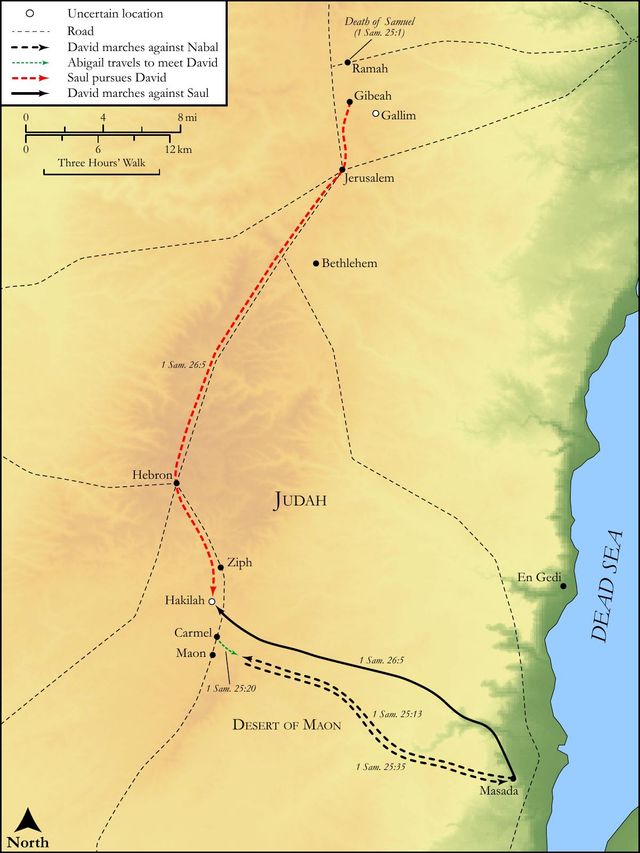
See on the biblical-era map
Study this verse
Public-domain commentary
Matthew Henry
From his Commentary on the Whole Bible. Henry comments on passages, not single verses — this entry covers 1 Samuel 25:18–31. His three-level outline is real structure in the source text, so it is rendered as structure.
We have here an account of Abigail's prudent management for the preserving of her husband and family from the destruction that was just coming upon them; and we find that she did her part admirably well and fully answered her character. The passion of fools often makes those breaches in a little time which the wise, with all their wisdom, have much ado to make up again. It is hard to say whether Abigail was more miserable in such a husband or Nabal happy in such a wife. A virtuous woman is a crown to her husband, to protect as well as adorn, and will do him good and not evil. Wisdom in such a case as this was better than weapons of war. 1. It was her wisdom that what she did she did quickly, and without delay; she made haste, Sa1 25:18. It was no time to trifle or linger when all was in danger. Those that desire conditions of peace must send when the enemy is yet a great way off, Luk 14:32. 2. It was her wisdom that what she did she did herself, because, being a woman of great prudence and very happy address, she knew better how to manage it than any servant she had. The virtuous woman will herself look well to the ways of her household, and not devolve this duty wholly upon others.
Abigail must endeavour to atone for Nabal's faults. Now he had been in two ways rude to David's messengers, and in them to David: He had denied them the provisions they asked for, and he had given them very provoking language. Now,
I.By a most generous present, Abigail atones for his denial of their request.
If Nabal had given them what came next to hand, they would have gone away thankful; but Abigail prepares the very best the house afforded and abundance of it (Sa1 25:18), according to the usual entertainments of those times, not only bread and flesh, but raisins and figs, which were their dried sweet-meats. Nabal grudged them water, but she took two bottles (casks or rundlets) of wine, loaded her asses with these provisions, and sent them before; for a gift pacifieth anger, Pro 21:14. Jacob thus pacified Esau. When the instruments of the churl are evil, the liberal devises liberal things, and loses nothing by it; for by liberal things shall he stand, Isa 32:7, Isa 32:8. Abigail not only lawfully, but laudably, disposed of all these goods of her husband's without his knowledge (even when she had reason to think that if he had known what she did he would not have consented to it), because it was not to gratify her own pride or vanity, but for the necessary defence of him and his family. which otherwise would have been inevitably ruined. Husbands and wives, for their common good and benefit, have a joint-interest in their worldly possessions; but if either waste, or unduly spend in any way, it is a robbing of the other.
II.By a most obliging demeanour, and charming speech, she atones for the abusive language which Nabal had given them.
She met David upon the march, big with resentment, and meditating the destruction of Nabal (Sa1 25:20); but with all possible expressions of complaisance and respect she humbly begs his favour, and solicits him to pass by the offence. Her demeanour was very submissive: She bowed herself to the ground before David (Sa1 25:23) and fell at his feet, Sa1 25:24. Yielding pacifies great offences. She put herself into the place and posture of a penitent and of a petitioner, and was not ashamed to do it, when it was for the good of her house, in the sight both of her own servants and of David's soldiers. She humbly begs of David that he will give her the hearing: Let thy handmaid speak in thy audience. But she needed not thus to bespeak his attention and patience; what she said was sufficient to command it, for certainly nothing could be more fine nor more moving. No topic of argument is left untouched; every thing is well placed and well expressed, most pertinently and pathetically urged, and improved to the best advantage, with such a force of natural rhetoric as cannot easily be paralleled.
1.She speaks to him all along with the deference and respect due to so great and good a man, calls him My lord, over and over, to expiate her husband's crime in saying, "Who is David?" She does not upbraid him with the heat of his passion, though he deserved to be reproved for it; nor does she tell him how ill it became his character; but endeavours to soften him and bring him to a better temper, not doubting but that then his own conscience would upbraid him with it.
2.She takes the blame of the ill-treatment of his messengers upon herself: "Upon me, my lord, upon me, let this iniquity be, Sa1 25:24. If thou wilt be angry, be angry with me, rather than with my poor husband, and look upon it as the trespass of thy handmaid," Sa1 25:28. Sordid spirits care not how much others suffer for their faults, while generous spirits can be content to suffer for the faults of others. Abigail here discovered the sincerity and strength of her conjugal affection and concern for her family: whatever Nabal was, he was her husband.
3.She excuses her husband's fault by imputing it to his natural weakness and want of understanding (Sa1 25:25): "Let not my lord take notice of his rudeness and ill manners, for it is like him; it is not the first time that he has behaved so churlishly; he must be borne with, for it is for want of wit: Nabal is his name" (which signifies a fool), "and folly is with him. It was owing to his folly, not his malice. He is simple, but not spiteful. Forgive him, for he knows not what he does." What she said was too true, and she said it to excuse his fault and prevent his ruin, else she would not have done well to give such a bad character as this of her own husband, whom she ought to make the best of, and not to speak ill of.
4.She pleads her own ignorance of the matter: "I saw not the young men, else they should have had a better answer, and should not have gone without their errand," intimating hereby that though her husband was foolish, and unfit to manage his affairs himself, yet he had so much wisdom as to be ruled by her and take her advice.
5.She takes it for granted that she has gained her point already, perhaps perceiving, by David's countenance, that he began to change his mind (Sa1 25:26): Seeing the Lord hath withholden thee. She depends not upon her own reasonings, but God's grace, to mollify him, and doubts not but that grace would work powerfully upon him; and then, "Let all thy enemies be as Nabal, that is, if thou forbear to avenge thyself, no doubt God will avenge thee on him, as he will on all thy other enemies." Or it intimates that it was below him to take vengeance on so weak and impotent an enemy as Nabal was, who, as he would do him no kindness, so he could do him no hurt, for he needed to wish no more concerning his enemies than that they might be as unable to resist him as Nabal was. Perhaps she refers to his sparing Saul, when, but the other day, he had him at his mercy. "Didst thou forbear to avenge thyself on that lion that would devour thee, and wilt thou shed the blood of this dog that can but bark at thee?" The very mentioning of what he was about to do, to shed blood and to avenge himself, was enough to work upon such a tender gracious spirit as David had; and it should seem, by his replay (Sa1 25:33), that it affected him.
6.She makes a tender of the present she had brought, but speaks of it as unworthy of David's acceptance, and therefore desires it may be given to the young men that followed him (Sa1 25:27), and particularly to those ten that were his messengers to Nabal, and whom he had treated so rudely.
7.She applauds David for the good services he had done against the common enemies of his country, the glory of which great achievements, she hoped, he would not stain by any personal revenge: "My lord fighteth the battles of the Lord against the Philistines, and therefore he will leave it to God to fight his battles against those that affront him, Sa1 25:28. Evil has not been found in thee all thy days. Thou never yet didst wrong to any of thy countrymen (though persecuted as a traitor), and therefore thou wilt not begin now, nor do a thing which Saul will improve for the justifying of his malice against thee."
8.She foretels the glorious issue of his present troubles. "It is true a man pursues thee and seeks thy life" (she names not Saul, out of respect to his present character as king), "but thou needest not look with so sharp and jealous an eye upon every one that affronts thee;" for all these storms that now ruffle thee will be blown over shortly. She speaks it with assurance,
(1.)That God would keep him safe: The soul of my lord shall be bound in the bundle of life with the Lord thy God, that is, God shall hold thy soul in life (as the expression is, Psa 66:9) as we hold those things which are bundled up or which are precious to us, Psa 116:15. Thy soul shall be treasured up in the treasure of lives (so the Chaldee), under lock and key as our treasure is. "Thou shalt abide under the special protection of the divine providence." The bundle of life is with the Lord our God, for in his hand our breath is, and our times. Those are safe, and may be easy, that have him for their protector. The Jews understand this not only of the life that now is, but of that which is to come, even the happiness of separate souls, and therefore use it commonly as an inscription on their gravestones. "Here we have laid the body, but trust that the soul is bound up in the bundle of life, with the Lord our God." There it is safe, while the dust of the body is scattered.
(2.)That God would make him victorious over his enemies. Their souls he shall sling out, Sa1 25:29. The stone is bound up in the sling, but it is in order to be thrown out again; so the souls of the godly shall be bundled as corn for the barn, but the souls of the wicked as tares for the fire.
(3.)That God would settle him in wealth and power: "The Lord will certainly make my lord a sure house, and no enemy thou hast can hinder it; therefore forgive this trespass," that is, "show mercy, as thou hopest to find mercy. God will make thee great, and it is the glory of great men to pass by offences."
9.She desires him to consider how much more comfortable it would be to him in the reflection to have forgiven this affront than to have revenged it, Sa1 25:30, Sa1 25:31. She reserves this argument for the last, as a very powerful one with so good a man, that the less he indulged his passion the more he consulted his peace and the repose of his own conscience, which every wise man will be tender of.
(1.)She cannot but think that if he should avenge himself it would afterwards be a grief and an offence of heart to him, Many have done that in a heat which they have a thousand times wished undone again. The sweetness of revenge is soon turned into bitterness.
(2.)She is confident that if he pass by the offence it will afterwards by no grief to him; but, on the contrary, it would yield him unspeakable satisfaction that his wisdom and grace had got the better of his passion. Note, When we are tempted to sin we should consider how it will appear in the reflection. Let us never do any thing for which our own consciences will afterwards have occasion to upbraid us, and which we shall look back upon with regret: My heart shall not reproach me.
10.She recommends herself to his favour: When the Lord shall have dealt well with my lord, then remember thy handmaid, as one that kept thee from doing that which would have disgraced thy honour, disquieted thy conscience, and made a blot in thy history. We have reason to remember those with respect and gratitude who have been instrumental to keep us from sin.
Historical interpretation
Historical reception
1 surviving comment on this verse from the historical church.
"For if a man ever rises to pursue you, etc." [1 Samuel 25:29] This Abigail, interceding on behalf of herself and her household, said to David, whom her husband had offended by his foolishness and drunkenness: "For if a man ever rises to pursue you and seek your life, the life of my lord will be bound up in the bundle of the living with the Lord your God. But the souls of your enemies will be whirled about, like in the circuit and sling's round; she beautifully distinguishes the state of the just from the lot of the reprobate with this comparison. For indeed she calls the souls of these living, so as to imply on the contrary that those are preoccupied with spiritual death, according to that saying of the prophet: The soul that sins shall die (Ezek. XVIII). She likens these to a bundle, and those to a stone of a sling; for a bundle is tied up, so that it may remain whole and be preserved; the stone is placed in the sling to be cast away. So indeed in this world the elect are compressed by the pressures of tribulations, so that being thus admonished, they may bind themselves more closely to each other with mutual love and be preserved forever in unity by the hand of their Redeemer. But the reprobate, the more freely they are let loose to their own pleasures in this life, the further they are cast away from the glory of the divine vision in the future, so that it may rightly be said of them: And indeed they are expelled from your hand. However, it marvelously describes the omnipotent providence of the heavenly protector when it says the soul of the holy man is necessarily kept with Him like in a bundle of the living. For as it is very easy for anyone to preserve a bundle of grass or hay held in their hand, so the power of our Lord and Savior effortlessly protects all the elect throughout the world from the beginning to the end of the age, so that none of them may perish in any way. According to what He Himself speaks of them in the Gospel under the figure of sheep: "And they follow me," He says, "and I give them eternal life, and they shall never perish, and no one will snatch them out of my hand" (John X). Just as a single bundle is bound with any kinds of ties, so the whole assembly of saints is bound together by the one and the same faith, hope, and love, and surrounded by one divine protection. The meaning of the letter is clearly evident, because the soul of David, despite his enemies pursuing him, was always kept in the land of the living. Moreover, his enemies, beset by adversities, were to be disturbed and driven out of their territories, like a stone whirled in a sling, or even taken away from human affairs.
Continue studying 1 Samuel 25:29 across the web’s major study libraries — every link below opens this exact verse, chapter, or book on the destination site.
Read & Compare
 BibleGatewayThis verse in more than 200 translations and 70 languages.
 Bible.comThe YouVersion reader — hundreds of translations, reading plans, and highlights.
 ESV.orgCrossway's official English Standard Version reader.
 NET BibleThe NET translation with 60,000+ translators' notes on every rendering decision.
 STEP BibleTyndale House's free study tool — original text, vocabulary, and scholarly resources.
 BibliaLogos Bible Software's free web reader.
 USCCBThe New American Bible (Revised Edition) with the U.S. bishops' study notes.
Commentaries
 BibleHub CommentariesDozens of classic commentaries on this verse, gathered on one page.
 StudyLightMore than 100 commentary sets — the largest collection on the web.
 BibleRefPlain-English commentary on what this verse means, verse by verse.
 Enduring WordDavid Guzik's free commentary on this chapter, widely used by Bible teachers.
 Bible Study ToolsVerse commentary alongside Greek and Hebrew study aids.
Original Language & Research
- BibleHub InterlinearThe verse word by word — original language, transliteration, and English.
- BibleHub LexiconEvery word's original-language definition and Strong's entry.
 Blue Letter BibleDeep-study tools — Strong's numbers, concordance, and word studies.
 SefariaThe Hebrew text with Rashi and centuries of Jewish commentary.
Sermons, Hymns & Audio


TrulyRandomVerse is not affiliated with these sites and doesn’t control their content. They’re linked because they’re genuinely useful.
Summary
In 1 Samuel 25:29, Abigail, in her profound and strategic plea to David, articulates a powerful theological truth concerning divine providence and justice. She assures David, who is being relentlessly pursued by King Saul and contemplating vengeance against Nabal, that his life is securely held by the LORD God, akin to a precious possession "bound in the bundle of life." In stark contrast, she prophesies that God will decisively and violently cast away David's enemies, illustrating God's unwavering protection for His anointed and His just retribution against those who oppose His purposes. This verse serves as a pivotal moment in the narrative, successfully dissuading David from rash, sinful action and reaffirming his trust in God's sovereign hand.
Context
ShowHideLiterary Context
This verse represents the theological and rhetorical climax of Abigail's masterful intervention, designed to prevent David from executing a vengeful massacre against Nabal and his household. David, having been gravely insulted and refused provisions by Nabal, had sworn to destroy every male in Nabal's house by morning, fueled by a righteous indignation that had devolved into sinful rage. Abigail, Nabal's wise and discerning wife, secretly prepared a lavish gift and went to meet David, humbly confessing her husband's folly and appealing to David's character as the LORD's anointed. Her speech, spanning 1 Samuel 25:24-31, is a masterpiece of diplomacy, theological insight, and prophetic wisdom, meticulously crafted to turn David from shedding innocent blood and to remind him of his divine destiny. Verse 29 specifically addresses David's immediate danger from Saul and his future as king, framing his current predicament within God's overarching plan for his life and reign.
Historical & Cultural Context
The narrative is set during a tumultuous period in Israel's early monarchy, where David, though already anointed king by Samuel (1 Samuel 16:13), is a fugitive from the jealous and increasingly unstable King Saul, who relentlessly seeks his life (1 Samuel 19:10). David operates as a mercenary leader in the wilderness, providing protection to local communities in exchange for provisions, a common practice for powerful figures in the ancient Near East. The concept of "blood vengeance" or retribution for insult was deeply ingrained in the culture, making David's initial reaction to Nabal's insolence understandable, though not justifiable for God's chosen leader. Abigail's intervention also highlights the significant, though often understated, role women could play in shaping events through wisdom, diplomacy, and moral courage, even within a patriarchal society. Her appeal to David's future as king underscores the cultural understanding of divine anointing and destiny, emphasizing the importance of a king's moral integrity.
Key Themes
ShowHideAbigail's words in this verse powerfully articulate several key themes present throughout the book of 1 Samuel and the broader biblical narrative. Firstly, the theme of Divine Protection and Preservation is central, assuring David that despite Saul's relentless pursuit, his life is divinely secured by God. This reinforces the idea that God defends and preserves His chosen ones, even when they are vulnerable and seemingly at the mercy of their enemies. Secondly, the verse highlights Divine Justice and Retribution, contrasting God's meticulous care for David with His decisive judgment against David's enemies. This foreshadows God's direct intervention in Nabal's death (1 Samuel 25:38), demonstrating that ultimate vengeance belongs to the Lord. Lastly, the passage underscores the theme of Wisdom and Discernment, exemplified by Abigail's ability to see beyond the immediate conflict and remind David of his spiritual obligations and future destiny, preventing him from a rash act that would have stained his conscience and future reign.
Exposition and Analysis
ShowHideKey Word Analysis
ShowHideThis word (נֶפֶשׁ, H5315) is used three times in the verse, referring to the life-force, self, or person. It encompasses not just physical existence but also the inner being, desires, and vitality. In the context of "to seek thy soul" (i.e., your life) and "the soul of my lord shall be bound," it emphasizes the totality of David's being that is under threat and, conversely, under divine protection. For enemies, their "souls" being "slung out" signifies their complete destruction or removal.
The verb "shall be bound" (יִצְרוּר, H6887) comes from a root meaning "to cramp" or "to bind up." In this context, it conveys the idea of being securely fastened or enclosed. When combined with "bundle," it paints a picture of something precious being carefully wrapped and secured, implying God's active and protective custody over David's life. It suggests an unbreakable bond and an inviolable safekeeping.
This noun (בִּצְרוֹר, H6872) refers to a small bag, pouch, or parcel, often used for carrying valuables, money, or precious items. Its usage here, "in the bundle of life," conveys the idea of something being securely and carefully kept, treasured, and accounted for. It implies a divine registry or inventory where David's life is meticulously preserved by God, like a precious jewel or a vital document. This metaphor speaks to God's intimate and protective care, ensuring that David's life is not subject to random chance or the whims of his enemies, but is held firmly within God's sovereign hand.
The verb "shall he sling out" (יקלענה, H7049) is derived from the root meaning "to sling" or "to hurl." The sling (qela', H7050) was a common and effective weapon in ancient warfare, capable of delivering a stone with great force and precision. The imagery here is one of swift, decisive, and violent expulsion. Just as a stone is forcefully cast away from the sling, so too will God decisively and completely remove David's enemies. This vivid metaphor emphasizes the finality and power of divine judgment, contrasting sharply with the secure preservation of David's life.
Verse Breakdown
ShowHide"Yet a man is risen to pursue thee, and to seek thy soul"
Abigail acknowledges the very real and immediate danger David faces from King Saul, who is relentlessly seeking to kill him. "To seek thy soul" is an idiom for seeking one's life, emphasizing the mortal threat. This part of the verse grounds Abigail's spiritual counsel in the harsh reality of David's circumstances, demonstrating her understanding and empathy.
"but the soul of my lord shall be bound in the bundle of life with the LORD thy God"
This is the core promise and theological assurance. Despite the danger, David's life ("soul" or person) is not vulnerable but is divinely secured. The metaphor of being "bound in the bundle of life" with God signifies ultimate protection, preservation, and a covenantal relationship where God Himself is the guardian of David's existence and destiny. It implies that David's life is precious to God and will be preserved for His purposes, much like a valuable item is carefully stored.
"and the souls of thine enemies, them shall he sling out, [as out] of the middle of a sling"
In stark contrast to David's security, Abigail pronounces divine judgment upon his enemies. The imagery of "slinging out" them (their "souls" or lives) conveys a forceful, decisive, and complete expulsion or destruction. Just as a stone is hurled away from a sling, so too will God cast away those who oppose David, demonstrating His absolute power, justice, and faithfulness to His anointed. This highlights God's active role in defending His chosen ones.
Literary Devices
ShowHideAbigail's speech in 1 Samuel 25:29 is rich with literary artistry, enhancing its persuasive power and theological depth. The most prominent device is Metaphor, particularly in the phrase "bound in the bundle of life." This vivid image transforms the abstract concept of divine protection into a tangible, relatable picture of a precious item securely kept, emphasizing God's meticulous care and preservation. Similarly, the act of God "slinging out" enemies employs a powerful and easily understood metaphor of a common weapon, conveying decisive, forceful, and final judgment. There is also a strong element of Contrast woven throughout the verse, juxtaposing the secure preservation of David's life with the violent expulsion of his enemies. This stark difference highlights God's distinct dealings with the righteous and the wicked, underscoring His justice. Furthermore, the verse functions as Foreshadowing, not only predicting the demise of David's enemies (like Nabal's swift death in 1 Samuel 25:38) but also affirming David's ultimate destiny as king, implying that his life must be preserved for God's greater plan.
Theological and Thematic Connections
ShowHideThe profound theological truth embedded in 1 Samuel 25:29 speaks to God's meticulous care for His covenant people and His unwavering commitment to justice. The concept of being "bound in the bundle of life" transcends mere physical preservation; it speaks to a spiritual reality where one's existence, purpose, and destiny are intimately intertwined with God's own being and plan. It assures the believer that their life is not left to chance or the malice of enemies, but is held securely in the divine register, a testament to God's faithfulness and sovereignty. Conversely, the imagery of "slinging out" enemies underscores God's active role as the righteous judge, who will decisively deal with those who oppose His will and harm His anointed. This passage reminds us that while we may face intense opposition, our ultimate security rests in God, and vengeance is His alone.
Reflection and Application
ShowHideAbigail's words to David offer profound comfort and practical guidance for believers navigating a world filled with opposition and injustice. When we feel "pursued" by life's challenges, by adversaries, or by the consequences of others' folly, this verse reminds us that our true security is not in our own strength or ability to retaliate, but in the sovereign hand of God. Our lives, as His children, are "bound in the bundle of life with the LORD our God," meaning we are precious to Him, meticulously cared for, and preserved for His divine purposes. This assurance should free us from the need to take matters into our own hands, to seek personal vengeance, or to succumb to fear. Instead, it calls us to trust in God's perfect timing and His righteous judgment, knowing that He will ultimately deal with all injustice. Like Abigail, we are called to exercise wisdom, seek peace, and rely on God's sovereignty, even when faced with overwhelming provocation, allowing Him to be our protector and defender, confident that His justice will prevail.
Questions for Reflection
ShowHideFAQ
ShowHideWhat does "bound in the bundle of life" truly mean for a believer today?
ShowHideFor a believer today, "bound in the bundle of life" signifies a profound spiritual security and divine preservation. It means that your life, your very soul, is intricately linked with God's own life and purposes. It suggests that you are precious to Him, meticulously cared for, and held securely in His divine registry. This isn't a guarantee against all suffering or physical harm, but an assurance that your ultimate destiny and spiritual well-being are eternally safe in His hands. It speaks to God's covenant faithfulness and His commitment to preserve His children for His glory, much like a shepherd carefully accounts for and protects each sheep in his flock, as seen in John 10:28-29.
Why does Abigail use the vivid imagery of a sling to describe God's dealing with enemies?
ShowHideAbigail uses the imagery of a sling because it was a common and powerful weapon in ancient Israel, familiar to David himself, who famously defeated Goliath with one (1 Samuel 17:50). This imagery conveys several key ideas: swiftness (a stone is hurled quickly), force (it delivers a powerful blow), decisiveness (the stone is cast away, not to return), and finality (the enemy is utterly removed). By using this metaphor, Abigail emphasizes that God's judgment against David's enemies will be direct, powerful, and complete, leaving no doubt about their ultimate fate. It contrasts sharply with the secure "bundle of life" for David, highlighting God's just and absolute power.
How does this verse relate to the broader biblical theme of divine justice?
ShowHideThis verse powerfully illustrates the biblical theme of divine justice by presenting a clear contrast between God's protective care for the righteous and His decisive judgment against the wicked. It underscores the principle that vengeance belongs to the Lord, as stated in Romans 12:19. While humans may seek immediate retribution, God's justice is perfect, timely, and executed according to His sovereign will. Abigail's prophecy that God will "sling out" David's enemies assures David that he does not need to take matters into his own hands, but can trust God to deal with his adversaries righteously. This theme culminates in the New Testament, where God's ultimate justice is revealed through Christ's triumph over sin and death, and His future judgment of all evil.
Christ-Centered Fulfillment
ShowHide1 Samuel 25:29 finds its ultimate and most profound fulfillment in Jesus Christ. The concept of being "bound in the bundle of life with the LORD thy God" beautifully foreshadows the eternal security and intimate union believers have with God through Christ. Jesus declared, "I give them eternal life, and they will never perish, and no one will snatch them out of my hand" (John 10:28). He is the very source and embodiment of this "bundle of life," offering not merely preservation from physical threats but eternal salvation from sin and death. Our lives are hidden with Christ in God (Colossians 3:3), ensuring a security far greater than David's temporal protection. Conversely, the imagery of God "slinging out" enemies finds its ultimate expression in Christ's decisive victory over sin, death, and the devil. Through His crucifixion and resurrection, Jesus disarmed the powers and authorities (Colossians 2:15), and He will ultimately cast out all evil, including Satan himself (Revelation 20:10). Thus, Christ is both the secure "bundle of life" for His people and the triumphant One who decisively defeats all their spiritual enemies, ensuring ultimate justice and eternal security for those in Him.