


1 Samuel 17:49
Bible text: King James Version (1769 Blayney text) · Public domain
Bible text: King James Version with Strong's numbers · Public domain
Bible text: Berean Standard Bible · Public domain
Bible text: American Standard Version (1901) · Public domain
Bible text: World English Bible, Messianic edition · Public domain
Bible text: Geneva Bible (1599) · Public domain
Bible text: Young's Literal Translation · Public domain
- וַיִּשְׁלַחvai·yish·Lachand he sentH7971Conj-w ¦ V-Qal-ConsecImperf-3msVerb Qal Consecutive Imperfect 3rd Singular Masculineוַandיִּשְׁלַחhe sent
- דָּוִדda·VidDavidH1732N-proper-mNoun Proper Masculine
- אֶת'et<obj.>H853DirObjMParticle Object Indicator
- יָדוֹya·Dohis handH3027N-csc ¦ 3msNoun Singular common gender Constructיָדhandוֹhis
- אֶל'elintoH413PrepPreposition
- הַכֶּלִיha·Ke·lithe bagH3627Art ¦ N-msNoun Singular Masculine Absoluteהַtheכֶּלִיbag
- וַיִּקַּחvai·yi·Kachand he tookH3947Conj-w ¦ V-Qal-ConsecImperf-3msVerb Qal Consecutive Imperfect 3rd Singular Masculineוַandיִּקַּחhe took
- מִשָּׁםmi·Shamfrom thereH8033Prep-m ¦ AdvAdverbמִfromשָּׁםthere
- אֶבֶן'e·vena stoneH68N-fsNoun Singular Feminine Absolute
- וַיְקַלַּעvay·ka·La'and he slung [it]H7049Conj-w ¦ V-Piel-ConsecImperf-3msVerb Piel Consecutive Imperfect 3rd Singular Masculineוַandיְקַלַּעhe slung [it]
- וַיַּךְvai·Yakhand he struckH5221Conj-w ¦ V-Hiphil-ConsecImperf-3msVerb Hiphil Consecutive Imperfect 3rd Singular Masculineוַandיַּךְhe struck
- אֶת'et<obj.>H853DirObjMParticle Object Indicator
- הַפְּלִשְׁתִּיha·pe·lish·Tithe PhilistineH6430Art ¦ N-msNoun Gentilic Singular Masculine AbsoluteהַtheפְּלִשְׁתִּיPhilistine
- אֶל'eltoH413PrepPreposition
- מִצְחוֹmitz·Chohis foreheadH4696N-msc ¦ 3msNoun Singular Masculine Constructמִצְחforeheadוֹhis
- וַתִּטְבַּעva·tit·Ba'and it sankH2883Conj-w ¦ V-Qal-ConsecImperf-3fsVerb Qal Consecutive Imperfect 3rd Singular Feminineוַandתִּטְבַּעit sank
- הָאֶבֶןha·'E·venthe stoneH68Art ¦ N-fsNoun Singular Feminine Absoluteהָtheאֶבֶןstone
- בְּמִצְחוֹbe·mitz·Choin his foreheadH4696Prep-b ¦ N-msc ¦ 3msNoun Singular Masculine Constructבְּinמִצְחforeheadוֹhis
- וַיִּפֹּלvai·yi·Poland he fellH5307Conj-w ¦ V-Qal-ConsecImperf-3msVerb Qal Consecutive Imperfect 3rd Singular Masculineוַandיִּפֹּלhe fell
- עַל'alonH5921PrepPreposition
- פָּנָיוpa·Navhis faceH6440N-mpc ¦ 3msNoun Plural Masculine Constructפָּנָיfaceוhis
- אָרְצָה'A·re·tzah[the] ground towardsH776N-fs ¦ SfxNoun Singular Feminine Absoluteאָרְצָ[the] groundהtowards
English is a literal word-by-word gloss of the Hebrew, not the KJV's wording. Why?
This is the original text the KJV's translators worked from — each Hebrew word with its own literal English meaning in this verse, prepared by scholars at Tyndale House, Cambridge. The KJV translates whole sentences, not word by word, so its wording differs: one Hebrew word can become several English words, and the KJV may choose “the LORD” where the gloss reads “Yahweh”. Both are faithful — they answer different questions. For the KJV's own rendering, switch to the KJV text.
Details
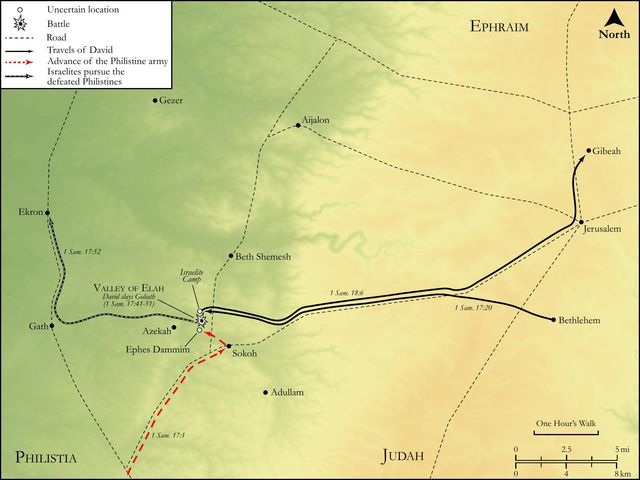
See on the biblical-era map
Study this verse
Public-domain commentary
Matthew Henry
From his Commentary on the Whole Bible. Henry comments on passages, not single verses — this entry covers 1 Samuel 17:48–58.
Here is 1. The engagement between the two champions, Sa1 17:48. To this engagement the Philistine advanced with a great deal of state and gravity; if he must encounter a pigmy, yet it shall be with the magnificence of a giant and a grandee. This is intimated in the manner of expression: He arose, and came, and drew nigh, like a stalking mountain, overlaid with brass and iron, to meet David. David advanced with no less activity and cheerfulness, as one that aimed more to do execution than to make a figure: He hasted, and ran, being lightly clad, to meet the Philistine. We may imagine with what tenderness and compassion the Israelites saw such a pleasing youth as this throwing himself into the mouth of destruction, but he knew whom he had believed and for whom he acted. 2. The fall of Goliath in this engagement. He was in no haste, because in no fear, but confident that he should soon at one stroke cleave his adversary's head; but, while he was preparing to do it solemnly, David did his business effectually, without any parade: he slang a stone which hit him in the forehead, and, in the twinkling of an eye, fetched him to the ground, Sa1 17:49. Goliath knew there were famous slingers in Israel (Jdg 20:16), yet was either so forgetful or presumptuous as to go with the beaver of his helmet open, and thither, to the only part left exposed, not so much David's art as God's providence directed the stone, and brought it with such force that it sunk into his head, notwithstanding the impudence with which his forehead was brazened. See how frail and uncertain life is, even when it thinks itself best fortified, and how quickly, how easily, and with how small a matter, the passage may be opened for life to go out and death to enter. Goliath himself has not power over the spirit to retain the spirit, Ecc 8:8. Let not the strong man glory in his strength, nor the armed man in his armour. See how God resists the proud and pours contempt upon those that bid defiance to him and his people. None ever hardened his heart against God and prospered. One of the Rabbin thinks that when Goliath said to David, Come, and I will give thy flesh to the fowls of the air, he threw up his head so hastily that his helmet fell off, and so left his broad forehead a fair mark for David. To complete the execution, David drew Goliath's own sword, a two-handed weapon for David, and with it cut off his head, Sa1 17:51. What need had David to take a sword of his own? his enemy's sword shall serve his purpose, when he has occasion for one. God is greatly glorified when his proud enemies are cut off with their own sword and he makes their own tongues to fall upon them, Psa 64:8. David's victory over Goliath was typical of the triumphs of the son of David over Satan and all the powers of darkness, whom he spoiled, and made a show of them openly (Col 2:15), and we through him are more than conquerors. 3. The defeat of the Philistines' army hereupon. They relied wholly upon the strength of their champion, and therefore, when they saw him slain, they did not, as Goliath had offered, throw down their arms and surrender themselves servants to Israel (Sa1 17:9), but took to their heels, being wholly dispirited, and thinking it to no purpose to oppose one before whom such a mighty man had fallen: They fled (Sa1 17:51), and this put life into the Israelites, who shouted and pursued them (David, it is probable, leading them on in the pursuit) even to the gates of their own cities, Sa1 17:52. In their return from the chase they seized all the baggage, plundered the tents (Sa1 17:53), and enriched themselves with the spoil. 4. David's disposal of his trophies, Sa1 17:54. He brought the head of the Philistine to Jerusalem, to be a terror to the Jebusites, who held the strong-hold of Sion: it is probable that he carried it in triumph to other cities. His armour he laid up in his tent; only the sword was preserved behind the ephod in the tabernacle, as consecrated to God, and a memorial of the victory to his honour, Sa1 21:9. 5. The notice that was taken of David. Though he had been at court formerly, yet, having been for some time absent (Sa1 17:15), Saul had forgotten him, being melancholy and mindless, and little thinking that his musician would have spirit enough to be his champion; and therefore, as if he had never seen him before, he asked whose son he was. Abner was a stranger to him, but brought him to Saul (Sa1 17:57), and he gave a modest account of himself, Sa1 17:58. And now he was introduced to the court with much greater advantages than before, in which he owned God's hand performing all things for him.
Historical interpretation
Three Centuries of Reception
5 surviving comments on this verse. Each one is dated, so this reads as a timeline rather than a list.
Select a marker to jump to its quote. Markers stagger vertically where authors wrote within a few decades of each other.
David never waged war unless he was driven to it. Thus prudence was combined in him with fortitude in the battle. For even when about to fight single-handed against Goliath, the enormous giant, he rejected the armor with which he was laden. His strength depended more on his own arm than on the weapons of others. Then, at a distance, to get a stronger throw, with one cast of a stone, he killed his enemy.
Therefore, let us take in our hands that stone, I mean the cornerstone, the spiritual rock. If Paul could think in these terms of the rock in the desert, no one will in any way feel resentment against me if I understand David’s stone in the same sense. In the case of the Jews in the desert, it was not the nature of the visible stone but the power of the spiritual stone which sent forth those streams of water. So, too, in David’s case, it was not the visible stone but the spiritual stone which sank into the barbarian’s head. This is why, at that time, I promised that I would say nothing based on rational arguments. “Our weapons are not merely carnal but spiritual, demolishing sophistries and reasoning and every proud height that raises itself against the knowledge of God.”
Having trust in Christ, consigning everything to the God of powers, regarding God alone as all that is highest—this has always been efficacious in achieving every good. This is the faith that has prevailed over all weapons. This was the strength that made that slight boy great, for he grew stronger by spurning weapons and brought low the armed giant by the power of a stone.
Therefore, brothers, let us arm ourselves with heavenly weapons for the coming judgment of the world: let us gird on the breastplate of faith, protect ourselves with the helmet of salvation, and defend ourselves with the word of God as with a spiritual sword. For the one who is arrayed with these weapons does not fear present disturbance and is not afraid of future judgment, since holy David, protected with this devotion, killed the very strong and armed Goliath without weapons and struck down the warlike man, girt about with defenses on all sides, by the strength of his faith alone. For although holy David did not put on a helmet, strap on a shield, or use a lance, he killed Goliath. He killed him, however, not with an iron spear but with a spiritual sword, for although he appeared weaponless in the eyes of human beings, yet he was adequately armed with divine grace. But the spiritual sword itself was not a sword, since it was not by the sword but by a stone that Goliath died when he was struck down. We read in the Scriptures that Christ is figuratively designated by the word stone, as the prophet says: “The stone that the builders rejected has become the head of the corner.” Therefore, when Goliath is struck by a stone, he is struck down by the power of Christ. And in what part of the body is he struck? On the forehead, for when the sacrilegious man is struck, there Christ was absent, and where his end comes upon him, there the sign of salvation is not to be found. For although Goliath was protected by weapons on all sides, still his forehead was exposed to death because it did not carry the Savior’s seal, and therefore he is slain in the spot where he is found to be bare of God’s grace.But there is no one who does not realize that this took place figuratively. For David had also put on armor beforehand but, since he was so heavy and awkward in it that he could hardly walk, he removed it at once, signifying that the weapons of this world are vain and superfluous things and that the person who chooses to involve himself in them will have no unimpeded road to heaven, since he will be too heavy and encumbered to walk. At the same time this teaches us that victory is not to be hoped for from arms alone but is to be prayed for in the name of the Savior.
And he put his hand into his bag, etc. We said above that the pastoral bag represents the hearts of the shepherds, who cling intimately to the side of Christ. Why then should not more rightly the conscience or soul of the highest and singularly good shepherd be called the pastoral bag? It contains five most clear stones, strong enough to overthrow the enemy: for it holds the purest knowledge of divine law, by which all error is conquered: whose fullness is expressed in one stone, and its breadth is spread in five books, which Christ alone could perfectly know and fulfill. Putting his hand into this bag, he took one of the five stones he had placed there, arming himself with one of the five books of Moses, of which he was the author and fulfiller, that is Deuteronomy, he used it as testimony to repel the ancient enemy's temptations. Moreover, he taught us, instructed by the Holy Scriptures, to overcome the snares of the same enemy through the unity of faith and charity. And he skillfully threw with the sling; for by the spiritual sense of the Scriptures, which we showed above as triple, he broke the pride of the enemy and gave us spiritual understanding as weapons against him. And he skillfully struck the Philistine on the forehead, because the very audacity of his presumption felled the devil: from the very show of his profession, he proved the worshippers of perverse doctrines to be foolish. For just as the hand indicates the strength of operations, so the forehead indicates the recognition of profession. Therefore, whoever fears being struck on the forehead, let him arm his forehead with the sign of the life-giving cross, saying with the Apostle: But far be it from me to boast except in the cross of our Lord Jesus Christ (Galatians VI). Finally, David himself, because he knew how to say: The light of your countenance is signed upon us, O Lord (Psalm IV), indeed struck down the forehead of the loquacious boasting Philistine, not sealed with the light of heavenly grace, although covered with the helmet of boasting. And rightly the stone is said to be fixed in his forehead, because the devil will never completely shake off the sentence of the divine word, which he receives either in himself or in his followers from Christ the Saviour or His members, but cursed he will suffer eternal damnation in hell without end. Similar to what Isaiah testifies to his irrevocable damnation, saying: And the passage of the rod is founded, which the Lord God will rest upon him (Isaiah XXX), that is, he will never be saved from torments in eternity, nor will he roam between punishments over varying times, nor will he find rest after the manner of our blows, who frequently raise the rod or lash from the back of the one being flogged, so that we can strike again, but without any interval of rest, he will groan subjected to perpetual retribution. This is against those who, because of Isaiah’s testimony, where it is written about the impious, say: And they will be imprisoned together in the dungeon, and after many days they will be visited (Isaiah XXIV); promise the devil and his angels and all the reprobate remission of such great crimes and eternal life with the Lord after long and innumerable ages, against the judgment of the Lord himself, who foretold that he will say in the last judgment: Depart from me, you cursed, into eternal fire (Matthew XXV). But the giant, struck by the stone, fell to the ground; because the diabolic error, struck by the word of God, no longer lofty as it once boasted, was revealed to be not heavenly but earthly and even lowest.
Continue studying 1 Samuel 17:49 across the web’s major study libraries — every link below opens this exact verse, chapter, or book on the destination site.
Read & Compare
 BibleGatewayThis verse in more than 200 translations and 70 languages.
 Bible.comThe YouVersion reader — hundreds of translations, reading plans, and highlights.
 ESV.orgCrossway's official English Standard Version reader.
 NET BibleThe NET translation with 60,000+ translators' notes on every rendering decision.
 STEP BibleTyndale House's free study tool — original text, vocabulary, and scholarly resources.
 BibliaLogos Bible Software's free web reader.
 USCCBThe New American Bible (Revised Edition) with the U.S. bishops' study notes.
Commentaries
 BibleHub CommentariesDozens of classic commentaries on this verse, gathered on one page.
 StudyLightMore than 100 commentary sets — the largest collection on the web.
 BibleRefPlain-English commentary on what this verse means, verse by verse.
 Enduring WordDavid Guzik's free commentary on this chapter, widely used by Bible teachers.
 Bible Study ToolsVerse commentary alongside Greek and Hebrew study aids.
Original Language & Research
- BibleHub InterlinearThe verse word by word — original language, transliteration, and English.
- BibleHub LexiconEvery word's original-language definition and Strong's entry.
 Blue Letter BibleDeep-study tools — Strong's numbers, concordance, and word studies.
 SefariaThe Hebrew text with Rashi and centuries of Jewish commentary.
Sermons, Hymns & Audio


TrulyRandomVerse is not affiliated with these sites and doesn’t control their content. They’re linked because they’re genuinely useful.
Summary
1 Samuel 17:49 vividly recounts the climactic moment of David's victory over Goliath, where the young shepherd, empowered by divine strength, slings a single stone that strikes the Philistine giant in the forehead with such devastating force that it penetrates his skull, causing him to fall immediately upon his face to the earth. This verse serves as the dramatic and decisive turning point of the narrative, marking the immediate and undeniable defeat of Israel's formidable adversary and powerfully showcasing the triumph of humble faith and divine power over overwhelming human might and arrogance.
Context
ShowHideLiterary Context
This verse represents the dramatic and pivotal climax of the extended narrative of David and Goliath, which dominates 1 Samuel chapter 17. Prior to this decisive blow, the Philistine champion, Goliath, had for forty days terrorized the Israelite army with his blasphemous taunts and challenges, effectively paralyzing them with fear and despair (1 Samuel 17:10-11). David, a young shepherd boy, arrives at the battlefront, hears Goliath's defiance of the living God, and is stirred by righteous indignation and unwavering faith. Despite the skepticism of King Saul and the derision of Goliath himself, David confidently asserts his trust in the Lord of Hosts, who had delivered him from lions and bears (1 Samuel 17:34-37). The verses immediately preceding 17:49 describe David's rejection of Saul's cumbersome armor and his simple preparation with his shepherd's staff, sling, and five smooth stones from the brook (1 Samuel 17:38-40), meticulously setting the stage for this miraculous and profoundly significant strike.
Historical & Cultural Context
The Philistines were a formidable military and political power among the nations of that day, frequently clashing with the nascent Israelite kingdom for control of vital trade routes and fertile lands. Their superior iron weaponry and well-organized military structure posed a constant and existential threat to early Israel, which was still consolidating its tribal confederation into a unified monarchy under Saul. The practice of single combat between champions, intended to decide the outcome of a battle and minimize overall casualties, was a recognized custom in ancient warfare. Goliath, described with immense stature (over nine feet tall) and heavily armored (1 Samuel 17:4-7), epitomized Philistine military might and pagan defiance against the God of Israel. David, in stark contrast, was a young shepherd, an occupation typically considered humble and unsuited for direct combat against a seasoned warrior. His weapon, the sling, while effective in the hands of a skilled user for hunting or defending flocks, was not a conventional weapon for a champion facing an armored giant, highlighting the profound cultural and military disparity between the two combatants and underscoring the unconventional nature of David's ultimate victory.
Key Themes
ShowHideThis verse powerfully encapsulates several foundational themes woven throughout the book of 1 Samuel. Foremost is the overarching theme of divine sovereignty and empowerment, demonstrating unequivocally that victory in battle belongs to the Lord, not to human strength, military might, or impressive weaponry (1 Samuel 17:47). It vividly illustrates the principle that God often chooses the weak, the overlooked, and the seemingly insignificant to accomplish His mighty purposes, thereby confounding the wisdom and strength of the world, a motif echoed throughout biblical history. The narrative also underscores the transformative power of unwavering faith in God's promises, contrasting David's audacious trust with the paralyzing fear and inaction of the entire Israelite army and their king (1 Samuel 17:24). Furthermore, this pivotal moment marks a significant turning point in David's miraculous rise to prominence, foreshadowing his future role as Israel's divinely chosen king and leader, a central narrative arc of 1 Samuel.
Exposition and Analysis
ShowHideKey Word Analysis
ShowHideMeaning "to sling; also to carve (as if a circular motion, or into light forms)." This archaic English term perfectly captures David's action. The Hebrew verb qala' implies not merely throwing but doing so with a practiced skill, precision, and considerable force. It speaks to David's honed expertise as a shepherd, where the sling was an essential tool for defending his flock, now divinely directed to a far greater purpose. The choice of this word emphasizes the human instrument's proficiency, which becomes an extension of divine will.
A primitive root meaning "to strike (lightly or severely, literally or figuratively)." In this context, nakah' denotes a decisive, impactful, and often fatal blow. Its usage here highlights the direct, forceful, and effective nature of David's action, leading immediately and irrevocably to Goliath's downfall. It was not a glancing or superficial hit but a direct impact with overwhelming power.
A primitive root meaning "to sink." This word is critically important as it emphasizes the depth and finality of the stone's impact. It didn't just strike Goliath; it penetrated his skull, indicating a catastrophic and immediately fatal injury. This graphic detail underscores the overwhelming and undeniable power behind the seemingly simple stone, ensuring Goliath's instantaneous and irreversible defeat, leaving no doubt as to the cause of his demise.
Verse Breakdown
ShowHide"And David put his hand in his bag,"
This opening clause establishes David's deliberate and prepared action. The "bag" (H3627, kᵉlîy), likely a shepherd's pouch, contained the five smooth stones he had carefully selected from the brook (1 Samuel 17:40). This signifies his readiness, his unconventional approach, and the culmination of his faith-filled resolve to confront the giant, contrasting sharply with the elaborate and conventional preparations of a seasoned warrior.
"and took thence a stone,"
This simple act underscores the seemingly inadequate nature of David's chosen weapon. It was not a sword, spear, or shield, but a single, ordinary stone (H68, ʼeben). This detail profoundly magnifies the miraculous outcome, emphasizing that the victory was not due to the weapon's inherent power or the warrior's conventional might, but to the sovereign power of God working through humble means.
"and slang [it],"
This phrase describes the swift, practiced, and powerful action of David's sling. It highlights his skill (H7049, qalaʻ) and the kinetic force he generated, but more importantly, it points to the precise moment of execution where human effort, born of faith, meets divine empowerment. The "it" refers to the stone, the humble instrument of God's deliverance.
"and smote the Philistine in his forehead,"
This is the critical point of impact. The forehead (H4696, mêtsach), though potentially protected by Goliath's helmet, was the precise and vulnerable target. This extraordinary precision strongly suggests divine guidance, ensuring the blow was not random but perfectly aimed to achieve its intended, fatal effect. It was a direct, head-on confrontation, both physically and symbolically.
"that the stone sunk into his forehead;"
This clause details the devastating and fatal effect of the blow. The stone's penetration (H2883, ṭâbaʻ) into Goliath's skull signifies the immediate and catastrophic nature of the injury. It is a graphic and powerful description of the overwhelming defeat, leaving no doubt about the severity of the impact and the finality of Goliath's demise.
"and he fell upon his face to the earth."
This final clause describes the immediate and humiliating consequence of the fatal blow. Goliath's collapse (H5307, nâphal), specifically "upon his face" (H6440, pânîym) to the earth (H776, ʼerets), is a posture of utter defeat, submission, and disgrace, as when Dagon, the god of the Philistines, was found "fallen upon his face to the earth before the ark of the LORD." The mighty giant, who had openly defied the armies of God, is brought low by a single stone from a shepherd boy, powerfully fulfilling David's earlier declaration that the battle belonged to the Lord.
Literary Devices
ShowHideThe narrative of 1 Samuel 17:49 is rich with literary devices that amplify its profound theological message. It functions as the Climax of the entire confrontation, the singular moment of ultimate tension release and decisive resolution. The stark contrast between David's simple, unconventional weapon and Goliath's elaborate, heavy armor creates powerful Irony and Understatement, emphasizing that human might and self-reliance are utterly insignificant before divine power. The extraordinary precision of the stone's trajectory and its immediately fatal impact strongly suggest Divine Intervention or Providence, where God's unseen hand guides David's action to achieve His intended purpose. The stone itself can be seen as potent Symbolism, representing not merely a physical projectile but an instrument of God's judgment, deliverance, and the triumph of the humble. Goliath's dramatic fall, specifically "upon his face to the earth," is vivid Imagery that conveys utter defeat, shame, and the complete reversal of fortunes, a common biblical motif for the downfall of the proud and arrogant. The entire scene serves as a powerful Type or Foreshadowing of God's consistent pattern of using the humble and despised to overcome the arrogant and seemingly invincible.
Theological and Thematic Connections
ShowHideThe triumph of David over Goliath, so vividly encapsulated in 1 Samuel 17:49, stands as a profound theological statement about the very nature of God and His active involvement in human affairs. It unequivocally declares that true strength, ultimate victory, and lasting security do not reside in human might, military prowess, impressive stature, or technological superiority, but solely in the sovereign power of the Lord. David's audacious faith-filled action, coupled with the stone's impossible precision and devastating impact, serves as an enduring testament to God's unparalleled ability to use the seemingly weak, insignificant, and ill-equipped to accomplish His grand and redemptive purposes, thereby confounding the wisdom and strength of the world. This narrative powerfully reinforces the timeless biblical principle that God delights in demonstrating His omnipotence through humble vessels, ensuring that all glory and honor redound to Him alone. It is a timeless reminder that when believers face "giants" in their lives—whether they be overwhelming challenges, paralyzing fears, pervasive injustices, or formidable adversaries—their ultimate reliance must be on God, for the battle is truly His, and He alone grants the victory.
Reflection and Application
ShowHideThe vivid and dramatic account of 1 Samuel 17:49 is far more than a historical record of a past victory; it is a living narrative that speaks with profound relevance directly to the human condition and the life of faith today. We all, in various seasons of our lives, encounter "giants"—formidable challenges, overwhelming fears, pervasive injustices, personal struggles, or spiritual adversaries that seem insurmountable and threaten to paralyze us. This verse calls us to transcend human assessments of strength and weakness and to embrace a God-centered perspective. Like David, we are invited to approach our "giants" not with conventional weapons, self-reliance, or worldly wisdom, but with an unwavering, audacious faith in the living God, who is infinitely greater and more powerful than any obstacle. It encourages us to trust in God's often unconventional methods, to recognize that He frequently works through humble means and seemingly inadequate resources to magnificently display His glory. Our courage in the face of daunting circumstances is not born of our own might or capability, but of our confident assurance in God's omnipotence and His unfailing faithfulness to deliver. This passage is a powerful and enduring reminder that with God, even the smallest individual, armed with simple faith, can achieve extraordinary victories, and that true spiritual battles are won not by human strength or ingenuity, but by divine intervention in response to humble, audacious, and unwavering trust in the Almighty.
Questions for Reflection
ShowHideFAQ
ShowHideWas David's victory purely a result of his skill, or was there divine intervention?
ShowHideWhile David was undoubtedly highly skilled with the sling, a proficiency honed by years of protecting his flock from predators, the biblical narrative strongly emphasizes divine intervention as the decisive factor. David himself explicitly declares that he comes "in the name of the Lord of hosts, the God of the armies of Israel, whom you have defied" (1 Samuel 17:45) and that "the battle is the Lord's" (1 Samuel 17:47). The extraordinary precision of the shot, striking Goliath in the only vulnerable spot (his forehead) and penetrating his skull, suggests a miraculous element beyond mere human ability or chance. It was David's human skill empowered, guided, and ultimately perfected by God's sovereign hand, demonstrating that God often uses humble human instruments to achieve His mighty and supernatural purposes, ensuring that all glory redounds to Him.
Why did Goliath fall "upon his face to the earth" instead of backward?
ShowHideThe specific detail that Goliath fell "upon his face to the earth" (prostrate) is highly significant and carries profound symbolic weight among the nations. Falling face down was universally understood as a posture of utter submission, complete defeat, and profound humiliation. For a giant who had openly defied the living God of Israel and arrogantly mocked His people, this manner of falling was a powerful and symbolic act of absolute disgrace and the complete reversal of his proud and defiant posture. It underscored the absolute and undeniable nature of his defeat at the hands of a seemingly insignificant opponent, fulfilling the prophetic nature of David's faith and demonstrating God's judgment upon the arrogant.
Christ-Centered Fulfillment
ShowHideThe narrative of David and Goliath, culminating in the decisive blow of 1 Samuel 17:49, powerfully foreshadows the ultimate and definitive victory of Jesus Christ over the forces of sin, death, and Satan. Just as David, a humble shepherd, stood against a seemingly invincible giant who defied God's people and held them in bondage to fear, so Jesus, the Good Shepherd (John 10:11), confronted the ultimate adversary, Satan, who held humanity captive. The world expected a mighty warrior-king to deliver Israel through conventional power, yet God chose a humble, unassuming figure to achieve victory through seemingly weak and unconventional means. Jesus's decisive victory was not achieved through military might or worldly power, but through His sacrificial death on the cross—an act that appeared to be weakness and defeat to the world but was, in fact, the decisive and fatal blow against the principalities and powers of darkness (Colossians 2:15). The single stone that struck Goliath's forehead can be seen as a type of Christ Himself, the "stone the builders rejected that has become the cornerstone" (Psalm 118:22; Matthew 21:42), the very foundation of God's new creation. Through His death and glorious resurrection, Jesus delivered a fatal blow to the head of the serpent, fulfilling the ancient promise of Genesis 3:15, and ensuring that all who trust in Him share in His ultimate and eternal triumph over every "giant" of sin, death, and spiritual oppression.