


1 Samuel 17:47
Bible text: King James Version (1769 Blayney text) · Public domain
Bible text: Berean Standard Bible · Public domain
Bible text: American Standard Version (1901) · Public domain
Bible text: World English Bible, Messianic edition · Public domain
Bible text: Geneva Bible (1599) · Public domain
Bible text: Young's Literal Translation · Public domain
- וְיֵדְעוּve·ye·de·'Uso they may knowH3045Conj-w ¦ V-Qal-ConjImperf-3mpVerb Qal Conjunction+Imperfect 3rd Plural Masculineוְsoיֵדְעוּthey may know
- כָּלkolallH3605N-mscNoun Singular Masculine Construct
- הַקָּהָלha·ka·Halthe assemblyH6951Art ¦ N-msNoun Singular Masculine Absoluteהַtheקָּהָלassembly
- הַזֶּהha·Zeh<the> thisH2088Art ¦ PrtParticle Demonstrativeהַ<the>זֶּהthis
- כִּיkithatH3588PrtParticle Conditional
- לֹאlo'notH3808NegParticle Negative
- בְּחֶרֶבbe·Che·revby swordH2719Prep-b ¦ N-fsNoun Singular Feminine Absoluteבְּbyחֶרֶבsword
- וּבַחֲנִיתu·va·cha·Nitand by spearH2595Conj-w ¦ Prep-b ¦ N-fsNoun Singular Feminine Absoluteוּandבַbyחֲנִיתspear
- יְהוֹשִׁיעַye·ho·Shi·a'he savesH3467V-Hiphil-Imperf-3msVerb Hiphil Imperfect 3rd Singular Masculine
- יְהוָהYah·wehYahwehH3068N-properNoun Proper Title
- כִּיkiforH3588PrtParticle Conditional
- לַיהוָהla·Yah·weh[belongs] to YahwehH3068Prep-l ¦ N-properNoun Proper Titleלַ[belongs] toיהוָהYahweh
- הַמִּלְחָמָהha·mil·cha·Mahthe battleH4421Art ¦ N-fsNoun Singular Feminine Absoluteהַtheמִּלְחָמָהbattle
- וְנָתַןve·na·Tanand he will giveH5414Conj-w ¦ V-Qal-ConsecPerf-3msVerb Qal Consecutive Perfect 3rd Singular Masculineוְandנָתַןhe will give
- אֶתְכֶם'et·Khem<obj.> youH853DirObjM ¦ 2mpParticle Object Indicatorאֶתְ<obj.>כֶםyou
- בְּיָדֵנוּbe·ya·De·nuin our handH3027Prep-b ¦ N-csc ¦ 1cpNoun Singular common gender Constructבְּinיָדֵhandנוּour
English is a literal word-by-word gloss of the Hebrew, not the KJV's wording. Why?
This is the original text the KJV's translators worked from — each Hebrew word with its own literal English meaning in this verse, prepared by scholars at Tyndale House, Cambridge. The KJV translates whole sentences, not word by word, so its wording differs: one Hebrew word can become several English words, and the KJV may choose “the LORD” where the gloss reads “Yahweh”. Both are faithful — they answer different questions. For the KJV's own rendering, switch to the KJV text.
Details
See on the biblical-era map
Study this verse
Public-domain commentary
Matthew Henry
From his Commentary on the Whole Bible. Henry comments on passages, not single verses — this entry covers 1 Samuel 17:40–47. His four-level outline is real structure in the source text, so it is rendered as structure.
We are now coming near this famous combat, and have in these verses the preparations and remonstrances made on both sides.
I.The preparations made on both sides for the encounter.
The Philistine was already fixed, as he had been daily for the last forty days. Well might he go with his armour, for he had sufficiently proved it. Only we are told (Sa1 17:41) that he came on and drew near, a signal, it is likely, being given that his challenge was accepted, and, as if he distrusted his helmet and coat of mail, a man went before him, carrying his shield, for his own hands were full with his sword and spear, Sa1 17:45. But what arms and ammunition is David furnished with? Truly none but what he brought with him as a shepherd; no breastplate, nor corselet, but his plain shepherd's coat; no spear, but his staff; no sword nor bow, but his sling; no quiver, but his scrip; nor any arrows, but, instead of them, five smooth stones picked up out of the brook, Sa1 17:40. By this it appeared that his confidence was purely in the power of God, and not in any sufficiency of his own, and that now at length he who put it into his heart to fight the Philistine put it into his head with what weapons to do it.
II.The conference which precedes the encounter, in which observe,
1.How very proud Goliath was, (1.) With what scorn he looked upon his adversary, Sa1 17:42. He looked about, expecting to meet some tall strong man, but, when he saw what a mean figure he made with whom he was to engage, he disdained him, thought it below him to enter the lists with him, fearing that the contemptibleness of the champion he contended with would lessen the glory of his victory. He took notice of his person, that he was but a youth, not come to his strength, ruddy and of a fair countenance, fitter to accompany the virgins of Israel in their dances (if mixed dancing was then in use) than to lead on the men of Israel in their battles. He took notice of his array with great indignation (Sa1 17:43): "Am I a dog, that thou comest to me with staves? Dost thou think to beat me as easily as thou dost thy shepherd's dog?" (2.) With what confidence he presumed upon his success. He cursed David by his gods, imprecating the impotent vengeance of his idols against him, thinking these fire-balls thrown about him would secure his success: and therefore, in confidence of that, he darts his grimaces, as if threatening words would kill (Sa1 17:44): "Come to me, and I will give thy flesh to the fowls of the air, it will be a tender and delicate feast for them." Thus the security and presumption of fools destroy them.
2.How very pious David was. His speech savours nothing of ostentation, but God is all in all in it, Sa1 17:45-47.
(1.)He derives his authority from God: "I come to thee by warrant and commission from heaven, in the name of the Lord, who has called me to and anointed me for this undertaking, who, by his universal providence, is the Lord of hosts, of all hosts, and therefore has power to do what he pleases, and, by the special grace of his covenant, is the God of the armies of Israel, and therefore has engaged and will employ his power for their protection, and against thee who hast impiously defied them." The name of God David relied on, as Goliath did on his sword and spear. See Psa 20:7; Psa 118:10, Psa 118:11.
(2.)He depends for success upon God, Sa1 17:46. David speaks with as much assurance as Goliath had done, but upon better ground; it is his faith that says, "This day will the Lord deliver thee into my hand, and not only thy carcase, but the carcases of the host of the Philistines, shall be given to the birds and beasts of prey." (3.) He devotes the praise and glory of all to God. He did not, like Goliath, seek his own honour, but the honour of God, not doubting but by the success of this action,
[1.]All the world should be made to know that there is a God, and that the God of Israel is the one only living and true God, and all other pretended deities are vanity and a lie.
[2.]All Israel (whom he calls not this army, but this assembly, or church, because they were now religiously attending the goings of their God and King, as they used to do in the sanctuary) shall know that the Lord saveth not with sword and spear (Sa1 17:47), but can, when he pleases, save without either and against both, Psa 46:9. David addresses himself to this combat rather as a priest that was going to offer a sacrifice to the justice of God than as a soldier that was going to engage an enemy of his country.
Historical interpretation
Historical reception
1 surviving comment on this verse from the historical church.
And we need only the Lord’s goodness to stay the storm. Easy it is for him to stay it, but we are unworthy of the calm, yet the grace of his patience is enough for us, so that with good fortune by it we may get the better of our foes. So the divine apostle has taught us to pray “for he will with the temptation also make a way to escape that you may be able to bear it.” But I beseech your godliness to stop the mouths of the objectors and make them understand that it is not for them who stand, as the phrase goes, out of range, to scoff at men fighting in the ranks and giving and receiving blows; for what does it matter which weapon the soldier uses to strike down his antagonists? Even the great David did not use a panoply when he killed the aliens’ champion, and Samson killed thousands on one day with the jawbone of an ass. Nobody grumbles at the victory, nor accuses the conqueror of cowardice, because he wins it without brandishing a spear or covering himself with his shield or throwing darts or shooting arrows. The defenders of true religion must be criticized in the same way, nor must we try to find language which will stir strife, but rather arguments which plainly proclaim the truth and make those who venture to oppose it ashamed of themselves.
Continue studying 1 Samuel 17:47 across the web’s major study libraries — every link below opens this exact verse, chapter, or book on the destination site.
Read & Compare
 BibleGatewayThis verse in more than 200 translations and 70 languages.
 Bible.comThe YouVersion reader — hundreds of translations, reading plans, and highlights.
 ESV.orgCrossway's official English Standard Version reader.
 NET BibleThe NET translation with 60,000+ translators' notes on every rendering decision.
 STEP BibleTyndale House's free study tool — original text, vocabulary, and scholarly resources.
 BibliaLogos Bible Software's free web reader.
 USCCBThe New American Bible (Revised Edition) with the U.S. bishops' study notes.
Commentaries
 BibleHub CommentariesDozens of classic commentaries on this verse, gathered on one page.
 StudyLightMore than 100 commentary sets — the largest collection on the web.
 BibleRefPlain-English commentary on what this verse means, verse by verse.
 Enduring WordDavid Guzik's free commentary on this chapter, widely used by Bible teachers.
 Bible Study ToolsVerse commentary alongside Greek and Hebrew study aids.
Original Language & Research
- BibleHub InterlinearThe verse word by word — original language, transliteration, and English.
- BibleHub LexiconEvery word's original-language definition and Strong's entry.
 Blue Letter BibleDeep-study tools — Strong's numbers, concordance, and word studies.
 SefariaThe Hebrew text with Rashi and centuries of Jewish commentary.
Sermons, Hymns & Audio


TrulyRandomVerse is not affiliated with these sites and doesn’t control their content. They’re linked because they’re genuinely useful.
Summary
1 Samuel 17:47 encapsulates David's profound theological declaration before confronting Goliath, asserting that divine power, not human weaponry or might, determines the outcome of battle. It serves as a public proclamation to both the Israelite and Philistine armies that the impending victory would be solely attributed to God, thereby revealing His glory and unique methods of deliverance to all present.
Context
ShowHideLiterary Context
This verse is uttered at the dramatic climax of David's initial interaction with Goliath and the Israelite army. Having arrived at the battlefield to bring provisions to his brothers, David witnesses Goliath's daily taunts and the paralyzing fear gripping King Saul and his soldiers, as detailed in 1 Samuel 17:1-11. Outraged by Goliath's defiance of the living God, David volunteers to fight, despite his youth and lack of military experience. His bold declaration in verse 47 directly challenges Goliath's reliance on physical might and armor, as seen in 1 Samuel 17:45, setting the stage for a dramatic display of God's power through an unlikely champion. The narrative immediately following this verse details David's unconventional victory, fulfilling his prophetic words and underscoring the divine nature of the triumph.
Historical & Cultural Context
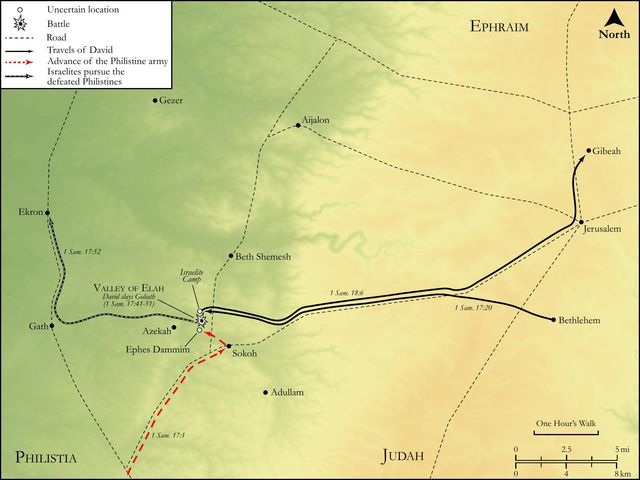
The confrontation between David and Goliath takes place in the Valley of Elah, a strategic border region between Philistine and Israelite territories. The Philistines, a formidable Aegean people who had settled on the coastal plain, were a persistent military threat to Israel, often possessing superior iron weaponry and military organization. The practice of "champion combat," where two armies would send out their strongest warriors to fight on behalf of their respective nations, was a known custom of the nations, intended to minimize overall casualties. Goliath, described as a giant of immense stature and heavily armed in 1 Samuel 17:4-7, was the Philistine champion. The Israelite army, led by King Saul, was at a significant disadvantage, both in morale and perhaps equipment. David, a shepherd, represents the antithesis of a conventional warrior, highlighting the cultural expectation that strength and military prowess were prerequisites for battle, an expectation David subverts through his unwavering faith.
Key Themes
ShowHide1 Samuel 17:47 powerfully articulates several core themes central to the book of Samuel and the broader Old Testament narrative. Foremost is the theme of Divine Sovereignty and Deliverance, emphasizing that God is the ultimate actor in human affairs and battles, not human strength or weaponry. David's declaration, "the battle is the LORD'S," asserts Yahweh's ownership and active participation in the conflict, contrasting with the Philistines' reliance on their gods and military might. This ties into the theme of Faith Over Human Might, where God frequently chooses the weak and unassuming to accomplish His purposes, demonstrating that His power is made perfect in weakness, a principle echoed in 1 Corinthians 1:27-29. Furthermore, the verse highlights God's Glory Revealed to All Nations, as David explicitly states "all this assembly shall know" God's saving power. The victory would not merely be an Israelite triumph but a public demonstration of Yahweh's supremacy over pagan deities and human limitations, echoing themes found in Exodus 14 where God's power was displayed to both Israel and Egypt.
Exposition and Analysis
ShowHideKey Word Analysis
ShowHideThis verb signifies "to deliver," "to rescue," "to preserve," or "to grant victory." It carries a strong theological connotation, often referring to God's act of bringing salvation or deliverance to His people from enemies or oppression. David's use of this word emphasizes that true deliverance comes from God alone, not from human instruments of war like swords and spears, highlighting a spiritual and divine source of victory that transcends conventional means.
This noun refers to a "lance" or "javelin," a thrusting weapon. In conjunction with "sword," it represents the typical arsenal and military might of ancient warfare. David's declaration that the LORD does not save "with sword and spear" directly challenges the prevailing military paradigm, asserting that God's power operates independently of and superior to human weaponry.
This noun refers to a "war," "fight," or "conflict." In this context, it specifically denotes the physical engagement between armies. The declaration "the battle is the LORD'S" transforms a conventional military conflict into a divine contest, asserting God's proprietorship over the entire engagement, from its initiation to its outcome. It implies that the human participants are merely instruments in a larger divine plan.
The divine name YHWH (Yahweh, the covenant God of Israel) combined with the possessive indicates absolute ownership and authority. It signifies that the battle is not merely for the LORD, but belongs to Him. He is the one who initiates, directs, and ultimately wins the conflict, asserting His absolute sovereignty and control over all circumstances, including warfare.
Verse Breakdown
ShowHide"And all this assembly shall know"
David's declaration is not a private thought but a public proclamation intended for both the Israelite and Philistine armies. The phrase "all this assembly" underscores the universal scope of God's impending revelation. David desires that God's power and character be made manifest to everyone present, serving as a powerful testimony to His unique identity as the living God, distinct from the idols of the Philistines.
"that the LORD saveth not with sword and spear"
This clause directly challenges the conventional wisdom of military might. Swords and spears were the primary weapons of warfare in ancient times, symbolizing human strength, tactical prowess, and technological advantage. David asserts that Yahweh's saving power is not dependent on, limited by, or even associated with these human instruments. This highlights God's transcendence and His ability to work through unconventional, often seemingly weak, means to achieve His purposes, thereby ensuring that the glory belongs solely to Him.
"for the battle [is] the LORD'S"
This is the central theological assertion of the verse. It declares God's absolute sovereignty and ownership over the conflict. The battle is not a human endeavor that God merely assists; rather, it is His battle, fought on His terms, for His glory. This phrase transforms the human conflict into a divine one, where God Himself is the primary warrior and strategist, fighting on behalf of His people.
"and he will give you into our hands"
This is a prophetic declaration of victory, spoken with absolute confidence in God's power. "You" refers to Goliath and, by extension, the entire Philistine army. "Our hands" refers to the hands of the Israelites, but implicitly, it is God who will perform the act of "giving." This statement is not a boast of human capability but a confident prediction based on the premise that the battle belongs to the LORD, and He will ensure His people's triumph.
Literary Devices
ShowHideThe verse employs several potent literary devices. Contrast is central, starkly juxtaposing human military might ("sword and spear") with divine power and methods ("the LORD saveth," "the battle is the LORD'S"). This highlights the radical difference between worldly strength and God's unconventional, sovereign deliverance. The phrase "the battle is the LORD'S" functions as a powerful Theological Statement, a concise declaration of fundamental truth about God's nature and His active involvement in the world. David's words also carry the weight of Prophetic Declaration, as he confidently foretells Goliath's defeat, not as a personal boast, but as a divinely assured outcome. This declaration also serves as a form of Exhortation, implicitly calling the assembled armies to recognize and trust in God's power rather than their own fears or conventional strategies.
Theological and Thematic Connections
ShowHide1 Samuel 17:47 is a foundational text for understanding God's active role as a divine warrior and deliverer throughout biblical history. It underscores the profound truth that victory in life's greatest battles—whether physical, spiritual, or personal—is not achieved through human strength, wisdom, or resources, but through the sovereign power and intervention of God. This principle challenges humanity's innate tendency to rely on its own capabilities and instead calls for radical dependence on the Almighty. David's faith-filled declaration prefigures countless instances where God works through unexpected means and unlikely individuals to accomplish His purposes, ensuring that all glory redounds to Him alone. This verse serves as an enduring reminder that when we face overwhelming odds, our trust must be placed in the One who owns the battle and guarantees the victory.
Reflection and Application
ShowHideDavid's declaration in 1 Samuel 17:47 offers profound encouragement and a vital paradigm for believers navigating the challenges of contemporary life. In a world that often values self-reliance, strategic planning, and material resources, this verse calls us to a counter-cultural trust in God's sovereign power. It reminds us that our most daunting "Goliaths"—whether they be spiritual strongholds, seemingly insurmountable personal obstacles, pervasive injustices, or overwhelming anxieties—are not ours to conquer in our own strength. Instead, we are invited to surrender these battles to the Lord, recognizing that He is the true warrior who fights on our behalf. This doesn't negate our responsibility to act in faith, but it reorients our perspective, shifting our focus from our limited capabilities to His infinite power. When we allow God to take ownership of our battles, the outcome serves as a powerful testimony to His faithfulness and might, not only transforming our circumstances but also revealing His glory to a watching world, just as it did for the assembly in the Valley of Elah.
Questions for Reflection
ShowHideFAQ
ShowHideWhat does it mean for "the battle to be the LORD'S" in a practical sense for believers today?
ShowHidePractically, "the battle is the LORD'S" means that as believers, we are called to surrender our struggles, conflicts, and challenges to God, trusting in His sovereign power and wisdom rather than relying solely on our own strength, strategies, or resources. It implies that God is actively involved in our lives and fights on our behalf. This doesn't mean passive inaction; rather, it means acting in faith, obedience, and prayer, while recognizing that the ultimate victory and deliverance come from Him. For instance, in spiritual warfare, we are reminded that we wrestle not against flesh and blood, but against principalities, against powers, against the rulers of the darkness of this world, against spiritual wickedness in high places, and thus, the victory belongs to God through Christ. It encourages us to seek God's guidance, rely on His strength, and give Him the glory for every triumph, big or small.
Christ-Centered Fulfillment
ShowHide1 Samuel 17:47 finds its ultimate and most profound fulfillment in the person and work of Jesus Christ. David, the shepherd boy who defeated the giant not by human might but by divine power, serves as a powerful foreshadowing of the true Son of David, Jesus, who came to fight the ultimate battle against sin, death, and the devil. Just as David declared that the LORD saves "not with sword and spear," Jesus accomplished humanity's salvation not through military conquest or worldly power, but through His sacrificial death on the cross, a seemingly weak and foolish act in human eyes, as described in 1 Corinthians 1:18. The "battle" against humanity's greatest enemies—sin, death, and Satan—was truly the LORD'S, and Jesus, as the divine warrior, decisively triumphed over them at Calvary, disarming the powers and authorities and putting them to open shame, by triumphing over them in Him. His resurrection confirms that the victory belongs to God, providing eternal deliverance and demonstrating that God's saving power transcends all human limitations and expectations, offering salvation to "all this assembly" who believe in Him, as promised in John 3:16.