


Exodus 14:14
Bible text: King James Version (1769 Blayney text) · Public domain
Bible text: Berean Standard Bible · Public domain
Bible text: American Standard Version (1901) · Public domain
Bible text: World English Bible, Messianic edition · Public domain
Bible text: Geneva Bible (1599) · Public domain
Bible text: Young's Literal Translation · Public domain
- יְהוָהYah·wehYahwehH3068N-properNoun Proper Title
- יִלָּחֵםyi·la·Chemhe will fightH3898V-Niphal-Imperf-3msVerb Niphal Imperfect 3rd Singular Masculine
- לָכֶםla·Khemfor youPrep-l ¦ 2mpSuffix Personal 2nd Plural Masculineלָforכֶםyou
- וְאַתֶּםve·'a·Temand youH859Conj-w ¦ Pro-2mpPronoun Personal 2nd Plural Masculineוְandאַתֶּםyou
- תַּחֲרִישׁוּןta·cha·ri·Shunyou will keep quiet !H2790V-Hiphil-Imperf-2mp ¦ SfxVerb Hiphil Imperfect 2nd Plural Masculineתַּחֲרִישׁוּyou will keep quietן!
English is a literal word-by-word gloss of the Hebrew, not the KJV's wording. Why?
This is the original text the KJV's translators worked from — each Hebrew word with its own literal English meaning in this verse, prepared by scholars at Tyndale House, Cambridge. The KJV translates whole sentences, not word by word, so its wording differs: one Hebrew word can become several English words, and the KJV may choose “the LORD” where the gloss reads “Yahweh”. Both are faithful — they answer different questions. For the KJV's own rendering, switch to the KJV text.
Details
See on the biblical-era maps

Study this verse
Public-domain commentary
Matthew Henry
From his Commentary on the Whole Bible. Henry comments on passages, not single verses — this entry covers Exodus 14:10–14. His three-level outline is real structure in the source text, so it is rendered as structure.
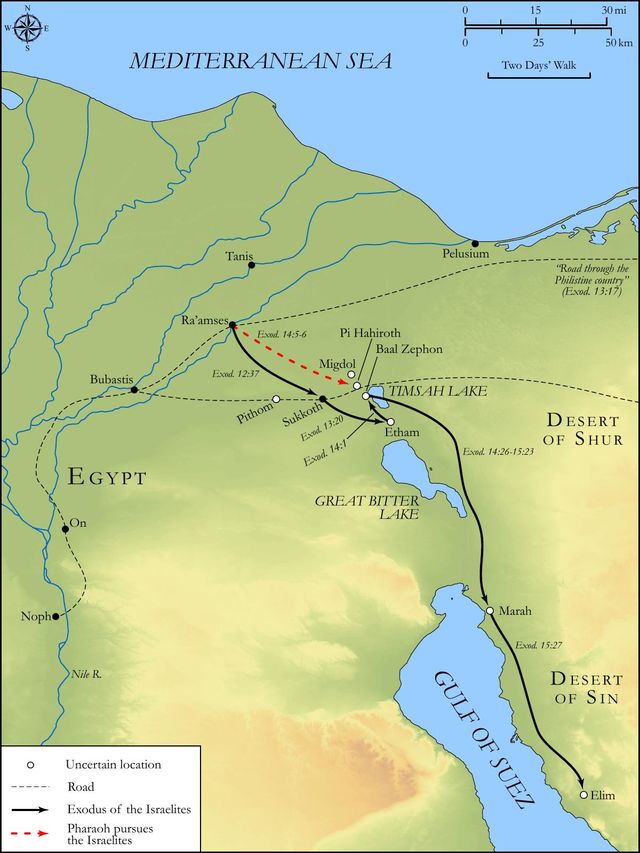
We have here, I. The fright that the children of Israel were in when they perceived that Pharaoh pursued them, Exo 14:10. They knew very well the strength and rage of the enemy, and their own weakness; numerous indeed they were, but all on foot, unarmed, undisciplined, disquieted by long servitude, and (which was worst of all) now penned up by the situation of their camp, so that they could not make their escape. On the one hand was Pi-hahiroth, a range of craggy rocks impassable; on the other hand were Migdol and Baalzephon, which, some think were forts and garrisons upon the frontiers of Egypt; before them was the sea; behind them were the Egyptians: so that there was no way open for them but upwards, and thence their deliverance came. Note, We may be in the way of our duty, following God and hastening towards heaven, and yet may be in great straits, troubled on every side, Co2 4:8. In this distress, no marvel that the children of Israel were sorely afraid; their father Jacob was so in a like case (Gen 32:7); when without are fightings, it cannot be otherwise but that within are fears: what therefore was the fruit of this fear? According as that was, the fear was good or evil. 1. Some of them cried out unto the Lord; their fear set them a praying, and that was a good effect of it. God brings us into straits that he may bring us to our knees. 2. Others of them cried out against Moses; their fear set them a murmuring, Exo 14:11, Exo 14:12. They give up themselves for lost; and as if God's arm were shortened all of a sudden, and he were not as able to work miracles today as he was yesterday, they despair of deliverance, and can count upon nothing but dying in the wilderness. How inexcusable was their distrust! Did they not see themselves under the guidance and protection of a pillar from heaven? And can almighty power fail them, or infinite goodness be false to them? Yet this was not the worst; they quarrel with Moses for bringing them out of Egypt, and, in quarrelling with him, fly in the face of God himself, and provoke him to wrath whose favour was now the only succour they had to flee to. As the Egyptians were angry with themselves for the best deed they ever did, so the Israelites were angry with God for the greatest kindness that was ever done them; so gross are the absurdities of unbelief. They here express, (1.) A sordid contempt of liberty, preferring servitude before it, only because it was attended with some difficulties. A generous spirit would have said, "If the worst come to the worst," as we say, "It is better to die in the field of honour than to live in the chains of slavery;" nay, under God's conduct, they could not miscarry, and therefore they might say, "Better live God's freemen in the open air of a wilderness than the Egyptians' bondmen in the smoke of the brick-kilns." But because, for the present, they are a little embarrassed, they are angry that they were not left buried alive in their house of bondage. (2.) Base ingratitude to Moses, who had been the faithful instrument of their deliverance. They condemn him, as if he had dealt hardly and unkindly with them, whereas it was evident, beyond dispute, that whatever he did, and however it issued, it was by direction from their God, and with design for their good. What they had said in a former ferment (when they hearkened not to Moses for anguish of spirit), they repeat and justify in this: We said in Egypt, Let us alone; and it was ill-said, yet more excusable, because then they had not had so much experience as they had now of God's wonderful appearances in their favour. But they had as soon forgotten the miracles of mercy as the Egyptians had forgotten the miracles of wrath; and they, as well as the Egyptians, hardened their hearts, at last, to their own ruin; as Egypt after ten plagues, so Israel after ten provocations, of which this was the first (Num 14:22), were sentenced to die in the wilderness.
II.The seasonable encouragement that Moses gave them in this distress, Exo 14:13, Exo 14:14.
He answered not these fools according to their folly. God bore with the provocation they gave to him, and did not (as he might justly have done) chose their delusions, and bring their fears upon them; and therefore Moses might well afford to pass by the affront they put upon him. Instead of chiding them, he comforts them, and with an admirable presence and composure of mind, not disheartened either by the threatenings of Egypt or the tremblings of Israel, stills their murmuring, with the assurance of a speedy and complete deliverance: Fear you not. Note, It is our duty and interest, when we cannot get out of our troubles, yet to get above our fears, so that they may only serve to quicken our prayers and endeavours, but may not prevail to silence our faith and hope.
1.He assures them that God would deliver them, that he would undertake their deliverance, and that he would effect it in the utter ruin of their pursuers: The Lord shall fight for you. This Moses was confident of himself, and would have them to be so, though as yet he knew not how or which way it would be brought to pass. God had assured him that Pharaoh and his host should be ruined, and he comforts them with the same comforts wherewith he had been comforted.
2.He directs them to leave it to God, in a silent expectation of the event: "Stand still, and think not to save yourselves either by fighting or flying; wait God's orders, and observe them; be not contriving what course to take, but follow your leader; wait God's appearances, and take notice of them, that you may see how foolish you are to distrust them. Compose yourselves, by an entire confidence in God, into a peaceful prospect of the great salvation God is now about to work for you. Hold your peace; you need not so much as give a shout against the enemy, as Jos 6:16. The work shall be done without any concurrence of yours." Note,
(1.)If God himself bring his people into straits, he will himself discover a way to bring them out again.
(2.)In times of great difficulty and great expectation, it is our wisdom to keep our spirits calm, quiet, and sedate; for then we are in the best frame both to do our own work and to consider the work of God. Your strength is to sit still (Isa 30:7), for the Egyptians shall help in vain, and threaten to hurt in vain.
Continue studying Exodus 14:14 across the web’s major study libraries — every link below opens this exact verse, chapter, or book on the destination site.
Read & Compare
 BibleGatewayThis verse in more than 200 translations and 70 languages.
 Bible.comThe YouVersion reader — hundreds of translations, reading plans, and highlights.
 ESV.orgCrossway's official English Standard Version reader.
 NET BibleThe NET translation with 60,000+ translators' notes on every rendering decision.
 STEP BibleTyndale House's free study tool — original text, vocabulary, and scholarly resources.
 BibliaLogos Bible Software's free web reader.
 USCCBThe New American Bible (Revised Edition) with the U.S. bishops' study notes.
Commentaries
 BibleHub CommentariesDozens of classic commentaries on this verse, gathered on one page.
 StudyLightMore than 100 commentary sets — the largest collection on the web.
 BibleRefPlain-English commentary on what this verse means, verse by verse.
 Enduring WordDavid Guzik's free commentary on this chapter, widely used by Bible teachers.
 Bible Study ToolsVerse commentary alongside Greek and Hebrew study aids.
Original Language & Research
- BibleHub InterlinearThe verse word by word — original language, transliteration, and English.
- BibleHub LexiconEvery word's original-language definition and Strong's entry.
 Blue Letter BibleDeep-study tools — Strong's numbers, concordance, and word studies.
 SefariaThe Hebrew text with Rashi and centuries of Jewish commentary.
Sermons, Hymns & Audio


TrulyRandomVerse is not affiliated with these sites and doesn’t control their content. They’re linked because they’re genuinely useful.
Summary
Exodus 14:14 stands as a monumental declaration from Moses to a terrified Israel, cornered between Pharaoh's relentless army and the impassable Red Sea. It powerfully encapsulates the essence of God's active, sovereign intervention on behalf of His people, promising that the LORD Himself will wage their battle, while simultaneously calling them to a posture of quiet trust, cessation of frantic human effort, and expectant faith. This verse serves as a timeless theological anchor, reminding all generations that ultimate deliverance and salvation emanate from divine power, not from human strength, strategy, or self-reliance.
Context
ShowHideLiterary Context
This pivotal verse is situated at the dramatic climax of Israel's initial escape from Egyptian bondage. Immediately preceding it, the Israelites, having recently witnessed God's mighty plagues that broke Pharaoh's will, find themselves in an seemingly insurmountable predicament. Pharaoh, with a hardened heart, has pursued them with his elite chariots and cavalry, trapping them against the natural barrier of the Red Sea Exodus 14:9. Overwhelmed by terror, the Israelites cry out to the LORD, yet simultaneously turn on Moses with bitter complaints, lamenting their newfound freedom and expressing a desire to return to slavery in Egypt Exodus 14:10-12. Moses, demonstrating profound faith, responds by reassuring them not to fear, promising that God will deliver them and that they will never again see the Egyptians Exodus 14:13. Exodus 14:14 is the powerful culmination of this divine reassurance, serving as the direct prelude to God's awe-inspiring miracle of parting the Red Sea and the subsequent destruction of the pursuing Egyptian army Exodus 14:15-31.
Historical & Cultural Context
The Exodus narrative unfolds against the intricate tapestry of Pharaoh's power and the gods of Egypt. Pharaoh, in Egyptian theology, was considered a divine king, the embodiment of human imperial might and absolute authority. His relentless pursuit of the Israelites was not merely a military maneuver but a profound assertion of his perceived divine right and a reversal of his reluctant permission for them to depart. The Red Sea (Hebrew: Yam Suph, often translated "Sea of Reeds") presented an insuperable natural barrier, creating an "impossible" situation that highlighted Israel's utter helplessness. In this cultural milieu, where nations typically fought with their deities, the concept of a singular, sovereign God (Yahweh) fighting for His people, without their active participation in the battle, was a revolutionary and unique aspect of Israelite theology. This underscored Yahweh's unparalleled omnipotence and His unwavering commitment to His covenant people. The Israelites, having endured generations of slavery, were an untrained, unarmed multitude, rendering their deliverance entirely dependent on miraculous divine intervention.
Key Themes
ShowHideExodus 14:14 powerfully contributes to several overarching theological and narrative themes within the book of Exodus and the broader Pentateuch. Foremost is the theme of Divine Deliverance and Salvation, showcasing Yahweh as the ultimate rescuer who actively intervenes to save His people from oppression and impossible odds. This event is a foundational demonstration of God's Sovereignty and Omnipotence over all creation, including natural forces and human empires, proving that no situation is beyond His control. The verse also underscores the Necessity of Faith and Trust in God, calling His people to a posture of quiet reliance rather than frantic self-effort, a theme echoed in passages like Psalm 46:10. Furthermore, it powerfully illustrates God's Faithfulness to His Covenant Promises, particularly those made to Abraham, Isaac, and Jacob, demonstrating His unwavering commitment to His chosen people and His plan for their redemption and formation as a nation. This miracle also serves as a profound act of Divine Judgment against Pharaoh and Egypt, fulfilling God's earlier declaration to "get glory over Pharaoh and all his host" Exodus 14:4.
Exposition and Analysis
ShowHideExodus 14:14 is a concise yet profoundly impactful statement, delivering both a divine promise of intervention and a human command for a specific response.
Key Word Analysis
ShowHideThis is God's personal, covenant name, Yahweh (H3068). It emphasizes His self-existence, eternal nature, and His unwavering faithfulness to His promises. The use of this specific name here signifies that it is this covenant-keeping, relational God—the God who has revealed Himself to Israel—who will actively engage on their behalf, distinguishing Him from the impotent deities of Egypt and other nations. It underscores His unique character as the One who acts decisively in history.
This Hebrew verb (H3898) means "to feed on," "to consume," and by implication, "to battle," "to wage war," or "to contend." It conveys active, decisive, and often destructive engagement. The future tense ("shall fight") emphasizes divine initiative and certainty. This is not a battle Israel is equipped to win, nor one they are even called to participate in; it is Yahweh's battle, demonstrating His role as the Divine Warrior.
This verb (H2790) carries a rich semantic range, including "to scratch," "to engrave," "to plow," "to fabricate," "to devise," and significantly, "to be silent," "to be still," "to be inactive," or even "to be deaf." In this context, it is a command to cease frantic human effort, to stop panicking, to refrain from complaining, and to adopt a posture of quiet trust and expectant waiting. It signifies an active stillness rooted in faith, not passive resignation or apathy. It is a call to surrender human control and allow God to work without interference.
Verse Breakdown
ShowHide"The LORD shall fight for you,"
This is the divine promise, the active and sovereign component of the verse. God is not a distant observer but the primary, decisive actor. The phrase "for you" emphatically highlights His protective, redemptive, and advocating intent. This battle is beyond Israel's capacity or responsibility; God takes full, active ownership of their deliverance, demonstrating His omnipotence and faithfulness to His covenant.
"and ye shall hold your peace."
This is the human response, the passive yet profoundly faithful component. In the face of overwhelming odds and natural human inclination to panic, strategize, or complain, Israel is commanded to be still. This stillness is an act of profound faith, demonstrating their complete reliance on God alone. It means quieting their fears, silencing their complaints, and refraining from any self-reliant action that would interfere with or presume upon God's unique and miraculous work.
Literary Devices
ShowHideExodus 14:14 employs several powerful literary devices to convey its profound message. The most prominent is Antithesis/Contrast, which juxtaposes God's active, decisive "fighting" with humanity's required "holding of peace" or stillness. This stark contrast highlights the divine-human dynamic in salvation: God is the active agent of deliverance, while humanity's role is one of trusting surrender. The verse also utilizes Direct Address, as Moses' words are a direct, authoritative command and promise delivered to the terrified Israelite community, cutting through their fear and complaint with divine certainty. Furthermore, the statement carries the weight of a Divine Declaration or oracle, imbuing the promise with absolute certainty and the command with non-negotiable authority, emphasizing the unwavering nature of God's word. The use of the Imperative Mood in "hold your peace" underscores the urgency and necessity of this faithful response.
Theological and Thematic Connections
ShowHideExodus 14:14 reveals several profound theological truths that resonate throughout the biblical narrative. It firmly establishes God as the Divine Warrior and Deliverer, the one who actively intervenes on behalf of His people, especially when they are helpless and facing insurmountable odds. He is not a distant deity but a God who "fights" for His covenant people, demonstrating His power over all earthly forces and His commitment to their redemption. This theme recurs throughout Scripture, portraying God as the ultimate victor over all enemies of His people and His purposes. The "impossible" situation at the Red Sea serves as a dramatic backdrop for God's absolute Sovereignty and Omnipotence over circumstances, nature, and human adversaries, teaching that no situation is beyond His power to resolve. The command to "hold your peace" underscores the Necessity of Faith and Trust, emphasizing that true deliverance often requires a posture of quiet reliance on God rather than frantic human effort or self-salvation. It is a call to surrender control and allow God to work. Ultimately, this act of deliverance reaffirms God's unwavering Faithfulness to His Covenant promises made to Abraham, Isaac, and Jacob, demonstrating His steadfast commitment to His chosen people and His redemptive plan.
This theme of divine intervention and human trust is echoed throughout the Bible:
Reflection and Application
ShowHideExodus 14:14 offers a timeless and profoundly relevant principle for believers navigating the complexities and challenges of contemporary life. In a world that constantly pressures us to strive, hustle, and maintain control over every outcome, this verse calls us to embrace a counter-cultural posture of faith. When we encounter our own "Red Sea" moments—situations that appear utterly impossible, where we feel trapped by overwhelming circumstances, paralyzing fear, or formidable opposition—our natural human inclination might be to succumb to panic, resort to self-reliant strategies, or descend into bitter complaint. This verse, however, redirects our focus and reorients our response:
Questions for Reflection
ShowHideFAQ
ShowHideDoes "hold your peace" imply that we should do absolutely nothing in the face of challenges?
ShowHideNo, "hold your peace" (Hebrew chârash) does not advocate for total passivity, apathy, or inaction in all circumstances. In this specific context, it is a command to cease frantic, self-reliant, or complaining efforts that would interfere with or presume upon God's unique and miraculous work. It calls for a posture of active faith and trust, allowing God to act decisively. Immediately following this declaration, Moses is commanded to lift his staff and stretch out his hand over the sea Exodus 14:15-16, indicating that while Israel was to be still in their panic and self-effort, there was still a role for obedient action under divine direction. It's about discerning when to act in obedience and when to wait on God's sovereign and unique intervention.
Is the promise "The LORD shall fight for you" exclusively for ancient Israel, or does it apply to believers today?
ShowHideWhile the immediate historical context is Israel's miraculous deliverance from Egypt, the underlying theological principle of God fighting for His people is timeless and applies to believers in all ages. God's character as a deliverer, protector, and advocate remains constant. However, the mode of His fighting may differ. For believers today, God fights spiritual battles (e.g., against sin, temptation, spiritual forces of evil), provides for our needs, guides us through difficult circumstances, defends our cause, and ultimately secures our salvation and eternal destiny. The promise assures us of His active presence, unwavering advocacy, and ultimate victory in our lives, even when we face overwhelming odds.
Why did God wait until the Israelites were trapped at the Red Sea before intervening so dramatically?
ShowHideGod often orchestrates circumstances to allow His people to reach a point of human impossibility or utter helplessness. This serves several divine purposes: primarily, to demonstrate His power unmistakably, ensuring that their deliverance would be clearly seen as a divine miracle and not a human achievement. By allowing the Israelites to be cornered, God ensured their absolute dependence on Him, thereby building their faith, humbling Pharaoh, and bringing immense glory to His own name, fulfilling His stated purpose to "get glory over Pharaoh and all his host" Exodus 14:4. This dramatic setup also served as a foundational lesson for Israel about Yahweh's unique identity as their sovereign Deliverer.
Christ-Centered Fulfillment
ShowHideExodus 14:14, with its powerful declaration of divine intervention and call to stillness, finds its ultimate fulfillment and amplification in the person and redemptive work of Jesus Christ. The Lord who fought for Israel at the Red Sea is the same God who, in the fullness of time, sent His Son to be the ultimate Divine Warrior. While God delivered Israel from physical slavery and a pursuing army, Jesus fought and won the decisive battle against humanity's greatest and most pervasive enemies: sin, death, and the devil. His sinless life, sacrificial death on the cross, and glorious resurrection constitute the supreme act of God fighting for us, securing a spiritual and eternal deliverance far grander and more profound than the physical rescue from Egypt. He did not merely defeat an earthly army; He conquered the very powers that enslave humanity, leading us out of the bondage of sin and into the glorious freedom of God's children Galatians 5:1.
Just as Israel was commanded to "hold their peace" and witness God's salvation, believers in Christ are called to "be still" and rest in the finished work of Jesus. We do not fight for our own salvation, justification, or righteousness; Christ has already fought and won that battle decisively on Calvary Colossians 2:15. Our peace, righteousness, and eternal hope come from trusting in His victory, not from our striving, religious efforts, or self-improvement. The Exodus narrative, with its "Red Sea" crossing from slavery to freedom, profoundly prefigures the greater liberation found in Christ, who leads His people out of the dominion of darkness and into His marvelous light Colossians 1:13. He is the one who "fights for us" by bearing our sins, conquering our spiritual foes, and making a way to God where there was no way John 14:6. The peace that comes from "holding your peace" in Exodus 14:14 foreshadows the deep, abiding, and supernatural peace that Christ offers His followers John 14:27. He is our peace Ephesians 2:14, and through Him, we can experience a profound stillness of soul even amidst life's most turbulent storms, knowing that the ultimate battle has been won and our eternal security is guaranteed in Him.