


2 Chronicles 20:17
Bible text: King James Version (1769 Blayney text) · Public domain
Bible text: King James Version with Strong's numbers · Public domain
Bible text: Berean Standard Bible · Public domain
Bible text: American Standard Version (1901) · Public domain
Bible text: World English Bible, Messianic edition · Public domain
Bible text: Geneva Bible (1599) · Public domain
Bible text: Young's Literal Translation · Public domain
- לֹאlo'notH3808NegParticle Negative
- לָכֶםla·Khem[belongs] to youPrep-l ¦ 2mpSuffix Personal 2nd Plural Masculineלָ[belongs] toכֶםyou
- לְהִלָּחֵםle·hi·la·Chemto fightH3898Prep-l ¦ V-Niphal-InfVerb Niphal Infinitive Constructלְtoהִלָּחֵםfight
- בָּזֹאתba·Zotin this [battle]H2063Prep-b ¦ PrtParticle Demonstrativeבָּinזֹאתthis [battle]
- הִתְיַצְּבוּhit·ya·tze·Vutake your standH3320V-Hithpael-Imp-2mpVerb Hithpael Imperative 2nd Plural Masculine
- עִמְדוּ'im·DustandH5975V-Qal-Imp-2mpVerb Qal Imperative 2nd Plural Masculine
- וּרְאוּu·re·'Uand seeH7200Conj-w ¦ V-Qal-Imp-2mpVerb Qal Imperative 2nd Plural Masculineוּandרְאוּsee
- אֶת'et<obj.>H853DirObjMParticle Object Indicator
- יְשׁוּעַתye·shu·'At[the] victory ofH3444N-fscNoun Singular Feminine Construct
- יְהוָהYah·wehYahwehH3068N-properNoun Proper Title
- עִמָּכֶם'i·ma·Khemwith youH5973Prep ¦ 2mpPrepositionעִמָּwithכֶםyou
- יְהוּדָהye·hu·DahO JudahH3063N-properNoun Proper Location
- וִירוּשָׁלִַםvi·ru·sha·Limand JerusalemH3389Conj-w ¦ N-properNoun Proper LocationוִandירוּשָׁלִַםJerusalem
- אַל'almay notH408NegParticle Negative
- תִּירְאוּti·re·'Uyou be afraidH3372V-Qal-Imperf-2mpVerb Qal Imperfect 2nd Plural Masculine
- וְאַלve·'aland may notH408Conj-w ¦ NegParticle Negativeוְandאַלmay not
- תֵּחַתּוּte·Cha·tuyou be dismayedH2865V-Niphal-Imperf-2mpVerb Niphal Imperfect 2nd Plural Masculine
- מָחָרma·ChartomorrowH4279N-msNoun Singular Masculine Absolute
- צְאוּtze·'Ugo outH3318V-Qal-Imp-2mpVerb Qal Imperative 2nd Plural Masculine
- לִפְנֵיהֶםlif·nei·Hem<to> before themH6440Prep-l ¦ N-mpc ¦ 3mpNoun Plural Masculine Constructלִ<to>פְנֵיbeforeהֶםthem
- וַיהוָהva·Yah·wehand YahwehH3068Conj-w ¦ N-properNoun Proper TitleוַandיהוָהYahweh
- עִמָּכֶם'i·ma·Khem[will be] with youH5973Prep ¦ 2mpPrepositionעִמָּ[will be] withכֶםyou
English is a literal word-by-word gloss of the Hebrew, not the KJV's wording. Why?
This is the original text the KJV's translators worked from — each Hebrew word with its own literal English meaning in this verse, prepared by scholars at Tyndale House, Cambridge. The KJV translates whole sentences, not word by word, so its wording differs: one Hebrew word can become several English words, and the KJV may choose “the LORD” where the gloss reads “Yahweh”. Both are faithful — they answer different questions. For the KJV's own rendering, switch to the KJV text.
Details
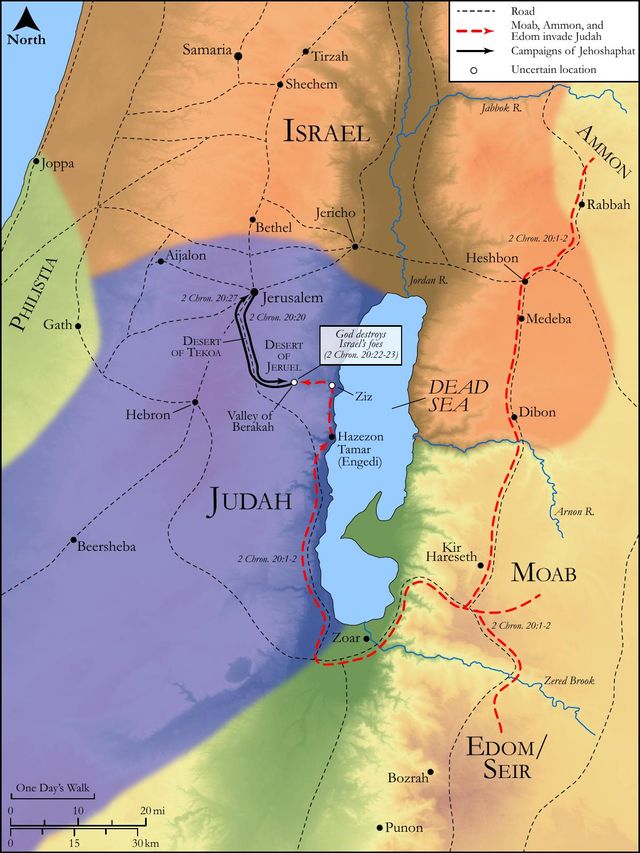
See on the biblical-era map
Study this verse
Public-domain commentary
Matthew Henry
From his Commentary on the Whole Bible. Henry comments on passages, not single verses — this entry covers 2 Chronicles 20:14–19.
We have here God's gracious answer to Jehoshaphat's prayer; and it was a speedy answer. While he was yet speaking God heard: before the congregation was dismissed they had assurance given them that they should be victorious; for it is never in vain to seek God. 1. The spirit of prophecy came upon a Levite that was present, not in any place of eminency, but in the midst of the congregation, Ch2 20:14. The Spirit, like the wind, blows where and on whom he listeth. He was of the sons of Asaph, and therefore one of the singers; on that office God would put an honour. Whether he was a prophet before this or no is uncertain, most probably he was, which would make him the more regarded. There needed no sign, the thing itself was to be performed the very next day, and that would be confirmation enough to his prophecy. 2. He encouraged them to trust in God, though the danger was very threatening (Ch2 20:15): "Be not afraid; you have admitted fear enough to bring you to God, do not now admit that which will drive you to God, do not now admit that which will drive you from him again. The battle is not yours; it is not in your own strength, not for your own cause, that you engage; the battle is God's: he does and will, as you have desired, interest himself in the cause." 3. He gives them intelligence of the motions of the enemy, and orders them to march towards them, with particular directions where they should find them. Tomorrow (the day after the fast) go you down against them, Ch2 20:16, Ch2 20:17. It is fit that he who commands the deliverance should command those for whom the deliverance is to be wrought, and give the necessary orders, both for time and place. 4. He assures them that they should be, not the glorious instruments, but the joyful spectators, of the total defeat of the enemy: "You shall not need to strike a stroke; the work shall be done to your hands; only stand still and see it," Ch2 20:17. As Moses said to Israel at the Red Sea (Exo 14:13), "God is with you, who is able to do his work himself, and will do it. If the battle be his, the victory shall be his too." Let but the Christian soldier go out against his spiritual enemies, and the God of peace will tread them under his feet and make him more than a conqueror. 5. Jehoshaphat and his people received these assurances with faith, reverence, and thankfulness. (1.) They bowed their heads, Jehoshaphat first, and then all the people, fell before the Lord, and worshipped, receiving with a holy awe and fear of God this token of his favour, and saying with faith, Be it unto us according to thy word. (2.) They lifted up their voices in praise to God, Ch2 20:19. An active faith can give thanks for a promise though it be not yet performed, knowing that God's bonds are as good as ready money. God hath spoken in his holiness; I will rejoice, Psa 60:5.
Continue studying 2 Chronicles 20:17 across the web’s major study libraries — every link below opens this exact verse, chapter, or book on the destination site.
Read & Compare
 BibleGatewayThis verse in more than 200 translations and 70 languages.
 Bible.comThe YouVersion reader — hundreds of translations, reading plans, and highlights.
 ESV.orgCrossway's official English Standard Version reader.
 NET BibleThe NET translation with 60,000+ translators' notes on every rendering decision.
 STEP BibleTyndale House's free study tool — original text, vocabulary, and scholarly resources.
 BibliaLogos Bible Software's free web reader.
 USCCBThe New American Bible (Revised Edition) with the U.S. bishops' study notes.
Commentaries
 BibleHub CommentariesDozens of classic commentaries on this verse, gathered on one page.
 StudyLightMore than 100 commentary sets — the largest collection on the web.
 BibleRefPlain-English commentary on what this verse means, verse by verse.
 Enduring WordDavid Guzik's free commentary on this chapter, widely used by Bible teachers.
 Bible Study ToolsVerse commentary alongside Greek and Hebrew study aids.
Original Language & Research
- BibleHub InterlinearThe verse word by word — original language, transliteration, and English.
- BibleHub LexiconEvery word's original-language definition and Strong's entry.
 Blue Letter BibleDeep-study tools — Strong's numbers, concordance, and word studies.
 SefariaThe Hebrew text with Rashi and centuries of Jewish commentary.
Sermons, Hymns & Audio


TrulyRandomVerse is not affiliated with these sites and doesn’t control their content. They’re linked because they’re genuinely useful.
Summary
2 Chronicles 20:17 delivers a profound prophetic word from God to King Jehoshaphat and the people of Judah, assuring them of divine intervention and victory against an overwhelming invading army. It is a powerful testament to God's sovereignty, His faithfulness to His covenant people, and a call to unwavering faith, commanding them to stand firm, witness His salvation, and cast off fear, for the Lord Himself would fight on their behalf.
Context
ShowHideLiterary Context
This verse is the climactic core of God's direct response to King Jehoshaphat's fervent prayer in 2 Chronicles 20. Following the alarming news of a vast coalition of armies advancing against Judah, Jehoshaphat, demonstrating exemplary spiritual leadership, proclaimed a national fast and gathered the people at the temple. There, he offered a powerful prayer, acknowledging God's supreme power, recalling His covenant promises to Abraham, and confessing Judah's utter helplessness before their enemies, declaring, "we have no might against this great company that comes against us; nor do we know what to do, but our eyes are upon You" 2 Chronicles 20:12. In response, the Spirit of the Lord came upon Jahaziel, a Levite, who then delivered this divine oracle of assurance and instruction, setting the stage for a miraculous, bloodless victory that would profoundly impact the nation.
Historical & Cultural Context
King Jehoshaphat reigned over Judah (c. 870-848 BC) and was generally a righteous king who sought to reform the nation and walk in the ways of the Lord. The invading forces comprised the Moabites, Ammonites, and Meunites (likely from Mount Seir, Edom), formidable enemies from the east and south, representing a significant existential threat to Judah's sovereignty and survival. In the warfare of that day, such a coalition would typically necessitate a direct military confrontation, relying on strategic prowess and numerical strength. However, God's instruction to "stand ye still" and "see the salvation of the LORD" directly challenged conventional military wisdom, emphasizing a divine, supernatural intervention over human might. This act of faith would serve as a powerful witness to surrounding nations of Yahweh's unique power and His active involvement in the affairs of His people.
Key Themes
ShowHideThe passage powerfully articulates several foundational themes. Divine Deliverance is paramount, as God explicitly promises to fight for Judah, negating the need for their own military engagement. This underscores God's active role as a Warrior for His people, a theme echoed in the deliverance at the Red Sea. Faith and Trust are central, as the command to "stand ye still" is not passivity but a profound act of surrendering human control and relying entirely on God's power and timing. This requires a radical trust in God's word, even when circumstances seem dire. Furthermore, the repeated exhortation, "fear not, nor be dismayed," highlights the theme of Courage and Assurance, directly addressing the natural human response to overwhelming odds. Finally, the promise "the LORD will be with you" emphasizes God's Enduring Presence, a cornerstone of biblical theology, assuring His people of His unfailing support and active involvement in their trials, a promise that resonates throughout scripture, from the call of Moses in Exodus 3:12 to the Great Commission in Matthew 28:20.
Exposition and Analysis
ShowHideKey Word Analysis
ShowHideThis verb means "to place (any thing so as to stay); reflexively, to station, offer, continue." In this context, it implies taking a deliberate, firm posture or position. It's not about preparing to fight, but about establishing oneself firmly to observe God's action, a disciplined act of expectant waiting.
This feminine passive participle means "something saved, i.e. (abstractly) deliverance; hence, aid, victory, prosperity." Here, it refers to a comprehensive, miraculous physical deliverance from the invading armies. It signifies a decisive, divinely wrought triumph that demonstrates God's power and faithfulness, accomplished entirely by the Lord.
This primitive root means "to prostrate; hence, to break down, either (literally) by violence, or (figuratively) by confusion and fear; abolish, affright, be (make) afraid, amaze, beat down, discourage, (cause to) dismay, go down, scare, terrify." The command "nor be dismayed" directly counters this state of utter hopelessness and despair, assuring the people that their fear is unwarranted because God is actively engaged on their behalf.
Verse Breakdown
ShowHide"Ye shall not [need] to fight in this [battle]:"
This opening declaration immediately removes the burden of military engagement from Judah. It is a direct negation of human effort as the primary means of victory, setting the stage for divine intervention. The bracketed words in KJV indicate they are supplied for clarity, but the meaning is clear: God will render their fighting unnecessary.
"set yourselves, stand ye [still],"
This is a dual command for a specific posture. "Set yourselves" implies taking a firm, strategic position, while "stand ye still" means to hold one's ground, not to flee or rush into battle, but to remain fixed and expectant. It's a call to disciplined, faith-filled waiting.
"and see the salvation of the LORD with you,"
The purpose of their standing still is to be eyewitnesses to God's mighty act of deliverance. The "salvation" (Hebrew yᵉshûwʻâh) is not something they achieve, but something God performs "with you," meaning on their behalf and in their presence.
"O Judah and Jerusalem:"
This direct address personalizes the divine message, specifically naming the people and capital city who are the recipients of this promise and the beneficiaries of God's impending salvation.
"fear not, nor be dismayed;"
This is a powerful double negative imperative, directly confronting the natural human emotions of terror and despair in the face of overwhelming odds. It serves as a spiritual antidote, reinforcing the assurance of God's protective presence.
"to morrow go out against them:"
Despite the promise that they won't need to fight, they are commanded to physically confront the enemy. This is an act of obedience and faith, demonstrating their trust in God's word even when it seems paradoxical. They are to advance to the battleground, not to fight, but to witness.
"for the LORD [will be] with you."
This concluding phrase provides the ultimate reason and assurance for all the preceding commands. God's active, personal, and unfailing presence is the guarantee of their victory and the foundation of their courage. It is the bedrock promise upon which their faith is to rest.
Literary Devices
ShowHide2 Chronicles 20:17 is rich in literary devices that amplify its message. The primary device is a Divine Oracle, delivered through the prophet Jahaziel, which carries the absolute authority of God's direct word, leaving no room for doubt. The use of Imperative Mood is prominent ("set yourselves," "stand ye still," "see," "fear not," "be not dismayed," "go out"), creating a series of direct commands that demand immediate and unwavering obedience from the people. There is striking Contrast between human inability ("Ye shall not need to fight") and divine omnipotence ("see the salvation of the LORD"). The phrase "fear not, nor be dismayed" employs Parallelism and Repetition, emphasizing the critical importance of overcoming anxiety through faith. Finally, the recurring phrase "the LORD will be with you" functions as a Leitmotif or Thematic Repetition, serving as the foundational promise that undergirds all the instructions and assurances, reinforcing God's constant, active presence as the ultimate source of strength and victory.
Theological and Thematic Connections
ShowHideThis pivotal verse profoundly shapes our understanding of God's character and His relationship with His people. It reveals a God who is not distant but intimately involved in the affairs of humanity, a God who hears prayer and actively intervenes on behalf of those who trust Him. The emphasis on God fighting for His people underscores His sovereignty and omnipotence, reminding us that true victory belongs to Him, not to human strength or strategy. It teaches that faith is not passive resignation but an active posture of reliance and obedience, even when the path forward seems counter-intuitive. The narrative serves as a powerful illustration of divine grace and faithfulness, demonstrating that God's promises are trustworthy and His presence is the ultimate antidote to fear and despair.
Reflection and Application
ShowHide2 Chronicles 20:17 offers timeless wisdom for believers navigating the "battles" of life today. It reminds us that our first response to overwhelming challenges should be to seek God's face in prayer, acknowledging our helplessness and fully entrusting our circumstances to His sovereign hand, just as Jehoshaphat did. There are moments when God calls us not to strive harder in our own strength, but to "stand still" – to cease our anxious efforts, to quiet our fears, and to position ourselves to witness His supernatural intervention. This doesn't mean idleness, but rather a profound act of spiritual surrender and expectant faith, allowing God to work in ways far beyond our comprehension. When we truly grasp that "the LORD will be with you," the power of fear and dismay diminishes, replaced by a deep assurance that our ultimate victory is secured in Him. Our role is to obey His instructions, even if they seem paradoxical, and then to observe and glorify Him for His mighty acts of deliverance, knowing that He delights in revealing His salvation to those who trust Him.
Questions for Reflection
ShowHideFAQ
ShowHideDoes "stand ye still" mean I should do nothing in the face of challenges?
ShowHideNo, "stand ye still" (Hebrew: yâtsab, ʻâmad) does not imply passivity or inaction in the face of danger. Instead, it conveys taking a firm, fixed position – a posture of readiness and waiting for God's intervention. It means establishing oneself firmly to observe what God is about to do, rather than rushing into battle or fleeing. In this specific context, it was followed by the command to "to morrow go out against them," indicating an act of obedient presence, not idleness. It's about discerning when God calls for human effort and when He calls for faith-filled waiting for His supernatural work, as seen in Exodus 14:14.
Christ-Centered Fulfillment
ShowHide2 Chronicles 20:17 finds its ultimate and most profound fulfillment in Jesus Christ. The promise that "the LORD will be with you" culminates in the incarnation of God Himself, Emmanuel, "God with us" Matthew 1:23. While Jehoshaphat and Judah were called to "stand still" and witness God's physical salvation from earthly enemies, Christ's work provides eternal "salvation" (Greek: soteria, mirroring yᵉshûwʻâh) from the ultimate enemies: sin, death, and the power of the devil. The "battle" that we "need not fight" is the spiritual warfare for our souls, for Christ has already fought and won the decisive victory on the cross. He is the true Lamb of God who takes away the sin of the world, and through His resurrection, He triumphed over death, disarming principalities and powers Colossians 2:15. Believers are called to "stand firm" in the faith 1 Corinthians 16:13, not in their own strength, but in the finished work of Christ, knowing that the Spirit of God dwells within them, ensuring His abiding presence "always, even to the end of the age" Matthew 28:20. Our victory is not in our fighting, but in resting in the One who has already secured the eternal triumph.