


2 Chronicles 20:18
Bible text: King James Version (1769 Blayney text) · Public domain
Bible text: King James Version with Strong's numbers · Public domain
Bible text: Berean Standard Bible · Public domain
Bible text: American Standard Version (1901) · Public domain
Bible text: World English Bible, Messianic edition · Public domain
Bible text: Geneva Bible (1599) · Public domain
Bible text: Young's Literal Translation · Public domain
- וַיִּקֹּדvai·yi·Kodand he bowed lowH6915Conj-w ¦ V-Qal-ConsecImperf-3msVerb Qal Consecutive Imperfect 3rd Singular Masculineוַandיִּקֹּדhe bowed low
- יְהוֹשָׁפָטye·ho·sha·FatJehoshaphatH3092N-proper-mNoun Proper Masculine
- אַפַּיִם'a·Pa·yimfaceH639N-mdNoun Dual Masculine Absolute
- אָרְצָה'A·re·tzah[the] ground towardsH776N-fs ¦ SfxNoun Singular Feminine Absoluteאָרְצָ[the] groundהtowards
- וְכָלve·kholand allH3605Conj-w ¦ N-mscNoun Singular Masculine Constructוְandכָלall
- יְהוּדָהye·hu·DahJudahH3063N-properNoun Proper Location
- וְיֹשְׁבֵיve·yo·she·Veiand [the] inhabitants ofH3427Conj-w ¦ V-Qal-Prtcpl-mpVerb Qal Participle Plural Masculine Constructוְandיֹשְׁבֵי[the] inhabitants of
- יְרוּשָׁלִַםye·ru·sha·LimJerusalemH3389N-properNoun Proper Location
- נָפְלוּna·fe·Luthey fell downH5307V-Qal-Perf-3cpVerb Qal Perfect 3rd Plural common gender
- לִפְנֵיlif·Nei<to> beforeH6440Prep-l ¦ N-mpcNoun Plural Masculine Constructלִ<to>פְנֵיbefore
- יְהוָהYah·wehYahwehH3068N-properNoun Proper Title
- לְהִשְׁתַּחֲוֹתle·hish·ta·cha·Votto bow downH7812Prep-l ¦ V-Hishtaphel-InfVerb Hishtaphel Infinitive Constructלְtoהִשְׁתַּחֲוֹתbow down
- לַיהוָהla·Yah·wehto YahwehH3068Prep-l ¦ N-properNoun Proper TitleלַtoיהוָהYahweh
English is a literal word-by-word gloss of the Hebrew, not the KJV's wording. Why?
This is the original text the KJV's translators worked from — each Hebrew word with its own literal English meaning in this verse, prepared by scholars at Tyndale House, Cambridge. The KJV translates whole sentences, not word by word, so its wording differs: one Hebrew word can become several English words, and the KJV may choose “the LORD” where the gloss reads “Yahweh”. Both are faithful — they answer different questions. For the KJV's own rendering, switch to the KJV text.
Details
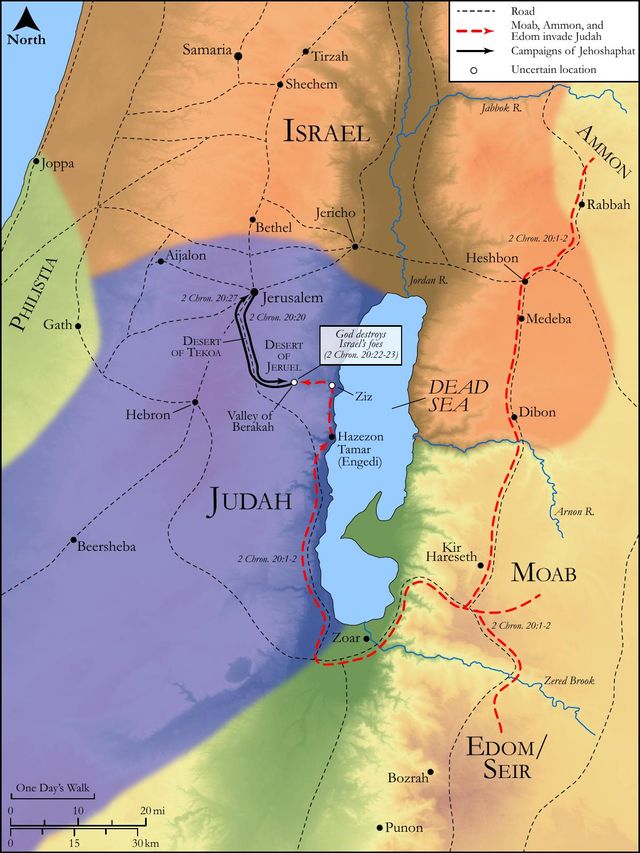
See on the biblical-era map
Study this verse
Public-domain commentary
Matthew Henry
From his Commentary on the Whole Bible. Henry comments on passages, not single verses — this entry covers 2 Chronicles 20:14–19.
We have here God's gracious answer to Jehoshaphat's prayer; and it was a speedy answer. While he was yet speaking God heard: before the congregation was dismissed they had assurance given them that they should be victorious; for it is never in vain to seek God. 1. The spirit of prophecy came upon a Levite that was present, not in any place of eminency, but in the midst of the congregation, Ch2 20:14. The Spirit, like the wind, blows where and on whom he listeth. He was of the sons of Asaph, and therefore one of the singers; on that office God would put an honour. Whether he was a prophet before this or no is uncertain, most probably he was, which would make him the more regarded. There needed no sign, the thing itself was to be performed the very next day, and that would be confirmation enough to his prophecy. 2. He encouraged them to trust in God, though the danger was very threatening (Ch2 20:15): "Be not afraid; you have admitted fear enough to bring you to God, do not now admit that which will drive you to God, do not now admit that which will drive you from him again. The battle is not yours; it is not in your own strength, not for your own cause, that you engage; the battle is God's: he does and will, as you have desired, interest himself in the cause." 3. He gives them intelligence of the motions of the enemy, and orders them to march towards them, with particular directions where they should find them. Tomorrow (the day after the fast) go you down against them, Ch2 20:16, Ch2 20:17. It is fit that he who commands the deliverance should command those for whom the deliverance is to be wrought, and give the necessary orders, both for time and place. 4. He assures them that they should be, not the glorious instruments, but the joyful spectators, of the total defeat of the enemy: "You shall not need to strike a stroke; the work shall be done to your hands; only stand still and see it," Ch2 20:17. As Moses said to Israel at the Red Sea (Exo 14:13), "God is with you, who is able to do his work himself, and will do it. If the battle be his, the victory shall be his too." Let but the Christian soldier go out against his spiritual enemies, and the God of peace will tread them under his feet and make him more than a conqueror. 5. Jehoshaphat and his people received these assurances with faith, reverence, and thankfulness. (1.) They bowed their heads, Jehoshaphat first, and then all the people, fell before the Lord, and worshipped, receiving with a holy awe and fear of God this token of his favour, and saying with faith, Be it unto us according to thy word. (2.) They lifted up their voices in praise to God, Ch2 20:19. An active faith can give thanks for a promise though it be not yet performed, knowing that God's bonds are as good as ready money. God hath spoken in his holiness; I will rejoice, Psa 60:5.
Continue studying 2 Chronicles 20:18 across the web’s major study libraries — every link below opens this exact verse, chapter, or book on the destination site.
Read & Compare
 BibleGatewayThis verse in more than 200 translations and 70 languages.
 Bible.comThe YouVersion reader — hundreds of translations, reading plans, and highlights.
 ESV.orgCrossway's official English Standard Version reader.
 NET BibleThe NET translation with 60,000+ translators' notes on every rendering decision.
 STEP BibleTyndale House's free study tool — original text, vocabulary, and scholarly resources.
 BibliaLogos Bible Software's free web reader.
 USCCBThe New American Bible (Revised Edition) with the U.S. bishops' study notes.
Commentaries
 BibleHub CommentariesDozens of classic commentaries on this verse, gathered on one page.
 StudyLightMore than 100 commentary sets — the largest collection on the web.
 BibleRefPlain-English commentary on what this verse means, verse by verse.
 Enduring WordDavid Guzik's free commentary on this chapter, widely used by Bible teachers.
 Bible Study ToolsVerse commentary alongside Greek and Hebrew study aids.
Original Language & Research
- BibleHub InterlinearThe verse word by word — original language, transliteration, and English.
- BibleHub LexiconEvery word's original-language definition and Strong's entry.
 Blue Letter BibleDeep-study tools — Strong's numbers, concordance, and word studies.
 SefariaThe Hebrew text with Rashi and centuries of Jewish commentary.
Sermons, Hymns & Audio


TrulyRandomVerse is not affiliated with these sites and doesn’t control their content. They’re linked because they’re genuinely useful.
Summary
Second Chronicles 20:18 powerfully depicts the immediate, profound, and unified response of King Jehoshaphat and the entire nation of Judah to a divine oracle of deliverance. Confronted by an overwhelming invading army, their initial fear and earnest petition for help transformed into an extraordinary act of humble worship and prostration before the Lord, demonstrating unwavering faith in God's promise of victory even before the battle was fought. This pivotal moment underscores the transformative power of believing God's word and responding with complete adoration and submission.
Context
ShowHideLiterary Context
This verse serves as the immediate and climactic response within the dramatic narrative of 2 Chronicles 20. The chapter opens with Judah facing an existential threat from a vast coalition of Ammonites, Moabites, and Meunim. Overwhelmed and without human recourse, King Jehoshaphat wisely proclaimed a national fast, gathered the people in the temple court, and offered a fervent prayer, acknowledging God's sovereignty and their utter dependence (see 2 Chronicles 20:5-12). In response, the Spirit of the Lord came upon Jahaziel, a Levite, who delivered a stunning prophecy: "Do not be afraid or dismayed at this great horde, for the battle is not yours but God's" (2 Chronicles 20:15). Verse 18 describes the immediate, spontaneous, and unified reaction of the king and the people to this divine assurance, preceding any military action and setting the stage for God's miraculous intervention.
Historical & Cultural Context
In the days of the kings, military invasions were constant and terrifying threats, often leading to national annihilation or subjugation. The typical responses to a superior force included desperate defense, seeking powerful alliances, or outright surrender. For Judah, a relatively small kingdom, facing such a formidable coalition would have been a national existential crisis. The act of prostration – "bowed his head with his face to the ground" and "fell before the LORD" – was a universally recognized gesture of ultimate humility, submission, and profound reverence in the presence of a king, a deity, or a divine messenger. It signified complete surrender of one's will and an acknowledgment of the superior authority and power of the one being honored. For a king like Jehoshaphat, who held immense power and authority, to publicly prostrate himself alongside his people underscored the absolute sovereignty of Yahweh over all earthly rulers and circumstances. This communal act of worship also served to unify the nation in their trust in God, reinforcing their collective identity as God's covenant people.
Key Themes
ShowHideThe passage powerfully articulates several key themes central to the book of Chronicles, particularly the Chronicler's emphasis on faithful kingship and the consequences of obedience. First, it highlights the theme of divine sovereignty and deliverance, emphasizing that God alone is the ultimate deliverer, capable of turning impossible situations into triumphs. This aligns with the Chronicler's consistent message that true strength comes from trusting God, as seen in 2 Chronicles 16:9. Second, it showcases the importance of humility and dependence on God, as Jehoshaphat and Judah acknowledge their helplessness and seek God's intervention rather than relying on their own strength or military might. Third, the immediate and unified worship demonstrates profound faith in God's promises, illustrating a trust that believes God's word even before its physical manifestation. This is a recurring motif, where faithfulness to God leads to blessing and victory, such as in 2 Chronicles 14:11. Finally, the scene underscores the significance of corporate worship and unity in the face of adversity, portraying a nation bound together by shared faith and a common posture of adoration before their God, echoing the importance of the temple and communal worship throughout the Chronicler's narrative.
Exposition and Analysis
ShowHideKey Word Analysis
ShowHideMeaning "Jehovah-judged." The name itself is significant, foreshadowing the divine judgment that will fall upon Judah's enemies, not upon Judah itself. It emphasizes that God is the ultimate judge and deliverer, reinforcing the theme that "the battle is not yours but God's."
Meaning "to shrivel up, i.e., contract or bend the body (or neck) in deference." This word describes the physical act of bowing the head, specifically indicating a deep, humble gesture of respect, submission, and reverence. It's a deliberate act of lowering oneself, signifying profound deference to a superior authority. In this context, it highlights Jehoshaphat's personal and immediate acknowledgment of God's supreme authority and the truth of His prophetic word.
Meaning "to fall." This term describes the collective action of "all Judah and the inhabitants of Jerusalem" falling to the ground. While qâdad implies a bending or contracting, nâphal suggests a more complete prostration, often implying a state of awe, terror, or complete submission. Here, it signifies a corporate act of utter surrender and homage to the Lord, a physical manifestation of their complete dependence and worship.
Meaning "to depress, i.e., prostrate (especially reflexive, in homage to royalty or God); bow (self) down, crouch, fall down (flat), humbly beseech, do (make) obeisance, do reverence, make to stoop, worship." This verb encapsulates the spiritual intent behind the physical acts of bowing and falling. It describes not just a physical posture but a profound spiritual attitude of adoration, reverence, and submission to God. It indicates that their prostration was not out of fear of the enemy, but out of worship for the Lord who had promised deliverance.
Verse Breakdown
ShowHide"And Jehoshaphat bowed his head with [his] face to the ground:"
This clause describes the king's personal, immediate, and profound act of humility and reverence. As the spiritual and political leader, his posture set the example for the entire nation. Bowing the head and placing the face to the ground was the ultimate expression of submission and adoration, signifying that he recognized God's absolute supremacy over his own royal authority and life. It was an act of personal surrender to God's will and word, demonstrating his faith in the prophecy just delivered.
"and all Judah and the inhabitants of Jerusalem fell before the LORD,"
This clause emphasizes the corporate and unified nature of the response. It was not just Jehoshaphat, but the entire assembled population—representing the whole nation, including the "inhabitants" (H3427, from yâshab, meaning 'to dwell') of "Jerusalem" (H3389, Yᵉrûwshâlaim)—who joined in this act of prostration. "Fell before the LORD" (H3068, Yᵉhôvâh) reiterates the physical act of falling to the ground in a posture of complete submission and awe, directly in the presence of God (H6440, pânîym, 'face' or 'presence'), signifying their collective acknowledgment of His power and their dependence.
"worshipping the LORD."
This final phrase defines the motivation and purpose behind their physical actions. Their bowing and falling were not mere gestures of despair or fear, but expressions of genuine worship (H7812, shâchâh). This worship was a direct, faith-filled response to the divine promise delivered by Jahaziel, demonstrating their belief in God's word even before the battle had begun. It was an act of thanksgiving and adoration for a victory already declared by God, acknowledging His sovereignty and faithfulness.
Literary Devices
ShowHideThe verse effectively employs Parallelism and Symbolism to convey its powerful message. The parallelism is evident in the mirroring actions: Jehoshaphat's personal act of prostration ("bowed his head with his face to the ground") is immediately followed by the collective prostration of "all Judah and the inhabitants of Jerusalem fell before the LORD." This highlights the unity and shared faith of the king and his people, emphasizing that the response was universal and consensual. The act itself is rich in Symbolism: bowing the head and falling with one's face to the ground symbolizes ultimate humility, complete surrender, and profound reverence. It is a visual representation of acknowledging one's utter dependence and God's absolute sovereignty. The immediate nature of this worship, occurring after the prophecy but before the battle, also creates a sense of Dramatic Irony for the reader, who knows the miraculous deliverance that is about to unfold, further emphasizing the depth of their faith and the certainty of God's word.
Theological and Thematic Connections
ShowHideThe profound worship described in 2 Chronicles 20:18 is a powerful theological statement about the nature of faith, God's sovereignty, and the proper human response to divine revelation. It teaches that true worship is not merely a plea for help in distress, but a posture of humble adoration and thanksgiving that flows from a confident trust in God's word, even when circumstances seem insurmountable. This immediate, corporate prostration before the Lord demonstrates a radical belief that God's promise is as good as its fulfillment. It underscores the truth that when God declares a victory, the appropriate response is not to strategize or fear, but to worship Him as the one who has already accomplished it. This act of faith-filled worship effectively shifts the burden from human capability to divine omnipotence, setting the stage for God to demonstrate His power and affirming His unchanging character as the faithful covenant-keeping God.
Reflection and Application
ShowHideThe scene in 2 Chronicles 20:18 offers a timeless model for believers facing overwhelming challenges. It calls us to move beyond mere petition to a place of profound, faith-filled worship when God speaks His word into our circumstances. In moments of great uncertainty or fear, our natural inclination might be to panic, strategize, or despair, relying on our own limited strength. However, this passage encourages us to shift our focus from the problem to the character and promises of God. When we receive a word from the Lord, whether through Scripture, prayer, or godly counsel, our immediate and humble response should be one of adoration and trust, even before we see the solution manifest. This act of worship is not a means to manipulate God, but a recognition of His sovereignty and a declaration of our complete dependence. It prepares our hearts to receive His deliverance and strengthens our resolve to stand firm in faith, knowing that the battle truly belongs to the Lord and that His promises are always trustworthy.
Questions for Reflection
ShowHideFAQ
ShowHideWhy did Jehoshaphat and Judah worship before the battle had even begun?
ShowHideTheir worship was a profound act of faith and immediate obedience to God's revealed word. The prophet Jahaziel had just delivered a clear and direct message from the Lord: "Do not be afraid or dismayed at this great horde, for the battle is not yours but God's" (2 Chronicles 20:15). This divine assurance transformed their fear into faith. Their prostration and worship were not a plea for help, but an expression of thanksgiving and trust for a victory that God had already declared. It demonstrated their belief that God's promise was as good as its fulfillment, showcasing a deep, active faith that honored God's sovereignty and faithfulness, and recognized His presence among them.
What is the significance of "bowing his head with his face to the ground" and "falling before the LORD"?
ShowHideThese physical postures are powerful expressions of ultimate humility, submission, and reverence. Prostration before a king or deity signified complete surrender, acknowledging the superior authority and power of the one being honored. For Jehoshaphat, a king himself, to assume such a posture publicly underscored his recognition of God's absolute sovereignty over all earthly rulers and circumstances. For the entire nation to join him demonstrated their collective acknowledgment of God's omnipotence and their utter dependence on Him. It was a tangible, visible act of worship that communicated total adoration and trust in the divine presence, signifying that they had placed their entire hope and future in God's hands. This physical act mirrored their spiritual surrender and profound respect for the Lord.
Christ-Centered Fulfillment
ShowHideThe deliverance of Judah in 2 Chronicles 20, powerfully punctuated by their faith-filled worship in verse 18, profoundly foreshadows the ultimate victory secured by Jesus Christ. Just as the "battle is the LORD's" for Judah against an overwhelming enemy, so too the decisive battle against sin, death, and the powers of darkness was fought and won by God through His Son. Humanity was utterly helpless against these spiritual forces, much like Judah against the vast coalition. Yet, Christ, the true King, did not merely bow His head but humbled Himself to the point of death on a cross, becoming the ultimate sacrifice for humanity's deliverance (see Philippians 2:8). His resurrection is the ultimate declaration of victory, the divine oracle that assures believers of their complete and eternal deliverance. Our worship today, like Judah's, is a response to a battle already won by our Lord. We, too, fall before the Lord, not in fear of an impending battle, but in humble adoration and grateful praise for the triumph Christ has already accomplished on our behalf (see Colossians 2:15). Our worship is a Christ-centered fulfillment of Judah's faith, recognizing that through Him, we are more than conquerors, and the battle for our eternal salvation has been decisively won (see Romans 8:37). He is the one before whom "every knee should bow" (Philippians 2:10), fulfilling the posture of worship seen in Judah's response.