


2 Chronicles 20:16
Bible text: King James Version (1769 Blayney text) · Public domain
Bible text: King James Version with Strong's numbers · Public domain
Bible text: Berean Standard Bible · Public domain
Bible text: American Standard Version (1901) · Public domain
Bible text: World English Bible, Messianic edition · Public domain
Bible text: Geneva Bible (1599) · Public domain
Bible text: Young's Literal Translation · Public domain
- מָחָרma·ChartomorrowH4279N-msNoun Singular Masculine Absolute
- רְדוּre·Dugo downH3381V-Qal-Imp-2mpVerb Qal Imperative 2nd Plural Masculine
- עֲלֵיהֶם'a·lei·Hemon themH5921Prep ¦ 3mpPrepositionעֲלֵיonהֶםthem
- הִנָּםhi·Namthere theyH2005Prt ¦ 3mpParticle Interjectionהִנָּthereםthey
- עֹלִים'o·Lim[will be] coming upH5927V-Qal-Prtcpl-mpVerb Qal Participle Plural Masculine Absolute
- בְּמַעֲלֵהbe·ma·'a·Lehon [the] ascent ofH4608Prep-b ¦ N-mscNoun Singular Masculine Constructבְּonמַעֲלֵה[the] ascent of
- הַצִּיץha·Tzitz<the> ZizH6732Art ¦ N-properNoun Proper Locationהַ<the>צִּיץZiz
- וּמְצָאתֶםu·me·tza·Temand you will findH4672Conj-w ¦ V-Qal-ConsecPerf-2mpVerb Qal Consecutive Perfect 2nd Plural Masculineוּandמְצָאתֶםyou will find
- אֹתָם'o·Tam<obj.> themH853DirObjM ¦ 3mpParticle Object Indicatorאֹתָ<obj.>םthem
- בְּסוֹףbe·Sofat [the] end ofH5490Prep-b ¦ N-mscNoun Singular Masculine Constructבְּatסוֹף[the] end of
- הַנַּחַלha·Na·chalthe wadiH5158Art ¦ N-msNoun Singular Masculine Absoluteהַtheנַּחַלwadi
- פְּנֵיpe·Nei[the] face ofH6440N-mpcNoun Plural Masculine Construct
- מִדְבַּרmid·Bar[the] wilderness ofH4057N-mscNoun Singular Masculine Construct
- יְרוּאֵלye·ru·'ElJeruelH3385N-properNoun Proper Location
English is a literal word-by-word gloss of the Hebrew, not the KJV's wording. Why?
This is the original text the KJV's translators worked from — each Hebrew word with its own literal English meaning in this verse, prepared by scholars at Tyndale House, Cambridge. The KJV translates whole sentences, not word by word, so its wording differs: one Hebrew word can become several English words, and the KJV may choose “the LORD” where the gloss reads “Yahweh”. Both are faithful — they answer different questions. For the KJV's own rendering, switch to the KJV text.
Details
See on the biblical-era map
Study this verse
Public-domain commentary
Matthew Henry
From his Commentary on the Whole Bible. Henry comments on passages, not single verses — this entry covers 2 Chronicles 20:14–19.
We have here God's gracious answer to Jehoshaphat's prayer; and it was a speedy answer. While he was yet speaking God heard: before the congregation was dismissed they had assurance given them that they should be victorious; for it is never in vain to seek God. 1. The spirit of prophecy came upon a Levite that was present, not in any place of eminency, but in the midst of the congregation, Ch2 20:14. The Spirit, like the wind, blows where and on whom he listeth. He was of the sons of Asaph, and therefore one of the singers; on that office God would put an honour. Whether he was a prophet before this or no is uncertain, most probably he was, which would make him the more regarded. There needed no sign, the thing itself was to be performed the very next day, and that would be confirmation enough to his prophecy. 2. He encouraged them to trust in God, though the danger was very threatening (Ch2 20:15): "Be not afraid; you have admitted fear enough to bring you to God, do not now admit that which will drive you to God, do not now admit that which will drive you from him again. The battle is not yours; it is not in your own strength, not for your own cause, that you engage; the battle is God's: he does and will, as you have desired, interest himself in the cause." 3. He gives them intelligence of the motions of the enemy, and orders them to march towards them, with particular directions where they should find them. Tomorrow (the day after the fast) go you down against them, Ch2 20:16, Ch2 20:17. It is fit that he who commands the deliverance should command those for whom the deliverance is to be wrought, and give the necessary orders, both for time and place. 4. He assures them that they should be, not the glorious instruments, but the joyful spectators, of the total defeat of the enemy: "You shall not need to strike a stroke; the work shall be done to your hands; only stand still and see it," Ch2 20:17. As Moses said to Israel at the Red Sea (Exo 14:13), "God is with you, who is able to do his work himself, and will do it. If the battle be his, the victory shall be his too." Let but the Christian soldier go out against his spiritual enemies, and the God of peace will tread them under his feet and make him more than a conqueror. 5. Jehoshaphat and his people received these assurances with faith, reverence, and thankfulness. (1.) They bowed their heads, Jehoshaphat first, and then all the people, fell before the Lord, and worshipped, receiving with a holy awe and fear of God this token of his favour, and saying with faith, Be it unto us according to thy word. (2.) They lifted up their voices in praise to God, Ch2 20:19. An active faith can give thanks for a promise though it be not yet performed, knowing that God's bonds are as good as ready money. God hath spoken in his holiness; I will rejoice, Psa 60:5.
Continue studying 2 Chronicles 20:16 across the web’s major study libraries — every link below opens this exact verse, chapter, or book on the destination site.
Read & Compare
 BibleGatewayThis verse in more than 200 translations and 70 languages.
 Bible.comThe YouVersion reader — hundreds of translations, reading plans, and highlights.
 ESV.orgCrossway's official English Standard Version reader.
 NET BibleThe NET translation with 60,000+ translators' notes on every rendering decision.
 STEP BibleTyndale House's free study tool — original text, vocabulary, and scholarly resources.
 BibliaLogos Bible Software's free web reader.
 USCCBThe New American Bible (Revised Edition) with the U.S. bishops' study notes.
Commentaries
 BibleHub CommentariesDozens of classic commentaries on this verse, gathered on one page.
 StudyLightMore than 100 commentary sets — the largest collection on the web.
 BibleRefPlain-English commentary on what this verse means, verse by verse.
 Enduring WordDavid Guzik's free commentary on this chapter, widely used by Bible teachers.
 Bible Study ToolsVerse commentary alongside Greek and Hebrew study aids.
Original Language & Research
- BibleHub InterlinearThe verse word by word — original language, transliteration, and English.
- BibleHub LexiconEvery word's original-language definition and Strong's entry.
 Blue Letter BibleDeep-study tools — Strong's numbers, concordance, and word studies.
 SefariaThe Hebrew text with Rashi and centuries of Jewish commentary.
Sermons, Hymns & Audio


TrulyRandomVerse is not affiliated with these sites and doesn’t control their content. They’re linked because they’re genuinely useful.
Summary
Second Chronicles 20:16 delivers God's precise and actionable instructions to King Jehoshaphat and the people of Judah, detailing the exact geographical location where they would encounter the vast invading armies. This verse is a pivotal moment in the narrative, following Jehoshaphat's fervent prayer and the divine assurance of victory, serving as a concrete command that demanded obedient faith and set the stage for God's miraculous intervention on behalf of His people.
Context
ShowHideLiterary Context
This verse serves as the immediate, practical follow-up to the prophetic word delivered by Jahaziel, a Levite, in 2 Chronicles 20:15. Having heard King Jehoshaphat's desperate and humble prayer for deliverance, acknowledging Judah's utter helplessness and God's supreme power (2 Chronicles 20:6-12), the Spirit of the Lord came upon Jahaziel, who proclaimed, "Do not be afraid or discouraged because of this vast army. For the battle is not yours, but God's." Verse 16 then transitions seamlessly from this overarching divine declaration to specific, actionable intelligence. It provides the crucial details necessary for Judah to position themselves to witness God's promised victory, thereby setting the stage for the miraculous, non-combative defeat of the enemy described in the subsequent verses of 2 Chronicles 20.
Historical & Cultural Context
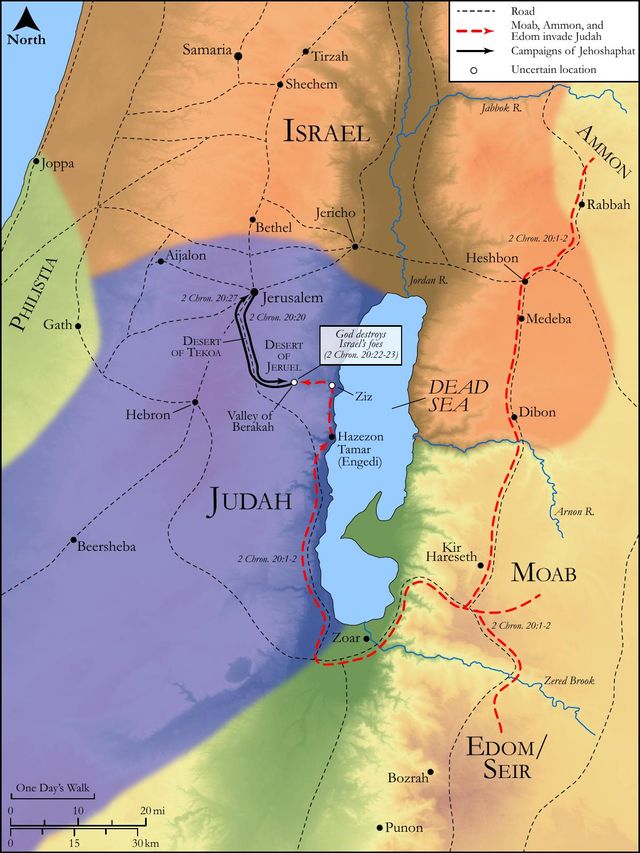
At this juncture, the kingdom of Judah, under King Jehoshaphat (c. 870-846 BC), faced an overwhelming threat from a formidable coalition of Moabites, Ammonites, and Meunim (or Edomites). These nations were traditional adversaries of Israel, frequently launching incursions from the eastern side of the Jordan Valley, often traversing the desolate Judean wilderness. The "cliff of Ziz" and the "wilderness of Jeruel" were not abstract locations but identifiable geographical features—likely a challenging ascent or pass and a specific desolate region, respectively—that constituted common invasion routes from the Dead Sea area towards Jerusalem. Culturally, in times of severe national crisis, it was a deeply ingrained practice for kings to seek divine counsel through prophets or priests, typically accompanied by public fasting and prayer, as Jehoshaphath diligently orchestrated. God's response through Jahaziel, including these remarkably precise geographical details, would have been unequivocally understood as a clear, undeniable sign of divine intervention and active, intimate participation in their defense.
Key Themes
ShowHideThis verse powerfully underscores several foundational themes prevalent throughout 2 Chronicles 20 and, indeed, the broader biblical narrative. Firstly, it highlights Divine Guidance and Specificity, demonstrating that God is not merely sovereign in a general sense but is intimately involved in the granular details of His people's lives, providing precise, actionable instructions when needed. Secondly, it emphasizes Obedience in Faith, as Judah was commanded to "go down against them" even though the battle had been explicitly declared to be God's. Their role was not to engage in combat, but simply to show up at a specific place, an act of profound trust in God's revealed word. This beautifully illustrates the dynamic and often paradoxical balance between divine sovereignty and human responsibility. Lastly, the verse powerfully showcases God's Omniscience and Sovereignty over Circumstances, as He knew the exact movements and impending location of the enemy, even before Judah moved, reinforcing the profound truth that no earthly force can thwart His divine plans, as vividly demonstrated in the ultimate triumph described in 2 Chronicles 20:22-24.
Exposition and Analysis
ShowHideKey Word Analysis
ShowHideThis primitive root signifies "to descend," implying movement from a higher elevation to a lower one. In this context, it directs Judah to move from the elevated Judean plateau (where Jerusalem and Tekoa were situated) down towards the Dead Sea region and the wilderness. This was a strategic command, instructing Judah to meet the enemy at a specific point in their ascent, potentially when they were already fatigued or vulnerable from traversing difficult terrain.
Derived from the root ʻâlâh (to ascend), this noun means "an elevation," "acclivity," or "ascent." When paired with "Ziz" (Tsîyts, H6732), it specifically refers to "the ascent of Ziz" or "cliff of Ziz." This denotes a particular, identifiable pass or steep path, which was a critical geographical choke point—a natural invasion route for armies approaching Judah from the east after crossing the Jordan Valley or traversing the wilderness. God's naming of this precise location demonstrates His intimate knowledge of the terrain and the enemy's movements, providing Judah with exact, actionable intelligence.
This term, often translated "wilderness" or "desert," refers to an uncultivated, sparsely populated, often arid or semi-arid region, primarily suitable for grazing rather than agriculture. When combined with "Jeruel" (Yᵉrûwʼêl, H3385), it refers to a specific desolate area within the Judean desert. The enemy would be found "before" or "facing" this wilderness, suggesting a point where they might be preparing to enter or emerge from the more challenging terrain, making them identifiable and potentially vulnerable.
Verse Breakdown
ShowHide"To morrow go ye down against them:"
This opening clause conveys the immediacy and directness of God's command. "To morrow" indicates a specific, impending action, leaving no room for delay or doubt. The instruction to "go down against them" is a call to active, obedient positioning, even though the subsequent narrative reveals they were not to engage in combat themselves, but simply to position themselves as witnesses to God's intervention.
"behold, they come up by the cliff of Ziz;"
This clause reveals God's perfect omniscience and foresight. He not only knows the enemy's current location but also their precise movement and intended route. The imperative "behold" (or "look!") draws immediate attention to this divine insight, confirming the accuracy of the intelligence and reinforcing the certainty of the impending encounter. The "cliff of Ziz" is identified as their specific and challenging ascent route.
"and ye shall find them at the end of the brook, before the wilderness of Jeruel."
This provides the exact rendezvous point, pinpointing the enemy's anticipated location with remarkable precision. The "brook" (likely a wadi or dry riverbed, nachal H5158) and the "wilderness of Jeruel" (midbâr Yᵉrûwʼêl) serve as further geographical markers. This detailed instruction ensures that Judah would not miss the enemy, allowing them to fulfill their part in God's plan by being present at the designated place, ready to witness His miraculous deliverance.
Literary Devices
ShowHideThe verse employs several powerful literary devices. Foremost is Divine Omniscience, as God reveals the enemy's exact location and trajectory, demonstrating His absolute knowledge and sovereign control over all circumstances. There is a strong element of Foreshadowing, as these precise instructions set the stage for the miraculous, bloodless victory that follows, building anticipation for how God will fulfill His promise to fight for Judah. The use of specific, real-world Geographical Precision ("cliff of Ziz," "brook," "wilderness of Jeruel") lends a compelling sense of realism and historical verifiability to the narrative, underscoring that God's intervention is not vague but grounded in the tangible world. Furthermore, there's a subtle Irony in the command to "go down against them" when Judah's actual role is to stand still and watch God fight, highlighting the paradoxical nature of faith and divine warfare.
Theological and Thematic Connections
ShowHideThis verse is a profound testament to God's active and meticulously detailed involvement in the affairs of His people. It teaches us that divine sovereignty does not negate human responsibility; rather, it often calls for an obedient response, even if that response is simply to "show up" in faith. God's specific instructions underscore His unwavering faithfulness to those who seek Him, demonstrating that He is not a distant, abstract deity but one who provides precise, actionable guidance in times of crisis. The narrative of Jehoshaphat's victory, initiated by this divine directive, serves as a powerful illustration that when God fights, victory is assured, regardless of the overwhelming odds. It cultivates a deep trust that God knows the path through our wildernesses and the exact location of our adversaries, guiding us to the very place where He will reveal His power and secure our deliverance.
Reflection and Application
ShowHideFor believers today, 2 Chronicles 20:16 offers profound and enduring lessons on navigating life's most overwhelming challenges. When confronted with seemingly insurmountable obstacles, our first and most crucial response, mirroring Jehoshaphat's, should be fervent prayer and a humble acknowledgment of our helplessness coupled with an unwavering recognition of God's omnipotence. This verse then powerfully reminds us that God often provides specific, actionable guidance, even if those instructions seem counterintuitive, demand radical faith, or appear to place us directly in the path of our adversaries. Our role is not always to "fight" in our own strength or devise our own strategies, but rather to obey His precise directions, to "go down" to the appointed place, and to stand firm, trusting implicitly that the battle truly belongs to Him. We can find immense comfort and peace in God's meticulous knowledge of our circumstances, knowing that He sees every "cliff of Ziz" and every "wilderness of Jeruel" in our lives, and He has a precise, perfect plan for our deliverance and His ultimate glory.
Questions for Reflection
ShowHideFAQ
ShowHideWhy did God give such specific geographical instructions instead of just promising victory?
ShowHideGod's specific geographical instructions served multiple crucial purposes. Firstly, they profoundly demonstrated His absolute omniscience and sovereignty, proving beyond doubt that He knew the enemy's exact location, movements, and vulnerabilities. This precise, verifiable knowledge would have immeasurably built the faith of Jehoshaphat and all Judah, confirming that the message was truly from God and not a mere human guess or strategic estimation. Secondly, it provided clear, actionable steps for Judah's obedience, removing any ambiguity about where they needed to go. This act of obedient positioning was essential for them to witness God's unique, miraculous deliverance, which would redound to His glory and serve as a powerful testimony to surrounding nations. It also strategically placed Judah to observe the enemy's self-destruction, rather than engaging in direct combat, reinforcing the truth that the battle is the Lord's.
What is the significance of the "cliff of Ziz" and "wilderness of Jeruel" in this narrative?
ShowHideThe "cliff of Ziz" and the "wilderness of Jeruel" are not merely arbitrary names but identifiable geographical features in the Judean wilderness, east of Jerusalem. The "cliff of Ziz" (Ma'aleh ha-Tzitz) was likely a steep ascent or pass, a common and strategic route for invaders coming from the Dead Sea region towards the heart of Judah. The "wilderness of Jeruel" (Midbar Yeruel) was a desolate, uncultivated area within this desert landscape. God's mention of these specific locations underscored His detailed control over the situation. It meant that the invaders, having traversed difficult terrain, would be found at a precise point, perhaps exhausted or disoriented, making them vulnerable to God's divine ambush. This geographical precision highlights the reality of God's intervention in the physical world and His meticulous planning for His people's deliverance, ensuring Judah was positioned to witness His power, as seen in 2 Chronicles 20:22-24.
Christ-Centered Fulfillment
ShowHideThe divine command in 2 Chronicles 20:16, where God gives precise instructions for His people to position themselves to witness His victory, finds its ultimate fulfillment in the person and redemptive work of Jesus Christ. Just as God directed Judah to a specific place to see His power, so too does God, in Christ, direct humanity to the ultimate battlefield where He secured victory: the cross. There, the true "battle" against sin, death, and the powers of darkness was fought, not by human might or strategic positioning, but by the perfect obedience and sacrificial death of the Lamb of God who takes away the sin of the world. Believers are called not to fight for their salvation, but to "go down" in faith and repentance, to stand in Christ's finished work, and to witness His triumph. The Lord Jesus, our ultimate General and Victor, has already triumphed over all principalities and powers, disarming them and making a public spectacle of them on the cross (Colossians 2:15). Our role, like Judah's, is to stand firm in the victory already won, putting on the full armor of God not to earn salvation, but to stand against the schemes of the devil, knowing that the spiritual battle is the Lord's (Ephesians 6:10-18). Christ's specific instructions to His disciples, such as the Great Commission to "go and make disciples of all nations" (Matthew 28:19-20), mirror God's precise guidance to Jehoshaphat, calling us to obedient action based on His sovereign authority and assured victory.