


2 Chronicles 20:15
Bible text: King James Version (1769 Blayney text) · Public domain
Bible text: King James Version with Strong's numbers · Public domain
Bible text: Berean Standard Bible · Public domain
Bible text: American Standard Version (1901) · Public domain
Bible text: World English Bible, Messianic edition · Public domain
Bible text: Geneva Bible (1599) · Public domain
Bible text: Young's Literal Translation · Public domain
- וַיֹּאמֶרvai·Yo·merand he saidH559Conj-w ¦ V-Qal-ConsecImperf-3msVerb Qal Consecutive Imperfect 3rd Singular Masculineוַandיֹּאמֶרhe said
- הַקְשִׁיבוּhak·Shi·vupay attentionH7181V-Hiphil-Imp-2mpVerb Hiphil Imperative 2nd Plural Masculine
- כָלkholO allH3605N-mscNoun Singular Masculine Construct
- יְהוּדָהye·hu·DahJudahH3063N-properNoun Proper Location
- וְיֹשְׁבֵיve·yo·she·Veiand [the] inhabitants ofH3427Conj-w ¦ V-Qal-Prtcpl-mpVerb Qal Participle Plural Masculine Constructוְandיֹשְׁבֵי[the] inhabitants of
- יְרוּשָׁלִַםye·ru·sha·LimJerusalemH3389N-properNoun Proper Location
- וְהַמֶּלֶךְve·ha·Me·lekhand the kingH4428Conj-w ¦ Art ¦ N-msNoun Singular Masculine Absoluteוְandהַtheמֶּלֶךְking
- יְהוֹשָׁפָטye·ho·sha·FatJehoshaphatH3092N-proper-mNoun Proper Masculine
- כֹּהkohthusH3541AdvAdverb
- אָמַר'a·Marhe saysH559V-Qal-Perf-3msVerb Qal Perfect 3rd Singular Masculine
- יְהוָהYah·wehYahwehH3068N-properNoun Proper Title
- לָכֶםla·Khemto youPrep-l ¦ 2mpSuffix Personal 2nd Plural Masculineלָtoכֶםyou
- אַתֶּם'A·temO youH859Pro-2mpPronoun Personal 2nd Plural Masculine
- אַל'almay notH408NegParticle Negative
- תִּירְאוּti·re·'Uyou be afraidH3372V-Qal-Imperf-2mpVerb Qal Imperfect 2nd Plural Masculine
- וְאַלve·'aland may notH408Conj-w ¦ NegParticle Negativeוְandאַלmay not
- תֵּחַתּוּte·Cha·tuyou be dismayedH2865V-Niphal-Imperf-2mpVerb Niphal Imperfect 2nd Plural Masculine
- מִפְּנֵיmi·pe·Nei<from> because ofH6440Prep-m ¦ N-mpcNoun Plural Masculine Constructמִ<from>פְּנֵיbecause of
- הֶהָמוֹןhe·ha·Monthe multitudeH1995Art ¦ N-msNoun Singular Masculine Absoluteהֶtheהָמוֹןmultitude
- הָרָבha·Rav<the> greatH7227Art ¦ Adj-msAdjective Singular Masculine Absoluteהָ<the>רָבgreat
- הַזֶּהha·Zeh<the> thisH2088Art ¦ PrtParticle Demonstrativeהַ<the>זֶּהthis
- כִּיkiforH3588PrtParticle Conditional
- לֹאlo'notH3808NegParticle Negative
- לָכֶםla·Khem[belongs] to youPrep-l ¦ 2mpSuffix Personal 2nd Plural Masculineלָ[belongs] toכֶםyou
- הַמִּלְחָמָהha·mil·cha·Mahthe battleH4421Art ¦ N-fsNoun Singular Feminine Absoluteהַtheמִּלְחָמָהbattle
- כִּיkiforH3588PrtParticle Conditional
- לֵאלֹהִיםle·lo·Himto GodH430Prep-l ¦ N-mpNoun Plural Masculine AbsoluteלֵtoאלֹהִיםGod
English is a literal word-by-word gloss of the Hebrew, not the KJV's wording. Why?
This is the original text the KJV's translators worked from — each Hebrew word with its own literal English meaning in this verse, prepared by scholars at Tyndale House, Cambridge. The KJV translates whole sentences, not word by word, so its wording differs: one Hebrew word can become several English words, and the KJV may choose “the LORD” where the gloss reads “Yahweh”. Both are faithful — they answer different questions. For the KJV's own rendering, switch to the KJV text.
Details
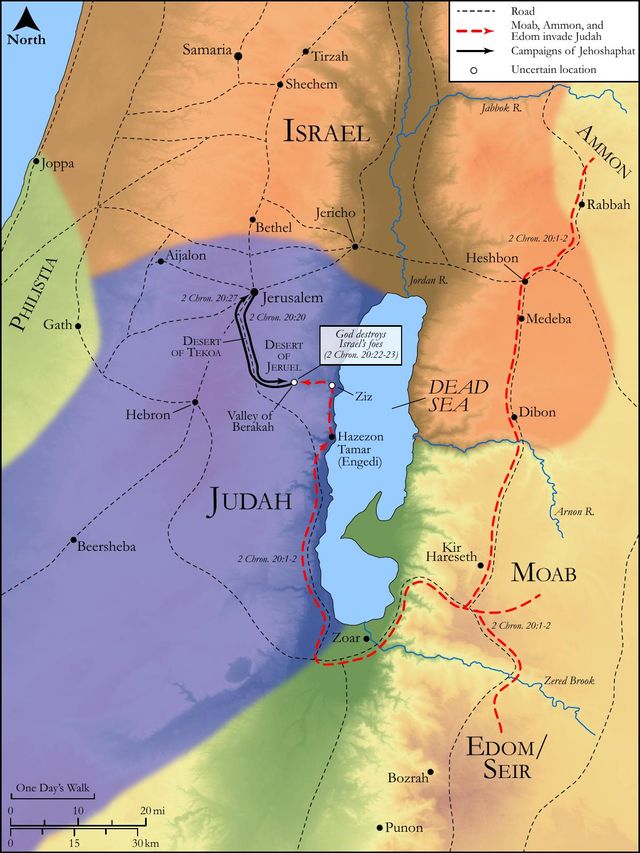
See on the biblical-era map
Study this verse
Public-domain commentary
Matthew Henry
From his Commentary on the Whole Bible. Henry comments on passages, not single verses — this entry covers 2 Chronicles 20:14–19.
We have here God's gracious answer to Jehoshaphat's prayer; and it was a speedy answer. While he was yet speaking God heard: before the congregation was dismissed they had assurance given them that they should be victorious; for it is never in vain to seek God. 1. The spirit of prophecy came upon a Levite that was present, not in any place of eminency, but in the midst of the congregation, Ch2 20:14. The Spirit, like the wind, blows where and on whom he listeth. He was of the sons of Asaph, and therefore one of the singers; on that office God would put an honour. Whether he was a prophet before this or no is uncertain, most probably he was, which would make him the more regarded. There needed no sign, the thing itself was to be performed the very next day, and that would be confirmation enough to his prophecy. 2. He encouraged them to trust in God, though the danger was very threatening (Ch2 20:15): "Be not afraid; you have admitted fear enough to bring you to God, do not now admit that which will drive you to God, do not now admit that which will drive you from him again. The battle is not yours; it is not in your own strength, not for your own cause, that you engage; the battle is God's: he does and will, as you have desired, interest himself in the cause." 3. He gives them intelligence of the motions of the enemy, and orders them to march towards them, with particular directions where they should find them. Tomorrow (the day after the fast) go you down against them, Ch2 20:16, Ch2 20:17. It is fit that he who commands the deliverance should command those for whom the deliverance is to be wrought, and give the necessary orders, both for time and place. 4. He assures them that they should be, not the glorious instruments, but the joyful spectators, of the total defeat of the enemy: "You shall not need to strike a stroke; the work shall be done to your hands; only stand still and see it," Ch2 20:17. As Moses said to Israel at the Red Sea (Exo 14:13), "God is with you, who is able to do his work himself, and will do it. If the battle be his, the victory shall be his too." Let but the Christian soldier go out against his spiritual enemies, and the God of peace will tread them under his feet and make him more than a conqueror. 5. Jehoshaphat and his people received these assurances with faith, reverence, and thankfulness. (1.) They bowed their heads, Jehoshaphat first, and then all the people, fell before the Lord, and worshipped, receiving with a holy awe and fear of God this token of his favour, and saying with faith, Be it unto us according to thy word. (2.) They lifted up their voices in praise to God, Ch2 20:19. An active faith can give thanks for a promise though it be not yet performed, knowing that God's bonds are as good as ready money. God hath spoken in his holiness; I will rejoice, Psa 60:5.
Continue studying 2 Chronicles 20:15 across the web’s major study libraries — every link below opens this exact verse, chapter, or book on the destination site.
Read & Compare
 BibleGatewayThis verse in more than 200 translations and 70 languages.
 Bible.comThe YouVersion reader — hundreds of translations, reading plans, and highlights.
 ESV.orgCrossway's official English Standard Version reader.
 NET BibleThe NET translation with 60,000+ translators' notes on every rendering decision.
 STEP BibleTyndale House's free study tool — original text, vocabulary, and scholarly resources.
 BibliaLogos Bible Software's free web reader.
 USCCBThe New American Bible (Revised Edition) with the U.S. bishops' study notes.
Commentaries
 BibleHub CommentariesDozens of classic commentaries on this verse, gathered on one page.
 StudyLightMore than 100 commentary sets — the largest collection on the web.
 BibleRefPlain-English commentary on what this verse means, verse by verse.
 Enduring WordDavid Guzik's free commentary on this chapter, widely used by Bible teachers.
 Bible Study ToolsVerse commentary alongside Greek and Hebrew study aids.
Original Language & Research
- BibleHub InterlinearThe verse word by word — original language, transliteration, and English.
- BibleHub LexiconEvery word's original-language definition and Strong's entry.
 Blue Letter BibleDeep-study tools — Strong's numbers, concordance, and word studies.
 SefariaThe Hebrew text with Rashi and centuries of Jewish commentary.
Sermons, Hymns & Audio


TrulyRandomVerse is not affiliated with these sites and doesn’t control their content. They’re linked because they’re genuinely useful.
Summary
Second Chronicles 20:15 delivers a profound divine declaration through the prophet Jahaziel to King Jehoshaphat and the people of Judah, who faced an overwhelming invasion from a vast confederacy of enemy armies. In a moment of national despair and earnest prayer, this verse powerfully assures them that the impending conflict is not theirs to fight but belongs entirely to God. It urges them to cast aside paralyzing fear and disheartening dismay, compelling them instead to place their unwavering trust in His sovereign power and promised intervention. This pivotal message encapsulates a timeless truth of divine assurance in the face of insurmountable odds, shifting the focus from human inadequacy and strategic limitations to God's omnipotent capability and unwavering faithfulness.
Context
ShowHideLiterary Context
This verse stands as the climactic divine response to a desperate national crisis. Upon receiving news of the massive invading army, King Jehoshaphat, demonstrating exemplary leadership rooted in faith, immediately proclaimed a fast throughout all Judah. He then gathered the people in the temple for a heartfelt and humble prayer, acknowledging God's absolute sovereignty and Judah's utter helplessness (2 Chronicles 20:5-12). Following this fervent supplication, the Spirit of the LORD came upon Jahaziel, a Levite, who then delivered this precise prophetic word (2 Chronicles 20:14). The narrative immediately following this declaration vividly portrays the people's worshipful response (2 Chronicles 20:18-19) and their subsequent miraculous victory, where the enemy armies turned on each other without Judah needing to strike a single blow (2 Chronicles 20:20-23). This spectacular divine intervention serves as a powerful, tangible demonstration and confirmation of the truth declared in 2 Chronicles 20:15.
Historical & Cultural Context
King Jehoshaphat reigned over the Southern Kingdom of Judah from approximately 870 to 845 BC. While generally considered a righteous king who sought to reform Judah, he was not without his strategic missteps, notably his alliance with the ungodly King Ahab of Israel. The invasion described in 2 Chronicles 20 involved a formidable coalition of Moabites, Ammonites, and Meunites (people from Mount Seir), who were long-standing, traditional enemies of Israel and Judah. Such a "great multitude" would have constituted an existential threat to the relatively small and vulnerable kingdom of Judah, naturally evoking widespread terror and despair among its populace. In the wars of that day, the sheer size and numerical superiority of an invading army often predetermined the outcome, making divine intervention the only viable and credible hope for a smaller nation facing such overwhelming odds. The role of prophets like Jahaziel was absolutely crucial in conveying God's direct will and providing divine assurance to the king and the people, particularly during moments of profound national crisis, thereby serving as God's authoritative mouthpiece.
Key Themes
ShowHideThe central and most radiating theme from this verse is Divine Sovereignty and Omnipotence. The unequivocal declaration, "the battle is not yours, but God's," asserts that ultimate control, responsibility for the conflict's outcome, and the power to deliver victory rest solely with the Almighty Yahweh. This profound truth directly confronts the human tendency towards Fear and Dismay, which naturally arise when facing seemingly insurmountable challenges. Consequently, it issues a divine call for radical Trust and Faith in God's unparalleled ability to deliver, even when circumstances appear utterly hopeless from a human perspective. The narrative powerfully underscores the biblical principle that God Fights for His People, demonstrating His unwavering faithfulness and covenant commitment to those who humble themselves and rely exclusively on Him. This account also highlights the transformative power of Prayer and Humility as the primary and most effective response to overwhelming challenges, echoing the profound sentiment found throughout the Psalms, such as Psalm 46:1 "God is our refuge and strength, a very present help in trouble.".
Exposition and Analysis
ShowHideKey Word Analysis
ShowHideThis word, derived from H3372, carries the primary sense of being terrified, dreading, or experiencing profound fear. In this specific context, it refers to the paralyzing terror that would naturally grip a people facing an overwhelmingly superior military force. The divine command "Be not afraid" is not a dismissal of the very real and immediate threat, but rather a direct divine injunction to resist the emotional and psychological surrender to fear, choosing instead to place unwavering trust in a greater, more powerful, and sovereign God.
Originating from H2865, this term signifies being broken down, shattered, or utterly disheartened and discouraged. It describes a profound state of despair where one's spirit is crushed, and all hope for a positive outcome seems irretrievably lost. The parallel command "nor dismayed" complements "afraid" by specifically addressing the internal collapse of courage, morale, and resolve. Together, these two prohibitions form a comprehensive divine injunction against both external terror and internal despondency, calling for a steadfast heart.
This word refers to a physical engagement, conflict, or general warfare. The profound declaration "for the battle [is] not yours, but God's" is a pivotal theological statement. It signifies that the ownership, the responsibility for its execution, the means of engagement, and ultimately the victory in this specific conflict are entirely appropriated by God Himself. This statement fundamentally removes the immense burden of human capability, strategic planning, and military might, placing it squarely and exclusively on divine power, thereby radically altering the nature of the impending engagement for Judah.
Verse Breakdown
ShowHide"And he said, Hearken ye, all Judah, and ye inhabitants of Jerusalem, and thou king Jehoshaphat"
This opening clause meticulously establishes the specific, comprehensive, and authoritative audience for the divine message. It is addressed to the entire nation, encompassing both the general populace of Judah, the specific residents of the capital city Jerusalem (who would bear the brunt of an invasion), and crucially, their leader, King Jehoshaphat. This broad and inclusive address underscores the universal relevance, binding authority, and direct applicability of the message for every individual involved in the unfolding national crisis.
"Thus saith the LORD unto you"
This is a classic and potent prophetic formula, unequivocally asserting that the words that immediately follow are not Jahaziel's personal opinion or counsel, but rather a direct, authoritative, and infallible utterance from Yahweh, the covenant God of Israel. It lends immense weight, divine infallibility, and absolute truthfulness to the subsequent command and promise, demanding immediate, reverent, and obedient attention from all who hear it.
"Be not afraid nor dismayed by reason of this great multitude"
This segment constitutes a direct divine command, explicitly addressing the natural, overwhelming human response to the seemingly insurmountable odds. The "great multitude" refers specifically to the vast, seemingly invincible coalition of enemy armies that threatened Judah's existence. God explicitly forbids both paralyzing fear and spirit-crushing despair, indicating that such reactions are not only natural but also contrary to the profound faith and trust He expects from His people in times of crisis.
"for the battle [is] not yours, but God's"
This is the core theological declaration of the verse and the foundational reason for the preceding command. It represents a radical and transformative reorientation of perspective. It asserts, with absolute clarity, that the ownership, responsibility for its outcome, and ultimate execution of the conflict belong entirely and exclusively to God. This profound phrase removes the burden of human effort, strategic capacity, and military might, promising a divine intervention and a victory that transcends all human ability and expectation.
Literary Devices
ShowHideThe verse employs several potent literary devices to convey its powerful message. Direct Address is prominently featured, as God's message is specifically and personally directed to "all Judah," "inhabitants of Jerusalem," and "king Jehoshaphat," creating an immediate and intimate connection with the entire audience. As a Divine Oracle or Prophecy, the authoritative phrase "Thus saith the LORD" establishes the absolute truthfulness, infallibility, and divine authority of the message, elevating it far beyond mere human counsel or strategic advice. The most impactful device is Contrast, particularly evident in the sharp declaration "the battle is not yours, but God's." This stark juxtaposition highlights the fundamental and radical shift in agency from human responsibility and capability to divine intervention and sovereignty, emphasizing God's complete and ultimate control. The description of the enemy as a "great multitude" effectively uses Hyperbole to underscore the overwhelming and seemingly insurmountable nature of the threat, thereby magnifying the miraculous power and glory of God's promised intervention. Furthermore, the "battle" itself can be seen as a Metaphor for any insurmountable challenge or spiritual conflict, extending the verse's profound application beyond literal warfare to encompass life's myriad spiritual, personal, and societal struggles.
Theological and Thematic Connections
ShowHideThe profound message of 2 Chronicles 20:15 resonates deeply throughout the entire biblical narrative, consistently affirming God's unchanging character as a divine warrior and faithful deliverer of His people. It powerfully underscores the theological truth that God frequently orchestrates circumstances and allows His people to face seemingly impossible odds precisely to demonstrate His unparalleled power, unwavering faithfulness, and ultimate glory. This principle serves as a direct challenge to human self-sufficiency and strategic reliance, compelling His people to lean not on their own limited strength, but solely on His infinite might. It teaches that true security, lasting peace, and decisive victory are found not in human military might, strategic brilliance, or numerical superiority, but in humble, radical dependence on the God who actively fights for His own. This foundational truth is a cornerstone of biblical faith, echoing through countless narratives of God's miraculous deliverance and His people's subsequent worship.
Reflection and Application
ShowHideFor believers today, 2 Chronicles 20:15 offers immense encouragement, profound spiritual insight, and a vital paradigm for navigating the myriad "battles" of life. These battles can manifest as deeply personal struggles with sin, intense spiritual warfare against unseen forces, challenging relational conflicts, daunting financial crises, or overwhelming societal injustices. The verse unequivocally calls us to adopt Jehoshaphat's posture of immediate, earnest, and humble prayer, acknowledging our own inherent limitations and God's boundless, omnipotent power. It directly challenges the natural human inclination to panic, despair, or attempt to control every outcome in the face of overwhelming odds. Instead, it urges us to surrender control and allow God to actively fight on our behalf. This divine directive does not imply passivity or inaction; rather, it calls for a profound and transformative shift in our reliance. We are called to obey God's leading, step out in faith, and take responsible action, all the while knowing with absolute certainty that the ultimate victory belongs entirely to Him. Embracing this liberating truth frees us from debilitating anxiety and empowers us to face life's most daunting challenges with courage, confident that our God is supremely able to deliver us, transforming moments of fear into glorious opportunities for His power and glory to be magnificently revealed.
Questions for Reflection
ShowHideFAQ
ShowHideWhat was the immediate outcome of Jehoshaphat's obedience to this prophecy?
ShowHideThe immediate outcome of Jehoshaphat's and Judah's obedience to Jahaziel's prophecy was a miraculous and utterly decisive victory, achieved without them needing to engage in physical combat. After hearing the prophet's words, Jehoshaphat and all Judah responded with profound humility and worship, bowing down and prostrating themselves before the LORD (2 Chronicles 20:18). The very next morning, they rose early and went out to face the enemy. Before engaging, Jehoshaphat, in an extraordinary act of faith, appointed singers to praise the LORD as they marched, placing worship at the forefront of their strategic approach (2 Chronicles 20:21). As they began to sing and praise, the LORD supernaturally set ambushes against the Ammonites, Moabites, and those from Mount Seir who had come against Judah, causing them to turn on each other and completely destroy themselves (2 Chronicles 20:22-23). By the time Judah arrived at the battlefield, they found only dead bodies, and spent three days gathering immense spoil, so vast that they could not carry it all (2 Chronicles 20:24-25). This spectacular and bloodless victory perfectly demonstrated the truth that "the battle [was] not yours, but God's."
Does "the battle is not yours, but God's" mean believers should do nothing in the face of challenges?
ShowHideNo, this verse absolutely does not advocate for passivity, resignation, or inaction on the part of believers. Rather, it profoundly emphasizes that the ultimate source of victory and the power to overcome belong exclusively to God, not to human strength, ingenuity, or strategic prowess. While God indeed fights the battle, He very often calls His people to participate in ways that demonstrate their faith, obedience, and active reliance upon Him. In Jehoshaphat's case, they still had to gather, earnestly pray, listen intently to the prophet's divine word, and then courageously march out to the battlefield. Their action was one of faith-filled obedience and trust, not self-reliance or aggressive engagement. Similarly, believers today are called to pray fervently, seek God's wisdom diligently, take responsible and Spirit-led action, and walk in humble obedience, but always with the foundational understanding that true deliverance, lasting success, and ultimate triumph come from God's omnipotent power working through them, not from their own inherent capabilities or efforts. It is fundamentally about radical reliance upon God, not passive resignation to circumstances, and active trust in His power, not complacent waiting.
Christ-Centered Fulfillment
ShowHideThe profound declaration "the battle is not yours, but God's" finds its ultimate, most comprehensive, and eternally significant fulfillment in the person and redemptive work of Jesus Christ. Humanity faced an overwhelming and utterly unconquerable "multitude" of spiritual enemies: the dominion of sin, the sting of death, and the destructive power of Satan. This was a battle that was utterly beyond our finite capacity to win, a spiritual war in which we were hopelessly outmatched. Yet, in Jesus Christ, the "battle" for our eternal salvation was not merely assisted but decisively fought and eternally won by God Himself. Jesus, the Lamb of God who takes away the sin of the world, courageously entered the fray, not as a general leading an earthly army, but as the suffering servant who bore the full, crushing weight of our spiritual adversaries. His sacrificial death on the cross was the decisive, definitive victory over sin's tyrannical dominion, and His glorious resurrection was the triumphant conquest over death and the grave, effectively disarming the powers and authorities that held humanity captive. Therefore, we are called to "be not afraid nor dismayed" in the face of our ongoing spiritual struggles, knowing with absolute certainty that Christ has already secured the ultimate and eternal victory (John 16:33). Our participation in this "battle" is now one of faith, resting in His finished work, and living out the victory He has already achieved for us, knowing that in all these things we are more than conquerors through Him who loved us. He is our peace, our strength, and our ultimate deliverer, the one who truly fights for us and secures our eternal triumph.