


2 Chronicles 20:14
Bible text: King James Version (1769 Blayney text) · Public domain
Bible text: King James Version with Strong's numbers · Public domain
Bible text: Berean Standard Bible · Public domain
Bible text: American Standard Version (1901) · Public domain
Bible text: World English Bible, Messianic edition · Public domain
Bible text: Geneva Bible (1599) · Public domain
Bible text: Young's Literal Translation · Public domain
- וְיַחֲזִיאֵלve·ya·cha·zi·'Eland JahazielH3166Conj-w ¦ N-proper-mNoun Proper MasculineוְandיַחֲזִיאֵלJahaziel
- בֶּןben[the] son ofH1121N-mscNoun Singular Masculine Construct
- זְכַרְיָהוּze·khar·Ya·huZechariahH2148N-proper-mNoun Proper Masculine
- בֶּןben[the] son ofH1121N-mscNoun Singular Masculine Construct
- בְּנָיָהBe·na·yahBenaiahH1141N-proper-mNoun Proper Masculine
- בֶּןben[the] son ofH1121N-mscNoun Singular Masculine Construct
- יְעִיאֵלye·'i·'ElJeielH3273N-proper-mNoun Proper Masculine
- בֶּןben[the] son ofH1121N-mscNoun Singular Masculine Construct
- מַתַּנְיָהma·tan·YahMattaniahH4983N-proper-mNoun Proper Masculine
- הַלֵּוִיha·le·Vithe LeviteH3881Art ¦ N-msNoun Gentilic Singular Masculine AbsoluteהַtheלֵּוִיLevite
- מִןminone ofH4480PrepPreposition
- בְּנֵיbe·Nei[the] descendants ofH1121N-mpcNoun Plural Masculine Construct
- אָסָף'a·SafAsaphH623N-proper-mNoun Proper Masculine
- הָיְתָהha·ye·Tahit wasH1961V-Qal-Perf-3fsVerb Qal Perfect 3rd Singular Feminine
- עָלָיו'a·Lavon himH5921Prep ¦ 3msPrepositionעָלָיonוhim
- רוּחַRu·ach[the] spirit ofH7307N-fscNoun Singular Feminine Construct
- יְהוָהYah·wehYahwehH3068N-properNoun Proper Title
- בְּתוֹךְbe·Tokhin [the] midst ofH8432Prep-b ¦ N-mscNoun Singular Masculine Constructבְּinתוֹךְ[the] midst of
- הַקָּהָלha·ka·Halthe assemblyH6951Art ¦ N-msNoun Singular Masculine Absoluteהַtheקָּהָלassembly
English is a literal word-by-word gloss of the Hebrew, not the KJV's wording. Why?
This is the original text the KJV's translators worked from — each Hebrew word with its own literal English meaning in this verse, prepared by scholars at Tyndale House, Cambridge. The KJV translates whole sentences, not word by word, so its wording differs: one Hebrew word can become several English words, and the KJV may choose “the LORD” where the gloss reads “Yahweh”. Both are faithful — they answer different questions. For the KJV's own rendering, switch to the KJV text.
Details
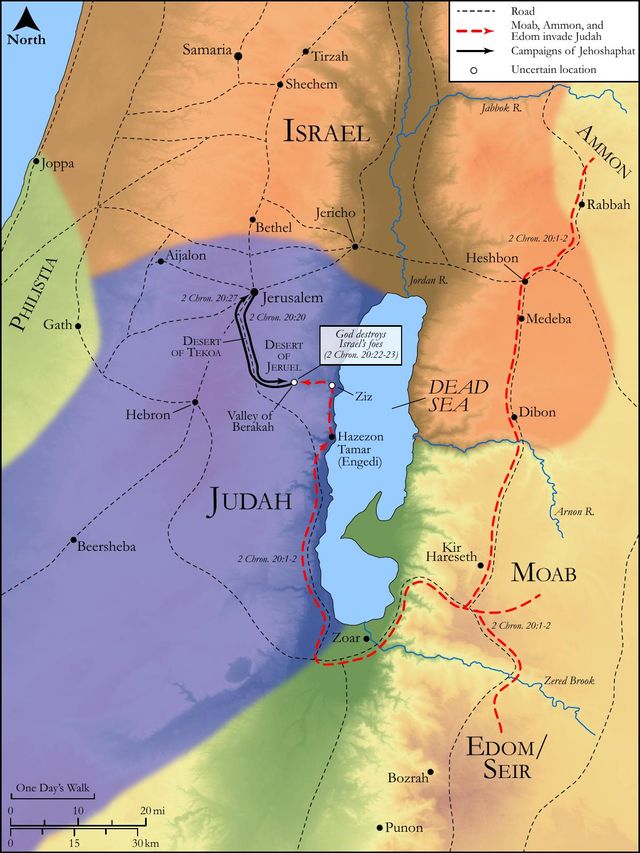
See on the biblical-era map
Study this verse
Public-domain commentary
Matthew Henry
From his Commentary on the Whole Bible. Henry comments on passages, not single verses — this entry covers 2 Chronicles 20:14–19.
We have here God's gracious answer to Jehoshaphat's prayer; and it was a speedy answer. While he was yet speaking God heard: before the congregation was dismissed they had assurance given them that they should be victorious; for it is never in vain to seek God. 1. The spirit of prophecy came upon a Levite that was present, not in any place of eminency, but in the midst of the congregation, Ch2 20:14. The Spirit, like the wind, blows where and on whom he listeth. He was of the sons of Asaph, and therefore one of the singers; on that office God would put an honour. Whether he was a prophet before this or no is uncertain, most probably he was, which would make him the more regarded. There needed no sign, the thing itself was to be performed the very next day, and that would be confirmation enough to his prophecy. 2. He encouraged them to trust in God, though the danger was very threatening (Ch2 20:15): "Be not afraid; you have admitted fear enough to bring you to God, do not now admit that which will drive you to God, do not now admit that which will drive you from him again. The battle is not yours; it is not in your own strength, not for your own cause, that you engage; the battle is God's: he does and will, as you have desired, interest himself in the cause." 3. He gives them intelligence of the motions of the enemy, and orders them to march towards them, with particular directions where they should find them. Tomorrow (the day after the fast) go you down against them, Ch2 20:16, Ch2 20:17. It is fit that he who commands the deliverance should command those for whom the deliverance is to be wrought, and give the necessary orders, both for time and place. 4. He assures them that they should be, not the glorious instruments, but the joyful spectators, of the total defeat of the enemy: "You shall not need to strike a stroke; the work shall be done to your hands; only stand still and see it," Ch2 20:17. As Moses said to Israel at the Red Sea (Exo 14:13), "God is with you, who is able to do his work himself, and will do it. If the battle be his, the victory shall be his too." Let but the Christian soldier go out against his spiritual enemies, and the God of peace will tread them under his feet and make him more than a conqueror. 5. Jehoshaphat and his people received these assurances with faith, reverence, and thankfulness. (1.) They bowed their heads, Jehoshaphat first, and then all the people, fell before the Lord, and worshipped, receiving with a holy awe and fear of God this token of his favour, and saying with faith, Be it unto us according to thy word. (2.) They lifted up their voices in praise to God, Ch2 20:19. An active faith can give thanks for a promise though it be not yet performed, knowing that God's bonds are as good as ready money. God hath spoken in his holiness; I will rejoice, Psa 60:5.
Continue studying 2 Chronicles 20:14 across the web’s major study libraries — every link below opens this exact verse, chapter, or book on the destination site.
Read & Compare
 BibleGatewayThis verse in more than 200 translations and 70 languages.
 Bible.comThe YouVersion reader — hundreds of translations, reading plans, and highlights.
 ESV.orgCrossway's official English Standard Version reader.
 NET BibleThe NET translation with 60,000+ translators' notes on every rendering decision.
 STEP BibleTyndale House's free study tool — original text, vocabulary, and scholarly resources.
 BibliaLogos Bible Software's free web reader.
 USCCBThe New American Bible (Revised Edition) with the U.S. bishops' study notes.
Commentaries
 BibleHub CommentariesDozens of classic commentaries on this verse, gathered on one page.
 StudyLightMore than 100 commentary sets — the largest collection on the web.
 BibleRefPlain-English commentary on what this verse means, verse by verse.
 Enduring WordDavid Guzik's free commentary on this chapter, widely used by Bible teachers.
 Bible Study ToolsVerse commentary alongside Greek and Hebrew study aids.
Original Language & Research
- BibleHub InterlinearThe verse word by word — original language, transliteration, and English.
- BibleHub LexiconEvery word's original-language definition and Strong's entry.
 Blue Letter BibleDeep-study tools — Strong's numbers, concordance, and word studies.
 SefariaThe Hebrew text with Rashi and centuries of Jewish commentary.
Sermons, Hymns & Audio


TrulyRandomVerse is not affiliated with these sites and doesn’t control their content. They’re linked because they’re genuinely useful.
Summary
Second Chronicles 20:14 marks a pivotal moment of divine intervention during a severe national crisis for the kingdom of Judah. As King Jehoshaphat and all of Judah stood united in desperate prayer before the Lord, the Spirit of the LORD dramatically descended upon Jahaziel, a Levite, empowering him to deliver a direct, prophetic word from God. This divine communication served as God's immediate and unequivocal response to their humble plea, assuring them of victory without battle and reaffirming His active presence and sovereign care for His people in their moment of profound helplessness.
Context
ShowHideLiterary Context
This verse serves as the dramatic climax of Judah's desperate appeal to God in the face of an overwhelming invasion. Immediately preceding it, King Jehoshaphat, confronted by a vast coalition of Moabites, Ammonites, and Meunites, proclaimed a national fast and gathered all the people—men, women, and children—in the temple court. His powerful prayer, recorded in 2 Chronicles 20:5-12, eloquently articulated Judah's helplessness and their absolute dependence on God, reminding Him of His covenant promises. The Spirit's descent upon Jahaziel is God's direct, audible answer to this collective cry, providing divine assurance and setting the stage for the miraculous deliverance that unfolds in 2 Chronicles 20:15-24.
Historical & Cultural Context
The invasion described in 2 Chronicles 20 presented an existential threat to the kingdom of Judah. The sheer size and unity of the enemy coalition—Moab, Ammon, and the Meunites—implied a formidable military challenge that Judah, with its limited resources, could not hope to overcome on its own. In the warfare of that day, such a united front often portended total annihilation or subjugation. Jehoshaphat's response—a national fast and seeking God in the temple—was a deeply significant act of humility and faith, reflecting a cultural understanding that national crises necessitated divine intervention. The temple was the spiritual and civic center, the place where God's presence was believed to dwell and where covenant appeals were made. The identification of Jahaziel as a Levite of the "sons of Asaph" is also culturally significant, as the Asaphites were a prominent family of temple musicians and singers, often associated with prophetic praise and worship, making Jahaziel's anointing consistent with a lineage dedicated to divine service and communication.
Key Themes
ShowHideThis verse powerfully underscores several key themes woven throughout 2 Chronicles and the broader biblical narrative. Firstly, it highlights Divine Revelation and Guidance, demonstrating God's willingness to directly communicate His will to His people in times of desperate need, often through chosen vessels. Secondly, it exemplifies Prophetic Empowerment, showing that the "Spirit of the LORD" supernaturally equips individuals for specific divine tasks, transforming an ordinary Levite into a mouthpiece for God's sovereign word. Thirdly, the event emphasizes Corporate Dependence and the Power of Prayer, illustrating that God hears and responds to the sincere, united cry of His gathered people, affirming His active Presence in the Congregation and His attentiveness to their pleas, as seen in 2 Chronicles 7:14. Finally, it foreshadows the theme of God's Sovereign Deliverance, assuring Judah that the battle is not theirs, but God's, a truth reiterated throughout the book when God's people trust Him, as in 2 Chronicles 14:11.
Exposition and Analysis
ShowHideKey Word Analysis
ShowHideThis term (H7307) denotes wind, breath, or a sensible exhalation, but figuratively, and most significantly here, it refers to the spiritual aspect of a rational being, including its expression and functions. In the Old Testament, the "Spirit of the LORD" consistently signifies a divine, supernatural endowment or inspiration from God. It is the empowering presence of God that equips individuals for specific divine tasks, such as prophetic utterance, leadership, or extraordinary physical ability. Here, it underscores that Jahaziel's subsequent message was not of human origin or wisdom, but a direct, divinely inspired word from God Himself, carrying divine authority and certainty.
This is the sacred, self-revealed name of God (H3068), derived from the verb "to be" (H1961, hayah), signifying "the self-Existent" or "the Eternal." It is the covenant name of God, emphasizing His unchanging nature, His active presence, and His faithfulness to His promises. When paired with "Spirit," it indicates that the power and message originate from the ultimate, sovereign, and covenant-keeping God of Israel, not from any lesser deity or human source.
This name (H3166) means "beheld of God" or "God sees." It is profoundly fitting for a person through whom God chooses to reveal His perspective and plan to His people. His detailed lineage ("the son of Zechariah, the son of Benaiah, the son of Jeiel, the son of Mattaniah, a Levite of the sons of Asaph") emphasizes his specific identity within the priestly and musical class. The sons of Asaph were renowned for their roles in temple worship, often incorporating prophetic elements into their music (e.g., 1 Chronicles 25:1). This background lends credibility to his sudden prophetic anointing, demonstrating that God often chooses those already dedicated to His service to deliver His messages, yet His choice remains sovereign.
Verse Breakdown
ShowHide"Then upon Jahaziel the son of Zechariah, the son of Benaiah, the son of Jeiel, the son of Mattaniah, a Levite of the sons of Asaph"
This detailed identification establishes the specific individual chosen by God for this critical moment. Jahaziel is not a king, a military leader, or a well-known prophet, but a Levite from a lineage known for temple music and service. This emphasis on his specific identity underscores God's sovereign choice, often working through unexpected channels to demonstrate that the power and message originate solely from Him, not from human status, prominence, or conventional expectations.
"came the Spirit of the LORD"
This is the core action of the verse, signifying a direct, supernatural intervention by God. The "coming" of the Spirit indicates a divine empowerment, a temporary anointing for a specific, immediate purpose—in this case, to deliver a prophetic message. It marks Jahaziel as God's chosen mouthpiece for this critical moment, validating the words he is about to speak as divinely inspired and carrying God's full authority. This phrase highlights the dynamic and active nature of God's presence among His people.
"in the midst of the congregation"
This crucial detail underscores the public and communal nature of God's revelation. The Spirit's descent and the subsequent prophecy were not a private communication but occurred before the entire assembled nation of Judah. This public display served to authenticate the message, to assure all present of God's active presence among them, and to foster corporate faith and unity in the face of overwhelming odds. It demonstrated that God was truly with His people, hearing their collective prayer and responding openly.
Literary Devices
ShowHideThe verse employs several powerful literary devices that amplify its theological significance. Divine Intervention is central, as God directly intercedes in the human crisis through the supernatural empowerment of Jahaziel. This is a classic example of a Theophany or divine manifestation, though through an intermediary, where the Spirit of the LORD visibly and undeniably "comes upon" an individual, marking them as a divine messenger. The detailed genealogy of Jahaziel serves as a form of Authentication or Validation, grounding the extraordinary event in a known, albeit not politically prominent, lineage within the community, lending credibility to the unexpected prophet. Furthermore, the setting "in the midst of the congregation" creates a strong sense of Public Witness and Communal Experience, emphasizing that God's message is for all His people, not just a select few. The suddenness and specificity of the Spirit's arrival create a moment of Dramatic Tension Release, as the nation's desperate prayer is immediately answered by a clear, divine word, setting the stage for the narrative's miraculous resolution.
Theological and Thematic Connections
ShowHideThis verse is a profound testament to God's faithfulness, His attentiveness to the prayers of His people, and His sovereign power to intervene in human affairs. It highlights that God is not a distant deity but actively engages with His covenant community, especially in times of crisis. The "Spirit of the LORD" empowering Jahaziel connects to a broader biblical theme where God's Spirit equips individuals for specific tasks, whether for leadership, craftsmanship, or prophetic utterance. This divine anointing validates the message as God's own, instilling confidence and obedience in the hearers. It underscores the principle that God often chooses unexpected vessels to deliver His most vital messages, demonstrating that the power resides in Him, not in the messenger. The public nature of this event also reinforces the importance of corporate prayer and God's desire to reveal Himself to His gathered people, fostering communal faith and unity.
Reflection and Application
ShowHideThe scene in 2 Chronicles 20:14 offers timeless lessons for believers facing overwhelming circumstances. Like Jehoshaphat, our first and most crucial response to crisis should be to humble ourselves, acknowledge our helplessness, and collectively seek God's face through prayer and worship. This passage reminds us that God is not silent; He hears the cries of His people and desires to provide clear guidance and assurance. We are encouraged to remain attentive and open to His voice, which may come through unexpected channels or individuals, just as it did through Jahaziel, a Levite known for music, not necessarily prophecy. The public nature of this divine encounter also emphasizes the power and importance of corporate prayer and seeking God together as a community, fostering shared faith and encouraging one another to trust in God's sovereign plan, even when the path ahead seems impossible from a human perspective. It calls us to remember that the battle is truly the Lord's, and our role is to stand firm in faith and obedience.
Questions for Reflection
ShowHideFAQ
ShowHideWho was Jahaziel and why was he chosen?
ShowHideJahaziel was a Levite, specifically identified as being "of the sons of Asaph." The sons of Asaph were a prominent family of Levites known for their roles as temple musicians, singers, and often involved in prophetic worship (e.g., 1 Chronicles 25:1). He was not a king or a military commander, nor a conventionally designated prophet, but God sovereignly chose him, a dedicated servant in the temple, to deliver His message. This choice underscores that God can use anyone from within His covenant community, often those dedicated to worship and service, to deliver His vital messages, demonstrating that the power and authority reside in God alone, not in human status or expectation.
What is the significance of the "Spirit of the LORD" coming upon him?
ShowHideThe "Spirit of the LORD" coming upon Jahaziel signifies a divine anointing and supernatural empowerment for a specific task—in this case, prophetic utterance. This phrase in the Old Testament consistently denotes God's direct intervention, equipping individuals with divine wisdom, courage, or prophetic insight beyond their natural abilities. It means that Jahaziel's subsequent message was not his own human wisdom or opinion, but a direct, divinely inspired word from God Himself, carrying absolute authority and certainty for King Jehoshaphat and the people of Judah. It served as the ultimate validation that his message was truly from God.
Why did this happen "in the midst of the congregation"?
ShowHideThe Spirit's descent and Jahaziel's prophecy occurring "in the midst of the congregation" was crucial for several reasons. Firstly, it publicly validated the message, ensuring that all present witnessed the divine authentication of Jahaziel's words, leaving no room for doubt about its origin. Secondly, it powerfully demonstrated God's active presence among His gathered people, reaffirming His closeness and attentiveness to their collective cries. Thirdly, it provided corporate assurance and encouragement, uniting the entire nation in faith and trust in God's forthcoming deliverance, dispelling any doubt about the divine origin of the message and fostering communal reliance on God. This public display solidified the message for all.
Christ-Centered Fulfillment
ShowHideThe anointing of Jahaziel by the "Spirit of the LORD" in 2 Chronicles 20:14 profoundly foreshadows the ultimate and permanent anointing of Jesus Christ. While the Spirit came upon Old Testament figures for specific tasks and temporary periods, Jesus was uniquely and fully indwelt by the Spirit without measure, as affirmed in John 3:34. The Spirit descended upon Jesus at His baptism, empowering Him for His earthly ministry, as He Himself declared in Luke 4:18, "The Spirit of the Lord is upon me, because he has anointed me to proclaim good news to the poor." Furthermore, Jahaziel's role as a messenger of divine hope and deliverance points to Christ as the ultimate Prophet, who not only delivers God's word but is the Word made flesh (John 1:1). The temporary outpouring of the Spirit on Jahaziel also anticipates the permanent indwelling of the Holy Spirit in all believers after Christ's ascension, fulfilling the promise of Joel 2:28 on the Day of Pentecost (Acts 2:1-4). Now, the Spirit empowers God's people not just for specific prophetic moments, but for ongoing witness, service, and life in Christ (Ephesians 1:13-14), making every believer a vessel through whom God's presence and truth can be manifested to a world in need of His divine intervention.