


Exodus 14:13
Bible text: King James Version (1769 Blayney text) · Public domain
Bible text: King James Version with Strong's numbers · Public domain
Bible text: Berean Standard Bible · Public domain
Bible text: American Standard Version (1901) · Public domain
Bible text: World English Bible, Messianic edition · Public domain
Bible text: Geneva Bible (1599) · Public domain
Bible text: Young's Literal Translation · Public domain
- וַיֹּאמֶרvai·Yo·merand he saidH559Conj-w ¦ V-Qal-ConsecImperf-3msVerb Qal Consecutive Imperfect 3rd Singular Masculineוַandיֹּאמֶרhe said
- מֹשֶׁהmo·ShehMosesH4872N-proper-mNoun Proper Masculine
- אֶל'eltoH413PrepPreposition
- הָעָםha·'Amthe peopleH5971Art ¦ N-msNoun Singular Masculine Absoluteהָtheעָםpeople
- אַל'almay notH408NegParticle Negative
- תִּירָאוּti·ra·'Uyou be afraidH3372V-Qal-Imperf-2mpVerb Qal Imperfect 2nd Plural Masculine
- הִתְיַצְבוּhit·yatz·Vustand firmH3320V-Hithpael-Imp-2mpVerb Hithpael Imperative 2nd Plural Masculine
- וּרְאוּu·re·'Uand seeH7200Conj-w ¦ V-Qal-Imp-2mpVerb Qal Imperative 2nd Plural Masculineוּandרְאוּsee
- אֶת'et<obj.>H853DirObjMParticle Object Indicator
- יְשׁוּעַתye·shu·'At[the] deliverance ofH3444N-fscNoun Singular Feminine Construct
- יְהוָהYah·wehYahwehH3068N-properNoun Proper Title
- אֲשֶׁר'a·SherwhichH834RelParticle Relative
- יַעֲשֶׂהya·'a·Sehhe will bring aboutH6213V-Qal-Imperf-3msVerb Qal Imperfect 3rd Singular Masculine
- לָכֶםla·Khemfor youPrep-l ¦ 2mpSuffix Personal 2nd Plural Masculineלָforכֶםyou
- הַיּוֹםhai·Yomthis dayH3117Art ¦ N-msNoun Singular Masculine Absoluteהַthisיּוֹםday
- כִּיKiforH3588PrtParticle Conditional
- אֲשֶׁר'a·SherwhichH834RelParticle Relative
- רְאִיתֶםre·'i·Temyou have seenH7200V-Qal-Perf-2mpVerb Qal Perfect 2nd Plural Masculine
- אֶת'et<obj.>H853DirObjMParticle Object Indicator
- מִצְרַיִםmitz·Ra·yimEgyptH4713N-properNoun Proper Location
- הַיּוֹםhai·Yomthis dayH3117Art ¦ N-msNoun Singular Masculine Absoluteהַthisיּוֹםday
- לֹאlo'notH3808NegParticle Negative
- תֹסִיפוּto·Si·fuyou will repeatH3254V-Hiphil-Imperf-2mpVerb Hiphil Imperfect 2nd Plural Masculine
- לִרְאֹתָםlir·'o·Tamto see themH7200Prep-l ¦ V-Qal-Inf ¦ 3mpVerb Qal Infinitive Constructלִtoרְאֹתָseeםthem
- עוֹדodagainH5750Adj-msAdjective Numerical Singular Masculine Absolute
- עַד'aduntilH5704PrepPreposition
- עוֹלָםo·LamperpetuityH5769N-msNoun Singular Masculine Absolute
English is a literal word-by-word gloss of the Hebrew, not the KJV's wording. Why?
This is the original text the KJV's translators worked from — each Hebrew word with its own literal English meaning in this verse, prepared by scholars at Tyndale House, Cambridge. The KJV translates whole sentences, not word by word, so its wording differs: one Hebrew word can become several English words, and the KJV may choose “the LORD” where the gloss reads “Yahweh”. Both are faithful — they answer different questions. For the KJV's own rendering, switch to the KJV text.
Details
See on the biblical-era maps

Study this verse
Public-domain commentary
Matthew Henry
From his Commentary on the Whole Bible. Henry comments on passages, not single verses — this entry covers Exodus 14:10–14. His three-level outline is real structure in the source text, so it is rendered as structure.
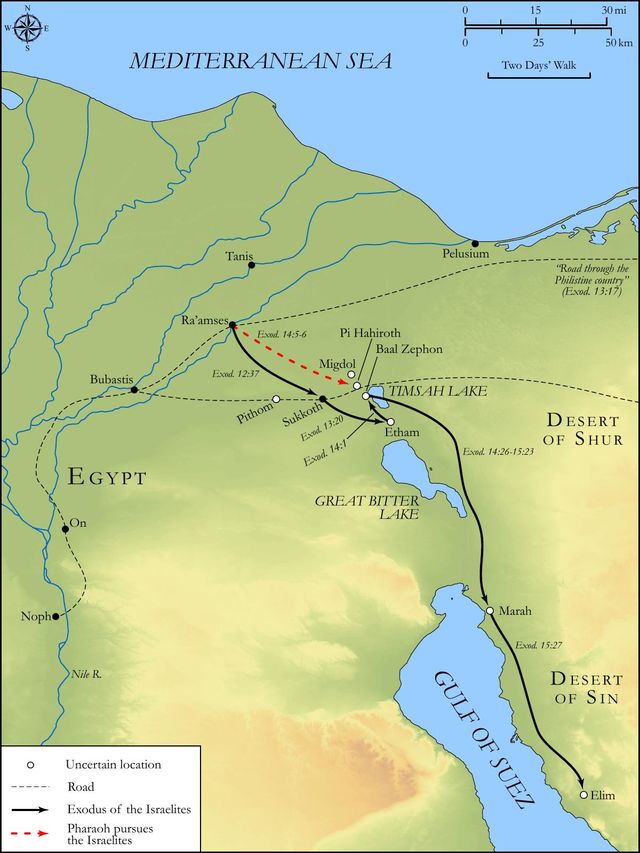
We have here, I. The fright that the children of Israel were in when they perceived that Pharaoh pursued them, Exo 14:10. They knew very well the strength and rage of the enemy, and their own weakness; numerous indeed they were, but all on foot, unarmed, undisciplined, disquieted by long servitude, and (which was worst of all) now penned up by the situation of their camp, so that they could not make their escape. On the one hand was Pi-hahiroth, a range of craggy rocks impassable; on the other hand were Migdol and Baalzephon, which, some think were forts and garrisons upon the frontiers of Egypt; before them was the sea; behind them were the Egyptians: so that there was no way open for them but upwards, and thence their deliverance came. Note, We may be in the way of our duty, following God and hastening towards heaven, and yet may be in great straits, troubled on every side, Co2 4:8. In this distress, no marvel that the children of Israel were sorely afraid; their father Jacob was so in a like case (Gen 32:7); when without are fightings, it cannot be otherwise but that within are fears: what therefore was the fruit of this fear? According as that was, the fear was good or evil. 1. Some of them cried out unto the Lord; their fear set them a praying, and that was a good effect of it. God brings us into straits that he may bring us to our knees. 2. Others of them cried out against Moses; their fear set them a murmuring, Exo 14:11, Exo 14:12. They give up themselves for lost; and as if God's arm were shortened all of a sudden, and he were not as able to work miracles today as he was yesterday, they despair of deliverance, and can count upon nothing but dying in the wilderness. How inexcusable was their distrust! Did they not see themselves under the guidance and protection of a pillar from heaven? And can almighty power fail them, or infinite goodness be false to them? Yet this was not the worst; they quarrel with Moses for bringing them out of Egypt, and, in quarrelling with him, fly in the face of God himself, and provoke him to wrath whose favour was now the only succour they had to flee to. As the Egyptians were angry with themselves for the best deed they ever did, so the Israelites were angry with God for the greatest kindness that was ever done them; so gross are the absurdities of unbelief. They here express, (1.) A sordid contempt of liberty, preferring servitude before it, only because it was attended with some difficulties. A generous spirit would have said, "If the worst come to the worst," as we say, "It is better to die in the field of honour than to live in the chains of slavery;" nay, under God's conduct, they could not miscarry, and therefore they might say, "Better live God's freemen in the open air of a wilderness than the Egyptians' bondmen in the smoke of the brick-kilns." But because, for the present, they are a little embarrassed, they are angry that they were not left buried alive in their house of bondage. (2.) Base ingratitude to Moses, who had been the faithful instrument of their deliverance. They condemn him, as if he had dealt hardly and unkindly with them, whereas it was evident, beyond dispute, that whatever he did, and however it issued, it was by direction from their God, and with design for their good. What they had said in a former ferment (when they hearkened not to Moses for anguish of spirit), they repeat and justify in this: We said in Egypt, Let us alone; and it was ill-said, yet more excusable, because then they had not had so much experience as they had now of God's wonderful appearances in their favour. But they had as soon forgotten the miracles of mercy as the Egyptians had forgotten the miracles of wrath; and they, as well as the Egyptians, hardened their hearts, at last, to their own ruin; as Egypt after ten plagues, so Israel after ten provocations, of which this was the first (Num 14:22), were sentenced to die in the wilderness.
II.The seasonable encouragement that Moses gave them in this distress, Exo 14:13, Exo 14:14.
He answered not these fools according to their folly. God bore with the provocation they gave to him, and did not (as he might justly have done) chose their delusions, and bring their fears upon them; and therefore Moses might well afford to pass by the affront they put upon him. Instead of chiding them, he comforts them, and with an admirable presence and composure of mind, not disheartened either by the threatenings of Egypt or the tremblings of Israel, stills their murmuring, with the assurance of a speedy and complete deliverance: Fear you not. Note, It is our duty and interest, when we cannot get out of our troubles, yet to get above our fears, so that they may only serve to quicken our prayers and endeavours, but may not prevail to silence our faith and hope.
1.He assures them that God would deliver them, that he would undertake their deliverance, and that he would effect it in the utter ruin of their pursuers: The Lord shall fight for you. This Moses was confident of himself, and would have them to be so, though as yet he knew not how or which way it would be brought to pass. God had assured him that Pharaoh and his host should be ruined, and he comforts them with the same comforts wherewith he had been comforted.
2.He directs them to leave it to God, in a silent expectation of the event: "Stand still, and think not to save yourselves either by fighting or flying; wait God's orders, and observe them; be not contriving what course to take, but follow your leader; wait God's appearances, and take notice of them, that you may see how foolish you are to distrust them. Compose yourselves, by an entire confidence in God, into a peaceful prospect of the great salvation God is now about to work for you. Hold your peace; you need not so much as give a shout against the enemy, as Jos 6:16. The work shall be done without any concurrence of yours." Note,
(1.)If God himself bring his people into straits, he will himself discover a way to bring them out again.
(2.)In times of great difficulty and great expectation, it is our wisdom to keep our spirits calm, quiet, and sedate; for then we are in the best frame both to do our own work and to consider the work of God. Your strength is to sit still (Isa 30:7), for the Egyptians shall help in vain, and threaten to hurt in vain.
Continue studying Exodus 14:13 across the web’s major study libraries — every link below opens this exact verse, chapter, or book on the destination site.
Read & Compare
 BibleGatewayThis verse in more than 200 translations and 70 languages.
 Bible.comThe YouVersion reader — hundreds of translations, reading plans, and highlights.
 ESV.orgCrossway's official English Standard Version reader.
 NET BibleThe NET translation with 60,000+ translators' notes on every rendering decision.
 STEP BibleTyndale House's free study tool — original text, vocabulary, and scholarly resources.
 BibliaLogos Bible Software's free web reader.
 USCCBThe New American Bible (Revised Edition) with the U.S. bishops' study notes.
Commentaries
 BibleHub CommentariesDozens of classic commentaries on this verse, gathered on one page.
 StudyLightMore than 100 commentary sets — the largest collection on the web.
 BibleRefPlain-English commentary on what this verse means, verse by verse.
 Enduring WordDavid Guzik's free commentary on this chapter, widely used by Bible teachers.
 Bible Study ToolsVerse commentary alongside Greek and Hebrew study aids.
Original Language & Research
- BibleHub InterlinearThe verse word by word — original language, transliteration, and English.
- BibleHub LexiconEvery word's original-language definition and Strong's entry.
 Blue Letter BibleDeep-study tools — Strong's numbers, concordance, and word studies.
 SefariaThe Hebrew text with Rashi and centuries of Jewish commentary.
Sermons, Hymns & Audio


TrulyRandomVerse is not affiliated with these sites and doesn’t control their content. They’re linked because they’re genuinely useful.
Summary
Exodus 14:13 captures Moses' pivotal declaration to the terrified Israelites, who found themselves trapped between Pharaoh's pursuing army and the impassable Red Sea. In this moment of profound despair and panic, Moses, speaking with divine authority, calls the people to abandon their fear, adopt a posture of unwavering faith, and prepare to witness the Lord's imminent, decisive, and complete deliverance, assuring them that their formidable oppressors would be vanquished forever.
Context
ShowHideLiterary Context
This powerful declaration from Moses serves as a direct, divinely inspired response to the Israelites' profound despair and bitter complaints. Immediately preceding this verse, the people, upon seeing Pharaoh's army approaching, were "sore afraid" and cried out to the Lord, then turned on Moses, lamenting their liberation and expressing a preference for slavery over an apparent death trap (Exodus 14:10-12). Moses' words in verse 13 aim to redirect their gaze from the overwhelming threat to the omnipotent God. The verses that follow detail God's subsequent instructions to Moses to stretch out his hand over the sea, leading to the miraculous parting of the waters and the subsequent, complete destruction of the Egyptian army, thereby fulfilling Moses' prophetic promise (Exodus 14:15-31).
Historical & Cultural Context
At this juncture, the Israelites were a recently emancipated slave population, numbering perhaps two million or more, largely untrained for combat and lacking military organization. They faced the most formidable military power of their era: Pharaoh's elite chariotry and cavalry, renowned for their effectiveness in warfare. The "Red Sea" (Hebrew: Yam Suph, often translated as "Sea of Reeds") presented an impassable geographical barrier, effectively trapping them. Among the nations, military might was often perceived as a direct reflection of a nation's deity's power. Thus, Pharaoh's relentless pursuit was not merely a military maneuver but a direct challenge to the supremacy of Yahweh. Moses' counter-intuitive command to "stand still" profoundly defied conventional military wisdom, emphasizing that this was not a battle for human strength or strategy, but a divine intervention orchestrated by God alone.
Key Themes
ShowHideExodus 14:13 powerfully encapsulates several overarching themes central to the book of Exodus and the broader biblical narrative. Firstly, it highlights the theme of Divine Sovereignty and Deliverance, demonstrating that God is in absolute control, even over seemingly insurmountable circumstances, and is uniquely capable of delivering His people. Secondly, it underscores the theme of Faith vs. Fear, contrasting the Israelites' human panic with Moses' call to trust in God's power and promises. This moment serves as a foundational lesson in reliance on God's intervention rather than human strength or despair. Finally, it foreshadows the recurring biblical theme of God Fighting for His People, where He acts decisively on behalf of the helpless, establishing His glory and vindicating His covenant faithfulness, as seen throughout the narrative of Israel's wilderness journey and beyond.
Exposition and Analysis
ShowHideKey Word Analysis
ShowHideThis root word signifies to be afraid, dread, or to revere. In this context, it is an emphatic negative imperative, "Fear ye not," which is a command to cease and desist from paralyzing terror. It addresses the core emotional and spiritual state of the people, directing them away from a natural human response of panic towards a posture of trust in divine power. The command to "fear not" is not a dismissal of their legitimate danger, but a redirection of their focus from the immediate threat to the omnipotent Deliverer.
This primitive root means to place (anything so as to stay), or reflexively, to station, offer, or continue. In the context of "stand still," it implies far more than passive waiting. It denotes taking a firm, resolute stand, positioning oneself with unwavering faith and readiness to observe God's action. It is an active cessation of human striving, panicked flight, or self-reliant combat, in favor of a posture of patient expectation and trust in God's impending intervention. It signifies a confident and unmoving reliance on divine power.
This feminine passive participle signifies something saved, deliverance, aid, victory, or prosperity. This significant Hebrew term encompasses far more than mere physical rescue; it denotes a comprehensive, holistic deliverance, help, and liberation. It speaks of God's powerful, decisive, and complete act of saving His people from their oppressors, bringing about a state of security, welfare, and well-being. It is a term that points to God's ultimate and complete triumph over all opposing forces.
Verse Breakdown
ShowHideMoses' declaration in Exodus 14:13 is a masterful blend of urgent command, divine promise, and prophetic assurance, designed to transform a moment of terror into one of profound faith:
Literary Devices
ShowHideExodus 14:13 is rich with rhetorical and literary devices that amplify its impact and theological significance. Contrast is immediately evident, setting the Israelites' overwhelming fear and human helplessness against Moses' calm, authoritative commands rooted in divine power. The repeated Imperative Commands—"Fear ye not," "stand still," and "see"—convey the urgency, authority, and non-negotiable nature of Moses' message, which originates from God. The use of Repetition and Emphasis is clear with the phrase "to day," which appears twice, underscoring the immediacy and certainty of God's impending action. Furthermore, the definitive declaration "no more for ever" functions as a powerful Hyperbole or Emphatic Negation, providing absolute assurance of the finality of their deliverance and the complete eradication of the threat. Finally, the entire verse functions as a Prophetic Declaration, as Moses, speaking on behalf of God, declares what God will do, transforming a moment of utter despair into one of profound, hopeful anticipation and a testament to divine omnipotence.
Theological and Thematic Connections
ShowHideExodus 14:13 stands as a foundational theological statement regarding God's character and His unwavering relationship with His covenant people. It profoundly teaches that God is utterly Sovereign and Omnipotent, capable of orchestrating deliverance even in seemingly impossible situations, demonstrating His supreme power over all natural forces and human adversaries. He is revealed as Faithful to His Covenants, as His miraculous deliverance here is a direct continuation and fulfillment of His promises to Abraham, Isaac, and Jacob, underscoring His unwavering commitment to His chosen people. Crucially, the verse establishes God as the Ultimate Deliverer, emphasizing that human strength, military strategy, or wisdom are utterly insufficient; true salvation, comprehensive and decisive, comes from God alone. He actively fights for His people when they are helpless, revealing His glory. Moreover, this passage affirms that God is A God Who Acts in History, whose salvation is not an abstract concept but a concrete, visible, and powerfully enacted reality in specific historical moments for His own glory and the vindication of His name. This narrative echoes the broader biblical truth that God often works most powerfully when human resources are exhausted, thereby ensuring that "salvation belongs to the LORD."
Reflection and Application
ShowHideExodus 14:13 offers profound and enduring encouragement for believers navigating their own "Red Sea moments"—those overwhelming situations that seem insurmountable, where all human solutions have failed, and fear threatens to paralyze. It serves as a timeless reminder that our initial and primary response to crisis should be faith and confident expectation in God, rather than succumbing to panic or despair. While it is natural to feel fear in the face of overwhelming odds, we are called to actively resist its paralyzing grip and instead lean into God's sovereign promises and character. The command to "stand still" is particularly counter-intuitive in a crisis, yet it is a profound spiritual discipline. It means ceasing our own frantic striving, surrendering control, and trusting in God's perfect timing and His unique method of deliverance. This is not passive resignation, but an active posture of patient expectation, knowing that God is at work even when we cannot perceive it. Finally, we are exhorted to actively "see the salvation of the LORD." This implies cultivating a spiritual alertness and unwavering expectation that God will indeed act, even when circumstances appear bleak. It is a call to look for His mighty hand at work, to anticipate His intervention, and to be ready to give Him all the glory when His deliverance is revealed, often precisely when human efforts prove futile, thereby magnifying His glory for all to see.
Questions for Reflection
ShowHideFAQ
ShowHideWhy did God lead the Israelites to such a seemingly impossible trap at the Red Sea?
ShowHideGod deliberately led the Israelites to the Red Sea, instructing them to turn back and encamp by the sea (Exodus 14:2), precisely to create this "trap." His purpose was not to ensnare them, but to demonstrate His absolute power and glory to both Israel and Egypt. He intended to draw Pharaoh into a final, decisive confrontation where He would utterly defeat Egypt's military might, proving His supremacy over all other gods and nations. This "trap" was, in fact, a divinely orchestrated stage for a spectacular revelation of God's omnipotence and faithfulness, designed to deepen Israel's faith and humble their oppressors.
Does "stand still" mean we should do nothing in the face of problems?
ShowHideThe Hebrew phrase translated "stand still" (הִתְיַצְּבוּ - hityatsvu) does not advocate for passive inaction, apathy, or irresponsible neglect of problems. Instead, it signifies a resolute, firm posture of faith, a cessation of human striving, panicked efforts, or self-reliant solutions. It is about trusting God to act when human solutions are exhausted or inadequate, rather than attempting to solve problems in our own strength or through ungodly means. It means to be ready, expectant, and unmoving in one's faith, anticipating God's intervention, rather than fleeing in fear or fighting on one's own terms. It's a call to spiritual composure and reliance on divine power.
Is "salvation" in this verse only about physical rescue?
ShowHideWhile the immediate context of Exodus 14:13 is indeed the physical deliverance of the Israelites from the pursuing Egyptian army, the Hebrew word yeshua (salvation) is much broader in its biblical scope. It encompasses comprehensive deliverance, help, victory, and welfare. In the biblical narrative, physical rescues often serve as powerful types or foreshadowings of deeper, spiritual salvation. This event points to God's complete and holistic saving power, which extends beyond just one moment or one type of threat, ultimately culminating in the grand spiritual deliverance offered through Christ.
Christ-Centered Fulfillment
ShowHideExodus 14:13 finds its profound and ultimate fulfillment in the person and redemptive work of Jesus Christ. Just as Moses declared God's imminent deliverance to a trapped and terrified Israel, Jesus Christ is the very embodiment of God's yeshua (salvation), the ultimate Deliverer for all humanity. He came not merely to rescue from physical armies, but from the far more formidable and eternal enemies of sin, death, and the power of the devil. His life, atoning death on the cross, and glorious resurrection constitute the definitive "salvation of the LORD" for all who believe, as Simeon prophesied, "For mine eyes have seen thy salvation, which thou hast prepared before the face of all people." Indeed, there is "salvation in no other" (Acts 4:12). Furthermore, just as the Egyptians were seen "no more for ever" by the Israelites, Christ's victory on the cross definitively defeats sin and death. For those united with Him, the power of these spiritual oppressors is broken, and their final, eternal defeat is assured, as He "destroyed him who has the power of death, that is, the devil" (Hebrews 2:14). In the New Testament, Jesus repeatedly calls His followers to "fear not" in the face of life's storms, anxieties, and persecutions, reminding them of God's sovereign care, even over those who can "kill the body" (Matthew 10:28). He invites us to "stand still" or "rest" in Him, finding peace and cessation from our striving and anxiety, for He declares, "Come to me, all who labor and are heavy laden, and I will give you rest" (Matthew 11:28). The miraculous Red Sea deliverance thus serves as a powerful foreshadowing of the greater spiritual Exodus from the bondage of sin, accomplished through Christ, leading His people into true freedom and eternal life in the promised land of God's presence.