


Isaiah 35:4
Bible text: King James Version (1769 Blayney text) · Public domain
Bible text: King James Version with Strong's numbers · Public domain
Bible text: Berean Standard Bible · Public domain
Bible text: American Standard Version (1901) · Public domain
Bible text: World English Bible, Messianic edition · Public domain
Bible text: Geneva Bible (1599) · Public domain
Bible text: Young's Literal Translation · Public domain
- אִמְרוּ'im·RusayH559V-Qal-Imp-2mpVerb Qal Imperative 2nd Plural Masculine
- לְנִמְהֲרֵיle·nim·ha·reito [people] hasty ofH4116Prep-l ¦ V-Niphal-Prtcpl-mpVerb Niphal Participle Plural Masculine Constructלְtoנִמְהֲרֵי[people] hasty of
- לֵבLevheartH3820N-msNoun Singular Masculine Absolute
- חִזְקוּchiz·Kube strongH2388V-Qal-Imp-2mpVerb Qal Imperative 2nd Plural Masculine
- אַל'almay notH408NegParticle Negative
- תִּירָאוּti·Ra·'uyou be afraidH3372V-Qal-Imperf-2mpVerb Qal Imperfect 2nd Plural Masculine
- הִנֵּהhi·Nehhere!H2009PrtParticle Interjection
- אֱלֹהֵיכֶם'e·lo·hei·Khemyour GodH430N-mpc ¦ 2mpNoun Plural Masculine ConstructאֱלֹהֵיGodכֶםyour
- נָקָםna·KamvengeanceH5359N-msNoun Singular Masculine Absolute
- יָבוֹאya·Vo'he will comeH935V-Qal-Imperf-3msVerb Qal Imperfect 3rd Singular Masculine
- גְּמוּלge·Mul[the] recompense ofH1576N-mscNoun Singular Masculine Construct
- אֱלֹהִים'E·lo·HimGodH430N-mpNoun Plural Masculine Absolute
- הוּאhu'heH1931Pro-3msPronoun Personal 3rd Singular Masculine
- יָבוֹאya·Vo'he will comeH935V-Qal-Imperf-3msVerb Qal Imperfect 3rd Singular Masculine
- וְיֹשַׁעֲכֶםve·yo·sha·'a·Khemand he may deliver youH3467Conj-w ¦ V-Hiphil-Imperf-3ms ¦ 2mpVerb Hiphil Imperfect 3rd Singular Masculineוְandיֹשַׁעֲhe may deliverכֶםyou
English is a literal word-by-word gloss of the Hebrew, not the KJV's wording. Why?
This is the original text the KJV's translators worked from — each Hebrew word with its own literal English meaning in this verse, prepared by scholars at Tyndale House, Cambridge. The KJV translates whole sentences, not word by word, so its wording differs: one Hebrew word can become several English words, and the KJV may choose “the LORD” where the gloss reads “Yahweh”. Both are faithful — they answer different questions. For the KJV's own rendering, switch to the KJV text.
Details
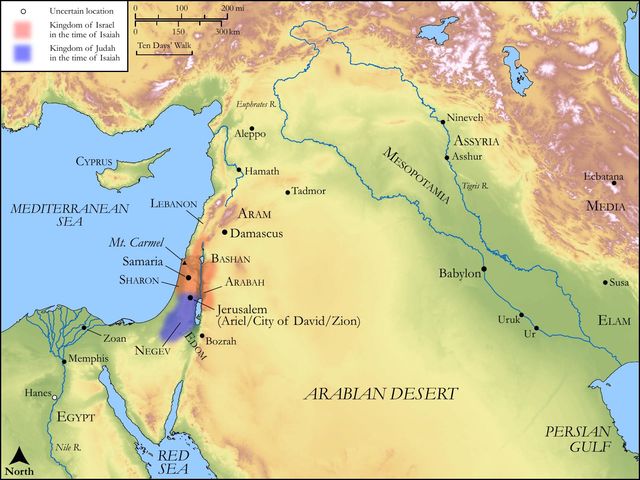
See on the biblical-era map
Study this verse
Public-domain commentary
Matthew Henry
From his Commentary on the Whole Bible. Henry comments on passages, not single verses — this entry covers Isaiah 35:1–4. His two-level outline is real structure in the source text, so it is rendered as structure.
In these verses we have,
I.The desert land blooming.
In the foregoing chapter we had a populous and fruitful country turned into a horrid wilderness; here we have in lieu of that, a wilderness turned into a good land. When the land of Judah was freed from the Assyrian army, those parts of the country that had been made as a wilderness by the ravages and outrages they committed began to recover themselves, and to look pleasantly again, and to blossom as the rose. When the Gentile nations, that had been long as a wilderness, bringing forth no fruit to God, received the gospel, joy came with it to them, Psa 67:3, Psa 67:4; Psa 96:11, Psa 96:12. When Christ was preached in Samaria there was great joy in that city (Act 8:8); those that sat in darkness saw a great and joyful light, and then they blossomed, that is, gave hopes of abundance of fruit; for that was it which the preachers of the gospel aimed at (Joh 15:16), to go and bring forth fruit, Rom 1:13; Col 1:6. Though blossoms are not fruit, and often miscarry and come to nothing, yet they are in order to fruit. Converting grace makes the soul that was a wilderness to rejoice with joy and singing, and to blossom abundantly. This flourishing desert shall have all the glory of Lebanon given to it, which consisted in the strength and stateliness of its cedars, together with the excellency of Carmel and Sharon, which consisted in corn and cattle. Whatever is valuable in any institution is brought into the gospel. All the beauty of the Jewish church was admitted into the Christian church, and appeared in its perfection, as the apostle shows at large in his epistle to the Hebrews. Whatever was excellent an desirable in the Mosaic economy is translated into the evangelical institutes.
II.The glory of God shining forth:
They shall see the glory of the Lord. God will manifest himself more than ever in his grace and love to mankind (for that is his glory and excellency), and he shall give them eyes to see it, and hearts to be duly affected with it. This is that which will make the desert blossom. The more we see by faith of the glory of the Lord and the excellency of our God the more joyful and the more fruitful shall we be.
III.The feeble and faint-hearted encouraged, Isa 35:3, Isa 35:4.
God's prophets and ministers are in a special manner charged, by virtue of their office, to strengthen the weak hands, to comfort those who could not yet recover the fright they had been put into by the Assyrian army with an assurance that God would now return in mercy to them. This is the design of the gospel,
1.To strengthen those that are weak and to confirm them - the weak hands, which are unable either to work or fight, and can hardly be lifted up in prayer, and the feeble knees, which are unable either to stand or walk and unfit for the race set before us. The gospel furnishes us with strengthening considerations, and shows us where strength is laid up for us. Among true Christians there are many that have weak hands and feeble knees, that are yet but babes in Christ; but it is our duty to strengthen our brethren (Luk 22:32), not only to bear with the weak, but to do what we can to confirm them, Rom 15:1; Th1 5:14. It is our duty also to strengthen ourselves, to lift up the hands which hang down (Heb 12:12), improving the strength God has given us, and exerting it.
2.To animate those that are timorous and discouraged: Say to those that are of a fearful heart, because of their own weakness and the strength of their enemies, that are hasty (so the word is), that are for betaking themselves to flight upon the first alarm, and giving up the cause, that say, in their haste, "We are cut off and undone" (Psa 31:22), there is enough in the gospel to silence these fears; it says to them, and let them say it to themselves and one to another, Be strong, fear not. Fear is weakening; the more we strive against it the stronger we are both for doing and suffering; and, for our encouragement to strive, he that says to us, Be strong has laid help for us upon one that is mighty.
IV.Assurance given of the approach of a Saviour:
"Your God will come with vengeance. God will appear for you against your enemies, will recompense both their injuries and your losses." The Messiah will come, in the fulness of time, to take vengeance on the powers of darkness, to spoil them, and make a show of them openly, to recompense those that mourn in Zion with abundant comforts. He will come and save us. With the hopes of this the Old Testament saints strengthened their weak hands. He will come again at the end of time, will come in flaming fire, to recompense tribulation to those who have troubled his people, and, to those who were troubled, rest, such a rest as will be not only a final period to, but a full reward of, all their troubles, Th2 1:6, Th2 1:7. Those whose hearts tremble for the ark of God, and who are under a concern for his church in the world, may silence their fears with this, God will take the work into his own hands. Your God will come, who pleads your cause and owns your interest, even God himself, who is God alone.
Historical interpretation
Two Centuries of Reception
5 surviving comments on this verse. Each one is dated, so this reads as a timeline rather than a list.
Select a marker to jump to its quote. Markers stagger vertically where authors wrote within a few decades of each other.
The actions of Christ must be seen alongside the rule of the Scriptures. Unless I am mistaken, we see that Christ’s work consisted of two actions: preaching and power. Let us look at each of these in the order we have just listed them. First, Christ was announced as a preacher. Isaiah said, “Cry out loud, and do not hold back. Lift up your voice as a trumpet, and declare to my people their crimes and to the house of Jacob their sins. Then seek me day by day and desire to learn my ways, as a nation that has done righteousness and has not forsaken the judgment of God,” and so forth. Second, it was announced that Christ would do acts of power from the Father. Isaiah said, “Behold, our God will come with judgment; he will come and save us. Then the sick will be healed, the eyes of the blind will see, the ears of the deaf will hear, the mute will speak, and the lame will leap as a deer.”
(Verse 3, 4.) Strengthen the weak hands, and make firm the feeble knees. Say to those who are fearful, “Be strong, do not fear! Behold, your God will bring vengeance and retribution. God Himself will come and save you (or as the Septuagint translates, us). Then the eyes of the blind will be opened, and the ears of the deaf will hear. Then the lame will leap like a deer, and the tongue of the mute will sing, for water will burst forth in the wilderness, and streams in the desert, and the dry ground will become a pool (or marsh), and the thirsty land springs of water. In the dens where the dragons once lived, green rushes and reeds shall grow (in the version of the Seventy: There will be the joy of birds and the folds of flocks). And there shall be a path and a road (or a clean road) and it shall be called the holy road, no unclean person shall pass through it. And this shall be for us a direct road, so that fools shall not go astray (or as the Seventy translated, There will be no unclean road there, those who are scattered shall pass through it and shall not wander. There will be, it says, no lion there, and no wicked beast shall ascend it, nor shall it be found there; but they who are set free shall walk on it. And those who are redeemed by the Lord shall return and come to Zion with praise, and everlasting joy shall be upon their heads. They shall obtain joy and gladness, and sorrow and sighing shall flee away. We have mixed together both editions, so that the size of the books may not be stretched in presenting each one, which has already exceeded the limit of brevity.) To the apostles, about whom it was said above: They themselves will see the glory of the Lord and the beauty of our God, it is commanded that they strengthen the hands that are weak among the nations, and make firm the feeble knees, so that those who were unable to do the work of God with weak hands and had a dry right hand, may extend it to good works. And those who once stumbled among idols in various errors, may walk firmly on the path of truth, and may the faith of the Lord strengthen the weak and fearful, so that they may not be afraid, and may the fear of the one God drive away all fears of error. The reason, however, is security and constancy, because Christ is coming, to whom the Father has given all judgment: and he will render to each one according to their works (John 5). He himself will come and save you, to whom it is said, do not be afraid: whether us, as the Apostles say that salvation is common with those who believe. Then the eyes of the blind will be opened, and the ears of the deaf will be opened. Then the lame will leap like a deer, and the tongue of the mute will be opened. Although this was fulfilled by the magnitude of the signs, when the Lord spoke to the disciples of John, who were sent to him: Go and report to John what you have heard and seen: the blind see, the lame walk, lepers are cleansed, the deaf hear, the dead rise, the poor have the good news preached to them (Luke 7:22); yet it is fulfilled daily among the Gentiles, when those who were previously blind and used to stumble into wood and stones, now see the light of truth. And those who could not hear the words of the Scriptures with deaf ears, now rejoice in the precepts of God; for those who were previously closed off and did not follow the right path, leap like deer, imitating their teachers, and the tongue of the mute will be opened, whom Satan had closed off in order that they could not confess the Lord. Therefore, the eyes will be opened, the ears will hear, the lame will leap, and the tongue of the mute will be opened, for they have been torn apart, or have burst forth, in the desert of the Church of baptismal waters, and there are streams and rivers in the wilderness, namely different spiritual graces; and what was dry has been turned into marshes and a pond, so that it not only lacks the heat of thirst but also becomes navigable and irrigated, and has many springs that the deer desires, and those who drink from them can bless the Lord, according to what is written: Bless the Lord from the fountains of Israel (Ps. 67:27). In the prisons of the souls of the Gentiles, in which dragons dwelled before, there will be reed and rush, on which the faith of the Lord will be written, and on which the weary limbs will rest; whether it will be the joy of birds, and the cages of flocks: so that the doves may take wings, and leaving behind the lowly, may hasten to the heights, and be able to say with the Psalmist, The Lord feeds me, and I shall not want: He has placed me in a place of pasture: He has nourished me by refreshing waters. There will be a path, and a very clean road, which will be called holy, and which says of itself: I am the way (John 14:6), through which someone who is defiled cannot pass. Hence it is also said in the psalm, Blessed are the undefiled in the way (Psalm 119:1). And this way will be for us, that is, our God, so straight and level and plain, that it has no error: and the foolish and senseless may perish trying to enter, to whom Wisdom speaks in Proverbs: If anyone is little, let him come to me. And she has spoken to the foolish, come and eat my bread, and drink the wine which I have mixed for you. Leave behind foolishness, and live, and walk in the ways of prudence (Prov. 5:4-6). For God has chosen the foolish things of the world (1 Cor. 1): of which the prince of fools speaks in the psalm, God, you know my foolishness. And the foolishness of God is wiser than men (Ps. 68:6). Therefore the Septuagint translated: And those who were scattered (1 Cor. 2), and separated from the fellowship of the Lord, will by no means wander. It follows, There will not be a lion there: our adversary the devil, who prowls around roaring, how could he enter the sheepfold of the Lord (I Peter V). And the evil beasts, his satellites, will not climb through it. For the track of a snake cannot be found on a rock. But those who have been freed from the chains of sin, redeemed by the blood of the Savior, and have repented; and have come to Zion, of which we have often said: You have come to Mount Zion, and to the heavenly city of the living God Jerusalem (Hebrews XII, 22); let us not seek a golden Zion in the manner of the Jews, and a gemmed Jerusalem, which, according to the prophecy of Daniel, has been dissolved into eternal ashes (Daniel IX). And there will be everlasting joy for those praising the Lord over their heads, so that after they have conquered the world, they may say with the Apostle and Prophet: I have completed the race, I have kept the faith, the crown of righteousness has been reserved for me (2 Timothy 4:7-8); and, Lord, as with the shield of your good will, you have crowned us (Psalm 5:12). Then, with joy and gladness succeeding, sorrow and groaning will flee when He comes from Zion to deliver. All these things we interpret, according to the Apostle Paul, as referring to the first coming of the Savior: but the Jews and our Judaizers refer them to the second, on account of a single verse, 'They shall be converted, and shall come to Zion with praise; desiring the blood of sacrifices, the bondage of all nations, and the beauty of wives.'
This is the divine arrangement, as far as any human being can investigate it, better minds in a better way, lesser minds less effectively; this divine arrangement is giving us hints of a great and significant mystery. Christ, you see, was going to come in the flesh, not anyone at all, not an angel, not an ambassador; but “he himself will come and save you.” It wasn’t anyone who was going to come; and yet how was he going to come? He was going to be born in mortal flesh, to be a tiny infant, to be laid in a manger, wrapped in cradle clothes, nourished on milk; going to grow up, and finally even to be done to death. So in all these indications of humility there is indeed a pattern of an extreme humility.
Christ said, “I am in the Father, and the Father is in me,” and “Whoever sees me, sees the Father.” The inclusion of just one syllable, “and,” distinguishes the Father from the Son. It also demonstrates that you possess neither the Father nor the Son. Tell me, Arian, do you refer to the Father as God? And how! But what about the Son? Him too I profess to be God. You will do well to acknowledge this also, for when his coming in the flesh was announced beforehand, the prophet said about him, “Be encouraged, you who are lowly of soul, and do not fear. Behold, your God will bring the vengeance of retribution. God himself will come and save us.”
“This is the will of my Father,” he said, “that all who see the Son and believe in him should have eternal life.” But notice that he who was sent also came by his own will, as the prophet Isaiah said: “Be encouraged, you who are lowly of soul, and do not fear. Behold, our God will bring judgment. God himself will come and save us.”
Continue studying Isaiah 35:4 across the web’s major study libraries — every link below opens this exact verse, chapter, or book on the destination site.
Read & Compare
 BibleGatewayThis verse in more than 200 translations and 70 languages.
 Bible.comThe YouVersion reader — hundreds of translations, reading plans, and highlights.
 ESV.orgCrossway's official English Standard Version reader.
 NET BibleThe NET translation with 60,000+ translators' notes on every rendering decision.
 STEP BibleTyndale House's free study tool — original text, vocabulary, and scholarly resources.
 BibliaLogos Bible Software's free web reader.
 USCCBThe New American Bible (Revised Edition) with the U.S. bishops' study notes.
Commentaries
 BibleHub CommentariesDozens of classic commentaries on this verse, gathered on one page.
 StudyLightMore than 100 commentary sets — the largest collection on the web.
 BibleRefPlain-English commentary on what this verse means, verse by verse.
 Enduring WordDavid Guzik's free commentary on this chapter, widely used by Bible teachers.
 Bible Study ToolsVerse commentary alongside Greek and Hebrew study aids.
Original Language & Research
- BibleHub InterlinearThe verse word by word — original language, transliteration, and English.
- BibleHub LexiconEvery word's original-language definition and Strong's entry.
 Blue Letter BibleDeep-study tools — Strong's numbers, concordance, and word studies.
 SefariaThe Hebrew text with Rashi and centuries of Jewish commentary.
Sermons, Hymns & Audio


TrulyRandomVerse is not affiliated with these sites and doesn’t control their content. They’re linked because they’re genuinely useful.
Summary
Isaiah 35:4 delivers a profound prophetic assurance of divine intervention and ultimate salvation to those afflicted by fear and anxiety. It directly addresses individuals with a "fearful heart," urging them to embrace strength and cast off dread. The verse promises that God Himself will imminently arrive, bringing both righteous vengeance upon oppressors and a just recompense, culminating in the complete deliverance and rescue of His people from all forms of distress. This declaration serves as a powerful anchor of hope, emphasizing God's active presence and unwavering commitment to His covenant.
Context
ShowHideLiterary Context
Isaiah 35:4 is strategically positioned within a pivotal section of Isaiah's prophecy, specifically following a vivid depiction of divine judgment in Isaiah 34 and preceding a glorious vision of Israel's restoration in Isaiah 35. Chapter 34 details God's fierce indignation against the nations, particularly Edom, serving as a backdrop for the contrasting hope offered to His people. Chapter 35, in turn, paints an idyllic picture of a transformed wilderness blooming with life, a "highway of holiness" for the redeemed, and the joyful return of Zion's exiles. Within this grand narrative, Isaiah 35:4 functions as a direct, pastoral address, providing immediate comfort and a foundational promise for the miraculous events and deliverance that are about to unfold for God's faithful remnant. It is a personal word of encouragement amidst the universal drama of judgment and redemption.
Historical & Cultural Context
The prophecies of Isaiah were delivered during a tumultuous period in Israel's history, marked by the looming threats of Assyrian and Babylonian empires, periods of national unfaithfulness, and the eventual experience of exile. The audience for this message would have been a people facing immense political instability, military threats, and spiritual despondency. The concept of "fearful heart" would resonate deeply with those living under oppression or anticipating severe judgment. Culturally, the idea of God's "vengeance" and "recompense" was understood not as arbitrary wrath, but as righteous justice—God settling accounts for wrongs committed against His covenant people, upholding His divine order, and fulfilling His promises. The assurance of God's "coming" and "saving" would evoke the historical memory of God's past deliverances, such as the Exodus, reinforcing His role as the ultimate rescuer and defender of His people.
Key Themes
ShowHideIsaiah 35:4 contributes significantly to several overarching themes within Isaiah and biblical theology. Firstly, it underscores the theme of Divine Comfort and Encouragement, directly commanding the fearful to "Be strong, fear not," echoing God's consistent call for His people to trust in His presence despite daunting circumstances, as seen in Isaiah 41:10. Secondly, the verse highlights God's Imminent and Personal Intervention, emphasizing that "your God will come." This portrays God not as a distant deity, but as an active, personal, and sovereign agent who draws near to execute His will in human history, a theme central to the covenant relationship. Thirdly, it reveals God's Righteous Justice and Retribution, through the terms "vengeance" and "recompence," signifying that God will rectify wrongs and bring a just settlement, ensuring that no injustice goes unaddressed and that His people are vindicated, a principle affirmed in Deuteronomy 32:35. Finally, the verse culminates in the theme of Ultimate Salvation and Deliverance, promising that God "will come and save you." This encompasses not only physical rescue from oppression but also spiritual redemption and the establishment of His righteous kingdom, a salvific work that finds its ultimate expression in the person and work of the Messiah, as prophesied in Isaiah 49:6.
Exposition and Analysis
ShowHideKey Word Analysis
ShowHideThis word literally means "to be liquid or flow easily," implying a state of being "hasty" or "impetuous." When applied to the heart (H3820, lêb), it describes a heart that is quick to panic, prone to anxiety, despair, or rash action due to fear. It suggests a lack of steadfastness and a tendency to be overwhelmed by circumstances.
This primitive root means "to fasten upon," and by extension, "to seize, be strong (figuratively, courageous, causatively strengthen, cure, help, repair, fortify), obstinate." In this context, it is an imperative command to take courage, to be firm, to hold fast, and to be fortified against the fear that threatens to overwhelm the "hasty heart." It implies a divinely enabled steadfastness.
This term refers to "treatment," "an act (of good or ill)," or "requital." It signifies a just return, a repayment, or a settlement for actions. Paired with "vengeance" (H5359, nâqâm), it underscores the idea of a righteous and complete retribution, ensuring that every wrong is righted and that justice is fully served, not merely as an act of anger, but as a divine balancing of accounts.
Verse Breakdown
ShowHide"Say to them [that are] of a fearful heart,"
This opening phrase establishes the specific audience for this divine message: those whose inner disposition is characterized by fear, anxiety, or a tendency to panic. The prophet is commissioned to deliver a direct, pastoral word of comfort and instruction to individuals experiencing deep apprehension.
"Be strong, fear not:"
This is a powerful, dual imperative command. "Be strong" calls for courage, steadfastness, and inner fortitude, a divinely imparted strength. "Fear not" is a direct prohibition against succumbing to dread or terror, urging a posture of trust and confidence rather than apprehension. These commands are not based on human capacity but on the subsequent promise of God's action.
"behold, your God will come [with] vengeance, [even] God [with] a recompence;"
This clause reveals the foundation for the preceding commands. The adverb "behold" draws attention to a certain and imminent event. The repeated phrase "your God" emphasizes the personal and covenantal relationship God has with His people. He is not a generic deity but their God. His coming is explicitly linked to "vengeance" and "recompence." These terms signify God's righteous judgment against those who have oppressed His people and His just settlement of all wrongs, ensuring that justice is fully served.
"he will come and save you."
This final clause states the ultimate purpose and blessed outcome of God's intervention. The repetition of "he will come" reinforces the certainty and active nature of His arrival. The culmination of His coming, however, is not merely judgment on others, but "to save you." This encompasses comprehensive deliverance—from enemies, from oppression, from the consequences of sin, and ultimately, into the full experience of His promised kingdom and blessings.
Literary Devices
ShowHideIsaiah 35:4 employs several potent literary devices to convey its message of hope and assurance. The most prominent is Imperative language ("Say," "Be strong," "fear not"), which lends a direct, authoritative, and urgent tone to the divine command, demanding an immediate response from the fearful heart. There is also clear Parallelism in the latter part of the verse, specifically Synonymous Parallelism, where "vengeance" and "recompence" are used in conjunction to reinforce the concept of God's comprehensive and righteous justice. Similarly, the repeated phrase "he will come" emphasizes the certainty and active nature of God's intervention, leading to the ultimate outcome: "and save you." The use of Divine Epithets like "your God" personalizes the message, reminding the audience of God's covenant relationship and His unwavering commitment to His people. Furthermore, the phrase "fearful heart" can be seen as a form of Metonymy, where "heart" represents the totality of one's inner being—feelings, will, and intellect—thus signifying a person entirely consumed by apprehension.
Theological and Thematic Connections
ShowHideIsaiah 35:4 stands as a testament to God's unwavering character as both a righteous judge and a compassionate deliverer. Theologically, it affirms God's absolute sovereignty and His active engagement in human affairs, asserting that He is not a distant observer but one who draws near to execute His perfect will. The promise of "vengeance" and "recompence" underscores divine justice, assuring His people that all wrongs committed against them will be addressed and rectified by the ultimate arbiter. This is not an arbitrary act of wrath but a necessary component of God's holiness, ensuring that His moral order prevails. Simultaneously, the promise "he will come and save you" highlights God's boundless mercy and faithfulness to His covenant. It reminds believers that even in their deepest fears and most desperate circumstances, their ultimate hope rests in God's power to intervene, redeem, and bring about complete salvation. This dual aspect of God's character—justice and salvation—is foundational to understanding His work throughout Scripture.
Reflection and Application
ShowHideIsaiah 35:4 offers timeless comfort and a powerful call to faith for believers across generations. In a world often fraught with uncertainty, anxiety, and injustice, our hearts can easily become "fearful" or "hasty," prone to panic and despair. This verse directly addresses that human vulnerability, urging us to "Be strong, fear not." This is not a call to stoicism or self-reliance, but a command rooted in the certainty of God's character and His promised intervention. We are encouraged to find our strength not in our own resilience, but in the knowledge that "your God will come." This means trusting that God is actively working, even when circumstances seem overwhelming. It calls us to release our grip on fear and embrace the confident expectation that God will ultimately bring justice to situations of injustice and complete deliverance from all forms of distress, whether physical, emotional, or spiritual. Our hope is anchored in His ultimate salvation, which promises a future where all tears are wiped away and His righteous kingdom is fully established.
Questions for Reflection
ShowHideFAQ
ShowHideWhat does "fearful heart" mean in this context?
ShowHideThe Hebrew phrase translated "fearful heart" literally means "hasty of heart" or "impetuous heart." It describes a heart that is prone to panic, quick to give way to anxiety, despair, or rash action when faced with daunting circumstances. It signifies a state of inner turmoil and a lack of steadfastness, which the divine command to "Be strong, fear not" directly addresses, offering a divine antidote to human apprehension.
Is God's "vengeance" in this verse a positive or negative concept?
ShowHideIn the biblical context, especially with God, "vengeance" and "recompence" are not about arbitrary wrath or personal spite, but about righteous justice. They refer to God's commitment to setting things right, vindicating His oppressed people, and bringing a just settlement for wrongs committed against them. It is a necessary act of His holiness to restore moral order and ensure that justice ultimately prevails. It is a positive concept for the oppressed, signifying their ultimate vindication and deliverance, as seen in passages like Psalm 94:1.
Does this prophecy apply only to ancient Israel, or does it have relevance for believers today?
ShowHideWhile Isaiah 35:4 was initially given to ancient Israel facing specific historical challenges, its core message of divine comfort, God's active intervention, and ultimate salvation has enduring relevance for believers today. The human condition of a "fearful heart" is universal. The promise that "your God will come" speaks to God's unchanging character and His ongoing commitment to His people in all ages. The ultimate fulfillment of this promise is found in Christ, making it a source of hope and encouragement for all who trust in Him, as God continues to work justice and salvation in the world and in individual lives, culminating in His final return and the new heavens and new earth (Revelation 21:1-4).
Christ-Centered Fulfillment
ShowHideIsaiah 35:4 finds its most profound and complete fulfillment in the person and work of Jesus Christ. The promise that "your God will come" is ultimately realized in the Incarnation, when God Himself entered human history in the person of Jesus (John 1:14). He came not only as a divine presence but specifically "to save you" (Matthew 1:21), fulfilling the deepest longing for deliverance from sin, death, and the power of evil. The "vengeance" and "recompence" spoken of in Isaiah are perfectly executed through Christ's atoning sacrifice on the cross, where He triumphed over the powers of darkness (Colossians 2:15) and bore the just recompense for humanity's sin, thereby securing salvation for all who believe. His first coming brought spiritual deliverance and the inauguration of God's kingdom, while His second coming will bring the full and final "recompence" against all injustice and the complete "salvation" of His people into an eternal state of peace and righteousness, where "God will wipe away every tear from their eyes" (Revelation 21:4). Thus, Jesus is the ultimate answer to the "fearful heart," for in Him, God has indeed come, He has brought justice, and He has saved us.