


Isaiah 35:3
- חַזְּקוּcha·ze·KustrengthenH2388V-Piel-Imp-2mpVerb Piel Imperative 2nd Plural Masculine
- יָדַיִםya·Da·yimhandsH3027N-cdNoun Dual common gender Absolute
- רָפוֹתra·FotslackH7504Adj-fpAdjective Plural Feminine Absolute
- וּבִרְכַּיִםu·vir·Ka·yimand kneesH1290Conj-w ¦ N-fdNoun Dual Feminine Absoluteוּandבִרְכַּיִםknees
- כֹּשְׁלוֹתko·she·LotstumblingH3782V-Qal-Prtcpl-fpVerb Qal Participle Plural Feminine Absolute
- אַמֵּצוּ'a·Me·tzumake firmH553V-Piel-Imp-2mpVerb Piel Imperative 2nd Plural Masculine
English is a literal word-by-word gloss of the Hebrew, not the KJV's wording. Why?
This is the original text the KJV's translators worked from — each Hebrew word with its own literal English meaning in this verse, prepared by scholars at Tyndale House, Cambridge. The KJV translates whole sentences, not word by word, so its wording differs: one Hebrew word can become several English words, and the KJV may choose “the LORD” where the gloss reads “Yahweh”. Both are faithful — they answer different questions. For the KJV's own rendering, switch to the KJV text.
Details
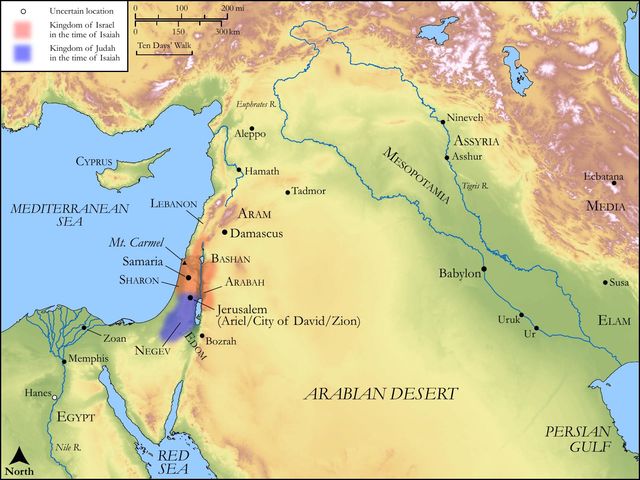
See on the biblical-era map
Study this verse
Public-domain commentary
Matthew Henry
From his Commentary on the Whole Bible. Henry comments on passages, not single verses — this entry covers Isaiah 35:1–4. His two-level outline is real structure in the source text, so it is rendered as structure.
In these verses we have,
I.The desert land blooming.
In the foregoing chapter we had a populous and fruitful country turned into a horrid wilderness; here we have in lieu of that, a wilderness turned into a good land. When the land of Judah was freed from the Assyrian army, those parts of the country that had been made as a wilderness by the ravages and outrages they committed began to recover themselves, and to look pleasantly again, and to blossom as the rose. When the Gentile nations, that had been long as a wilderness, bringing forth no fruit to God, received the gospel, joy came with it to them, Psa 67:3, Psa 67:4; Psa 96:11, Psa 96:12. When Christ was preached in Samaria there was great joy in that city (Act 8:8); those that sat in darkness saw a great and joyful light, and then they blossomed, that is, gave hopes of abundance of fruit; for that was it which the preachers of the gospel aimed at (Joh 15:16), to go and bring forth fruit, Rom 1:13; Col 1:6. Though blossoms are not fruit, and often miscarry and come to nothing, yet they are in order to fruit. Converting grace makes the soul that was a wilderness to rejoice with joy and singing, and to blossom abundantly. This flourishing desert shall have all the glory of Lebanon given to it, which consisted in the strength and stateliness of its cedars, together with the excellency of Carmel and Sharon, which consisted in corn and cattle. Whatever is valuable in any institution is brought into the gospel. All the beauty of the Jewish church was admitted into the Christian church, and appeared in its perfection, as the apostle shows at large in his epistle to the Hebrews. Whatever was excellent an desirable in the Mosaic economy is translated into the evangelical institutes.
II.The glory of God shining forth:
They shall see the glory of the Lord. God will manifest himself more than ever in his grace and love to mankind (for that is his glory and excellency), and he shall give them eyes to see it, and hearts to be duly affected with it. This is that which will make the desert blossom. The more we see by faith of the glory of the Lord and the excellency of our God the more joyful and the more fruitful shall we be.
III.The feeble and faint-hearted encouraged, Isa 35:3, Isa 35:4.
God's prophets and ministers are in a special manner charged, by virtue of their office, to strengthen the weak hands, to comfort those who could not yet recover the fright they had been put into by the Assyrian army with an assurance that God would now return in mercy to them. This is the design of the gospel,
1.To strengthen those that are weak and to confirm them - the weak hands, which are unable either to work or fight, and can hardly be lifted up in prayer, and the feeble knees, which are unable either to stand or walk and unfit for the race set before us. The gospel furnishes us with strengthening considerations, and shows us where strength is laid up for us. Among true Christians there are many that have weak hands and feeble knees, that are yet but babes in Christ; but it is our duty to strengthen our brethren (Luk 22:32), not only to bear with the weak, but to do what we can to confirm them, Rom 15:1; Th1 5:14. It is our duty also to strengthen ourselves, to lift up the hands which hang down (Heb 12:12), improving the strength God has given us, and exerting it.
2.To animate those that are timorous and discouraged: Say to those that are of a fearful heart, because of their own weakness and the strength of their enemies, that are hasty (so the word is), that are for betaking themselves to flight upon the first alarm, and giving up the cause, that say, in their haste, "We are cut off and undone" (Psa 31:22), there is enough in the gospel to silence these fears; it says to them, and let them say it to themselves and one to another, Be strong, fear not. Fear is weakening; the more we strive against it the stronger we are both for doing and suffering; and, for our encouragement to strive, he that says to us, Be strong has laid help for us upon one that is mighty.
IV.Assurance given of the approach of a Saviour:
"Your God will come with vengeance. God will appear for you against your enemies, will recompense both their injuries and your losses." The Messiah will come, in the fulness of time, to take vengeance on the powers of darkness, to spoil them, and make a show of them openly, to recompense those that mourn in Zion with abundant comforts. He will come and save us. With the hopes of this the Old Testament saints strengthened their weak hands. He will come again at the end of time, will come in flaming fire, to recompense tribulation to those who have troubled his people, and, to those who were troubled, rest, such a rest as will be not only a final period to, but a full reward of, all their troubles, Th2 1:6, Th2 1:7. Those whose hearts tremble for the ark of God, and who are under a concern for his church in the world, may silence their fears with this, God will take the work into his own hands. Your God will come, who pleads your cause and owns your interest, even God himself, who is God alone.
Historical interpretation
Four Centuries of Reception
7 surviving comments on this verse. Each one is dated, so this reads as a timeline rather than a list.
Select a marker to jump to its quote. Markers stagger vertically where authors wrote within a few decades of each other.
Wherefore lift up the hands which hang down, and the feeble knees; [Isaiah 35:3] And make straight paths for your feet, lest that which is lame be turned out of the way; but let it rather be healed. Follow peace with all men, and holiness, without which no man shall see the Lord: Looking diligently lest any man fail of the grace of God; lest any root of bitterness springing up trouble you, and thereby many be defiled; Lest there be any fornicator, or profane person, as Esau, who for one morsel of meat sold his birthright. For ye know how that afterward, when he would have inherited the blessing, he was rejected: for he found no place of repentance, though he sought it carefully with tears. For ye are not come unto the mount that might be touched, and that burned with fire, nor unto blackness, and darkness, and tempest, And the sound of a trumpet, and the voice of words; which voice they that heard intreated that the word should not be spoken to them any more: (For they could not endure that which was commanded, And if so much as a beast touch the mountain, it shall be stoned, or thrust through with a dart: And so terrible was the sight, that Moses said, I exceedingly fear and quake:) But ye are come unto mount Sion, and unto the city of the living God, the heavenly Jerusalem, and to an innumerable company of angels, To the general assembly and church of the firstborn, which are written in heaven, and to God the Judge of all, and to the spirits of just men made perfect, And to Jesus the mediator of the new covenant, and to the blood of sprinkling, that speaketh better things than that of Abel. See that ye refuse not him that speaketh. For if they escaped not who refused him that spake on earth, much more shall not we escape, if we turn away from him that speaketh from heaven: Whose voice then shook the earth: but now he hath promised, saying, Yet once more I shake not the earth only, but also heaven. And this word, Yet once more, signifieth the removing of those things that are shaken, as of things that are made, that those things which cannot be shaken may remain. Wherefore we receiving a kingdom which cannot be moved, let us have grace, whereby we may serve God acceptably with reverence and godly fear: For our God is a consuming fire.
The sick of the palsy is healed, and that in public, in the sight of the people. For, says Isaiah, “they shall see the glory of the Lord and the excellence of our God.” What glory, and what excellence? “Be strong, you weak hands and feeble knees” refers to the palsy. “Be strong; fear not.” “Be strong” is not vainly repeated, nor is “fear not” vainly added; because with the renewal of the limbs there was to be, according to the promise, a restoration also of bodily energies: “Arise, and take up your couch”; and likewise moral courage not to be afraid of those who should say, “Who can forgive sins, but God alone?”
Now we have this prophecy fulfilled in the Gospels, partly, when they brought to our Lord and Savior a paralytic lying on a bed, who he made whole with a word; and partly, when many that were blind and possessed with demons, yes, laboring under various diseases and weaknesses, were released from their sufferings by his saving power. Nor should we forget how even now throughout the whole world multitudes bound by all forms of evil, full of ignorance of Almighty God in their souls, are healed and cured miraculously and beyond all argument by the medicine of his teaching. Except that now we call him God as we should, as one who can work thus, as I have already shown in the evidence of his divinity. Yes, surely it is right now to acknowledge him to be God, since he has given proof of power divine and truly inspired.For it was specifically God’s work to give strength to the paralyzed, to give life to the dead, to supply health to the sick, to open the eyes of the blind, to restore the lame and to make the tongue-tied speak plainly, all of which things were done by our Savior Jesus Christ, because he was God. And they have been witnessed to by many throughout all the world that preach him—whose evidence unvarnished and truthful is confirmed by trial of torture, and by persistence even to death, which they have shown forth before kings and rulers and all nations, witnessing to the truth of what they preach.
Therefore the traders came from Gilead, that is, from their possessions of or dwelling in the law, and brought their wares to the church, so that that balm might heal the sins of the nations. Of them it is said, “Be strong, you hands that are feeble and you knees that are without strength.” The balm is unspoiled faith. Such a faith Peter exhibited when he said to the lame man, “In the name of Jesus Christ of Nazareth, arise and walk.” And he arose and walked, as was right. Such a faith Peter had when he said to the paralytic, “Aeneas, the Lord Jesus heals you; get up and make your bed.” And he got up and made his bed. Such a faith he had when he said to the dead woman, “Arise in the name of our Lord Jesus Christ.” And the departed woman arose. With the mortar made from this cement those stones are fastened together from which God is able to raise up children to Abraham.
Then let us flee the wickedness of this world, in which “the very days are evil,” and flee it relentlessly. On that account Isaiah cries out, “Be strong, you hands which are feeble and you knees which are without strength.” This means: Be strong, you knees, not of the body but of the soul, so that the footstep of the spirit can rise up straightway to the heights of heaven. Thus conduct will be more stable, life more mature, grace more abundant and discretion more guarded.
The grace of this time in which John was exhorting sinners to repentance and baptizing those who confessed their sins in the desert, Isaiah previously witnessed when he said, “The desert will rejoice and blossom like the lily. The desert of the Jordan will bloom and exult. Strengthen the hands of the abandoned and bolster their weak knees. You who are lowly of soul, be encouraged and do not fear.”
(Verse 3, 4.) Strengthen the weak hands, and make firm the feeble knees. Say to those who are fearful, “Be strong, do not fear! Behold, your God will bring vengeance and retribution. God Himself will come and save you (or as the Septuagint translates, us). Then the eyes of the blind will be opened, and the ears of the deaf will hear. Then the lame will leap like a deer, and the tongue of the mute will sing, for water will burst forth in the wilderness, and streams in the desert, and the dry ground will become a pool (or marsh), and the thirsty land springs of water. In the dens where the dragons once lived, green rushes and reeds shall grow (in the version of the Seventy: There will be the joy of birds and the folds of flocks). And there shall be a path and a road (or a clean road) and it shall be called the holy road, no unclean person shall pass through it. And this shall be for us a direct road, so that fools shall not go astray (or as the Seventy translated, There will be no unclean road there, those who are scattered shall pass through it and shall not wander. There will be, it says, no lion there, and no wicked beast shall ascend it, nor shall it be found there; but they who are set free shall walk on it. And those who are redeemed by the Lord shall return and come to Zion with praise, and everlasting joy shall be upon their heads. They shall obtain joy and gladness, and sorrow and sighing shall flee away. We have mixed together both editions, so that the size of the books may not be stretched in presenting each one, which has already exceeded the limit of brevity.) To the apostles, about whom it was said above: They themselves will see the glory of the Lord and the beauty of our God, it is commanded that they strengthen the hands that are weak among the nations, and make firm the feeble knees, so that those who were unable to do the work of God with weak hands and had a dry right hand, may extend it to good works. And those who once stumbled among idols in various errors, may walk firmly on the path of truth, and may the faith of the Lord strengthen the weak and fearful, so that they may not be afraid, and may the fear of the one God drive away all fears of error. The reason, however, is security and constancy, because Christ is coming, to whom the Father has given all judgment: and he will render to each one according to their works (John 5). He himself will come and save you, to whom it is said, do not be afraid: whether us, as the Apostles say that salvation is common with those who believe. Then the eyes of the blind will be opened, and the ears of the deaf will be opened. Then the lame will leap like a deer, and the tongue of the mute will be opened. Although this was fulfilled by the magnitude of the signs, when the Lord spoke to the disciples of John, who were sent to him: Go and report to John what you have heard and seen: the blind see, the lame walk, lepers are cleansed, the deaf hear, the dead rise, the poor have the good news preached to them (Luke 7:22); yet it is fulfilled daily among the Gentiles, when those who were previously blind and used to stumble into wood and stones, now see the light of truth. And those who could not hear the words of the Scriptures with deaf ears, now rejoice in the precepts of God; for those who were previously closed off and did not follow the right path, leap like deer, imitating their teachers, and the tongue of the mute will be opened, whom Satan had closed off in order that they could not confess the Lord. Therefore, the eyes will be opened, the ears will hear, the lame will leap, and the tongue of the mute will be opened, for they have been torn apart, or have burst forth, in the desert of the Church of baptismal waters, and there are streams and rivers in the wilderness, namely different spiritual graces; and what was dry has been turned into marshes and a pond, so that it not only lacks the heat of thirst but also becomes navigable and irrigated, and has many springs that the deer desires, and those who drink from them can bless the Lord, according to what is written: Bless the Lord from the fountains of Israel (Ps. 67:27). In the prisons of the souls of the Gentiles, in which dragons dwelled before, there will be reed and rush, on which the faith of the Lord will be written, and on which the weary limbs will rest; whether it will be the joy of birds, and the cages of flocks: so that the doves may take wings, and leaving behind the lowly, may hasten to the heights, and be able to say with the Psalmist, The Lord feeds me, and I shall not want: He has placed me in a place of pasture: He has nourished me by refreshing waters. There will be a path, and a very clean road, which will be called holy, and which says of itself: I am the way (John 14:6), through which someone who is defiled cannot pass. Hence it is also said in the psalm, Blessed are the undefiled in the way (Psalm 119:1). And this way will be for us, that is, our God, so straight and level and plain, that it has no error: and the foolish and senseless may perish trying to enter, to whom Wisdom speaks in Proverbs: If anyone is little, let him come to me. And she has spoken to the foolish, come and eat my bread, and drink the wine which I have mixed for you. Leave behind foolishness, and live, and walk in the ways of prudence (Prov. 5:4-6). For God has chosen the foolish things of the world (1 Cor. 1): of which the prince of fools speaks in the psalm, God, you know my foolishness. And the foolishness of God is wiser than men (Ps. 68:6). Therefore the Septuagint translated: And those who were scattered (1 Cor. 2), and separated from the fellowship of the Lord, will by no means wander. It follows, There will not be a lion there: our adversary the devil, who prowls around roaring, how could he enter the sheepfold of the Lord (I Peter V). And the evil beasts, his satellites, will not climb through it. For the track of a snake cannot be found on a rock. But those who have been freed from the chains of sin, redeemed by the blood of the Savior, and have repented; and have come to Zion, of which we have often said: You have come to Mount Zion, and to the heavenly city of the living God Jerusalem (Hebrews XII, 22); let us not seek a golden Zion in the manner of the Jews, and a gemmed Jerusalem, which, according to the prophecy of Daniel, has been dissolved into eternal ashes (Daniel IX). And there will be everlasting joy for those praising the Lord over their heads, so that after they have conquered the world, they may say with the Apostle and Prophet: I have completed the race, I have kept the faith, the crown of righteousness has been reserved for me (2 Timothy 4:7-8); and, Lord, as with the shield of your good will, you have crowned us (Psalm 5:12). Then, with joy and gladness succeeding, sorrow and groaning will flee when He comes from Zion to deliver. All these things we interpret, according to the Apostle Paul, as referring to the first coming of the Savior: but the Jews and our Judaizers refer them to the second, on account of a single verse, 'They shall be converted, and shall come to Zion with praise; desiring the blood of sacrifices, the bondage of all nations, and the beauty of wives.'
Continue studying Isaiah 35:3 across the web’s major study libraries — every link below opens this exact verse, chapter, or book on the destination site.
Read & Compare
 BibleGatewayThis verse in more than 200 translations and 70 languages.
 Bible.comThe YouVersion reader — hundreds of translations, reading plans, and highlights.
 ESV.orgCrossway's official English Standard Version reader.
 NET BibleThe NET translation with 60,000+ translators' notes on every rendering decision.
 STEP BibleTyndale House's free study tool — original text, vocabulary, and scholarly resources.
 BibliaLogos Bible Software's free web reader.
 USCCBThe New American Bible (Revised Edition) with the U.S. bishops' study notes.
Commentaries
 BibleHub CommentariesDozens of classic commentaries on this verse, gathered on one page.
 StudyLightMore than 100 commentary sets — the largest collection on the web.
 BibleRefPlain-English commentary on what this verse means, verse by verse.
 Enduring WordDavid Guzik's free commentary on this chapter, widely used by Bible teachers.
 Bible Study ToolsVerse commentary alongside Greek and Hebrew study aids.
Original Language & Research
- BibleHub InterlinearThe verse word by word — original language, transliteration, and English.
- BibleHub LexiconEvery word's original-language definition and Strong's entry.
 Blue Letter BibleDeep-study tools — Strong's numbers, concordance, and word studies.
 SefariaThe Hebrew text with Rashi and centuries of Jewish commentary.
Sermons, Hymns & Audio


TrulyRandomVerse is not affiliated with these sites and doesn’t control their content. They’re linked because they’re genuinely useful.
Summary
Isaiah 35:3 issues a powerful, imperative call to action, urging God's people to find renewed strength and courage in the face of despair. Situated within a grand prophetic vision of future glory and the dramatic transformation of creation, this verse serves as a direct exhortation to those who are weary, disheartened, or lacking resolve, preparing them to receive and participate in the magnificent salvation that the Lord Himself is about to bring. It underscores the vital role of human perseverance and mutual encouragement in anticipation of divine intervention, bridging the gap between God's magnificent promises and the immediate need for steadfastness among His people.
Context
ShowHideLiterary Context
Isaiah 35:3 stands as a pivotal exhortation within a chapter that functions as a glorious climax to the preceding prophecies of judgment and restoration. Chapter 34 details God's fierce judgment upon the nations, particularly Edom, depicting a desolate wasteland. In stark contrast, chapter 35 immediately shifts to a vibrant, Edenic vision of redemption for Israel. The desert will blossom, the blind will see, the deaf will hear, and the lame will leap, all culminating in the "Highway of Holiness" for the redeemed of the Lord. Verse 3, "Strengthen ye the weak hands, and confirm the feeble knees," serves as an interjection, a direct command to the people to prepare their hearts and minds for this impending divine breakthrough, which is explicitly promised in the subsequent verse: "Be strong, fear not: behold, your God will come with vengeance, even God with a recompence; he will come and save you" Isaiah 35:4. Thus, the human response of strengthening oneself is directly linked to the certainty of God's saving action, highlighting the interplay between divine initiative and human readiness.
Historical & Cultural Context
The book of Isaiah addresses various periods of Israelite history, from the Assyrian threat in the 8th century BCE to the Babylonian exile and the promise of return. While the immediate historical backdrop might be the period of Assyrian oppression or the impending Babylonian captivity, the prophetic vision of Isaiah 35 transcends specific historical moments, pointing to a future, ultimate restoration. The imagery of "weak hands" and "feeble knees" would have resonated deeply with a people experiencing national decline, political instability, and spiritual apathy, or those anticipating exile. Hands are symbols of work, action, and power, while knees represent stability, strength, and the ability to stand or move forward. To have weak hands and feeble knees implies a state of utter helplessness, exhaustion, or despair, a condition often brought on by prolonged suffering or a loss of hope in God's promises. The exhortation, therefore, is a call to overcome this spiritual and physical debilitation, a common theme for a people prone to discouragement during times of trial, as seen in other prophetic books like Jeremiah.
Key Themes
ShowHideIsaiah 35:3 contributes significantly to several overarching themes within the book of Isaiah and biblical theology. Firstly, it highlights the theme of Divine Sovereignty and Restoration, emphasizing that God Himself is the ultimate source of strength and the initiator of salvation, transforming desolation into flourishing life. Secondly, it underscores Human Responsibility and Perseverance, calling for an active response of faith and courage from those who are to receive this salvation. The plural "ye" implies a communal responsibility, fostering a theme of Mutual Encouragement and Support within the community of faith, where believers are called to uplift one another. This encouragement is not based on human optimism but on the steadfastness of God's covenant promises, a theme prevalent throughout Isaiah, particularly in passages like Isaiah 40:29-31. The verse bridges the gap between God's grand prophetic promises and the immediate need for human steadfastness, preparing the way for the "Highway of Holiness" mentioned later in the chapter.
Exposition and Analysis
ShowHideKey Word Analysis
ShowHideThis primitive root (H2388) conveys the idea "to fasten upon; hence, to seize, be strong (figuratively, courageous, causatively strengthen, cure, help, repair, fortify), obstinate." In this imperative command, it urges an active, intentional effort to restore vigor and resolve, often used in contexts of preparing for battle or undertaking a difficult, demanding task. It signifies a call to make firm, to fortify, and to be courageous.
Derived from a root meaning "to sink down" or "to relax," this word (H7504) describes a state of being "slack (in body or mind); weak." When applied to "hands," it suggests an inability to work, hold, or act effectively, indicative of despair, exhaustion, or a lack of resolve. It points to a profound lack of energy or firmness, both physically and spiritually.
This primitive root (H3782) means "to totter or waver (through weakness of the legs, especially the ankle); by implication, to falter, stumble, faint or fall." Applied to "knees," it vividly portrays instability, an inability to stand firm, or a readiness to collapse. The combination of "weak hands" and "feeble knees" paints a comprehensive picture of utter physical and spiritual debilitation, a state of being utterly disheartened and unable to proceed.
Verse Breakdown
ShowHide"Strengthen ye the weak hands"
This is a direct, imperative command delivered to a plural audience ("ye"), signifying a communal responsibility. "Weak hands" metaphorically represent a lack of power, resolve, or ability to act effectively. Hands are instruments of work, battle, and support. To strengthen them means to restore their vigor, courage, and capacity for action, implying a call to overcome despondency and engage with renewed purpose and determination in the face of daunting circumstances.
"and confirm the feeble knees"
This parallel imperative reinforces the first, emphasizing the holistic nature of the call to resilience. "Feeble knees" symbolize instability, a lack of steadfastness, or an inability to stand firm or move forward. Knees are essential for standing, walking, and kneeling (in prayer or submission). To "confirm" (from the Hebrew root ʼâmats H553, meaning to be alert, courageous, or establish) them means to make them firm, steady, and resolute. This speaks to restoring courage, stability, and perseverance, enabling the people to stand upright and advance with confidence in God's promises.
Literary Devices
ShowHideIsaiah 35:3 employs several powerful literary devices to convey its urgent message. The primary device is Metaphor, where "weak hands" and "feeble knees" serve as vivid, concrete representations of spiritual and physical exhaustion, despair, or a debilitating lack of resolve. These are not literal physical ailments but symbolic expressions of a people's disheartened state, unable to act or stand firm. The verse also utilizes Parallelism, specifically Synonymous Parallelism, where the two clauses ("Strengthen ye the weak hands" and "confirm the feeble knees") express similar ideas using different but related imagery. Both clauses convey the imperative to restore vigor and steadfastness, with the second clause intensifying the meaning of the first. This repetition emphasizes the urgency and comprehensive nature of the command. Furthermore, the verse functions as an Exhortation or Imperative, a direct command to the audience, making the call to action immediate and personal, despite its broader prophetic context. The Imagery of physical debilitation makes the spiritual message profoundly relatable and impactful, allowing the audience to grasp the depth of their current state and the necessity of the commanded restoration.
Theological and Thematic Connections
ShowHideIsaiah 35:3, while an ancient command, carries profound theological weight that resonates throughout the biblical narrative. It articulates the tension between human weakness and divine strength, a recurring theme in Scripture. The call to "strengthen" and "confirm" is not an appeal to self-reliance but an exhortation to prepare for and align with God's promised intervention. It underscores the principle that while God provides the ultimate salvation, His people are called to a posture of readiness, faith, and mutual encouragement. This verse reminds us that spiritual vitality is not a passive state but requires active engagement, supported by the community of faith, as we await and participate in God's redemptive work. It is a call to courageous faith, not in one's own ability, but in the steadfast character and promises of God.
Reflection and Application
ShowHideIsaiah 35:3 offers a timeless and deeply relevant message for believers today, inviting us to consider our own spiritual posture in the journey of faith. In a world often marked by discouragement, anxiety, and weariness, the call to "strengthen ye the weak hands, and confirm the feeble knees" serves as a powerful reminder that we are not meant to succumb to despair. This verse encourages us to actively cultivate spiritual resilience, drawing upon the inexhaustible strength of God's promises and His unfailing presence. It also highlights our profound responsibility to one another within the body of Christ. When we observe a brother or sister faltering under the weight of trials, it is our sacred duty to come alongside them, offering prayer, encouragement, practical support, and the steadfast truth of God's Word. This mutual strengthening is not merely a suggestion but an imperative for the health and vitality of the Christian community, enabling all to stand firm and press forward in hope, even when the path seems arduous and the challenges overwhelming. It calls us to both personal spiritual discipline and compassionate communal engagement.
Questions for Reflection
ShowHideFAQ
ShowHideWhat does "weak hands" and "feeble knees" symbolize in this verse?
ShowHideIn Isaiah 35:3, "weak hands" and "feeble knees" are powerful metaphors for a state of spiritual and physical exhaustion, despondency, and a profound lack of resolve or courage. "Hands" often symbolize capability, action, and work, so weak hands suggest an inability to perform, to fight, or to hold on to hope. "Knees" represent stability, strength, and the ability to stand firm or move forward. Feeble knees, therefore, imply instability, a tendency to stumble, or a complete lack of fortitude. Together, they paint a vivid picture of utter helplessness and despair, a condition that the prophetic message seeks to alleviate by calling for renewed strength and confidence in God's impending salvation. This imagery is common in prophetic and wisdom literature to describe a disheartened people, as seen in passages like Job 4:4.
Is this verse an individual or communal command?
ShowHideThe command "Strengthen ye" (חַזְּקוּ - chazzəqû) uses the plural imperative in Hebrew, indicating that it is directed to a collective audience, the people of God. While individuals are certainly called to cultivate personal spiritual strength, the plural form strongly implies a communal responsibility. It is a call for those who are spiritually stronger or more resilient to actively uplift and encourage their fellow believers who are struggling, disheartened, or weary. This highlights the vital role of mutual support and encouragement within the community of faith, ensuring that no one is left to falter alone. This communal aspect is echoed in New Testament exhortations for believers to bear one another's burdens and encourage each other daily, as in Galatians 6:2.
Christ-Centered Fulfillment
ShowHideIsaiah 35:3, with its call to strengthen the weak and confirm the feeble, finds its ultimate and most profound fulfillment in the person and work of Jesus Christ. While initially an exhortation to Israel awaiting their physical restoration, the spiritual realities it addresses—human weakness, despair, and the need for divine empowerment—are perfectly met in the Gospel. Jesus Himself came to bring strength to the spiritually weak, to give sight to the blind, and to enable the lame to walk, fulfilling the very signs prophesied in Isaiah 35:5-6. He is the one who truly "strengthens" our weak hands, empowering us through the Holy Spirit to live a life of faith and obedience, as promised in Philippians 4:13. Moreover, He "confirms" our feeble knees, establishing our hearts in righteousness and giving us steadfastness in the face of trials, enabling us to stand firm in the truth of God's Word, as elaborated in Ephesians 6:10-18. The "Highway of Holiness" (Isaiah 35:8) is ultimately realized in Christ, who is "the way, the truth, and the life" John 14:6. Through His atoning sacrifice and resurrection, Christ provides the ultimate source of courage and hope, transforming those who were utterly lost and without strength into a people made strong and able to walk in newness of life, anticipating the glorious and eternal restoration found in His coming kingdom Revelation 21:4.