


Isaiah 34:8
Bible text: King James Version (1769 Blayney text) · Public domain
Bible text: King James Version with Strong's numbers · Public domain
Bible text: Berean Standard Bible · Public domain
Bible text: American Standard Version (1901) · Public domain
Bible text: World English Bible, Messianic edition · Public domain
Bible text: Geneva Bible (1599) · Public domain
Bible text: Young's Literal Translation · Public domain
- כִּיkiforH3588PrtParticle Conditional
- יוֹםYoma day ofH3117N-mscNoun Singular Masculine Construct
- נָקָםna·KamvengeanceH5359N-msNoun Singular Masculine Absolute
- לַיהוָהla·Yah·weh[belongs] to YahwehH3068Prep-l ¦ N-properNoun Proper Titleלַ[belongs] toיהוָהYahweh
- שְׁנַתshe·Nata year ofH8141N-fscNoun Singular Feminine Construct
- שִׁלּוּמִיםshi·lu·Mimretribution<s>H7966N-mpNoun Plural Masculine Absolute
- לְרִיבle·Rivfor [the] cause ofH7379Prep-l ¦ N-mscNoun Singular Masculine Constructלְforרִיב[the] cause of
- צִיּוֹןtzi·YonZionH6726N-properNoun Proper Location
English is a literal word-by-word gloss of the Hebrew, not the KJV's wording. Why?
This is the original text the KJV's translators worked from — each Hebrew word with its own literal English meaning in this verse, prepared by scholars at Tyndale House, Cambridge. The KJV translates whole sentences, not word by word, so its wording differs: one Hebrew word can become several English words, and the KJV may choose “the LORD” where the gloss reads “Yahweh”. Both are faithful — they answer different questions. For the KJV's own rendering, switch to the KJV text.
Details
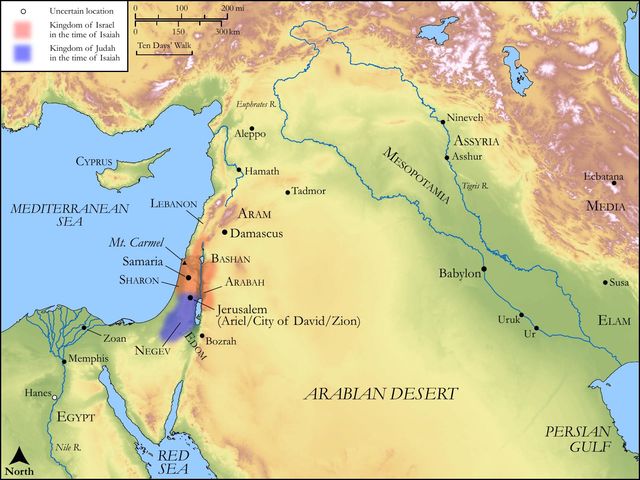
See on the biblical-era map
Study this verse
Public-domain commentary
Matthew Henry
From his Commentary on the Whole Bible. Henry comments on passages, not single verses — this entry covers Isaiah 34:1–8. His three-level outline is real structure in the source text, so it is rendered as structure.
Here we have a prophecy, as elsewhere we have a history, of the wars of the Lord, which we are sure are all both righteous and successful. This world, as it is his creature, he does good to; but as it is in the interest of Satan, who is called the god of this world, he fights against it.
I.Here is the trumpet sounded and the war proclaimed, Isa 34:1.
All nations must hear and hearken, not only because what God is about to do is well worthy their remark (as Isa 33:13), but because they are all concerned in it; it is with them that God has a quarrel; it is against them that God is coming forth in wrath. Let them all take notice that the great God is angry with them; his indignation is upon all nations, and therefore let all nations come near to hear. The trumpet is blown in the city (Amo 3:6), and the watchmen on the walls cry, Hearken to the sound of the trumpet, Jer 6:17. Let the earth hear, and the fulness thereof, for it is the Lord's (Psa 24:1) and ought to hearken to its Maker and Master. The world must hear, and all things that come forth of it, the children of men, that are of the earth earthy, come out of it, and must return to it; or the inanimate products of the earth are called to, as more likely to hearken than sinners, whose hearts are hardened against the calls of God. Hear, O you mountains! the Lord's controversy, Mic 6:2. It is so just a controversy that all the world may be safely appealed to concerning the equity of it.
II.Here is the manifesto published, setting forth,
1.Whom he makes war against (Isa 34:2): The indignation of the Lord is upon all nations; they are all in confederacy against God and religion, all in the interests of the devil, and therefore he is angry with them all, even with all the nations that forget him. He has long suffered all nations to walk in their own ways (Act 14:16), but now he will no longer keep silence. As they have all had the benefit of his patience, so they must all expect now to feel his resentments. His fury is in a special manner upon all their armies,
(1.)Because with them they have done mischief to the people of God; those are they that have made bloody work with them, and therefore they must be sure to have blood given them to drink.
(2.)Because with them they hope to make their part good against the justice and power of God they trust to them as their defence, and therefore on them, in the first place, God's fury will come. Armies before God's fury are but as dry stubble before a consuming fire, though ever so numerous and courageous.
2.Whom he makes war for, and what are the grounds and reasons of the war (Isa 34:8): It is the day of the Lord's vengeance, and he it is to whom vengeance belongs, and who is never unrighteous in taking vengeance, Rom 3:5. As there is a day of the Lord's patience, so there will be a day of his vengeance; for, though he bear long, he will not bear always. It is the year of recompences for the controversy of Zion. Zion is the holy city, the city of our solemnities, a type and figure of the church of God in the world. Zion has a just quarrel with her neighbours for the wrongs they have done her, for all their treacherous and barbarous usage of her, profaning her holy things, laying waste her palaces, and slaying her sons. She has left it to God to plead her cause, and he will do so when the time, even the set time, to favour Zion shall have come; then he will recompense to her persecutors and oppressors all the mischiefs they have done her. The controversy will be decided, that Zion has been wronged, and therein Zion's God has been himself abused. Judgment will be given upon this decision, and execution done. Note, There is a time prefixed in the divine counsels for the deliverance of the church and the destruction of her enemies, a year of the redeemed, which will come, a year of recompences for the controversy of Zion; and we must patiently wait till then, and judge nothing before the time.
III.Here are the operations of the war, and the methods of it, settled, with an infallible assurance of success.
1.The sword of the Lord is bathed in heaven; this is all the preparation here made for the war, Isa 34:5. It may probably allude to some custom they had then of bathing their swords in some liquor or other, to harden them or brighten them; it is the same with the furbishing of it, that it may glitter, Eze 21:9-11. God's sword is bathed in heaven, in his counsel and decree, in his justice and power, and then there is not standing before it.
2.It shall come down. What he has determined shall without fail be put in execution. It shall come down from heaven, and the higher the place is, whence it comes, the heavier will it fall. It will come down upon Idumea, the people of God's curse, the people that lie under his curse and are by it doomed to destruction. Miserable, for ever miserable, are those that have by their sins made themselves the people of God's curse; for the sword of the Lord will infallibly attend the curse of the Lord and execute the sentences of it; and those whom he curses are cursed indeed. It shall come down to judgment, to execute judgment upon sinners. Note, God's sword of war is always a sword of justice. It is observed of him out of whose mouth goeth the sharp sword that in righteousness he doth judge and make war, Rev 19:11, Rev 19:15.
3.The nations and their armies shall be given up to the sword (Isa 34:2): God has delivered them to the slaughter, and then they cannot deliver themselves, nor can all the friends they have deliver them from it. Those only are slain whom God delivers to the slaughter, for the keys of death are in his hand; and, in delivering them to the slaughter, he has utterly destroyed them; their destruction is as sure, when God has doomed them to it, as if they were destroyed already, utterly destroyed. God has, in effect, delivered all the cruel enemies of his church to the slaughter by that word (Rev 13:10), He that kills with the sword must be killed by the sword, for the Lord is righteous.
4.Pursuant to the sentence, a terrible slaughter shall be made among them (Isa 34:6): The sword of the Lord, when it comes down with commission, does vast execution; it is filled, satiated, surfeited, with blood, the blood of the slain, and made fat with their fatness. When the day of God's abused mercy and patience is over the sword of his justice gives no quarter, spares none. Men have by sin lost the honour of the human nature and made themselves like the beasts that perish; they are therefore justly denied the compassion and respect that are owing to the human nature and killed as beasts, and no more is made of slaying an army of men than of butchering a flock of lambs or goats and feeding on the fat of the kidneys of rams. Nay, the sword of the Lord shall not only dispatch the lambs and goats, the infantry of their armies, the poor common soldiers, but (Isa 34:7) the unicorns too shall be made to come down with them, and the bullocks with the bulls, though they are ever so proud, and strong, and fierce (the great men, and the mighty men, and the chief captains Rev 6:15), the sword of the Lord will make as easy a prey of as of the lambs and the goats. The greatest of men are nothing before the wrath of the great God. See what bloody work will be made: The land shall be soaked with blood, as with the rain that comes often upon it and in great abundance; and their dust, their dry and barren land, shall be made fat with the fatness of men slain in their full strength, as with manure. Nay even the mountains, which are hard and rocky, shall be melted with their blood, Isa 34:3. These expressions are hyperbolical (as St. John's vision of blood to the horse-bridles, Rev 14:20), and are made use of because they sound very dreadful to sense (it makes us even shiver to think of such abundance of human gore), and are therefore proper to express the terror of God's wrath, which is dreadful beyond conception and expression. See what work sin and wrath make even in this world, and think how much more terrible the wrath to come is, which will bring down the unicorns themselves to the bars of the pit.
5.This great slaughter will be a great sacrifice to the justice of God (Isa 34:6): The Lord has a sacrifice in Bozrah; there it is that the great Redeemer has his garments dyed with blood, Isa 63:1. Sacrifices were intended for the honour of God, to make it appear that he hates sin and demands satisfaction for it, and that nothing but blood will make atonement; and for these ends the slaughter is made, that in it the wrath of God may be revealed from heaven against all the ungodliness and unrighteousness of men, especially their ungodly unrighteous enmity to his people, which was the sin that the Edomites were notoriously guilty of. In great sacrifices abundance of beasts were killed, hecatombs offered, and their blood poured out before the altar; and so will it be in this day of the Lord's vengeance. And thus would the whole earth have been soaked with the blood of sinners if Jesus Christ, the great propitiation, had not shed his blood for us; but those who reject him, and will not make a covenant with God by that sacrifice, will themselves fall as victims to divine wrath. Damned sinners are everlasting sacrifices, Mar 9:48, Mar 9:49. Those that sacrifice not (which is the character of the ungodly, Ecc 9:2) must be sacrificed.
6.These slain shall be detestable to mankind, and shall be as much their loathing as ever they were their terror (Isa 34:3): They shall be cast out, and none shall pay them the respect of a decent burial; but their stink shall come up out of their carcases, that all people by the odious smell, as well as by the ghastly sight, may be made to conceive an indignation against sin and a dread of the wrath of God. They lie unburied, that they may remain monuments of divine justice.
7.The effect and consequence of this slaughter shall be universal confusion and desolation, as if the whole frame of nature were dissolved and melted down (Isa 34:4): All the host of heaven shall pine and waste away (so the word is); the sun shall be darkened, and the moon look black, or be turned into blood; the heavens themselves shall be rolled together as a scroll or parchment when we have done with it, and lay it by, or as when it is shrivelled up by the heat of the fire. The stars shall fall as the leaves in autumn; all the beauty, joy, and comfort, of the vanquished nation shall be lost and done away, magistracy and government shall be abolished, and all dominion and rule, but that of the sword of war, shall fall. Conquerors, in those times, affected to lay waste the countries they conquered; and such a complete desolation is here described by such figurative expressions as will yet have a literal and full accomplishment in the dissolution of all things at the end of time, of which last day of judgment the judgments which God does now sometimes remarkably execute on sinful nations are figures, earnests, and forerunners; and by these we should be awakened to think of that, for which reason these expressions are used here and Rev 6:12, Rev 6:13. But they are used without a metaphor, Pe2 3:10, where we are told that the heavens shall pass away with a great noise and the earth shall be burnt up.
Historical interpretation
Two Centuries of Reception
2 surviving comments on this verse. Each one is dated, so this reads as a timeline rather than a list.
Select a marker to jump to its quote. Markers stagger vertically where authors wrote within a few decades of each other.
(Verses 8 and following) For it is the day of the Lord's vengeance, the year of retribution in the judgment of Zion. Its streams will be turned into pitch, and its soil into sulfur; its land will become burning pitch. Night and day it will not be extinguished; its smoke will go up forever. From generation to generation it will lie desolate; no one will pass through it forever. The pelican and the hedgehog will possess it, the owl and the raven will dwell in it. It will be stretched out with a measuring line, and it will be reduced to nothing, and its plumb line to desolation. Her nobles will not be there; rather, they will call upon the king, and all his princes will be nothing. Thorns, thistles, and briers will grow in his palaces; it will become a haunt for jackals, a feeding place for ostriches. And wild creatures will meet with hyenas; the wild goat will cry to his fellow; indeed, there the night bird settles and finds for herself a resting place. There the owl nests and lays and hatches and gathers her young in her shadow; indeed, there the hawks are gathered, each one with her mate. Search diligently in the book of the Lord and read. One of them did not fail, and one did not seek the other. For what proceeds from my mouth, he commanded, and his spirit gathered them. And he sent them a lot, and his hand divided it for them in measure; they will possess it forever, and they will dwell in it from generation to generation. The Hebrews, as we have said above, contend that these things are prophesied about the Roman Empire and are preached as a vengeance on Zion, the former devastation of the most powerful kingdom, which many of ours also think is written in the Apocalypse of John according to the letter. But we consider this to be the year of the vengeance of the Lord, the year of retributions and judgments in Zion, of which the Savior himself spoke: 'The Spirit of the Lord is upon me, because he has anointed me to bring good news to the poor; he has sent me to proclaim release to the captives and recovery of sight to the blind, to let the oppressed go free, to proclaim the year of the Lord's favor.' (Luke 4:18-19, Isaiah 61:1-3). Also, as it is written: 'Rise up, you women who are at ease.' (Isaiah 32:9). And remember the days of the year in sorrow with hope, so that, after the general consummation of the whole world, the prophecy may return to Jerusalem, to which it was spoken at that time, and its devastation be described in full detail: namely, that after the time of the Roman siege has come, everything will be consumed by pitch, sulfur, and burning flames, and its smoke will remain forever, and it will be inhabited by the pelican and the hedgehog, and the ibis and the raven, which are creatures accustomed to inhabiting desolate places. And let this be done, because the cord and the plumb line of the Lord, that is, his judgment, cannot be changed. His nobles, that is, the Apostles and believers, will not be there, nor will they be joined with the number of the damned: but rather they will invoke King Christ. But all the leaders of the city, namely the Scribes and the Pharisees, will be reduced to nothingness, and thorns and nettles and brambles will grow in their once ornate houses. And there will be a haunt for dragons, and pastures for ostriches, which themselves are signs of extreme desolation. And there they will encounter, according to the LXX, various apparitions of demons, or as all others have translated according to the Hebrew, Siim and Iim, onocentaurs, and shaggy figures, and lamia, which the fables of the Gentiles and the creations of poets describe. Also, there the hedgehog nurtures its puppies, and it has a very faithful watchpost: there the kites gather, a very carnivorous bird, which in Hebrew is called Dajoth (or, as the LXX translated, deer, which we will discuss later). Among these things, the Prophet speaks to those who hear: O men (or, all) who hear me speaking, what I announce about the future, all things will be fulfilled. For in the book the words of the Lord are written, and His intention is determined, and not even one thing will be in vain. For whatever proceeds from my mouth, he has commanded, that is, I speak on his behalf; but the words are the Lord's, and by his spirit whatever is said will be accomplished. Each thing will be fulfilled according to his decree and measure: and they will not leave their order even unto eternal generations. Let these things be said according to the Hebrew and historical explanation. Moreover, those who follow the allegory, expelling the people of the Jews under the names of beasts and monsters, affirm that they will dwell in Jerusalem, serving idols and various superstitions: and these are the onocrotali and hedgehogs, the raven and dragons, and ostriches, and onocentaurs, and demons, and shaggy creatures, and the lamia, which is called Lilith in Hebrew (); and the lamia has been translated from the ground by Symmachus, which some Hebrews suspect to be the Fury. And indeed, if we consider the various colonies brought to Jerusalem from different nations, and according to the customs of their provinces, each family worshipped their own demons as wonders, we will affirm that all of this existed in Jerusalem. And what the LXX translated: 'There the deer met them and saw their own faces: they passed by in number, and not one of them perished or sought another. For the Lord commanded them, and his spirit gathered them; and he himself gave them lots, and his hand divided them: that they may feed forever, and possess it in generation after generation, and rest in it.' We will interpret this allegorically, teaching that the deer, that is, the Apostles and all holy teachers, about whom it is written: 'As the deer longs for the fountains of water, so my soul longs for you, O God' (Ps. 41:1); and elsewhere: 'The voice of the Lord perfects the deer' (Ps. 28:9); and again: 'Let the deer of friendship and the colt of your graces speak to you' (Prov. 5); and in Job: 'You keep the minds of the deer, and you send forth their offspring' (Job. 39:2); and in the Song of Songs it is said: 'My beloved is like a roe or a young deer on the mountains of spices' (Song. 2:9); that they met each other in Jerusalem and saw each other's appearances, and passed by and left it, and went to different provinces, because the Lord had commanded them: 'Go and teach all nations, baptizing them in the name of the Father, and of the Son, and of the Holy Spirit' (Matthew 28:19); and his spirit gathered them, giving them lots and dividing them, so that some would go to the Indians, others to Spain, others to Illyricum, others to Greece; and each would rest in their own province of the Gospel and teaching. What we have said above about Jerusalem being prophesied, and the Jews suspecting that it refers to the Roman rule, some people attribute to the whole world, so as not to seem to differ from the earlier interpretations.
It [sacred Scripture] has a dreadful appearance when, describing hell, it says, “The day of the vengeance of the Lord, the year of recompense of the judgment of Zion. And the streams thereof shall be turned into pitch, and the ground thereof into brimstone: and the land thereof shall become burning pitch. Night and day it shall not be quenched … forever.”
Continue studying Isaiah 34:8 across the web’s major study libraries — every link below opens this exact verse, chapter, or book on the destination site.
Read & Compare
 BibleGatewayThis verse in more than 200 translations and 70 languages.
 Bible.comThe YouVersion reader — hundreds of translations, reading plans, and highlights.
 ESV.orgCrossway's official English Standard Version reader.
 NET BibleThe NET translation with 60,000+ translators' notes on every rendering decision.
 STEP BibleTyndale House's free study tool — original text, vocabulary, and scholarly resources.
 BibliaLogos Bible Software's free web reader.
 USCCBThe New American Bible (Revised Edition) with the U.S. bishops' study notes.
Commentaries
 BibleHub CommentariesDozens of classic commentaries on this verse, gathered on one page.
 StudyLightMore than 100 commentary sets — the largest collection on the web.
 BibleRefPlain-English commentary on what this verse means, verse by verse.
 Enduring WordDavid Guzik's free commentary on this chapter, widely used by Bible teachers.
 Bible Study ToolsVerse commentary alongside Greek and Hebrew study aids.
Original Language & Research
- BibleHub InterlinearThe verse word by word — original language, transliteration, and English.
- BibleHub LexiconEvery word's original-language definition and Strong's entry.
 Blue Letter BibleDeep-study tools — Strong's numbers, concordance, and word studies.
 SefariaThe Hebrew text with Rashi and centuries of Jewish commentary.
Sermons, Hymns & Audio


TrulyRandomVerse is not affiliated with these sites and doesn’t control their content. They’re linked because they’re genuinely useful.
Summary
Isaiah 34:8 serves as a profound declaration of divine judgment, pinpointing a specific, appointed time when God's righteous wrath will be decisively unleashed upon those who oppose Him. This verse powerfully underscores the Lord's active role as the ultimate arbiter of justice, bringing a full and equitable requital for the long-standing grievances and profound suffering endured by His covenant people, Zion. In doing so, it unequivocally vindicates them and demonstrates His unwavering commitment to His covenant promises and His perfect moral order.
Context
ShowHideLiterary Context
Isaiah 34:8 is strategically placed within a sweeping prophetic oracle (Isaiah 34-35) that masterfully contrasts universal judgment with ultimate salvation. Chapter 34, in particular, meticulously details a catastrophic divine judgment destined for the nations, with a pronounced focus on Edom, a perennial adversary of Israel. The preceding verses, from Isaiah 34:1-7, paint a vivid and terrifying picture of upheaval in the heavens and earthly desolation, depicting the slaughter of armies and the transformation of the land into an uninhabitable wasteland. Within this dramatic tableau, verse 8 functions as the crucial interpretive key, revealing that the described destruction is not random chaos but a deliberate, purposeful, and divinely ordained act of justice. The subsequent verses, Isaiah 34:9-17, then elaborate on the perpetual ruin of Edom as a direct, irreversible consequence of this "day of the LORD'S vengeance," emphasizing the absolute finality and thoroughness of God's retribution.
Historical & Cultural Context
The primary object of this specific prophecy, Edom, was a nation descended from Esau, Jacob's brother, and maintained a long, bitter history of animosity, betrayal, and opportunistic aggression towards Israel. Their historical transgressions included refusing passage to Israel during the Exodus (as recounted in Numbers 20:14-21) and, notably, exploiting Judah's vulnerability during the Babylonian conquest (a betrayal condemned in Obadiah 1:10-14). In Hebrew thought, the concept of "vengeance," especially when attributed to a deity, was not akin to human spite, vindictiveness, or emotional retaliation. Instead, it represented a righteous, necessary act of restoring moral order, upholding justice, and enforcing covenant stipulations. It was God's just and holy response to persistent wickedness, covenant-breaking, and unrepentant sin. "Zion" here refers to Jerusalem, the revered capital of Judah and the spiritual heart of God's covenant people, representing the community that had suffered profound injustices and oppression at the hands of nations like Edom.
Key Themes
ShowHideThis verse powerfully articulates several core theological and narrative themes prevalent throughout Isaiah's extensive prophecy and the broader Old Testament. Firstly, it highlights Divine Sovereignty and Justice, portraying God as the supreme, active Judge who intervenes decisively in human history to rectify wrongs and execute His righteous decrees. Secondly, it emphasizes the profound motif of The Day of the Lord, a recurring prophetic concept signifying a decisive, often cataclysmic, intervention by God to judge the wicked and deliver His people; here, it is explicitly defined as a day of punitive action. Thirdly, the verse underscores the Vindication of Zion, demonstrating God's unwavering faithfulness to His covenant people by taking up their "controversy" and bringing a just "recompense" against their oppressors. This theme powerfully reinforces God's role as the divine plead the cause of the oppressed, assuring that justice will ultimately prevail for His chosen ones, a truth beautifully echoed in Isaiah 62:1-2.
Exposition and Analysis
ShowHideKey Word Analysis
ShowHideThis term signifies far more than a mere 24-hour period; it denotes a specific, appointed, and profoundly significant space of time defined by an associated event or action. In this context, it marks the divinely ordained period during which God's decisive and certain judgment will unfold, emphasizing its predetermined nature and inevitability.
When applied to divine action, nâqâm refers to righteous retribution and the restoration of moral order, rather than personal spite or vindictiveness. It represents God's just and holy response to wickedness, injustice, and the violation of His covenant, ensuring that wrongs are set right and His perfect holiness is upheld.
This term implies a legal dispute, a lawsuit, or a profound grievance. It vividly portrays God acting as the divine advocate or legal representative for Zion, taking up their case against those who have wronged them. It underscores that the ensuing judgment is a just and necessary resolution to a long-standing legal or moral conflict.
This word signifies a requital, a full and just payment, or a deserved retribution. It powerfully underscores the idea that God's judgment is a precise and equitable settlement for all actions, ensuring that every deed receives its appropriate consequence, thereby perfectly balancing the scales of divine justice.
Verse Breakdown
ShowHide"For [it is] the day of the LORD'S vengeance"
This opening clause unequivocally declares the nature of the impending divine action. It is a specific, appointed time ("the day") when the sovereign Lord (Yahweh, the covenant God of Israel) will execute His righteous and holy retribution ("vengeance"). This "day" is not a random occurrence but a divinely ordained intervention, signifying a decisive and climactic moment of judgment in history.
"[and] the year of recompences"
This phrase expands upon the preceding one, emphasizing the thoroughness, completeness, and potentially the duration of the judgment. The use of "year" (Hebrew: shâneh) suggests a full cycle or a protracted period of divine action, indicating that the retribution will be comprehensive and exhaustive. "Recompences" (Hebrew: shillûwm) highlights that this judgment is a just and deserved repayment, a full settlement for past wrongs, ensuring that justice is served completely and without deviation.
"for the controversy of Zion"
This final clause reveals the specific reason and the ultimate beneficiary of God's decisive action. "Controversy" (Hebrew: rîyb) refers to the legal case, grievance, or dispute that Zion (Jerusalem, representing God's covenant people) has endured at the hands of its adversaries. The Lord is acting as Zion's divine advocate, taking up their cause, vindicating His people, and bringing a just and final conclusion to their long-standing grievances against those who oppressed them.
Literary Devices
ShowHideIsaiah 34:8 masterfully employs several literary devices to convey its powerful and solemn message of divine judgment. The most prominent is Parallelism, specifically synonymous parallelism, where "the day of the LORD'S vengeance" is expertly echoed and reinforced by "the year of recompences for the controversy of Zion." Both phrases convey the same core idea of a divinely appointed time of justice and retribution, with the complementary use of "day" and "year" emphasizing the certainty, comprehensiveness, and perhaps the prolonged nature of this period of divine action. There is also a subtle yet significant use of Metonymy, where "Zion" stands in for the people of Israel or Judah, the covenant community. The "controversy" is not merely about the physical city but profoundly about the injustices inflicted upon God's chosen people. Furthermore, the phrase "controversy of Zion" can be seen as a form of Personification, as Zion, a city or people, is depicted as having a legal "case" or "grievance" that God Himself takes up, casting Him as the ultimate advocate for the wronged and the divine resolver of all disputes.
Theological and Thematic Connections
ShowHideIsaiah 34:8 profoundly articulates God's unwavering commitment to justice and His steadfast covenant faithfulness. It reveals a God who is not passive in the face of widespread wickedness but actively intervenes to uphold His righteousness and vindicate His people. The "day of the LORD" is a recurring and central theological motif that signifies God's decisive and often cataclysmic intervention in human history, here specifically for judgment against those who oppose His will and harm His chosen ones. This concept offers immense assurance to the oppressed that their suffering is seen, heard, and will ultimately be addressed, while simultaneously serving as a stern and solemn warning to the unrighteous that accountability is absolutely certain. God's "vengeance" is not a human emotion driven by malice but a holy act of setting the world aright, a necessary component of His perfect justice that ensures recompense for every wrong.
Reflection and Application
ShowHideIsaiah 34:8 offers profound and enduring truths that resonate deeply with believers across all generations. For those who experience injustice, persecution, or feel overwhelmed by the prevailing evil in the world, this verse provides immense comfort and unwavering assurance. It powerfully reminds us that God sees every wrong, hears every cry, and will ultimately act as the righteous Judge, bringing a full and just recompense. This should cultivate a patient and unwavering trust in His perfect timing and sovereign plan, knowing that His justice, though sometimes delayed from our perspective, is absolutely certain and unavoidable. Conversely, for those who might be tempted to oppress, mock, or disregard God's commands and His people, this verse serves as a solemn and urgent warning. It underscores the undeniable reality of divine accountability and the inevitability of a day when all actions will receive their just reward or punishment. Therefore, we are called to live righteously, to extend mercy and forgiveness, and to trust in God's ultimate vindication, rather than taking vengeance into our own hands.
Questions for Reflection
ShowHideFAQ
ShowHideIs God's "vengeance" in this verse similar to human revenge?
ShowHideNo. God's "vengeance" (Hebrew: nâqâm) as described in Isaiah 34:8 is fundamentally different from human revenge. Human revenge is often driven by personal malice, uncontrolled anger, or a desire for retribution outside of true justice. In stark contrast, God's vengeance is a righteous act of divine justice. It is His sovereign and holy response to persistent wickedness, pervasive injustice, and unrepentant rebellion against His moral order and His covenant. Its ultimate purpose is to set things right, to uphold His perfect holiness, and to vindicate His wronged people, as powerfully echoed in later scriptures like Deuteronomy 32:35 and Romans 12:19. It is a measured, just, and perfect act of retribution, never an impulsive or vindictive one.
Who is "Zion" in this context, and how does God's action relate to them?
ShowHideIn the immediate context of Isaiah, "Zion" (Hebrew: Tsîyôwn) primarily refers to Jerusalem and, by extension, the people of Judah or Israel. It represents God's covenant people and the sacred place where His presence dwells. The "controversy of Zion" (Hebrew: rîyb Tsîyôwn) refers to the legal case, profound grievance, or suffering that Zion has endured at the hands of its enemies, particularly nations like Edom who consistently opposed God's purposes. God's action in Isaiah 34:8 signifies His role as Zion's divine advocate and defender. He is actively taking up their cause, bringing a just "recompense" against those who have oppressed, mocked, or violated His chosen people, thereby vindicating them and demonstrating His unwavering faithfulness to His covenant promises and His people.
What is the significance of "the day of the LORD" in this verse?
ShowHide"The day of the LORD" (Hebrew: yôwm Yᵉhôvâh) is a recurring, central, and profoundly significant prophetic motif throughout the Old Testament, signifying a specific, decisive time when God intervenes dramatically in human history. Its precise nature varies depending on the context, sometimes bringing glorious salvation and sometimes severe judgment. In Isaiah 34:8, it is explicitly characterized as a "day of the LORD'S vengeance" and a "year of recompenses." This strongly emphasizes its punitive aspect, indicating a period of intense divine judgment against the wicked and those who oppose God's purposes, particularly on behalf of His suffering people. It highlights God's absolute sovereignty, His active and personal involvement in history, and the certainty of ultimate accountability for all nations and individuals.
Christ-Centered Fulfillment
ShowHideWhile Isaiah 34:8 speaks of a specific historical judgment, particularly against Edom, its profound theological principles find their ultimate, comprehensive, and eternal fulfillment in Jesus Christ. The "day of the LORD'S vengeance" foreshadows the ultimate and final judgment to be executed by the Son of God Himself, to whom "the Father judges no one, but has given all judgment to the Son" (John 5:22). Christ's first coming inaugurated an era of grace and salvation, offering redemption to all who believe, but His second coming will be the definitive and inescapable "day of recompenses." At that glorious and terrifying return, He will appear "in flaming fire, inflicting vengeance on those who do not know God and on those who do not obey the gospel of our Lord Jesus" (2 Thessalonians 1:7-9). The "controversy of Zion," representing the myriad grievances, injustices, and suffering of God's people throughout history, finds its ultimate resolution and perfect vindication in Christ's triumph over sin, death, and all opposing powers. The church, as the spiritual "heavenly Jerusalem" (Hebrews 12:22-24), is the new Zion for whom Christ perfectly intercedes and whose ultimate deliverance, glorification, and eternal justice are irrevocably guaranteed through His finished work on the cross and His promised return. Thus, the justice and recompense promised in Isaiah find their perfect and final expression in the person and redemptive work of Jesus Christ, the righteous Judge and faithful Redeemer of all humanity.