


Isaiah 34:9
Bible text: King James Version (1769 Blayney text) · Public domain
Bible text: Berean Standard Bible · Public domain
Bible text: American Standard Version (1901) · Public domain
Bible text: World English Bible, Messianic edition · Public domain
Bible text: Geneva Bible (1599) · Public domain
Bible text: Young's Literal Translation · Public domain
- וְנֶהֶפְכוּve·ne·hef·Khuand they will be changedH2015Conj-w ¦ V-Niphal-ConsecPerf-3cpVerb Niphal Consecutive Perfect 3rd Plural common genderוְandנֶהֶפְכוּthey will be changed
- נְחָלֶיהָne·cha·Lei·haits torrentsH5158N-mpc ¦ 3fsNoun Plural Masculine Constructנְחָלֶיtorrentsהָits
- לְזֶפֶתle·Ze·fetinto pitchH2203Prep-l ¦ N-fsNoun Singular Feminine Absoluteלְintoזֶפֶתpitch
- וַעֲפָרָהּva·'a·fa·Rahand its dustH6083Conj-w ¦ N-msc ¦ 3fsNoun Singular Masculine Constructוַandעֲפָרָdustהּits
- לְגָפְרִיתle·ga·fe·Ritinto sulfurH1614Prep-l ¦ N-fsNoun Singular Feminine Absoluteלְintoגָפְרִיתsulfur
- וְהָיְתָהve·ha·ye·Tahand it will becomeH1961Conj-w ¦ V-Qal-ConsecPerf-3fsVerb Qal Consecutive Perfect 3rd Singular Feminineוְandהָיְתָהit will become
- אַרְצָהּ'ar·Tzahits landH776N-fsc ¦ 3fsNoun Singular Feminine Constructאַרְצָlandהּits
- לְזֶפֶתle·Ze·fet<into> pitchH2203Prep-l ¦ N-fsNoun Singular Feminine Absoluteלְ<into>זֶפֶתpitch
- בֹּעֵרָהbo·'e·RahburningH1197V-Qal-Prtcpl-fsVerb Qal Participle Singular Feminine Absolute
English is a literal word-by-word gloss of the Hebrew, not the KJV's wording. Why?
This is the original text the KJV's translators worked from — each Hebrew word with its own literal English meaning in this verse, prepared by scholars at Tyndale House, Cambridge. The KJV translates whole sentences, not word by word, so its wording differs: one Hebrew word can become several English words, and the KJV may choose “the LORD” where the gloss reads “Yahweh”. Both are faithful — they answer different questions. For the KJV's own rendering, switch to the KJV text.
Details
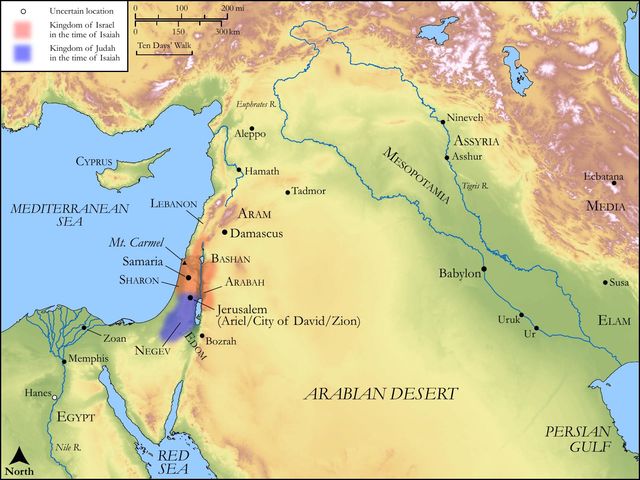
See on the biblical-era map
Study this verse
Public-domain commentary
Matthew Henry
From his Commentary on the Whole Bible. Henry comments on passages, not single verses — this entry covers Isaiah 34:9–17. His two-level outline is real structure in the source text, so it is rendered as structure.
This prophecy looks very black, but surely it looks so further than upon Edom and Bozrah. 1. It describes the melancholy changes that are often made by the divine Providence, in countries, cities, palaces, and families. Places that have flourished and been much frequented strangely go to decay. We know not where to find the places where many great towns, celebrated in history, once stood. Fruitful countries, in process of time, are turned into barrenness, and pompous populous cities into ruinous heaps. Old decayed castles look frightful, and their ruins are almost as much dreaded as ever their garrisons were. 2. It describes the destroying judgments which are the effects of God's wrath and the just punishment of those that are enemies to his people, which God will inflict when the year of the redeemed has come, and the year of recompences for the controversy of Zion. Those that aim to ruin the church can never do that, but will infallibly ruin themselves. 3. It describes the final desolation of this wicked world, which is reserved unto fire at the day of judgment, Pe2 3:7. The earth itself, when it, and all the works that are therein, shall be burnt up, will (for aught I know) be turned into a hell to all those that set their affections on earthly things. However, this prophecy shows us what will be the lot of the generation of God's curse.
I.The country shall become like the lake of Sodom, Isa 34:9, Isa 34:10.
The streams thereof, that both watered the land and pleased and refreshed the inhabitants, shall now be turned into pitch, shall be congealed, shall look black, and shall move slowly, or not at all. Their floods to lazy streams of pitch shall turn; so Sir R. Blackmore. The dust thereof shall be turned into brimstone; so combustible has sin made their land that it shall take fire at the first spark of God's wrath struck upon it; and, when it has taken fire, it shall become burning pitch; the fire shall be universal, not a house, or town, on fire, but a whole country; and it shall not be in the power of any to suppress or extinguish it. It shall burn continually, burn perpetually, and shall not be quenched night nor day. The torment of those in hell, or that have a hell within them in their own consciences, is without interruption; the smoke of this fire goes up for ever. As long as there are provoking sinners on earth, from one generation to another, an increase of sinful men, to augment the fierce anger of the Lord (Num 32:14), there will be a righteous God in heaven to punish them for it. And as long as a people keep up a succession of sinners God will have a succession of plagues for them; nor will any that fall under the wrath of God be ever able to recover themselves. It will be found, how light soever men make of it, that it is a fearful thing to fall into the hands of the living God. If the land be doomed to destruction, none shall pass through it, but travellers will choose rather to go a great way about than come within the smell of it.
II.The cities shall become like old decayed houses, which, being deserted by the owners, look very frightful, being commonly possessed by beasts of prey or birds of ill omen. See how dismally the palaces of the enemy look; the description is peculiarly elegant and fine.
1.God shall mark them for ruin and destruction. He shall stretch out upon Bozrah the line of confusion with the stones or plummets of emptiness, Isa 34:11. This intimates the equity of the sentence passed upon it; it is given according to the rules of justice and the exact agreeableness of the execution with the sentence; the destruction is not wrought at random, but by line and level. The confusion and emptiness that shall overspread the face of the whole country shall be like that of the whole earth when it was Tohu and Bohu (the very words here used) - without form and void. Gen 1:2. Sin will soon turn a paradise into a chaos, and sully the beauty of the whole creation. When there is confusion there will soon be emptiness; but both are appointed by the governor of the world, and in exact proportions.
2.Their great men shall be all cut off, and none of them shall dare to appear (Isa 34:12): They shall call the nobles of the kingdom to take care of the arduous affairs which lie before them, but none shall be there to take this ruin under their hand, and all her princes, having the sad tidings brought them, shall be nothing, shall be at their wits' end, and not be able to stand them in stead, to shelter them from destruction.
III.Even the houses of state, and those of strength, shall become as wildernesses (Isa 34:13); not only grass shall grow, but thorns shall come up, in her palaces, nettles and brambles in the fortresses thereof, and there shall be none to cut them up or tread them down. We sometimes see ruined buildings thus overgrown with rubbish. It intimates that the place shall not only be uninhabited and unfrequented where a full court used to be kept, but that it shall be under the curse of God; for thorns and thistles were the production of the curse, Gen 3:18.
IV.They shall become the residence and rendezvous of fearful frightful beasts and birds, which usually frequent such melancholy places, because there they may be undisturbed, and, when they are frightened thither, they help to frighten men thence. This circumstance of the desolation, being apt to strike a horror upon the mind, is much enlarged upon here, Isa 34:11. The cormorant shall possess it, or the pelican, which affects to be solitary (Psa 102:6); and the bittern, which makes a hideous noise, the owl, a melancholy bird, the raven, a bird of prey, invited by the dead carcases, shall dwell there (with all the ill-boding monsters of the air, Sir R. B.), all the unclean birds, which were not for the service of man, Isa 34:13. It shall be a habitation for dragons, which are poisonous and hurtful.
And in their lofty rooms of state,
Where cringing sycophants did wait,
Dragons shall hiss and hungry wolves shall howl;
In courts before by mighty lords possess'd
The serpent shall erect his speckled crest,
Or fold his circling spires to rest.
- Sir R. Blackmore
That which was a court for princes shall now be a court for owls or ostriches, Isa 34:14. The wild beasts of the desert, the dry and sandy country, shall meet, as it were by appointment, with the wild beasts of the island, the wet marshy country, and shall regale themselves with such a perfect desolation as they shall find there.
Leopards, and all the rav'ning brotherhoods
That range the plains, or lurk in woods,
Each other shall invite to come,
And make this wilder place their home.
Fierce beasts of every frightful shape and size
Shall settle here their bloody colonies.
- Sir R. Blackmore
The satyr shall cry to his fellow to go with him to this desert place, or, being there, they shall please themselves that they have found such an agreeable habitation. There shall the screech-owl rest, a night-bird and an ominous one. The great owl shall there make her nest (Isa 34:15) and lay and hatch; the breed of them shall be kept up to provide heirs for this desolate place. The vultures which feast on carcases, shall be gathered there, every one with his mate. Now observe, 1. How the places which men have deserted, and keep at a distance from, are proper receptacles for other animals, which the providence of God takes care of, and will not neglect. 2. Whom those resemble that are morose, unsociable, and unconversable, and affect a melancholy retirement; they are like these solitary creatures that take delight in desolations. 3. What a dismal change sin makes; it turns a fruitful land into barrenness, a frequented city into a wilderness.
V.Here is an assurance given of the full accomplishment of this prediction, even to the most minute circumstance of it (Isa 34:16, Isa 34:17):
"Seek you out of the book of the Lord and read. When this destruction comes compare the event with the prediction, and you will find it to answer exactly." Note, The book of the prophets is the book of the Lord, and we ought to consult it and converse with it as of divine origin and authority. We must not only read it, but see out of it, search into it, turn first to one text and then to another and compare them together. Abundance of useful knowledge might thus be extracted, by a diligent search, out of the scriptures, which cannot be got by a superficial reading of them. When you have read the prediction out of the book of the Lord then observe,
1.That according to what you have read so you see; not one of these shall fail, either beast or fowl: and, it being foretold that they shall possess it from generation to generation, in order to that, that the species may be propagated, none shall want her mate; these marks of desolation shall be fruitful, and multiply, and replenish the land.
2.That God's mouth having commanded this direful muster his Spirit shall gather them, as the creatures by instinct were gathered to Adam to be named and to Noah to be housed. What God's word has appointed his Spirit will effect and bring about, for no word of God shall fall to the ground. The word of God's promise shall in like manner be accomplished by the operations of the Spirit.
3.That there is an exact order and proportion observed in the accomplishment of this threatening: He has cast the lot for these birds and beasts, so that each one shall know his place as readily as if it were marked by line. See the like, Joe 2:7, Joe 2:8, They shall not break their ranks, neither shall one thrust another. The soothsayers among the heathen foretold events by the flight of birds, as if the fate of men depended on them. But here we find that the flight of birds is under the direction of the God of Israel: he has cast the lot for them.
4.That the desolation shall be perpetual: They shall possess it for ever. God's Jerusalem may be laid in ruins; but Jerusalem of old recovered itself out of its ruins, till it gave place to the gospel Jerusalem, which may be brought low, but shall be rebuilt, and shall continue till it give place to the heavenly Jerusalem. But the enemies of the church shall be for ever desolate, shall be punished with an everlasting destruction.
Historical interpretation
Historical reception
1 surviving comment on this verse from the historical church.
(Verses 8 and following) For it is the day of the Lord's vengeance, the year of retribution in the judgment of Zion. Its streams will be turned into pitch, and its soil into sulfur; its land will become burning pitch. Night and day it will not be extinguished; its smoke will go up forever. From generation to generation it will lie desolate; no one will pass through it forever. The pelican and the hedgehog will possess it, the owl and the raven will dwell in it. It will be stretched out with a measuring line, and it will be reduced to nothing, and its plumb line to desolation. Her nobles will not be there; rather, they will call upon the king, and all his princes will be nothing. Thorns, thistles, and briers will grow in his palaces; it will become a haunt for jackals, a feeding place for ostriches. And wild creatures will meet with hyenas; the wild goat will cry to his fellow; indeed, there the night bird settles and finds for herself a resting place. There the owl nests and lays and hatches and gathers her young in her shadow; indeed, there the hawks are gathered, each one with her mate. Search diligently in the book of the Lord and read. One of them did not fail, and one did not seek the other. For what proceeds from my mouth, he commanded, and his spirit gathered them. And he sent them a lot, and his hand divided it for them in measure; they will possess it forever, and they will dwell in it from generation to generation. The Hebrews, as we have said above, contend that these things are prophesied about the Roman Empire and are preached as a vengeance on Zion, the former devastation of the most powerful kingdom, which many of ours also think is written in the Apocalypse of John according to the letter. But we consider this to be the year of the vengeance of the Lord, the year of retributions and judgments in Zion, of which the Savior himself spoke: 'The Spirit of the Lord is upon me, because he has anointed me to bring good news to the poor; he has sent me to proclaim release to the captives and recovery of sight to the blind, to let the oppressed go free, to proclaim the year of the Lord's favor.' (Luke 4:18-19, Isaiah 61:1-3). Also, as it is written: 'Rise up, you women who are at ease.' (Isaiah 32:9). And remember the days of the year in sorrow with hope, so that, after the general consummation of the whole world, the prophecy may return to Jerusalem, to which it was spoken at that time, and its devastation be described in full detail: namely, that after the time of the Roman siege has come, everything will be consumed by pitch, sulfur, and burning flames, and its smoke will remain forever, and it will be inhabited by the pelican and the hedgehog, and the ibis and the raven, which are creatures accustomed to inhabiting desolate places. And let this be done, because the cord and the plumb line of the Lord, that is, his judgment, cannot be changed. His nobles, that is, the Apostles and believers, will not be there, nor will they be joined with the number of the damned: but rather they will invoke King Christ. But all the leaders of the city, namely the Scribes and the Pharisees, will be reduced to nothingness, and thorns and nettles and brambles will grow in their once ornate houses. And there will be a haunt for dragons, and pastures for ostriches, which themselves are signs of extreme desolation. And there they will encounter, according to the LXX, various apparitions of demons, or as all others have translated according to the Hebrew, Siim and Iim, onocentaurs, and shaggy figures, and lamia, which the fables of the Gentiles and the creations of poets describe. Also, there the hedgehog nurtures its puppies, and it has a very faithful watchpost: there the kites gather, a very carnivorous bird, which in Hebrew is called Dajoth (or, as the LXX translated, deer, which we will discuss later). Among these things, the Prophet speaks to those who hear: O men (or, all) who hear me speaking, what I announce about the future, all things will be fulfilled. For in the book the words of the Lord are written, and His intention is determined, and not even one thing will be in vain. For whatever proceeds from my mouth, he has commanded, that is, I speak on his behalf; but the words are the Lord's, and by his spirit whatever is said will be accomplished. Each thing will be fulfilled according to his decree and measure: and they will not leave their order even unto eternal generations. Let these things be said according to the Hebrew and historical explanation. Moreover, those who follow the allegory, expelling the people of the Jews under the names of beasts and monsters, affirm that they will dwell in Jerusalem, serving idols and various superstitions: and these are the onocrotali and hedgehogs, the raven and dragons, and ostriches, and onocentaurs, and demons, and shaggy creatures, and the lamia, which is called Lilith in Hebrew (); and the lamia has been translated from the ground by Symmachus, which some Hebrews suspect to be the Fury. And indeed, if we consider the various colonies brought to Jerusalem from different nations, and according to the customs of their provinces, each family worshipped their own demons as wonders, we will affirm that all of this existed in Jerusalem. And what the LXX translated: 'There the deer met them and saw their own faces: they passed by in number, and not one of them perished or sought another. For the Lord commanded them, and his spirit gathered them; and he himself gave them lots, and his hand divided them: that they may feed forever, and possess it in generation after generation, and rest in it.' We will interpret this allegorically, teaching that the deer, that is, the Apostles and all holy teachers, about whom it is written: 'As the deer longs for the fountains of water, so my soul longs for you, O God' (Ps. 41:1); and elsewhere: 'The voice of the Lord perfects the deer' (Ps. 28:9); and again: 'Let the deer of friendship and the colt of your graces speak to you' (Prov. 5); and in Job: 'You keep the minds of the deer, and you send forth their offspring' (Job. 39:2); and in the Song of Songs it is said: 'My beloved is like a roe or a young deer on the mountains of spices' (Song. 2:9); that they met each other in Jerusalem and saw each other's appearances, and passed by and left it, and went to different provinces, because the Lord had commanded them: 'Go and teach all nations, baptizing them in the name of the Father, and of the Son, and of the Holy Spirit' (Matthew 28:19); and his spirit gathered them, giving them lots and dividing them, so that some would go to the Indians, others to Spain, others to Illyricum, others to Greece; and each would rest in their own province of the Gospel and teaching. What we have said above about Jerusalem being prophesied, and the Jews suspecting that it refers to the Roman rule, some people attribute to the whole world, so as not to seem to differ from the earlier interpretations.
Continue studying Isaiah 34:9 across the web’s major study libraries — every link below opens this exact verse, chapter, or book on the destination site.
Read & Compare
 BibleGatewayThis verse in more than 200 translations and 70 languages.
 Bible.comThe YouVersion reader — hundreds of translations, reading plans, and highlights.
 ESV.orgCrossway's official English Standard Version reader.
 NET BibleThe NET translation with 60,000+ translators' notes on every rendering decision.
 STEP BibleTyndale House's free study tool — original text, vocabulary, and scholarly resources.
 BibliaLogos Bible Software's free web reader.
 USCCBThe New American Bible (Revised Edition) with the U.S. bishops' study notes.
Commentaries
 BibleHub CommentariesDozens of classic commentaries on this verse, gathered on one page.
 StudyLightMore than 100 commentary sets — the largest collection on the web.
 BibleRefPlain-English commentary on what this verse means, verse by verse.
 Enduring WordDavid Guzik's free commentary on this chapter, widely used by Bible teachers.
 Bible Study ToolsVerse commentary alongside Greek and Hebrew study aids.
Original Language & Research
- BibleHub InterlinearThe verse word by word — original language, transliteration, and English.
- BibleHub LexiconEvery word's original-language definition and Strong's entry.
 Blue Letter BibleDeep-study tools — Strong's numbers, concordance, and word studies.
 SefariaThe Hebrew text with Rashi and centuries of Jewish commentary.
Sermons, Hymns & Audio


TrulyRandomVerse is not affiliated with these sites and doesn’t control their content. They’re linked because they’re genuinely useful.
Summary
Isaiah 34:9 presents a terrifying prophetic vision of divine judgment, depicting a land utterly transformed by God's wrath into a desolate, perpetually burning wasteland. The vivid imagery of streams turning to pitch and dust to brimstone evokes a complete and irreversible destruction, signifying the severe and unyielding consequences for those nations that oppose the Lord and His covenant people. This verse serves as a stark warning of God's righteous indignation against sin and rebellion, portraying a scene of absolute desolation where life is extinguished and the very elements of nature are consumed by divine fire.
Context
ShowHideLiterary Context
Isaiah 34 forms a pivotal part of a larger prophetic oracle, often referred to as a "little apocalypse" (chapters 34-35), which starkly contrasts the severity of God's judgment with the glory of His future restoration. Chapter 34, specifically titled "The Day of the Lord's Vengeance," pronounces a universal judgment against all nations, with a particular and intense focus on Edom, Israel's long-standing historical adversary. This chapter vividly portrays the complete and cataclysmic destruction of the wicked, setting the stage for the glorious promises of salvation and restoration found in Isaiah 35. The extreme imagery in verse 9 underscores the finality and totality of this judgment, making it clear that there will be no escape or recovery for those who incur God's wrath, emphasizing the irreversible nature of divine retribution.
Historical & Cultural Context
The specific mention of "pitch" and "brimstone" (sulphur) immediately calls to mind the catastrophic judgment of Sodom and Gomorrah, a foundational narrative of divine retribution in Israelite consciousness. This powerful allusion serves to emphasize the severity, divine origin, and comprehensive nature of the coming destruction, signaling that it will be as complete and devastating as that ancient event. Edom, a nation descended from Esau, had a long history of animosity and betrayal towards Israel, often exploiting their misfortunes. The prophecy against Edom, therefore, carries a particular weight, representing God's justice against those who persistently oppose His people and His divine purposes. The transformation of a once-fertile land into an uninhabitable, burning waste would have been a profoundly potent image of ultimate curse, abandonment, and divine displeasure within Israelite thought.
Key Themes
ShowHideThis verse powerfully contributes to several key themes within the book of Isaiah and broader biblical theology. Firstly, it highlights the theme of Divine Judgment, demonstrating God's absolute sovereignty and His righteous response to human sin and rebellion. The imagery emphasizes the Fiery Desolation that results from God's wrath, a motif consistently used throughout Scripture to describe ultimate destruction and purification. Furthermore, the irreversible nature of the transformation underscores the Finality of Judgment, signifying that once God's decree is enacted, there is no turning back or possibility of recovery for the judged. This serves as a stark warning, reinforcing the call to repentance and adherence to God's covenant, as seen in the broader prophetic messages of Isaiah concerning the "Day of the Lord."
Exposition and Analysis
ShowHideKey Word Analysis
ShowHideThis primitive root means "to turn about or over," implying a complete change, an overturning, or a perversion. In this context, it signifies a radical and irreversible transformation of the natural landscape. The streams are not merely polluted but fundamentally become pitch, indicating a shift in their very essence and function from life-giving to destructive.
Derived from an unused root meaning "to liquify," this word refers to asphalt or bitumen, a highly flammable, viscous substance. Its use here, especially in conjunction with "brimstone," directly alludes to the destruction of Sodom and Gomorrah, emphasizing the nature of the judgment as fiery, consuming, and utterly destructive, rendering the land uninhabitable.
Probably related to "cypress-resin," this term refers to sulphur, known for its strong odor and high flammability. Like "pitch," its presence signifies a judgment by fire, a divine act of purification and destruction that leaves nothing but desolation. The combination of pitch and brimstone paints a picture of an inferno, a land perpetually smoldering and uninhabitable.
Verse Breakdown
ShowHide"And the streams thereof shall be turned into pitch"
This clause describes a fundamental perversion of the natural order. Life-giving water sources, essential for sustenance, fertility, and habitation, are transformed into a thick, black, flammable substance. This signifies the cessation of all life and fruitfulness, replaced by an element of destruction and barrenness, indicating a complete reversal of natural blessing.
"and the dust thereof into brimstone"
The very ground, the source of life and foundation for habitation, is similarly transformed. Dust, which represents the common earth and from which humanity was formed, becomes brimstone, a highly combustible material. This imagery reinforces the idea that the entire land, from its waters to its soil, is consumed by the divine fire of judgment, leaving no part untouched.
"and the land thereof shall become burning pitch"
This final clause synthesizes the previous two, emphasizing the comprehensive and enduring nature of the judgment. The entire land is not merely affected by pitch and brimstone but becomes a perpetually burning, smoldering mass. This signifies total and irreversible desolation, a land rendered forever uninhabitable and a monument to God's unyielding wrath against wickedness.
Literary Devices
ShowHideIsaiah 34:9 employs several powerful Literary Devices to convey its message of utter destruction. The most prominent is Imagery, which creates a vivid and terrifying mental picture of a land consumed by fire. The transformation of "streams into pitch" and "dust into brimstone" is a striking example of Hyperbole, exaggerating the natural state to emphasize the extreme and unnatural nature of the divine judgment. This hyperbole underscores the complete and irreversible desolation. Furthermore, the specific choice of "pitch" and "brimstone" constitutes a clear Allusion to the destruction of Sodom and Gomorrah in Genesis 19, immediately recalling a well-known biblical precedent for total divine retribution. This allusion amplifies the severity and theological significance of the promised judgment. The verse also utilizes Parallelism, repeating the structure of transformation ("streams...turned into pitch," "dust...into brimstone," "land...become burning pitch") to build a cumulative effect, reinforcing the comprehensive nature of the destruction.
Theological and Thematic Connections
ShowHideIsaiah 34:9 serves as a profound theological statement on the character of God, particularly His holiness and justice. It underscores that God is not merely a benevolent deity but also a righteous judge who will not tolerate unrepentant sin and rebellion indefinitely. The imagery of consuming fire and irreversible desolation highlights the seriousness of divine wrath, demonstrating that there are ultimate and terrifying consequences for those who set themselves against the Creator. This verse stands as a solemn reminder that God's justice is as real and unyielding as His love and mercy, providing a necessary balance to a full understanding of His nature. It warns humanity that persistent wickedness will inevitably lead to a state of complete spiritual and existential barrenness, mirroring the physical desolation described.
Reflection and Application
ShowHideThe vivid and terrifying imagery of Isaiah 34:9 compels us to sober reflection on the nature of God's justice and the ultimate consequences of sin. It serves as a stark reminder that God is holy and righteous, and His patience with human rebellion is not infinite. For believers, this verse deepens our appreciation for the immense grace found in Christ, who delivers us from such wrath. It should stir within us a profound gratitude for salvation and a renewed commitment to living lives that honor God, marked by repentance and obedience. For those who have not yet embraced God's offer of salvation, it stands as a solemn warning, urging them to consider the eternal implications of rejecting His authority and love. The desolation described is not merely historical but points to a spiritual reality of separation from God, which is the true "burning pitch" of existence, a state of utter barrenness and alienation from the source of all life.
Questions for Reflection
ShowHideFAQ
ShowHideWhat is the significance of the "pitch" and "brimstone" imagery in Isaiah 34:9?
ShowHideThe imagery of "pitch" (Hebrew, zepheth) and "brimstone" (Hebrew, gophrîyth) is highly significant because it directly alludes to the destruction of Sodom and Gomorrah in Genesis 19. This connection immediately conveys a sense of complete, fiery, and divinely orchestrated destruction. In the biblical narrative, pitch (asphalt) and brimstone (sulphur) are associated with God's direct judgment against profound wickedness, rendering the land utterly uninhabitable and a perpetual monument to His wrath. Thus, Isaiah uses this powerful, well-known historical precedent to emphasize the severity, totality, and irreversible nature of the judgment awaiting those who oppose God.
Is the prophecy in Isaiah 34:9 meant to be interpreted literally or symbolically?
ShowHideWhile the language is highly vivid and employs literal elements (pitch, brimstone), prophetic passages often use such intense imagery to convey spiritual and theological truths that transcend a purely literal, physical interpretation. The transformation of an entire land into perpetually burning pitch is an example of hyperbole, emphasizing the completeness and finality of the judgment. It signifies a state of utter desolation, barrenness, and divine curse, where all life and fertility are extinguished. Therefore, it is best understood as a symbolic representation of the absolute and irreversible nature of God's judgment against sin and rebellion, drawing on historical events like Sodom and Gomorrah to illustrate the terrifying reality of divine retribution. It speaks to a spiritual reality of separation from God that culminates in eternal consequences, rather than a precise geological prediction.
Christ-Centered Fulfillment
ShowHideWhile Isaiah 34:9 vividly portrays the terrifying reality of God's righteous wrath against sin, its ultimate Christ-centered fulfillment lies in the profound truth that Jesus Christ Himself bore this very judgment on behalf of humanity. The "burning pitch" and "brimstone" that symbolize the consuming fire of divine anger were poured out upon the Son of God at the cross. He, who knew no sin, became sin for us, so that in Him we might become the righteousness of God (2 Corinthians 5:21). The desolation described in Isaiah 34:9, which represents the just consequences of rebellion against a holy God, is precisely what Christ endured, allowing those who believe in Him to escape this condemnation.
Through His sacrifice, Jesus became the Lamb of God who takes away the sin of the world, diverting the full force of God's judgment from His people. The New Testament speaks of a future "lake which burneth with fire and brimstone" (Revelation 21:8) as the final destination for the unredeemed, echoing the Old Testament imagery of consuming judgment. However, for those who are "in Christ Jesus," there is "no condemnation" (Romans 8:1), because Christ has already suffered the ultimate desolation, allowing believers to inherit eternal life and communion with God, rather than the burning wasteland of His wrath. Thus, Isaiah 34:9, while a terrifying prophecy of judgment, ultimately magnifies the glorious redemption found in Jesus Christ, the one who bore the curse for us (Galatians 3:13).