


Genesis 19:28
Bible text: King James Version (1769 Blayney text) · Public domain
Bible text: King James Version with Strong's numbers · Public domain
Bible text: Berean Standard Bible · Public domain
Bible text: American Standard Version (1901) · Public domain
Bible text: World English Bible, Messianic edition · Public domain
Bible text: Geneva Bible (1599) · Public domain
Bible text: Young's Literal Translation · Public domain
- וַיַּשְׁקֵףvai·yash·Kefand he looked downH8259Conj-w ¦ V-Hiphil-ConsecImperf-3msVerb Hiphil Consecutive Imperfect 3rd Singular Masculineוַandיַּשְׁקֵףhe looked down
- עַל'alonH5921PrepPreposition
- פְּנֵיpe·Nei[the] face ofH6440N-mpcNoun Plural Masculine Construct
- סְדֹםse·DomSodomH5467N-properNoun Proper Location
- וַעֲמֹרָהva·'a·mo·Rahand GomorrahH6017Conj-w ¦ N-properNoun Proper LocationוַandעֲמֹרָהGomorrah
- וְעַלve·'aland onH5921Conj-w ¦ PrepPrepositionוְandעַלon
- כָּלkolallH3605N-mscNoun Singular Masculine Construct
- פְּנֵיpe·Nei[the] face ofH6440N-mpcNoun Plural Masculine Construct
- אֶרֶץ'E·retz[the] land ofH776N-fscNoun Singular Feminine Construct
- הַכִּכָּרha·ki·Karthe valleyH3603Art ¦ N-fsNoun Singular Feminine Absoluteהַtheכִּכָּרvalley
- וַיַּרְאvai·Yar'and he sawH7200Conj-w ¦ V-Qal-ConsecImperf-3msVerb Qal Consecutive Imperfect 3rd Singular Masculineוַandיַּרְאhe saw
- וְהִנֵּהve·hi·Nehand there!H2009Conj-w ¦ PrtParticle Interjectionוְandהִנֵּהthere!
- עָלָה'a·Lahit went upH5927V-Qal-Perf-3msVerb Qal Perfect 3rd Singular Masculine
- קִיטֹרki·Tor[the] smoke ofH7008N-mscNoun Singular Masculine Construct
- הָאָרֶץha·'A·retzthe landH776Art ¦ N-fsNoun Singular Feminine Absoluteהָtheאָרֶץland
- כְּקִיטֹרke·ki·Torlike [the] smoke ofH7008Prep-k ¦ N-mscNoun Singular Masculine Constructכְּlikeקִיטֹר[the] smoke of
- הַכִּבְשָׁןha·kiv·Shan<the> furnaceH3536Art ¦ N-msNoun Singular Masculine Absoluteהַ<the>כִּבְשָׁןfurnace
English is a literal word-by-word gloss of the Hebrew, not the KJV's wording. Why?
This is the original text the KJV's translators worked from — each Hebrew word with its own literal English meaning in this verse, prepared by scholars at Tyndale House, Cambridge. The KJV translates whole sentences, not word by word, so its wording differs: one Hebrew word can become several English words, and the KJV may choose “the LORD” where the gloss reads “Yahweh”. Both are faithful — they answer different questions. For the KJV's own rendering, switch to the KJV text.
Details
See on the biblical-era maps


Study this verse
Public-domain commentary
Matthew Henry
From his Commentary on the Whole Bible. Henry comments on passages, not single verses — this entry covers Genesis 19:27–29. His two-level outline is real structure in the source text, so it is rendered as structure.
Our communion with God consists in our gracious regard to him and his gracious regard to us; we have here therefore the communion that was between God and Abraham, in the event concerning Sodom, as before in the consultation concerning it, for communion with God is to be kept up in providences as well as in ordinances.
I.Here is Abraham's pious regard to God in this event, in two things:
- 1. A careful expectation of the event, Gen 19:27. He got up early to look towards Sodom; and, to intimate that his design herein was to see what became of his prayers, he went to the very place where he had stood before the Lord, and set himself there, as upon his watch tower, Hab 2:1. Note, When we have prayed we must look after our prayers, and observe the success of them. We must direct our prayer as a letter, and then look up for an answer, direct our prayer as an arrow, and then look up to see whether it reach the mark, Psa 5:3. Our enquiries after news must be in expectation of an answer to our prayers. 2. An awful observation of it: He looked towards Sodom (Gen 19:28), not as Lot's wife did, tacitly reflecting upon the divine severity, but humbly adoring it and acquiescing in it. Thus the saints, when they see the smoke of Babylon's torment rising up for ever (like Sodom's here), will say again and again, Alleluia, Rev 19:3. Those that have, in the day of grace, most earnestly interceded for sinners, will, in the day of judgment, be content to see them perish, and will glorify God in their destruction.
II.Here is God's favourable regard to Abraham, Gen 19:29.
As before when Abraham prayed for Ishmael, God heard him for Isaac, so now, when he prayed for Sodom, he heard him for Lot. He remembered Abraham, and, for his sake, sent Lot out of the overthrow. Note,
1.God will certainly give an answer of peace to the prayer of faith, in his own way and time; though, for a while, it seem to be forgotten, yet, sooner or later, it will appear to be remembered.
2.The relations and friends of godly people fare the better for their interest in God and intercessions with him; it was out of respect to Abraham that Lot was rescued: perhaps this word encouraged Moses long afterwards to pray (Exo 32:13), Lord, remember Abraham; and see Isa 63:11.
Historical interpretation
Historical reception
1 surviving comment on this verse from the historical church.
(Verse 28.) And behold, a flame was rising from the earth like the vapor of a furnace. Regarding this, we read in Hebrew: Behold, a rising (ἀναθυμίασις) of the furnace, which we can call vapor, smoke, or ashes.
Continue studying Genesis 19:28 across the web’s major study libraries — every link below opens this exact verse, chapter, or book on the destination site.
Read & Compare
 BibleGatewayThis verse in more than 200 translations and 70 languages.
 Bible.comThe YouVersion reader — hundreds of translations, reading plans, and highlights.
 ESV.orgCrossway's official English Standard Version reader.
 NET BibleThe NET translation with 60,000+ translators' notes on every rendering decision.
 STEP BibleTyndale House's free study tool — original text, vocabulary, and scholarly resources.
 BibliaLogos Bible Software's free web reader.
 USCCBThe New American Bible (Revised Edition) with the U.S. bishops' study notes.
Commentaries
 BibleHub CommentariesDozens of classic commentaries on this verse, gathered on one page.
 StudyLightMore than 100 commentary sets — the largest collection on the web.
 BibleRefPlain-English commentary on what this verse means, verse by verse.
 Enduring WordDavid Guzik's free commentary on this chapter, widely used by Bible teachers.
 Bible Study ToolsVerse commentary alongside Greek and Hebrew study aids.
Original Language & Research
- BibleHub InterlinearThe verse word by word — original language, transliteration, and English.
- BibleHub LexiconEvery word's original-language definition and Strong's entry.
 Blue Letter BibleDeep-study tools — Strong's numbers, concordance, and word studies.
 SefariaThe Hebrew text with Rashi and centuries of Jewish commentary.
Sermons, Hymns & Audio


TrulyRandomVerse is not affiliated with these sites and doesn’t control their content. They’re linked because they’re genuinely useful.
Summary
Genesis 19:28 offers a stark and unforgettable image of the aftermath of divine judgment, as Abraham gazes upon the devastated landscape of Sodom and Gomorrah. The verse vividly portrays the catastrophic destruction through the rising smoke, likened to that of a furnace, serving as a powerful visual testament to God's righteous wrath against profound and unrepentant wickedness.
Context
ShowHideLiterary Context
This verse immediately follows the cataclysmic destruction of Sodom and Gomorrah and the other cities of the plain, recounted in Genesis 19:24-25. The narrative has built to this moment through Abraham's fervent intercession for the cities, where he pleaded with God to spare them if even ten righteous individuals could be found (Genesis 18:23-33). The failure to find even this small number sealed their fate. Simultaneously, Abraham's nephew, Lot, and his two daughters were miraculously delivered from the impending doom by angels, narrowly escaping just before the fiery judgment descended (Genesis 19:15-23). Thus, Genesis 19:28 presents Abraham's solemn morning-after observation, a visual confirmation of the divine pronouncements and the terrifying reality of God's righteous judgment that he had so earnestly sought to avert.
Historical & Cultural Context
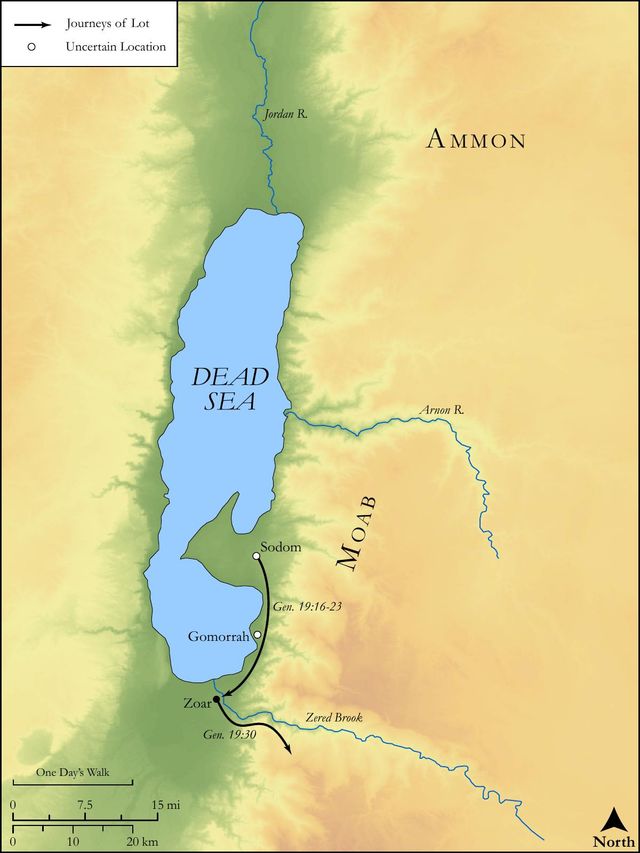
The "land of the plain" (Hebrew: kikkâr) refers to the fertile Jordan Valley, specifically the southern end near the Dead Sea, where Sodom, Gomorrah, Admah, Zeboiim, and Bela (later Zoar) were located. This region was known for its lushness, likened to the "garden of the Lord" (Genesis 13:10). However, these cities were infamous for their extreme wickedness, characterized by pride, abundance, idleness, and a failure to help the poor and needy (Ezekiel 16:49-50). The specific sin that led to their final destruction, as highlighted in Genesis 19:4-9, was a pervasive and aggressive homosexual assault, indicative of a complete breakdown of moral order and hospitality. The imagery of "smoke of a furnace" would have been readily understood in the days of the patriarchs, when furnaces were used for smelting metals or baking bricks, implying an intense, consuming, and deliberate heat.
Key Themes
ShowHideThis verse contributes significantly to several major themes within Genesis and the broader biblical narrative. It powerfully underscores the theme of Divine Justice and Judgment, demonstrating God's absolute holiness and His commitment to act decisively against pervasive and unrepentant sin. It highlights the Consequences of Human Wickedness, serving as a stark warning about the dire outcomes of moral corruption and a refusal to heed divine warnings. Furthermore, it reinforces the theme of God's Sovereignty, showcasing His ultimate control over creation and human affairs, including the power to execute precise and total judgment. For Abraham, it also serves as a profound confirmation of God's faithfulness to His word, both in judgment and in the deliverance of the righteous, such as Lot, echoing the broader theme of God's Covenant Faithfulness even amidst judgment.
Exposition and Analysis
ShowHideKey Word Analysis
ShowHideThis verb means "to lean out (of a window), i.e. (by implication) peep or gaze (passively, be a spectacle)." In this context, it suggests Abraham's deliberate act of looking from a vantage point, likely a high place, to observe the plain. It conveys a sense of focused attention, perhaps even a solemn, awestruck gaze upon the unfolding spectacle of divine judgment.
Meaning "a fume, i.e. cloud." This word vividly describes the thick, rising vapor that would have been visible from a distance, indicating a massive, widespread conflagration. It is not merely a wisp, but a significant, pervasive cloud of fumes.
Meaning "a smelting furnace (as reducing metals)." This is a crucial word, as it specifies the type of fire. A smelting furnace generates extremely high, controlled heat designed to utterly transform or consume its contents. This imagery emphasizes the intensity, totality, and deliberate nature of the destruction, far beyond a natural fire.
Verse Breakdown
ShowHide"And he looked toward Sodom and Gomorrah"
This clause establishes Abraham's perspective and the object of his gaze. Having interceded for the cities and witnessed Lot's escape, Abraham, from his vantage point (likely near Hebron, a higher elevation), turns his attention to the region where the cities once stood. His act of "looking" (H8259, shâqaph) implies a deliberate and expectant observation, perhaps with a sense of dread or solemn confirmation.
"and toward all the land of the plain"
This expands the scope of the destruction beyond just the cities themselves to encompass the entire fertile region. It indicates the comprehensive and pervasive nature of God's judgment, affecting not just the centers of wickedness but the surrounding environment that had been corrupted by their presence.
"and beheld, and, lo,"
This phrase conveys a sense of sudden, impactful realization or revelation. "Beheld" (H7200, râʼâh) signifies seeing clearly or perceiving, while "lo" (Hebrew: hinneh) is an interjection that draws immediate attention to what is about to be described, emphasizing the awe, horror, or profound significance of the sight. It marks the moment Abraham's expectation or apprehension is confirmed by the visual evidence.
"the smoke of the country went up as the smoke of a furnace."
This is the climactic descriptive clause. The "smoke of the country" (H7008, qîyṭôwr from the land H776, ʼerets) confirms the widespread nature of the devastation. The powerful simile "as the smoke of a furnace" (H3536, kibshân) is central to the verse's meaning. It signifies an exceptionally hot, consuming, and thorough fire, far beyond any natural conflagration. A furnace is a controlled environment for intense heat, suggesting that this was not a random disaster but a precise, complete, and deliberate act of divine judgment, leaving nothing but utter desolation.
Literary Devices
ShowHideThe primary literary device employed in Genesis 19:28 is Simile. The comparison of "the smoke of the country" to "the smoke of a furnace" is highly effective. This simile conveys several layers of meaning: it emphasizes the intensity of the fire, suggesting a heat so extreme that it utterly consumed everything; it highlights the totality of the destruction, implying that nothing survived the conflagration; and it subtly points to the deliberate nature of the judgment, as a furnace is a controlled environment for specific, often destructive, purposes. Beyond simile, the verse also utilizes vivid Imagery, painting a powerful visual for the reader. The rising smoke serves as a tangible, undeniable symbol of divine wrath and the irreversible consequences of sin. This imagery evokes a sense of both awe at God's power and solemnity at the severity of His justice. The use of the interjection "lo" (or "behold") also creates a sense of immediate dramatic impact, drawing the reader's attention to the profound and terrifying sight Abraham witnesses.
Theological and Thematic Connections
ShowHideGenesis 19:28 profoundly illustrates God's unyielding holiness and His commitment to justice. The complete annihilation of Sodom and Gomorrah, evidenced by the rising smoke, serves as an enduring testament that God is not indifferent to sin, particularly when it becomes pervasive, unrepentant, and openly defiant. This event underscores the severe consequences of human wickedness and the reality that divine patience, while vast, is not infinite. It stands as a solemn warning against moral corruption and the dangers of embracing a lifestyle contrary to God's righteous standards.
Reflection and Application
ShowHideGenesis 19:28 compels us to deeply consider the gravity of sin and the immutable character of God. It is a profound reminder that God is holy, righteous, and just, and He takes sin with utmost seriousness. While we live under the New Covenant of grace, this account serves as a timeless and solemn warning that God's justice is an inherent aspect of His being, and there will ultimately be an accounting for all unrighteousness. Therefore, we are called to live lives marked by genuine repentance, pursuing holiness and obedience to God's commands. This passage challenges us to examine our own lives and societies for any pervasive sin that might provoke divine displeasure, urging us to turn from evil and embrace righteousness. It also reminds us of the importance of heeding God's warnings and not clinging to the world's temptations, as Lot's wife tragically demonstrated, recognizing the eternal implications of our choices.
Questions for Reflection
ShowHideFAQ
ShowHideDoes the destruction of Sodom and Gomorrah imply God is cruel?
ShowHideNo, the destruction of Sodom and Gomorrah, while undeniably severe, is presented in Scripture not as an act of cruelty, but as a demonstration of divine justice against extreme, pervasive, and unrepentant wickedness. The cities' inhabitants were given ample opportunity to repent, and their sin was so profound that it "cried out" to God (Genesis 18:20). God's action underscores His absolute holiness and His commitment to upholding righteousness, serving as a solemn warning for all generations about the dire consequences of persistent sin. This act highlights God's justice, which is a necessary complement to His boundless mercy and patience.
Why is the imagery of "smoke of a furnace" used to describe the destruction?
ShowHideThe imagery of "the smoke of a furnace" (Hebrew: kibshân) is used to convey the intensity, completeness, and deliberate nature of the destruction. A furnace generates exceptionally high, controlled heat, often used for smelting or total consumption. This comparison suggests that God's judgment was not a random natural disaster but a precise, thorough, and total annihilation. It emphasizes the severity and finality of the divine wrath poured out on the cities and the surrounding plain, leaving no doubt about the extent of the devastation and the deliberate purpose behind it.
Christ-Centered Fulfillment
ShowHideWhile Genesis 19:28 depicts the terrifying reality of God's righteous judgment against sin, it implicitly points forward to the ultimate fulfillment of both divine justice and mercy found in Jesus Christ. The smoke rising from Sodom and Gomorrah foreshadows the coming judgment on all unrighteousness, a judgment that is eternal and consuming. Yet, in a profound act of divine love, Christ Himself bore the full wrath of God on the cross, becoming the perfect sacrifice for sin (Isaiah 53:5-6). He experienced the "furnace" of God's wrath so that those who believe in Him might be spared. Through His atoning work, believers are delivered from the judgment that sin deserves, finding refuge and salvation in Him (Romans 5:9). Thus, the terrifying smoke of judgment in Genesis points forward to the smoke of the sacrifice of Christ, which ascended as a pleasing aroma to God (Ephesians 5:2), reconciling humanity to Himself and offering an escape from the ultimate furnace of divine wrath for all who put their faith in Him (John 3:16-18).