


Genesis 13:10
Bible text: King James Version (1769 Blayney text) · Public domain
Bible text: King James Version with Strong's numbers · Public domain
Bible text: Berean Standard Bible · Public domain
Bible text: American Standard Version (1901) · Public domain
Bible text: World English Bible, Messianic edition · Public domain
Bible text: Geneva Bible (1599) · Public domain
Bible text: Young's Literal Translation · Public domain
- וַיִּשָּׂאvai·yi·sa'and he lifted upH5375Conj-w ¦ V-Qal-ConsecImperf-3msVerb Qal Consecutive Imperfect 3rd Singular Masculineוַandיִּשָּׂאhe lifted up
- לוֹטLotLotH3876N-proper-mNoun Proper Masculine
- אֶת'et<obj.>H853DirObjMParticle Object Indicator
- עֵינָיו'ei·Navhis eyesH5869N-fdc ¦ 3msNoun Dual Feminine Constructעֵינָיeyesוhis
- וַיַּרְאvai·yaR'and he sawH7200Conj-w ¦ V-Qal-ConsecImperf-3msVerb Qal Consecutive Imperfect 3rd Singular Masculineוַandיַּרְאhe saw
- אֶת'et<obj.>H853DirObjMParticle Object Indicator
- כָּלkolallH3605N-mscNoun Singular Masculine Construct
- כִּכַּרki·Kar[the] valley ofH3603N-fscNoun Singular Feminine Construct
- הַיַּרְדֵּןhai·yar·Denthe JordanH3383Art ¦ N-properNoun Proper LocationהַtheיַּרְדֵּןJordan
- כִּיkithatH3588PrtParticle Conditional
- כֻלָּהּkhu·Lahall of itH3605N-msc ¦ 3fsNoun Singular Masculine Constructכֻלָּall ofהּit
- מַשְׁקֶהmash·Keh[was] well-wateredH4945N-msNoun Singular Masculine Absolute
- לִפְנֵיlif·Nei<to> beforeH6440Prep-l ¦ N-mpcNoun Plural Masculine Constructלִ<to>פְנֵיbefore
- שַׁחֵתsha·ChetdestroyedH7843V-Piel-InfVerb Piel Infinitive Construct
- יְהוָהYah·wehYahwehH3068N-properNoun Proper Title
- אֶת'et<obj.>H853DirObjMParticle Object Indicator
- סְדֹםse·DomSodomH5467N-properNoun Proper Location
- וְאֶתve·'Etand <obj.>H853Conj-w ¦ DirObjMParticle Object Indicatorוְandאֶת<obj.>
- עֲמֹרָה'a·mo·RahGomorrahH6017N-properNoun Proper Location
- כְּגַןke·ganlike [the] garden ofH1588Prep-k ¦ N-cscNoun Singular common gender Constructכְּlikeגַן[the] garden of
- יְהוָהYah·wehYahwehH3068N-properNoun Proper Title
- כְּאֶרֶץke·'E·retzlike [the] land ofH776Prep-k ¦ N-fscNoun Singular Feminine Constructכְּlikeאֶרֶץ[the] land of
- מִצְרַיִםmitz·Ra·yimEgyptH4714N-properNoun Proper Location
- בֹּאֲכָהbo·'a·Khahgoing youH935V-Qal-Inf ¦ 2msVerb Qal Infinitive Constructבֹּאֲgoingכָהyou
- צֹעַרTzo·'arZoarH6820N-properNoun Proper Location
English is a literal word-by-word gloss of the Hebrew, not the KJV's wording. Why?
This is the original text the KJV's translators worked from — each Hebrew word with its own literal English meaning in this verse, prepared by scholars at Tyndale House, Cambridge. The KJV translates whole sentences, not word by word, so its wording differs: one Hebrew word can become several English words, and the KJV may choose “the LORD” where the gloss reads “Yahweh”. Both are faithful — they answer different questions. For the KJV's own rendering, switch to the KJV text.
Details
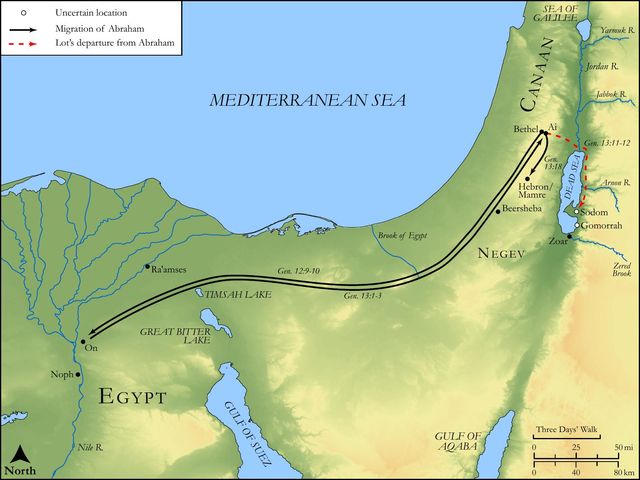
See on the biblical-era maps


Study this verse
Public-domain commentary
Matthew Henry
From his Commentary on the Whole Bible. Henry comments on passages, not single verses — this entry covers Genesis 13:10–13. His three-level outline is real structure in the source text, so it is rendered as structure.
We have here the choice that Lot made when he parted from Abram. Upon this occasion, one would have expected, 1. That he should have expressed an unwillingness to part from Abram, and that, at least, he should have done it with reluctancy. 2. That he should have been so civil as to have remitted the choice back again to Abram. But we find not any instance of deference or respect to his uncle in the whole management. Abram having offered him the choice, without compliment he accepted it, and made his election. Passion and selfishness make men rude. Now, in the choice which Lot made, we may observe,
I.How much he had an eye to the goodness of the land.
He beheld all the plan of Jordan, the flat country in which Sodom stood, that it was admirably well watered every where (and perhaps the strife had been about water, which made him particularly fond of that convenience), and so Lot chose all that plain, Gen 13:10, Gen 13:11. That valley, which was like the garden of Eden itself, now yielded him a most pleasant prospect. It was, in his eye, beautiful for situation, the joy of the whole earth; and therefore he doubted not but that it would yield him a comfortable settlement, and that in such a fruitful soil he should certainly thrive, and grow very rich: and this was all he looked at. But what came of it? Why, the next news we hear of him is that he is in the briars among them, he and his carried captive. While he lived among them, he vexed his righteous soul with their conversation, and never had a good day with them, till, at last, God fired the town over his head, and forced him to the mountain for safety who chose the plain for wealth and pleasure. Note, Sensual choices are sinful choices, and seldom speed well. Those who in choosing relations, callings, dwellings, or settlements are guided and governed by the lusts of the flesh, the lusts of the eye, or the pride of life, and consult not the interests of their souls and their religion, cannot expect God's presence with them, nor his blessing upon them, but are commonly disappointed even in that which they principally aimed at, and miss of that which they promised themselves satisfaction in. In all our choices this principle should overrule us, That that is best for us which is best for our souls.
II.How little he considered the wickedness of the inhabitants: But the men of Sodom were wicked, Gen 13:13. Note,
1.Though all are sinners, yet some are greater sinners than others. The men of Sodom were sinners of the first magnitude, sinners before the Lord, that is, impudent daring sinners; they were so to a proverb. Hence we read of those that declare their sin as Sodom, they hide it not, Isa 3:9.
2.That some sinners are the worse for living in a good land. So the Sodomites were: for this was the iniquity of Sodom, pride, fulness of bread, and abundance of idleness; and all these were supported by the great plenty their country afforded, Eze 16:49. Thus the prosperity of fools destroys them.
3.That God often gives great plenty to great sinners. Filthy Sodomites dwell in a city, in a fruitful plain, while faithful Abram and his pious family dwell in tents upon the barren mountains.
4.When wickedness has come to the height, ruin is not far off. Abounding sins are sure presages of approaching judgments. Now Lot's coming to dwell among the Sodomites may be considered,
(1.)As a great mercy to them, and a likely means of bringing them to repentance; for now they had a prophet among them and a preacher of righteousness, and, if they had hearkened to him, they might have been reformed, and the ruin prevented. Note, God sends preachers, before he sends destroyers; for he is not willing that any should perish.
(2.)As a great affliction to Lot, who was not only grieved to see their wickedness (Pe2 2:7, Pe2 2:8), but was molested and persecuted by them, because he would not do as they did. Note, It has often been the vexatious lot of good men to live among wicked neighbours, to sojourn in Mesech (Psa 120:5), and it cannot but be the more grievous, if, as Lot here, they have brought it upon themselves by an unadvised choice.
Historical interpretation
Three Centuries of Reception
2 surviving comments on this verse. Each one is dated, so this reads as a timeline rather than a list.
Select a marker to jump to its quote. Markers stagger vertically where authors wrote within a few decades of each other.
Haughtiness is the companion of those who deviate from the truth. In fact, as Abraham was quite humble in that he offered the choice, so Lot was rather insolent in presuming to choose. Virtue humbles itself, whereas wickedness becomes arrogant. Lot should rather have relied on one more wise than he, to be on the safe side. Indeed, he did not have the knowledge to make a choice.
Therefore, Lot, having lifted up his eyes, saw all the region around Jordan, which was all watered before the Lord destroyed Sodom and Gomorrah, like the paradise of the Lord and like Egypt as you go towards Zoar. And Lot chose for himself the region around Jordan and moved eastward; and the rest up to the point where it says: but the men of Sodom were wicked and great sinners before the Lord. He praises the fertility of the land and at the same time notes the impiety of the inhabitants, so that they may be understood to be deserving of greater damnation, for they turned the greatest gifts of God not to the fruit of piety but to the increase of luxury: where also it is silently added to the praises of blessed Lot, because in that land, living among those natives, neither the wealth of the rich soil nor the example of the inhabitants could in any way corrupt the integrity of his purity. However, concerning which sins the Sodomites were subject to, except for that abominable one which Scripture mentions later, the prophet Ezekiel sufficiently explains, speaking to Jerusalem: Behold, this was the iniquity of your sister Sodom: pride, fulness of bread, and abundance, and idleness were in her and in her daughters; and they did not strengthen the hand of the poor and needy, and they were haughty and committed abomination before me (Ezekiel 16:49). From all these, blessed Lot was free, as testified by the sacred history, which declares that he received the angels as guests and that through them he was rescued from the perishing impious ones; and the judgment of blessed Peter the apostle proves, where it is said: And righteous Lot, who was oppressed by the filthy conduct of the wicked, was delivered (2 Peter 2:7). For he was righteous by sight and hearing, dwelling among them who day by day tortured his righteous soul with their lawless deeds. For what good merit could be lacking in him, whom the apostolic voice declares righteous? In him, those present could hear nothing but the fame of righteousness, for the deeds and sight of the wicked known to his pure eyes and ears were nothing but torture and affliction. That which is said about him moving from the east to Haran also signifies Mesopotamia, from where he had already long ago physically departed, led by Abraham; but because a reader might doubt whether his mind was still held by love for his kindred and homeland or whether, like Abraham, he had perfectly departed from his country and kindred and from his father's house, Scripture took care to specifically intimate even concerning him that he departed not only in body but in mind from those places and inhabitants, and because of his faith and hope in divine blessing, he consented to remain a perpetual guest and sojourner wherever Abraham chose. For that Haran, a city located to the east of the promised land, is testified by Scripture, which later says: Then Jacob set out and came to the land of the east, when he had indeed journeyed from Bethel to Haran.
Continue studying Genesis 13:10 across the web’s major study libraries — every link below opens this exact verse, chapter, or book on the destination site.
Read & Compare
 BibleGatewayThis verse in more than 200 translations and 70 languages.
 Bible.comThe YouVersion reader — hundreds of translations, reading plans, and highlights.
 ESV.orgCrossway's official English Standard Version reader.
 NET BibleThe NET translation with 60,000+ translators' notes on every rendering decision.
 STEP BibleTyndale House's free study tool — original text, vocabulary, and scholarly resources.
 BibliaLogos Bible Software's free web reader.
 USCCBThe New American Bible (Revised Edition) with the U.S. bishops' study notes.
Commentaries
 BibleHub CommentariesDozens of classic commentaries on this verse, gathered on one page.
 StudyLightMore than 100 commentary sets — the largest collection on the web.
 BibleRefPlain-English commentary on what this verse means, verse by verse.
 Enduring WordDavid Guzik's free commentary on this chapter, widely used by Bible teachers.
 Bible Study ToolsVerse commentary alongside Greek and Hebrew study aids.
Original Language & Research
- BibleHub InterlinearThe verse word by word — original language, transliteration, and English.
- BibleHub LexiconEvery word's original-language definition and Strong's entry.
 Blue Letter BibleDeep-study tools — Strong's numbers, concordance, and word studies.
 SefariaThe Hebrew text with Rashi and centuries of Jewish commentary.
Sermons, Hymns & Audio


TrulyRandomVerse is not affiliated with these sites and doesn’t control their content. They’re linked because they’re genuinely useful.
Summary
Genesis 13:10 describes Lot's pivotal decision to choose the Plain of Jordan, a region appearing exceptionally fertile and well-watered, for his settlement. This choice, made after Abram generously allowed him the first selection of land to resolve disputes, reveals Lot's immediate priorities focused on material prosperity and sets the stage for the subsequent narrative of his life, subtly foreshadowing the future divine judgment upon the very cities within this desirable region.
Context
ShowHideLiterary Context
This verse is situated at a crucial juncture in the narrative of Abram and Lot, immediately following their return from Egypt. Both had become exceedingly wealthy in livestock, silver, and gold, making the land insufficient to sustain their combined herds and households without conflict. Disputes had arisen between their herdsmen, prompting Abram's magnanimous offer to Lot to choose any land he desired, emphasizing peace and unity over personal gain Genesis 13:8-9. Lot's subsequent action of "lifting up his eyes" and surveying the land is the direct response to Abram's offer, showcasing his decision-making process and priorities as he selects what he perceives to be the most advantageous territory. This choice is a narrative hinge, leading to the separation of Abram and Lot and setting each on distinct paths.
Historical & Cultural Context
In the lands of the patriarchs, particularly for nomadic pastoralists like Abram and Lot, access to abundant water and fertile pastureland was paramount for survival and prosperity. The Jordan Valley, fed by the Jordan River, was indeed a lush oasis in an otherwise arid region, making it highly desirable. The comparison to "the land of Egypt" (specifically the Nile Delta) further underscores its reputation for agricultural richness, a standard of fertility well-understood by the original audience. The cities of Sodom and Gomorrah, though not yet explicitly described in their wickedness, were part of this fertile region, indicating a settled, urbanized environment that contrasted with the nomadic lifestyle. Lot's choice reflects a common human desire for immediate material security and ease, which often involved settling near established centers of commerce and resources.
Key Themes
ShowHideGenesis 13:10 contributes significantly to several overarching themes in the book of Genesis. It highlights the theme of human choice versus divine promise, contrasting Lot's decision based on sight with Abram's reliance on God's unseen provision. It underscores the deceptive nature of outward appearance, where the Plain of Jordan's beauty masks its moral corruption and impending judgment, a theme that resonates throughout biblical narratives concerning worldly allure. Furthermore, it introduces the theme of divine judgment through the parenthetical foreshadowing of Sodom and Gomorrah's destruction, emphasizing God's omniscience and moral governance over human affairs. This verse also subtly develops the theme of covenant and inheritance, as Lot's self-chosen inheritance contrasts sharply with the divinely promised inheritance Abram receives subsequent to Lot's departure Genesis 13:14-17.
Exposition and Analysis
ShowHideKey Word Analysis
ShowHideFrom the root meaning "to cause to drink," this term describes a region that is abundantly irrigated, not merely by rainfall but by a consistent water source, making it exceptionally fertile and productive for agriculture and pasturage. It conveys a sense of lushness and prosperity, a "fat pasture" in the eyes of a herdsman.
Derived from a verb meaning "to fence" or "to protect," a garden implies a cultivated, enclosed, and highly productive area. The comparison to "the garden of the LORD" immediately evokes imagery of the Garden of Eden, signifying a place of unparalleled natural beauty, fertility, and abundance, a veritable paradise.
This primitive root means "to decay," "to ruin," or "to corrupt." In this context, it refers to the complete and utter devastation brought about by divine judgment. Its inclusion here as a parenthetical note serves as a stark and immediate contrast to the region's initial beauty, revealing its ultimate fate and the moral decay that necessitated such destruction.
Verse Breakdown
ShowHideLiterary Devices
ShowHideThe verse is rich in Simile, comparing the Plain of Jordan to "the garden of the LORD" and "the land of Egypt," which powerfully conveys its extraordinary fertility and beauty. This use of comparison elevates the description, making the plain appear paradisiacal and immensely desirable. However, this idyllic portrayal is immediately undercut by a striking use of Dramatic Irony. The narrator's parenthetical insertion, "before the LORD destroyed Sodom and Gomorrah," provides the reader with crucial information that Lot lacks. This creates a tension between Lot's perception of prosperity and the reader's foreknowledge of impending judgment, highlighting Lot's spiritual blindness. Furthermore, this parenthetical clause serves as a clear instance of Foreshadowing, hinting at the tragic events that will unfold later in the narrative concerning Sodom and Gomorrah and Lot's involvement. The verse also employs Contrast, subtly pitting the outward beauty and material promise of the land against its inherent moral corruption and ultimate destruction.
Theological and Thematic Connections
ShowHideLot's choice in Genesis 13:10 is a profound theological statement on human discernment and priorities. It vividly illustrates the common human tendency to prioritize immediate material gain and visual appeal over spiritual considerations or long-term consequences. Lot's decision, based purely on what "looked good" to the eye, stands in stark contrast to Abram's faith-based trust in God's unseen provision and covenant promises. The divine commentary regarding Sodom and Gomorrah's future destruction serves as a powerful reminder that God's perspective on places and people often differs radically from human perception, revealing that outward prosperity can mask deep moral decay and impending judgment. This narrative teaches that true blessing and enduring inheritance are not found in human calculation or material advantage, but in faithful reliance on God's sovereign will and covenant promises.
Reflection and Application
ShowHideGenesis 13:10 serves as a timeless cautionary tale, urging us to critically examine the criteria by which we make significant life decisions. Lot's choice, driven by the allure of a seemingly prosperous and fertile land, ultimately led him into a morally corrupt environment, endangering his family and causing him immense distress, as vividly depicted in his later experiences in Sodom. This narrative powerfully underscores that what appears good on the surface—whether a career opportunity, a place to live, or a relationship—may harbor hidden dangers or spiritual compromises. It challenges us to move beyond superficial evaluations and immediate gratification, instead cultivating spiritual discernment that prioritizes God's will, moral integrity, and long-term spiritual well-being over worldly allure or material advantage. Our choices, even seemingly pragmatic ones, have profound spiritual consequences that ripple through our lives and the lives of those connected to us.
Questions for Reflection
ShowHideFAQ
ShowHideWhy is the destruction of Sodom and Gomorrah mentioned in this verse, seemingly out of chronological order?
ShowHideThe parenthetical phrase "before the LORD destroyed Sodom and Gomorrah" serves as a crucial piece of divine commentary and dramatic irony inserted by the narrator. It immediately informs the reader of the future judgment awaiting this seemingly idyllic region, highlighting the spiritual blindness of Lot's choice. It underscores that material prosperity, without spiritual discernment, can lead to ruin, and it reveals God's omniscient perspective, contrasting it with Lot's limited human view.
What does the comparison to "the garden of the LORD" signify, and why is it significant?
ShowHideThis phrase explicitly links the Plain of Jordan to the Garden of Eden, symbolizing ultimate fertility, beauty, and abundance. For Lot, it represented a paradise of natural resources and economic potential. The significance lies in the subtle contrast: while Lot saw only the physical benefits of a "paradise," the true purpose of Eden was a place of divine communion and obedience. This comparison implies that Lot's focus was purely materialistic, overlooking the moral character of the land's inhabitants and its spiritual implications, leading him away from God's intended path.
What central lesson can be learned from Lot's choice in Genesis 13:10 for believers today?
ShowHideLot's decision, based solely on visual appeal and economic advantage, serves as a powerful cautionary tale. It teaches us to look beyond immediate gratification and superficial prosperity when making significant life choices. True wisdom involves spiritual discernment, considering the long-term consequences, and prioritizing God's will over worldly allure. As seen in Lot's later experiences in Sodom, material gain can lead to moral compromise, spiritual distress, and even endanger one's family, emphasizing the need to align our choices with divine principles rather than earthly desires.
Christ-Centered Fulfillment
ShowHideLot's choice of the Plain of Jordan, a worldly "garden of the LORD" that ultimately led to his entanglement with the wicked cities of Sodom and Gomorrah, powerfully illustrates the human tendency to prioritize immediate, visible prosperity over spiritual discernment. This path, driven by the desires of the eyes, ultimately leads to ruin and judgment. In profound contrast, Abram's faith-filled relinquishment of choice and his subsequent reception of God's unconditional promise foreshadow the true and eternal inheritance found only in Christ. While Lot sought a temporal, earthly paradise that was destined for destruction, Christ offers an eternal kingdom and a new creation that far surpasses the lost Garden of Eden. The judgment foreshadowed for Sodom and Gomorrah points to the ultimate judgment from which Christ delivers His people through His atoning sacrifice on the cross. Believers, through faith in Him, receive a spiritual inheritance and true prosperity that is not of this world, but is secured by His redemptive work and guaranteed by His resurrection, inviting us to seek first His kingdom and righteousness Matthew 6:33.