


Deuteronomy 34:3
Bible text: King James Version (1769 Blayney text) · Public domain
Bible text: Berean Standard Bible · Public domain
Bible text: American Standard Version (1901) · Public domain
Bible text: World English Bible, Messianic edition · Public domain
Bible text: Geneva Bible (1599) · Public domain
Bible text: Young's Literal Translation · Public domain
- וְאֶתve·'Etand <obj.>H853Conj-w ¦ DirObjMParticle Object Indicatorוְandאֶת<obj.>
- הַנֶּגֶבha·Ne·gevthe NegevH5045Art ¦ N-properNoun Proper LocationהַtheנֶּגֶבNegev
- וְאֶתve·'Etand <obj.>H853Conj-w ¦ DirObjMParticle Object Indicatorוְandאֶת<obj.>
- הַכִּכָּרha·ki·Karthe districtH3603Art ¦ N-fsNoun Singular Feminine Absoluteהַtheכִּכָּרdistrict
- בִּקְעַתbik·'Atin [the] valley ofH1237N-fscNoun Singular Feminine Construct
- יְרֵחוֹye·re·ChoJerichoH3405N-properNoun Proper Location
- עִיר'ir[the] city ofH5899N-fscNoun Singular Feminine Construct
- הַתְּמָרִיםha·te·ma·Rimthe palm treesH5899Art ¦ N-mpNoun Plural Masculine Absoluteהַtheתְּמָרִיםpalm trees
- עַד'adtoH5704PrepPreposition
- צֹעַרTzo·'arZoarH6820N-properNoun Proper Location
English is a literal word-by-word gloss of the Hebrew, not the KJV's wording. Why?
This is the original text the KJV's translators worked from — each Hebrew word with its own literal English meaning in this verse, prepared by scholars at Tyndale House, Cambridge. The KJV translates whole sentences, not word by word, so its wording differs: one Hebrew word can become several English words, and the KJV may choose “the LORD” where the gloss reads “Yahweh”. Both are faithful — they answer different questions. For the KJV's own rendering, switch to the KJV text.
Details
See on the biblical-era map
Study this verse
Public-domain commentary
Matthew Henry
From his Commentary on the Whole Bible. Henry comments on passages, not single verses — this entry covers Deuteronomy 34:1–4. His two-level outline is real structure in the source text, so it is rendered as structure.
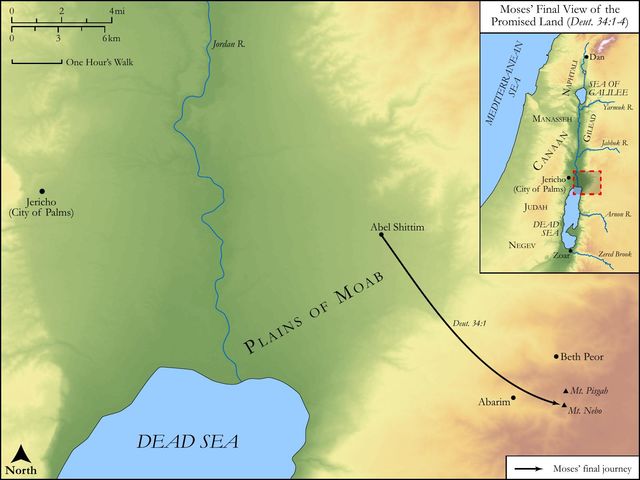
Here is, I. Moses climbing upwards towards heaven, as high as the top of Pisgah, there to die; for that was the place appointed, Deu 32:49, Deu 32:50. Israel lay encamped upon the flat grounds in the plains of Moab, and thence he went up, according to order, to the mountain of Nebo, to the highest point or ridge of that mountain, which was called Pisgah, Deu 32:1. Pisgah is an appellative name for all such eminences. It should seem, Moses went up alone to the top of Pisgah, alone without help - a sign that his natural force was not abated when on the last day of his life he could walk up to the top of a high hill without such supporters as once he had when his hands were heavy (Exo 17:12), alone without company. When he had made an end of blessing Israel, we may suppose, he solemnly took leave of Joshua, and Eleazar, and the rest of his friends, who probably brought him to the foot of the hill; but then he gave them such a charge as Abraham gave to his servants at the foot of another hill: Tarry you here while I go yonder and die: they must not see him die, because they must not know of his sepulchre. But, whether this were so or not, he went up to the top of Pisgah, 1. To show that he was willing to die. When he knew the place of his death, he was so far from avoiding it that he cheerfully mounted a steep hill to come at it. Note, Those that through grace are well acquainted with another world, and have been much conversant with it, need not be afraid to leave this. 2. To show that he looked upon death as his ascension. The soul of a man, of a good man, when it leaves the body, goes upwards (Ecc 3:21), in conformity to which motion of the soul, the body of Moses shall go along with it as far upwards as its earth will carry it. When God's servants are sent for out of the world, the summons runs thus, Go up and die.
II.Moses looking downward again towards this earth, to see the earthly Canaan into which he must never enter, but therein by faith looking forwards to the heavenly Canaan into which he should now immediately enter. God had threatened that he should not come into the possession of Canaan, and the threatening is fulfilled. But he had also promised that he should have a prospect of it, and the promise is here performed: The Lord showed him all that good land, v. 1.
1.If he went up alone to the top of Pisgah, yet he was not alone, for the Father was with him, Joh 16:32. If a man has any friends, he will have them about him when he lies a dying. But if, either through God's providence or their unkindness, it should so happen that we should then be alone, we need fear no evil if the great and good Shepherd be with us, Psa 23:4.
2.Though his sight was very good, and he had all the advantage of high ground that he could desire for the prospect, yet he could not have seen what he now saw, all Canaan from end to end (reckoned about fifty or sixty miles), if his sight had not been miraculously assisted and enlarged, and therefore it is said, The Lord showed it to him. Note, All the pleasant prospects we have of the better country we are beholden to the grace of God for; it is he that gives the spirit of wisdom as well as the spirit of revelation, the eye as well as the object. This sight which God here gave Moses of Canaan, probably, the devil designed to mimic, and pretended to out-do, when in an airy phantom he showed to our Saviour, whom he had placed like Moses upon an exceedingly high mountain, all the kingdoms of the world and the glory of them, not gradually, as here, first one country and then another, but all in a moment of time.
3.He saw it at a distance. Such a sight the Old Testament saints had of the kingdom of the Messiah; they saw it afar off. Thus Abraham, long before this, saw Christ's day; and, being fully persuaded of it, embraced it in the promise, leaving others to embrace it in the performance, Heb 11:13. Such a sight believers now have, through grace, of the bliss and glory of their future state. The word and ordinances are to them what Mount Pisgah was to Moses; from them they have comfortable prospects of the glory to be revealed, and rejoice in hope of it.
4.He saw it, but must never enjoy it. As God sometimes takes his people away from the evil to come, so at other times he takes them away from the good to come, that is, the good which shall be enjoyed by the church in the present world. Glorious things are spoken of the kingdom of Christ in the latter days, its advancement, enlargement, and flourishing state; we foresee it, but we are not likely to live to see it. Those that shall come after us, we hope will enter that promised land, which is a comfort to us when we find our own carcases falling in this wilderness. See Kg2 7:2.
5.He saw all this just before his death. Sometimes God reserves the brightest discoveries of his grace to his people to be the support of their dying moments. Canaan was Immanuel's land (Isa 8:8), so that in viewing it he had a view of the blessings we enjoy by Christ. It was a type of heaven (Heb 11:16), which faith is the substance and evidence of. Note, Those may leave this world with a great deal of cheerfulness that die in the faith of Christ, and in the hope of heaven, and with Canaan in their eye. Having thus seen the salvation of God, we may well say, Lord, now let thou thy servant depart in peace.
Continue studying Deuteronomy 34:3 across the web’s major study libraries — every link below opens this exact verse, chapter, or book on the destination site.
Read & Compare
 BibleGatewayThis verse in more than 200 translations and 70 languages.
 Bible.comThe YouVersion reader — hundreds of translations, reading plans, and highlights.
 ESV.orgCrossway's official English Standard Version reader.
 NET BibleThe NET translation with 60,000+ translators' notes on every rendering decision.
 STEP BibleTyndale House's free study tool — original text, vocabulary, and scholarly resources.
 BibliaLogos Bible Software's free web reader.
 USCCBThe New American Bible (Revised Edition) with the U.S. bishops' study notes.
Commentaries
 BibleHub CommentariesDozens of classic commentaries on this verse, gathered on one page.
 StudyLightMore than 100 commentary sets — the largest collection on the web.
 BibleRefPlain-English commentary on what this verse means, verse by verse.
 Enduring WordDavid Guzik's free commentary on this chapter, widely used by Bible teachers.
 Bible Study ToolsVerse commentary alongside Greek and Hebrew study aids.
Original Language & Research
- BibleHub InterlinearThe verse word by word — original language, transliteration, and English.
- BibleHub LexiconEvery word's original-language definition and Strong's entry.
 Blue Letter BibleDeep-study tools — Strong's numbers, concordance, and word studies.
 SefariaThe Hebrew text with Rashi and centuries of Jewish commentary.
Sermons, Hymns & Audio


TrulyRandomVerse is not affiliated with these sites and doesn’t control their content. They’re linked because they’re genuinely useful.
Summary
Deuteronomy 34:3 offers a precise geographical snapshot of the southern expanse of the Promised Land, divinely revealed to Moses from the summit of Mount Nebo. This verse meticulously details the Negeb, the fertile plain surrounding Jericho—famously known as "the city of palm trees"—and the distant city of Zoar, providing Moses with a tangible and comprehensive glimpse of the vast territory Israel was poised to inherit. It is a poignant moment of divine revelation, underscoring God's unwavering faithfulness to His covenant promises, even as His faithful servant Moses prepared to conclude his earthly journey without physically entering the land.
Context
ShowHideLiterary Context
This verse is situated within the climactic final chapter of Deuteronomy, which recounts the poignant conclusion of Moses' extraordinary leadership and life. After four decades of guiding the Israelites through the wilderness, Moses is granted a miraculous, sweeping panoramic vision of the entire Promised Land from the peak of Mount Nebo, also known as Pisgah. This divine revelation, meticulously detailed in Deuteronomy 34:1-4, serves as God's final act of faithfulness to His servant, even though Moses himself was not permitted to enter the land due to his prior disobedience at Meribah, as recorded in Numbers 20:12. Deuteronomy 34:3 specifically delineates the southern portion of this incredible vista, setting the stage for Joshua's imminent leadership and the nation's decisive entry into Canaan.
Historical & Cultural Context
At this juncture, the Israelites were encamped on the eastern side of the Jordan River, poised to enter the land God had solemnly promised to their ancestors. The geographical features meticulously mentioned in this verse held profound significance. "The south" refers to the Negeb, a semi-arid region stretching towards the Sinai Peninsula, which, despite its challenging terrain, was vital for its sparse but life-sustaining resources and strategic location. The "plain of the valley of Jericho" precisely identifies the lush, fertile oasis of Jericho, nestled within the Jordan Rift Valley (part of the larger Arabah), renowned for its abundant vegetation, particularly its iconic date palms, hence its apt epithet "the city of palm trees." This area was strategically crucial as a primary gateway to the central highlands of Canaan. Zoar, mentioned as the southernmost limit of Moses' view in this direction, was an ancient city with deep biblical roots, notably associated with Lot's dramatic escape from the destruction of Sodom and Gomorrah in Genesis 19:22. This meticulous geographical detail profoundly underscored the tangible reality and immense scope of the land God was sovereignly bestowing upon His chosen people.
Key Themes
ShowHideDeuteronomy 34:3 powerfully contributes to several overarching themes woven throughout Deuteronomy and the broader Pentateuch. Foremost is the theme of Divine Faithfulness and Promise. Despite Moses' personal failure and the Israelites' repeated rebellions, God unequivocally honors His covenant with Abraham, Isaac, and Jacob by showing Moses the land promised to their descendants (see Genesis 13:15). This act profoundly highlights God's unwavering commitment to His word, even when human instruments falter. Another crucial theme is Geographical Specificity as Divine Confirmation. The detailed naming of distinct regions and cities like Jericho and Zoar serves to affirm the concrete reality and vastness of the promised inheritance, transforming an abstract divine promise into a tangible, visible reality. Finally, the mention of "the city of palm trees" (Jericho) carries a strong element of Foreshadowing of Conquest. Jericho would become the first major stronghold encountered and miraculously conquered by the Israelites under Joshua's leadership, as vividly recounted in Joshua 6:20, signifying the decisive entry and initial victories in the Promised Land.
Exposition and Analysis
ShowHideKey Word Analysis
ShowHideFrom an unused root meaning "to be parched," this term refers to the arid or semi-arid region in the southern part of Judah, often specifically translated as "the Negeb." It signifies a distinct geographical zone characterized by its challenging terrain and sparse rainfall, yet crucial for its strategic location and occasional oases. Its inclusion in Moses' vision emphasizes the full scope of the land, from its fertile valleys to its more desolate fringes.
From a root meaning "to circle," kikkâr properly denotes a "circle" or "circumjacent tract or region." While often translated as "plain," here it specifically refers to the circular, fertile basin of the Jordan Valley around Jericho, highlighting its unique geographical formation and agricultural richness within the broader rift valley.
This is a well-known and evocative epithet for Jericho, directly translating to "city of the palm trees." It emphasizes Jericho's most prominent natural feature: an abundance of date palms. These palms were a valuable resource, providing food, building materials, and shade, making Jericho a significant and prosperous oasis in the desert landscape. This descriptive phrase not only identifies the city but also implicitly hints at its prosperity and strategic importance.
Verse Breakdown
ShowHide"And the south"
This phrase points to the Negeb, the southern desert region, indicating the southernmost extent of the land revealed to Moses in that direction. It encompasses a vast and often challenging terrain, signifying the full breadth and diversity of the inheritance God was showing him.
"and the plain of the valley of Jericho"
This refers to the fertile, circular basin of the Jordan Valley surrounding the city of Jericho. This area was a crucial oasis, contrasting sharply with the more arid regions, and was strategically vital as a gateway to the central highlands of Canaan, a key entry point for the Israelites.
"the city of palm trees"
This is a descriptive epithet for Jericho, highlighting its abundance of date palms and its lush, fertile nature. It underscores the city's prosperity and economic importance, and implicitly foreshadows its future role as the first major city to be confronted and conquered by the Israelites upon their entry into the land.
"unto Zoar"
This specifies the distant city of Zoar as the southern limit of Moses' panoramic view in the direction of the Dead Sea. Zoar's inclusion provides a precise geographical marker, connecting the divine vision to well-known ancient locations with significant biblical history, particularly its association with Lot's escape from divine judgment.
Literary Devices
ShowHideDeuteronomy 34:3, within the profound context of Moses' final vision, employs several powerful literary devices. The overarching device is Panoramic Vision, a divine act that grants Moses a supernatural, sweeping view of the entire Promised Land, far transcending natural human sight. This emphasizes God's omnipotence and His direct, sovereign involvement in the covenant's fulfillment. Geographical Naming is meticulously used throughout the verse, with specific locations like "the south" (referring to the Negeb), "the plain of the valley of Jericho," and "Zoar" being explicitly named. This specificity grounds the divine promise in concrete reality, making the inheritance tangible and verifiable for the audience. The phrase "the city of palm trees" functions as an Epithet for Jericho, a descriptive title that highlights its most prominent natural feature and serves as a memorable identifier. This epithet also subtly employs Foreshadowing, as Jericho's lushness and strategic position hint at its future significance as the first major city to be confronted and miraculously conquered by the Israelites upon their entry into Canaan.
Theological and Thematic Connections
ShowHideDeuteronomy 34:3, in its vivid depiction of Moses' final, sweeping vision of the Promised Land, profoundly illustrates the intricate nature of divine promise and human limitation. It reveals a God who, even in judgment for disobedience, remains utterly faithful to His covenant, granting Moses a glimpse of the fulfillment he would not personally experience. This poignant moment underscores that God's overarching plans transcend individual lives and that His sovereign purposes will ultimately be accomplished, often through successive generations. It serves as a powerful reminder that while we may not always see the full realization of God's promises in our lifetime or precisely in the way we expect, His word is eternally sure, and His ultimate design will prevail. This passage encourages a posture of profound faith, trusting in the unseen future and the sovereign hand of God, even when our own earthly journey concludes before the destination is fully reached.
Reflection and Application
ShowHideMoses' experience on Mount Nebo, seeing the Promised Land but not being permitted to enter it, offers a profound and enduring lesson for believers today. It teaches us about the very nature of faith, which often involves trusting God's grand vision and unwavering promises even when their full realization lies beyond our immediate grasp or personal experience. Just as God faithfully showed Moses the land, He often gives us glimpses of His divine purposes for our lives, our communities, or His unfolding kingdom, inviting us to participate wholeheartedly in His grand narrative even if we don't see the final chapter. This verse calls us to cultivate profound patience, steadfast perseverance, and an unshakeable trust in God's perfect timing and sovereign plan. It reminds us that our faithfulness in our current sphere, however limited our view, contributes to a larger divine tapestry that will ultimately unfold according to His perfect will, often through those who come after us. We are called to be faithful stewards of the vision God has given us, knowing with certainty that His promises are always true, even if their ultimate fulfillment is reserved for another time or another generation.
Questions for Reflection
ShowHideFAQ
ShowHideWhy was Moses not allowed to enter the Promised Land?
ShowHideMoses was forbidden from entering the Promised Land due to an act of disobedience at Meribah. As recounted in Numbers 20:12, God commanded Moses to speak to a rock to bring forth water for the Israelites. However, in a moment of frustration and perhaps a display of his own authority rather than God's, Moses struck the rock twice with his staff. God declared that because Moses did not "sanctify" Him in the eyes of the Israelites, he would not lead them into the land. This act, though seemingly minor, represented a failure to fully trust and obey God's specific instructions, and to uphold God's holiness and power before the people.
What is the significance of Jericho being called "the city of palm trees"?
ShowHideThe epithet "the city of palm trees" (עִיר הַתְּמָרִים, Ir HaTemarim) highlights Jericho's identity as a fertile and prosperous oasis in the otherwise arid Jordan Valley. Date palms were an incredibly valuable resource, providing essential food, building materials, and much-needed shade, underscoring the city's prosperity and strategic importance as a hub of life. More significantly, this descriptive name serves as a subtle yet powerful foreshadowing of Jericho's future role as the first major city to be encountered and miraculously conquered by the Israelites under Joshua, as detailed in Joshua 6, marking their decisive and divinely-empowered entry into Canaan.
Where is Zoar mentioned elsewhere in the Bible?
ShowHideZoar is primarily known from the dramatic account of Lot's escape from the destruction of Sodom and Gomorrah. In Genesis 19:22, Lot pleads with the angels to allow him and his family to flee to this small city, which he describes as "a little one," to save their lives. His desperate request was granted, and the city was mercifully spared for his sake. Zoar's mention in Deuteronomy 34:3 thus grounds Moses' vision in a landscape rich with ancient biblical history and profound divine intervention.
Christ-Centered Fulfillment
ShowHideDeuteronomy 34:3, with Moses' panoramic view of the Promised Land from Mount Nebo, finds its profound Christ-centered fulfillment in the person and redemptive work of Jesus Christ. Moses, though a faithful servant and unparalleled prophet, could only see the earthly inheritance from afar and, due to his own sin, could not lead the people into it. He stands as a powerful type of the Law, which perfectly reveals God's righteous standard but ultimately cannot bring humanity into true rest or the promised spiritual inheritance. Jesus, however, is the ultimate fulfillment of that promise. He is the true and greater Joshua, who not only leads His people into the promised land but is the very entrance to the "better country"—a heavenly one (as so beautifully described in Hebrews 11:16). Where Moses saw a physical land, Christ inaugurates a spiritual reality, a new covenant inheritance that transcends all geographical boundaries. He is the one who secures our eternal dwelling place, faithfully preparing a place for us in His Father's house (John 14:2-3). The vision from Nebo, a mere glimpse of what God would do, points forward to the ultimate vision of God's kingdom fully realized through Christ, where there will be no more curse, and God Himself will dwell eternally among His redeemed people (Revelation 21:1-4). Through Christ, we are led into the ultimate rest that the earthly land could only foreshadow (Hebrews 4:8-10), inheriting not just a territory, but eternal life and unbroken communion with God Himself.