


Deuteronomy 34:4
Bible text: King James Version (1769 Blayney text) · Public domain
Bible text: King James Version with Strong's numbers · Public domain
Bible text: Berean Standard Bible · Public domain
Bible text: American Standard Version (1901) · Public domain
Bible text: World English Bible, Messianic edition · Public domain
Bible text: Geneva Bible (1599) · Public domain
Bible text: Young's Literal Translation · Public domain
- וַיֹּאמֶרvai·Yo·merand he saidH559Conj-w ¦ V-Qal-ConsecImperf-3msVerb Qal Consecutive Imperfect 3rd Singular Masculineוַandיֹּאמֶרhe said
- יְהוָהYah·wehYahwehH3068N-properNoun Proper Title
- אֵלָיו'e·Lavto himH413Prep ¦ 3msPrepositionאֵלָיtoוhim
- זֹאתzotthisH2063PrtParticle Demonstrative
- הָאָרֶץha·'A·retz[is] the landH776Art ¦ N-fsNoun Singular Feminine Absoluteהָ[is] theאָרֶץland
- אֲשֶׁר'a·SherwhichH834RelParticle Relative
- נִשְׁבַּעְתִּיNish·ba'·tiI sworeH7650V-Niphal-Perf-1csVerb Niphal Perfect 1st Singular common gender
- לְאַבְרָהָםle·'av·ra·Hamto AbrahamH85Prep-l ¦ N-proper-mNoun Proper MasculineלְtoאַבְרָהָםAbraham
- לְיִצְחָקle·yitz·Chakto IsaacH3327Prep-l ¦ N-proper-mNoun Proper MasculineלְtoיִצְחָקIsaac
- וּלְיַעֲקֹבu·le·ya·'a·Koand to JacobH3290Conj-w ¦ Prep-l ¦ N-proper-mNoun Proper MasculineוּandלְtoיַעֲקֹבJacob
- לֵאמֹרle·Mor<to> sayingH559Prep-l ¦ V-Qal-InfVerb Qal Infinitive Constructלֵ<to>אמֹרsaying
- לְזַרְעֲךָle·zar·'a·Khato your offspringH2233Prep-l ¦ N-msc ¦ 2msNoun Singular Masculine Constructלְtoזַרְעֲoffspringךָyour
- אֶתְּנֶנָּה'et·te·Ne·nahI will give itH5414V-Qal-Imperf-1cs ¦ 3fsVerb Qal Imperfect 1st Singular common genderאֶתְּנֶנָּI will giveהit
- הֶרְאִיתִיךָher·'i·Ti·khaI have let see [it] youH7200V-Hiphil-Perf-1cs ¦ 2msVerb Hiphil Perfect 1st Singular common genderהֶרְאִיתִיI have let see [it]ךָyou
- בְעֵינֶיךָve·'ei·Nei·khawith your own eyesH5869Prep-b ¦ N-fdc ¦ 2msNoun Dual Feminine Constructבְwithעֵינֶיown eyesךָyour
- וְשָׁמָּהve·Sha·mahand there towardsH8033Conj-w ¦ Adv ¦ SfxAdverbוְandשָׁמָּthereהtowards
- לֹאlo'notH3808NegParticle Negative
- תַעֲבֹרta·'a·Voryou will pass overH5674V-Qal-Imperf-2msVerb Qal Imperfect 2nd Singular Masculine
English is a literal word-by-word gloss of the Hebrew, not the KJV's wording. Why?
This is the original text the KJV's translators worked from — each Hebrew word with its own literal English meaning in this verse, prepared by scholars at Tyndale House, Cambridge. The KJV translates whole sentences, not word by word, so its wording differs: one Hebrew word can become several English words, and the KJV may choose “the LORD” where the gloss reads “Yahweh”. Both are faithful — they answer different questions. For the KJV's own rendering, switch to the KJV text.
Details
See on the biblical-era map
Study this verse
Public-domain commentary
Matthew Henry
From his Commentary on the Whole Bible. Henry comments on passages, not single verses — this entry covers Deuteronomy 34:1–4. His two-level outline is real structure in the source text, so it is rendered as structure.
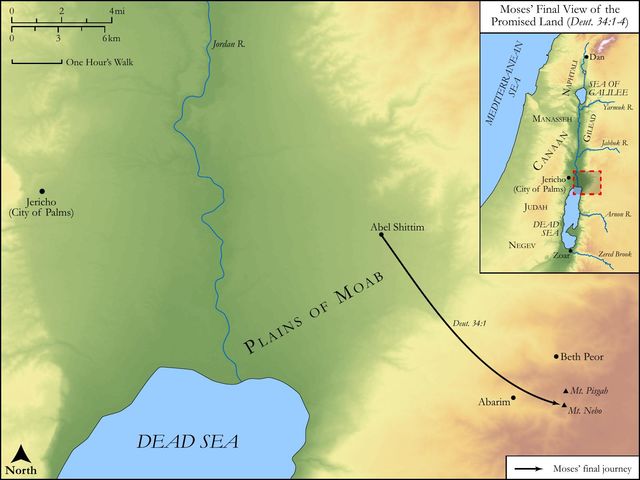
Here is, I. Moses climbing upwards towards heaven, as high as the top of Pisgah, there to die; for that was the place appointed, Deu 32:49, Deu 32:50. Israel lay encamped upon the flat grounds in the plains of Moab, and thence he went up, according to order, to the mountain of Nebo, to the highest point or ridge of that mountain, which was called Pisgah, Deu 32:1. Pisgah is an appellative name for all such eminences. It should seem, Moses went up alone to the top of Pisgah, alone without help - a sign that his natural force was not abated when on the last day of his life he could walk up to the top of a high hill without such supporters as once he had when his hands were heavy (Exo 17:12), alone without company. When he had made an end of blessing Israel, we may suppose, he solemnly took leave of Joshua, and Eleazar, and the rest of his friends, who probably brought him to the foot of the hill; but then he gave them such a charge as Abraham gave to his servants at the foot of another hill: Tarry you here while I go yonder and die: they must not see him die, because they must not know of his sepulchre. But, whether this were so or not, he went up to the top of Pisgah, 1. To show that he was willing to die. When he knew the place of his death, he was so far from avoiding it that he cheerfully mounted a steep hill to come at it. Note, Those that through grace are well acquainted with another world, and have been much conversant with it, need not be afraid to leave this. 2. To show that he looked upon death as his ascension. The soul of a man, of a good man, when it leaves the body, goes upwards (Ecc 3:21), in conformity to which motion of the soul, the body of Moses shall go along with it as far upwards as its earth will carry it. When God's servants are sent for out of the world, the summons runs thus, Go up and die.
II.Moses looking downward again towards this earth, to see the earthly Canaan into which he must never enter, but therein by faith looking forwards to the heavenly Canaan into which he should now immediately enter. God had threatened that he should not come into the possession of Canaan, and the threatening is fulfilled. But he had also promised that he should have a prospect of it, and the promise is here performed: The Lord showed him all that good land, v. 1.
1.If he went up alone to the top of Pisgah, yet he was not alone, for the Father was with him, Joh 16:32. If a man has any friends, he will have them about him when he lies a dying. But if, either through God's providence or their unkindness, it should so happen that we should then be alone, we need fear no evil if the great and good Shepherd be with us, Psa 23:4.
2.Though his sight was very good, and he had all the advantage of high ground that he could desire for the prospect, yet he could not have seen what he now saw, all Canaan from end to end (reckoned about fifty or sixty miles), if his sight had not been miraculously assisted and enlarged, and therefore it is said, The Lord showed it to him. Note, All the pleasant prospects we have of the better country we are beholden to the grace of God for; it is he that gives the spirit of wisdom as well as the spirit of revelation, the eye as well as the object. This sight which God here gave Moses of Canaan, probably, the devil designed to mimic, and pretended to out-do, when in an airy phantom he showed to our Saviour, whom he had placed like Moses upon an exceedingly high mountain, all the kingdoms of the world and the glory of them, not gradually, as here, first one country and then another, but all in a moment of time.
3.He saw it at a distance. Such a sight the Old Testament saints had of the kingdom of the Messiah; they saw it afar off. Thus Abraham, long before this, saw Christ's day; and, being fully persuaded of it, embraced it in the promise, leaving others to embrace it in the performance, Heb 11:13. Such a sight believers now have, through grace, of the bliss and glory of their future state. The word and ordinances are to them what Mount Pisgah was to Moses; from them they have comfortable prospects of the glory to be revealed, and rejoice in hope of it.
4.He saw it, but must never enjoy it. As God sometimes takes his people away from the evil to come, so at other times he takes them away from the good to come, that is, the good which shall be enjoyed by the church in the present world. Glorious things are spoken of the kingdom of Christ in the latter days, its advancement, enlargement, and flourishing state; we foresee it, but we are not likely to live to see it. Those that shall come after us, we hope will enter that promised land, which is a comfort to us when we find our own carcases falling in this wilderness. See Kg2 7:2.
5.He saw all this just before his death. Sometimes God reserves the brightest discoveries of his grace to his people to be the support of their dying moments. Canaan was Immanuel's land (Isa 8:8), so that in viewing it he had a view of the blessings we enjoy by Christ. It was a type of heaven (Heb 11:16), which faith is the substance and evidence of. Note, Those may leave this world with a great deal of cheerfulness that die in the faith of Christ, and in the hope of heaven, and with Canaan in their eye. Having thus seen the salvation of God, we may well say, Lord, now let thou thy servant depart in peace.
Historical interpretation
Historical reception
1 surviving comment on this verse from the historical church.
And yet only before his death was [Moses] forgiven; and this was the man who, because of this guilt, was ordered to die lest he enter the Promised Land.
Continue studying Deuteronomy 34:4 across the web’s major study libraries — every link below opens this exact verse, chapter, or book on the destination site.
Read & Compare
 BibleGatewayThis verse in more than 200 translations and 70 languages.
 Bible.comThe YouVersion reader — hundreds of translations, reading plans, and highlights.
 ESV.orgCrossway's official English Standard Version reader.
 NET BibleThe NET translation with 60,000+ translators' notes on every rendering decision.
 STEP BibleTyndale House's free study tool — original text, vocabulary, and scholarly resources.
 BibliaLogos Bible Software's free web reader.
 USCCBThe New American Bible (Revised Edition) with the U.S. bishops' study notes.
Commentaries
 BibleHub CommentariesDozens of classic commentaries on this verse, gathered on one page.
 StudyLightMore than 100 commentary sets — the largest collection on the web.
 BibleRefPlain-English commentary on what this verse means, verse by verse.
 Enduring WordDavid Guzik's free commentary on this chapter, widely used by Bible teachers.
 Bible Study ToolsVerse commentary alongside Greek and Hebrew study aids.
Original Language & Research
- BibleHub InterlinearThe verse word by word — original language, transliteration, and English.
- BibleHub LexiconEvery word's original-language definition and Strong's entry.
 Blue Letter BibleDeep-study tools — Strong's numbers, concordance, and word studies.
 SefariaThe Hebrew text with Rashi and centuries of Jewish commentary.
Sermons, Hymns & Audio


TrulyRandomVerse is not affiliated with these sites and doesn’t control their content. They’re linked because they’re genuinely useful.
Summary
Deuteronomy 34:4 captures a profoundly poignant and pivotal moment in biblical history, as Moses, at the end of his earthly journey, is granted a panoramic vision of the Promised Land from Mount Nebo. This divine act serves as a powerful testament to God's unwavering faithfulness to the ancient covenant promises made generations earlier to Abraham, Isaac, and Jacob, assuring their ultimate fulfillment to Israel. Simultaneously, the verse reaffirms the personal consequence for Moses, who, despite seeing the land, is barred from entering it, underscoring the gravity of obedience even for God's most esteemed servants.
Context
ShowHideLiterary Context
This verse is situated within the final chapter of Deuteronomy, which serves as the concluding narrative of Moses' life and ministry and, indeed, the entire Pentateuch. Following his extensive farewell discourses, the reiteration of the Law, and the pronouncement of blessings and curses upon Israel, Moses ascends Mount Nebo, specifically to the peak of Pisgah, as commanded by the LORD in Deuteronomy 34:1. From this elevated vantage point, God Himself reveals the vast expanse of the land of Canaan, stretching from Gilead in the north to Dan, encompassing the territories of Naphtali, Ephraim, Manasseh, Judah, and the fertile plain of Jericho, all the way to the Western Sea, as detailed in Deuteronomy 34:1-3. This panoramic vision immediately precedes Moses' death and burial, setting the stage for the transition of leadership to Joshua, who is divinely appointed to lead the Israelites into the land that Moses could only behold. The chapter thus functions as a solemn yet hopeful conclusion to an era, marking the end of Moses' direct leadership while affirming the continuity of God's redemptive plan for His people.
Historical & Cultural Context
The concept of a "Promised Land" was central to Israel's identity and covenant relationship with Yahweh, dating back to the call of Abraham. For centuries, the descendants of Abraham had lived as sojourners, anticipating the fulfillment of God's oath to grant them a specific territory. The act of God showing Moses the land from a high mountain echoes the LORD's word to Abram to lift up his eyes and look at all the land that He would give to him and his seed, an act of granting dominion, signifying ownership and transfer. The land itself, Canaan, was already inhabited by various peoples, and its conquest would be a significant undertaking, symbolizing God's faithfulness to His people and His judgment upon the idolatrous nations. Moses' exclusion from the land was a direct consequence of his disobedience at the waters of Meribah, as recorded in Numbers 20:12, a significant event that underscored the absolute necessity of obedience to God's specific commands, even for a leader of Moses' stature. This historical moment also highlights the transition of leadership, a recurring theme in Scripture, where the mantle of authority passed from an elder, foundational figure to a younger successor, as from Elijah to Elisha, ensuring continuity and stability for the nation.
Key Themes
ShowHideDeuteronomy 34:4 powerfully encapsulates several overarching themes prevalent throughout Deuteronomy and the Pentateuch. Firstly, it underscores Divine Faithfulness and Promise-Keeping, demonstrating God's absolute commitment to His covenantal oaths, particularly the Abrahamic covenant concerning the land, first articulated in Genesis 12:7. The explicit mention of Abraham, Isaac, and Jacob emphasizes the multi-generational certainty and immutability of God's word. Secondly, the verse highlights the Consequences of Disobedience, as Moses' inability to enter the land serves as a stark reminder that even profound faith and dedicated service do not exempt one from the repercussions of direct defiance against God's commands, as seen in Deuteronomy 32:51. This reinforces the theme of God's justice and holiness, demonstrating that He holds even His most esteemed servants accountable. Finally, the scene sets the stage for Leadership Transition and the Continuity of God's Plan, illustrating that while individual leaders may complete their assignments, God's overarching purposes for His people continue seamlessly, with Joshua now poised to lead Israel into their inheritance, as commanded in Joshua 1:2.
Exposition and Analysis
ShowHideKey Word Analysis
ShowHideThis term (יְהֹוָה, Yᵉhôvâh) is the sacred, covenantal name of God, often rendered as Yahweh or Jehovah. It signifies "the self-Existent" or "the Eternal One," emphasizing God's unchanging, sovereign nature and His faithfulness to His covenant promises. In this context, it highlights that the one speaking to Moses is the very God who made the ancient promises to the patriarchs and is now bringing them to fruition.
The verb "sware" (שָׁבַע, shâbaʻ) is derived from the Hebrew word for "seven," a number often associated with completeness and solemnity. When God "swears" an oath, it signifies an unbreakable, self-binding commitment, a divine guarantee that His word is absolutely certain and will be fulfilled. It underscores the immutable nature of the covenant promises made to Abraham, Isaac, and Jacob, establishing the divine certainty of the land's inheritance.
The term "seed" (זֶרַע, zeraʻ) refers to offspring or descendants. In the context of the Abrahamic covenant, it carries profound theological weight, signifying not just biological progeny but the covenantal heirs through whom God's promises would be realized. It points to the continuity of God's plan through generations of Israel, leading ultimately to the singular "Seed," Christ, through whom all God's promises find their ultimate "Yes."
Verse Breakdown
ShowHide"And the LORD said unto him,"
This opening phrase immediately establishes divine initiative and authority. It is God Himself, Yahweh, who directly addresses Moses, emphasizing the solemnity and definitive nature of the pronouncement that follows. This is not a human observation but a direct revelation from the Almighty, underscoring the weight and truth of His words.
"This [is] the land which I sware unto Abraham, unto Isaac, and unto Jacob,"
This clause is a powerful affirmation of God's covenant faithfulness across generations. The land being shown to Moses is explicitly identified as the very land promised by solemn oath to the patriarchs centuries earlier. This direct link to Abraham, Isaac, and Jacob underscores the enduring and unchanging nature of God's promises, demonstrating His steadfast commitment to His word.
"saying, I will give it unto thy seed:"
This further clarifies the content and beneficiaries of the ancient oath. The promise was not merely to the patriarchs themselves but specifically to their descendants, the nation of Israel. Moses, seeing the land, is witnessing the impending fulfillment of this ancient, multi-generational promise to the very people he has led for forty years through the wilderness.
"I have caused thee to see [it] with thine eyes,"
This phrase highlights God's grace and partial fulfillment for Moses. Despite his inability to enter, God grants him the profound privilege of beholding the land. It is a divine act, allowing Moses a visual confirmation of the promise, a final, personal glimpse of the culmination of their wilderness journey and the faithfulness of God.
"but thou shalt not go over thither."
This concluding, stark statement delivers the consequence of Moses' disobedience at Meribah. The conjunction "but" creates a sharp contrast, emphasizing the boundary he cannot cross. It is a poignant reminder of God's justice and the seriousness of sin, even for a beloved and highly esteemed servant, and marks the definitive end of Moses' physical leadership over Israel in their entry to the land.
Literary Devices
ShowHideDeuteronomy 34:4 is rich in Contrast, primarily between the privilege of seeing and the prohibition from entering. Moses is granted the profound gift of beholding the Promised Land, a vision of God's faithfulness and the culmination of his life's work, yet he is simultaneously barred from setting foot within it. This creates a poignant tension, highlighting both divine grace and divine justice. The verse also employs Divine Speech, as the LORD directly addresses Moses, lending immense authority and weight to the pronouncement. This direct address emphasizes the personal nature of God's interaction with His servant and the definitive nature of His decree. Furthermore, the scene serves as Foreshadowing, setting the stage for Joshua's leadership and the subsequent conquest of the land, signaling that while one era ends, God's overarching plan for His people continues. The land itself functions as Symbolism, representing not only a physical inheritance but also God's covenant blessings, rest, and the fulfillment of His promises, pointing to a greater, spiritual reality.
Theological and Thematic Connections
ShowHideDeuteronomy 34:4 stands as a profound theological statement on the unwavering nature of God's covenant promises, His perfect justice, and His sovereign plan that transcends individual lives. It demonstrates that God's word, sworn centuries earlier to the patriarchs, remains steadfast and will be brought to fruition in His timing and according to His methods. While Moses, the great lawgiver and leader, experiences the consequence of his disobedience, God's larger purpose for Israel's inheritance of the land remains inviolable. This scene teaches us that God's faithfulness is not contingent on human perfection, but His justice demands accountability, even from His most chosen servants, underscoring His holiness.
Reflection and Application
ShowHideDeuteronomy 34:4 offers profound lessons for believers today, inviting us to contemplate God's character and our own walk of faith. It reminds us that God is utterly faithful to His promises, even when their full realization extends beyond our personal involvement or lifetime. We are called to cultivate a deep trust in His sovereign plan and timing, understanding that His purposes will ultimately prevail, regardless of immediate circumstances. Simultaneously, Moses' exclusion serves as a solemn warning: obedience to God's commands is paramount for all, irrespective of our position, influence, or past faithfulness. Even great leaders are accountable for their actions, and God's standards are unyielding. This passage encourages us to finish our race well, fulfilling our God-given assignments with integrity and humility, even if others are destined to carry the torch forward into the next phase of God's grand design. Our ultimate goal is to be faithful stewards, knowing that God's kingdom purposes will always advance, and our personal obedience contributes to His glory.
Questions for Reflection
ShowHideFAQ
ShowHideWhy was Moses not allowed to enter the Promised Land, despite leading Israel for 40 years?
ShowHideMoses was barred from entering the Promised Land due to an act of disobedience at the waters of Meribah, as recorded in Numbers 20:1-13. God had commanded Moses to speak to the rock to bring forth water for the thirsty Israelites. However, in frustration with the people's grumbling and rebellion, Moses struck the rock twice with his staff, saying, "Hear now, you rebels: shall we bring water for you out of this rock?" (Numbers 20:10). God viewed this action as a failure to trust and honor Him as holy before the eyes of the Israelites. His actions misrepresented God's character and direct command, leading to the divine decree that he would not lead the people into the land (Numbers 20:12).
What is the significance of Moses seeing the land but not entering it?
ShowHideMoses seeing the land but not entering it carries multiple layers of profound significance. Firstly, it underscores God's unwavering faithfulness to His covenant promises; He allowed Moses to witness the impending fulfillment of the Abrahamic covenant regarding the land, even if Moses himself would not participate in the physical entry. Secondly, it serves as a powerful visual reminder of the consequences of disobedience, even for a beloved and highly esteemed servant of God like Moses. It highlights God's holiness and justice, demonstrating that no one is exempt from accountability for direct defiance. Thirdly, it symbolizes the transition from the old covenant era (represented by Moses, the lawgiver) to a new phase of God's redemptive plan (represented by Joshua, who leads the people into the land). It is a poignant moment of both grace (seeing) and judgment (not entering), marking a pivotal shift in God's dealings with His people.
Did God break His promise to Moses by not letting him enter the Promised Land?
ShowHideNo, God did not break His promise. The promise of the land was primarily made to Abraham and his "seed" or descendants (Genesis 12:7), which referred to the nation of Israel as a whole. While Moses was God's chosen leader to bring them to the threshold of that land, his personal entry was contingent upon his obedience and honoring God's holiness. God's promise to Israel was indeed fulfilled through Joshua, Moses' successor, who led the people into their inheritance. Moses' role was to lead them to the land, and he faithfully fulfilled that mission. His exclusion was a specific, just consequence for his actions at Meribah, not a revocation of God's broader, unconditional covenant with His people concerning the land.
Christ-Centered Fulfillment
ShowHideDeuteronomy 34:4, with its poignant scene of Moses gazing upon the Promised Land he cannot enter, finds profound Christ-centered fulfillment in the New Testament. Moses, representing the Law and the old covenant, could lead God's people to the promise, but not into the ultimate rest and inheritance. This powerfully foreshadows the inadequacy of the Law to bring ultimate salvation or direct access to God's presence; it can only reveal sin and point the way to a greater reality. The true "Promised Land" for believers is not a physical territory but the spiritual inheritance and eternal rest found in Christ, as beautifully expounded in Hebrews 4:1-11. Just as Joshua (whose name is the Hebrew equivalent of Jesus) led Israel into the earthly inheritance, so Jesus, our greater Joshua, leads us into the heavenly one. He is the one who "goes over thither" on our behalf, breaking down the barrier of sin and opening the way to the Father through His own body and blood (Hebrews 10:19-20). Moses saw the promise from afar, but through Christ, we are invited to enter and possess the spiritual blessings "in the heavenly places" (Ephesians 1:3). The ultimate fulfillment of God's sworn promises to Abraham, Isaac, and Jacob is not merely a land, but a people redeemed and brought into eternal fellowship with God through the perfect obedience and atoning sacrifice of the singular "seed" of Abraham, Jesus Christ (Galatians 3:16).