


Deuteronomy 32:52
Bible text: King James Version (1769 Blayney text) · Public domain
Bible text: Berean Standard Bible · Public domain
Bible text: American Standard Version (1901) · Public domain
Bible text: World English Bible, Messianic edition · Public domain
Bible text: Geneva Bible (1599) · Public domain
Bible text: Young's Literal Translation · Public domain
- כִּיkiforH3588PrtParticle Conditional
- מִנֶּגֶדmi·Ne·gedfrom beforeH5048Prep-m ¦ Adj-msAdjective Numerical Singular Masculine Absoluteמִfromנֶּגֶדbefore
- תִּרְאֶהtir·'Ehyou will seeH7200V-Qal-Imperf-2msVerb Qal Imperfect 2nd Singular Masculine
- אֶת'et<obj.>H853DirObjMParticle Object Indicator
- הָאָרֶץha·'A·retzthe landH776Art ¦ N-fsNoun Singular Feminine Absoluteהָtheאָרֶץland
- וְשָׁמָּהve·Sha·mahand there towardsH8033Conj-w ¦ Adv ¦ SfxAdverbוְandשָׁמָּthereהtowards
- לֹאlo'notH3808NegParticle Negative
- תָבוֹאta·Vo'you will goH935V-Qal-Imperf-2msVerb Qal Imperfect 2nd Singular Masculine
- אֶל'elintoH413PrepPreposition
- הָאָרֶץha·'A·retzthe landH776Art ¦ N-fsNoun Singular Feminine Absoluteהָtheאָרֶץland
- אֲשֶׁר'a·SherwhichH834RelParticle Relative
- אֲנִי'a·NiIH589Pro-1csPronoun Personal 1st Singular common gender
- נֹתֵןno·Ten[am] about to giveH5414V-Qal-Prtcpl-msVerb Qal Participle Singular Masculine Absolute
- לִבְנֵיliv·Neito [the] peopleH1121Prep-l ¦ N-mpcNoun Plural Masculine Constructלִtoבְנֵי[the] people
- יִשְׂרָאֵלYis·ra·'ElIsraelH3478N-properNoun Proper Location
English is a literal word-by-word gloss of the Hebrew, not the KJV's wording. Why?
This is the original text the KJV's translators worked from — each Hebrew word with its own literal English meaning in this verse, prepared by scholars at Tyndale House, Cambridge. The KJV translates whole sentences, not word by word, so its wording differs: one Hebrew word can become several English words, and the KJV may choose “the LORD” where the gloss reads “Yahweh”. Both are faithful — they answer different questions. For the KJV's own rendering, switch to the KJV text.
Details
See on the biblical-era map
Study this verse
Public-domain commentary
Matthew Henry
From his Commentary on the Whole Bible. Henry comments on passages, not single verses — this entry covers Deuteronomy 32:44–52. His three-level outline is real structure in the source text, so it is rendered as structure.
Here is, I. The solemn delivery of this song to the children of Israel, Deu 32:44, Deu 32:45. Moses spoke it to as many as could hear him, while Joshua, in another assembly, at the same time, delivered it to as many as his voice would reach. Thus coming to them from the mouth of both their governors, Moses who was laying down the government, and Joshua who was taking it up, they would see they were both in the same mind, and that, though they changed their commander, there was no change in the divine command; Joshua, as well as Moses, would be a witness against them if ever they forsook God.
II.An earnest charge to them to mind these and all the rest of the good words that Moses had said to them.
How earnestly does he long after them all, how very desirous that the word of God might make deep and lasting impressions upon them, how jealous over them with a godly jealousy, lest they should at any time let slip these great things!
1.The duties he charges upon them are, (1.) Carefully to attend to these themselves: "Set your hearts both to the laws, and to the promises and threatenings, the blessings and curses, and now at last to this song. Let the mind be closely applied to the consideration of these things; be affected with them; be intent upon your duty, and cleave to it with full purpose of heart." (2.) Faithfully to transmit these things to those that should come after them: "What interest you have in your children, or influence upon them, use it for this purpose; and command them (as your father Abraham did, Gen 18:19) to observe to do all the words of this law." Those that are good themselves cannot but desire that their children may be so likewise, and that posterity may keep up religion in their day and the entail of it may not be cut off.
2.The arguments he uses to persuade them to make religion their business and to persevere in it are,
(1.)The vast importance of the things themselves which he had charged upon them (Deu 32:47): "It is not a vain thing, because it is your life. It is not an indifferent thing, but of absolute necessity; it is not a trifle, but a matter of consequence, a matter of life and death; mind it, and you are made for ever; neglect it, and you are for ever undone." O that men were but fully persuaded of this, that religion is their life, even the life of their souls!
(2.)The vast advantage it would be of to them: Through this thing you shall prolong your days in Canaan, which is a typical promise of that eternal life which Christ has assured us those shall enter into that keep the commandments of God, Mat 19:17.
III.Orders given to Moses concerning his death.
Now that this renowned witness for God had finished his testimony, he must go up to Mount Nebo and die; in the prophecy of Christ's two witnesses there is a plain allusion to Moses and Elias (Rev 11:6), and perhaps their removal, being by martyrdom, is no less glorious than the removal either of Moses or Elias. Orders were given to Moses that self-same day, Deu 32:48. Now that he had done his work, why should he desire to live a day longer? He had indeed formerly prayed that he might go over Jordan, but now he is entirely satisfied, and, as God had bidden him, saith no more of that matter.
1.God here reminds him of the sin he had been guilty of, for which he was excluded Canaan (Deu 32:51), that he might the more patiently bear the rebuke because he had sinned, and that now he might renew his sorrow for that unadvised word, for it is good for the best of men to die repenting of the infirmities they are conscious to themselves of. It was an omission that was thus displeasing to God; he did not sanctify God, as he ought to have done, before the children of Israel, he did not carry himself with a due decorum in executing the orders he had then received.
2.He reminds him of the death of his brother Aaron (Deu 32:50), to make his own the more familiar and the less formidable. Note, It is a great encouragement to us, when we die, to think of our friends that have gone before us through that darksome valley, especially of Christ, our elder brother and great high priest.
3.He sends him up to a high hill, thence to take a view of the land of Canaan and then die, Deu 32:49, Deu 32:50. The remembrance of his sin might make death terrible, but the sight God gave him of Canaan took off the terror of it, as it was a token of God's being reconciled to him, and a plain indication to him that though his sin shut him out of the earthly Canaan, yet it should not deprive him of that better country which in this world can only be seen, and that with an eye of faith. Note, Those may die with comfort and ease whenever God calls for them (notwithstanding the sins they remember against themselves) who have a believing prospect and a well-grounded hope of eternal life beyond death.
Continue studying Deuteronomy 32:52 across the web’s major study libraries — every link below opens this exact verse, chapter, or book on the destination site.
Read & Compare
 BibleGatewayThis verse in more than 200 translations and 70 languages.
 Bible.comThe YouVersion reader — hundreds of translations, reading plans, and highlights.
 ESV.orgCrossway's official English Standard Version reader.
 NET BibleThe NET translation with 60,000+ translators' notes on every rendering decision.
 STEP BibleTyndale House's free study tool — original text, vocabulary, and scholarly resources.
 BibliaLogos Bible Software's free web reader.
 USCCBThe New American Bible (Revised Edition) with the U.S. bishops' study notes.
Commentaries
 BibleHub CommentariesDozens of classic commentaries on this verse, gathered on one page.
 StudyLightMore than 100 commentary sets — the largest collection on the web.
 BibleRefPlain-English commentary on what this verse means, verse by verse.
 Enduring WordDavid Guzik's free commentary on this chapter, widely used by Bible teachers.
 Bible Study ToolsVerse commentary alongside Greek and Hebrew study aids.
Original Language & Research
- BibleHub InterlinearThe verse word by word — original language, transliteration, and English.
- BibleHub LexiconEvery word's original-language definition and Strong's entry.
 Blue Letter BibleDeep-study tools — Strong's numbers, concordance, and word studies.
 SefariaThe Hebrew text with Rashi and centuries of Jewish commentary.
Sermons, Hymns & Audio


TrulyRandomVerse is not affiliated with these sites and doesn’t control their content. They’re linked because they’re genuinely useful.
Summary
Deuteronomy 32:52 delivers God's final, poignant instruction to Moses, confirming that while he will be granted a panoramic view of the Promised Land from Mount Nebo, he will not physically enter it. This declaration encapsulates the divine consequence for Moses' singular act of disobedience at Meribah, yet simultaneously reaffirms God's unwavering faithfulness to His covenant promises to the children of Israel, setting the stage for the imminent leadership transition to Joshua and the nation's entry into their inheritance.
Context
ShowHideLiterary Context
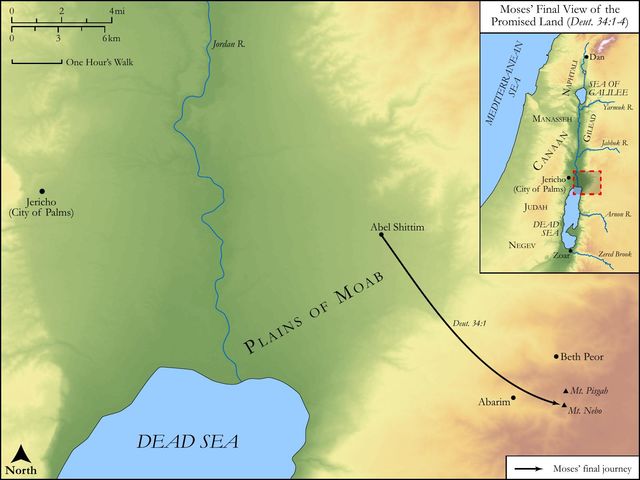
This verse serves as the solemn conclusion to the "Song of Moses" in Deuteronomy 32, a profound poetic and prophetic utterance that recounts God's steadfast faithfulness to Israel despite their persistent rebellion. Immediately following this song, God directly commands Moses to ascend Mount Nebo (specifically Mount Pisgah, as clarified in Deuteronomy 34:1) to view the land and then die there. The song itself functions as a prophetic witness, foretelling Israel's future apostasy, their subsequent judgment, and God's eventual restoration. The verses directly preceding Deuteronomy 32:52 explicitly link Moses' impending death on the mountain to his failure to uphold God's holiness at the waters of Meribah. The subsequent chapter, Deuteronomy 33, contains Moses' final, powerful blessing upon the tribes of Israel, further solidifying his role as mediator and prophet even in his final earthly moments.
Historical & Cultural Context
The historical setting for this declaration is the plains of Moab, situated on the eastern side of the Jordan River, approximately forty years after the miraculous Exodus from Egypt. The generation that had rebelled in the wilderness had largely perished, and a new generation, born and raised under Moses' leadership in the desert, now stood poised to enter the land of Canaan. Moses, at 120 years of age, had faithfully led the Israelites for four decades. His exclusion from the Promised Land is a direct, divine consequence of his sin at the waters of Meribah, meticulously recorded in Numbers 20:1-13. There, instead of speaking to the rock as commanded by God, Moses, in a moment of frustration and anger, struck it twice, seemingly claiming the power for himself ("Must we bring you water out of this rock?"). This act, in God's eyes, failed to "sanctify" or honor Him as holy before the people, demonstrating a lack of trust and perfect obedience from His chosen leader. In ancient Israelite culture, leaders like Moses were seen as direct representatives of God, and their actions carried immense weight, reflecting God's character and holiness to the entire nation.
Key Themes
ShowHideDeuteronomy 32:52 profoundly contributes to several overarching themes woven throughout Deuteronomy and the broader Pentateuch. Firstly, it powerfully underscores the theme of divine justice and the consequences of sin, illustrating that even the most revered and intimate servants of God are not exempt from accountability for disobedience. God's holiness and righteous standards apply universally, and sin, even a seemingly minor lapse, carries repercussions, particularly for those in positions of leadership. Secondly, it highlights God's unwavering faithfulness to His covenant promises. Despite Moses' personal consequence, the overarching promise of the land to the children of Israel, first given to Abraham in Genesis 12:7, remains steadfast and will be fulfilled through the next generation, led by Joshua. This demonstrates God's absolute reliability in His covenant commitments. Thirdly, the verse marks a critical point in the theme of leadership transition, signaling the imminent conclusion of Moses' earthly ministry and the inauguration of a new era for Israel under Joshua's guidance, a transition also detailed in Deuteronomy 31. Finally, Moses' act of "seeing" the land, though from a distance, subtly introduces the theme of seeing by faith, echoing the patriarchs who, as noted in Hebrews 11:13, "saw them afar off, and were persuaded of them, and embraced them."
Exposition and Analysis
ShowHideKey Word Analysis
ShowHideThis verb, H7200, encompasses not merely a physical act of looking but also a deeper perception, comprehension, or even a visionary experience. In this context, Moses is granted a unique privilege to "behold" or "view" the Promised Land, allowing him to discern its reality and beauty. This "seeing" is a final act of divine grace, enabling him to grasp the fulfillment of God's promise from a unique, elevated perspective, even if he cannot physically enter. It implies a full apprehension of the land's vastness and significance.
This noun, H776, refers specifically to the land of Canaan, the Promised Land. It is more than just a geographical territory; it is the central component of God's covenant with Abraham, Isaac, and Jacob. It represents God's promised inheritance, a place of rest, blessing, and the ultimate fulfillment of divine promise for the nation of Israel. The phrase "the land which I give the children of Israel" underscores its divine origin and its purpose as a gratuitous gift from God.
This primitive root, H5414, emphasizes God's sovereign initiative, generous provision, and active bestowal. The land is not something earned by human merit or conquest but is a divine "gift," freely "bestowed" by God based on His covenant faithfulness. This highlights the gratuity of God's promises and the fact that His ultimate purposes are carried out by His power, even as individual disobedience (like Moses' at Meribah) can impact personal participation in those promises.
Verse Breakdown
ShowHide"Yet thou shalt see the land before [thee];"
This opening clause conveys a profound paradox: a privilege coupled with a limitation. Moses, the faithful leader who brought Israel to the very threshold of their inheritance, is granted the unique and direct opportunity to view the entire expanse of the Promised Land. The phrase "before thee" emphasizes the clarity and directness of this divinely granted vision. It is an act of grace, allowing Moses a final, comprehensive understanding and appreciation of the destination he had tirelessly led his people towards for forty years, a testament to God's faithfulness in showing him the fulfillment of His promises.
"but thou shalt not go thither unto the land which I give the children of Israel."
This second clause delivers the stark, unyielding divine decree that follows the privilege. Despite his unparalleled intimacy with God, his lifelong dedication, and his pivotal role in Israel's history, Moses is explicitly forbidden from physically entering the land. The repetition of "the land which I give the children of Israel" underscores that while the land is a guaranteed gift to the nation as a whole, Moses' personal disobedience at Meribah prevents his individual entry. This highlights God's unwavering justice, His demand for holiness, and the serious consequences of even a momentary lapse in faithfulness from those in positions of leadership.
Literary Devices
ShowHideDeuteronomy 32:52 employs several powerful literary devices that deepen its theological impact. Irony is profoundly present, as Moses, the one chosen by God to lead Israel out of bondage and through the wilderness, is himself barred from entering the very land he brought them to. This creates a deeply poignant and melancholic tone, emphasizing the personal cost of disobedience, even for a figure as revered as Moses. The verse also functions as foreshadowing, signaling the imminent end of Moses' leadership and the crucial transition to Joshua, who would indeed lead the people into the land. Furthermore, Moses' act of "seeing" the land from afar can be interpreted as rich symbolism. It symbolizes the limitations of the Old Covenant and the Law (represented by Moses) in bringing people into the full inheritance and true spiritual rest. It also symbolizes the nature of faith, where one can "see" and believe in God's promises, even if their complete earthly realization is not granted within one's lifetime.
Theological and Thematic Connections
ShowHideDeuteronomy 32:52 powerfully illustrates the profound tension between divine justice and unwavering covenant faithfulness. While God holds even His most esteemed servants accountable for their disobedience, demonstrating the seriousness of sin and His unblemished holiness, His overarching promises to His people remain steadfast and immutable. Moses' exclusion from the land underscores that God's righteous standards apply to all, and even a momentary lapse in faith from a trusted leader carries significant repercussions. Yet, the very act of allowing Moses to "see" the land from afar reaffirms God's absolute commitment to Israel's inheritance, demonstrating that individual consequences do not negate God's broader redemptive plan for His covenant people. This verse serves as a profound reminder that God's ways are higher than our ways, and His standards are universal, even as His grace ensures the ultimate fulfillment of His divine purposes for His chosen nation.
Reflection and Application
ShowHideDeuteronomy 32:52 offers a sobering yet profoundly hopeful lesson for all believers. It serves as a stark reminder that no one, regardless of their spiritual stature, past service, or intimacy with God, is exempt from the consequences of disobedience. Moses, who spoke with God face-to-face and led millions, still faced the repercussions of his actions at Meribah. This truth should cultivate in us a deep reverence for God's holiness and a meticulous commitment to obedience, recognizing that even seemingly minor acts of unfaithfulness can have significant implications for our journey, our witness, and our ministry. Yet, the verse also highlights God's unwavering faithfulness to His promises. While Moses did not enter, Israel, the recipient of God's covenant promise, certainly did. This teaches us to trust in God's larger, perfect plan, even when our personal desires or expectations are not fully realized. Our ultimate hope rests not in our perfect performance, but in God's perfect promise and His ability to bring His plans to fruition, through others if necessary. We are called to finish our race with integrity, knowing that God's sovereign purposes will ultimately prevail, whether or not we see their full earthly manifestation in our own lifetime.
Questions for Reflection
ShowHideFAQ
ShowHideWhy was Moses not allowed to enter the Promised Land, despite his faithfulness for forty years?
ShowHideMoses was forbidden from entering the Promised Land primarily due to his act of disobedience at the waters of Meribah, as detailed in Numbers 20:1-13. God had commanded him to speak to the rock to bring forth water, but in his frustration with the rebellious Israelites, Moses struck the rock twice. God declared that because Moses "did not trust in Me enough to honor Me as holy in the sight of the Israelites," he would not lead them into the land. This incident underscored the seriousness of even a momentary lapse in obedience and faith, especially from a leader who was meant to perfectly represent God's holiness and power to the people. It was a matter of God's justice and His demand for perfect obedience, even from His most favored servants, to uphold His divine glory.
What is the significance of Moses being allowed to "see" the land but not enter it?
ShowHideThe act of "seeing" the land from afar, as described in Deuteronomy 34:1-4, carries multiple layers of profound significance. Spiritually, it can be seen as a final act of divine grace, allowing Moses a panoramic vision of the fulfillment of God's promises, providing a moment of closure and confirmation for his long ministry. Theologically, it highlights the inherent limitations of the Old Covenant and the Law, which Moses personified. The Law could lead Israel to the threshold of the promise, revealing God's will and exposing sin, but it could not ultimately bring them into the full rest and inheritance of God's presence. This foreshadows the necessity of a new covenant and a different kind of leader. Practically, it marked the clear and divinely ordained transition of leadership from Moses to Joshua, ensuring there was no ambiguity about who would lead the next generation into the land. It also serves as a powerful reminder that while God's promises are absolutely sure, individual participation in their earthly fulfillment can be conditional on obedience and faithfulness.
Christ-Centered Fulfillment
ShowHideDeuteronomy 32:52, with its poignant depiction of Moses viewing the Promised Land but being barred from entry, finds profound Christ-centered fulfillment in the person and redemptive work of Jesus. Moses, as the quintessential representative of the Law, could lead God's people to the very edge of God's promises, but his own sin and the inherent limitations of the Law itself prevented him from bringing them into the promised rest. This inability of the Law to fully usher humanity into God's ultimate inheritance is perfectly overcome by Christ. Just as Moses was unable to bring the people into the earthly Canaan, the Law, being weak because of the flesh, cannot bring humanity into true spiritual rest or eternal life (Romans 8:3). It merely points the way and reveals the need for a Savior. Jesus, however, is the perfect mediator and the true Joshua (whose name is the Hebrew equivalent of Jesus). He not only leads His people to the ultimate, heavenly Promised Land but brings them into it through His perfect obedience and atoning sacrifice. Through Christ, believers enter into the true Sabbath rest that the earthly Canaan only foreshadowed (Hebrews 4:9-10). Moses' death outside the land symbolizes the end of the old covenant's efficacy in fully delivering God's people, while Christ's resurrection and ascension usher in the new covenant, granting believers direct, confident access to God's presence and the full inheritance of salvation and eternal life (Hebrews 10:19-20). Thus, Moses' viewing of the land from afar points to the greater reality of Christ, who enables us not just to see, but to fully enter and possess the spiritual blessings of God's eternal kingdom.