


Deuteronomy 33:1
- וְזֹאתve·Zotand thisH2063Conj-w ¦ PrtParticle Demonstrativeוְandזֹאתthis
- הַבְּרָכָהha·be·ra·Khah[is] the blessingH1293Art ¦ N-fsNoun Singular Feminine Absoluteהַ[is] theבְּרָכָהblessing
- אֲשֶׁר'a·SherwhichH834RelParticle Relative
- בֵּרַךְbe·Rakhhe blessedH1288V-Piel-Perf-3msVerb Piel Perfect 3rd Singular Masculine
- מֹשֶׁהmo·ShehMosesH4872N-proper-mNoun Proper Masculine
- אִישׁ'ish[the] man ofH376N-mscNoun Singular Masculine Construct
- הָאֱלֹהִיםha·'E·lo·Him<the> GodH430Art ¦ N-mpNoun Plural Masculine Absoluteהָ<the>אֱלֹהִיםGod
- אֶת'et<obj.>H853DirObjMParticle Object Indicator
- בְּנֵיbe·Nei[the] people ofH1121N-mpcNoun Plural Masculine Construct
- יִשְׂרָאֵלYis·ra·'ElIsraelH3478N-properNoun Proper Location
- לִפְנֵיlif·Nei<to> beforeH6440Prep-l ¦ N-mpcNoun Plural Masculine Constructלִ<to>פְנֵיbefore
- מוֹתוֹmo·Tohis deathH4194N-msc ¦ 3msNoun Singular Masculine Constructמוֹתdeathוֹhis
English is a literal word-by-word gloss of the Hebrew, not the KJV's wording. Why?
This is the original text the KJV's translators worked from — each Hebrew word with its own literal English meaning in this verse, prepared by scholars at Tyndale House, Cambridge. The KJV translates whole sentences, not word by word, so its wording differs: one Hebrew word can become several English words, and the KJV may choose “the LORD” where the gloss reads “Yahweh”. Both are faithful — they answer different questions. For the KJV's own rendering, switch to the KJV text.
Details
See on the biblical-era map
Study this verse
Public-domain commentary
Matthew Henry
From his Commentary on the Whole Bible. Henry comments on passages, not single verses — this entry covers Deuteronomy 33:1–5. His two-level outline is real structure in the source text, so it is rendered as structure.
The first verse is the title of the chapter: it is a blessing. In the foregoing chapter he had thundered out the terrors of the Lord against Israel for their sin; it was a chapter like Ezekiel's roll, full of lamentation, and mourning, and woe. Now to soften that, and that he might not seem to part in anger, he here subjoins a blessing, and leaves his peace, which should descend and rest upon all those among them that were the sons of peace. Thus Christ's last work on earth was to bless his disciples (Luk 24:50), like Moses here, in token of parting as friends. Moses blessed them, 1. As a prophet - a man of God. Note, It is a very desirable thing to have an interest in the prayers of those that have an interest in heaven; it is a prophet's reward. In this blessing Moses not only expresses his good wishes to this people, but by the spirit of prophecy foretels things to come concerning them. 2. As a parent to Israel; for so good princes are to their subjects. Jacob upon his death-bed blessed his sons (Gen 49:1), in conformity to whose example Moses here blesses the tribes that were descended from them, to show that though they had been very provoking yet the entail of the blessing was not cut off. The doing of this immediately before his death would not only be the more likely to leave an impression upon them, but would be an indication of the great good-will of Moses to them, that he desired their happiness, though he must die and not share in it.
He begins his blessing with a lofty description of the glorious appearances of God to them in giving them the law, and the great advantage they had by it.
I.There was a visible and illustrious discovery of the divine majesty, enough to convince and for ever silence atheists and infidels, to awaken and affect those that were most stupid and careless, and to put to shame all secret inclinations to other gods, Deu 33:2.
1.His appearance was glorious: he shone forth like the sun when he goes forth in his strength. Even Seir and Paran, two mountains at some distance, were illuminated by the divine glory which appeared on Mount Sinai, and reflected some of the rays of it, so bright was the appearance, and so much taken notice of by the adjacent countries. To this the prophet alludes, to set forth the wonders of the divine providence, Hab 3:3, Hab 3:4; Psa 18:7-9. The Jerusalem Targum has a strange gloss upon this, that, "when God came down to give the law, he offered it on Mount Seir to the Edomites, but they refused it, because they found in it, Thou shalt not kill. Then he offered it on Mount Paran to the Ishmaelites, but they also refused it, because they found in it, Thou shalt not steal; and then he came to Mount Sinai and offered it to Israel, and they said, All that the Lord shall say we will do." I would not have transcribed so groundless a conceit but for the antiquity of it.
2.His retinue was glorious; he came with his holy myriads, as Enoch had long since foretold he should come in the last day to judge the world, Jde 1:14. These were the angels, those chariots of God in the midst of which the Lord was, on that holy place, Psa 68:17. They attended the divine majesty, and were employed as his ministers in the solemnities of the day. Hence the law is said to be given by the disposition of angels, Act 7:53; Heb 2:2.
II.He gave them his law, which is,
1.Called a fiery law, because it was given them out of the midst of the fire (Deu 4:33), and because it works like fire; if it be received, it is melting, warming, purifying, and burns up the dross of corruption; if it be rejected, it hardens, sears, torments, and destroys. The Spirit descended in cloven tongues as of fire; for the gospel also is a fiery law.
2.It is said to go from his right hand, either because he wrote it on tables of stone, or to denote the power and energy of the law and the divine strength that goes along with it, that it may not return void. Or it came as a gift to them, and a precious gift it was, a right-hand blessing.
3.It was an instance of the special kindness he had for them: Yea, he loved the people (v. 32), and therefore, though it was a fiery law, yet it is said to go for them (Deu 33:2), that is, in favour to them. Note, The law of God written in the heart is a certain evidence of the love of God shed abroad there: we must reckon God's law one of the gifts of his grace. Yea, he embraced the people, or laid them in his bosom; so the word signifies, which denotes not only the dearest love, but the most tender and careful protection. All his saints are in his hand. Some understand it particularly of his supporting them and preserving them alive at Mount Sinai, when the terror was so great that Moses himself quaked; they heard the voice of God and lived, Deu 4:33. Or it denotes his forming them into a people by his law; he moulded and fashioned them as a potter does the clay. Or they were in his hand to be covered and protected, used and disposed of, as the seven stars were in the hand of Christ, Rev 1:16. Note, God has all his saints in his hand; and, though there are ten thousands of his saints (Deu 33:2), yet his hand, with which he measures the waters, is large enough, and strong enough, to hold them all, and we may be sure that none can pluck them out of his hand, Joh 10:28.
III.He disposed them to receive the law which he gave them:
They sat down at thy feet, as scholars at the feet of their master, in token of reverence, in attendance and humble submission to what is taught; so Israel sat at the foot of Mount Sinai, and promised to hear and do whatever God should say. They were struck to thy feet, so some read it; namely, by the terrors of Mount Sinai, which greatly humbled them for the present, Exo 20:19. Every one then stood ready to receive God's words, and did so again when the law was publicly read to them, as Jos 8:34. It is a great privilege when we have heard the words of God to have opportunity of hearing them again. Joh 17:26, I have declared thy name, and will declare it. So Israel not only had received the law, but should still receive it by their prayers, and other lively oracles. The people are taught (Deu 33:4, Deu 33:5), in gratitude for the law of God, always to keep up an honourable remembrance both of the law itself and of Moses by whom it was given. Two of the Chaldee paraphrasts read it, The children of Israel said, Moses commanded us a law. And the Jews say that as soon as a child was able to speak his father was obliged to teach him these words: Moses commanded us a law, even the inheritance of the congregation of Jacob.
1.They are taught to speak with great respect of the law, and to call it the inheritance of the congregation of Jacob. They looked upon it, (1.) As peculiar to them, and that by which they were distinguished from other nations, who neither had the knowledge of it (Psa 147:20), nor, if they had, were under those obligations to observe it that Israel were under: and therefore (says bishop Patrick), "when the Jews conquered any country, they did not force any to embrace the law of Moses, but only to submit to the seven precepts of Noah." (2.) As entailed upon them; for so inheritances are to be transmitted to their posterity. And, (3.) As their wealth and true treasure. Those that enjoy the word of God and the means of grace have reason to say, We have a goodly heritage. He is indeed a rich man in whom the word of Christ dwells richly. Perhaps the law is called their inheritance because it was given them with their inheritance, and we so annexed to it that the forsaking of the law would be a forfeiture of the inheritance. See Psa 119:111.
2.They are taught to speak with great respect of Moses; and they were the more obliged to keep up his name because he had not provided for the keeping of it up in his family; his posterity were never called the sons of Moses, as the priests were the sons of Aaron. (1.) They must own Moses a great benefactor to their nation, in that he commanded them the law; for, though it came from the hand of God, it went through the hand of Moses. (2.,) He was king in Jeshurun. Having commanded them the law, as long as he lived he took care to see it observed and put in execution; and they were very happy in having such a king, who ruled them, and went in and out before them at all times, but did in a special manner look great when the heads of the people were gathered together in parliament, as it were, and Moses was president among them. Some understand this of God himself; he did then declare himself their King when he gave them the law, and he continued so long as they were Jeshurun, an upright people, and till they rejected him, Sa1 12:12. But it seems rather to be understood of Moses. A good government is a great blessing to any people, and what they have reason to be very thankful for; and that constitution is very happy which as Israel's, which as ours, divides the power between the king in Jeshurun and the heads of the tribes, when they are gathered together.
Continue studying Deuteronomy 33:1 across the web’s major study libraries — every link below opens this exact verse, chapter, or book on the destination site.
Read & Compare
 BibleGatewayThis verse in more than 200 translations and 70 languages.
 Bible.comThe YouVersion reader — hundreds of translations, reading plans, and highlights.
 ESV.orgCrossway's official English Standard Version reader.
 NET BibleThe NET translation with 60,000+ translators' notes on every rendering decision.
 STEP BibleTyndale House's free study tool — original text, vocabulary, and scholarly resources.
 BibliaLogos Bible Software's free web reader.
 USCCBThe New American Bible (Revised Edition) with the U.S. bishops' study notes.
Commentaries
 BibleHub CommentariesDozens of classic commentaries on this verse, gathered on one page.
 StudyLightMore than 100 commentary sets — the largest collection on the web.
 BibleRefPlain-English commentary on what this verse means, verse by verse.
 Enduring WordDavid Guzik's free commentary on this chapter, widely used by Bible teachers.
 Bible Study ToolsVerse commentary alongside Greek and Hebrew study aids.
Original Language & Research
- BibleHub InterlinearThe verse word by word — original language, transliteration, and English.
- BibleHub LexiconEvery word's original-language definition and Strong's entry.
 Blue Letter BibleDeep-study tools — Strong's numbers, concordance, and word studies.
 SefariaThe Hebrew text with Rashi and centuries of Jewish commentary.
Sermons, Hymns & Audio


TrulyRandomVerse is not affiliated with these sites and doesn’t control their content. They’re linked because they’re genuinely useful.
Summary
Deuteronomy 33:1 serves as a profound introduction to Moses' final prophetic act: a solemn and divinely inspired blessing pronounced upon the twelve tribes of Israel just before his death. This verse sets the stage for a powerful farewell address, marking the culmination of Moses' extraordinary leadership and ministry as "the man of God." It underscores his unique standing as God's chosen mediator and prepares the audience for a spiritual impartation of favor and future provision, echoing God's enduring covenant faithfulness to His people as they stand on the threshold of their promised inheritance.
Context
ShowHideLiterary Context
Deuteronomy 33:1 initiates a distinct poetic section within the book of Deuteronomy, immediately following Moses' extensive review of the Law, the covenant stipulations, and his final exhortations to Israel concerning their future in the Promised Land. The entire book of Deuteronomy is framed as Moses' farewell discourse, delivered to the new generation of Israelites on the plains of Moab. Chapter 33, specifically, functions as Moses' spiritual last will and testament, a series of individual blessings pronounced over each tribe. This structure intentionally parallels Jacob's final blessings upon his sons in Genesis 49, highlighting a continuity of patriarchal and prophetic authority in Israel's history. It is a capstone to Moses' ministry, preceding the poignant account of his death and burial in Deuteronomy 34.
Historical & Cultural Context
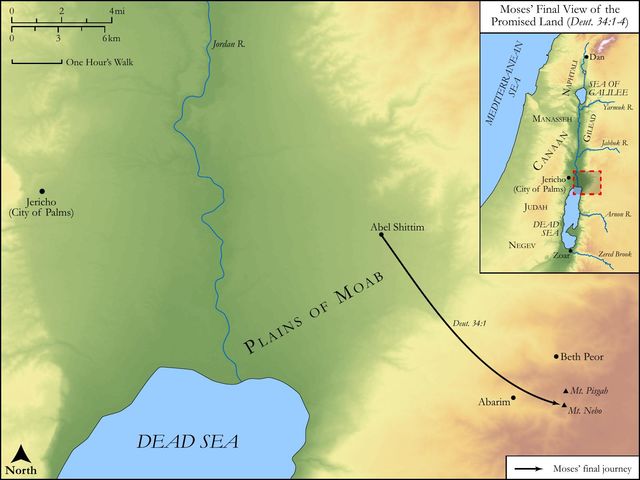
This verse is set on the plains of Moab, east of the Jordan River, with the land of Canaan visible but not yet entered. The generation that experienced the Exodus had largely passed away, and a new generation, born and matured in the wilderness, stood poised to enter the Promised Land. Moses' imminent death (explicitly mentioned in the verse) signifies a critical leadership transition from him to Joshua. In the ancient Near East, a final blessing from a patriarch or leader carried immense weight, often seen as a prophetic pronouncement that shaped the destiny of the recipients. Such blessings were not mere wishes but potent declarations believed to convey divine favor and influence future prosperity and identity. Moses, as God's chosen mediator, delivers these blessings with divine authority, solidifying the covenant relationship between Yahweh and Israel before his departure.
Key Themes
ShowHideDeuteronomy 33:1 introduces several profound themes that resonate throughout the chapter and the broader biblical narrative. Firstly, it emphasizes Moses' unique legacy and authority as "the man of God," a rare and significant title signifying one divinely appointed and intimately connected with the Lord, speaking on His behalf. His final act is one of blessing, confirming his role as God's chosen messenger and intercessor for Israel, echoing his unique relationship with God as described in Deuteronomy 34:10. Secondly, the verse highlights the nature of divine blessing, which is not merely a human wish but a prophetic pronouncement of God's favor and future provision for each tribe, reflecting God's enduring covenant faithfulness despite Israel's past failures and future challenges (cf. the blessings for obedience in Deuteronomy 28:1-14). Thirdly, it underscores the theme of transition and continuity; Moses' death is imminent, yet his final words ensure the spiritual continuity of Israel's journey under God's guidance, looking forward to the nation's prosperity and strength in the land, a testament to God's unwavering commitment to His promises.
Exposition and Analysis
ShowHideKey Word Analysis
ShowHideThis term (H1293) signifies more than a mere wish for good fortune; it denotes a divine impartation of favor, power, and prosperity. In a covenantal context, a "blessing" is God's active pronouncement of good upon His people, often tied to obedience and faithfulness. Here, it is a prophetic declaration, carrying the weight of God's own intentions for Israel's future, encompassing material well-being, numerical increase, and spiritual flourishing within the Promised Land.
This word (H376) in the phrase "man of God" (Hebrew: ʼîysh ʼĕlôhîym) is profound. It refers to an individual, but in this construct, it elevates Moses to a unique status as God's representative. It highlights his personal relationship with Yahweh (H430, ʼĕlôhîym), signifying that he is not merely a human leader but one divinely appointed, empowered, and intimately connected with the divine, speaking with an authority that transcends human wisdom.
This term (H4194) refers to the cessation of life, but in this context, it carries significant weight. The explicit mention of Moses' imminent death adds a poignant and solemn dimension to his final blessings. It emphasizes the definitive end of his earthly ministry, yet simultaneously highlights the enduring nature of the divine promises he is delivering, which will continue beyond his physical presence.
Verse Breakdown
ShowHide"And this [is] the blessing,"
This opening phrase immediately establishes the nature of the ensuing discourse. It signals that the following chapters (Deuteronomy 33) contain a series of divine pronouncements of favor and prosperity, not merely human wishes. The use of "this" points forward to the specific blessings upon each tribe, emphasizing their collective significance as a unified prophetic word.
"wherewith Moses the man of God"
This clause identifies the authoritative speaker. The appellation "Moses the man of God" is crucial, lending immense weight and divine authority to the blessings. It signifies that Moses is not speaking on his own accord but as God's specially chosen and empowered representative, ensuring that the blessings are divinely sanctioned and potent. This title underscores his unparalleled prophetic stature and intimate communion with Yahweh.
"blessed the children of Israel"
This specifies the recipients of the blessing: the entire nation of Israel, represented by its twelve tribes. The act of "blessed" (Hebrew: bârak', H1288) here is a formal, public, and prophetic act, conveying God's intended good for His covenant people as they prepare to enter and settle in the Promised Land. It is a corporate blessing, affirming their collective identity and destiny as the "children of Israel" (H1121, bên H3478, Yisrâʼêl).
"before his death."
This poignant phrase adds a layer of solemnity and finality to the blessings. It underscores that these are Moses' last inspired words to the people he faithfully led for forty years. Knowing his end is near, these blessings carry the weight of a spiritual testament, imparting a final, enduring legacy of hope and divine promise to the nation, ensuring spiritual continuity beyond his physical presence.
Literary Devices
ShowHideDeuteronomy 33:1 employs several effective literary devices. It serves as a Framing Device, introducing the entire poetic section of tribal blessings that follows, setting the tone and context for Moses' final prophetic words. The explicit mention of "before his death" functions as Foreshadowing, creating a poignant sense of urgency and solemnity, reminding the audience of Moses' imminent departure and lending ultimate weight to his final pronouncements. The use of the specific Appellation "Moses the man of God" is a powerful rhetorical choice. This title immediately elevates Moses' status and authority, signaling to the audience that the words he is about to speak are not merely human counsel but divinely inspired declarations, thereby enhancing the theological significance and prophetic nature of the blessings.
Theological and Thematic Connections
ShowHideDeuteronomy 33:1 is deeply rooted in the theology of God's covenant faithfulness and His election of Israel. It portrays God as the ultimate source of all blessing, who uses His chosen servants, like Moses, to mediate His favor to His people. The act of blessing, especially from a dying patriarch, underscores the enduring nature of God's promises even amidst transitions and the passing of generations. It affirms that God's plan for Israel's prosperity and presence in the land is secure, not contingent on any single human leader, but on His unwavering covenant commitment. This verse also highlights the profound significance of prophetic utterance and the power of words spoken under divine inspiration, shaping the future and identity of a nation.
Reflection and Application
ShowHideDeuteronomy 33:1 offers powerful insights for contemporary believers concerning leadership, legacy, and the enduring nature of God's promises. Moses, knowing his earthly journey was concluding, chose to use his final moments not for self-pity or personal concerns, but to impart blessing and hope to the people he had faithfully served for forty years. This challenges us to consider the profound impact of our words, especially in moments of transition or farewell, recognizing that they carry significant weight and can impart either blessing or despair. Like Moses, we are called to live lives that point others to God, building a spiritual inheritance of faith, truth, and blessing for future generations. This verse also serves as a powerful reminder of God's unwavering commitment to His people; even as one era ends and leaders pass on, God's plan and promises continue, assuring us of His steadfast faithfulness in all circumstances.
Questions for Reflection
ShowHideFAQ
ShowHideWhy is Moses called "the man of God" here?
ShowHideThe title "man of God" (Hebrew: ish ha'Elohim) is a rare and highly significant designation in the Old Testament, reserved for individuals who enjoyed a uniquely intimate relationship with God and were divinely commissioned to speak on His behalf. For Moses, this title underscores his unparalleled prophetic authority and his role as the primary mediator of the covenant between God and Israel. It signifies that the blessings he is about to pronounce are not merely human wishes but divinely inspired pronouncements, carrying the full weight of God's will and purpose for His people. Deuteronomy 34:10 further emphasizes Moses' unique prophetic stature, stating that "there has not arisen a prophet since in Israel like Moses, whom the Lord knew face to face."
What is the significance of this blessing being given "before his death"?
ShowHideThe timing of these blessings, "before his death," adds immense weight and solemnity to Moses' words. In ancient cultures, the final words of a patriarch or leader were considered particularly potent and prophetic, often shaping the destiny of their descendants. For Moses, knowing his earthly journey was ending, these blessings represent his final, comprehensive spiritual testament to the nation he led. It highlights the selflessness of his leadership—using his last moments to impart favor and hope to his people rather than focusing on himself. This detail underscores the enduring nature of God's covenant promises, which continue even as human leaders pass away, ensuring continuity for Israel's future.
How does this blessing relate to the rest of Deuteronomy?
ShowHideThis blessing serves as a climactic capstone to the entire book of Deuteronomy, which is largely Moses' farewell discourse. After extensively reviewing the Law, recounting Israel's history, and reiterating the covenant's demands and promises, Moses concludes his ministry by prophetically blessing each tribe. It functions as a spiritual will and testament, reaffirming God's unwavering commitment to His covenant with Israel and His intention to bless them in the Promised Land, despite their past failures and future challenges. It is a powerful affirmation of God's faithfulness, looking forward to Israel's prosperity and strength under divine guidance as they prepare to enter their inheritance (cf. the blessings and curses outlined in Deuteronomy 28).
Christ-Centered Fulfillment
ShowHideDeuteronomy 33:1, with Moses' final blessing upon Israel before his death, powerfully foreshadows the ultimate blessing bestowed by Christ. Moses, as "the man of God" and mediator of the Old Covenant, prefigures Jesus, the perfect "man of God" and mediator of a New and better Covenant (Hebrews 8:6). Just as Moses' final act was to bless his people, Jesus, before His ascension, gave His disciples a final commission and blessing, promising His enduring presence and the power of the Holy Spirit (Matthew 28:18-20 and Luke 24:50-51). The blessings Moses pronounced were largely temporal and conditional, tied to the land and obedience to the Law. In contrast, the blessing Christ secures through His death and resurrection is eternal, spiritual, and unconditional for those in Him, redeeming us from the curse of the Law and granting us the blessing of Abraham, which is the Spirit (Galatians 3:13-14). Christ's ultimate "blessing" is the gift of salvation, reconciliation with God, and eternal life, a spiritual inheritance far surpassing the earthly one Moses envisioned for Israel. He is the Prophet like Moses (Deuteronomy 18:15) who brings the ultimate and everlasting blessing.