


Deuteronomy 34:1
Bible text: King James Version (1769 Blayney text) · Public domain
Bible text: King James Version with Strong's numbers · Public domain
Bible text: Berean Standard Bible · Public domain
Bible text: American Standard Version (1901) · Public domain
Bible text: World English Bible, Messianic edition · Public domain
Bible text: Geneva Bible (1599) · Public domain
Bible text: Young's Literal Translation · Public domain
- וַיַּעַלvai·Ya·'aland he went upH5927Conj-w ¦ V-Qal-ConsecImperf-3msVerb Qal Consecutive Imperfect 3rd Singular Masculineוַandיַּעַלhe went up
- מֹשֶׁהmo·ShehMosesH4872N-proper-mNoun Proper Masculine
- מֵעַרְבֹתme·'ar·Votfrom [the] desert plains ofH6160Prep-m ¦ N-properNoun Proper Locationמֵfromעַרְבֹת[the] desert plains of
- מוֹאָבmo·'AvMoabH4124N-properNoun Proper Location
- אֶל'eltoH413PrepPreposition
- הַרhar[the] mountain ofH2022N-mscNoun Singular Masculine Construct
- נְבוֹne·VoNeboH5015N-properNoun Proper Location
- רֹאשׁrosh[the] top ofH7218N-mscNoun Singular Masculine Construct
- הַפִּסְגָּהha·pis·Gah<the> PisgahH6449Art ¦ N-properNoun Proper Locationהַ<the>פִּסְגָּהPisgah
- אֲשֶׁר'a·SherwhichH834RelParticle Relative
- עַל'al[is] onH5921PrepPreposition
- פְּנֵיpe·Nei[the] face ofH6440N-mpcNoun Plural Masculine Construct
- יְרֵחוֹye·re·ChoJerichoH3405N-properNoun Proper Location
- וַיַּרְאֵהוּvai·yar·'E·huand he showed himH7200Conj-w ¦ V-Hiphil-ConsecImperf-3ms ¦ 3msVerb Hiphil Consecutive Imperfect 3rd Singular Masculineוַandיַּרְאֵhe showedהוּhim
- יְהוָהYah·wehYahwehH3068N-properNoun Proper Title
- אֶת'et<obj.>H853DirObjMParticle Object Indicator
- כָּלkolallH3605N-mscNoun Singular Masculine Construct
- הָאָרֶץha·'A·retzthe landH776Art ¦ N-fsNoun Singular Feminine Absoluteהָtheאָרֶץland
- אֶת'et<obj.>H853DirObjMParticle Object Indicator
- הַגִּלְעָדha·gil·'Ad<the> GileadH1568Art ¦ N-properNoun Proper Locationהַ<the>גִּלְעָדGilead
- עַד'adtoH5704PrepPreposition
- דָּןDanDanH1835N-properNoun Proper Location
English is a literal word-by-word gloss of the Hebrew, not the KJV's wording. Why?
This is the original text the KJV's translators worked from — each Hebrew word with its own literal English meaning in this verse, prepared by scholars at Tyndale House, Cambridge. The KJV translates whole sentences, not word by word, so its wording differs: one Hebrew word can become several English words, and the KJV may choose “the LORD” where the gloss reads “Yahweh”. Both are faithful — they answer different questions. For the KJV's own rendering, switch to the KJV text.
Details
See on the biblical-era map
Study this verse
Public-domain commentary
Matthew Henry
From his Commentary on the Whole Bible. Henry comments on passages, not single verses — this entry covers Deuteronomy 34:1–4. His two-level outline is real structure in the source text, so it is rendered as structure.
Here is, I. Moses climbing upwards towards heaven, as high as the top of Pisgah, there to die; for that was the place appointed, Deu 32:49, Deu 32:50. Israel lay encamped upon the flat grounds in the plains of Moab, and thence he went up, according to order, to the mountain of Nebo, to the highest point or ridge of that mountain, which was called Pisgah, Deu 32:1. Pisgah is an appellative name for all such eminences. It should seem, Moses went up alone to the top of Pisgah, alone without help - a sign that his natural force was not abated when on the last day of his life he could walk up to the top of a high hill without such supporters as once he had when his hands were heavy (Exo 17:12), alone without company. When he had made an end of blessing Israel, we may suppose, he solemnly took leave of Joshua, and Eleazar, and the rest of his friends, who probably brought him to the foot of the hill; but then he gave them such a charge as Abraham gave to his servants at the foot of another hill: Tarry you here while I go yonder and die: they must not see him die, because they must not know of his sepulchre. But, whether this were so or not, he went up to the top of Pisgah, 1. To show that he was willing to die. When he knew the place of his death, he was so far from avoiding it that he cheerfully mounted a steep hill to come at it. Note, Those that through grace are well acquainted with another world, and have been much conversant with it, need not be afraid to leave this. 2. To show that he looked upon death as his ascension. The soul of a man, of a good man, when it leaves the body, goes upwards (Ecc 3:21), in conformity to which motion of the soul, the body of Moses shall go along with it as far upwards as its earth will carry it. When God's servants are sent for out of the world, the summons runs thus, Go up and die.
II.Moses looking downward again towards this earth, to see the earthly Canaan into which he must never enter, but therein by faith looking forwards to the heavenly Canaan into which he should now immediately enter. God had threatened that he should not come into the possession of Canaan, and the threatening is fulfilled. But he had also promised that he should have a prospect of it, and the promise is here performed: The Lord showed him all that good land, v. 1.
1.If he went up alone to the top of Pisgah, yet he was not alone, for the Father was with him, Joh 16:32. If a man has any friends, he will have them about him when he lies a dying. But if, either through God's providence or their unkindness, it should so happen that we should then be alone, we need fear no evil if the great and good Shepherd be with us, Psa 23:4.
2.Though his sight was very good, and he had all the advantage of high ground that he could desire for the prospect, yet he could not have seen what he now saw, all Canaan from end to end (reckoned about fifty or sixty miles), if his sight had not been miraculously assisted and enlarged, and therefore it is said, The Lord showed it to him. Note, All the pleasant prospects we have of the better country we are beholden to the grace of God for; it is he that gives the spirit of wisdom as well as the spirit of revelation, the eye as well as the object. This sight which God here gave Moses of Canaan, probably, the devil designed to mimic, and pretended to out-do, when in an airy phantom he showed to our Saviour, whom he had placed like Moses upon an exceedingly high mountain, all the kingdoms of the world and the glory of them, not gradually, as here, first one country and then another, but all in a moment of time.
3.He saw it at a distance. Such a sight the Old Testament saints had of the kingdom of the Messiah; they saw it afar off. Thus Abraham, long before this, saw Christ's day; and, being fully persuaded of it, embraced it in the promise, leaving others to embrace it in the performance, Heb 11:13. Such a sight believers now have, through grace, of the bliss and glory of their future state. The word and ordinances are to them what Mount Pisgah was to Moses; from them they have comfortable prospects of the glory to be revealed, and rejoice in hope of it.
4.He saw it, but must never enjoy it. As God sometimes takes his people away from the evil to come, so at other times he takes them away from the good to come, that is, the good which shall be enjoyed by the church in the present world. Glorious things are spoken of the kingdom of Christ in the latter days, its advancement, enlargement, and flourishing state; we foresee it, but we are not likely to live to see it. Those that shall come after us, we hope will enter that promised land, which is a comfort to us when we find our own carcases falling in this wilderness. See Kg2 7:2.
5.He saw all this just before his death. Sometimes God reserves the brightest discoveries of his grace to his people to be the support of their dying moments. Canaan was Immanuel's land (Isa 8:8), so that in viewing it he had a view of the blessings we enjoy by Christ. It was a type of heaven (Heb 11:16), which faith is the substance and evidence of. Note, Those may leave this world with a great deal of cheerfulness that die in the faith of Christ, and in the hope of heaven, and with Canaan in their eye. Having thus seen the salvation of God, we may well say, Lord, now let thou thy servant depart in peace.
Continue studying Deuteronomy 34:1 across the web’s major study libraries — every link below opens this exact verse, chapter, or book on the destination site.
Read & Compare
 BibleGatewayThis verse in more than 200 translations and 70 languages.
 Bible.comThe YouVersion reader — hundreds of translations, reading plans, and highlights.
 ESV.orgCrossway's official English Standard Version reader.
 NET BibleThe NET translation with 60,000+ translators' notes on every rendering decision.
 STEP BibleTyndale House's free study tool — original text, vocabulary, and scholarly resources.
 BibliaLogos Bible Software's free web reader.
 USCCBThe New American Bible (Revised Edition) with the U.S. bishops' study notes.
Commentaries
 BibleHub CommentariesDozens of classic commentaries on this verse, gathered on one page.
 StudyLightMore than 100 commentary sets — the largest collection on the web.
 BibleRefPlain-English commentary on what this verse means, verse by verse.
 Enduring WordDavid Guzik's free commentary on this chapter, widely used by Bible teachers.
 Bible Study ToolsVerse commentary alongside Greek and Hebrew study aids.
Original Language & Research
- BibleHub InterlinearThe verse word by word — original language, transliteration, and English.
- BibleHub LexiconEvery word's original-language definition and Strong's entry.
 Blue Letter BibleDeep-study tools — Strong's numbers, concordance, and word studies.
 SefariaThe Hebrew text with Rashi and centuries of Jewish commentary.
Sermons, Hymns & Audio


TrulyRandomVerse is not affiliated with these sites and doesn’t control their content. They’re linked because they’re genuinely useful.
Summary
Deuteronomy 34:1 captures the poignant culmination of Moses' earthly ministry and the Pentateuch, detailing his final ascent from the plains of Moab to the summit of Mount Nebo, specifically the peak of Pisgah. From this divinely appointed vantage point, the Lord graciously grants Moses a sweeping panoramic vision of the entire Promised Land, stretching from the fertile region of Gilead in the east all the way to Dan in the far north, a profound preview of the inheritance God had faithfully promised to Abraham's descendants.
Context
ShowHideLiterary Context
This verse serves as the solemn opening of the final chapter of Deuteronomy, and by extension, the entire Pentateuch. It immediately follows Moses' profound farewell addresses, his final blessings upon the tribes of Israel in Deuteronomy 33, and the powerful Song of Moses in Deuteronomy 32. The narrative shifts here from Moses' prophetic oratory and legislative instruction to his final, solitary act of obedience before his death. This ascent sets the stage for the crucial transition of leadership to Joshua, as detailed in Deuteronomy 34:9, and the subsequent conquest of Canaan in the book of Joshua. The verse underscores the bittersweet reality of Moses' life: he led Israel to the very threshold of the Promised Land but was forbidden from entering it himself due to his disobedience at Meribah, a consequence explicitly stated in Numbers 20:12 and reiterated in Deuteronomy 32:51.
Historical & Cultural Context
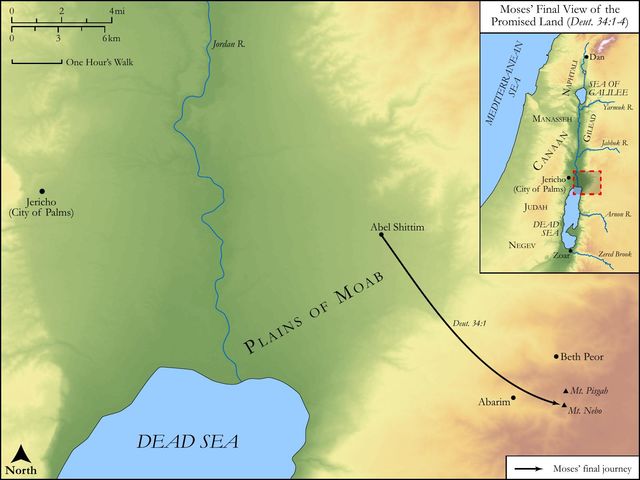
At this point in Israel's history, after forty years of wilderness wandering, the Israelites were encamped on the plains of Moab, east of the Jordan River. This location was their final staging ground, poised on the brink of crossing into Canaan. The region of Moab was strategically significant, offering a direct view across the Jordan Valley to the fertile lands of Canaan. Mount Nebo, part of the Abarim mountain range, was a prominent peak in this area, known for its commanding views. For an ancient nomadic people, the concept of a "promised land" was not merely a geographical designation but a deeply theological reality, representing the tangible fulfillment of God's covenant faithfulness to His ancestors, particularly Abraham (Genesis 12:7). The detailed geographical markers—Gilead, Dan, Jericho—would have been highly significant to the Israelite audience, vividly painting the picture of the vast and diverse inheritance awaiting them.
Key Themes
ShowHideDeuteronomy 34:1 powerfully encapsulates several overarching themes central to the Pentateuch and the unfolding narrative of Israel. Firstly, it highlights Divine Sovereignty and Faithfulness. God's explicit command for Moses to ascend Nebo and His subsequent act of "shewing" him the land emphasize His ultimate control over the fulfillment of His promises, even as He exercises His sovereign right to limit Moses' personal entry. This demonstrates that God's plan will be accomplished regardless of human limitations. Secondly, it underscores the theme of A Leader's Farewell and Transition. This ascent marks Moses' final public act as a leader, a poignant moment before his death and the transfer of authority to Joshua, ensuring the continuity of God's redemptive plan for His people. It is a testament to the fact that God raises up and transitions leaders for His purposes. Thirdly, the verse emphasizes The Scope and Certainty of the Promise. The panoramic view, stretching "all the land of Gilead, unto Dan," signifies the vastness and completeness of the territory God was giving to Israel, assuring them of the full realization of the Abrahamic covenant. It is a visual testament to God's unwavering commitment to His word, even when human instruments are limited or fall short, as seen in Numbers 20:12.
Exposition and Analysis
ShowHideKey Word Analysis
ShowHideThe central figure of the Pentateuch, whose name means "drawing out" (from the water), referencing his rescue as an infant. Here, he is presented at the culmination of his life, a faithful servant of God who led Israel out of Egypt and through the wilderness, but is now at the threshold of the Promised Land, unable to enter. His final act is one of obedience to God's command to ascend.
This refers to a specific mountain in the Abarim range, located east of the Jordan River. While its name might be related to a Babylonian deity, in this biblical context, it functions as the divinely appointed location from which Moses is granted his final, sweeping view of the Promised Land. It is a place of both revelation and limitation for Moses.
A primitive root meaning "to see," but here used in the causative sense, "to cause to see" or "to show." This highlights the divine initiative: it was not merely Moses' effort to gain a view, but the LORD Himself who actively displayed the land to him. This emphasizes God's sovereign involvement and gracious act in Moses' final moments.
This refers to a fertile, mountainous region east of the Jordan River, known for its rich pastures and balm. It was part of the territory allotted to the tribes of Reuben, Gad, and the half-tribe of Manasseh. Its inclusion in the panoramic view signifies the eastern extent of the promised inheritance, demonstrating the breadth of God's provision.
Derived from a root meaning "judge," Dan refers to the northernmost city of Israel, originally called Laish and later renamed by the tribe of Dan (Judges 18:29). The phrase "unto Dan" signifies the northernmost boundary of the land, completing the geographical scope of the promise. Its mention confirms the full, expansive reach of God's promised territory, often used as a marker for the entire land.
Verse Breakdown
ShowHide"And Moses went up from the plains of Moab unto the mountain of Nebo, to the top of Pisgah, that [is] over against Jericho."
This clause meticulously details Moses' final physical journey and the precise geographical location of his last stand. The "plains of Moab" signify the end of the forty years of wilderness wandering, marking the literal threshold of the Promised Land. His deliberate ascent to "Mount Nebo, to the top of Pisgah," emphasizes a divinely commanded act, a final moment of obedience. The phrase "over against Jericho" highlights the strategic vantage point, directly overlooking the first major city the Israelites were destined to conquer upon entering Canaan, creating a profound sense of imminent fulfillment and the tangible reality of the promise.
"And the LORD shewed him all the land of Gilead, unto Dan,"
This second clause reveals the central divine action of the verse. It is not merely Moses' human effort to gain a view, but "the LORD shewed him," underscoring God's direct intervention, sovereign grace, and active participation in Moses' final moments. The description of the land, "all the land of Gilead, unto Dan," is a merism, a representative description encompassing the eastern and northern extremities of the promised territory. This signifies the entirety of the vast inheritance promised to Abraham's descendants, confirming the certainty, comprehensiveness, and unwavering nature of God's covenant promises.
Literary Devices
ShowHideDeuteronomy 34:1 is rich in Poignancy, marking the bittersweet culmination of Moses' extraordinary life and leadership. There is a profound sense of Irony in Moses being allowed to see the land he yearned to enter but was forbidden from doing so, a consequence of his earlier disobedience. The verse employs vivid Geographical Detail ("plains of Moab," "Mount Nebo," "Pisgah," "Jericho," "Gilead," "Dan") to establish a concrete setting and emphasize the vastness and tangible reality of the promised inheritance. The phrase "the LORD shewed him" is a clear instance of Divine Intervention or Theophany, highlighting God's direct and personal involvement in Moses' final moments, a gracious act of revelation. The panoramic view itself serves as powerful Symbolism, representing the fulfillment of God's covenant promises, even if that fulfillment extends beyond the lifespan of any single individual. It is a visual testament to God's faithfulness across generations and His ultimate control over His redemptive plan.
Theological and Thematic Connections
ShowHideDeuteronomy 34:1 stands as a powerful testament to God's unwavering faithfulness to His covenant promises, even as it underscores the limitations of human instruments and the consequences of disobedience. Moses, despite his unparalleled leadership, intimate relationship with God, and lifelong dedication, was barred from entering the Promised Land due to a singular act of unfaithfulness. Yet, God, in His boundless grace and sovereign mercy, allowed him to see the full scope of the inheritance, demonstrating that His plans and promises transcend individual lives and are ultimately fulfilled by His sovereign will, not dependent on any single person. This passage reminds us that while God uses human agents, His work is not contingent on their perfection, and His purposes will always come to fruition. It also speaks to the nature of faith, where one may "see" the promise from afar without fully experiencing its earthly realization, trusting in God's greater design and the continuity of His redemptive plan.
Reflection and Application
ShowHideDeuteronomy 34:1 offers a profound lesson in leadership, divine sovereignty, and the nature of fulfillment, challenging our often-individualistic notions of success and accomplishment. Moses, the greatest prophet and leader of Israel, reaches the end of his earthly journey with a clear vision of what he cannot personally possess. This poignant moment reminds us that our greatest contribution may be to faithfully lead others to the threshold of God's promises, even if we are not the ones to fully enter or see the complete realization of those promises in our lifetime. It calls us to trust God's overarching plan, to find contentment in His sovereign will, and to embrace the continuity of His work through successive generations. We are invited to cultivate a long-term vision, recognizing that God's faithfulness extends far beyond our individual capacities or timelines, and that seeing His promises from afar can be a profound act of faith and grace, a testament to God's faithfulness even when our own journey concludes before the full harvest.
Questions for Reflection
ShowHideFAQ
ShowHideWhy was Moses not allowed to enter the Promised Land?
ShowHideMoses was forbidden from entering the Promised Land due to an act of disobedience at Meribah, as detailed in Numbers 20:7-13. God had commanded Moses to speak to the rock to bring forth water for the thirsty Israelites. However, in his frustration and perhaps a moment of pride, Moses struck the rock twice with his staff. This act, though seemingly minor, represented a failure to perfectly obey God's specific instructions and, more significantly, a failure to honor God as holy before the people. As God Himself stated, "Because you did not trust in me enough to honor me as holy in the sight of the Israelites, you will not bring this community into the land I give them" (Numbers 20:12). This divine judgment underscored the absolute necessity of obedience and the profound holiness of God, even for His most esteemed servant.
What is the significance of "Gilead, unto Dan" in this verse?
ShowHideThe phrase "all the land of Gilead, unto Dan" is a merism, a literary device where two contrasting or extreme parts represent the whole. "Gilead" refers to the fertile region east of the Jordan River, which was already being settled by some Israelite tribes. "Dan" refers to the northernmost city of Israel, located in the far north of the land, which would later become a significant tribal territory. By mentioning these two geographical points, the text vividly conveys the full, expansive scope of the territory God was promising to Israel, from its eastern reaches across the Jordan to its northernmost boundary. It's akin to the more common biblical phrase "from Dan to Beersheba" (Judges 20:1), which similarly signifies the entire breadth of the land of Israel from north to south. This detail underscores the completeness, certainty, and vastness of God's covenant promise to provide a comprehensive inheritance for His people.
Christ-Centered Fulfillment
ShowHideDeuteronomy 34:1, while marking the end of Moses' earthly journey, powerfully foreshadows the greater work of Jesus Christ. Moses, the faithful servant, led God's people to the very threshold of the physical Promised Land but, due to the limitations of the Law and his own sin, could not bring them in (Numbers 20:12). He saw the physical inheritance from afar, a testament to God's promise. Jesus, the greater Moses, fulfills what the first could not. He is the one who truly leads His people into the ultimate Promised Land – not a physical territory, but the spiritual rest and eternal life found in God's presence (Hebrews 4:8-9). While Moses delivered the Law, Jesus brought grace and truth, perfectly fulfilling the Law's demands and becoming the only way to God (John 1:17; John 14:6). Moses' ascent to Pisgah was a solitary, poignant moment; yet, on the Mount of Transfiguration, Moses himself appeared with Elijah alongside Jesus, bearing witness to the One who would accomplish a greater exodus—the ultimate redemption through His death and resurrection (Matthew 17:1-8). Thus, Moses' vision from Nebo, though limited in its earthly scope, ultimately points to Christ, who opens the way for all believers to enter into the fullness of God's eternal promises and the true inheritance of salvation.