


2 Kings 7:2
Bible text: King James Version (1769 Blayney text) · Public domain
Bible text: King James Version with Strong's numbers · Public domain
Bible text: Berean Standard Bible · Public domain
Bible text: American Standard Version (1901) · Public domain
Bible text: World English Bible, Messianic edition · Public domain
Bible text: Geneva Bible (1599) · Public domain
Bible text: Young's Literal Translation · Public domain
- וַיַּעַןvai·Ya·'anand he answeredH6030Conj-w ¦ V-Qal-ConsecImperf-3msVerb Qal Consecutive Imperfect 3rd Singular Masculineוַandיַּעַןhe answered
- הַשָּׁלִישׁha·sha·Lishthe officerH7991Art ¦ N-msNoun Singular Masculine Absoluteהַtheשָּׁלִישׁofficer
- אֲשֶׁר'a·SherwhoH834RelParticle Relative
- לַמֶּלֶךְla·me·leKh[belonged] to the kingH4428Prep-l ¦ N-msNoun Singular Masculine Absoluteלַ[belonged] to theמֶּלֶךְking
- נִשְׁעָןnish·'An[who] was leaningH8172V-Niphal-Prtcpl-msVerb Niphal Participle Singular Masculine Absolute
- עַל'alonH5921PrepPreposition
- יָדוֹya·Dohis handH3027N-csc ¦ 3msNoun Singular common gender Constructיָדhandוֹhis
- אֶת'et<obj.>H853DirObjMParticle Object Indicator
- אִישׁ'ish[the] man ofH376N-mscNoun Singular Masculine Construct
- הָאֱלֹהִיםha·'E·lo·Him<the> GodH430Art ¦ N-mpNoun Plural Masculine Absoluteהָ<the>אֱלֹהִיםGod
- וַיֹּאמַרvai·yo·Marand he saidH559Conj-w ¦ V-Qal-ConsecImperf-3msVerb Qal Consecutive Imperfect 3rd Singular Masculineוַandיֹּאמַרhe said
- הִנֵּהhi·Nehhere!H2009PrtParticle Interjection
- יְהוָהYah·wehYahwehH3068N-properNoun Proper Title
- עֹשֶׂה'o·Seh[is] makingH6213V-Qal-Prtcpl-msVerb Qal Participle Singular Masculine Absolute
- אֲרֻבּוֹת'a·ru·bOtwindowsH699N-fpNoun Plural Feminine Absolute
- בַּשָּׁמַיִםba·sha·Ma·yimin the heavensH8064Prep-b ¦ N-mpNoun Plural Masculine Absoluteבַּin theשָּׁמַיִםheavens
- הֲיִהְיֶהha·yih·Yeh¿ will it happenH1961Interrog ¦ V-Qal-Imperf-3msVerb Qal Imperfect 3rd Singular Masculineהֲ¿יִהְיֶהwill it happen
- הַדָּבָרha·da·Varthe thingH1697Art ¦ N-msNoun Singular Masculine Absoluteהַtheדָּבָרthing
- הַזֶּהha·Zeh<the> thisH2088Art ¦ PrtParticle Demonstrativeהַ<the>זֶּהthis
- וַיֹּאמֶרvai·Yo·merand he saidH559Conj-w ¦ V-Qal-ConsecImperf-3msVerb Qal Consecutive Imperfect 3rd Singular Masculineוַandיֹּאמֶרhe said
- הִנְּכָהhi·ne·Khahhere youH2005Prt ¦ 2msParticle Interjectionהִנְּhereכָהyou
- רֹאֶהro·'Eh[are] about to seeH7200V-Qal-Prtcpl-msVerb Qal Participle Singular Masculine Absolute
- בְּעֵינֶיךָbe·'ei·Nei·khawith your own eyesH5869Prep-b ¦ N-fdc ¦ 2msNoun Dual Feminine Constructבְּwithעֵינֶיown eyesךָyour
- וּמִשָּׁםu·mi·Shamand from thereH8033Conj-w ¦ Prep-m ¦ AdvAdverbוּandמִfromשָּׁםthere
- לֹאlo'notH3808NegParticle Negative
- תֹאכֵלto·Khelyou will eatH398V-Qal-Imperf-2msVerb Qal Imperfect 2nd Singular Masculine
English is a literal word-by-word gloss of the Hebrew, not the KJV's wording. Why?
This is the original text the KJV's translators worked from — each Hebrew word with its own literal English meaning in this verse, prepared by scholars at Tyndale House, Cambridge. The KJV translates whole sentences, not word by word, so its wording differs: one Hebrew word can become several English words, and the KJV may choose “the LORD” where the gloss reads “Yahweh”. Both are faithful — they answer different questions. For the KJV's own rendering, switch to the KJV text.
Details
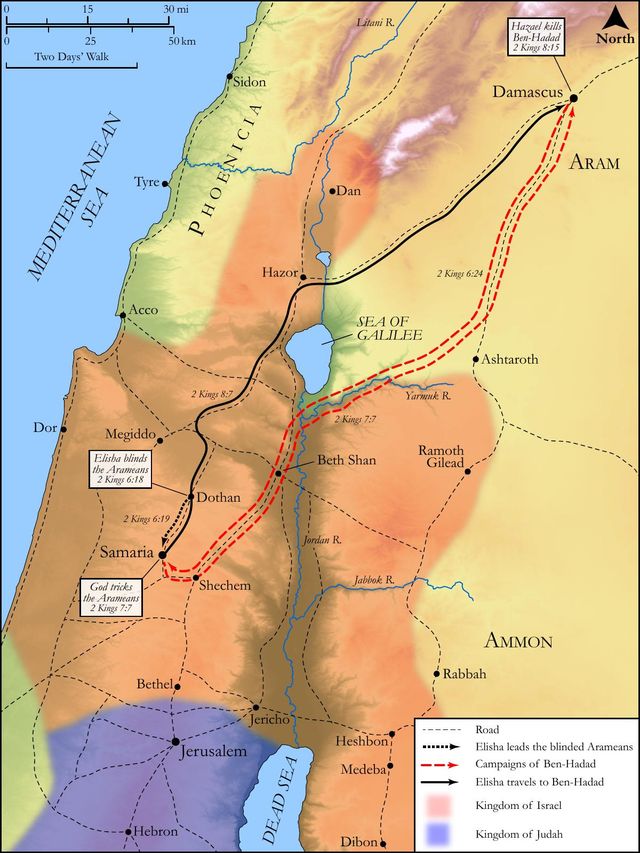
See on the biblical-era map
Study this verse
Public-domain commentary
Matthew Henry
From his Commentary on the Whole Bible. Henry comments on passages, not single verses — this entry covers 2 Kings 7:1–2.
Here, I. Elisha foretels that, notwithstanding the great straits to which the city of Samaria is reduced, yet within twenty-four hours they shall have plenty, Kg2 7:1. The king of Israel despaired of it and grew weary of waiting: then Elisha foretold it, when things were at the worst. Man's extremity is God's opportunity of magnifying his own power; his time to appear for his people is when their strength is gone, Deu 32:36. When they had given over expecting help it came. When the son of man comes shall he find faith on the earth? Luk 18:8. The king said, What shall I wait for the Lord any longer? And perhaps some of the elders were ready to say the same: "Well," said Elisha, "you hear what these say; now hear you the word of the Lord, hear what he says, hear it and heed it and believe it: tomorrow corn shall be sold at the usual rate in the gate of Samaria;" that is, the siege shall be raised, for the gate of the city shall be opened, and the market shall be held there as formerly. The return of peace is thus expressed (Jdg 5:11), Then shall the people of the Lord go down to the gates, to buy and sell there. 2. The consequence of that shall be great plenty. This would, in time, follow of course, but that corn should be thus cheap in so short a time was quite beyond what could be thought of. Though the king of Israel had just now threatened Elisha's life, God promises to save his life and the life of his people; for where sin abounded grace doth much more abound.
II.A peer of Israel that happened to be present openly declared his disbelief of this prediction, Kg2 7:2.
He was a courtier whom the king had an affection for, as the man of his right hand, on whom he leaned, that is, on whose prudence he much relied, and in whom he reposed much confidence. He thought it impossible, unless God should rain corn out of the clouds, as once he did manna; no less than the repetition of Moses's miracle will serve him, though that of Elijah might have served to answer this intention, the increasing of the meal in the barrel.
III.The just doom passed upon him for his infidelity, that he should see this great plenty for this conviction, and yet not eat of it to his comfort. Note, Unbelief is a sin by which men greatly dishonour and displease God, and deprive themselves of the favours he designed for them. The murmuring Israelites saw Canaan, but could not enter in because of unbelief. Such (says bishop Patrick) will be the portion of those that believe not the promise of eternal life; they shall see it at a distance - Abraham afar off, but shall never taste of it; for they forfeit the benefit of the promise if they cannot find in their heart to take God's word.
Historical interpretation
Historical reception
1 surviving comment on this verse from the historical church.
Elisha said, “Tomorrow there will be relief from the siege and the famine in the city of Samaria.” But an officer of the house of king Jehoram mocked these words and derided the word [of the prophet]. Elisha answered him what the Scripture relates here. Some say that this man was the one whose story is reported by the biblical text above. He had sent to Elisha a messenger or a captain of the guard [of the king] to arrest him or to kill him but later had repented of his evil scheme and had run after him, preventing him from executing his command. This poor man, therefore, had seen the delivery of the town and the consequent abundance of which he had not profited, because on that same day the inhabitants of the city, who were coming out to plunder, had trampled him, and he had died. In his miserable fate he prefigures the fall of the people of Abraham, those who could see “the bread” of life “descended from heaven” to them but in large number were not worthy of enjoying that vivifying abundance, even though, at the same time, it was abundantly given to all those who asked for it through the grace of our Savior Jesus Christ.
Continue studying 2 Kings 7:2 across the web’s major study libraries — every link below opens this exact verse, chapter, or book on the destination site.
Read & Compare
 BibleGatewayThis verse in more than 200 translations and 70 languages.
 Bible.comThe YouVersion reader — hundreds of translations, reading plans, and highlights.
 ESV.orgCrossway's official English Standard Version reader.
 NET BibleThe NET translation with 60,000+ translators' notes on every rendering decision.
 STEP BibleTyndale House's free study tool — original text, vocabulary, and scholarly resources.
 BibliaLogos Bible Software's free web reader.
 USCCBThe New American Bible (Revised Edition) with the U.S. bishops' study notes.
Commentaries
 BibleHub CommentariesDozens of classic commentaries on this verse, gathered on one page.
 StudyLightMore than 100 commentary sets — the largest collection on the web.
 BibleRefPlain-English commentary on what this verse means, verse by verse.
 Enduring WordDavid Guzik's free commentary on this chapter, widely used by Bible teachers.
 Bible Study ToolsVerse commentary alongside Greek and Hebrew study aids.
Original Language & Research
- BibleHub InterlinearThe verse word by word — original language, transliteration, and English.
- BibleHub LexiconEvery word's original-language definition and Strong's entry.
 Blue Letter BibleDeep-study tools — Strong's numbers, concordance, and word studies.
 SefariaThe Hebrew text with Rashi and centuries of Jewish commentary.
Sermons, Hymns & Audio


TrulyRandomVerse is not affiliated with these sites and doesn’t control their content. They’re linked because they’re genuinely useful.
Summary
Second Kings 7:2 vividly portrays a moment of profound human skepticism in the face of divine promise. During the dire Aramean siege of Samaria, a high-ranking royal official, a trusted aide to the king, cynically dismisses the prophet Elisha's miraculous prophecy of immediate abundance. His incredulity, expressed through a rhetorical question challenging God's ability to act supernaturally beyond all natural means, is met with Elisha's swift and severe judgment: the official would indeed witness the divine provision with his own eyes but would be tragically prevented from partaking in it, serving as a stark and immediate consequence for his unbelief in God's revealed word.
Context
ShowHideLiterary Context
This verse is strategically placed at a critical juncture in the narrative of the Aramean siege of Samaria, following a harrowing depiction of extreme famine and suffering within the city, where conditions had deteriorated to the point of cannibalism, a grim fulfillment of covenant curses for disobedience, as recounted in 2 Kings 6:29. King Jehoram, overwhelmed by despair, unjustly blames Elisha for the calamity and seeks his life. In this atmosphere of utter hopelessness and human desperation, Elisha delivers a startling prophecy from the LORD in 2 Kings 7:1, promising an impossible abundance of food within twenty-four hours. The official's cynical response in 2 Kings 7:2 directly follows this divine promise, immediately highlighting the human reaction of incredulity to God's supernatural intervention. The subsequent verses (2 Kings 7:3-20) then meticulously detail the miraculous fulfillment of Elisha's prophecy, underscoring the dramatic contrast between human doubt and divine omnipotence and faithfulness.
Historical & Cultural Context
Ancient sieges were notoriously brutal military strategies designed to starve a city into submission, and Samaria's plight, as described in 2 Kings 6, was a classic, albeit extreme, example of such tactics. The "lord on whose hand the king leaned" (Hebrew: הַשָּׁלִישׁ, hashshalish) was not a commoner but a high-ranking royal official, likely an aide-de-camp, a chief military officer, or a trusted advisor, signifying his close proximity to the king and his position of significant authority and influence within the royal court. His role often involved advising the king and executing his commands. In the cultural context of ancient Israel, prophets like Elisha were understood to be direct spokespersons for Yahweh, delivering His very word. To doubt or dismiss a prophet's word, especially one prefaced with the authoritative "Thus says the LORD," was not merely questioning a man but directly challenging God Himself. This official's public skepticism was therefore a profound act of defiance against divine authority, carrying severe implications for both himself and potentially for the king and the people who witnessed his unbelief.
Key Themes
ShowHideSeveral major theological and narrative themes converge and are powerfully illustrated in this verse. Firstly, it profoundly highlights the theme of Divine Sovereignty and Provision, demonstrating God's absolute ability to intervene miraculously in human affairs, transcending natural laws and human limitations. The official's rhetorical question about "windows in heaven" inadvertently alludes to an overwhelming, supernatural outpouring, reminiscent of God opening the floodgates during the deluge in Genesis 7:11 or pouring out blessings in Malachi 3:10. Secondly, the verse starkly contrasts Faith vs. Unbelief. Elisha's unwavering confidence in God's word stands in sharp opposition to the official's cynical, human-centered reasoning. This tension underscores the ongoing biblical theme of the necessity of faith for experiencing God's promises. Thirdly, it emphasizes the severe Consequences of Disbelief. The official's immediate and severe judgment serves as a solemn warning that questioning God's direct word through His prophet carries serious repercussions, demonstrating that unbelief can act as a barrier to receiving divine blessings, even when they are publicly displayed.
Exposition and Analysis
ShowHideKey Word Analysis
ShowHideThis term (H7991) refers to a high-ranking official, literally "a general of the third rank (upward, i.e. the highest); captain, (great) lord, prince." The phrase "on whose hand the king leaned" further specifies his role as a trusted aide or confidant, indicating his close proximity to royal power and influence. His position made his public skepticism particularly weighty and impactful, as it came from a voice of authority.
This word (H699) denotes "a lattice; (by implication) a window, dovecot... chimney... sluice." In this context, "windows in heaven" (אֲרֻבֹּת הַשָּׁמָיִם, arubbot hashshamayim) is a powerful metaphor for an overwhelming, sudden, and supernatural outpouring or opening of the heavens. The official uses it to convey the utter human impossibility of Elisha's prophecy, suggesting only an act as inconceivable as opening literal floodgates in the sky could bring such abundance.
The verb (H398) means "to eat (literally or figuratively);... consume, devour... dine, eat." In Elisha's pronouncement, "shalt not eat thereof," it signifies a direct and severe judgment. Despite witnessing the miraculous provision, the official would be excluded from personally benefiting from it, highlighting the direct correlation between his unbelief and his inability to partake in the very blessing he doubted.
Verse Breakdown
ShowHide"Then a lord on whose hand the king leaned answered the man of God, and said,"
This opening clause introduces the key human antagonist to Elisha's prophecy, emphasizing his prominent status and close relationship with the king. His "answer" is not a genuine inquiry but a cynical retort, immediately setting up the tension between human reason and divine revelation.
"Behold, [if] the LORD would make windows in heaven, might this thing be?"
This is a rhetorical question, saturated with profound skepticism and incredulity. The official employs hyperbole ("windows in heaven") to dismiss Elisha's prophecy as utterly impossible from a human perspective, thereby directly challenging God's omnipotence and Elisha's authority as His prophet. It reveals a mind that prioritizes natural limitations over supernatural possibilities.
"And he said, Behold, thou shalt see [it] with thine eyes, but shalt not eat thereof."
This is Elisha's immediate, divinely inspired judgment. The emphatic "Behold" (הִנֵּה, hinneh) underscores the certainty of both the coming abundance and the official's tragic exclusion. He would be a compelled witness to God's faithfulness and power, seeing the miraculous provision unfold, but his personal unbelief would prevent him from partaking in the blessing, leading to a tragic and ironic end.
Literary Devices
ShowHideThe passage is rich with Irony, as the very abundance the official disbelieved in ultimately becomes the context of his demise; he sees the miraculous provision but is prevented from partaking, dying amidst plenty. There is a stark Contrast drawn between the prophet Elisha's unwavering faith in God's word and the official's profound human skepticism and reliance on logical impossibility. The official's question employs both Hyperbole and Metaphor with the phrase "windows in heaven," which vividly exaggerates the perceived impossibility of the prophecy, drawing on imagery of overwhelming, supernatural outpouring. Elisha's response functions as powerful Foreshadowing, immediately predicting the official's tragic fate and thus building narrative tension towards the fulfillment of both the prophecy of abundance and the judgment. The entire exchange also serves as a potent Didactic Narrative, teaching a profound lesson about the consequences of unbelief and the certainty of God's word.
Theological and Thematic Connections
ShowHideThis exchange powerfully underscores the biblical tension between human doubt and divine omnipotence. It serves as a stark reminder that God's ways are higher than our ways, and His ability to act is not constrained by human logic or perceived impossibilities. The official's cynical question directly challenged the very nature of God's sovereignty, His faithfulness to His word, and the authority of His chosen messenger. His punishment highlights the gravity of unbelief, not merely as a lack of intellectual assent but as a spiritual rebellion that can prevent one from participating in God's blessings, even when those blessings are made manifest. This narrative teaches that faith is not just a virtue but a necessary posture for receiving and experiencing God's miraculous provision, demonstrating that God honors His word and holds those accountable who scorn it.
Reflection and Application
ShowHideThe account of the doubting official in 2 Kings 7:2 serves as a timeless mirror for our own hearts, challenging us to examine the posture of our faith. In moments of extreme difficulty, when circumstances seem utterly hopeless and human solutions are exhausted, where do we place our ultimate trust? Are we quick to dismiss God's promises as unrealistic or impossible, allowing our limited understanding and cynical reasoning to overshadow divine revelation? This narrative compels us to confront our own tendencies towards unbelief, reminding us that God's power is not confined by our logical frameworks or the severity of our crises. Just as the official saw the abundance but could not partake, our own cynicism can prevent us from experiencing the fullness of God's provision and joy, even when His blessings are manifest all around us. True faith, however, is the confident expectation that God will fulfill His word, regardless of how impossible it may seem, enabling us to fully participate in His miraculous work and receive the abundant life He offers.
Questions for Reflection
ShowHideFAQ
ShowHideWho was the "lord on whose hand the king leaned"?
ShowHideThis individual was a high-ranking royal official, likely an aide-de-camp or a chief military officer, who held a position of significant trust and authority close to King Jehoram. The phrase "on whose hand the king leaned" indicates his role as a trusted advisor, perhaps even physically supporting the king, especially in times of weakness or distress. His prominent position means his public doubt was not merely personal skepticism but a challenge to divine authority from a voice of influence within the kingdom. His identity is not specified, making him a representative figure of human reason and unbelief.
What is the significance of "windows in heaven"?
ShowHide"Windows in heaven" is a powerful metaphorical expression in Hebrew, signifying an overwhelming, supernatural outpouring or supply that bypasses all normal means. It suggests a sudden, abundant, and miraculous provision directly from God. The official uses this phrase rhetorically to convey the utter absurdity and human impossibility of Elisha's prophecy from his perspective. It is an image found elsewhere in scripture, such as in Genesis 7:11 describing the floodgates of heaven opening for the deluge, and in Malachi 3:10 where God promises to open the windows of heaven to pour out blessings for those who are faithful in tithing.
Why was the punishment so severe for simply doubting?
ShowHideThe punishment was severe because the official's doubt was not merely a private thought but a public, cynical challenge to God's direct word spoken through His prophet, Elisha. In ancient Israel, prophets were God's spokespersons, and to doubt their word was to doubt God Himself. This act questioned God's omnipotence, His faithfulness, and the authority of His chosen messenger. The immediate and public judgment served several purposes: it validated Elisha's prophetic authority, demonstrated the seriousness of unbelief, and provided a stark warning to others present that God's word is absolute and cannot be mocked or dismissed without consequence. It underscored that faith is essential for receiving God's blessings.
Christ-Centered Fulfillment
ShowHideThe narrative of the doubting official in 2 Kings 7:2 finds profound Christ-centered fulfillment, illuminating the ultimate consequences of unbelief in the face of divine revelation. Just as the official questioned Elisha, the prophet of God, humanity often questions the ultimate Prophet, Jesus Christ, who is the very Word made flesh, dwelling among us (John 1:14). The official's cynical "windows in heaven" challenge to God's power is answered definitively in Christ's earthly ministry, where He demonstrated absolute authority over nature and the impossible. He miraculously fed thousands with a few loaves and fish (Matthew 14:13-21), walked on water (Matthew 14:22-33), and turned water into wine (John 2:1-11), proving that with God, nothing is impossible (Luke 1:37). The official's tragic fate – seeing the provision but not partaking – powerfully foreshadows the spiritual reality of those who witness God's redemptive work in Christ but refuse to believe. They see the offer of eternal life and abundant grace, yet their unbelief prevents them from entering into it, ultimately leading to a spiritual hunger even amidst the spiritual feast provided by the Lamb of God who takes away the sin of the world. Christ Himself is the ultimate Bread of Life (John 6:35), and only those who believe in Him will truly eat and never hunger, receiving the abundant life He offers (John 10:10). The judgment on the official serves as a solemn warning that while God's provision is limitless, our access to it is conditioned on faith in His revealed word, culminating in saving faith in His Son.