


Judges 5:11
Bible text: King James Version (1769 Blayney text) · Public domain
Bible text: King James Version with Strong's numbers · Public domain
Bible text: Berean Standard Bible · Public domain
Bible text: American Standard Version (1901) · Public domain
Bible text: World English Bible, Messianic edition · Public domain
Bible text: Geneva Bible (1599) · Public domain
Bible text: Young's Literal Translation · Public domain
- מִקּוֹלmi·Kolfrom [the] sound ofH6963Prep-m ¦ N-mscNoun Singular Masculine Constructמִfromקּוֹל[the] sound of
- מְחַצְצִיםme·cha·TzimarchersH2686V-Piel-Prtcpl-mpVerb Piel Participle Plural Masculine Absolute
- בֵּיןbeinbetweenH996Adj-mscAdjective Numerical Singular Masculine Construct
- מַשְׁאַבִּיםmash·'a·Bim[the] places for drawing waterH4857N-mpNoun Plural Masculine Absolute
- שָׁםshamthereH8033AdvAdverb
- יְתַנּוּye·ta·Nuthey will recountH8567V-Piel-Imperf-3mpVerb Piel Imperfect 3rd Plural Masculine
- צִדְקוֹתtzid·Kot[the] righteousness<es> ofH6666N-fpcNoun Plural Feminine Construct
- יְהוָהYah·wehYahwehH3068N-properNoun Proper Title
- צִדְקֹתtzid·Kot[the] righteousness<es> ofH6666N-fpcNoun Plural Feminine Construct
- פִּרְזֹנוֹpir·zo·Nohis rural peopleH6520N-msc ¦ 3msNoun Singular Masculine Constructפִּרְזֹנrural peopleוֹhis
- בְּיִשְׂרָאֵלbe·Yis·ra·'Elin IsraelH3478Prep-b ¦ N-properNoun Proper LocationבְּinיִשְׂרָאֵלIsrael
- אָז'azthenH227AdvAdverb
- יָרְדוּya·re·Duthey went downH3381V-Qal-Perf-3cpVerb Qal Perfect 3rd Plural common gender
- לַשְּׁעָרִיםla·she·'a·Rimto the gatesH8179Prep-l ¦ N-mpNoun Plural Masculine Absoluteלַto theשְּׁעָרִיםgates
- עַם'am[the] people ofH5971N-mscNoun Singular Masculine Construct
- יְהוָהYah·wehYahwehH3068N-properNoun Proper Title
English is a literal word-by-word gloss of the Hebrew, not the KJV's wording. Why?
This is the original text the KJV's translators worked from — each Hebrew word with its own literal English meaning in this verse, prepared by scholars at Tyndale House, Cambridge. The KJV translates whole sentences, not word by word, so its wording differs: one Hebrew word can become several English words, and the KJV may choose “the LORD” where the gloss reads “Yahweh”. Both are faithful — they answer different questions. For the KJV's own rendering, switch to the KJV text.
Details
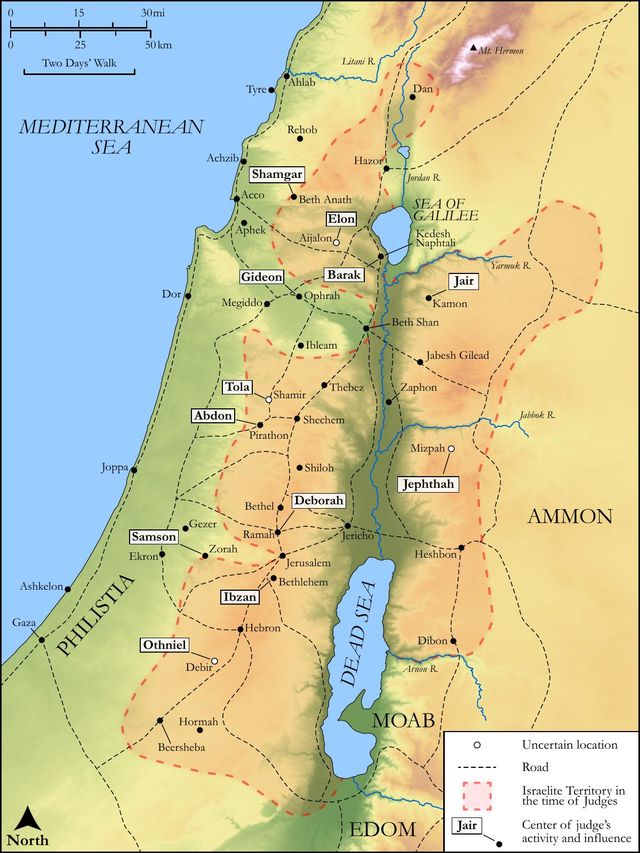
See on the biblical-era maps
Study this verse
Public-domain commentary
Matthew Henry
From his Commentary on the Whole Bible. Henry comments on passages, not single verses — this entry covers Judges 5:6–11. His three-level outline is real structure in the source text, so it is rendered as structure.
Here, I. Deborah describes the distressed state of Israel under the tyranny of Jabin, that the greatness of their trouble might make their salvation appear the more illustrious and the more gracious (Jdg 5:6): From the days of Shamgar, who did something towards the deliverance of Israel from the Philistines, to the days of Jael, the present day, in which Jael has so signalized herself, the country has been in a manner desolate. 1. No trade. For want of soldiers to protect men of business in their business from the incursions of the enemy, and for want of magistrates to restrain and punish thieves and robbers among them (men of broken fortunes and desperate spirits, that, having no employment, took to rob on the highroad), all commerce ceased, and the highways were unoccupied; no caravans of merchants, as formerly. 2. No travelling. Whereas in times when there was some order and government the travellers might be safe in the open roads, and the robbers were forced to lurk in the by-ways, no, on the contrary, the robbers insulted on the open roads without check, and the honest travellers were obliged to sculk and walk through by-ways, in continual frights. 3. No tillage. The fields must needs be laid waste and unoccupied when the inhabitants of the villages, the country farmers, ceased from their employment, quitted their houses which were continually alarmed and plundered by the banditti, and were obliged to take shelter for themselves and their families in walled and fenced cities. 4. No administration of justice. There was war in the gates where their courts were kept, Jdg 5:8. So that it was not till this salvation was wrought that the people of the Lord durst go down to the gates, Jdg 5:11. The continual incursions of the enemy deprived the magistrates of the dignity, and the people of the benefit, of their government. 5. No peace to him that went out nor to him that came in. The gates through which they passed and repassed were infested by the enemy; nay, the places of drawing water were alarmed by the archers - a mighty achievement to terrify the drawers of water. 6. Neither arms nor spirit to help themselves with, not a shield nor spear seen among forty thousand, Jdg 5:8. Either they were disarmed by their oppressors, or they themselves neglected the art of war; so that, though they had spears and shields, they were not to be seen, but were thrown by and suffered to rust, they having neither skill nor will to use them.
II.She shows in one word what it was that brought all this misery upon them:
They chose new gods, Jdg 5:8. It was their idolatry that provoked God to give them up thus into the hands of their enemies. The Lord their God was one Lord, but this would not content them: they must have more, many more, still more. Their God was the Ancient of days, still the same, and therefore they grew weary of him, and must have new gods, which they were as fond of as children of new clothes, names newly invented, heroes newly canonized. Their fathers, when put to their choice, chose the Lord for their God (Jos 24:21), but they would not abide by that choice, they must have gods of their own choosing.
III.She takes notice of God's great goodness to Israel in raising up such as should redress these grievances.
Herself first (Jdg 5:7): Till that I Deborah arose, to restrain and punish those who disturbed the public peace, and protect men in their business, and then the face of things was changed for the better quickly; those beasts of prey retired upon the breaking forth of this joyful light, and man went forth again to his work and labour, Psa 104:22, Psa 104:23. Thus she became a mother in Israel, a nursing mother, such was the affection she bore to her people, and such the care and pains she took for the public welfare. Under her there were other governors of Israel (Jdg 5:9), who, like her, had done their part as governors to reform the people, and then, like her, offered themselves willingly to serve in the war, not insisting upon the exemption which their dignity and office entitled them to, when the had so fair an opportunity of appearing in their country's cause; and no doubt the example of the governors influenced the people in like manner willingly to offer themselves, Jdg 5:2. Of these governors she says, My heart is towards them, that is, "I truly love and honour them; they have won my heart for ever; I shall never forget them." Note, Those are worthy of double honour that recede voluntarily from the demands of their honour to serve God and his church.
IV.She calls upon those who had a particular share in the advantages of this great salvation to offer up particular thanks to God for it, Jdg 5:10, Jdg 5:11. Let every man speak as he found of the goodness of God in this happy change of the posture of public affairs.
1.You that ride on white asses, that is, the nobility and gentry. Horses were little used in that county; they had, it is probable, a much better breed of asses than we have; but persons of quality, it seems, were distinguished by the colour of the asses they rode on; the white being more rare were therefore more valued. Notice is taken of Abdon's sons and grandsons riding on ass-colts, as indicating them to be men of distinction, Jdg 12:14. Let such as are by this salvation restored, not only to their liberty as other Israelites, but to their dignity, speak God's praises.
2.Let those that sit in judgment be sensible of it, and thankful for it as a very great mercy, that they may sit safely there, that the sword of justice is not struck out of their hand by the sword of war.
3.Let those that walk by the way, and meet with none there to make them afraid, speak to themselves in pious meditations, and to their fellow-travellers in religious discourses, of the goodness of God in ridding the roads of those banditti that had so long infested them.
4.Let those that draw in peace, and have not their wells taken from them, or stopped up, nor are in danger of being caught by the enemy when they go forth to draw, there, where they find themselves so much more safe and easy than they have been, there let them rehearse the acts of the Lord, not Deborah's acts, nor Barak's, but the Lord's, taking notice of his hand making peace in their borders, and creating a defence upon all the glory. This is the Lord's doing. Observe in these acts of his,
(1.)Justice executed on his daring enemies. They are the righteous acts of the Lord. See him pleading a righteous cause, and sitting in the throne judging aright, and give him glory as the Judge of all the earth.
(2.)Kindness shown to his trembling people, the inhabitants of the villages, who lay most open to the enemy, had suffered most, and were most in danger, Eze 38:11. It is the glory of God to protect those that are most exposed, and to help the weakest. Let us all take notice of the share we in particular have in the public peace and tranquility, the inhabitants of the villages especially, and give God the praise of it.
Historical interpretation
Historical reception
1 surviving comment on this verse from the historical church.
(Judges 5:11) Then the people of the Lord went down to the gates and obtained the leadership. The people of the Lord went down to the gates, that is, to the gates of the house of the Lord, because with the Lord blessed and praised at the place of victory, they descended into the house of the Lord to praise the Lord there, offering prayers and sacrifices to Him. But as for the tribe of Issachar, that they were the teachers of the other tribes is shown in the Book of Chronicles, where it says: Of the sons of Issachar, there were men who had understanding of the times, to know what Israel ought to do, two hundred chiefs; and all their brethren followed their command (1 Chronicles 12:32). And the reason these scholars are called asses is shown in the book of Genesis where it says: Issachar, a strong donkey lying down between the borders, saw that rest was good and the land was pleasant, and he bowed his shoulder to bear the burden and became a servant under tribute (Gen. XLIX, 14, 15). The donkey is called strong in the Book of Genesis because of the strength of the law, since it carried the law on its shoulder and gave tribute, that is, imparted the teaching of the law to the other tribes. In the Book of Judges, they are called donkeys, because they were weakened and humiliated, and remained weak, oppressed by the yoke of the nations, and only satisfied with the law of God.
Continue studying Judges 5:11 across the web’s major study libraries — every link below opens this exact verse, chapter, or book on the destination site.
Read & Compare
 BibleGatewayThis verse in more than 200 translations and 70 languages.
 Bible.comThe YouVersion reader — hundreds of translations, reading plans, and highlights.
 ESV.orgCrossway's official English Standard Version reader.
 NET BibleThe NET translation with 60,000+ translators' notes on every rendering decision.
 STEP BibleTyndale House's free study tool — original text, vocabulary, and scholarly resources.
 BibliaLogos Bible Software's free web reader.
 USCCBThe New American Bible (Revised Edition) with the U.S. bishops' study notes.
Commentaries
 BibleHub CommentariesDozens of classic commentaries on this verse, gathered on one page.
 StudyLightMore than 100 commentary sets — the largest collection on the web.
 BibleRefPlain-English commentary on what this verse means, verse by verse.
 Enduring WordDavid Guzik's free commentary on this chapter, widely used by Bible teachers.
 Bible Study ToolsVerse commentary alongside Greek and Hebrew study aids.
Original Language & Research
- BibleHub InterlinearThe verse word by word — original language, transliteration, and English.
- BibleHub LexiconEvery word's original-language definition and Strong's entry.
 Blue Letter BibleDeep-study tools — Strong's numbers, concordance, and word studies.
 SefariaThe Hebrew text with Rashi and centuries of Jewish commentary.
Sermons, Hymns & Audio


TrulyRandomVerse is not affiliated with these sites and doesn’t control their content. They’re linked because they’re genuinely useful.
Summary
Judges 5:11, a vibrant declaration within the Song of Deborah and Barak, celebrates Israel's profound transformation from a state of pervasive fear and oppression to one of secure worship and communal flourishing. It vividly portrays a people delivered by divine intervention from constant threats, particularly at vulnerable points like water sources. This liberation enables them to publicly recount and proclaim the Lord's righteous and saving acts, not merely as private gratitude but as a foundational practice for their restored society. The verse culminates in the image of the people confidently re-engaging with public life at the city gates, symbolizing the restoration of peace, justice, and order under God's sovereign care.
Context
ShowHideLiterary Context
Judges 5:11 is a pivotal verse within the "Song of Deborah and Barak" (Judges 5), a magnificent poetic recounting of Israel's decisive victory over the Canaanite forces led by Sisera. This song immediately follows the prose narrative of the battle in Judges 4, serving as a theological and celebratory interpretation of the events. The song itself is structured as a hymn of praise, moving from an invocation to God's past mighty acts, to a lament over Israel's previous state of oppression and disunity, a vivid description of the battle, and finally, a celebration of the triumph and a curse upon those who did not aid the Lord. Verse 11 specifically marks a turning point, moving from the description of the dire conditions before the battle (e.g., the desolate roads and abandoned villages) to the joyous outcome of deliverance and the subsequent acts of worship and societal restoration. It emphasizes the consequence of God's victory – a return to normal, safe life and the imperative to remember and declare His deeds.
Historical & Cultural Context
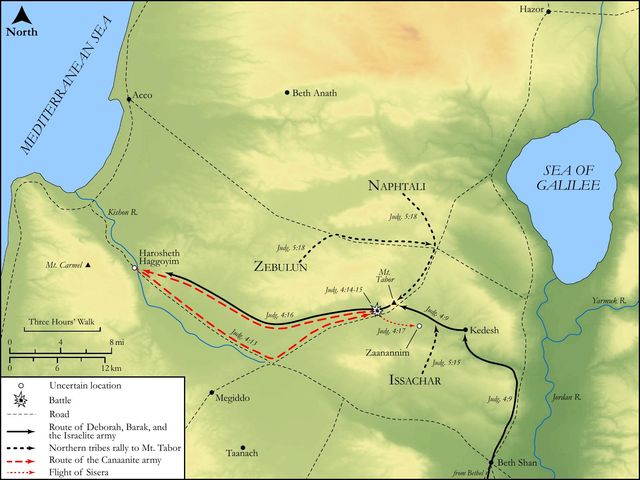
For twenty years, Israel had suffered under the harsh oppression of King Jabin of Hazor and his formidable military commander, Sisera, who possessed 900 iron chariots (Judges 4:3). This period was marked by extreme insecurity, with roads unsafe for travel and daily life, even essential tasks like drawing water, fraught with danger from marauding bands and archers. "Places of drawing water" (mashʼâb) were particularly vulnerable, as they were often outside fortified areas and necessary for survival, making them prime targets for ambush. The "gates" (shaʻar) of a city were not merely entrances but served as the central hub for community life, commerce, legal proceedings, and public assembly. The inability to safely gather at the gates or draw water symbolized the complete breakdown of civil order and the pervasive fear that gripped the Israelites. The victory celebrated in Judges 5, therefore, signifies a profound return to normalcy, security, and the re-establishment of communal life, allowing the people to once again gather freely and safely, and for justice to be administered in the public square.
Key Themes
ShowHideThis verse powerfully articulates several core themes central to the book of Judges and broader biblical theology. Firstly, it highlights Divine Deliverance, underscoring that Israel's freedom from oppression is not a result of human might but a direct, miraculous intervention by the Lord. The "noise of archers" represents the specific, terrifying threat from which God delivers His people, a theme echoed in Psalm 18:2 where God is called a deliverer. Secondly, it emphasizes the Public Proclamation of God's Righteous Acts. The command to "rehearse the righteous acts of the LORD" transforms private gratitude into a communal, public declaration, essential for remembering God's faithfulness, justice, and powerful intervention. This act of remembrance serves to solidify faith for the present generation and transmit the narrative of God's goodness to future ones, as seen in the broader call to remember God's works throughout the Psalms (e.g., Psalm 78:4). Finally, the verse speaks to the Restoration of Peace and Security. The ability of "the people of the LORD [to] go down to the gates" symbolizes a decisive return to civil order, safety, and the unhindered resumption of public life. This restoration underscores God's commitment to the well-being of His "villages in Israel" and the re-establishment of justice and peace in the land, a vision often associated with God's kingdom (e.g., Isaiah 2:4).
Exposition and Analysis
ShowHideKey Word Analysis
ShowHideFrom an unused root meaning "to call aloud," this word refers to a voice or sound. In the context of Judges 5:11, "the noise of archers" (קול יורים, qol yorim) evokes the terrifying sounds of battle, specifically the whizzing of arrows and the cries associated with an ambush. It signifies the pervasive auditory threat that instilled fear and prevented the Israelites from engaging in normal daily activities, particularly at vulnerable water sources. The cessation of this "noise" represents the profound peace and security brought by God's deliverance.
A primitive root meaning "to ascribe (praise), i.e., celebrate, commemorate; lament, rehearse." This verb implies a deliberate, public, and repeated act of recounting. It is not merely a private recollection but a communal and active declaration of God's deeds. In this verse, it signifies the imperative for the delivered Israelites to continually tell the story of God's saving acts, ensuring that the memory of His intervention is not lost but actively passed down and ingrained into the collective consciousness of the community. It emphasizes the role of testimony and communal memory in preserving faith.
From the root צָדַק, meaning "rightness (abstractly), subjectively (rectitude), objectively (justice), morally (virtue) or figuratively (prosperity); justice, moderately, right(-eous) (act, -ly, -ness)." While the KJV translates it as "righteous acts" (plural), the underlying Hebrew noun is singular, emphasizing the quality of God's righteousness as manifested in His deeds. In this context, it refers specifically to God's just, faithful, and saving deeds—His active demonstration of covenant faithfulness through concrete acts of deliverance and judgment. These "righteous acts" are those by which God upholds His covenant, defends the oppressed, and executes justice against His enemies, thereby revealing His character and bringing about prosperity for His people.
Verse Breakdown
ShowHide"[They that are delivered] from the noise of archers in the places of drawing water"
This clause vividly paints the picture of the immediate past—a time of constant terror and vulnerability. "The noise of archers" (קול יורים, qol yorim) evokes the sound of arrows flying, the constant threat of ambush, and the pervasive fear that made even mundane, essential tasks like drawing water perilous. The "places of drawing water" (משאבים, mash'abim) were critical, often exposed locations, symbolizing the extreme danger that permeated daily life. The phrase "they that are delivered" highlights God's active role in bringing about this radical change from danger to safety.
"there shall they rehearse the righteous acts of the LORD"
This is the core command and purpose of their deliverance. The "there" refers to the now-safe places of drawing water, or more broadly, any place where people gather in security. The delivered people are not merely to be grateful; they are commanded to "rehearse," or repeatedly declare and teach, God's "righteous acts" (צדקות, tsedeqot). This public proclamation serves as a communal act of worship, remembrance, and instruction, ensuring that the memory of God's saving intervention is preserved and celebrated.
"[even] the righteous acts [toward the inhabitants] of his villages in Israel"
This specifies the beneficiaries and the scope of God's saving work. God's righteous acts are directed specifically "toward the inhabitants of his villages in Israel," emphasizing His covenantal faithfulness to His people, even in their scattered and vulnerable state. It underscores that God's justice is not abstract but profoundly personal and redemptive for His chosen ones, extending His care to every corner of His people's dwelling.
"then shall the people of the LORD go down to the gates"
This final clause describes the glorious consequence and symbol of their deliverance and renewed worship. "The people of the LORD" – a term emphasizing their covenant relationship – are now able to confidently and freely "go down to the gates." This signifies the complete restoration of public life, security, and the ability to conduct justice and commerce openly. It stands in stark contrast to the previous state of hiding and fear, marking a return to communal flourishing under God's protection and the re-establishment of civil order.
Literary Devices
ShowHideJudges 5:11 is rich in Symbolism, using "places of drawing water" to represent the vulnerability of daily life and "gates" to symbolize security, community, and the restoration of civil order and justice. The contrast between the "noise of archers" and the subsequent "rehearsing of righteous acts" employs powerful Juxtaposition, highlighting the dramatic shift from terror and oppression to worship and freedom. The phrase "noise of archers" also functions as Metonymy, where the sound represents the entire oppressive military threat and the fear it instilled. Furthermore, the Repetition of "righteous acts" (צדקות, tsedeqot) emphasizes the central importance of God's just and saving deeds, making them the focal point of the people's remembrance and proclamation. This repetition serves to engrain the message of God's active intervention and unwavering faithfulness into the collective memory of Israel.
Theological and Thematic Connections
ShowHideJudges 5:11 profoundly illustrates the cyclical pattern of sin, oppression, repentance, and deliverance that defines the book of Judges, yet it transcends this cycle by emphasizing the enduring call to remember and proclaim God's faithfulness. The verse underscores that divine deliverance is not merely an end to suffering but a summons to worship and communal testimony. It highlights God's active involvement in the affairs of His people, demonstrating His justice and covenant loyalty through powerful, redemptive acts. The transformation from fear to freedom, from hiding to public gathering, serves as a timeless paradigm for God's restorative work in the lives of individuals and communities. This passage reminds us that our liberation from any form of bondage should naturally lead to a public declaration of God's character and deeds, solidifying faith for ourselves and future generations.
Reflection and Application
ShowHideJudges 5:11 offers a powerful blueprint for how believers today should respond to God's deliverance in their lives. Just as the Israelites were called to "rehearse the righteous acts of the LORD" in their newfound security, we too are invited to cultivate a deep, communal memory of God's faithfulness. This means actively recounting His interventions, both in personal testimony and corporate worship, ensuring that His saving deeds are not forgotten but celebrated and passed on. When God delivers us from spiritual bondage, fear, or any form of oppression, our natural response should be public praise and a renewed commitment to living out our faith in the open, confident in His protection. The ability to "go down to the gates" symbolizes our freedom to engage fully in life, serving God and community without the paralyzing fear that once held us captive. This verse encourages us to live as a people who remember, proclaim, and embody the peace and justice that come from the Lord, allowing our transformation to be a visible testament to His power and goodness.
Questions for Reflection
ShowHideFAQ
ShowHideWhat does "the noise of archers in the places of drawing water" specifically mean?
ShowHideThis phrase vividly describes the pervasive danger and fear that characterized Israel's life under Canaanite oppression. "The noise of archers" refers to the constant threat of ambush, the sound of arrows, and the terror of sudden attacks. "Places of drawing water" (mashʼâb) were essential for daily life but often located outside the protection of fortified cities, making them highly vulnerable to raids. Therefore, the phrase collectively represents the extreme insecurity and constant threat of violence that made even the most basic, necessary activities perilous for the Israelites before God's deliverance. It underscores the depth of their oppression and the magnitude of their liberation.
Why is it important for the people to "rehearse the righteous acts of the LORD"?
ShowHideRehearsing God's righteous acts is crucial for several reasons. Firstly, it is an act of worship and gratitude, acknowledging God as the true source of their deliverance. Secondly, it serves as a communal memory, ensuring that the story of God's faithfulness and power is not forgotten but passed down through generations, strengthening the faith of the community. Thirdly, it reinforces their identity as "the people of the LORD," reminding them of their covenant relationship and God's active role in their history. This public proclamation builds corporate faith, fosters resilience, and provides a foundation for future trust in God's continued protection and provision, as seen in the call to remember God's works in Psalm 77:11 and Psalm 105:5.
Christ-Centered Fulfillment
ShowHideJudges 5:11, while celebrating a specific historical deliverance, finds its ultimate and most profound fulfillment in the person and work of Jesus Christ. The "noise of archers" and the pervasive fear of oppression in Judges foreshadow the far greater spiritual bondage to sin, death, and the devil from which humanity suffers. Christ is the ultimate Deliverer who, through His crucifixion and resurrection, has definitively disarmed the spiritual powers and authorities (Colossians 2:15). He has delivered us from the "domain of darkness" and transferred us into "the kingdom of his beloved Son" (Colossians 1:13). No longer do we live in fear of the ultimate enemy, for Christ has destroyed "him who has the power of death, that is, the devil" (Hebrews 2:14). Our "places of drawing water"—our daily lives, our most vulnerable moments—are now secure in Him. Consequently, like the delivered Israelites, we are called to "rehearse the righteous acts of the LORD," which now preeminently include the saving work of Christ. We are a "chosen race, a royal priesthood... that you may proclaim the excellencies of him who called you out of darkness into his marvelous light" (1 Peter 2:9). The ability of the people to "go down to the gates" symbolizes the profound peace and freedom we have in Christ, enabling us to live openly and confidently as citizens of His kingdom. This peace, which surpasses all understanding (Philippians 4:7), allows us to engage with the world, not in fear, but as ambassadors of reconciliation, knowing that in Christ, the gates of the New Jerusalem are always open, and there is no longer any need for fear or hiding (Revelation 21:25).