


Judges 4:3
- וַיִּצְעֲקוּvai·yitz·'a·Kuand they cried outH6817Conj-w ¦ V-Qal-ConsecImperf-3mpVerb Qal Consecutive Imperfect 3rd Plural Masculineוַandיִּצְעֲקוּthey cried out
- בְנֵיve·nei[the] people ofH1121N-mpcNoun Plural Masculine Construct
- יִשְׂרָאֵלYis·ra·'ElIsraelH3478N-properNoun Proper Location
- אֶל'eltoH413PrepPreposition
- יְהוָהYah·wehYahwehH3068N-properNoun Proper Title
- כִּיkiforH3588PrtParticle Conditional
- תְּשַׁעte·Sha'nineH8672N-cscNoun Singular common gender Construct
- מֵאוֹתme·'othundred<s>H3967N-fpNoun Plural Feminine Absolute
- רֶכֶבre·khevchariot[s] ofH7393N-mscNoun Singular Masculine Construct
- בַּרְזֶלbar·ZelironH1270N-msNoun Singular Masculine Absolute
- לוֹlo[belonged] to <the> himPrep-l ¦ 3msSuffix Personal 3rd Singular Masculineל[belonged] to <the>וֹhim
- וְהוּאVe·hu'and heH1931Conj-w ¦ Pro-3msPronoun Personal 3rd Singular Masculineוְandהוּאhe
- לָחַץla·Chatzhe oppressedH3905V-Qal-Perf-3msVerb Qal Perfect 3rd Singular Masculine
- אֶת'et<obj.>H853DirObjMParticle Object Indicator
- בְּנֵיbe·Nei[the] people ofH1121N-mpcNoun Plural Masculine Construct
- יִשְׂרָאֵלYis·ra·'ElIsraelH3478N-properNoun Proper Location
- בְּחָזְקָהbe·cha·ze·Kahwith forceH2394Prep-b ¦ N-fsNoun Singular Feminine Absoluteבְּwithחָזְקָהforce
- עֶשְׂרִים'es·RimtwentyH6242N-mpNoun Plural Masculine Absolute
- שָׁנָהsha·Nahyear[s]H8141N-fsNoun Singular Feminine Absolute
English is a literal word-by-word gloss of the Hebrew, not the KJV's wording. Why?
This is the original text the KJV's translators worked from — each Hebrew word with its own literal English meaning in this verse, prepared by scholars at Tyndale House, Cambridge. The KJV translates whole sentences, not word by word, so its wording differs: one Hebrew word can become several English words, and the KJV may choose “the LORD” where the gloss reads “Yahweh”. Both are faithful — they answer different questions. For the KJV's own rendering, switch to the KJV text.
Details
See on the biblical-era map
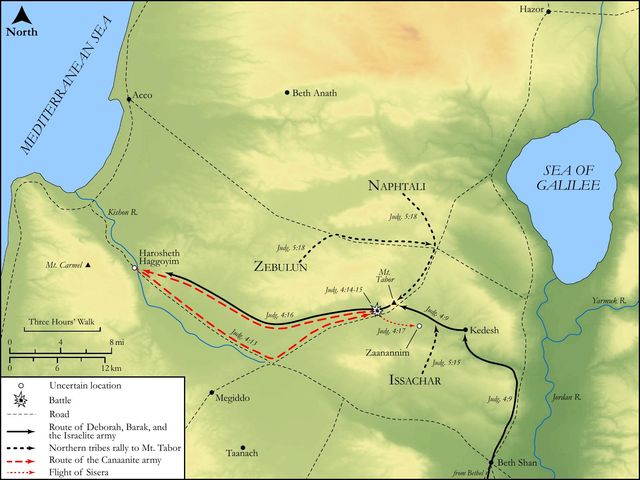
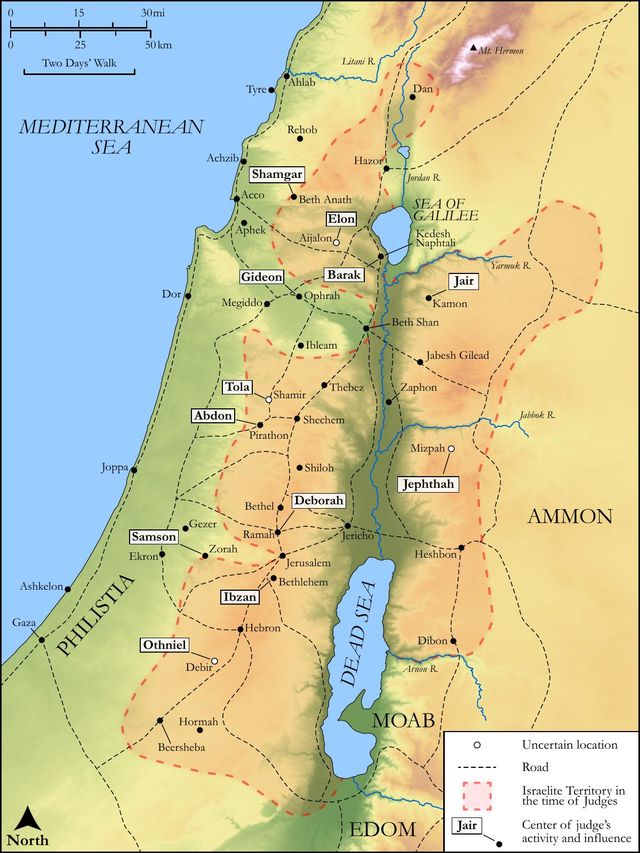
Study this verse
Public-domain commentary
Matthew Henry
From his Commentary on the Whole Bible. Henry comments on passages, not single verses — this entry covers Judges 4:1–3. His two-level outline is real structure in the source text, so it is rendered as structure.
Here is, I. Israel backsliding from God: They again did evil in his sight, forsook his service, and worshipped idols; for this was the sin which now most easily beset them, Jdg 4:1. See in this, 1. The strange strength of corruption, which hurries men into sin notwithstanding the most frequent experience of its fatal consequences. The bent to backslide is with great difficulty restrained. 2. The common ill effects of a long peace. The land had rest eighty years, which should have confirmed them in their religion; but, on the contrary, it made them secure and wanton, and indulgent of those lusts which the worship of the false gods was calculated for the gratification of. Thus the prosperity of fools destroys them. Jeshurun waxeth fat and kicketh. 3. The great loss which a people sustains by the death of good governors. The did evil, because Ehud was dead. So it may be read. He kept a strict eye upon them, restrained and punished every thing that looked towards idolatry, and kept them close to God's service. But, when he was gone, they revolted, fearing him more than God.
II.Israel oppressed by their enemies.
When they forsook God, he forsook them; and then they became an easy prey to every spoiler. They alienated themselves from God as if he were none of theirs; and then God alienated them as none of his. Those that threw themselves out of God's service threw themselves out of his protection. What has my beloved to do in my house when she has thus played the harlot? Jer 11:15. He sold them into the hand of Jabin, Jdg 4:2. This Jabin reigned in Hazor, as another of the same name, and perhaps his ancestor, had done before him, whom Joshua routed and slew, and burnt his city, Jos 11:1, Jos 11:10. But it seems, in process of time, the city was rebuilt, the power regained, the loss retrieved, and, by degrees, the king of Hazor becomes able to tyrannize over Israel, who by sin had lost all their advantage against the Canaanites. This servitude was longer than either of the former, and much more grievous. Jabin, and his general Sisera, did mightily oppress Israel. That which aggravated the oppression was,
1.That this enemy was nearer to them than any of the former, in their borders, in their bowels, and by this means had the more opportunity to do them a mischief.
2.That they were the natives of the country, who bore an implacable enmity to them, for invading and dispossessing them, and when they had them in their power would be so much the more cruel and mischievous towards them in revenge of the old quarrel.
3.That these Canaanites had formerly been conquered and subdued by Israel, were of old sentenced to be their servants (Gen 9:25), and might now have been under their feet, and utterly incapable of giving them any disturbance, if their own slothfulness, cowardice, and unbelief, had not suffered them thus to get head. To be oppressed by those whom their fathers had conquered, and whom they themselves had foolishly spared, could not but be very grievous.
III.Israel returning to their God:
They cried unto the Lord, when distress drove them to him, and they saw no other way of relief. Those that slight God in their prosperity will find themselves under a necessity of seeking him when they are in trouble.
Continue studying Judges 4:3 across the web’s major study libraries — every link below opens this exact verse, chapter, or book on the destination site.
Read & Compare
 BibleGatewayThis verse in more than 200 translations and 70 languages.
 Bible.comThe YouVersion reader — hundreds of translations, reading plans, and highlights.
 ESV.orgCrossway's official English Standard Version reader.
 NET BibleThe NET translation with 60,000+ translators' notes on every rendering decision.
 STEP BibleTyndale House's free study tool — original text, vocabulary, and scholarly resources.
 BibliaLogos Bible Software's free web reader.
 USCCBThe New American Bible (Revised Edition) with the U.S. bishops' study notes.
Commentaries
 BibleHub CommentariesDozens of classic commentaries on this verse, gathered on one page.
 StudyLightMore than 100 commentary sets — the largest collection on the web.
 BibleRefPlain-English commentary on what this verse means, verse by verse.
 Enduring WordDavid Guzik's free commentary on this chapter, widely used by Bible teachers.
 Bible Study ToolsVerse commentary alongside Greek and Hebrew study aids.
Original Language & Research
- BibleHub InterlinearThe verse word by word — original language, transliteration, and English.
- BibleHub LexiconEvery word's original-language definition and Strong's entry.
 Blue Letter BibleDeep-study tools — Strong's numbers, concordance, and word studies.
 SefariaThe Hebrew text with Rashi and centuries of Jewish commentary.
Sermons, Hymns & Audio


TrulyRandomVerse is not affiliated with these sites and doesn’t control their content. They’re linked because they’re genuinely useful.
Summary
Judges 4:3 profoundly articulates a pivotal moment in Israel's cyclical narrative within the Book of Judges, portraying their desperate return to the LORD after prolonged apostasy and severe oppression. This verse vividly illustrates the depth of their suffering under Jabin, the Canaanite king, whose formidable military strength, symbolized by his nine hundred chariots of iron, represented an overwhelming and seemingly insurmountable threat. This intense subjugation, endured for twenty years, finally compelled the children of Israel to cry out to their covenant God, setting the stage for divine intervention and deliverance.
Context
ShowHideLiterary Context
Judges 4:3 is strategically placed within the narrative of Deborah and Barak, immediately following the brief mention of Shamgar's deliverance in Judges 3:31 and the explicit statement in Judges 4:1 that "the children of Israel again did evil in the sight of the LORD, after Ehud was dead." This verse thus serves as the crucial trigger point, initiating the "cry" phase of the recurring sin-oppression-cry-deliverance cycle that structures the entire book. It establishes the dire circumstances—a prolonged, severe oppression by a technologically superior enemy—that necessitate the emergence of a new deliverer, in this case, the prophetess Deborah. The emphasis on the "chariots of iron" immediately highlights the overwhelming military disparity, underscoring the human impossibility of Israel's situation and foreshadowing the miraculous nature of God's eventual intervention.
Historical & Cultural Context
The period of the Judges (approximately 12th-11th centuries BCE) was characterized by Israel's incomplete conquest of Canaan and their decentralized tribal structure, often leading to vulnerability against more organized and technologically advanced Canaanite city-states. The Canaanites, particularly those in the northern plains like Hazor (Jabin's capital), possessed superior military technology, most notably the "chariots of iron." These were formidable war machines, often equipped with iron scythes on their wheels, making them devastatingly effective on flat terrain and a significant tactical advantage over the largely infantry-based Israelite forces, who often retreated to the hill country. The "twenty years" of oppression signifies not a mere raid but a deeply entrenched and prolonged period of subjugation, likely involving heavy taxation, forced labor, and restrictions on movement and trade. This extended duration underscores the profound economic, social, and spiritual hardship endured by the Israelites, explaining the depth of their desperation before they finally turned to the LORD.
Key Themes
ShowHideThis verse powerfully encapsulates several foundational themes woven throughout the Book of Judges and the broader biblical narrative. Firstly, it vividly illustrates the Cycle of Sin and Deliverance, a central motif in Judges, where Israel's persistent disobedience (Judges 4:1) leads to divine discipline through foreign oppression, which in turn prompts their desperate cry to God and His subsequent raising of a deliverer. Secondly, it highlights God's Sovereignty Over Human Might. Despite the overwhelming military superiority of Jabin's "nine hundred chariots of iron," the Israelites' cry to the LORD acknowledges His ultimate authority and power to intervene, demonstrating that no earthly force can withstand the will of the Almighty. This theme is dramatically fulfilled as God orchestrates the miraculous defeat of Sisera's chariots later in the narrative, rendering their technological advantage useless (Judges 4:15). Finally, the verse underscores the Transformative Power of Desperation and Repentance. It often took extreme hardship and prolonged suffering—like the "twenty years" of oppression—for the Israelites to humble themselves and genuinely seek God. This profound desperation became the catalyst for their repentance and fervent appeal to divine mercy, demonstrating that God hears the cries of His people when they genuinely turn to Him.
Exposition and Analysis
ShowHideKey Word Analysis
ShowHideThis verb (H6817) denotes a loud, urgent, and often desperate shriek or outcry, typically made in a context of distress, injustice, or imminent danger. It is more than a complaint; it signifies an earnest appeal for help, implying a recognition of utter helplessness and a turning to a higher, more powerful entity. Its use here highlights the depth of Israel's suffering and their acknowledgment that only divine intervention could deliver them from the overwhelming might of Jabin.
This term (H3068) refers to the self-Existent or Eternal God, the covenant name of God (Yahweh) revealed to Israel. The fact that the Israelites "cried unto the LORD" signifies a return to their covenant relationship, acknowledging Him as their sovereign God, distinct from the false deities they had been serving. It indicates a turning from idolatry and a desperate appeal to the one true God who had historically delivered them.
This verb (H3905) literally means "to press" or "to crush," and figuratively, "to distress," "afflict," or "tyrannize." It conveys a sense of severe, relentless pressure and subjugation, indicating not just military defeat but a prolonged period of economic exploitation, social degradation, and physical hardship. The use of this word underscores the harshness and duration of Jabin's rule, truly grinding the Israelites down over two decades.
Verse Breakdown
ShowHide"And the children of Israel cried unto the LORD:"
This clause marks a crucial turning point in the cycle of apostasy and judgment. After a period of spiritual wandering and subsequent suffering, the Israelites, pushed to the brink by two decades of severe oppression, finally abandon their self-reliance and their false gods. Their "cry" is a desperate, heartfelt plea directed to Yahweh, the God of their covenant, signifying a moment of repentance and recognition that He is their only true source of deliverance.
"for he had nine hundred chariots of iron;"
This explanatory clause immediately provides the overwhelming reason for Israel's desperation and the formidable nature of their oppressor. Jabin's possession of 900 chariots, reinforced with iron, highlights his immense military superiority and the seemingly insurmountable odds facing the Israelites. This detail emphasizes the human impossibility of their situation, thereby magnifying the power and glory of God's eventual miraculous deliverance.
"and twenty years he mightily oppressed the children of Israel."
This final clause underscores both the duration and the intensity of the suffering. The "twenty years" signifies a prolonged, generational period of severe subjugation, illustrating the depth of Israel's disobedience and the severity of God's disciplinary hand. It also explains why their cry to the LORD was so desperate and genuine, as they had endured a generation of crushing tyranny, leading them to a point of utter brokenness and dependence.
Literary Devices
ShowHideJudges 4:3 masterfully employs several literary devices to convey its powerful message. Irony is evident in Israel's desperate cry to the LORD, despite their prior abandonment of Him, highlighting the cyclical nature of their relationship with God and their tendency to turn to Him only in times of extreme distress. The "nine hundred chariots of iron" serve as powerful Symbolism, representing not just overwhelming military might but also the seemingly insurmountable obstacles and oppressive forces that can hold God's people in bondage. This symbol sets up a dramatic Juxtaposition between the immense, tangible power of the Canaanite army and the unseen, yet infinitely greater, power of the LORD, who will ultimately overcome these chariots. Furthermore, the verse contributes to the overarching Repetition of the sin-oppression-cry-deliverance cycle that defines the narrative structure of the Book of Judges, reinforcing the theological message about God's faithfulness despite Israel's recurring unfaithfulness. The phrase "mightily oppressed" uses Hyperbole to emphasize the extreme severity and prolonged duration of the Canaanite tyranny, underscoring the depth of Israel's suffering.
Theological and Thematic Connections
ShowHideJudges 4:3 is profoundly significant for understanding the nature of God's covenant relationship with Israel and His consistent character. It demonstrates that while God allows His people to experience the natural consequences of their disobedience, His ear remains ever open to their genuine cries of repentance. This verse underscores the theological truth that God's discipline is not merely punitive but ultimately redemptive, designed to humble His people, expose the futility of their self-reliance and idolatry, and bring them back into right relationship with Him. The overwhelming power of the "chariots of iron" serves to highlight the magnitude of God's power in deliverance, proving that no human or military might can withstand His will. It sets the stage for a miraculous intervention that will glorify God alone, not human strength or strategy, reinforcing His ultimate sovereignty over all earthly powers.
Reflection and Application
ShowHideJudges 4:3 offers timeless lessons for believers today, reminding us that the patterns of human fallenness and divine faithfulness transcend ancient history. Just as Israel strayed and suffered, we too can find ourselves under various forms of "oppression"—whether the crushing weight of sin, the painful consequences of poor choices, the relentless pressure of worldly systems, or the overwhelming challenges of life that feel like "chariots of iron," seemingly insurmountable and beyond our control. This verse serves as a powerful call to humility and repentance: when we are at our lowest, when our own strength and resources are utterly exhausted, our most effective and indeed only true recourse is to cry out to the LORD. He is not a distant God, but one who hears the desperate pleas of His children. Our prolonged suffering can often be a divine alarm clock, a catalyst prompting us to abandon self-reliance and turn wholeheartedly back to Him. This passage encourages us to cultivate a posture of constant dependence on God, acknowledging His sovereignty even over the most formidable obstacles in our lives, and trusting in His unfailing power to deliver us.
Questions for Reflection
ShowHideFAQ
ShowHideWhy did God allow Israel to be oppressed for so long, especially by such a powerful enemy?
ShowHideGod allowed Israel to be oppressed for twenty years as a direct consequence of their persistent disobedience and idolatry, as explicitly stated in Judges 4:1. This prolonged period of severe subjugation served as divine discipline, designed to humble them, expose the futility of their idolatry and self-reliance, and ultimately drive them to repentance and a renewed reliance on Him. The severity of the oppression, symbolized by Jabin's "nine hundred chariots of iron," highlighted the depth of their sin and the dire need for divine intervention, thereby magnifying God's power and glory when He finally delivered them. It was a painful but necessary process to bring His covenant people back into right relationship with Him, demonstrating that God is faithful even when His people are not, and that His discipline is ultimately redemptive and restorative.
Christ-Centered Fulfillment
ShowHideJudges 4:3, with its poignant depiction of Israel's desperate cry under overwhelming oppression, finds its ultimate fulfillment and resolution in the person and work of Jesus Christ. The "chariots of iron" represent not only the formidable military might of ancient Canaanites but also the seemingly insurmountable spiritual powers of sin, death, and the devil that hold all humanity in bondage. Humanity, in its fallen state, is utterly helpless against these spiritual forces, unable to deliver itself from their tyranny. Just as Israel cried out to the LORD in their distress, so too does humanity, consciously or unconsciously, groan under the weight of a broken world, longing for a deliverer. Jesus is the ultimate answer to this universal cry. He is the Lamb of God who takes away the sin of the world, the one who, unlike the temporary judges, offers a complete and eternal deliverance. He did not merely defeat physical chariots but triumphed over all spiritual principalities and powers through His sacrificial death on the cross and His glorious resurrection (Colossians 2:15). When we, like Israel, cry out to the LORD, we are crying out to Christ, who invites all who are weary and burdened to come to Him for rest. He is our great High Priest who can sympathize with our weaknesses, having Himself experienced ultimate oppression and suffering on the cross, becoming the very means of our liberation from the tyranny of sin and death. In Christ, the cycle of sin and temporary deliverance is broken, replaced by an everlasting covenant of grace and a permanent victory over all oppression.