


Judges 4:1
Bible text: King James Version (1769 Blayney text) · Public domain
Bible text: Berean Standard Bible · Public domain
Bible text: American Standard Version (1901) · Public domain
Bible text: World English Bible, Messianic edition · Public domain
Bible text: Geneva Bible (1599) · Public domain
Bible text: Young's Literal Translation · Public domain
- וַיֹּסִפוּvai·yo·Si·fuand they repeatedH3254Conj-w ¦ V-Hiphil-ConsecImperf-3mpVerb Hiphil Consecutive Imperfect 3rd Plural Masculineוַandיֹּסִפוּthey repeated
- בְּנֵיbe·Nei[the] people ofH1121N-mpcNoun Plural Masculine Construct
- יִשְׂרָאֵלYis·ra·'ElIsraelH3478N-properNoun Proper Location
- לַעֲשׂוֹתla·'a·Sotto doH6213Prep-l ¦ V-Qal-InfVerb Qal Infinitive Constructלַtoעֲשׂוֹתdo
- הָרַעha·Ra'the evilH7451Art ¦ Adj-msAdjective Singular Masculine Absoluteהָtheרַעevil
- בְּעֵינֵיbe·'ei·Neiin [the] eyes ofH5869Prep-b ¦ N-fdcNoun Dual Feminine Constructבְּinעֵינֵי[the] eyes of
- יְהוָהYah·wehYahwehH3068N-properNoun Proper Title
- וְאֵהוּדve·'e·Hudand EhudH164Conj-w ¦ N-proper-mNoun Proper MasculineוְandאֵהוּדEhud
- מֵתMethe had diedH4191V-Qal-Perf-3msVerb Qal Perfect 3rd Singular Masculine
English is a literal word-by-word gloss of the Hebrew, not the KJV's wording. Why?
This is the original text the KJV's translators worked from — each Hebrew word with its own literal English meaning in this verse, prepared by scholars at Tyndale House, Cambridge. The KJV translates whole sentences, not word by word, so its wording differs: one Hebrew word can become several English words, and the KJV may choose “the LORD” where the gloss reads “Yahweh”. Both are faithful — they answer different questions. For the KJV's own rendering, switch to the KJV text.
Details
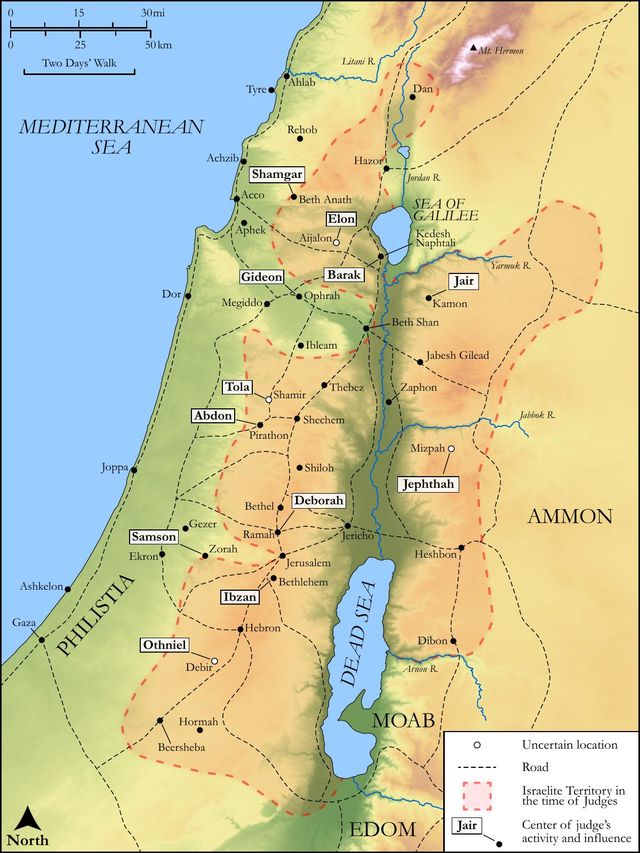
See on the biblical-era maps
Study this verse
Public-domain commentary
Matthew Henry
From his Commentary on the Whole Bible. Henry comments on passages, not single verses — this entry covers Judges 4:1–3. His two-level outline is real structure in the source text, so it is rendered as structure.
Here is, I. Israel backsliding from God: They again did evil in his sight, forsook his service, and worshipped idols; for this was the sin which now most easily beset them, Jdg 4:1. See in this, 1. The strange strength of corruption, which hurries men into sin notwithstanding the most frequent experience of its fatal consequences. The bent to backslide is with great difficulty restrained. 2. The common ill effects of a long peace. The land had rest eighty years, which should have confirmed them in their religion; but, on the contrary, it made them secure and wanton, and indulgent of those lusts which the worship of the false gods was calculated for the gratification of. Thus the prosperity of fools destroys them. Jeshurun waxeth fat and kicketh. 3. The great loss which a people sustains by the death of good governors. The did evil, because Ehud was dead. So it may be read. He kept a strict eye upon them, restrained and punished every thing that looked towards idolatry, and kept them close to God's service. But, when he was gone, they revolted, fearing him more than God.
II.Israel oppressed by their enemies.
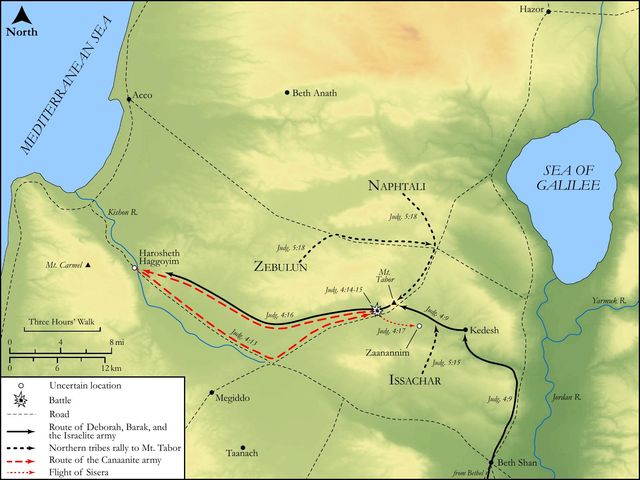
When they forsook God, he forsook them; and then they became an easy prey to every spoiler. They alienated themselves from God as if he were none of theirs; and then God alienated them as none of his. Those that threw themselves out of God's service threw themselves out of his protection. What has my beloved to do in my house when she has thus played the harlot? Jer 11:15. He sold them into the hand of Jabin, Jdg 4:2. This Jabin reigned in Hazor, as another of the same name, and perhaps his ancestor, had done before him, whom Joshua routed and slew, and burnt his city, Jos 11:1, Jos 11:10. But it seems, in process of time, the city was rebuilt, the power regained, the loss retrieved, and, by degrees, the king of Hazor becomes able to tyrannize over Israel, who by sin had lost all their advantage against the Canaanites. This servitude was longer than either of the former, and much more grievous. Jabin, and his general Sisera, did mightily oppress Israel. That which aggravated the oppression was,
1.That this enemy was nearer to them than any of the former, in their borders, in their bowels, and by this means had the more opportunity to do them a mischief.
2.That they were the natives of the country, who bore an implacable enmity to them, for invading and dispossessing them, and when they had them in their power would be so much the more cruel and mischievous towards them in revenge of the old quarrel.
3.That these Canaanites had formerly been conquered and subdued by Israel, were of old sentenced to be their servants (Gen 9:25), and might now have been under their feet, and utterly incapable of giving them any disturbance, if their own slothfulness, cowardice, and unbelief, had not suffered them thus to get head. To be oppressed by those whom their fathers had conquered, and whom they themselves had foolishly spared, could not but be very grievous.
III.Israel returning to their God:
They cried unto the Lord, when distress drove them to him, and they saw no other way of relief. Those that slight God in their prosperity will find themselves under a necessity of seeking him when they are in trouble.
Continue studying Judges 4:1 across the web’s major study libraries — every link below opens this exact verse, chapter, or book on the destination site.
Read & Compare
 BibleGatewayThis verse in more than 200 translations and 70 languages.
 Bible.comThe YouVersion reader — hundreds of translations, reading plans, and highlights.
 ESV.orgCrossway's official English Standard Version reader.
 NET BibleThe NET translation with 60,000+ translators' notes on every rendering decision.
 STEP BibleTyndale House's free study tool — original text, vocabulary, and scholarly resources.
 BibliaLogos Bible Software's free web reader.
 USCCBThe New American Bible (Revised Edition) with the U.S. bishops' study notes.
Commentaries
 BibleHub CommentariesDozens of classic commentaries on this verse, gathered on one page.
 StudyLightMore than 100 commentary sets — the largest collection on the web.
 BibleRefPlain-English commentary on what this verse means, verse by verse.
 Enduring WordDavid Guzik's free commentary on this chapter, widely used by Bible teachers.
 Bible Study ToolsVerse commentary alongside Greek and Hebrew study aids.
Original Language & Research
- BibleHub InterlinearThe verse word by word — original language, transliteration, and English.
- BibleHub LexiconEvery word's original-language definition and Strong's entry.
 Blue Letter BibleDeep-study tools — Strong's numbers, concordance, and word studies.
 SefariaThe Hebrew text with Rashi and centuries of Jewish commentary.
Sermons, Hymns & Audio


TrulyRandomVerse is not affiliated with these sites and doesn’t control their content. They’re linked because they’re genuinely useful.
Summary
Judges 4:1 marks a somber and familiar pivot in the narrative of ancient Israel, signaling a disheartening return to spiritual disobedience and rebellion against the LORD immediately following a period of peace and deliverance under the judge Ehud. This verse serves as the grim initiation of yet another turn in the recurring cycle of sin, oppression, and eventual divine deliverance that characterizes the book of Judges, thereby setting the stage for the subsequent oppression by the Canaanites under King Jabin.
Context
ShowHideLiterary Context
Judges 4:1 directly follows the eighty-year period of peace described in Judges 3:30, which was secured by the judge Ehud's deliverance from Moabite oppression. This verse acts as a critical turning point, initiating the next phase of the Deuteronomistic cycle that pervades the book of Judges. This cyclical pattern, clearly articulated in Judges 2:11-19, involves Israel doing evil in the LORD's sight, suffering oppression, crying out to God, receiving a deliverer (judge), and enjoying a period of peace, only to repeat the pattern. The death of Ehud, a charismatic and effective leader, creates a spiritual vacuum that Israel fails to fill with sustained faithfulness to God, leading inevitably to renewed apostasy and the subsequent oppression by Jabin, king of Canaan, detailed in the verses that follow, particularly Judges 4:2-3.
Historical & Cultural Context
During the period of the Judges, Israel existed as a loose confederacy of tribes without a centralized monarchy or a consistent, unified spiritual leadership. This lack of cohesive authority often left them vulnerable to internal moral decay and external pressures from surrounding nations. The phrase "did evil in the sight of the LORD" typically refers to Israel's abandonment of their covenant with Yahweh, often manifesting in the worship of Canaanite deities like Baal and Asherah, and the adoption of their associated immoral practices, which were pervasive in the land. The Canaanites, with their fortified cities and superior military technology (especially iron chariots, mentioned later in Judges 4:3), posed a significant and persistent threat, both militarily and culturally, to Israel's nascent settlement in the land. Israel's spiritual compromise made them susceptible to this cultural and military dominance.
Key Themes
ShowHideThis verse powerfully encapsulates several foundational themes within the book of Judges and the broader Old Testament narrative. Firstly, it highlights the Cycle of Sin and Deliverance, demonstrating humanity's persistent fallen nature and tendency to forget God's past mercies, even after experiencing profound deliverance. Secondly, it underscores Spiritual Amnesia, where Israel's collective memory of God's covenant and their obligations rapidly fades in the absence of a strong, righteous leader. The phrase "when Ehud was dead" emphasizes Israel's over-reliance on human figures rather than a direct, sustained relationship with the LORD, a theme that echoes throughout the book, culminating in the lament that "everyone did what was right in their own eyes" (Judges 21:25). Finally, the verse implicitly points to the Consequences of Covenant Infidelity. Israel's renewed disobedience directly precipitates the subsequent oppression, serving as a stark reminder that turning away from God inevitably leads to negative outcomes, as forewarned in the Deuteronomic covenant (e.g., Deuteronomy 28).
Exposition and Analysis
ShowHideKey Word Analysis
ShowHideThis verb means "to add or augment," often used adverbially to signify "to continue to do a thing" or "to do again." In Judges 4:1, it critically underscores the repetitive nature of Israel's sin. It is not a new or isolated incident but a re-engagement with a pattern of disobedience that has plagued them throughout their history. This repetition highlights their stubbornness and spiritual short-sightedness, emphasizing the tragic predictability of their apostasy and their failure to learn from past experiences.
This word denotes something "bad" or "evil," both naturally and morally. In the context of "did evil in the sight of the LORD," it signifies more than mere moral transgression; it represents a deliberate and profound spiritual rebellion against Yahweh and His covenant. This "evil" primarily refers to idolatry—the worship of foreign gods like Baal and Asherah—and the associated rejection of Yahweh's exclusive claim on Israel's allegiance. It also encompasses oppression and a general disregard for the Mosaic Law, which are direct consequences of covenant infidelity.
This word literally means "eye" but is used figuratively to denote "outward appearance," "presence," or "perception." The phrase "in the sight of the LORD" emphasizes that Israel's actions are not merely human failings but are judged from God's divine perspective. It highlights God's omnipresence and His righteous standard. Their sin is not hidden; it is a direct affront to the One who delivered them and with whom they have a covenant relationship. This phrase underscores the theological gravity of their disobedience and sets the stage for God's just response.
Verse Breakdown
ShowHide"¶ And the children of Israel"
This clause identifies the collective subject of the action: the covenant people, the descendants of Jacob (Israel, H3478), who were chosen by God, delivered from Egypt, and brought into the promised land. The collective nature of their sin implies a widespread spiritual decline across the tribes, indicating a pervasive failure rather than isolated incidents.
"again did evil in the sight of the LORD"
This is the core theological declaration of the verse. It states the specific action—"did evil" (H6213, H7451)—and its repetitive nature—"again" (H3254). The phrase "in the sight of the LORD" (H5869, H3068) highlights the divine perspective and judgment, emphasizing that their actions were a direct affront to God's holiness and covenant stipulations. This "evil" primarily refers to idolatry and covenant unfaithfulness, the most egregious violations of their relationship with Yahweh.
"when Ehud was dead"
This clause provides the immediate temporal context and a significant causal factor. The death (H4191) of Ehud (H164), the previous judge who brought eighty years of peace, marks the moment of Israel's relapse. It suggests that Israel's faithfulness was often contingent on the presence of a strong, charismatic leader rather than a deeply rooted, personal commitment to Yahweh. The spiritual vacuum left by Ehud's absence exposed the underlying spiritual weakness and idolatrous tendencies of the people, leading them to quickly forget God's past mercies.
Literary Devices
ShowHideJudges 4:1 masterfully employs several literary techniques to convey its message. Formulaic Language is prominent, with the phrase "did evil in the sight of the LORD" being a recurring motif throughout the book of Judges and the broader Deuteronomistic History. This repetition signals a predictable pattern of apostasy, creating a sense of tragic inevitability and underscoring Israel's persistent unfaithfulness. The verse also uses Juxtaposition, placing the extended period of peace and deliverance under Ehud (from Judges 3:30) immediately before the renewed sin upon his death. This stark contrast highlights Israel's spiritual fragility and their quick descent into disobedience once the immediate influence of a righteous leader is removed. Furthermore, the verse functions as Foreshadowing, hinting at the impending oppression and the subsequent need for a new deliverer, thereby propelling the narrative forward into the story of Deborah and Barak. Finally, there is an element of Irony in Israel's repeated failure to learn from their past experiences, despite God's consistent deliverance, revealing a deep-seated spiritual amnesia and a profound lack of spiritual maturity.
Theological and Thematic Connections
ShowHideJudges 4:1 serves as a stark reminder of humanity's persistent inclination towards sin and forgetfulness of God's grace. It illustrates the tragic reality that even after experiencing divine deliverance and periods of peace, the human heart, left to its own devices, will often drift back into rebellion. The theological implication is profound: Israel's repeated failure underscores the inadequacy of human leadership and the need for a deeper, more enduring transformation of the heart that only God can provide. It highlights the enduring tension between God's faithfulness to His covenant promises and Israel's chronic infidelity, setting the stage for the progressive revelation of God's plan for ultimate redemption, which transcends temporary human solutions.
Reflection and Application
ShowHideJudges 4:1 offers timeless lessons for believers today, serving as a potent warning against spiritual complacency and the dangers of relying solely on external circumstances or human leaders for our spiritual vitality. Just as Israel repeatedly fell into sin after periods of blessing and the absence of a strong judge, we too can drift away from God when comfort sets in, or when the immediate presence of spiritual mentors or a vibrant church community wanes. This verse calls us to cultivate a deep, personal, and consistent relationship with God that transcends our circumstances and is not dependent on others. It challenges us to actively remember God's past faithfulness, to guard against spiritual amnesia, and to remain vigilant in our walk, understanding that true spiritual growth is a continuous journey of obedience, repentance, and reliance on the Holy Spirit, not a destination achieved once and for all. It compels us to examine our own hearts for areas where we might be prone to spiritual drift and to proactively seek God's face, even in times of peace and prosperity.
Questions for Reflection
ShowHideFAQ
ShowHideWhy did Israel keep falling into the same cycle of sin, despite God's repeated deliverance?
ShowHideIsrael's repeated descent into sin, as exemplified in Judges 4:1, stemmed from a complex interplay of factors. Fundamentally, it highlights the deep-seated human propensity for sin and rebellion against God, a truth echoed throughout Scripture (e.g., Romans 3:23). Specifically, Israel's failure was due to several reasons: a lack of centralized spiritual and political authority during the period of the Judges, which led to each tribe doing "what was right in their own eyes" (Judges 21:25); the pervasive influence of surrounding pagan Canaanite cultures and their idolatrous practices (e.g., Baal worship); Israel's failure to fully dispossess the Canaanites as commanded by God (Judges 1:21-36); and a collective "spiritual amnesia" where they quickly forgot God's past mercies and their covenant obligations once a deliverer died. Their faith was often contingent on charismatic human leaders rather than a deep, personal commitment to Yahweh, revealing a fundamental heart issue.
What does "did evil in the sight of the LORD" specifically mean in the context of Judges?
ShowHideThe phrase "did evil in the sight of the LORD" is a recurring theological formula in the book of Judges and other historical books of the Old Testament. It signifies more than just general immorality or social transgression. In the context of Israel's covenant relationship with Yahweh, it primarily refers to a deliberate and profound breach of that covenant. This "evil" typically encompassed: Idolatry, the most grievous sin, involving the worship of foreign gods like Baal and Asherah, which directly violated the first two commandments (Exodus 20:3-5); Covenant Unfaithfulness, a rejection of God's revealed will and the laws given through Moses; and often, Injustice, as a departure from God's righteous standards would inevitably lead to oppression of the vulnerable within their society. It implies a conscious turning away from the God who delivered them, choosing instead to follow the ways of the surrounding pagan nations, thereby provoking divine judgment.
Christ-Centered Fulfillment
ShowHideThe recurring cycle of sin, oppression, and temporary deliverance in Judges, epitomized by Judges 4:1, powerfully underscores the inadequacy of human solutions and points to the ultimate need for a perfect, eternal Deliverer. Israel's inability to break free from this cycle, even with the raising of judges, reveals the depth of human sinfulness and the futility of relying on temporary leaders or periods of peace. This narrative foreshadows the coming of Christ, who alone can break the cycle of sin and death definitively. Unlike the judges who provided only temporary respite and whose influence waned with their death, Jesus is the eternal King and perfect High Priest who offers a lasting deliverance. He is the ultimate Judge who bears the judgment for our sin (Romans 6:23) and the true Deliverer who sets us free from the bondage of sin once and for all (John 8:34-36). The spiritual amnesia and moral failure of Israel highlight humanity's desperate need for a Savior who not only rescues from external oppression but also transforms the heart from within, providing a righteousness and peace that is not dependent on human leadership but on His finished work (Matthew 1:21). His sacrifice provides the ultimate and permanent solution to the problem of humanity's persistent evil in the sight of the Lord.