


Judges 3:31
Bible text: King James Version (1769 Blayney text) · Public domain
Bible text: King James Version with Strong's numbers · Public domain
Bible text: Berean Standard Bible · Public domain
Bible text: American Standard Version (1901) · Public domain
Bible text: World English Bible, Messianic edition · Public domain
Bible text: Geneva Bible (1599) · Public domain
Bible text: Young's Literal Translation · Public domain
- וְאַחֲרָיוve·'a·cha·Ravand after himH310Conj-w ¦ Adj-mpc ¦ 3msAdjective Numerical Plural Masculine Constructוְandאַחֲרָיafterוhim
- הָיָהha·Yahhe wasH1961V-Qal-Perf-3msVerb Qal Perfect 3rd Singular Masculine
- שַׁמְגַּרsham·GarShamgarH8044N-proper-mNoun Proper Masculine
- בֶּןben[the] son ofH1121N-mscNoun Singular Masculine Construct
- עֲנָת'a·NatAnathH6067N-proper-mNoun Proper Masculine
- וַיַּךְvai·Yakhand he struck downH5221Conj-w ¦ V-Hiphil-ConsecImperf-3msVerb Hiphil Consecutive Imperfect 3rd Singular Masculineוַandיַּךְhe struck down
- אֶת'et<obj.>H853DirObjMParticle Object Indicator
- פְּלִשְׁתִּיםpe·lish·Tim[the] PhilistinesH6430N-mpNoun Gentilic Plural Masculine Absolute
- שֵׁשׁsheshsixH8337N-csNoun Singular common gender Absolute
- מֵאוֹתme·'othundred<s>H3967N-fpNoun Plural Feminine Absolute
- אִישׁ'IshmanH376N-msNoun Singular Masculine Absolute
- בְּמַלְמַדbe·mal·Madwith [the] goad ofH4451Prep-b ¦ N-mscNoun Singular Masculine Constructבְּwithמַלְמַד[the] goad of
- הַבָּקָרha·ba·Kar<the> cattleH1241Art ¦ N-csNoun Singular common gender Absoluteהַ<the>בָּקָרcattle
- וַיֹּשַׁעvai·Yo·sha'and he deliveredH3467Conj-w ¦ V-Hiphil-ConsecImperf-3msVerb Hiphil Consecutive Imperfect 3rd Singular Masculineוַandיֹּשַׁעhe delivered
- גַּםgamalsoH1571AdvAdverb
- הוּאhu'heH1931Pro-3msPronoun Personal 3rd Singular Masculine
- אֶת'et<obj.>H853DirObjMParticle Object Indicator
- יִשְׂרָאֵלYis·ra·'ElIsraelH3478N-properNoun Proper Location
English is a literal word-by-word gloss of the Hebrew, not the KJV's wording. Why?
This is the original text the KJV's translators worked from — each Hebrew word with its own literal English meaning in this verse, prepared by scholars at Tyndale House, Cambridge. The KJV translates whole sentences, not word by word, so its wording differs: one Hebrew word can become several English words, and the KJV may choose “the LORD” where the gloss reads “Yahweh”. Both are faithful — they answer different questions. For the KJV's own rendering, switch to the KJV text.
Details
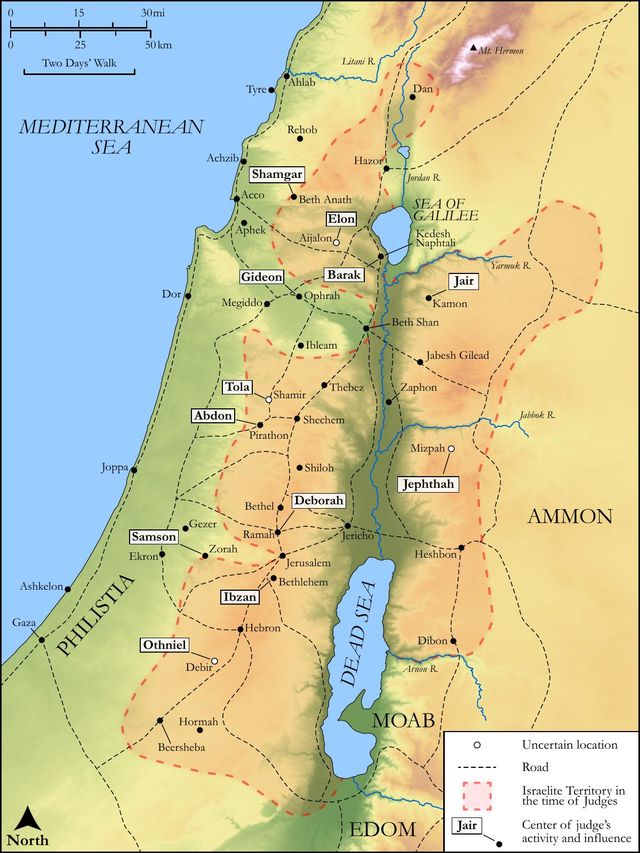
See on the biblical-era maps
Study this verse
Public-domain commentary
Matthew Henry
From his Commentary on the Whole Bible. Henry comments on passages, not single verses — this entry covers Judges 3:31.
When it is said the land had rest eighty years, some think it meant chiefly of that part of the land which lay eastward on the banks of Jordan, which had been oppressed by the Moabites; but it seems, by this passage here, that the other side of the country which lay south-west was in that time infested by the Philistines, against whom Shamgar made head. 1. It seems Israel needed deliverance, for he delivered Israel; how great the distress was Deborah afterwards related in her song (Jdg 5:6), that in the days of Shamgar the highways were unoccupied, etc.; that part of the country which lay next to the Philistines was so infested with plunderers that people could not travel the roads in safety, but were in danger of being set upon and robbed, nor durst they dwell in the unguarded villages, but were forced to take shelter in the fortified cities. 2. God raised him up to deliver them, as it should seem, while Ehud was yet living, but superannuated. So inconsiderable were the enemies for number that it seems the killing of 600 of them amounted to a deliverance of Israel, and so many he slew with an ox-goad, or, as some read it, a plough-share. It is probable that he was himself following the plough when the Philistines made an inroad upon the country to ravage it, and God put it into his heart to oppose them; the impulse being sudden and strong, and having neither sword nor spear to do execution with, he took the instrument that was next at hand, some of the tools of his plough, and with that killed so many hundred men and came off unhurt. See here, (1.) That God can make those eminently serviceable to his glory and his church's good whose extraction, education, and employment, are very mean and obscure. He that has the residue of the Spirit could, when he pleased, make ploughmen judges and generals, and fishermen apostles. (2.) It is no matter how weak the weapon is if God direct and strengthen the arm. An ox-goad, when God pleases, shall do more than Goliath's sword. And sometimes he chooses to work by such unlikely means, that the excellency of the power may appear to be of God.
Continue studying Judges 3:31 across the web’s major study libraries — every link below opens this exact verse, chapter, or book on the destination site.
Read & Compare
 BibleGatewayThis verse in more than 200 translations and 70 languages.
 Bible.comThe YouVersion reader — hundreds of translations, reading plans, and highlights.
 ESV.orgCrossway's official English Standard Version reader.
 NET BibleThe NET translation with 60,000+ translators' notes on every rendering decision.
 STEP BibleTyndale House's free study tool — original text, vocabulary, and scholarly resources.
 BibliaLogos Bible Software's free web reader.
 USCCBThe New American Bible (Revised Edition) with the U.S. bishops' study notes.
Commentaries
 BibleHub CommentariesDozens of classic commentaries on this verse, gathered on one page.
 StudyLightMore than 100 commentary sets — the largest collection on the web.
 BibleRefPlain-English commentary on what this verse means, verse by verse.
 Enduring WordDavid Guzik's free commentary on this chapter, widely used by Bible teachers.
 Bible Study ToolsVerse commentary alongside Greek and Hebrew study aids.
Original Language & Research
- BibleHub InterlinearThe verse word by word — original language, transliteration, and English.
- BibleHub LexiconEvery word's original-language definition and Strong's entry.
 Blue Letter BibleDeep-study tools — Strong's numbers, concordance, and word studies.
 SefariaThe Hebrew text with Rashi and centuries of Jewish commentary.
Sermons, Hymns & Audio


TrulyRandomVerse is not affiliated with these sites and doesn’t control their content. They’re linked because they’re genuinely useful.
Summary
Judges 3:31 concisely introduces Shamgar, son of Anath, as a divinely appointed deliverer who arose following Ehud's period of peace. This single verse recounts his extraordinary feat of slaying six hundred Philistine men using an ordinary ox goad, thereby bringing a measure of salvation to Israel. The account serves as a powerful testament to God's sovereign ability to raise up unexpected individuals and employ unconventional means to secure the deliverance of His people, profoundly illustrating that divine power is not limited by human resources, military might, or conventional expectations.
Context
ShowHideLiterary Context
Judges 3:31 stands as a remarkably succinct and almost parenthetical interlude within the cyclical narrative of the book of Judges. It immediately follows the detailed and dramatic account of Ehud's successful assassination of Eglon, King of Moab, and the subsequent eighty years of peace for Israel (Judges 3:12-30). Shamgar's appearance is presented with striking brevity, a mere single verse summarizing his entire contribution, before the narrative transitions to the more extensive and complex story of Deborah and Barak's leadership against the Canaanites (Judges 4-5). This conciseness might imply a localized deliverance, a brief respite, or, more likely, a deliberate authorial choice to highlight the unconventional nature of his victory and God's surprising methods, rather than providing a detailed biography. Nevertheless, his inclusion firmly places him within the recurring pattern of Israel's apostasy, oppression, cry for help, and God's compassionate response through a divinely raised deliverer, reinforcing the overarching theological message of God's faithfulness despite Israel's failures.
Historical & Cultural Context
The period of the Judges (roughly 12th-11th centuries BC) was characterized by a decentralized Israelite society, marked by tribal autonomy and frequent conflicts with surrounding peoples. The Philistines, who emerged as a dominant force along the southwestern coastal plain of Canaan (the "Philistine Plain"), were a formidable threat. Originating from the Aegean Sea region (likely Crete or Mycenae), they were part of the "Sea Peoples" migrations and brought with them advanced military technology, notably iron weaponry, which gave them a significant advantage over the Israelites, who were still largely reliant on bronze. The "ox goad" (Hebrew: malmad habbāqār) was a ubiquitous agricultural implement of the time, typically a long wooden pole, often 8-10 feet in length, equipped with a sharp metal point at one end for prodding oxen and a flattened, spade-like tip at the other for clearing debris from the plowshare. Its use as the sole weapon against 600 armed Philistine warriors dramatically underscores the extraordinary nature of Shamgar's feat, emphasizing divine empowerment over conventional military superiority and highlighting the vast technological disparity between the Philistines and the Israelites.
Key Themes
ShowHideShamgar's concise narrative contributes significantly to several foundational themes woven throughout the book of Judges and the broader Old Testament. Chief among these is the theme of Divine Deliverance through Unlikely Means. Shamgar is not introduced as a seasoned warrior or a prominent tribal leader; rather, he is presented as an ordinary individual, perhaps a farmer, whom God uses with an everyday agricultural tool to achieve a monumental victory. This echoes later biblical accounts where God uses seemingly inadequate instruments to accomplish His purposes, such as David's use of a sling against Goliath (1 Samuel 17). This highlights God's Sovereignty and Power, demonstrating that His ability to save is not reliant on human strength, military might, or strategic advantage, but on His own omnipotence and willingness to work through the unexpected (Zechariah 4:6). The account also subtly introduces the persistent and escalating conflict with the Philistines, a major antagonist for Israel in the later period of the Judges and throughout the early monarchy (e.g., Judges 10:6-7). Finally, it reiterates the recurring Cycle of Apostasy and Deliverance that defines the book of Judges, where Israel's oppression leads to a cry for help, and God, in His mercy, raises up a deliverer.
Exposition and Analysis
ShowHideKey Word Analysis
ShowHideThe name "Shamgar" (H8044) is of uncertain derivation, possibly Hurrian or Hittite, which has led some scholars to speculate about his non-Israelite or mixed ethnic background, or perhaps a connection to a specific region. Regardless of his precise origin, his inclusion in the list of judges underscores that God's choice of deliverers transcended conventional tribal or social boundaries. His brief mention emphasizes the divine initiative in raising up leaders, irrespective of their perceived status or lineage, to fulfill His purposes of delivering Israel.
The term malmâd' (H4451) specifically refers to a goad for oxen. This agricultural implement, typically a long wooden pole with a sharp metal point and a flattened end (used for clearing plows), was an ordinary tool of daily life for farmers. Its significance in this verse lies precisely in its ordinariness and its stark contrast to military weaponry. Shamgar's use of an ox goad (H1241, bâqâr', meaning "ox," is the modifying noun here) to slay 600 Philistines highlights the extraordinary power of God working through humble and unconventional means. It demonstrates that victory is not achieved by human might or sophisticated weaponry, but by divine enablement, ensuring that all glory redounds to God alone.
The verb yâshaʻ' (H3467) is a primitive root meaning "to be open, wide or free, i.e. (by implication) to be safe; causatively, to free or succor." It is a foundational term in the Old Testament, frequently used to describe God's acts of rescue for His people from their enemies or from distress. In Shamgar's case, his action is explicitly attributed as an act of deliverance for Israel, aligning him with the other judges who were raised up by God to bring temporary salvation. The use of this term points beyond mere military victory to a divinely orchestrated rescue, emphasizing God as the ultimate source of salvation and Shamgar as His chosen instrument.
Verse Breakdown
ShowHide"¶ And after him was Shamgar the son of Anath,"
This opening clause immediately places Shamgar's ministry in chronological succession to Ehud's, marking a new phase in Israel's history of deliverance. The phrase "son of Anath" is a unique patronymic. "Anath" was also the name of a prominent Canaanite goddess of war, which could suggest a non-Israelite background for Shamgar's family or a geographical connection to a place associated with this deity. The extreme brevity of this introduction sets the tone for his entire account, focusing squarely on his action rather than on his lineage or personal history.
"which slew of the Philistines six hundred men"
This clause details the astonishing scale of Shamgar's achievement. Slaying 600 men, which represents a significant military force, by a single individual marks him as a divinely empowered hero whose feat transcends typical human capability. The specific mention of "Philistines" identifies the particular enemy, highlighting the ongoing and formidable threat they posed to Israel and setting the stage for future, more extensive conflicts detailed later in the books of Judges and Samuel.
"with an ox goad:"
This is arguably the most striking and theologically significant detail of the verse. By specifying the unconventional weapon—an ordinary agricultural tool—the narrative transforms Shamgar's act from a mere military skirmish into a profound theological statement. It powerfully underscores the biblical principle that God is not limited by human resources, conventional warfare, or perceived inadequacy. His power is perfectly displayed through seemingly weak or humble means, ensuring that all glory for the victory redounds to Him alone, rather than to human strength or ingenuity.
"and he also delivered Israel."
This concluding clause unequivocally confirms Shamgar's role as a "judge" or deliverer in the divinely appointed sense. His act was not merely a personal feat of strength or a localized skirmish but had a direct, redemptive impact on the nation, bringing a measure of relief and security from Philistine oppression. The word "also" connects his deliverance to those provided by previous judges, affirming his place within the divinely ordained cycle of God's merciful intervention on behalf of His covenant people.
Literary Devices
ShowHideThe account of Shamgar in Judges 3:31, despite its extreme conciseness, masterfully employs several potent literary devices to convey its profound theological message. The most prominent is Irony, specifically situational irony, where an ordinary, non-military agricultural tool (the ox goad) is unexpectedly used to achieve an extraordinary military victory against a formidable, technologically superior enemy. This stark contrast powerfully highlights the divine power at work, subverting human expectations and demonstrating that God's strength is made perfect in weakness. Furthermore, the very brevity of the account itself functions as a literary device, drawing immediate and intense attention to the central, astonishing detail of the ox goad and the miraculous scale of the victory. This conciseness emphasizes the divine action and the miraculous nature of the event over the personality or extensive biography of the deliverer, ensuring that the focus remains on God's surprising intervention. There is also an element of Symbolism, where the ox goad symbolizes God's consistent ability to use the humble, the weak, and the unexpected to accomplish His mighty purposes, a recurring theme throughout biblical narrative. Finally, the verse serves as a subtle Foreshadowing of future deliverers, particularly those who would operate outside conventional military might, such as David, and ultimately, the Messiah, who would accomplish salvation through seemingly weak and unconventional means.
Theological and Thematic Connections
ShowHideShamgar's brief but impactful story profoundly reinforces the biblical truth that God's power is not contingent upon human strength, conventional resources, or impressive status. His choice of an individual wielding an ordinary agricultural tool against a formidable, technologically advanced enemy like the Philistines echoes a consistent divine pattern: God delights in using the weak, the foolish, and the overlooked to confound the strong and wise, ensuring that the glory belongs to Him alone. This narrative underscores God's active sovereignty in the affairs of His people, demonstrating His unwavering commitment to deliver them, even when their own faithfulness is intermittent. It's a testament to the fact that divine deliverance often comes through unexpected channels, reminding us that true victory is rooted in God's power, not human might or strategic advantage.
Reflection and Application
ShowHideShamgar's story, though remarkably short, offers a potent and enduring message for believers today. It challenges our often-human-centric view of capability and success, reminding us that God's criteria for usefulness are vastly different from our own. We frequently find ourselves feeling inadequate, lacking the "right" skills, abundant resources, or influential connections to make a significant impact in our spheres of influence or for God's kingdom. Yet, Shamgar, with his simple ox goad, profoundly demonstrates that God can take our ordinary lives, our everyday tools, and our perceived weaknesses, and transform them into instruments of extraordinary divine purpose. The key is not the magnitude of our gifts or the abundance of our resources, but our availability and willingness to be used by God. His story calls us to courageously step out in faith with what we have, trusting that God's power will be perfected in our weakness, enabling us to participate in His ongoing work of deliverance and transformation in the world around us, whether in our homes, workplaces, or communities.
Questions for Reflection
ShowHideFAQ
ShowHideWho was Shamgar, and why is his story so brief?
ShowHideShamgar, son of Anath, was one of the judges of Israel, mentioned very briefly in Judges 3:31 and again in Judges 5:6. His story is exceptionally concise, comprising only a single verse detailing his deliverance of Israel from the Philistines by slaying 600 men with an ox goad. The brevity might indicate a localized or temporary period of relief, or it could be a deliberate literary choice to emphasize the extraordinary nature of his feat and God's unconventional methods, rather than focusing on the judge's personal history. His inclusion, despite the brevity, highlights that God continually raised up deliverers throughout this tumultuous period, even those whose full narratives are not extensively recorded, reinforcing the divine initiative in Israel's salvation.
What was an ox goad, and why is its use significant?
ShowHideAn ox goad was a common agricultural tool, typically a long wooden pole (around 8-10 feet) used by farmers to guide and prod oxen while plowing. It usually had a sharp metal point on one end for urging the animals and a flat, spade-like tip on the other for clearing mud from the plowshare. Its use by Shamgar to slay 600 Philistine warriors, as recorded in Judges 3:31, is highly significant because it was not a conventional weapon of war. This detail powerfully underscores the theme that God's power is not limited by human resources, military might, or sophisticated weaponry. Instead, God often chooses the weak, the ordinary, and the unconventional to accomplish His extraordinary purposes, ensuring that the glory belongs to Him alone (1 Corinthians 1:27-29).
Christ-Centered Fulfillment
ShowHideShamgar's temporary deliverance of Israel with an ordinary ox goad serves as a powerful, albeit subtle, foreshadowing of the ultimate and eternal deliverance wrought by Jesus Christ. Just as Shamgar, an unlikely figure with an unconventional "weapon," brought salvation to his people, so too did Christ accomplish the greatest salvation through means that appeared weak and foolish to the world: His sacrificial death on the cross. The cross, like the ox goad, was an instrument of common use and a symbol of shame and weakness, yet it became the very means by which the Lamb of God conquered sin, death, and the powers of darkness. Shamgar's victory was a physical one, freeing Israel from Philistine oppression, but Christ's victory is spiritual and eternal, freeing humanity from the bondage of sin and eternal death (Colossians 2:13-15). He is the true deliverer, the Son of David, who did not come with an army or conventional weapons, but with divine authority and sacrificial love, fulfilling all the temporary deliverances of the judges and ushering in an everlasting kingdom of peace and righteousness (Isaiah 9:6-7).