


Judges 2:16
- וַיָּקֶםvai·Ya·kemand he raised upH6965Conj-w ¦ V-Hiphil-ConsecImperf-3msVerb Hiphil Consecutive Imperfect 3rd Singular Masculineוַandיָּקֶםhe raised up
- יְהוָהYah·wehYahwehH3068N-properNoun Proper Title
- שֹׁפְטִיםsho·fe·TimjudgesH8199V-Qal-Prtcpl-mpVerb Qal Participle Plural Masculine Absolute
- וַיּוֹשִׁיעוּםvai·Yo·o·shi·'Umand they delivered themH3467Conj-w ¦ V-Hiphil-ConsecImperf-3mp ¦ 3mpVerb Hiphil Consecutive Imperfect 3rd Plural Masculineוַandיּוֹשִׁיעוּthey deliveredםthem
- מִיַּדmi·Yadfrom [the] hand ofH3027Prep-m ¦ N-cscNoun Singular common gender Constructמִfromיַּד[the] hand of
- שֹׁסֵיהֶםsho·sei·Hemtheir plunderersH8154V-Qal-Prtcpl-mp ¦ 3mpVerb Qal Participle Plural Masculine Constructשֹׁסֵיplunderersהֶםtheir
English is a literal word-by-word gloss of the Hebrew, not the KJV's wording. Why?
This is the original text the KJV's translators worked from — each Hebrew word with its own literal English meaning in this verse, prepared by scholars at Tyndale House, Cambridge. The KJV translates whole sentences, not word by word, so its wording differs: one Hebrew word can become several English words, and the KJV may choose “the LORD” where the gloss reads “Yahweh”. Both are faithful — they answer different questions. For the KJV's own rendering, switch to the KJV text.
Details
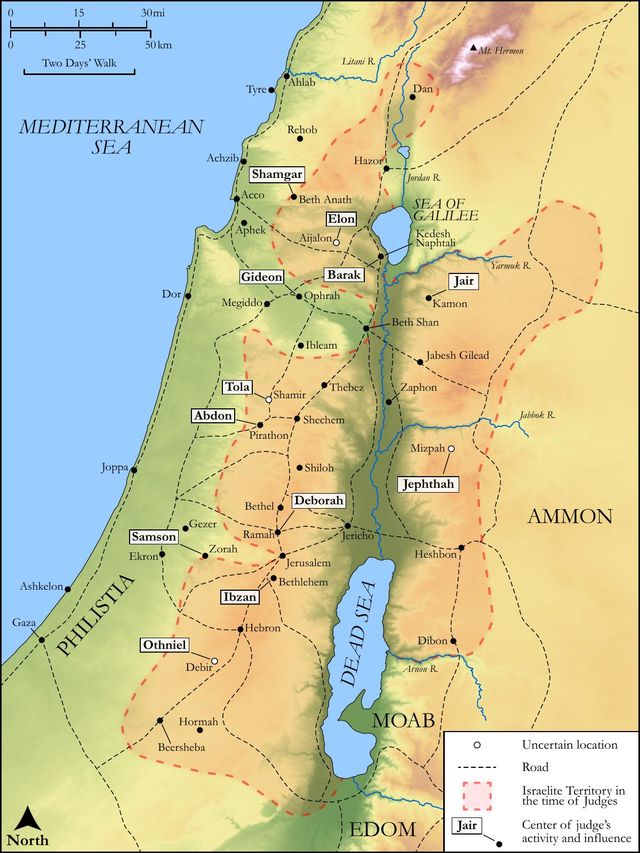
See on the biblical-era map
Study this verse
Public-domain commentary
Matthew Henry
From his Commentary on the Whole Bible. Henry comments on passages, not single verses — this entry covers Judges 2:6–23. His three-level outline is real structure in the source text, so it is rendered as structure.
The beginning of this paragraph is only a repetition of what account we had before of the people's good character during the government of Joshua, and of his death and burial (Jos 24:29, Jos 24:30), which comes in here again only to make way for the following account, which this chapter gives, of their degeneracy and apostasy. The angel had foretold that the Canaanites and their idols would be a snare to Israel; now the historian undertakes to show that they were so, and, that this may appear the more clear, he looks back a little, and takes notice, 1. Of their happy settlement in the land of Canaan. Joshua, having distributed this land among them, dismissed them to the quiet and comfortable possession of it (Jdg 2:6): He sent them away, not only every tribe, but every man to his inheritance, no doubt giving them his blessing. 2. Of their continuance in the faith and fear of God's holy name as long as Joshua lived, Jdg 2:7. As they went to their possessions with good resolutions to cleave to God, so they persisted for some time in these good resolutions, as long as they had good rulers that set them good examples, gave them good instructions, and reproved and restrained the corruptions that crept in among them, and as long as they had fresh in remembrance the great things God did for them when he brought them into Canaan: those that had seen these wonders had so much sense as to believe their own eyes, and so much reason as to serve that God who had appeared so gloriously on their behalf; but those that followed, because they had not seen, believed not. 3. Of the death and burial of Joshua, which gave a fatal stroke to the interests of religion among the people, Jdg 2:8, Jdg 2:9. Yet so much sense they had of their obligations to him that they did him honour at his death, and buried him in Timnath-heres; so it is called here, not, as in Joshua, Timnath-serah. Heres signifies the sun, a representation of which, some think, was set upon his sepulchre, and gave name to it, in remembrance of the sun's standing still at his word. So divers of the Jewish writers say; but I much question whether an image of the sun would be allowed to the honour of Joshua at that time, when, by reason of men's general proneness to worship the sun, it would be in danger of being abused to the dishonour of God. 4. Of the rising of a new generation, Jdg 2:10. All that generation in a few years wore off, their good instructions and examples died and were buried with them, and there arose another generation of Israelites who had so little sense of religion, and were in so little care about it, that, notwithstanding all the advantages of their education, one might truly say that they knew not the Lord, knew him not aright, knew him not as he had revealed himself, else they would not have forsaken him. They were so entirely devoted to the world, so intent upon the business of it or so indulgent of the flesh in ease and luxury, that they never minded the true God and his holy religion, and so were easily drawn aside to false gods and their abominable superstitions.
And so he comes to give us a general idea of the series of things in Israel during the time of the judges, the same repeated in the same order.
I.The people of Israel forsook the God of Israel, and gave that worship and honour to the dunghill deities of the Canaanites which was due to him alone. Be astonished, O heavens! at this, and wonder, O earth! Hath a nation, such a nation, so well fed, so well taught, changed its God, such a God, a God of infinite power, unspotted purity, inexhaustible goodness, and so very jealous of a competitor, for stocks and stones that could do neither good nor evil? Jer 2:11, Jer 2:12. Never was there such an instance of folly, ingratitude, and perfidiousness. Observe how it is described here, Jdg 2:11-13. In general, they did evil, nothing could be more evil, that is, more provoking to God, nor more prejudicial to themselves, and it was in the sight of the Lord; all evil is before him, but he takes special notice of the sin of having any other god. In particular,
1.They forsook the Lord (Jdg 2:12, and again Jdg 2:13); this was one of the two great evils they were guilty of, Jer 2:13. They had been joined to the Lord in covenant, but now they forsook him, as a wife treacherously departs from her husband. "They forsook the worship of the Lord," so the Chaldee: for those that forsake the worship of God do in effect forsake God himself. It aggravated this that he was the God of their fathers, so that they were born in his house, and therefore bound to serve him; and that he brought them out of the land of Egypt, he loosed their bonds, and upon that account also they were obliged to serve him.
2.When they forsook the only true God they did not turn atheists, nor were they such fools as to say, There is no God; but they followed other gods: so much remained of pure nature as to own a God, yet so much appeared of corrupt nature as to multiply gods, and take up with any, and to follow the fashion, not the rule, in religious worship. Israel had the honour of being a peculiar people and dignified above all others, and yet so false were they to their own privileges that they were fond of the gods of the people that were round about them. Baal and Ashtaroth, he-gods and she-gods; they made their court to sun and moon, Jupiter and Juno. Baalim signifies lords, and Ashtaroth blessed ones, both plural, for when they forsook Jehovah, who is one, they had gods many and lords many, as a luxuriant fancy pleased to multiply them. Whatever they took for their gods, they served them and bowed down to them, gave honour to them and begged favours from them.
II.The God of Israel was hereby provoked to anger, and delivered them up into the hand of their enemies, Jdg 2:14, Jdg 2:15.
He was wroth with them, for he is a jealous God and true to the honour of his own name; and the way he took to punish them for their apostasy was to make those their tormentors whom they yielded to as their tempters. They made themselves as mean and miserable by forsaking God as they would have been great and happy if they had continued faithful to him.
1.The scale of victory turned against them. After they forsook God, whenever they took the sword in hand they were as sure to be beaten as before they had been sure to conquer. Formerly their enemies could not stand before them, but, wherever they went, the hand of the Lord was for them; when they began to cool in their religion, God suspended his favour, stopped the progress of their successes, and would not drive out their enemies any more (Jdg 2:3), only suffered them to keep their ground; but now, when they had quite revolted to idolatry, the war turned directly against them, and they could not any longer stand before their enemies. God would rather give the success to those that had never known nor owned him than to those that had done both, but had now deserted him. Wherever they went, they might perceive that God himself had turned to be their enemy, and fought against them, Isa 63:10.
2.The balance of power then turned against them of course. Whoever would might spoil them, whoever would might oppress them. God sold them into the hands of their enemies; not only he delivered them up freely, as we do that which we have sold, but he did it upon a valuable consideration, that he might get himself honour as a jealous God, who would not spare even his own peculiar people when they provoked him. He sold them as insolvent debtors are sold (Mat 18:25), by their sufferings to make some sort of reparation to his glory for the injury it sustained by their apostasy. Observe how their punishment,
(1.)Answered what they had done. They served the gods of the nations that were round about them, even the meanest, and God made then serve the princes of the nations that were round about them, even the meanest. He that is company for every fool is justly made a fool of by every company.
(2.)How it answered what God has spoken. The hand of heaven was thus turned against them, as the Lord had said, and as the Lord had sworn (Jdg 2:15), referring to the curse and death set before them in the covenant, with the blessing and life. Those that have found God true to his promises may thence infer that he will be as true to his threatenings.
III.The God of infinite mercy took pity on them in their distresses, though they had brought themselves into them by their own sin and folly, and wrought deliverance for them. Nevertheless, though their trouble was the punishment of their sin and the accomplishment of God's word, yet they were in process of time saved out of their trouble, Jdg 2:16-18. Here observe,
1.The inducement of their deliverance. It came purely from God's pity and tender compassion; the reason was fetched from within himself. It is not said, It repented them because of their iniquities (for it appears, Jdg 2:17, that many of them continued unreformed), but, It repented the Lord because of their groanings; though it is not so much the burden of sin as the burden of affliction that they are said to groan under. It is true they deserved to perish for ever under his curse, yet, this being the day of his patience and our probation, he does not stir up all his wrath. He might in justice have abandoned them, but he could not for pity do it.
2.The instruments of their deliverance. God did not send angels from heaven to rescue them, nor bring in any foreign power to their aid, but raised up judges from among themselves, as there was occasion, men to whom God gave extraordinary qualifications for, and calls to, that special service for which they were designed, which was to reform and deliver Israel, and whose great attempts he crowned with wonderful success: The Lord was with the judges when he raised them up, and so they became saviours. Observe,
(1.)In the days of the greatest degeneracy and distress of the church there shall be some whom God will either find or make to redress its grievances and set things to rights.
(2.)God must be acknowledged in the seasonable rising up of useful men for public service. He endues men with wisdom and courage, gives them hearts to act and venture. All that are in any way the blessings of their country must be looked upon as the gifts of God.
(3.)Whom God calls he will own, and give them his presence; whom he raises up he will be with.
(4.)The judges of a land are its saviours.
IV.The degenerate Israelites were not effectually and thoroughly reformed, no, not by their judges, Jdg 2:17-19.
1.Even while their judges were with them, and active in the work of reformation, there were those that would not hearken to their judges, but at that very time went a whoring after other gods, so mad were they upon their idols, and so obstinately bent to backslide. They had been espoused to God, but broke the marriage-covenant, and went a whoring after these gods. Idolatry is spiritual adultery, so vile, and base, and perfidious a thing is it, and so hardly are those reclaimed that are addicted to it.
2.Those that in the times of reformation began to amend yet turned quickly out of the way again, and became as bad as ever. The way they turned out of was that which their godly ancestors walked in, and set them out in; but they soon started from under the influence both of their fathers' good example and of their own good education. The wicked children of godly parents do so, and will therefore have a great deal to answer for. However, when the judge was dead, they looked upon the dam which checked the stream of their idolatry as removed, and then it flowed down again with so much the more fury, and the next age seemed to be rather the worse for the attempts that had been made towards reformation, Jdg 2:19. They corrupted themselves more than their fathers, strove to outdo them in multiplying strange gods and inventing profane and impious rites of worship, as it were in contradiction to their reformers. They ceased not from, or, as the word is, they would not let fall, any of their own doings, grew not ashamed of those idolatrous services that were most odious nor weary of those that were most barbarous, would not so much as diminish one step of their hard and stubborn way. Thus those that have forsaken the good ways of God, which they have once known and professed, commonly grow most daring and desperate in sin, and have their hearts most hardened.
V.God's just resolution hereupon was still to continue the rod over them,
1.Their sin was sparing the Canaanites, and this in contempt and violation of the covenant God had made with them and the commands he had given them, Jdg 2:20.
2.Their punishment was that the Canaanites were spared, and so they were beaten with their own rod. They were not all delivered into the hand of Joshua while he lived, Jdg 2:23. Our Lord Jesus, though he spoiled principalities and powers, yet did not complete his victory at first. We see not yet all things put under him; there are remains of Satan's interest in the church, as there were of the Canaanites in the land; but our Joshua lives for ever, and will in the great day perfect his conquest. After Joshua's death, little was done for a long time against the Canaanites: Israel indulged them, and grew familiar with them, and therefore God would not drive them out any more, Jdg 2:21. If they will have such inmates as these among them, let them take them, and see what will come of it. God chose their delusions, Isa 66:4. Thus men cherish and indulge their own corrupt appetites and passions, and, instead of mortifying them, make provision for them, and therefore God justly leaves them to themselves under the power of their sins, which will be their ruin. So shall their doom be; they themselves have decided it. These remnants of the Canaanites were left to prove Israel (Jdg 2:22), whether they would keep the way of the Lord or not; not that God might know them, but that they might know themselves. It was to try,
(1.)Whether they could resist the temptations to idolatry which the Canaanites would lay before them. God had told them they could not, Deu 7:4. But they thought they could. "Well," said God, "I will try you;" and, upon trial, it was found that the tempters' charms were far too strong for them. God has told us how deceitful and desperately wicked our hearts are, but we are not willing to believe it till by making bold with temptation we find it too true by sad experience.
(2.)Whether they would make a good use of the vexations which the remaining natives would give them, and the many troubles they would occasion them, and would thereby be convinced of sin and humbled for it, reformed, and driven to God and their duty, whether by continual alarms from them they would be kept in awe and made afraid of provoking God.
Continue studying Judges 2:16 across the web’s major study libraries — every link below opens this exact verse, chapter, or book on the destination site.
Read & Compare
 BibleGatewayThis verse in more than 200 translations and 70 languages.
 Bible.comThe YouVersion reader — hundreds of translations, reading plans, and highlights.
 ESV.orgCrossway's official English Standard Version reader.
 NET BibleThe NET translation with 60,000+ translators' notes on every rendering decision.
 STEP BibleTyndale House's free study tool — original text, vocabulary, and scholarly resources.
 BibliaLogos Bible Software's free web reader.
 USCCBThe New American Bible (Revised Edition) with the U.S. bishops' study notes.
Commentaries
 BibleHub CommentariesDozens of classic commentaries on this verse, gathered on one page.
 StudyLightMore than 100 commentary sets — the largest collection on the web.
 BibleRefPlain-English commentary on what this verse means, verse by verse.
 Enduring WordDavid Guzik's free commentary on this chapter, widely used by Bible teachers.
 Bible Study ToolsVerse commentary alongside Greek and Hebrew study aids.
Original Language & Research
- BibleHub InterlinearThe verse word by word — original language, transliteration, and English.
- BibleHub LexiconEvery word's original-language definition and Strong's entry.
 Blue Letter BibleDeep-study tools — Strong's numbers, concordance, and word studies.
 SefariaThe Hebrew text with Rashi and centuries of Jewish commentary.
Sermons, Hymns & Audio


TrulyRandomVerse is not affiliated with these sites and doesn’t control their content. They’re linked because they’re genuinely useful.
Summary
Judges 2:16 marks a pivotal shift in the narrative of Israel's recurring apostasy and divine judgment, revealing God's profound compassion and sovereign intervention. Despite the Israelites' persistent disobedience, idolatry, and subsequent oppression by their enemies, the Lord, in His unwavering faithfulness to His covenant, actively raised up charismatic leaders—known as judges—whose primary mission was to deliver His people from the relentless grip of those who plundered and subjugated them. This verse establishes the recurring pattern of divine rescue that characterizes the entire Book of Judges, highlighting God's merciful response to human failure and His commitment to His covenant people.
Context
ShowHideLiterary Context
Judges 2:16 functions as a crucial hinge in the book, transitioning from the initial summary of Israel's post-Joshua failures to the detailed accounts of individual judges. The preceding verses (Judges 2:11-15) meticulously detail Israel's spiritual decline: a new generation emerged "who did not know the LORD or the works that he had done for Israel" (Judges 2:10). This ignorance led directly to abandoning Yahweh for the Canaanite deities Baal and Ashtaroth (Judges 2:11-13), provoking the Lord's intense anger. Consequently, "the anger of the LORD was kindled against Israel, and he gave them over to plunderers" (Judges 2:14), leading to severe distress and the Lord's hand being against them wherever they went (Judges 2:15). It is precisely against this bleak backdrop of judgment and suffering that Judges 2:16 introduces God's compassionate "nevertheless," signaling His merciful initiative to provide deliverance and thus setting the stage for the cyclical pattern of sin, oppression, cry, and rescue that defines the remainder of the book.
Historical & Cultural Context
The period of the Judges, spanning approximately 1375-1050 BC, was a tumultuous era in Israel's history, situated between the conquest of Canaan and the establishment of the monarchy. It was characterized by a decentralized tribal confederacy, famously summarized by the refrain, "there was no king in Israel; everyone did what was right in his own eyes" (Judges 17:6). This lack of central religious and political authority often resulted in internal disunity, widespread spiritual apostasy, and vulnerability to surrounding peoples. Neighboring groups such as the Canaanites, Philistines, Midianites, and Ammonites frequently exploited this weakness, oppressing the Israelites by plundering their crops, livestock, and resources, thereby "spoiling them" and reducing them to economic hardship and servitude. The "judges" were not primarily legal officials in the modern sense but divinely appointed, Spirit-empowered charismatic leaders, often military figures, raised by God to rally the tribes and deliver them from specific foreign oppressors, providing temporary periods of peace and stability.
Key Themes
ShowHideJudges 2:16 is foundational to several key themes woven throughout the book. Firstly, it powerfully underscores Divine Initiative and Sovereignty. Despite Israel's repeated unfaithfulness and self-inflicted misery, it is "the LORD" who actively "raised up" the judges, demonstrating His sovereign control over history and His unwavering commitment to His covenant people, even when they fail. This highlights God's Mercy and Faithfulness, as His steadfast love endures despite Israel's persistent idolatry and rebellion, providing a way out of their self-inflicted suffering. The verse also introduces The Role of the Judges as divinely appointed deliverers, not merely legal arbiters. Their primary function was to "deliver them out of the hand of those that spoiled them," illustrating God's chosen instruments for physical and spiritual liberation. This act of Deliverance from Oppression is central, showcasing God's power to rescue His people from the consequences of their sin and the tyranny of their enemies, a theme echoed throughout the biblical narrative, from the Exodus from Egypt to the ultimate salvation offered in Christ, as seen in passages like Psalm 107:1-6.
Exposition and Analysis
ShowHideKey Word Analysis
ShowHideThis is the sacred covenant name of God, Jehovah, signifying "the self-Existent or Eternal." Its use here emphasizes that the deliverance of Israel is not a random occurrence but a deliberate, covenantal act by the sovereign God who has bound Himself to His people. It underscores His faithfulness to His promises despite Israel's unfaithfulness.
This primitive root means "to rise" or "to cause to rise," encompassing various applications including to establish, ordain, or appoint. In this context, it highlights God's active, sovereign initiation in providing leaders. The judges were not self-appointed or democratically elected, but divinely chosen and empowered instruments of His will, demonstrating His direct intervention in Israel's affairs.
While this root can mean "to pronounce sentence" or "to litigate," its primary implication in the context of the Book of Judges is "to vindicate," "to govern," or "to deliver." These individuals were charismatic leaders, often military figures, whose main role was to bring salvation and liberation from foreign oppression, thereby restoring order and justice, rather than merely presiding over legal disputes.
Verse Breakdown
ShowHide"Nevertheless the LORD raised up judges"
This clause powerfully conveys God's sovereign initiative and compassionate intervention. The adverb "Nevertheless" (often wa-gam in Hebrew, here indicating a strong adversative "and yet" or "even so") acts as a profound counterpoint to Israel's apostasy and the ensuing divine judgment described in the preceding verses. It underscores that God's action is not a response to Israel's merit or repentance, but flows from His own character of mercy and faithfulness. "The LORD" (Yahweh) emphasizes that this is a covenantal act, a demonstration of His enduring commitment to His people. The phrase "raised up" (heqim) signifies a divine appointment and empowerment, indicating that these judges were God's chosen instruments, not self-appointed leaders.
"which delivered them"
This phrase clearly defines the primary function and purpose of the judges. Their role was not primarily legal or administrative, but active, military "deliverance" (yasha'). This verb denotes salvation, rescue, or liberation from distress or danger. It emphasizes the practical and immediate impact of their work: freeing Israel from their oppressors and the consequences of their sin.
"out of the hand of those that spoiled them"
This specifies the nature of the threat and the source of Israel's oppression. "Spoiled them" (shasa) refers to plunder, pillaging, or taking spoil, indicating that Israel's enemies were not just militarily dominant but also economically exploitative, robbing the Israelites of their resources and livelihood. "Out of the hand" (miyyad) signifies being rescued from the power, control, or grasp of their oppressors, underscoring the comprehensive nature of the deliverance provided by God through the judges.
Literary Devices
ShowHideThe verse employs several significant literary devices that enhance its theological message. Contrast is profoundly evident, with "Nevertheless" serving as a powerful adversative conjunction that starkly sets God's gracious intervention against the backdrop of Israel's profound failure and the subsequent divine judgment. This highlights the stark difference between human sinfulness and divine faithfulness. Divine Initiative is a key thematic and literary emphasis, as the active verb "raised up" is attributed directly to "the LORD," positioning God as the primary agent and orchestrator of Israel's salvation. This underscores His sovereignty and His active, compassionate involvement in human history. Furthermore, the verse functions as a Proleptic Statement or Foreshadowing, introducing the recurring cycle of sin, oppression, cry, and deliverance that will be repeated throughout the subsequent narratives of individual judges. It establishes the structural and theological pattern for the entire book, preparing the reader for the cyclical nature of Israel's relationship with God.
Theological and Thematic Connections
ShowHideJudges 2:16 is a profound theological statement on God's character and His interaction with humanity. It reveals a God who, despite His righteous anger against sin, is ultimately defined by His enduring mercy and steadfast love. Even when His covenant people break faith and face the consequences, He remains faithful to His own promises and character. This verse sets the stage for understanding the entire period of the judges as a testament to divine patience and a demonstration of God's commitment to His people's well-being, even when they are undeserving. It underscores the truth that God's grace often precedes repentance, providing a way out of self-inflicted suffering and drawing His people back to Himself. This divine pattern of rescue, where God raises up a deliverer in response to oppression, foreshadows the greater salvation history culminating in Christ.
Reflection and Application
ShowHideJudges 2:16 offers profound reassurance that even in our darkest moments, when we face the consequences of our own choices or the oppression of external forces, God's mercy endures. It reminds us that our failures do not exhaust His faithfulness. Just as He raised up unexpected deliverers for Israel, God continues to work in our lives, often providing a way out of difficult situations through means we might not anticipate. This verse encourages us to cultivate a posture of humility and dependence, recognizing that true deliverance comes not from our own strength or ingenuity, but from God's sovereign hand. It calls us to trust in His persistent grace, even when we find ourselves caught in cycles of sin or despair, knowing that He is always ready to hear our cry and provide a path to freedom and restoration. It challenges us to look for God's "nevertheless" moments in our own lives—those times when, despite our unworthiness, His grace breaks through.
Questions for Reflection
ShowHideFAQ
ShowHideWhat was the primary role of a "judge" in this context?
ShowHideIn the Book of Judges, the "judges" (Hebrew: shophetim') were primarily charismatic military leaders and deliverers, rather than legal arbiters in the modern sense. They were raised up by God's Spirit to rescue Israel from specific foreign oppressors who had "spoiled" or plundered them. Their role involved rallying the tribes, leading them in battle, and restoring a period of peace and stability. While some may have exercised judicial functions, their defining characteristic was their role as divinely appointed saviors who brought physical and spiritual liberation to the nation, as seen in the accounts of figures like Gideon or Samson.
Why did God keep raising up judges if Israel kept sinning?
ShowHideGod's repeated raising of judges, despite Israel's persistent sin and idolatry, is a powerful demonstration of His covenant faithfulness, enduring mercy, and steadfast love. It reveals His character as a God who does not abandon His people, even when they are unfaithful. This cycle illustrates God's patience and His desire for His people's repentance and well-being. It underscores that His grace is not dependent on human merit but flows from His unchanging nature and His commitment to the covenant He made with Abraham and through Moses. Each deliverance was an opportunity for Israel to return to Him, though they often failed to do so for long, highlighting the depth of His compassion even in the face of repeated rebellion, as summarized in Psalm 78:38-39.
Does this cycle of sin and deliverance apply to believers today?
ShowHideWhile the specific historical context of Judges is unique to ancient Israel, the underlying spiritual principles of sin, its consequences, and God's gracious deliverance remain highly relevant for believers today. We may not face physical oppression from foreign armies in the same way, but we battle against spiritual forces (Ephesians 6:12) and the persistent struggle with sin in our own lives (Romans 7:15-20). Judges 2:16 reminds us that when we stray, God, in His mercy, provides avenues for repentance, restoration, and deliverance from the spiritual "spoiling" that sin brings. It encourages us to continually turn to Him for rescue and to rely on His grace, rather than our own strength, to overcome our struggles, knowing that He is faithful to deliver us from temptation (1 Corinthians 10:13).
Christ-Centered Fulfillment
ShowHideJudges 2:16, with its profound emphasis on God raising up temporary deliverers for His people, finds its ultimate and perfect fulfillment in the person and redemptive work of Jesus Christ. The judges were imperfect, temporary saviors who could only offer limited, physical deliverance from specific oppressors, and their work had to be repeated again and again due to Israel's cyclical sin and spiritual amnesia. However, Jesus is the definitive and eternal Deliverer, the ultimate Judge who saves. He is the Lamb of God who takes away the sin of the world, providing not merely physical rescue but eternal salvation from the ultimate oppressors: sin, death, and the power of the devil. Where the judges were raised up by God for a time, Jesus is God incarnate, eternally appointed as Lord and Christ, and the author of eternal salvation. His deliverance is not cyclical but once-for-all, securing a perfect and lasting peace that transcends any temporary reprieve offered by the judges. He is the true Good Shepherd who lays down His life for His sheep, fulfilling the pattern of divine intervention with a sacrifice that fully satisfies God's righteous demands and offers complete freedom to all who believe. In Christ, God's "nevertheless" grace reaches its glorious climax, providing the ultimate solution to humanity's deepest need for rescue and reconciliation, as proclaimed in 2 Corinthians 5:19.