


Judges 2:11
- וַיַּעֲשׂוּvai·ya·'a·Suand they didH6213Conj-w ¦ V-Qal-ConsecImperf-3mpVerb Qal Consecutive Imperfect 3rd Plural Masculineוַandיַּעֲשׂוּthey did
- בְנֵיve·nei[the] people ofH1121N-mpcNoun Plural Masculine Construct
- יִשְׂרָאֵלYis·ra·'ElIsraelH3478N-properNoun Proper Location
- אֶת'et<obj.>H853DirObjMParticle Object Indicator
- הָרַעha·Ra'the evilH7451Art ¦ Adj-msAdjective Singular Masculine Absoluteהָtheרַעevil
- בְּעֵינֵיbe·'ei·Neiin [the] eyes ofH5869Prep-b ¦ N-fdcNoun Dual Feminine Constructבְּinעֵינֵי[the] eyes of
- יְהוָהYah·wehYahwehH3068N-properNoun Proper Title
- וַיַּעַבְדוּvai·ya·'av·Duand they servedH5647Conj-w ¦ V-Qal-ConsecImperf-3mpVerb Qal Consecutive Imperfect 3rd Plural Masculineוַandיַּעַבְדוּthey served
- אֶת'et<obj.>H853DirObjMParticle Object Indicator
- הַבְּעָלִיםha·be·'a·Limthe BaalsH1168Art ¦ N-mpNoun Title Plural Masculine AbsoluteהַtheבְּעָלִיםBaals
English is a literal word-by-word gloss of the Hebrew, not the KJV's wording. Why?
This is the original text the KJV's translators worked from — each Hebrew word with its own literal English meaning in this verse, prepared by scholars at Tyndale House, Cambridge. The KJV translates whole sentences, not word by word, so its wording differs: one Hebrew word can become several English words, and the KJV may choose “the LORD” where the gloss reads “Yahweh”. Both are faithful — they answer different questions. For the KJV's own rendering, switch to the KJV text.
Details
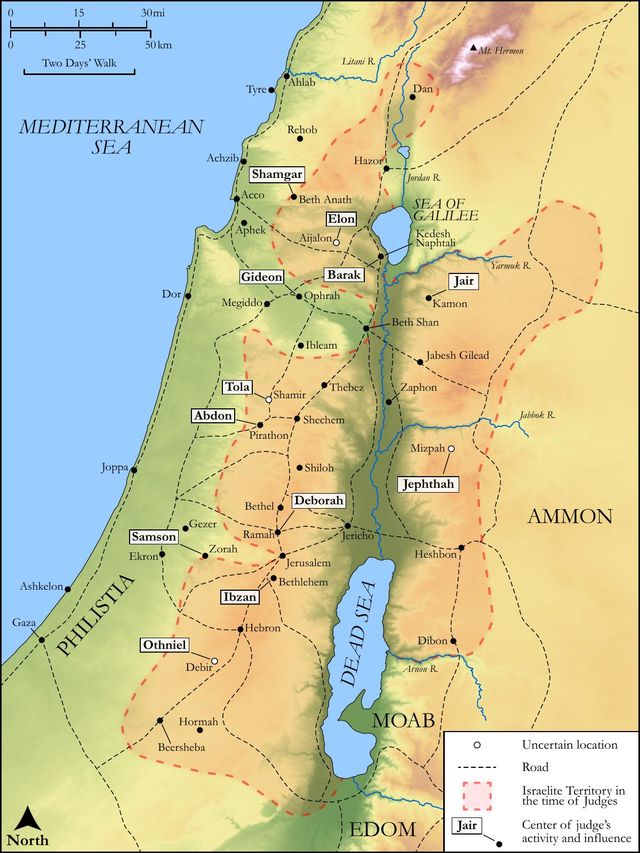
See on the biblical-era map
Study this verse
Public-domain commentary
Matthew Henry
From his Commentary on the Whole Bible. Henry comments on passages, not single verses — this entry covers Judges 2:6–23. His three-level outline is real structure in the source text, so it is rendered as structure.
The beginning of this paragraph is only a repetition of what account we had before of the people's good character during the government of Joshua, and of his death and burial (Jos 24:29, Jos 24:30), which comes in here again only to make way for the following account, which this chapter gives, of their degeneracy and apostasy. The angel had foretold that the Canaanites and their idols would be a snare to Israel; now the historian undertakes to show that they were so, and, that this may appear the more clear, he looks back a little, and takes notice, 1. Of their happy settlement in the land of Canaan. Joshua, having distributed this land among them, dismissed them to the quiet and comfortable possession of it (Jdg 2:6): He sent them away, not only every tribe, but every man to his inheritance, no doubt giving them his blessing. 2. Of their continuance in the faith and fear of God's holy name as long as Joshua lived, Jdg 2:7. As they went to their possessions with good resolutions to cleave to God, so they persisted for some time in these good resolutions, as long as they had good rulers that set them good examples, gave them good instructions, and reproved and restrained the corruptions that crept in among them, and as long as they had fresh in remembrance the great things God did for them when he brought them into Canaan: those that had seen these wonders had so much sense as to believe their own eyes, and so much reason as to serve that God who had appeared so gloriously on their behalf; but those that followed, because they had not seen, believed not. 3. Of the death and burial of Joshua, which gave a fatal stroke to the interests of religion among the people, Jdg 2:8, Jdg 2:9. Yet so much sense they had of their obligations to him that they did him honour at his death, and buried him in Timnath-heres; so it is called here, not, as in Joshua, Timnath-serah. Heres signifies the sun, a representation of which, some think, was set upon his sepulchre, and gave name to it, in remembrance of the sun's standing still at his word. So divers of the Jewish writers say; but I much question whether an image of the sun would be allowed to the honour of Joshua at that time, when, by reason of men's general proneness to worship the sun, it would be in danger of being abused to the dishonour of God. 4. Of the rising of a new generation, Jdg 2:10. All that generation in a few years wore off, their good instructions and examples died and were buried with them, and there arose another generation of Israelites who had so little sense of religion, and were in so little care about it, that, notwithstanding all the advantages of their education, one might truly say that they knew not the Lord, knew him not aright, knew him not as he had revealed himself, else they would not have forsaken him. They were so entirely devoted to the world, so intent upon the business of it or so indulgent of the flesh in ease and luxury, that they never minded the true God and his holy religion, and so were easily drawn aside to false gods and their abominable superstitions.
And so he comes to give us a general idea of the series of things in Israel during the time of the judges, the same repeated in the same order.
I.The people of Israel forsook the God of Israel, and gave that worship and honour to the dunghill deities of the Canaanites which was due to him alone. Be astonished, O heavens! at this, and wonder, O earth! Hath a nation, such a nation, so well fed, so well taught, changed its God, such a God, a God of infinite power, unspotted purity, inexhaustible goodness, and so very jealous of a competitor, for stocks and stones that could do neither good nor evil? Jer 2:11, Jer 2:12. Never was there such an instance of folly, ingratitude, and perfidiousness. Observe how it is described here, Jdg 2:11-13. In general, they did evil, nothing could be more evil, that is, more provoking to God, nor more prejudicial to themselves, and it was in the sight of the Lord; all evil is before him, but he takes special notice of the sin of having any other god. In particular,
1.They forsook the Lord (Jdg 2:12, and again Jdg 2:13); this was one of the two great evils they were guilty of, Jer 2:13. They had been joined to the Lord in covenant, but now they forsook him, as a wife treacherously departs from her husband. "They forsook the worship of the Lord," so the Chaldee: for those that forsake the worship of God do in effect forsake God himself. It aggravated this that he was the God of their fathers, so that they were born in his house, and therefore bound to serve him; and that he brought them out of the land of Egypt, he loosed their bonds, and upon that account also they were obliged to serve him.
2.When they forsook the only true God they did not turn atheists, nor were they such fools as to say, There is no God; but they followed other gods: so much remained of pure nature as to own a God, yet so much appeared of corrupt nature as to multiply gods, and take up with any, and to follow the fashion, not the rule, in religious worship. Israel had the honour of being a peculiar people and dignified above all others, and yet so false were they to their own privileges that they were fond of the gods of the people that were round about them. Baal and Ashtaroth, he-gods and she-gods; they made their court to sun and moon, Jupiter and Juno. Baalim signifies lords, and Ashtaroth blessed ones, both plural, for when they forsook Jehovah, who is one, they had gods many and lords many, as a luxuriant fancy pleased to multiply them. Whatever they took for their gods, they served them and bowed down to them, gave honour to them and begged favours from them.
II.The God of Israel was hereby provoked to anger, and delivered them up into the hand of their enemies, Jdg 2:14, Jdg 2:15.
He was wroth with them, for he is a jealous God and true to the honour of his own name; and the way he took to punish them for their apostasy was to make those their tormentors whom they yielded to as their tempters. They made themselves as mean and miserable by forsaking God as they would have been great and happy if they had continued faithful to him.
1.The scale of victory turned against them. After they forsook God, whenever they took the sword in hand they were as sure to be beaten as before they had been sure to conquer. Formerly their enemies could not stand before them, but, wherever they went, the hand of the Lord was for them; when they began to cool in their religion, God suspended his favour, stopped the progress of their successes, and would not drive out their enemies any more (Jdg 2:3), only suffered them to keep their ground; but now, when they had quite revolted to idolatry, the war turned directly against them, and they could not any longer stand before their enemies. God would rather give the success to those that had never known nor owned him than to those that had done both, but had now deserted him. Wherever they went, they might perceive that God himself had turned to be their enemy, and fought against them, Isa 63:10.
2.The balance of power then turned against them of course. Whoever would might spoil them, whoever would might oppress them. God sold them into the hands of their enemies; not only he delivered them up freely, as we do that which we have sold, but he did it upon a valuable consideration, that he might get himself honour as a jealous God, who would not spare even his own peculiar people when they provoked him. He sold them as insolvent debtors are sold (Mat 18:25), by their sufferings to make some sort of reparation to his glory for the injury it sustained by their apostasy. Observe how their punishment,
(1.)Answered what they had done. They served the gods of the nations that were round about them, even the meanest, and God made then serve the princes of the nations that were round about them, even the meanest. He that is company for every fool is justly made a fool of by every company.
(2.)How it answered what God has spoken. The hand of heaven was thus turned against them, as the Lord had said, and as the Lord had sworn (Jdg 2:15), referring to the curse and death set before them in the covenant, with the blessing and life. Those that have found God true to his promises may thence infer that he will be as true to his threatenings.
III.The God of infinite mercy took pity on them in their distresses, though they had brought themselves into them by their own sin and folly, and wrought deliverance for them. Nevertheless, though their trouble was the punishment of their sin and the accomplishment of God's word, yet they were in process of time saved out of their trouble, Jdg 2:16-18. Here observe,
1.The inducement of their deliverance. It came purely from God's pity and tender compassion; the reason was fetched from within himself. It is not said, It repented them because of their iniquities (for it appears, Jdg 2:17, that many of them continued unreformed), but, It repented the Lord because of their groanings; though it is not so much the burden of sin as the burden of affliction that they are said to groan under. It is true they deserved to perish for ever under his curse, yet, this being the day of his patience and our probation, he does not stir up all his wrath. He might in justice have abandoned them, but he could not for pity do it.
2.The instruments of their deliverance. God did not send angels from heaven to rescue them, nor bring in any foreign power to their aid, but raised up judges from among themselves, as there was occasion, men to whom God gave extraordinary qualifications for, and calls to, that special service for which they were designed, which was to reform and deliver Israel, and whose great attempts he crowned with wonderful success: The Lord was with the judges when he raised them up, and so they became saviours. Observe,
(1.)In the days of the greatest degeneracy and distress of the church there shall be some whom God will either find or make to redress its grievances and set things to rights.
(2.)God must be acknowledged in the seasonable rising up of useful men for public service. He endues men with wisdom and courage, gives them hearts to act and venture. All that are in any way the blessings of their country must be looked upon as the gifts of God.
(3.)Whom God calls he will own, and give them his presence; whom he raises up he will be with.
(4.)The judges of a land are its saviours.
IV.The degenerate Israelites were not effectually and thoroughly reformed, no, not by their judges, Jdg 2:17-19.
1.Even while their judges were with them, and active in the work of reformation, there were those that would not hearken to their judges, but at that very time went a whoring after other gods, so mad were they upon their idols, and so obstinately bent to backslide. They had been espoused to God, but broke the marriage-covenant, and went a whoring after these gods. Idolatry is spiritual adultery, so vile, and base, and perfidious a thing is it, and so hardly are those reclaimed that are addicted to it.
2.Those that in the times of reformation began to amend yet turned quickly out of the way again, and became as bad as ever. The way they turned out of was that which their godly ancestors walked in, and set them out in; but they soon started from under the influence both of their fathers' good example and of their own good education. The wicked children of godly parents do so, and will therefore have a great deal to answer for. However, when the judge was dead, they looked upon the dam which checked the stream of their idolatry as removed, and then it flowed down again with so much the more fury, and the next age seemed to be rather the worse for the attempts that had been made towards reformation, Jdg 2:19. They corrupted themselves more than their fathers, strove to outdo them in multiplying strange gods and inventing profane and impious rites of worship, as it were in contradiction to their reformers. They ceased not from, or, as the word is, they would not let fall, any of their own doings, grew not ashamed of those idolatrous services that were most odious nor weary of those that were most barbarous, would not so much as diminish one step of their hard and stubborn way. Thus those that have forsaken the good ways of God, which they have once known and professed, commonly grow most daring and desperate in sin, and have their hearts most hardened.
V.God's just resolution hereupon was still to continue the rod over them,
1.Their sin was sparing the Canaanites, and this in contempt and violation of the covenant God had made with them and the commands he had given them, Jdg 2:20.
2.Their punishment was that the Canaanites were spared, and so they were beaten with their own rod. They were not all delivered into the hand of Joshua while he lived, Jdg 2:23. Our Lord Jesus, though he spoiled principalities and powers, yet did not complete his victory at first. We see not yet all things put under him; there are remains of Satan's interest in the church, as there were of the Canaanites in the land; but our Joshua lives for ever, and will in the great day perfect his conquest. After Joshua's death, little was done for a long time against the Canaanites: Israel indulged them, and grew familiar with them, and therefore God would not drive them out any more, Jdg 2:21. If they will have such inmates as these among them, let them take them, and see what will come of it. God chose their delusions, Isa 66:4. Thus men cherish and indulge their own corrupt appetites and passions, and, instead of mortifying them, make provision for them, and therefore God justly leaves them to themselves under the power of their sins, which will be their ruin. So shall their doom be; they themselves have decided it. These remnants of the Canaanites were left to prove Israel (Jdg 2:22), whether they would keep the way of the Lord or not; not that God might know them, but that they might know themselves. It was to try,
(1.)Whether they could resist the temptations to idolatry which the Canaanites would lay before them. God had told them they could not, Deu 7:4. But they thought they could. "Well," said God, "I will try you;" and, upon trial, it was found that the tempters' charms were far too strong for them. God has told us how deceitful and desperately wicked our hearts are, but we are not willing to believe it till by making bold with temptation we find it too true by sad experience.
(2.)Whether they would make a good use of the vexations which the remaining natives would give them, and the many troubles they would occasion them, and would thereby be convinced of sin and humbled for it, reformed, and driven to God and their duty, whether by continual alarms from them they would be kept in awe and made afraid of provoking God.
Historical interpretation
Historical reception
1 surviving comment on this verse from the historical church.
It was the ancients who did this, of course, but because what was written is said to be “written for our sake, to whom the end of the ages has arrived,” not on their account, we should watch lest these sayings are seen to be true of more of us than of them. Do you want to see that such things are applied to us through the apostle, rather than through me? Listen for yourself to what he said: “What does Scripture say about how Elijah interceded with God against Israel? ‘Lord, they killed your prophets, they destroyed your altars, and I am left alone and they seek my soul.’ But what was the divine response? ‘I preserved for myself seven thousand men who did not bend the knee to Baal,’ ” then the apostle adds “ ‘thus, in this time also a remnant chosen by grace is saved,’ ” You can see, therefore, that those who “bent the knee to Baal” and those who “did not bend the knee” are understood by the apostle as the multitude of unbelievers and the remnant of believers, respectively. This demonstrates, then, that those who lived in unbelief and impiety at the time of the Savior also “bent the knee to Baal” and worshiped idols, whereas those who believed and fulfilled the works of faith “did not bend the knee to Baal.” It is never mentioned in the historical books or in the Gospels or in any other book of Scripture that some at the time of the Savior did in fact bend the knee to idols, but such an act is indeed attributed to those persons who were bound by their sins, as though held by fetters. Whenever we sin and “are taken captive to the law of sin,” therefore, we “bend our knees to Baal.” But we are not called to this, nor do we believe in this, such that we would again become servants of sin and again “bend the knee” to the devil. Instead, our calling and the purpose of our faith is both to bend the knee at the name of Jesus, for “at the name of Jesus, every knee bends in heaven and on earth and in hell,” and to bend the knee to “the Father of our Lord Jesus Christ, from whom every family in heaven and on earth is named.”
Continue studying Judges 2:11 across the web’s major study libraries — every link below opens this exact verse, chapter, or book on the destination site.
Read & Compare
 BibleGatewayThis verse in more than 200 translations and 70 languages.
 Bible.comThe YouVersion reader — hundreds of translations, reading plans, and highlights.
 ESV.orgCrossway's official English Standard Version reader.
 NET BibleThe NET translation with 60,000+ translators' notes on every rendering decision.
 STEP BibleTyndale House's free study tool — original text, vocabulary, and scholarly resources.
 BibliaLogos Bible Software's free web reader.
 USCCBThe New American Bible (Revised Edition) with the U.S. bishops' study notes.
Commentaries
 BibleHub CommentariesDozens of classic commentaries on this verse, gathered on one page.
 StudyLightMore than 100 commentary sets — the largest collection on the web.
 BibleRefPlain-English commentary on what this verse means, verse by verse.
 Enduring WordDavid Guzik's free commentary on this chapter, widely used by Bible teachers.
 Bible Study ToolsVerse commentary alongside Greek and Hebrew study aids.
Original Language & Research
- BibleHub InterlinearThe verse word by word — original language, transliteration, and English.
- BibleHub LexiconEvery word's original-language definition and Strong's entry.
 Blue Letter BibleDeep-study tools — Strong's numbers, concordance, and word studies.
 SefariaThe Hebrew text with Rashi and centuries of Jewish commentary.
Sermons, Hymns & Audio


TrulyRandomVerse is not affiliated with these sites and doesn’t control their content. They’re linked because they’re genuinely useful.
Summary
Judges 2:11 serves as a tragic and pivotal declaration of Israel's profound spiritual decline following the generation of Joshua. It concisely states that the "children of Israel did evil in the sight of the LORD" by abandoning their covenant God, Yahweh, and instead devoted themselves to the worship of "Baalim." This verse is foundational, establishing the pattern of apostasy, divine judgment, and subsequent oppression that characterizes the entire Book of Judges, revealing the deep-seated spiritual instability and unfaithfulness of God's chosen people.
Context
ShowHideLiterary Context
Judges 2:11 acts as the stark theological introduction to the recurring cycle of sin, judgment, and deliverance that defines the Book of Judges. It immediately follows the somber account of the death of Joshua and the elders who had personally witnessed God's mighty acts of deliverance and conquest, as detailed in Judges 2:6-10. The preceding verses lament the rise of a new generation that "knew not the LORD, nor yet the works which he had done for Israel" (Judges 2:10). Thus, this verse is not an isolated incident but the direct, inevitable consequence of that spiritual amnesia and covenant neglect, setting the stage for the subsequent divine discipline and the need for God to raise up judges.
Historical & Cultural Context
The period of the Judges, roughly spanning from 1200 to 1000 BC, was a tumultuous and transitional era for Israel, situated between the unified conquest under Joshua and the establishment of the monarchy. Having settled in the land of Canaan, the Israelites found themselves living amidst the indigenous Canaanite populations, who practiced a polytheistic religion centered on fertility cults. While El was a chief deity, the most active and popular god was Baal, a storm and fertility god believed to control rain, crops, and livestock. Worship of Baal often involved morally reprehensible practices such as ritual prostitution, the erection of sacred poles (Asherah), and even child sacrifice, all of which were explicitly forbidden by Yahweh's law (e.g., Deuteronomy 12:31). The temptation for Israel to adopt these practices was immense, as they promised immediate agricultural prosperity, a stark contrast to Yahweh's covenant blessings which were contingent upon their faithful obedience.
Key Themes
ShowHideThis pivotal verse immediately introduces and establishes the central themes that will reverberate throughout the Book of Judges: apostasy, idolatry, and covenant disobedience. The phrase "did evil in the sight of the LORD" becomes a recurring theological judgment that underscores Israel's persistent failure to uphold their covenant obligations to Yahweh, particularly the foundational first commandment to have no other gods before Him (Exodus 20:3). Their act of "serving Baalim" represents a profound spiritual rebellion and a deliberate turning away from the one true God who had miraculously delivered them from Egyptian bondage (Exodus 14). This act of idolatry is the direct catalyst for the "cycle of Judges"—Israel's sin leads to divine judgment (oppression by foreign nations), which prompts their desperate cry for deliverance, followed by God raising a judge to save them, leading to a period of peace, only for the cycle of unfaithfulness to inevitably repeat.
Exposition and Analysis
ShowHideKey Word Analysis
ShowHideThis term signifies not merely a general moral wrongdoing but that which is inherently displeasing, offensive, or abhorrent in God's eyes. It encompasses actions that are directly contrary to God's revealed will, His holy character, and the terms of His covenant. In the context of Judges, its primary reference is to idolatry and the abandonment of exclusive devotion to Yahweh.
A primitive root meaning "to work" in any sense; by implication, "to serve," "till," or "enslave." In this context, it denotes active worship, devotion, and allegiance, indicating a full and committed submission to these pagan deities. It implies a transfer of loyalty from Yahweh to the Baalim.
The plural form of "Baal," meaning "lord" or "master." While "Baal" could refer to any local deity or even a human master, here it specifically denotes the various manifestations of the Canaanite storm and fertility god. The use of the plural "Baalim" indicates the widespread nature of this idolatry, embracing multiple local Baals worshipped across different regions and cultic sites, rather than a single, unified cult.
Verse Breakdown
ShowHide"And the children of Israel did evil in the sight of the LORD"
This opening clause establishes the central theological conflict and the primary indictment against Israel. "Did evil" (Hebrew, ʻâsâh raʻ) signifies a deliberate action that is morally and spiritually wrong, a violation of God's covenant. "In the sight of the LORD" emphasizes that this is a divine judgment, not a human assessment, underscoring God's perfect knowledge and righteous indignation at their transgression. It signals a departure from the righteous path laid out in the Torah.
"and served Baalim"
This second clause specifies the nature of their evil: idolatry. The verb "served" (Hebrew, ʻâbad) implies active worship, devotion, and allegiance, indicating a full commitment to these pagan deities. By serving Baalim, the Israelites were not merely adding other gods to their worship of Yahweh (syncretism) but were actively replacing Him as the object of their trust and devotion, seeking prosperity and security from false gods rather than relying on the covenant promises of the one true God.
Literary Devices
ShowHideJudges 2:11 employs several significant literary devices that amplify its theological impact. The phrase "did evil in the sight of the LORD" functions as a leitmotif or recurring phrase throughout the Book of Judges, signaling the initiation of the cyclical pattern of sin and judgment that will dominate the narrative. This repetition emphasizes the persistent and cyclical nature of Israel's unfaithfulness. The mention of "Baalim" serves as a powerful symbol of Israel's spiritual adultery; it is not just a reference to pagan gods but represents the allure of worldly systems, the rejection of exclusive devotion to Yahweh, and the breaking of the covenant. The verse also utilizes foreshadowing, as it succinctly sets the stage for the entire narrative arc of the book, predicting the cycles of oppression and deliverance that will inevitably follow as a direct consequence of this initial act of apostasy.
Theological and Thematic Connections
ShowHideJudges 2:11 is foundational for understanding the theological message of the entire Book of Judges, powerfully illustrating the severe consequences of covenant unfaithfulness. It highlights the absolute necessity of exclusive worship of Yahweh and the profound dangers of spiritual syncretism, where the worship of the true God is mixed with pagan practices. The Israelites' turning to Baalim underscores humanity's inherent tendency towards idolatry, seeking security, prosperity, and identity from created things rather than from the Creator. This verse also introduces the theme of divine discipline, where God, in His faithfulness to His covenant, allows external oppression as a painful but necessary means of bringing His people to repentance and restoring their relationship with Him, even when His people are unfaithful.
Reflection and Application
ShowHideJudges 2:11 stands as a timeless and potent warning against spiritual compromise and the insidious nature of cultural assimilation that can gradually erode genuine faith. Just as the Israelites were tempted by the seemingly pragmatic appeal of Canaanite gods for agricultural prosperity and social integration, believers today face constant pressure to conform to worldly values and pursue "modern idols" such as wealth, status, worldly pleasures, or even political ideologies, which promise fulfillment and security apart from God. This verse compels us to humbly examine our own hearts and lives, asking what or whom we truly serve with our time, resources, and affections. It underscores the critical importance of cultivating a deep, personal, and experiential knowledge of God and His works, lest we, like the generation after Joshua, drift into spiritual apathy, compromise, and ultimately, idolatry. Our exclusive devotion to God is not merely a legalistic commandment but the very path to true life, lasting blessing, and authentic freedom.
Questions for Reflection
ShowHideFAQ
ShowHideWhat does "did evil in the sight of the LORD" truly mean in this context?
ShowHideIn the biblical narrative, "doing evil in the sight of the LORD" is a profound theological statement indicating a direct, intentional, and often rebellious violation of God's covenant commands and His holy character. It is not merely a moral failing but an act of spiritual rebellion and defiance against the divine will. In Judges 2:11, and consistently throughout the Book of Judges, this phrase primarily refers to Israel's abandonment of Yahweh worship and their turning to idolatry, specifically the worship of Canaanite deities like Baalim. This act was a fundamental breach of the very first commandment given at Sinai, "You shall have no other gods before me" (Exodus 20:3), and it provoked God's righteous anger and judgment, leading to the cycles of oppression described in the book.
Why was serving "Baalim" so problematic for the Israelites?
ShowHideServing Baalim was profoundly problematic for several critical reasons, striking at the heart of Israel's identity and covenant relationship with God. First, it was a direct violation of their exclusive covenant with Yahweh, who had delivered them from slavery in Egypt and established a unique, intimate relationship with them, demanding their singular devotion (Deuteronomy 6:4-5). Second, the worship of Baalim involved practices that were morally abhorrent and detestable to God, including ritual prostitution, cultic orgies, and even child sacrifice (Leviticus 18:21 and Deuteronomy 12:31). Third, it represented a fundamental distrust in God's provision and sovereignty; the Israelites turned to fertility gods for rain and crops instead of trusting the Lord who promised to bless their land if they obeyed Him (Deuteronomy 28:12). This spiritual syncretism undermined their identity as God's chosen people, led to moral decay, and ultimately resulted in divine judgment and oppression.
Christ-Centered Fulfillment
ShowHideJudges 2:11, with its stark depiction of Israel's persistent spiritual failure and descent into idolatry, powerfully underscores humanity's desperate need for a perfect deliverer and a new, unbreakable covenant. The recurring cycle of sin, divine judgment, and temporary deliverance by flawed judges throughout the Book of Judges vividly reveals the inadequacy of human leadership and the persistent unfaithfulness of God's people under the Old Covenant. This broken cycle finds its ultimate resolution and definitive fulfillment in Jesus Christ. Unlike the judges who could only offer temporary respite from external oppression, Jesus is the perfect and eternal Judge and Deliverer, who not only rescues His people from external enemies but from the very power and penalty of sin itself. He is the true Lamb of God who takes away the sin of the world, offering a definitive and perfect sacrifice that permanently deals with the "evil in the sight of the LORD" that plagued Israel. Through His atoning work, believers are brought into a New Covenant, where the law is written not on stone tablets but on their hearts (Jeremiah 31:33), and the Holy Spirit empowers them to live in true devotion to God, freeing them from the bondage of idolatry and the endless cycle of sin and judgment that marked the era of the judges (Romans 8:2-4). He is the true King, unlike the flawed and temporary judges, who establishes an eternal kingdom of righteousness and peace (Luke 1:33).