


Judges 13:1
Bible text: King James Version (1769 Blayney text) · Public domain
Bible text: King James Version with Strong's numbers · Public domain
Bible text: Berean Standard Bible · Public domain
Bible text: American Standard Version (1901) · Public domain
Bible text: World English Bible, Messianic edition · Public domain
Bible text: Geneva Bible (1599) · Public domain
Bible text: Young's Literal Translation · Public domain
- וַיֹּסִפוּvai·yo·Si·fuand they repeatedH3254Conj-w ¦ V-Hiphil-ConsecImperf-3mpVerb Hiphil Consecutive Imperfect 3rd Plural Masculineוַandיֹּסִפוּthey repeated
- בְּנֵיbe·Nei[the] people ofH1121N-mpcNoun Plural Masculine Construct
- יִשְׂרָאֵלYis·ra·'ElIsraelH3478N-properNoun Proper Location
- לַעֲשׂוֹתla·'a·Sotto doH6213Prep-l ¦ V-Qal-InfVerb Qal Infinitive Constructלַtoעֲשׂוֹתdo
- הָרַעha·Ra'the evilH7451Art ¦ Adj-msAdjective Singular Masculine Absoluteהָtheרַעevil
- בְּעֵינֵיbe·'ei·Neiin [the] eyes ofH5869Prep-b ¦ N-fdcNoun Dual Feminine Constructבְּinעֵינֵי[the] eyes of
- יְהוָהYah·wehYahwehH3068N-properNoun Proper Title
- וַיִּתְּנֵםvai·yi·te·Nemand he gave themH5414Conj-w ¦ V-Qal-ConsecImperf-3ms ¦ 3mpVerb Qal Consecutive Imperfect 3rd Singular Masculineוַandיִּתְּנֵhe gaveםthem
- יְהוָהYah·wehYahwehH3068N-properNoun Proper Title
- בְּיַדbe·yadin [the] hand ofH3027Prep-b ¦ N-cscNoun Singular common gender Constructבְּinיַד[the] hand of
- פְּלִשְׁתִּיםpe·lish·Tim[the] PhilistinesH6430N-mpNoun Gentilic Plural Masculine Absolute
- אַרְבָּעִים'ar·ba·'ImfortyH705N-mpNoun Plural Masculine Absolute
- שָׁנָהsha·Nahyear[s]H8141N-fsNoun Singular Feminine Absolute
English is a literal word-by-word gloss of the Hebrew, not the KJV's wording. Why?
This is the original text the KJV's translators worked from — each Hebrew word with its own literal English meaning in this verse, prepared by scholars at Tyndale House, Cambridge. The KJV translates whole sentences, not word by word, so its wording differs: one Hebrew word can become several English words, and the KJV may choose “the LORD” where the gloss reads “Yahweh”. Both are faithful — they answer different questions. For the KJV's own rendering, switch to the KJV text.
Details
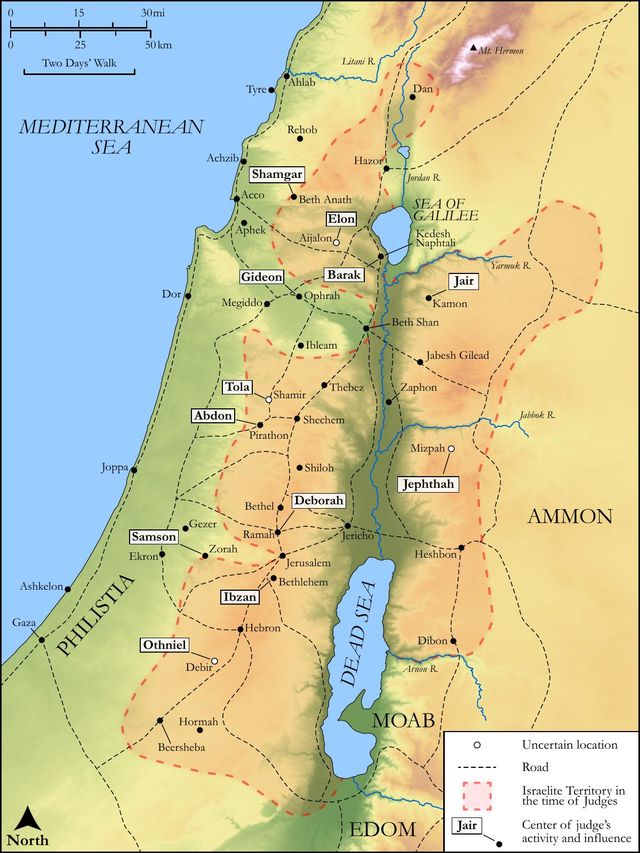
See on the biblical-era maps
Study this verse
Public-domain commentary
Matthew Henry
From his Commentary on the Whole Bible. Henry comments on passages, not single verses — this entry covers Judges 13:1–7. His two-level outline is real structure in the source text, so it is rendered as structure.
The first verse gives us a short account, such as we have too often met with already, of the great distress that Israel was in, which gave occasion for the raising up of a deliverer. They did evil, as they had done, in the sight of the Lord, and then God delivered them, as he had done, into the hands of their enemies. If there had been no sin, there would have needed no Saviour; but sin was suffered to abound, that grace might much more abound. The enemies God now sold them to were the Philistines, their next neighbours, that lay among them, the first and chief of the nations which were devoted to destruction, but which God left to prove them (Jdg 3:1, Jdg 3:3), the five lords of the Philistines, an inconsiderable people in comparison with Israel (they had but five cities of any note), and yet, when God made use of them as the staff in his hand, they were very oppressive and vexatious. And this trouble lasted longer than any yet: it continued forty years, though probably not always alike violent. When Israel was in this distress Samson was born; and here we have his birth foretold by an angel. Observe,
I.His extraction.
He was of the tribe of Dan, Jdg 13:2. Dan signifies a judge or judgment, Gen 30:6. And probably it was with an eye to Samson that dying Jacob foretold, Dan shall judge his people, that is, "he shall produce a judge for his people, though one of the sons of the handmaids, as one, as well as any one, of the tribes of Israel," Gen 49:16. The lot of the tribe of Dan lay next to the country of the Philistines, and therefore one of that tribe was most fit to be made a bridle upon them. His parents had been long childless. Many eminent persons were born of mothers that had been kept a great while in the want of the blessing of children, as Isaac, Joseph, Samuel, and John Baptist, that the mercy might be the more acceptable when it did come. Sing, O barren! thou that didst not bear, Isa 54:1. Note, Mercies long waited for often prove signal mercies, and it is made to appear that they were worth waiting for, and by them others may be encouraged to continue their hope in God's mercy.
II.The glad tidings brought to his mother, that she should have a son.
The messenger was an angel of the Lord (Jdg 13:3), yet appearing as a man, with the aspect and garb of a prophet, or man of God. And this angel (as the learned bishop Patrick supposes, on Jdg 13:18) was the Lord himself, that is, the Word of the Lord, who was to be the Messiah, for his name is called Wonderful, Jdg 13:18, and Jehovah, Jdg 13:19. The great Redeemer did in a particular manner concern himself about this typical redeemer. It was not so much for the sake of Manoah and his wife, obscure Danites, that this extraordinary message was sent, but for Israel's sake, whose deliverer he was to be, and not only so (his services to Israel not seeming to answer to the grandeur of his entry) but for the Messiah's sake, whose type he was to be, and whose birth must be foretold by an angel, as his was. The angel, in the message he delivers, 1. Takes notice of her affliction: Behold now, thou art barren and bearest not. Hence she might gather he was a prophet, that though a stranger to her, and one she had never seen before, yet he knew this to be her grievance. He tells her of it, not to upbraid her with it, but because perhaps at this time she was actually thinking of this affliction and bemoaning herself as one written childless. God often sends in comfort to his people very seasonably, when they feel most from their troubles. "Now thou art barren, but thou shalt not be always so," as she feared, "nor long so." 2. He assures her that she should conceive and bear a son (Jdg 13:3) and repeats the assurance, Jdg 13:5. To show the power of a divine word, the strongest man that ever was was a child of promise, as Isaac, born by force and virtue of a promise, and faith in that promise, Heb 11:11; Gal 4:23. Many a woman, after having been long barren, has borne a son by providence, but Samson was by promise, because a figure of the promised seed, so long expected by the faith of the Old Testament saints, 3. He appoints that the child should be a Nazarite from his birth, and therefore that the mother should be subject to the law of the Nazarites (though not under the vow of a Nazarite) and should drink no wine or strong drink so long as this child was to have its nourishment from her, either in the womb or at the breast, Jdg 13:4, Jdg 13:5. Observe, This deliverer of Israel must be in the strictest manner devoted to God and an example of holiness. It is spoken of as a kindness to the people that God raised up of their young men for Nazarites, Amo 2:11. Other judges had corrected their apostasies from God, but Samson must appear as one, more than any of them, consecrated to God; and, notwithstanding what we read of his faults, we have reason to think that being a Nazarite of God's making he did, in the course of his conversation, exemplify, not only the ceremony, but the substance of that separation to the Lord in which the Nazariteship did consist, Num 6:2. Those that would save others must by singular piety distinguish themselves. Samuel, who carried on Israel's deliverance from the Philistines, was a Nazarite by his mother's vow (Sa1 1:11), as Samson by the divine appointment. The mother of this deliverer must therefore deny herself, and not eat any unclean thing; what was lawful at another time was now to be forborne. As the promise tried her faith, so this precept tried her obedience; for God requires both from those on whom he will bestow his favours. Women with child ought conscientiously to avoid whatever they have reason to think will be any way prejudicial to the health or good constitution of the fruit of their body. And perhaps Samson's mother was to refrain from wine and strong drink, not only because he was designed for a Nazarite, but because he was designed for a man of great strength, which his mother's temperance would contribute to. 4. He foretels the service which this child should do to his country: He shall begin to deliver Israel. Note, It is very desirable that our children may be not only devoted entirely to God themselves, but instrumental for the good of others, and the service of their generation - not recluses, candles under a bushel, but on a candlestick. Observe, He shall begin to deliver Israel. This intimated that the oppression of the Philistines should last long, for Israel's deliverance from it should not so much as begin, not one step be taken towards it, till this child, who was now unborn, should have grown up to a capacity of beginning it. And yet he must not complete the deliverance: he shall only begin to deliver Israel, which intimates that the trouble should still be prolonged. God chooses to carry on his work gradually and by several hands. One lays the foundation of a good work, another builds, and perhaps a third brings forth the top stone. Now herein Samson was a type of Christ, (1.) As a Nazarite to God, a Nazarite from the womb. For, though our Lord Jesus was not a Nazarite himself, yet he was typified by the Nazarites, as being perfectly pure from all sin, not so much as conceived in it, and entirely devoted to his Father's honour. Of the Jewish church, as concerning the flesh, Christ came, because to them pertained the promise of him, Rom 9:4, Rom 9:5. By virtue of that promise,. he long lay as it were in the womb of that church, which for many ages was pregnant of him, and therefore, like Samson's mother, during that pregnancy was made a holy nation and a peculiar people, and strictly forbidden to touch any unclean thing for his sake, who in the fulness of time was to come from them. (2.) As a deliverer of Israel; for he is Jesus a Saviour, who saves his people from their sins. But with this difference: Samson did only begin to deliver Israel (David was afterwards raised up to complete the destruction of the Philistines), but our Lord Jesus is both Samson and David too, both the author and finisher of our faith.
III.The report which Manoah's wife, in a transport of joy, brings in all haste to her husband, of this surprising message Jdg 13:6, Jdg 13:7.
The glad tidings were brought her when she was alone, perhaps religiously employed in meditation or prayer; but she could not, she would not, conceal them from her husband, but gives him an account,
1.Of the messenger. It was a man of God, Jdg 13:6. His countenance she could describe; it was very awful: he had such a majesty in his looks, such a sparkling eye, such a shining face, so powerfully commanding reverence and respect, that according to the idea she had of an angel he had the very countenance of one. But his name she can give no account of, nor to what tribe or city of Israel he belonged, for he did not think fit to tell her, and, for her part, the very sight of him struck such an awe upon her that she durst not ask him. She was abundantly satisfied that he was a servant of God; his person and message she thought carried their own evidence along with them, and she enquired no further.
2.Of the message. She gives him a particular account both of the promise and of the precept (Jdg 13:7), that he also might believe the promise and might on all occasions be a monitor to her to observe the precept. Thus should yoke-fellows communicate to each other their experiences of communion with God, and their improvements in acquaintance with him, that they may be helpful to each other in the way that is called holy.
Historical interpretation
Historical reception
1 surviving comment on this verse from the historical church.
The Philistines for many years kept the Hebrew people in subjection; for they had lost the prerogative of faith, whereby their fathers had gained victories. Yet had not their Maker wholly blotted out the mark of their election nor the lot of their inheritance; but as they were often puffed up by success, He for the most part delivered them into the hand of their enemies, that thus, after the manner of men, they might be led to seek for themselves the remedy of their evils from heaven. For it is when any adversity oppresses us, that we submit ourselves to God; good fortune is wont to puff up the mind. This is proved by experience, as in other instances, so particularly in that change of fortune whereby success returned again from the Philistines to the Hebrews.
Continue studying Judges 13:1 across the web’s major study libraries — every link below opens this exact verse, chapter, or book on the destination site.
Read & Compare
 BibleGatewayThis verse in more than 200 translations and 70 languages.
 Bible.comThe YouVersion reader — hundreds of translations, reading plans, and highlights.
 ESV.orgCrossway's official English Standard Version reader.
 NET BibleThe NET translation with 60,000+ translators' notes on every rendering decision.
 STEP BibleTyndale House's free study tool — original text, vocabulary, and scholarly resources.
 BibliaLogos Bible Software's free web reader.
 USCCBThe New American Bible (Revised Edition) with the U.S. bishops' study notes.
Commentaries
 BibleHub CommentariesDozens of classic commentaries on this verse, gathered on one page.
 StudyLightMore than 100 commentary sets — the largest collection on the web.
 BibleRefPlain-English commentary on what this verse means, verse by verse.
 Enduring WordDavid Guzik's free commentary on this chapter, widely used by Bible teachers.
 Bible Study ToolsVerse commentary alongside Greek and Hebrew study aids.
Original Language & Research
- BibleHub InterlinearThe verse word by word — original language, transliteration, and English.
- BibleHub LexiconEvery word's original-language definition and Strong's entry.
 Blue Letter BibleDeep-study tools — Strong's numbers, concordance, and word studies.
 SefariaThe Hebrew text with Rashi and centuries of Jewish commentary.
Sermons, Hymns & Audio


TrulyRandomVerse is not affiliated with these sites and doesn’t control their content. They’re linked because they’re genuinely useful.
Summary
Judges 13:1 introduces the final and most prolonged period of oppression in the book of Judges, detailing Israel's renewed spiritual apostasy and God's subsequent judgment by delivering them into the prolonged dominion of the Philistines for forty years. This verse encapsulates the tragic, recurring cycle of disobedience, divine discipline, and suffering that characterizes the era, setting the dire stage for the miraculous birth and complex, often flawed, ministry of Samson, who emerges as a divinely appointed, yet humanly imperfect, deliverer.
Context
ShowHideLiterary Context
Judges 13:1 functions as a pivotal narrative hinge, initiating the final major cycle of Israel's apostasy and divine judgment, culminating in the story of Samson. This verse immediately follows the brief accounts of minor judges, Jephthah, Ibzan, Elon, and Abdon, who provided temporary periods of respite. The phrase "did evil again" directly echoes the recurring theological framework established early in the book, particularly in Judges 2:11-19, which outlines Israel's cyclical pattern of forgetting God, serving idols, suffering under oppressors, crying out to the LORD, and receiving a deliverer. The introduction of the Philistines and the specified "forty years" of oppression signals a new, more formidable, and deeply entrenched subjugation, setting the dramatic backdrop for the birth narrative of Samson and his subsequent, often ambiguous, role as a deliverer against this powerful enemy.
Historical & Cultural Context
By the time of the Judges, the Philistines were a dominant power in the southwestern coastal plain of Canaan, having migrated from the Aegean region (likely Crete). They were part of the "Sea Peoples" who settled in the Pentapolis (Gaza, Ashkelon, Ashdod, Gath, Ekron). Crucially, the Philistines possessed superior military technology, particularly iron weaponry and chariots, which gave them a significant advantage over the bronze-age Israelite tribes. Their polytheistic religion, centered on deities such as Dagon and Baal-zebub, was a constant spiritual lure and threat to Israel's covenant with Yahweh. The "forty years" of oppression mentioned in the verse indicates not merely sporadic raids but a deeply entrenched and pervasive Philistine control, encompassing political, economic, and military subjugation that would have profoundly impacted Israelite life, worship, and national identity, forcing them into a prolonged state of dependence and fear.
Key Themes
ShowHideThis opening verse powerfully reinforces several overarching themes central to the book of Judges and the broader Old Testament narrative. Foremost is the Cycle of Disobedience and Divine Discipline, as Israel's repeated "evil" directly provokes God's righteous response of "delivering them into the hand" of their enemies, a pattern consistently observed throughout the book (e.g., Judges 3:7-8 and Judges 6:1). It also highlights God's Sovereignty and Active Involvement in Israel's history; He is not a passive observer but actively orchestrates circumstances, using foreign nations as instruments of His righteous judgment and, ultimately, as catalysts for repentance. The introduction of the Philistines as a major, long-term oppressor foreshadows the ongoing conflict that would define the early monarchy, particularly during the time of Saul and David (e.g., 1 Samuel 4 and 1 Samuel 17), underscoring Israel's persistent failure to fully dispossess the inhabitants of the land as commanded and their continued desperate need for a true and lasting deliverer.
Exposition and Analysis
ShowHideKey Word Analysis
ShowHideThe Hebrew term raʻ (H7451) denotes something bad or evil, encompassing both natural calamity and moral wickedness. In the context of Judges, it consistently refers to Israel's deliberate moral and spiritual deviation from the LORD and His covenant. This "evil" primarily manifested as idolatry—the worship of foreign gods—and syncretism, which was a direct affront to God's holiness and His exclusive claim on Israel's worship. It signifies a profound spiritual rebellion and a betrayal of their covenant relationship.
The word translated "again" comes from the Hebrew root yâçaph (H3254), meaning "to add" or "to augment," often implying a continuation or repetition of an action. When paired with "did evil," it emphasizes the habitual, cumulative, and persistent nature of Israel's disobedience. It's not a one-time lapse but a pattern of adding sin upon sin, highlighting their stubborn refusal to learn from past judgments and deliverances, and deepening their spiritual malaise.
The verb nâthan (H5414) means "to give," "to place," or "to deliver." In this context, it signifies God's active and intentional act of handing over His people into the power of their enemies. This is not a passive allowance but a direct, sovereign act of divine judgment and discipline. It underscores God's control over historical events and His commitment to the covenant, which included both blessings for obedience and consequences for disobedience, demonstrating His faithfulness even in judgment.
Verse Breakdown
ShowHide"And the children of Israel did evil again in the sight of the LORD;"
This opening clause immediately re-establishes the tragic cycle that defines the book of Judges. The phrase "children of Israel" emphasizes their identity as God's covenant people, making their repeated disobedience all the more grievous. "Did evil again" highlights the persistent and deliberate nature of their sin, primarily idolatry and abandonment of the LORD, despite previous experiences of judgment and deliverance. The phrase "in the sight of the LORD" underscores that their sin was not hidden but a direct affront to God's holiness and His covenant relationship with them, demanding a divine response.
"and the LORD delivered them into the hand of the Philistines"
This clause reveals God's active and sovereign response to Israel's rebellion. The LORD, in His justice and faithfulness to His covenant, directly "delivered" or "gave" His people into the power of their enemies. The Philistines, a powerful and technologically advanced people, are identified as the specific instrument of divine discipline. This act of "delivering" serves as a severe corrective measure, designed to humble Israel, expose the futility of their idolatry, and ultimately lead them to repentance, demonstrating that God uses even foreign nations to accomplish His purposes.
"forty years."
This final phrase specifies the duration of the Philistine oppression. The period of "forty years" is significant in biblical narratives, often denoting a long and arduous time of testing, judgment, or preparation. In Judges 13:1, it signifies a complete generation under foreign domination, emphasizing the severity and endurance of God's judgment. This prolonged period of affliction underscores the deep-seated nature of Israel's spiritual problem and sets the stage for the desperate need for a deliverer, which the subsequent narrative of Samson will address.
Literary Devices
ShowHideJudges 13:1 is rich in literary devices that underscore its profound theological message. The most prominent is Repetition, specifically the recurrence of the "cycle of sin" motif that pervades the entire book of Judges. The phrase "did evil again" immediately signals a return to this familiar pattern: apostasy leads to oppression, which leads to a cry for help, followed by a deliverer, and a period of peace, only for the cycle to restart. This repetition serves to highlight Israel's spiritual stubbornness, their persistent failure to learn from history, and the deep-seated nature of their rebellion against God's covenant. Another device is Foreshadowing, as the verse explicitly sets the stage for the entire Samson narrative. The mention of the Philistines and the forty-year oppression creates a dramatic tension and anticipation for the coming deliverer, whose story will unfold against this backdrop of prolonged suffering. Furthermore, there is an element of Divine Irony in God's chosen people repeatedly falling into the very idolatry and moral decay they were meant to eradicate, leading to their subjugation by those they were meant to conquer and dispossess. Finally, the use of the Divine Passive/Active Voice (God "delivered" them) emphasizes God's ultimate sovereignty and control over historical events, even when they involve suffering and judgment, reinforcing His role as the primary actor in Israel's history and the ultimate source of both discipline and deliverance.
Theological and Thematic Connections
ShowHideJudges 13:1 powerfully encapsulates the core theological message of the book of Judges and resonates with broader biblical themes. It underscores the unwavering principle that sin, particularly covenant unfaithfulness and idolatry, inevitably leads to divine judgment and suffering. Yet, even within this judgment, God's steadfastness and commitment to His covenant people are evident; His discipline is not abandonment but a means to call them back to Himself. The "forty years" of oppression highlight the depth of Israel's spiritual sickness and the severity of God's corrective measures, demonstrating that genuine repentance often requires prolonged periods of humbling. This verse also implicitly points to the ongoing need for a true and lasting deliverer, one who can not only rescue from external enemies but also address the internal spiritual brokenness that perpetuates the cycle of sin, foreshadowing a greater salvation to come.
Reflection and Application
ShowHideJudges 13:1 serves as a stark mirror for both individuals and communities today. The phrase "did evil again" should prompt us to honestly examine our own lives for recurring patterns of sin, spiritual apathy, or areas where we repeatedly compromise our faith. Are there "forty-year" cycles of struggle in our lives that stem from unaddressed disobedience or a failure to truly learn from past consequences? This verse reminds us that God's discipline, though painful, is ultimately redemptive. Just as He "delivered" Israel into the hands of their oppressors to bring them to repentance, challenging circumstances in our lives can be divine invitations to return to Him, to re-evaluate our priorities, and to deepen our reliance on His grace. It calls us to break free from the gravitational pull of spiritual complacency and to actively pursue a life of consistent faithfulness, recognizing that true freedom comes not from escaping consequences, but from genuine repentance and a renewed commitment to the LORD.
Questions for Reflection
ShowHideFAQ
ShowHideWhat kind of "evil" did the children of Israel do again?
ShowHideWhile Judges 13:1 does not specify the exact nature of the "evil," the consistent pattern throughout the book of Judges (e.g., Judges 2:11-13) indicates that Israel's primary sin was idolatry—worshipping the gods of the surrounding nations, particularly Baal and Ashtoreth—and forsaking their covenant with the LORD. This often involved syncretism, attempting to blend the worship of Yahweh with pagan practices, which was a direct violation of the first two commandments (Exodus 20:3-5). Their "evil" was a comprehensive spiritual rebellion against their covenant Lord, demonstrating a profound lack of faithfulness.
Why did God "deliver" them into the hand of the Philistines?
ShowHideGod "delivered" them as an act of divine discipline and just judgment, not abandonment. This action was a direct consequence of Israel's repeated and deliberate sin, particularly their idolatry and unfaithfulness to the covenant. God, in His sovereignty and justice, used the Philistines as an instrument to humble His people, to expose the futility of their false gods, and to drive them to repentance and a renewed dependence on Him. This is a recurring theme in Judges, where God raises up oppressors to bring His people back to Himself (e.g., Judges 3:7-9), demonstrating His commitment to His covenant promises, even those involving discipline.
What is the significance of the "forty years" of oppression?
ShowHideIn biblical numerology, "forty" often symbolizes a significant period of testing, judgment, or transition. Examples include the forty years Israel wandered in the wilderness (Numbers 14:33), Moses' forty days on Mount Sinai (Exodus 34:28), or Elijah's forty-day journey to Horeb (1 Kings 19:8). In Judges 13:1, "forty years" signifies a prolonged and severe period of divine discipline, indicating the depth of Israel's spiritual decline and the intensity of God's corrective measure. It suggests a generation-long period of suffering intended to bring about a profound and lasting repentance, highlighting the gravity of their sin.
Christ-Centered Fulfillment
ShowHideJudges 13:1, with its stark portrayal of Israel's repeated sin and subsequent oppression, powerfully underscores humanity's desperate need for a perfect and ultimate deliverer, a need that finds its complete fulfillment only in Jesus Christ. The "evil again" of Israel reflects the universal human condition of sinfulness and rebellion against God, a cycle that no human effort or even the temporary deliverance of judges like Samson could definitively break. Samson, despite his miraculous birth and strength, was a flawed deliverer, ultimately unable to provide lasting freedom from the Philistine threat or Israel's spiritual brokenness. In contrast, Jesus, the true Lamb of God, enters human history not merely to deliver from external oppressors but to break the very power of sin and death itself (Hebrews 2:14-15). He is the one who, unlike Samson, perfectly obeys God (Philippians 2:8), offering a definitive sacrifice that atones for our "evil" once and for all (Romans 5:8). Through His resurrection, Christ provides not just a temporary reprieve but eternal life and a new creation, enabling believers to live in true freedom from the cycle of sin that plagued ancient Israel (2 Corinthians 5:17). He is the ultimate Judge and Deliverer, whose reign brings true peace and righteousness, far surpassing the limited and often compromised deliverances of the Old Testament.