


Judges 3:1
Bible text: King James Version (1769 Blayney text) · Public domain
Bible text: Berean Standard Bible · Public domain
Bible text: American Standard Version (1901) · Public domain
Bible text: World English Bible, Messianic edition · Public domain
Bible text: Geneva Bible (1599) · Public domain
Bible text: Young's Literal Translation · Public domain
- וְאֵלֶּהve·'E·lehand theseH428Conj-w ¦ PrtParticle Demonstrativeוְandאֵלֶּהthese
- הַגּוֹיִםha·go·Yim[are] the nationsH1471Art ¦ N-mpNoun Plural Masculine Absoluteהַ[are] theגּוֹיִםnations
- אֲשֶׁר'a·SherwhichH834RelParticle Relative
- הִנִּיחַhi·Ni·achhe leftH5117V-Hiphil-Perf-3msVerb Hiphil Perfect 3rd Singular Masculine
- יְהוָהYah·wehYahwehH3068N-properNoun Proper Title
- לְנַסּוֹתle·na·Sotto put to [the] testH5254Prep-l ¦ V-Piel-InfVerb Piel Infinitive Constructלְtoנַסּוֹתput to [the] test
- בָּםbamby <the> themPrep-b ¦ 3mpSuffix Personal 3rd Plural Masculineבָּby <the>םthem
- אֶת'et<obj.>H853DirObjMParticle Object Indicator
- יִשְׂרָאֵלYis·ra·'ElIsraelH3478N-properNoun Proper Location
- אֵת'et<obj.>H853DirObjMParticle Object Indicator
- כָּלkolallH3605N-msNoun Singular Masculine Absolute
- אֲשֶׁר'a·Sher[those] whoH834RelParticle Relative
- לֹאlo'notH3808NegParticle Negative
- יָדְעוּya·de·'Uthey had knownH3045V-Qal-Perf-3cpVerb Qal Perfect 3rd Plural common gender
- אֵת'et<obj.>H853DirObjMParticle Object Indicator
- כָּלkolallH3605N-mscNoun Singular Masculine Construct
- מִלְחֲמוֹתmil·cha·Mot[the] wars ofH4421N-fpcNoun Plural Feminine Construct
- כְּנָעַןke·Na·'anCanaanH3667N-properNoun Proper Location
English is a literal word-by-word gloss of the Hebrew, not the KJV's wording. Why?
This is the original text the KJV's translators worked from — each Hebrew word with its own literal English meaning in this verse, prepared by scholars at Tyndale House, Cambridge. The KJV translates whole sentences, not word by word, so its wording differs: one Hebrew word can become several English words, and the KJV may choose “the LORD” where the gloss reads “Yahweh”. Both are faithful — they answer different questions. For the KJV's own rendering, switch to the KJV text.
Details
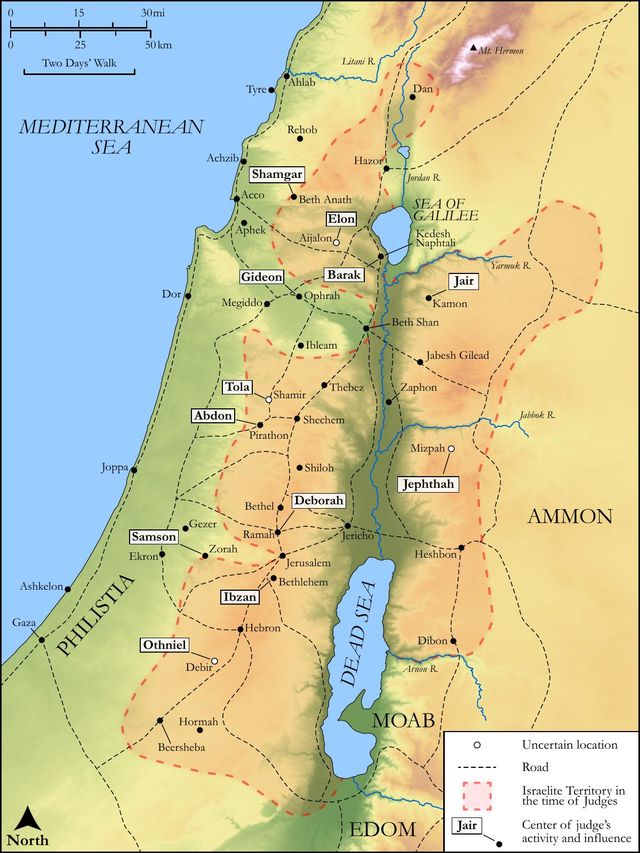
See on the biblical-era maps
Study this verse
Public-domain commentary
Matthew Henry
From his Commentary on the Whole Bible. Henry comments on passages, not single verses — this entry covers Judges 3:1–7. His two-level outline is real structure in the source text, so it is rendered as structure.
We are here told what remained of the old inhabitants of Canaan. 1. There were some of them that kept together in united bodies, unbroken (Jdg 3:3): The five lords of the Philistines, namely, Ashdod, Gaza, Askelon, Gath, and Ekron, Sa1 6:17. Three of these cities had been in part reduced (Jdg 1:18), but it seems the Philistines (probably with the help of the other two, which strengthened their confederacy with each other thenceforward) recovered the possession of them. These gave the greatest disturbance to Israel of any of the natives, especially in the latter times of the judges, and they were never quite reduced until David's time. There was a particular nation called Canaanites, that kept their ground with the Sidonians, upon the coast of the great sea. And in the north the Hivites held much of Mount Lebanon, it being a remote corner, in which perhaps they were supported by some of the neighbouring states. But, besides these, 2. There were every where in all parts of the country some scatterings of the nations (Jdg 3:5), Hittites, Amorites, etc., which, by Israel's foolish connivance and indulgence, were so many, so easy, and so insolent, that the children of Israel are said to dwell among them, as if the right had still remained in the Canaanites, and the Israelites had been taken in by their permission and only as tenants at will.
Now concerning these remnants of the natives observe,
I.How wisely God permitted them to remain.
It is mentioned in the close of the foregoing chapter as an act of God's justice, that he let them remain for Israel's correction. But here another construction is put upon it, and it appears to have been an act of God's wisdom, that he let them remain for Israel's real advantage, that those who had not known the wars of Canaan might learn war, Jdg 3:1, Jdg 3:2. It was the will of God that the people of Israel should be inured to war,
1.Because their country was exceedingly rich and fruitful, and abounded with dainties of all sorts, which, if they were not sometimes made to know hardship, would be in danger of sinking them into the utmost degree of luxury and effeminacy. They must sometimes wade in blood, and not always in milk and honey, lest even their men of war, by the long disuse of arms, should become as soft and as nice as the tender and delicate woman, that would not set so much as the sole of her foot to the ground for tenderness and delicacy, a temper as destructive to every thing that is good as it is to every thing that is great, and therefore to be carefully watched against by all God's Israel.
2.Because their country lay very much in the midst of enemies, by whom they must expect to be insulted; for God's heritage was a speckled bird; the birds round about were against her, Jer 12:9. It was therefore necessary they should be well disciplined, that they might defend their coasts when invaded, and might hereafter enlarge their coast as God had promised them. The art of war is best learnt by experience, which not only acquaints men with martial discipline, but (which is no less necessary) inspires them with a martial disposition. It was for the interest of Israel to breed soldiers, as it is the interest of an island to breed sea-men, and therefore God left Canaanites among them, that, by the less difficulties and hardships they met with in encountering them, they might be prepared for greater, and, by running with the footmen, might learn to contend with horses, Jer 12:5. Israel was a figure of the church militant, that must fight its way to a triumphant state. The soldiers of Christ must endure hardness, Ti2 2:3. Corruption is therefore left remaining in the hearts even of good Christians, that they may learn war, may keep on the whole armour of God, and stand continually upon their guard. The learned bishop Patrick offers another sense of Jdg 3:2 : That they might know to teach them war, that is, they shall know what it is to be left to themselves. Their fathers fought by a divine power. God taught their hands to war and their fingers to fight; but now that they have forfeited his favour let them learn what it is to fight like other men.
II.How wickedly Israel mingled themselves with those that did remain.
One thing God intended in leaving them among them was to prove Israel (Jdg 3:4), that those who were faithful to the God of Israel might have the honour of resisting the Canaanites' allurements to idolatry, and that those who were false and insincere might be discovered, and might fall under the shame of yielding to those allurements. Thus in the Christian churches there must needs be heresies, that those who are perfect may be made manifest, Co1 11:19. Israel, upon trial, proved bad.
1.They joined in marriage with the Canaanites (Jdg 3:6), though they could not advance either their honour or their estate by marrying with them. They would mar their blood instead of mending it, and sink their estates instead of raising them, by such marriages.
2.Thus they were brought to join in worship with them; they served their gods (Jdg 3:6), Baalim and the groves (Jdg 3:7), that is, the images that were worshipped in groves of thick trees, which were a sort of natural temples. In such unequal matches there is more reason to fear that the bad will corrupt the good than to hope that the good will reform the bad, as there is in laying two pears together, the one rotten and the other sound. When they inclined to worship other gods they forgot the Lord their God. In complaisance to their new relations, they talked of nothing by Baalim and the groves, so that by degrees they lost the remembrance of the true God, and forgot there was such a Being, and what obligations they lay under to him. In nothing is the corrupt memory of man more treacherous than in this, that it is apt to forget God; because out of sight, he is out of mind; and here begins all the wickedness that is in the world: they have perverted their way, for they have forgotten the Lord their God.
Historical interpretation
Two Centuries of Reception
2 surviving comments on this verse. Each one is dated, so this reads as a timeline rather than a list.
Select a marker to jump to its quote. Markers stagger vertically where authors wrote within a few decades of each other.
As useful as it is to me that you [the Lord] should leave me for a little while in order to test the steadfastness of my desire, so it is harmful if you let me be abandoned for too long because of my deserts and my sins. For no human strength will be able to endure by its own steadfastness if it is too long abandoned by your help in time of trial. Nor will it be able to give way instantly before the power and wherewithal of the adversary if you yourself, who are aware of human strengths and are the arbiter of our struggles, “do not permit us to be tried beyond our capacity, but with the trial also provide a way out, so that we may be able to endure.”We read something like this as it appears in mystical fashion in the book of Judges with respect to the extermination of the spiritual nations that are opposed to Israel: “These are the nations that the Lord forsook, so that by them he might instruct Israel, so that they might grow accustomed to fighting with their enemies.” And again, a little further on: “The Lord left them so that he might test Israel with them, whether or not they would hear the commandments of the Lord that he had laid down for their forefathers by the hand of Moses.” God did not begrudge Israel their peace or look with malice upon them, but he planned this conflict in the knowledge that it would be beneficial. Thus, constantly oppressed by the onslaught of the nations, they would never feel that they did not need the Lord’s help. Hence they would always meditate on him and cry out to him, and they would neither lapse into sluggish inactivity nor lose their ability to fight and their training in virtue. For frequently security and prosperity have brought low those whom adversities cannot overcome.
Almighty God shows wonderful providence in distributing his blessings. Frequently, by denying lesser gifts to those whom he has favored with great virtues, he offers their souls an opportunity for self-reproach. When they find themselves unable to reach the perfection they aspire to and see themselves struggling in vain for a mastery of virtues not granted them, they are not likely to pride themselves on the gifts they have received. For, when they see that of their own power they are incapable of overcoming small faults and slight imperfections, they begin to realize that their great virtues were not self-acquired. For a similar reason the Lord destroyed the powerful enemies who beset his chosen people on their way to the promised land, but [he] allowed the Philistines and Canaanites to survive, so that, as it is written, “he might try Israel by them.” Sometimes, as I have said, those who have received exceptional graces are the very ones God allows to retain small imperfections so that they may always have obstacles with which to contend. As a result they do not foster pride in their hearts even though they are victorious over powerful enemies, for they realize that the weakest of adversaries still causes them great weariness. It is quite remarkable how one and the same person can be vigorous in virtue and weak with infirmity, and while strongly fortified on one side see himself laid waste on the other. The good, therefore, for which he is striving without success, makes him cherish humbly the gifts God has given him.Why should we be surprised that this is true of people? Heaven itself witnessed the same occurrence, for some of its citizens were lost and some stood firm. Seeing one part fall through pride, the other, the chosen angels, kept their stand more humbly and therefore also more firmly. This loss, then, was beneficial for those citizens of heaven whom it helped to establish more firmly in their eternal condition. The same is true of us individually. A slight loss that safeguards humility can at times be of immense profit to a soul.
Continue studying Judges 3:1 across the web’s major study libraries — every link below opens this exact verse, chapter, or book on the destination site.
Read & Compare
 BibleGatewayThis verse in more than 200 translations and 70 languages.
 Bible.comThe YouVersion reader — hundreds of translations, reading plans, and highlights.
 ESV.orgCrossway's official English Standard Version reader.
 NET BibleThe NET translation with 60,000+ translators' notes on every rendering decision.
 STEP BibleTyndale House's free study tool — original text, vocabulary, and scholarly resources.
 BibliaLogos Bible Software's free web reader.
 USCCBThe New American Bible (Revised Edition) with the U.S. bishops' study notes.
Commentaries
 BibleHub CommentariesDozens of classic commentaries on this verse, gathered on one page.
 StudyLightMore than 100 commentary sets — the largest collection on the web.
 BibleRefPlain-English commentary on what this verse means, verse by verse.
 Enduring WordDavid Guzik's free commentary on this chapter, widely used by Bible teachers.
 Bible Study ToolsVerse commentary alongside Greek and Hebrew study aids.
Original Language & Research
- BibleHub InterlinearThe verse word by word — original language, transliteration, and English.
- BibleHub LexiconEvery word's original-language definition and Strong's entry.
 Blue Letter BibleDeep-study tools — Strong's numbers, concordance, and word studies.
 SefariaThe Hebrew text with Rashi and centuries of Jewish commentary.
Sermons, Hymns & Audio


TrulyRandomVerse is not affiliated with these sites and doesn’t control their content. They’re linked because they’re genuinely useful.
Summary
Judges 3:1 serves as a pivotal transitional verse, revealing the divine rationale behind the continued presence of unconquered nations within the land of Canaan after the initial conquest under Joshua. It clarifies that these lingering adversaries were not merely a consequence of Israel's incomplete obedience, but a sovereign act of the Lord, deliberately left to test and refine the faithfulness of the new generation of Israelites who had not personally experienced the formative wars of the conquest. This verse sets the theological and narrative stage for the cyclical pattern of sin, oppression, repentance, and deliverance that defines the entire book of Judges.
Context
ShowHideLiterary Context
This verse acts as a crucial bridge, connecting the theological summary of Israel's failures in Judges 1-2 with the subsequent narrative of the judges themselves. Judges 1 details the partial and often failed attempts of various tribes to dispossess the Canaanites. Judges 2 then provides the theological explanation for this disobedience, culminating in God's declaration in Judges 2:20-23 that because Israel broke the covenant, the Lord would no longer drive out the nations that Joshua had left. Judges 3:1 reiterates and elaborates on this divine purpose, specifically identifying who was being tested and why. It directly precedes the introduction of the first major oppressor, Cushan-Rishathaim, and the first judge, Othniel, initiating the primary narrative cycle of the book.
Historical & Cultural Context
The period of the Judges (roughly 1375-1050 BC) was a turbulent era for Israel, characterized by decentralization, tribalism, and a lack of strong central leadership following Joshua's death. The unified military effort of the conquest had waned, and individual tribes struggled to secure their allotted territories. The Canaanite inhabitants, including various city-states and ethnic groups like the Philistines, Phoenicians, and remnants of the Hittites, Amorites, Perizzites, Hivites, and Jebusites, retained strongholds throughout the land of Canaan. These groups practiced polytheistic religions, often involving fertility cults, ritual prostitution, and child sacrifice, posing a constant spiritual and moral threat to Israel's monotheistic covenant with Yahweh. The cultural landscape was one of constant interaction, often negative, where Israel was tempted to adopt the idolatrous practices and intermarry with the surrounding peoples, directly violating the commands given in Deuteronomy 7:1-5.
Key Themes
ShowHideJudges 3:1 underscores several critical themes that permeate the book. Firstly, Divine Sovereignty and Purpose in Adversity is paramount; God is not merely reacting to Israel's failure but actively orchestrating circumstances for His own ends, transforming potential punishment into a proving ground for His people. Secondly, the theme of Obedience and Disobedience is highlighted, as Israel's partial obedience in the conquest directly led to the very situation God then used for testing. This failure to fully dispossess the land, as commanded in Numbers 33:55, created the context for ongoing temptation and conflict. Thirdly, Generational Learning and Faithfulness is crucial; the verse explicitly states the nations were left for "as many [of Israel] as had not known all the wars of Canaan." This younger generation, unfamiliar with the miraculous victories of the Exodus and Conquest, needed to personally encounter God's power and learn dependence on Him, much like their ancestors were tested in the wilderness (Deuteronomy 8:2).
Exposition and Analysis
ShowHideKey Word Analysis
ShowHideThis term (H1471) refers to a foreign nation or Gentile people. In this context, it emphasizes the distinct, often pagan, identity and practices of the non-Israelite peoples inhabiting Canaan. Their continued presence represented a spiritual and physical threat, a constant source of temptation to idolatry and intermarriage, standing in direct opposition to Israel's covenant with Yahweh.
This verb (H3240) signifies "to deposit," "to allow to stay," or "to cause to remain." Crucially, it implies a deliberate, active decision on God's part, not merely a passive allowance or an oversight. God chose to leave these nations, indicating a sovereign purpose behind their continued existence within the land. This active "leaving" by God contrasts sharply with Israel's failure to "drive out," highlighting God's ultimate control even over the consequences of human disobedience.
This word (H5254) carries the meaning "to test," "to try," or "to put to the test." In a divine context, it is not a malicious temptation to sin (in the sense of enticing to evil), but rather a trial designed to reveal the true state of one's heart, to refine character, to demonstrate loyalty, and to develop spiritual maturity and dependence. Here, the test was whether Israel would obey the Lord and resist the idolatry of the surrounding nations, or succumb to their influence.
Verse Breakdown
ShowHide"Now these [are] the nations which the LORD left"
This opening clause immediately establishes the divine agency behind the continued presence of the Canaanite peoples. It is not merely a historical accident or a result of Israel's military weakness alone, but a deliberate act of God's sovereign will. The phrase "the LORD left" emphasizes His active role in the unfolding narrative, setting the stage for His purposes.
"to prove Israel by them"
This phrase reveals the explicit purpose of God's action. The remaining nations were a divinely appointed instrument for testing the faithfulness and obedience of the Israelites. This "proving" was intended to reveal the true condition of Israel's heart and their commitment to the covenant, particularly their willingness to worship Yahweh alone and reject the pagan practices of their neighbors. It was a crucible for their spiritual development.
"[even] as many [of Israel] as had not known all the wars of Canaan;"
This final clause specifies the primary recipients of this divine test: the younger generation who had grown up after the initial, unified conquest under Joshua. They had not personally witnessed the miraculous victories and direct divine intervention that characterized the Exodus and the early conquest. This generation needed to learn firsthand the necessity of relying on God for deliverance and the consequences of disobedience, thereby forging their own relationship with the Lord rather than relying solely on the experiences of their parents or the inherited faith of their ancestors.
Literary Devices
ShowHideJudges 3:1 employs several significant literary devices. It functions as a Transition verse, smoothly moving the narrative from the theological summary of Judges 2 into the cyclical pattern of the judges themselves. The verse also powerfully demonstrates Divine Sovereignty, attributing the continued presence of the nations directly to the Lord's deliberate action, not merely to Israel's failure. This highlights God's ultimate control over history and His ability to use even negative circumstances for His redemptive purposes. Furthermore, the verse serves as Foreshadowing, setting the stage for the entire book's narrative arc, which will repeatedly demonstrate Israel's failure under this test, leading to oppression, repentance, and the raising of deliverers. There is also an element of Irony in that Israel's disobedience (not fully dispossessing the land) becomes the very means through which God tests their obedience, turning their failure into a proving ground for their faithfulness.
Theological and Thematic Connections
ShowHideJudges 3:1 profoundly illustrates God's sovereign hand in human affairs, even when those affairs are marred by human failure. It teaches that God can use challenging circumstances, even those brought about by our own incomplete obedience or the consequences of past sin, as instruments for spiritual growth and refinement. The "proving" (testing) is not designed to make Israel fail, but to reveal their hearts, strengthen their faith, and teach them to rely on Him. This concept of divine testing is a recurring theme throughout Scripture, emphasizing that trials are often opportunities for deepening our relationship with God and demonstrating the genuineness of our faith. It underscores that God's ultimate goal for His people is their sanctification and unwavering devotion, even if it requires confronting persistent spiritual adversaries.
Reflection and Application
ShowHideJudges 3:1 offers profound insights for believers today, reminding us that God's purposes often unfold in ways we might not expect, even through the "leftover" challenges or persistent temptations in our lives. Just as God used the remaining nations to test Israel, He may allow or orchestrate difficult circumstances, not as punishment, but as opportunities for spiritual growth, to reveal our true dependence on Him, and to refine our faith. These trials are designed to draw us closer to Him, teach us spiritual warfare, and solidify our commitment to His commands. This verse compels us to examine areas of incomplete obedience in our own lives, recognizing that what we fail to fully surrender or dispossess can become the very ground for our spiritual battles. Ultimately, it calls us to trust in God's sovereign wisdom, even when the path is difficult, knowing that He is always working for our good and His glory, shaping us into more faithful disciples who learn to fight the good fight of faith.
Questions for Reflection
ShowHideFAQ
ShowHideWhy did God "leave" these nations if He had commanded Israel to completely drive them out?
ShowHideThis is a crucial point of tension in the book of Judges. God's initial command was indeed to utterly dispossess the land and destroy the idolatrous inhabitants (e.g., Deuteronomy 7:1-5). However, Israel failed to fully obey this command (as detailed in Judges 1). Judges 2:20-23 explicitly states that because Israel broke the covenant by not driving out the nations and by worshipping other gods, God declared He would no longer drive them out. Judges 3:1 then explains the purpose behind this divine decision: to test the faithfulness of the new generation of Israelites. So, while Israel's disobedience created the opportunity for the nations to remain, God sovereignly chose to leave them for a specific, redemptive purpose—to prove Israel's loyalty and teach them war, both physical and spiritual. It was a consequence of their sin, but also a means of their spiritual development and a demonstration of God's justice and patience.
Does God "tempt" people to sin through these tests?
ShowHideThe Hebrew word translated "to prove" or "to test" (nâçâh) in Judges 3:1 does not carry the connotation of luring someone into evil, as the English word "tempt" sometimes implies. Rather, it signifies a trial designed to reveal the true nature or strength of something, to refine, or to demonstrate faithfulness. God's purpose in leaving these nations was to test Israel's obedience and loyalty to Him, to see if they would truly serve Him alone and resist the idolatry of their neighbors. This is distinct from the idea of God enticing someone to commit evil, which the Bible explicitly states He does not do (James 1:13). The test was an opportunity for Israel to demonstrate their commitment and grow in their faith, not an attempt to make them fall.
Christ-Centered Fulfillment
ShowHideJudges 3:1, with its emphasis on Israel's failure and God's sovereign testing, profoundly points to the necessity and person of Jesus Christ. Israel's inability to fully dispossess the land and their subsequent repeated failures under divine testing underscore humanity's inherent weakness and inability to perfectly keep God's covenant. The cycle of sin, oppression, and temporary deliverance by human judges in the book of Judges foreshadows the deeper, more pervasive spiritual enemies—sin, death, and the devil—from which only a perfect Deliverer could save. Christ is the ultimate "Judge" and "Conqueror" who fully accomplished what Israel could not. He perfectly obeyed the Father, even unto death on the cross (Philippians 2:8), and through His resurrection, He triumphed over all spiritual adversaries (Colossians 2:15). While Israel was tested and failed, Jesus, the true Israel, was tested in every way yet without sin (Hebrews 4:15). He provides the ultimate victory and enables believers, through the indwelling Holy Spirit, to overcome the "nations" of sin and temptation that remain in our fallen world. His finished work ensures that even our trials and tests serve a redemptive purpose, drawing us closer to Him and conforming us to His image (Romans 8:28-29).