


Judges 3:8
Bible text: King James Version (1769 Blayney text) · Public domain
Bible text: King James Version with Strong's numbers · Public domain
Bible text: Berean Standard Bible · Public domain
Bible text: American Standard Version (1901) · Public domain
Bible text: World English Bible, Messianic edition · Public domain
Bible text: Geneva Bible (1599) · Public domain
Bible text: Young's Literal Translation · Public domain
- וַיִּחַרvai·yi·charand it burnedH2734Conj-w ¦ V-Qal-ConsecImperf-3msVerb Qal Consecutive Imperfect 3rd Singular Masculineוַandיִּחַרit burned
- אַף'af[the] anger ofH639N-mscNoun Singular Masculine Construct
- יְהוָהYah·wehYahwehH3068N-properNoun Proper Title
- בְּיִשְׂרָאֵלbe·Yis·ra·'Elon IsraelH3478Prep-b ¦ N-properNoun Proper LocationבְּonיִשְׂרָאֵלIsrael
- וַיִּמְכְּרֵםvai·yim·ke·Remand he sold themH4376Conj-w ¦ V-Qal-ConsecImperf-3ms ¦ 3mpVerb Qal Consecutive Imperfect 3rd Singular Masculineוַandיִּמְכְּרֵhe soldםthem
- בְּיַדbe·Yadin [the] hand ofH3027Prep-b ¦ N-cscNoun Singular common gender Constructבְּinיַד[the] hand of
- כּוּשַׁןku·ShanCushan-H3573N-proper-mNoun Proper Masculine
- רִשְׁעָתַיִםrish·'a·Ta·yimRishathaimH3573N-proper-mNoun Proper Masculine
- מֶלֶךְMe·lekh[the] king ofH4428N-mscNoun Singular Masculine Construct
- אֲרַם'a·RamAramH763N-properNoun Proper Location
- נַהֲרָיִםna·ha·Ra·yimNaharaimH763N-properNoun Proper Location
- וַיַּעַבְדוּvai·ya·'av·Duand they servedH5647Conj-w ¦ V-Qal-ConsecImperf-3mpVerb Qal Consecutive Imperfect 3rd Plural Masculineוַandיַּעַבְדוּthey served
- בְנֵיve·nei[the] people ofH1121N-mpcNoun Plural Masculine Construct
- יִשְׂרָאֵלYis·ra·'ElIsraelH3478N-properNoun Proper Location
- אֶת'et<obj.>H853DirObjMParticle Object Indicator
- כּוּשַׁןku·ShanCushan-H3573N-proper-mNoun Proper Masculine
- רִשְׁעָתַיִםrish·'a·Ta·yimRishathaimH3573N-proper-mNoun Proper Masculine
- שְׁמֹנֶהshe·mo·NeheightH8083N-csNoun Singular common gender Absolute
- שָׁנִיםsha·NimyearsH8141N-mpNoun Plural Masculine Absolute
English is a literal word-by-word gloss of the Hebrew, not the KJV's wording. Why?
This is the original text the KJV's translators worked from — each Hebrew word with its own literal English meaning in this verse, prepared by scholars at Tyndale House, Cambridge. The KJV translates whole sentences, not word by word, so its wording differs: one Hebrew word can become several English words, and the KJV may choose “the LORD” where the gloss reads “Yahweh”. Both are faithful — they answer different questions. For the KJV's own rendering, switch to the KJV text.
Details
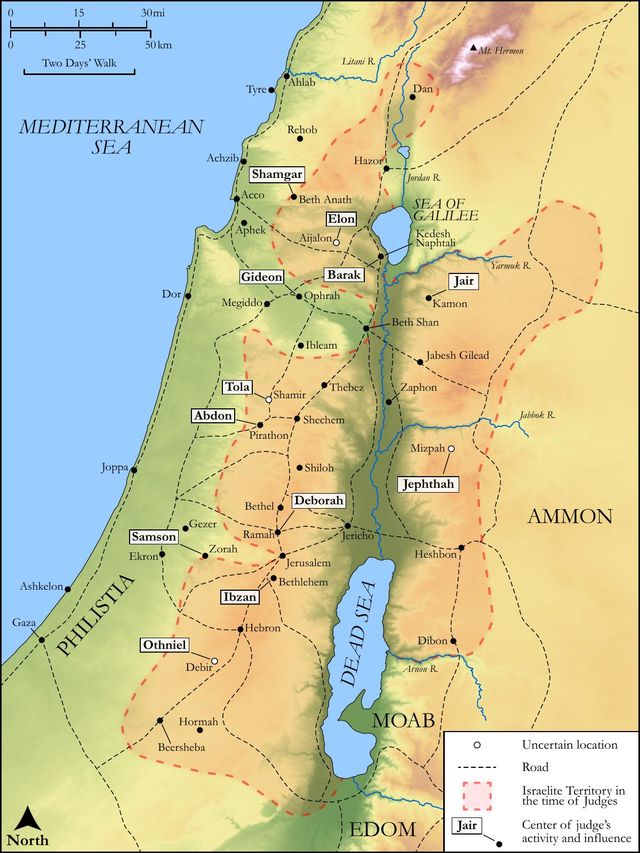
See on the biblical-era maps
Study this verse
Public-domain commentary
Matthew Henry
From his Commentary on the Whole Bible. Henry comments on passages, not single verses — this entry covers Judges 3:8–11. His two-level outline is real structure in the source text, so it is rendered as structure.
We now come to the records of the government of the particular judges, the first of which was Othniel, in whom the story of this book is knit to that of Joshua, for even in Joshua's time Othniel began to be famous, by which it appears that it was not long after Israel's settlement in Canaan before their purity began to be corrupted and their peace (by consequence) disturbed. And those who have taken pains to enquire into the sacred chronology are generally agreed that the Danites' idolatry, and the war with the Benjamites for abusing the Levite's concubine, though related in the latter end of this book, happened about this time, under or before the government of Othniel, who, though a judge, was not such a king in Israel as would keep men from doing what was right in their own eyes. In this short narrative of Othniel's government we have,
I.The distress that Israel was brought into for their sin, Jdg 3:8.
God being justly displeased with them for plucking up the hedge of their peculiarity, and laying themselves in common with the nations, plucked up the hedge of their protection and laid them open to the nations, set them to sale as goods he would part with, and the first that laid hands on them was Chushan-rishathaim, king of that Syria which lay between the two great rivers of Tigris and Euphrates, thence called Mesopotamia, which signifies in the midst of rivers. It is probable that this was a warlike prince, and, aiming to enlarge his dominions, he invaded the two tribes first on the other side Jordan that lay next him, and afterwards, perhaps by degrees, penetrated into the heart of the country, and as far as he went put them under contribution, exacting it with rigour, and perhaps quartering soldiers upon them. Laban, who oppressed Jacob with a hard service, was of this country; but it lay at such a distance that one could not have thought Israel's trouble would come from such a far country, which shows so much the more of the hand of God in it.
II.Their return to God in this distress:
When he slew them, then they sought him whom before they had slighted. The children of Israel, even the generality of them, cried unto the Lord, Jdg 3:9. At first they made light of their trouble, and thought they could easily shake off the yoke of a prince at such a distance; but, when it continued eight years, they began to feel the smart of it, and then those cried under it who before had laughed at it. Those who in the day of their mirth had cried to Baalim and Ashtaroth now that they are in trouble cry to the Lord from whom they had revolted, whose justice brought them into this trouble, and whose power and favour could alone help them out of it. Affliction makes those cry to God with importunity who before would scarcely speak to him.
III.God's return in mercy to them for their deliverance.
Though need drove them to him, he did not therefore reject their prayers, but graciously raised up a deliverer, or saviour, as the word is. Observe,
1.Who the deliverer was. It was Othniel, who married Caleb's daughter, one of the old stock that had seen the works of the Lord, and had himself, no question, kept his integrity, and secretly lamented the apostasy of his people, but waited for a divine call to appear publicly for the redress of their grievances. He was now, we may suppose, far advanced in years, when God raised him up to this honour, but the decays of age were no hindrance to his usefulness when God had work for him to do.
2.Whence he had his commission, not of man, nor by man; but the Spirit of the Lord came upon him (Jdg 3:10), the spirit of wisdom and courage to qualify him for the service, and a spirit of power to excite him to it, so as to give him and others full satisfaction that it was the will of God he should engage in it. The Chaldee says, The spirit of prophecy remained on him.
3.What method he took. He first judged Israel, reproved them, called them to account for their sins, and reformed them, and then went out to war. This was the right method. Let sin at home be conquered, that worst of enemies, and then enemies abroad will be the more easily dealt with. Thus let Christ be our Judge and Law-giver, and then he will save us, and on no other terms, Isa 33:22.
4.What good success he had. He prevailed to break the yoke of the oppression, and, as it should seem, to break the neck of the oppressor; for it is said, The Lord delivered Chushan-rishathaim into his hand. Now was Judah, of which tribe Othniel was, as a lion's whelp gone up from the prey.
5.The happy consequence of Othniel's good services. The land, though not getting ground, yet had rest, and some fruits of the reformation, forty years; and the benefit would have been perpetual if they had kept close to God and their duty.
Historical interpretation
Fifteen Centuries of Reception
2 surviving comments on this verse. Each one is dated, so this reads as a timeline rather than a list.
Select a marker to jump to its quote. Markers stagger vertically where authors wrote within a few decades of each other.
Now Chusarsaton's name is translated as "humiliation." They were delivered, then, to the hands of one who would humiliate them. And it was because they acted wickedly on the heights of the mountains against the Most High that he sent them to their humiliation. But I don't want you to think that it is only in relation to the ancients that divine providence delivers those who were exalted in wickedness for the purpose of humiliating them and that they may be healed by such a wholesome remedy. Presently as well, almighty God's healing providence is [not] lacking in relation to his church. Even now, there is a "Chusarsaton king of Mesopotamia" to whom souls are handed over for humiliation and affliction, souls who had moved themselves from despised Christian humility into pride and arrogance. The vice of pride is utterly hateful in the sight of God, for, as Scripture says, "pride is the beginning of departure from God" and, again, "God resists the proud, but gives grace to the humble."
Mesopotamia: In Hebrew Aramnaharim. Syria of the two rivers: so called because it lies between the Euphrates and the Tigris. It is absolutely called Syria, ver. 10.
Continue studying Judges 3:8 across the web’s major study libraries — every link below opens this exact verse, chapter, or book on the destination site.
Read & Compare
 BibleGatewayThis verse in more than 200 translations and 70 languages.
 Bible.comThe YouVersion reader — hundreds of translations, reading plans, and highlights.
 ESV.orgCrossway's official English Standard Version reader.
 NET BibleThe NET translation with 60,000+ translators' notes on every rendering decision.
 STEP BibleTyndale House's free study tool — original text, vocabulary, and scholarly resources.
 BibliaLogos Bible Software's free web reader.
 USCCBThe New American Bible (Revised Edition) with the U.S. bishops' study notes.
Commentaries
 BibleHub CommentariesDozens of classic commentaries on this verse, gathered on one page.
 StudyLightMore than 100 commentary sets — the largest collection on the web.
 BibleRefPlain-English commentary on what this verse means, verse by verse.
 Enduring WordDavid Guzik's free commentary on this chapter, widely used by Bible teachers.
 Bible Study ToolsVerse commentary alongside Greek and Hebrew study aids.
Original Language & Research
- BibleHub InterlinearThe verse word by word — original language, transliteration, and English.
- BibleHub LexiconEvery word's original-language definition and Strong's entry.
 Blue Letter BibleDeep-study tools — Strong's numbers, concordance, and word studies.
 SefariaThe Hebrew text with Rashi and centuries of Jewish commentary.
Sermons, Hymns & Audio


TrulyRandomVerse is not affiliated with these sites and doesn’t control their content. They’re linked because they’re genuinely useful.
Summary
Judges 3:8 inaugurates the grim cycle of disobedience, divine judgment, and subsequent oppression that defines the book of Judges. Following Israel's profound apostasy and adoption of foreign gods, the Lord's righteous anger was kindled, leading Him to sovereignly deliver His unfaithful people into the subjugation of Chushanrishathaim, the formidable king of Mesopotamia. This resulted in eight years of harsh servitude for the children of Israel, powerfully illustrating the immediate and severe consequences of covenant infidelity and setting the stage for the recurring narrative of divine discipline and eventual deliverance.
Context
ShowHideLiterary Context
This verse immediately follows the explicit declaration of Israel's spiritual rebellion in Judges 3:7, where they "did evil in the sight of the LORD and forgot the LORD their God and served the Baals and the Asherahs." Judges 3:8, therefore, presents the direct and inevitable consequence of this apostasy, serving as the first concrete instance of the "Judges cycle" outlined in Judges 2:11-19. The preceding chapters establish the theological framework: Israel's failure to drive out the remaining inhabitants of the land (as commanded in Judges 1) led to their entanglement with idolatry, which in turn provoked God's disciplinary hand. This verse is the pivot point, moving from the general description of Israel's sin to the specific manifestation of divine judgment and the introduction of the first oppressor, paving the way for the first deliverer, Othniel, in Judges 3:9.
Historical & Cultural Context
The period of the Judges, roughly spanning from the death of Joshua to the rise of the monarchy, was marked by political fragmentation, tribal disunity, and spiritual decline within Israel. There was "no king in Israel; everyone did what was right in his own eyes" (Judges 17:6). Chushanrishathaim, king of Mesopotamia (Hebrew: Aram Naharaim, "Aram of the two rivers"), represents a foreign power from the northeast. While the precise geographical extent of his rule and the nature of his interaction with Israel are debated, his designation as king of Mesopotamia suggests a significant, though perhaps distant, threat. The act of God "selling" Israel into his hand reflects Scripture's own teaching of divine sovereignty over nations and the use of one nation to punish another, as among the curses of the covenant Moses declared, "there ye shall be sold unto your enemies for bondmen and bondwomen." This serves as a divine judgment, not a commercial transaction, highlighting God's control over historical events.
Key Themes
ShowHideJudges 3:8 is foundational for several key themes recurring throughout the book. Firstly, it powerfully illustrates Divine Judgment and Discipline, emphasizing that God's "anger" is a righteous and holy response to covenant infidelity, not an uncontrolled emotion. His act of "selling them" is a sovereign, purposeful discipline designed to bring Israel to repentance, underscoring His commitment to His covenant people even through severe means. Secondly, the verse highlights the Consequences of Disobedience, demonstrating the direct link between Israel's spiritual apostasy (serving Baalim) and their loss of freedom and security. The eight years of oppression serve as a tangible and painful reminder that sin leads to bondage. Lastly, this verse firmly establishes the Cycle of Sin, Servitude, Supplication, and Salvation (the "Judges cycle"), which is the structural backbone of the entire book. It shows the initial phase of this cycle: Israel's sin leads to God's judgment, resulting in oppression, which will then lead to their crying out and God raising a deliverer, as described in Judges 2:11-19.
Exposition and Analysis
ShowHideKey Word Analysis
ShowHideProperly referring to the nose or nostril, this word is used idiomatically to denote the face or, more commonly, intense emotion, specifically ire or wrath. In this context, it signifies God's righteous indignation and burning displeasure, a holy response to Israel's idolatry and covenant unfaithfulness. It is not a capricious human emotion but a settled, just attribute of God.
This primitive root means "to sell," either literally (as merchandise or into slavery) or figuratively (to surrender or deliver). Here, it is used metaphorically to describe God's sovereign act of handing Israel over to their enemies. It emphasizes God's active role in their subjugation, not as a commercial transaction, but as a judicial act of delivering them into the consequences of their sin, fulfilling the warnings of the covenant curses.
This proper noun refers to the king of Mesopotamia. Its Hebrew etymology is often interpreted as "Cushan of Double Wickedness" or "Cushan the Wicked One of Twofold Wickedness." This symbolic name highlights the particularly evil and oppressive nature of this adversary, underscoring the severity of God's judgment and the depth of Israel's predicament under his rule. It also emphasizes the foreign and hostile power to which Israel was subjected.
Verse Breakdown
ShowHide"Therefore the anger of the LORD was hot against Israel"
This clause establishes the divine cause and motivation for the subsequent events. Israel's apostasy, detailed in the preceding verse, directly provoked God's righteous wrath. This is not arbitrary anger but a just response to covenant breaking and spiritual infidelity, demonstrating God's holiness and His intolerance for sin among His chosen people. The "hot" anger signifies its intensity and the certainty of its consequences.
"and he sold them into the hand of Chushanrishathaim king of Mesopotamia"
This explains the specific form of God's judgment. God Himself, in His sovereignty, delivered Israel into the power of a foreign oppressor. The phrase "sold them into the hand of" signifies a complete handover, a loss of freedom and autonomy, emphasizing God's active role in their subjugation. Chushanrishathaim, identified as the king of Mesopotamia (Aram Naharaim), signifies a powerful, distant, and formidable adversary, highlighting the extent of Israel's vulnerability and God's sovereign control over even distant nations to execute His purposes.
"and the children of Israel served Chushanrishathaim eight years"
This final clause details the immediate consequence and duration of the oppression. "Served" indicates forced labor, tribute, and subjugation, a direct reversal of their status as God's free people. The specific duration of "eight years" underscores the tangible and prolonged suffering endured, serving as a period of discipline designed to humble Israel and bring them to repentance.
Literary Devices
ShowHideJudges 3:8 effectively employs several literary devices to convey its message. Cause and Effect is central, as the verse explicitly links Israel's prior disobedience (the cause) to God's hot anger and their subsequent servitude (the effect). This establishes a clear moral and theological framework for understanding divine justice. The phrase "sold them into the hand" is a powerful Metaphor, conveying God's sovereign act of delivering His people into bondage without implying a literal commercial transaction. Furthermore, the very name Chushanrishathaim functions as Symbolism, likely signifying "Cush of Double Wickedness," which not only describes the oppressor's character but also emphasizes the severity and deservedness of Israel's judgment. The verse also serves as Foreshadowing, introducing the first instance of the recurring cycle of sin, oppression, and deliverance that will define the narrative structure of the entire book of Judges, preparing the reader for the subsequent cycles.
Theological and Thematic Connections
ShowHideJudges 3:8 is a profound theological statement on God's covenant faithfulness and His righteous governance over His people. It reveals that while God is merciful, His holiness demands a response to sin, especially from those in covenant with Him. His "hot anger" is not a human flaw but a divine attribute reflecting His unwavering commitment to justice and the purity of His relationship with Israel. The act of "selling" Israel into servitude underscores His sovereignty, demonstrating that even foreign powers are instruments in His hand to accomplish His disciplinary purposes. This discipline, though painful, is ultimately redemptive, designed to humble His people and draw them back into obedient relationship, preventing their complete apostasy. The repeated cycle initiated here highlights humanity's persistent tendency toward rebellion and God's persistent, though sometimes severe, pursuit of His people's repentance and restoration.
Reflection and Application
ShowHideJudges 3:8 serves as a timeless and sobering reminder that while God is rich in mercy, He is also just and holy, and there are tangible consequences for spiritual rebellion and disobedience. For believers today, this verse underscores the importance of guarding our hearts against idolatry, whether it be the worship of material possessions, self, or anything that takes God's rightful place in our lives. While we live under the New Covenant of grace, the principle remains that straying from God's path can lead to spiritual distress, broken fellowship, and a loss of the peace and freedom found in Christ. God's discipline, though painful, is always an expression of His love, intended to draw us back to Him, refine our faith, and restore our communion. It calls us to a posture of humility, quick repentance when we err, and unwavering faithfulness to the One who has delivered us.
Questions for Reflection
ShowHideFAQ
ShowHideWho was Chushanrishathaim and why is he significant?
ShowHideChushanrishathaim was the king of Mesopotamia (Aram Naharaim), and he is significant primarily because he was the first oppressor God sent against Israel in the period of the Judges. His name itself, often interpreted as "Cush of Double Wickedness," suggests a particularly severe and hostile adversary, underscoring the depth of Israel's sin and the severity of God's judgment. His emergence from Mesopotamia, a powerful region to the northeast, highlights God's sovereign ability to use even distant nations as instruments of His discipline, fulfilling the warnings of the covenant curses found in Deuteronomy 28. His oppression of Israel for eight years sets the precedent for the recurring cycle of foreign domination that characterizes the book.
What does "the anger of the LORD was hot" mean in this context? Is God prone to human-like fits of rage?
ShowHideThe phrase "the anger of the LORD was hot" (Hebrew: charah aph Yahweh) is an anthropomorphic expression, attributing a human characteristic (burning anger) to God to help us understand His divine response. It does not imply that God is prone to irrational or uncontrolled fits of rage like humans. Instead, it signifies His righteous indignation and holy displeasure against sin. God's anger is always just, controlled, and purposeful, stemming from His perfect holiness and His commitment to His covenant. In this context, it reflects His offense at Israel's idolatry and covenant breaking, which desecrated His name and jeopardized their relationship. It's a manifestation of His justice, designed to bring about repentance and restore fellowship, not to destroy. This righteous anger is a necessary attribute of a holy God who cannot tolerate evil, as seen in passages like Psalm 7:11.
Does God still "sell" or deliver His people into oppression today as a form of discipline?
ShowHideWhile the specific national covenant and judicial system of Old Testament Israel are distinct from the New Covenant experience of the Church, the underlying principle of divine discipline remains. God does not literally "sell" believers into physical slavery or national oppression today in the same way He did with Israel. However, the New Testament affirms that God disciplines those He loves (Hebrews 12:5-11). This discipline can manifest in various ways: allowing natural consequences of sin to unfold, permitting trials and difficulties, or even bringing about a sense of spiritual barrenness or distance when believers stray from His path. The purpose is always redemptive—to correct, purify, and draw His children back into closer fellowship and obedience, not to punish them eternally. The ultimate consequence for sin for believers was borne by Christ on the cross (Romans 8:1), but God's loving discipline helps us grow in holiness.
Christ-Centered Fulfillment
ShowHideThe recurring cycle of sin, oppression, and deliverance in Judges 3:8 and throughout the book points powerfully to humanity's desperate need for a permanent deliverer and a definitive end to the cycle of rebellion. Israel's inability to maintain faithfulness and their repeated descent into servitude highlight the futility of human effort in overcoming sin and its consequences. Chushanrishathaim's oppression, and the subsequent deliverances by temporary judges like Othniel (Judges 3:9), foreshadow the ultimate and perfect deliverance found only in Jesus Christ. Where Israel continually failed to keep the covenant, Christ perfectly fulfilled it. He is the true and eternal Judge, not merely delivering from external oppressors, but from the internal bondage of sin itself, the ultimate "double wickedness" that enslaves humanity (Romans 6:23). Through His atoning sacrifice, Christ bore the "anger of the LORD" against sin, freeing those who believe from the condemnation and power of sin, granting true spiritual freedom (John 8:36). He breaks the cycle of sin and death, offering not just temporary relief but eternal rest and reconciliation with God (Hebrews 4:1-11). Thus, Judges 3:8, with its stark portrayal of human failure and divine judgment, ultimately magnifies the glorious and complete salvation offered through our Lord Jesus Christ, the King who truly delivers His people from all their enemies, visible and invisible (Colossians 1:13-14).