


1 Samuel 10:6
Bible text: King James Version (1769 Blayney text) · Public domain
Bible text: Berean Standard Bible · Public domain
Bible text: American Standard Version (1901) · Public domain
Bible text: World English Bible, Messianic edition · Public domain
Bible text: Geneva Bible (1599) · Public domain
Bible text: Young's Literal Translation · Public domain
- וְצָלְחָהve·tza·le·Chahand it will rushH6743Conj-w ¦ V-Qal-ConsecPerf-3fsVerb Qal Consecutive Perfect 3rd Singular Feminineוְandצָלְחָהit will rush
- עָלֶיךָ'a·Lei·khaon youH5921Prep ¦ 2msPreposition Definiteעָלֶיonךָyou
- רוּחַRu·ach[the] spirit ofH7307N-fscNoun Singular Feminine Construct
- יְהוָהYah·wehYahwehH3068N-properNoun Proper Title
- וְהִתְנַבִּיתָve·hit·na·Bi·taand you will prophesyH5012Conj-w ¦ V-Hithpael-ConsecPerf-2msVerb Hithpael Consecutive Perfect 2nd Singular Masculineוְandהִתְנַבִּיתָyou will prophesy
- עִמָּם'i·Mamwith themH5973Prep ¦ 3mpPreposition Definiteעִמָּwithםthem
- וְנֶהְפַּכְתָּve·neh·pakh·Taand you will be changedH2015Conj-w ¦ V-Niphal-ConsecPerf-2msVerb Niphal Consecutive Perfect 2nd Singular Masculineוְandנֶהְפַּכְתָּyou will be changed
- לְאִישׁle·'Ishinto a manH376Prep-l ¦ N-msNoun Singular Masculine Absoluteלְintoאִישׁa man
- אַחֵר'a·CheranotherH312Adj-msAdjective Singular Masculine Absolute
English is a literal word-by-word gloss of the Hebrew, not the KJV's wording. Why?
This is the original text the KJV's translators worked from — each Hebrew word with its own literal English meaning in this verse, prepared by scholars at Tyndale House, Cambridge. The KJV translates whole sentences, not word by word, so its wording differs: one Hebrew word can become several English words, and the KJV may choose “the LORD” where the gloss reads “Yahweh”. Both are faithful — they answer different questions. For the KJV's own rendering, switch to the KJV text.
Details
See on the biblical-era map
Study this verse
Public-domain commentary
Matthew Henry
From his Commentary on the Whole Bible. Henry comments on passages, not single verses — this entry covers 1 Samuel 10:1–8. His three-level outline is real structure in the source text, so it is rendered as structure.
Samuel is here executing the office of a prophet, giving Saul full assurance from God that he should be king, as he was afterwards, according to these prophecies which went before of him.
I.He anointed him and kissed him, Sa1 10:1.
This was not done in a solemn assembly, but it was done by divine appointment, which made up the want of all external solemnities, nor was it ever the less valid for its being done in private, under a hedge, or, as the Jews say, by a fountain. God's institutions are great and honourable, though the circumstances of their administration be ever so mean and despicable.
1.Samuel, by anointing Saul, assured him that it was God's act to make him king: Is it not because the Lord hath anointed thee? And, in token of that, the high priest was anointed to his office, to signify the conferring of those gifts upon him that were requisite for the discharge of its duties, and the same was intimated in the anointing of kings; for whom God calls he qualifies, and suitable qualifications furnish good proof of a commission. These sacred unctions, then used, pointed at the great Messiah, or anointed one, the king of the church, and high priest of our profession, who was anointed with the oil of the Spirit, not by measure, but without measure, and above all the priests and princes of the Jewish church. It was common oil, no doubt, which Samuel used, and we read not of his blessing it or praying over it. But it was only a vial of oil that he anointed him with, the vessel brittle, because his kingdom would soon be cracked and broken, and the quantity small, because he had but little of the Spirit conferred upon him to what David had, who was therefore anointed with a horn of oil, as were Solomon and Jehu with a box of oil.
2.By kissing him, he assured him of his own approbation of the choice, not only his consent to it, but his complacency in it, though it abridged his power and eclipsed his glory and the glory of his family. "God has anointed thee," says Samuel, "to be king, and I am satisfied and very well pleased, in pledge of which take this kiss." It was likewise a kiss of homage and allegiance; hereby he not only owns him to be king, but his king, and in this sense we are commanded to kiss the Son, Psa 2:12. God has anointed him, and therefore we must thus acknowledge him and do homage to him. In Samuel's explication of the ceremony, he reminds him,
(1.)Of the nature of the government to which he is called. He was anointed to be a captain, a commander indeed, which bespeaks honour and power, but a commander in war, which bespeaks care, and toil, and danger.
(2.)Of the origin of it: The Lord hath anointed thee. By him he ruled, and therefore must rule for him, in dependence on him, and with an eye to his glory.
(3.)Of the end of it. It is over his inheritance, to take care of that, protect it, and order all the affairs of it for the best, as a steward whom a great man sets over his estate, to manage it for his service and give an account of it to him.
II.For his further satisfaction he gives him some signs, which should come to pass immediately, this very day; and they were such as would not only confirm the word of Samuel in general, and prove him a true prophet, but would confirm this word to Saul in particular, that he should be king.
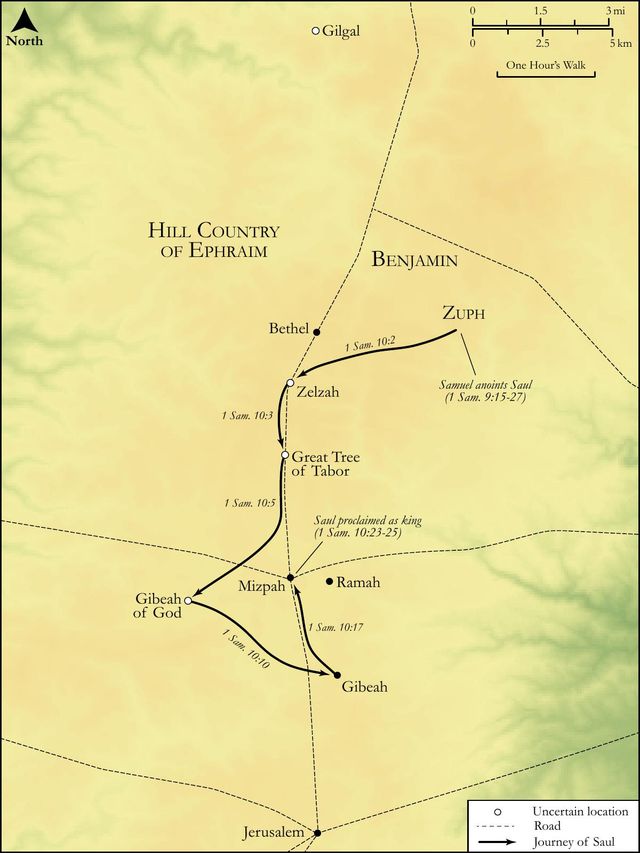
1.He should presently meet with some that would bring him intelligence from home of the care his father's house was in concerning him, Sa1 10:2. These he would meet hard by Rachel's sepulchre. The first place Samuel directed him to was a sepulchre, the sepulchre of one of his ancestors, for Rachel died in travail with Benjamin; there he must read a lecture of his own mortality, and now that he had a crown in his eye must think of his grave, in which all his honour would be laid in the dust. Here two men would meet him, perhaps sent on purpose to look after him, and would tell him the asses were found, and his father was in pain concerning him, saying, What shall I do for my son? He would reckon it happened well that he met with these messengers; and it is good to eye Providence in favourable conjunctures (though the matter be minute) and to be encouraged to trust it in greater matters.
2.He should next meet with others going to Bethel, where, it should seem, there was a high place for religious worship, and these men were bringing their sacrifices thither, Sa1 10:3, Sa1 10:4. It was a token for good to one that was designed for the government of Israel, wherever he came, to meet with people going to worship God. It is supposed that those kids and loaves, and the bottle of wine which the three men had with them, were designed for sacrifice, with the meat-offerings and drink-offerings that were to attend the sacrifice; yet Samuel tells Saul that they will give him two of their loaves, and he must take them. Such a present would look to us now like the relieving of a beggar. Saul must hereafter remember the time when he received alms, and must therefore be humble and charitable to the poor. But perhaps it would then be construed a fit present for a prince; and, as such, Saul must receive it, the first present that was brought to him, by such as knew not what they did, nor why they did it, but God put it into their hearts, which made it the more fit to be a sign to him. These two loaves, which were the first tribute paid to this newly-anointed king, might serve for an admonition to him not to spend the wealth of his crown in luxury, but still to be content with plain food. Bread is the staff of life.
3.The most remarkable sign of all would be his joining with a company of prophets that he should meet with, under the influence of a spirit of prophecy, which should at that time come upon him. What God works in us by his Spirit serves much more for the confirming of faith than any thing wrought for us by his providence. He here (Sa1 10:5, Sa1 10:6) tells him,
(1.)Where this would happen: At the hill of God, where there was a garrison of the Philistines, which is supposed to be near Gibeah, his own city, for there was the Philistines' garrison, Sa1 13:3. Perhaps it was one of the articles of Samuel's agreement with them that they should have a garrison there, or, rather, after they were subdued in the beginning of his time they got ground again, so far as to force this garrison into that place, and thence God raised up the man that should chastise them. There was a place that was called the hill of God, because of one of the schools of the prophets built upon it; and such respect did even Philistines themselves pay to religion that a garrison of their soldiers suffered a school of God's prophets to live peaceably by them, and did not only not dislodge them, but not restrain nor disturb the public exercises of their devotion.
(2.)Upon what occasion; he should meet a company of prophets with music before them, prophesying, and with them he should join himself. These prophets were not (as it should seem) divinely inspired to foretel things to come, nor did God reveal himself to them by dreams and visions, but they employed themselves in the study of the law, in instructing their neighbours, and in the acts of piety, especially in praising God, wherein they were wonderfully assisted and enlarged by the Spirit of God. It was happy for Israel that they had not only prophets, but companies of prophets, who gave them good instructions and set them good examples, and helped very much to keep up religion among them. Now the word of the Lord was not precious, as it had been when Samuel was first raised up, who had been instrumental in founding these colleges, or religious houses, whence, it is probable, the synagogues took their rise. What a pity was it that Israel should be weary of the government of such a man, who though he had not, as a man of war, expelled the Philistines, yet (which was a greater kindness to Israel) had, as a man of God, settled the schools of the prophets! Music was then used as a proper means to dispose the mind to receive the impressions of the good Spirit, as it did Elisha's, Kg2 3:15. But we have no reason to look for the same benefit by it now, unless we saw it as effectual as it was then in Saul's case, to drive away the evil spirit. These prophets had been at the high place, probably offering sacrifice, and now they came back singing psalms. We should come from holy ordinances with our hearts greatly enlarged in holy joy and praise. See Psa 138:5. Saul should find himself strongly moved to join with them, and should be turned thereby into another man from what he had been while he lived in a private capacity. The Spirit of God, by his ordinances, changes men, wonderfully transforms them; Saul, by praising God in the communion of saints, became another man, but whether a new man or no may be questioned.
III.He directs him to proceed in the administration of his government as Providence should lead him, and as Samuel should advise him.
1.He must follow Providence in ordinary cases (Sa1 10:7): "Do as occasion shall serve thee. Take such measures as thy own prudence shall direct thee." But,
2.In an extraordinary strait that would hereafter befal him at Gilgal, and would be the most critical juncture of all, when he would have special need of divine aids, he must wait for Samuel to come to him, and must tarry seven days in expectation of him, Sa1 10:8. How his failing in this matter proved his fall we find afterwards, Sa1 13:11. It was now a plain intimation to him that he was upon his good behaviour, and, though a king, must act under the direction of Samuel, and do as he should order him. The greatest of men must own themselves in subjection to God and his word.
Continue studying 1 Samuel 10:6 across the web’s major study libraries — every link below opens this exact verse, chapter, or book on the destination site.
Read & Compare
 BibleGatewayThis verse in more than 200 translations and 70 languages.
 Bible.comThe YouVersion reader — hundreds of translations, reading plans, and highlights.
 ESV.orgCrossway's official English Standard Version reader.
 NET BibleThe NET translation with 60,000+ translators' notes on every rendering decision.
 STEP BibleTyndale House's free study tool — original text, vocabulary, and scholarly resources.
 BibliaLogos Bible Software's free web reader.
 USCCBThe New American Bible (Revised Edition) with the U.S. bishops' study notes.
Commentaries
 BibleHub CommentariesDozens of classic commentaries on this verse, gathered on one page.
 StudyLightMore than 100 commentary sets — the largest collection on the web.
 BibleRefPlain-English commentary on what this verse means, verse by verse.
 Enduring WordDavid Guzik's free commentary on this chapter, widely used by Bible teachers.
 Bible Study ToolsVerse commentary alongside Greek and Hebrew study aids.
Original Language & Research
- BibleHub InterlinearThe verse word by word — original language, transliteration, and English.
- BibleHub LexiconEvery word's original-language definition and Strong's entry.
 Blue Letter BibleDeep-study tools — Strong's numbers, concordance, and word studies.
 SefariaThe Hebrew text with Rashi and centuries of Jewish commentary.
Sermons, Hymns & Audio


TrulyRandomVerse is not affiliated with these sites and doesn’t control their content. They’re linked because they’re genuinely useful.
Summary
First Samuel 10:6 records a pivotal moment in the life of Saul, Israel's first king-elect, as Samuel delivers a prophetic sign confirming God's choice and preparing him for his momentous new role. This verse foretells a profound divine encounter where the Spirit of the LORD would come upon Saul, enabling him to prophesy alongside a company of prophets and, most remarkably, transforming him into "another man," signifying a divinely wrought change in his capacity and disposition for leadership.
Context
ShowHideLiterary Context
This verse is part of a series of three distinct signs given by Samuel to Saul immediately following his private anointing as king in 1 Samuel 10:1. The preceding verses detail the first two signs: finding the lost donkeys and encountering men at the oak of Tabor who would offer him bread, symbolizing God's provision and Saul's new status (1 Samuel 10:2-5). The encounter with the company of prophets and the subsequent spiritual transformation described in 1 Samuel 10:6 serves as the third and most significant sign, publicly validating Samuel's prophetic word and God's anointing. This sequence of events is crucial for understanding Saul's initial divine enablement and his preparation for leading Israel, a nation transitioning from a tribal confederacy under judges to a centralized monarchy. The fulfillment of these signs, particularly the prophetic manifestation, would serve as undeniable proof to Saul that God was indeed with him, confirming his calling and equipping him for the daunting task ahead.
Historical & Cultural Context
In ancient Israel, the "Spirit of the LORD" (Hebrew: Ruach Yahweh) was understood as the active, empowering presence of God, often coming upon individuals for specific tasks, particularly leadership, craftsmanship, or prophetic utterance. This was not a permanent indwelling as understood in the New Covenant, but a temporary enablement for divine service, allowing individuals to perform supernatural feats or speak divinely inspired words. Prophets in this era often functioned in groups or "companies," and their prophetic activity could involve ecstatic praise, inspired speech, or fervent declarations of God's truth, sometimes accompanied by music and dance. The transition to monarchy was a significant shift for Israel, requiring a divinely appointed and equipped leader. The anointing with oil, as performed by Samuel, was a symbolic act conferring divine authority, and the accompanying signs, like the Spirit's coming, provided tangible evidence of this divine sanction to both the leader and the people, establishing legitimacy and divine backing.
Key Themes
ShowHideThe central theme of 1 Samuel 10:6 is Divine Empowerment, highlighting that God actively equips those He calls. Saul's transformation and prophetic ability are not inherent but are direct results of the Spirit of the LORD "coming upon" him, signifying a special impartation of divine power necessary for the immense tasks of leadership and prophecy. This empowerment underscores God's initiative in establishing leadership, demonstrating that His chosen instruments are divinely enabled. Another key theme is Prophetic Manifestation, as Saul is told he "shalt prophesy with them." This refers to a visible, often communal, spiritual activity where individuals speak under divine inspiration, a public display that would serve as a powerful sign to Saul and others that he was indeed chosen and empowered by God, connecting him to the established prophetic tradition. Finally, the verse introduces the theme of Transformative Change, encapsulated in the profound promise that Saul "shalt be turned into another man." This indicates a radical, God-wrought alteration, not merely in status but in capacity, character, and disposition, making him suitable for the weighty responsibilities of kingship, a change essential for understanding God's preparation of His chosen instruments for their unique roles in salvation history.
Exposition and Analysis
ShowHideKey Word Analysis
ShowHideThis multifaceted Hebrew term refers to breath, wind, or spirit. In a theological context, rûwach signifies the active, dynamic, and powerful presence of God, often manifesting as divine energy or power. When the Ruach Yahweh "comes upon" an individual, it denotes a special, temporary endowment of supernatural ability or insight for a specific purpose, such as leadership, prophecy, or extraordinary strength, as seen with figures like Samson (Judges 14:6) or Othniel (Judges 3:10). This is a divine enabling for a specific task.
This verb means "to speak by divine inspiration," "to utter," or "to behave as a prophet." In the Old Testament, "prophesying" often involved speaking under the direct influence of the Spirit, which could include ecstatic praise, inspired utterances, fervent declarations, or even foretelling the future, though the latter was not its sole or primary meaning. It often occurred in a communal setting, as seen with the "company of prophets" mentioned here, indicating a shared experience of divine inspiration.
The verb hâphak means "to turn," "to overturn," "to change," or "to transform." In this context, it signifies a profound, God-wrought alteration of Saul's being. It implies a fundamental shift in his disposition, capabilities, and perhaps even his inner character, making him suitable and equipped for the immense responsibilities of kingship, which he initially seemed to lack. This transformation is a divine act, not merely a human development.
Verse Breakdown
ShowHide"And the Spirit of the LORD will come upon thee"
This clause signifies a direct divine visitation and empowerment. It indicates that God's active, enabling presence would specifically descend upon Saul, a supernatural act providing him with the necessary spiritual and mental capacities for the tasks ahead. This was a clear sign of divine favor and validation of his anointing, demonstrating that his kingship was not merely a human appointment but a divine ordination, setting him apart for a unique role in Israel's history.
"and thou shalt prophesy with them"
This describes the immediate, visible manifestation of the Spirit's coming. Saul would join a company of prophets and participate in their ecstatic, inspired utterances. This public act of prophesying would serve as undeniable evidence to Saul and any witnesses that he had indeed been touched and empowered by God. It marked him as someone divinely chosen and set apart, capable of receiving and expressing divine communication, a crucial attribute for a king in Israel, who was expected to be in tune with God's will.
"and shalt be turned into another man"
This is the most profound promise in the verse, speaking of a radical, God-initiated transformation of Saul's person. This change was not merely external or superficial but implied a fundamental alteration of his inner being—his character, courage, wisdom, and overall disposition—to make him suitable for the weighty responsibilities of leading a nation. It suggests that God would equip him with the qualities necessary for kingship, qualities he may not have possessed naturally, thus making him a "new man" for a new purpose, divinely prepared for his unprecedented role.
Literary Devices
ShowHideThe verse effectively employs Foreshadowing, signaling Saul's imminent public manifestation as God's chosen leader and hinting at the profound internal changes necessary for his role. The phrase "the Spirit of the LORD will come upon thee" uses potent Symbolism, where the Spirit represents divine power, presence, and enablement, directly connecting Saul's future actions to God's active involvement and sanction. The most striking device is Transformation, explicitly stated in "shalt be turned into another man." This motif emphasizes the radical, God-wrought change in Saul's identity and capacity, setting the stage for his initial period of effective leadership and highlighting the divine nature of his preparation for kingship. These devices collectively underscore the divine origin of Saul's kingship and the supernatural nature of his preparation.
Theological and Thematic Connections
ShowHideFirst Samuel 10:6 powerfully illustrates God's sovereign initiative in choosing and equipping leaders for His purposes. It highlights the Old Testament understanding of the Spirit's work as a temporary endowment for specific tasks, contrasting with the New Covenant's promise of permanent indwelling. The verse underscores the principle that divine calling is always accompanied by divine equipping; God does not call the qualified but graciously qualifies the called. Saul's transformation into "another man" speaks to the necessity of a divinely wrought change for effective service, a theme that resonates throughout Scripture, pointing to the ultimate spiritual transformation available through Christ. This account also emphasizes the public and verifiable nature of God's signs, designed to build faith and confirm His word, not only to the individual but also to the community.
Reflection and Application
ShowHideFirst Samuel 10:6 offers profound insights into God's method of preparing and empowering those He calls to serve. It reminds us that our natural abilities are often insufficient for God's grand purposes, and He graciously provides the necessary spiritual resources and transformative grace. Just as Saul was supernaturally equipped for kingship, believers today are empowered by the Holy Spirit for service in the Kingdom of God, whether in leadership, teaching, or daily witness. This verse encourages us to rely not on our own strength, wisdom, or qualifications, but on the divine enablement that God supplies, recognizing that true effectiveness flows from His power. It also speaks to the ongoing process of spiritual transformation, where God continually shapes our character and capabilities to align with His will, making us more effective instruments in His hands. We are called to be open to God's transformative work, allowing Him to mold us into the people He intends to be, for His glory and the good of His people, trusting that His equipping will always match His calling.
Questions for Reflection
ShowHideFAQ
ShowHideWas Saul truly a prophet in the same sense as Samuel or Elijah?
ShowHideWhile Saul did "prophesy" as described in 1 Samuel 10:6 and later in 1 Samuel 19:23-24, his prophetic activity was primarily a temporary manifestation of divine empowerment, serving as a sign of God's anointing for kingship. It was often ecstatic and communal, not necessarily indicative of a lifelong office or the consistent reception and delivery of God's word like the major prophets. His later actions, particularly his disobedience and rejection of God's commands, demonstrate that this prophetic gift did not equate to a permanent state of moral or spiritual righteousness, nor did it establish him as a prophet in the traditional sense of one who consistently speaks for God to the nation.
What does "turned into another man" mean for Saul? Was it a permanent change?
ShowHide"Turned into another man" signifies a profound, God-wrought transformation in Saul's capacity, disposition, and suitability for kingship. It implies a shift from his previous, perhaps timid or ordinary, self to one endowed with the courage, wisdom, and spiritual authority necessary to lead Israel. This change was real and immediate, enabling him for his new role. However, it was not necessarily a permanent spiritual regeneration in the New Covenant sense, nor did it guarantee his lifelong faithfulness. While his capabilities were transformed, his heart remained susceptible to pride and disobedience, as evidenced by his later rejection by God (1 Samuel 15:23). The transformation was for a specific purpose and period, contingent on his ongoing obedience and submission to God's will.
How does the Spirit "coming upon" someone in the Old Testament differ from the Holy Spirit's work in the New Testament?
ShowHideIn the Old Testament, the Spirit "coming upon" individuals like Saul (1 Samuel 10:6), Samson (Judges 14:6), or the judges was primarily a temporary, task-specific empowerment for divine service, leadership, or prophetic utterance. The Spirit would come and go, enabling specific acts, but not necessarily indwelling the individual permanently. In the New Testament, following Christ's ascension and Pentecost (Acts 2:1-4), the Holy Spirit is poured out on all believers, indwelling them permanently (John 14:16-17, Romans 8:9). This indwelling brings about regeneration, sanctification, and empowers believers for a life of holiness and witness, a more profound and enduring work that transforms the very nature of the believer.
Christ-Centered Fulfillment
ShowHideThe experience of Saul in 1 Samuel 10:6 serves as a powerful foreshadowing of the ultimate divine empowerment and transformation found in Jesus Christ and extended to believers through Him. While Saul received a temporary anointing and a specific enablement for his earthly kingship, Jesus is the one upon whom the Spirit descended permanently and without measure (John 3:34). He is the true Prophet, Priest, and King, perfectly empowered by the Spirit for His ministry of teaching, healing, and ultimately, His atoning sacrifice. The "new man" that Saul became was a provisional change for a specific task and period, but in Christ, believers are truly made "new creations" (2 Corinthians 5:17), experiencing a radical, permanent spiritual transformation that impacts their very nature and empowers them for a life of righteousness and service. The promise of the Spirit's coming upon Saul points forward to the New Covenant reality where God's Spirit is poured out upon all flesh (Joel 2:28, fulfilled in Acts 2), enabling all who believe to live a transformed life in Christ and to participate in His ongoing mission, fulfilling what Saul's temporary enablement could only hint at.