


1 Samuel 19:24
Bible text: King James Version (1769 Blayney text) · Public domain
Bible text: King James Version with Strong's numbers · Public domain
Bible text: Berean Standard Bible · Public domain
Bible text: American Standard Version (1901) · Public domain
Bible text: World English Bible, Messianic edition · Public domain
Bible text: Geneva Bible (1599) · Public domain
Bible text: Young's Literal Translation · Public domain
- וַיִּפְשַׁטvai·yif·Shatand he stripped offH6584Conj-w ¦ V-Qal-ConsecImperf-3msVerb Qal Consecutive Imperfect 3rd Singular Masculineוַandיִּפְשַׁטhe stripped off
- גַּםgamalsoH1571AdvAdverb
- הוּאhu'heH1931Pro-3msPronoun Personal 3rd Singular Masculine
- בְּגָדָיוbe·ga·Davhis clothesH899N-mpc ¦ 3msNoun Plural Masculine Constructבְּגָדָיclothesוhis
- וַיִּתְנַבֵּאvai·yit·na·Be'and he prophesiedH5012Conj-w ¦ V-Hithpael-ConsecImperf-3msVerb Hithpael Consecutive Imperfect 3rd Singular Masculineוַandיִּתְנַבֵּאhe prophesied
- גַםgamalsoH1571AdvAdverb
- הוּאhu'heH1931Pro-3msPronoun Personal 3rd Singular Masculine
- לִפְנֵיlif·Nei<to> beforeH6440Prep-l ¦ N-mpcNoun Plural Masculine Constructלִ<to>פְנֵיbefore
- שְׁמוּאֵלshe·mu·'ElSamuelH8050N-proper-mNoun Proper Masculine
- וַיִּפֹּלvai·yi·Poland he fell downH5307Conj-w ¦ V-Qal-ConsecImperf-3msVerb Qal Consecutive Imperfect 3rd Singular Masculineוַandיִּפֹּלhe fell down
- עָרֹם'a·RomnakedH6174Adj-msAdjective Singular Masculine Absolute
- כָּלkolallH3605N-mscNoun Singular Masculine Construct
- הַיּוֹםhai·Yomthe dayH3117Art ¦ N-msNoun Singular Masculine Absoluteהַtheיּוֹםday
- הַהוּאha·Hu'<the> thatH1931Art ¦ Pro-3msPronoun Personal 3rd Singular Masculineהַ<the>הוּאthat
- וְכָלve·kholand allH3605Conj-w ¦ N-mscNoun Singular Masculine Constructוְandכָלall
- הַלָּיְלָהha·La·ye·lahthe nightH3915Art ¦ N-msNoun Singular Masculine Absoluteהַtheלָּיְלָהnight
- עַל'althere-H5921PrepPreposition
- כֵּןken-foreH3651AdvAdverb
- יֹאמְרוּyo·me·Rupeople sayH559V-Qal-Imperf-3mpVerb Qal Imperfect 3rd Plural Masculine
- הֲגַםha·Gam¿ alsoH1571Interrog ¦ AdvAdverbהֲ¿גַםalso
- שָׁאוּלsha·'Ul[is] SaulH7586N-proper-mNoun Proper Masculine
- בַּנְּבִיאִםba·ne·vi·'Imamong the prophetsH5030Prep-b ¦ N-mpNoun Plural Masculine Absoluteבַּamong theנְּבִיאִםprophets
English is a literal word-by-word gloss of the Hebrew, not the KJV's wording. Why?
This is the original text the KJV's translators worked from — each Hebrew word with its own literal English meaning in this verse, prepared by scholars at Tyndale House, Cambridge. The KJV translates whole sentences, not word by word, so its wording differs: one Hebrew word can become several English words, and the KJV may choose “the LORD” where the gloss reads “Yahweh”. Both are faithful — they answer different questions. For the KJV's own rendering, switch to the KJV text.
Details
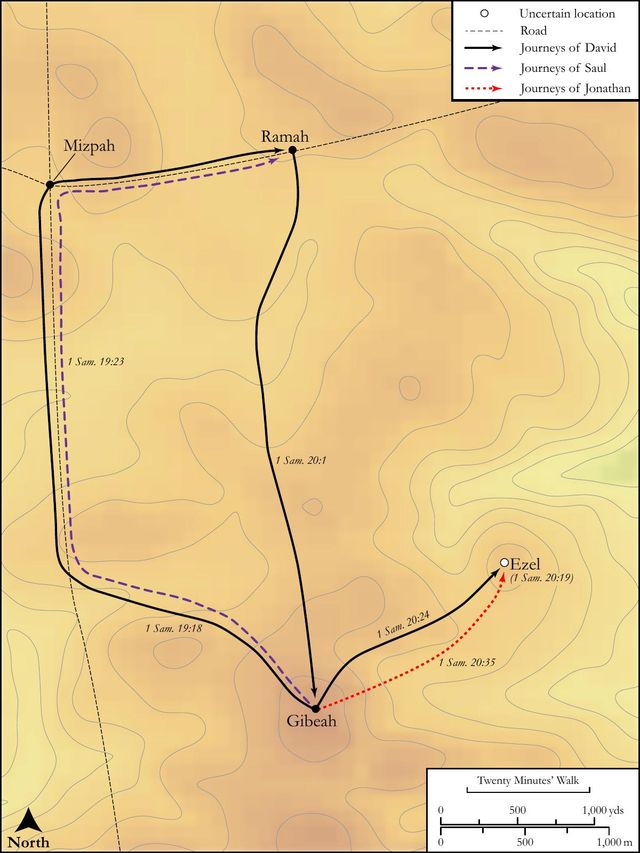
See on the biblical-era map
Study this verse
Public-domain commentary
Matthew Henry
From his Commentary on the Whole Bible. Henry comments on passages, not single verses — this entry covers 1 Samuel 19:18–24. His two-level outline is real structure in the source text, so it is rendered as structure.
Here is, I. David's place of refuge. Having got away in the night from his own house, he fled not to Bethlehem to his relations, nor to any of the cities of Israel that had caressed and cried him up, to make an interest in them for his own preservation; but he ran straight to Samuel and told him all that Saul had done to him, Sa1 19:18. 1. Because Samuel was the man that had given him assurance of the crown, and his faith in that assurance now beginning to fail, and he being ready to say in his haste (or in his flight, as some read it, Psa 116:11), All men are liars ("not only Saul that promised me my life, but Samuel himself that promised me the throne"), whither should he go but to Samuel, for such encouragements, in this day of distress, as would support his faith? In flying to Samuel he made God his refuge, trusting in the shadow of his wings; where else can a good man think himself safe? 2. Because Samuel, as a prophet, was best able to advise him what to do in this day of his distress. In the psalm he penned the night before he had lifted up his prayer to God, and now he takes the first opportunity of waiting upon Samuel to receive direction and instruction from God. If we expect answers of peace to our prayers, we must have our ears open to God's word. 3. Because with Samuel there was a college of prophets with whom he might join in praising God, and the pleasure of this exercise would be the greatest relief imaginable to him in his present distress. He met with little rest or satisfaction in Saul's court, and therefore went to seek it in Samuel's church. And, doubtless, what little pleasure is to be had in this world those have it that live a life of communion with God; to this David retired in the time of trouble, Psa 27:4-6.
II.David's protection in this place:
He and Samuel went and dwelt (or lodged) in Naioth, where the school of the prophets was, in Ramah, as in a privileged place, for the Philistines themselves would not disturb that meeting, Sa1 10:10. But Saul, having notice of it by some of his spies (Sa1 19:19), sent officers to seize David, Sa1 19:20. When they did not bring him he sent more; when they returned not he sent the third time (Sa1 19:21), and, hearing no tidings of these, he went himself, Sa1 19:22. So impatient was he in his thirst after David's blood, so restless to compass his design against him, that, though baffled by one providence after another, he could not perceive that David was under the special protection of Heaven. It was below the king to go himself on such an errand as this; but persecutors will stoop to any thing, and stick at nothing, to gratify their malice. Saul lays aside all public business to hunt David. How was David delivered, now that he was just ready to fall (like his own lamb formerly) into the mouth of the lions? Not as he delivered his lamb, by slaying the lion, or, as Elijah was delivered, by consuming the messengers with fire from heaven, but by turning the lions for the present into lambs.
1.When the messengers came into the congregation where David was among the prophets the Spirit of God came upon them, and they prophesied, that is, they joined with the rest in praising God. Instead of seizing David, they themselves were seized. And thus, (1.) God secured David; for either they were put into such an ecstasy by the spirit of prophecy that they could not think of any thing else, and so forgot their errand and never minded David, or they were by it put, for the present, into so good a frame that they could not entertain the thought of doing so bad a thing.
2.He put an honour upon the sons of the prophets and the communion of saints, and showed how he can, when he pleases, strike an awe upon the worst of men, by the tokens of his presence in the assemblies of the faithful, and force them to acknowledge that God is with them of a truth, Co1 14:24, Co1 14:25. See also the benefit of religious societies, and what good impressions may be made by them on minds that seemed unapt to receive such impressions. And where may the influences of the Spirit be expected but in the congregations of the saints? (3.) He magnified his power over the spirits of men. He that made the heart and tongue can manage both to serve his own purposes. Balaam prophesied the happiness of Israel, whom he would have cursed; and some of the Jewish writers think these messengers prophesied the advancement of David to the throne of Israel.
2.Saul himself was likewise seized with the spirit of prophecy before he came to the place. One would have thought that so bad a man as he was in no danger of being turned into a prophet; yet, when God will take this way of protecting David, even Saul had no sooner come (as bishop Hall expresses it) within smell of the smoke of Naioth but he prophesies, as his messengers did, Sa1 19:23. He stripped off his royal robe and warlike habiliments, because they were either too fine or too heavy for this service, and fell into a trance as it should seem, or into a rapture, which continued all that day and night. The saints at Damascus were delivered from the range of the New Testament Saul by a change wrought on his spirit, but of another nature from this. This was only amazing, but that sanctifying - this for a day, that for ever. Note, Many have great gifts and yet no grace, prophesy in Christ's name and yet are disowned by him, Mat 7:22, Mat 7:23. Now the proverb recurs, Is Saul among the prophets? See Sa1 10:12. Then it was different from what it had been, but now contrary. He is rejected of God, and actuated by an evil spirit, and yet among the prophets.
Historical interpretation
Five Centuries of Reception
6 surviving comments on this verse. Each one is dated, so this reads as a timeline rather than a list.
Select a marker to jump to its quote. Markers stagger vertically where authors wrote within a few decades of each other.
Now, it seems to me that fortuitous circumstance also is sometimes the cause of prophesying, as is true in the present case of Caiaphas. He was high priest of that year [in which] Jesus was to die for the people that the whole nation might not perish. For although others were high priests … no one prophesies except the high priest of the year in which Jesus was to suffer.And it was fortuitous circumstance that caused the messengers of Saul to prophesy when they were sent to David, along with Saul himself. For it is as if the fact that they were seeking David became the cause of their prophecy, such as it was, as has been recorded.
For by the arguments by which he [Eunomius] endeavors to destroy the truth, he is often himself unwittingly drawn into an advocacy of the very doctrines against which he is contending. Some such thing the history tells us concerning Saul … when moved with wrath against the prophets, he was overcome by grace and was found as one of the inspired (the Spirit of prophecy willing, as I suppose, to instruct the apostate by means of himself) whence the surprising nature of the event became a proverb … history records such an expression by way of wonder, “Is Saul also among the prophets?”
For all who do not love God are strangers, are antichrists. And though they come to the churches, they cannot be numbered among the children of God. That fountain of life does not belong to them. To have baptism is possible even for a bad person; to prophesy is possible even for a bad person. We find that king Saul prophesied: he was persecuting holy David, yet he was filled with the spirit of prophecy and began to prophesy.
The book of Kings [Samuel] gives us an example about prophecy. Saul was the persecutor of David. When he was persecuting him, he sent guards to drag him away to punishment, and those who were sent to bring David to be slain found him among the prophets; and Samuel was there too.… So he had fled to the place where besides Samuel, the most distinguished of all the prophets, there were also many other prophets. Pushing their way among them, while they were prophesying, came the emissaries of Saul, to drag him off, as I said, to death. The spirit of God leaped upon them and they began to prophesy, having come to lead a holy and just man of God to the execution block and snatch him away from among the prophets. They were suddenly filled with the spirit of God and turned into prophets. It’s possible this happened because of their innocence; after all, they hadn’t come of their own accord to arrest him but had been sent by their king. And perhaps they had indeed come to the place where David was but weren’t going to do what Saul had told them to; perhaps they too were intending to stay there. Because such things even happen today. Sometimes a bailiff is sent by high authority to drag somebody out of the church; he dare not act against God, and in order not to face execution himself he stays there, in the place he was sent, to haul someone out of it. So you could say, pleasantly surprised and relieved, that these men suddenly became prophets because they were innocent; the very gift of prophecy bore witness to their innocence. They came because they were sent, but they weren’t going to do what that bad man had told them to. Let us believe that about them.Others were sent; the Spirit of God leaped on them too, and they too began to prophesy. Let’s count them too with the first lot as being quite innocent. A third lot were sent; the same happened to them too; let them all be innocent. When they delayed and what Saul had ordered wasn’t done, he came himself. Was he too innocent? Was he also sent by some authority, and not ill-intentioned of his own free will? Yet the Spirit of God leaped on him too, and he began to prophesy. There you are, Saul is prophesying, he has the gift of prophecy, but he has not got charity. He has become a kind of instrument to be touched by the Spirit, not one to be cleansed by the Spirit. The Spirit of God, you see, touches some hearts to set them prophesying, and yet does not cleanse them.… And so the Spirit of God did not cleanse Saul the persecutor, but all the same it touched him to make him prophesy.
Caiaphas, the chief priest, was a persecutor of Christ; and yet he uttered a prophecy when he said, “It is right and proper that one man should die, and not the whole nation perish.” The Evangelist went on to explain this as a prophecy and said, “He did not, however, say this of himself, but being high priest, he prophesied.” Caiaphas prophesied, Saul prophesied; they had the gift of prophecy, but they didn’t have charity. Did Caiaphas have charity, considering he persecuted the Son of God, who was brought to us by charity? Did Saul have charity, who persecuted the one by whose hand he had been delivered from his enemies, so that he was guilty not only of envy but also of ingratitude? So we have proved that it is possible for you to have prophesy and not to have charity. But prophecy does you no good, according to the apostle: “If I do not have charity,” he says, “I am nothing.” He doesn’t say, “Prophesy is nothing,” or “Faith is nothing,” but “I myself am nothing, if I don’t have charity.” So while he has great gifts, he is nothing; although he has great gifts, he is nothing; because these great gifts which he has, he doesn’t have to his benefit but to his condemnation. It isn’t a great thing to have great gifts; but it is a great thing to use great gifts well; but you don’t use them well if you haven’t got charity. The fact is, it is only a good will that uses anything well; but there cannot be a good will where charity is not to be found.
He also stripped himself of his garments, etc. These are clearly the acts of a furious and insane person, to strip oneself, fall down vexed, and lie naked on the ground all day and night. Yet, even through the wrath of such a person, the divine power has something mystical to say for those who hear and discern. For through Balaam, who was of a contrary mind to Him, He foretold so many mysteries beforehand, and through the impious persecutor Caiaphas, He gave the secrets of His saving passion to be prophesied, and through a mute animal speaking with a human voice, He forbade the prophet’s folly; and He Himself through the possessed Saul, in the presence of Samuel and the other prophets, revealed whatever mystical things He wished, so that the innocent David might seize the path to salvation; so the madness of the pursuing Saul might be made evident to all everywhere; and finally, it might be understood how much the presence of the perfect confers on the desires of the humble, which could even lift the proud by the power of prophecy; and thus the future fate of the persecuting people might be marked, who by their hatred deserved to strip Christ of the ornament of His unique kingdom, to fall from the state of the ancient righteousness, advancing amidst the prosperity and adversity of the Church, naked of both heavenly and earthly glory, miserable and adhering only to worldly desires, and among these to hold the writings of prophecy, which would support the faith of the Church by word alone. And it is well said that he prophesied with the others before Samuel; for even now the infidel Synagogue meditates and reads the sayings of the Law and the prophets with the Church; yet the Synagogue lacks spiritual understanding, while the Church knows all those things to be understood about the Lord.
From where the proverb emerged, "Is Saul also among the prophets?" The Jews of the Church have become a proverb, who, with a perverted mentality, make use of Holy Scriptures, which they do not believe or understand, while among the faithful attentive to sacred readings. It is also a proverb for those who will say on the last day: "Lord, Lord, did we not prophesy in your name?" etc. (Matthew VII). And when you see certain unlearned individuals in the Church presumptuously taking the chair of teaching, and under the guise of a faithful teacher, instead of the commands of God, imposing their traditions to be observed, and their doctrines to be followed on deceived listeners, say, "Is Saul also among the prophets?"
Continue studying 1 Samuel 19:24 across the web’s major study libraries — every link below opens this exact verse, chapter, or book on the destination site.
Read & Compare
 BibleGatewayThis verse in more than 200 translations and 70 languages.
 Bible.comThe YouVersion reader — hundreds of translations, reading plans, and highlights.
 ESV.orgCrossway's official English Standard Version reader.
 NET BibleThe NET translation with 60,000+ translators' notes on every rendering decision.
 STEP BibleTyndale House's free study tool — original text, vocabulary, and scholarly resources.
 BibliaLogos Bible Software's free web reader.
 USCCBThe New American Bible (Revised Edition) with the U.S. bishops' study notes.
Commentaries
 BibleHub CommentariesDozens of classic commentaries on this verse, gathered on one page.
 StudyLightMore than 100 commentary sets — the largest collection on the web.
 BibleRefPlain-English commentary on what this verse means, verse by verse.
 Enduring WordDavid Guzik's free commentary on this chapter, widely used by Bible teachers.
 Bible Study ToolsVerse commentary alongside Greek and Hebrew study aids.
Original Language & Research
- BibleHub InterlinearThe verse word by word — original language, transliteration, and English.
- BibleHub LexiconEvery word's original-language definition and Strong's entry.
 Blue Letter BibleDeep-study tools — Strong's numbers, concordance, and word studies.
 SefariaThe Hebrew text with Rashi and centuries of Jewish commentary.
Sermons, Hymns & Audio


TrulyRandomVerse is not affiliated with these sites and doesn’t control their content. They’re linked because they’re genuinely useful.
Summary
1 Samuel 19:24 culminates King Saul's desperate pursuit of David in a dramatic display of divine sovereignty. After his attempts to capture David through messengers were repeatedly thwarted by the Spirit of God, Saul himself confronts this irresistible divine power. Stripped of his royal authority and dignity, he is overcome by the Spirit, prophesying and lying naked for an entire day and night. This extraordinary event leads to the ironic re-utterance of the proverb, "Is Saul also among the prophets?", powerfully demonstrating God's unyielding protection of His anointed David and the ultimate futility of human opposition to His divine will.
Context
ShowHideLiterary Context
This verse serves as the climactic conclusion to a series of escalating divine interventions in 1 Samuel 19. Following David's initial escapes from Saul's murderous intent, aided by Michal and Jonathan, David flees to Samuel at Naioth in Ramah, a known prophetic center. Saul, consumed by a jealous and murderous rage, dispatches three successive groups of messengers to seize David. Each time, however, the Spirit of God descends upon them, causing them to prophesy and rendering them incapable of fulfilling Saul's violent command. This repeated and escalating divine intervention underscores the futility of Saul's efforts and the inviolability of God's chosen one. The narrative builds suspense, culminating in Saul's personal confrontation with the Spirit, which not only protects David but also publicly humiliates Saul, setting the stage for his ultimate rejection as king.
Historical & Cultural Context
The events of 1 Samuel 19:24 are set within the early Israelite monarchy, a period marked by the transition from judges to kings, and the establishment of prophetic communities. Prophecy in this era was often characterized by ecstatic behavior, communal experiences, and direct divine inspiration, not always limited to verbal predictions. Saul's initial anointing as king was accompanied by the Spirit of God coming upon him, leading him to prophesy (1 Samuel 10:6). However, due to his disobedience, the Spirit had departed from him, replaced by a tormenting evil spirit (1 Samuel 16:14). The act of "stripping off clothes" or "nakedness" (Hebrew: 'arom) in biblical contexts could signify vulnerability, humiliation, a prophetic sign act (as seen in Isaiah 20:2-4), or simply the removal of outer garments, particularly royal attire, symbolizing a loss of status and control. In this instance, it powerfully communicates Saul's utter powerlessness before God.
Key Themes
ShowHideThe passage powerfully highlights God's sovereign protection of David, His chosen king, against the malicious and persistent attempts of King Saul. The irresistible power of the Holy Spirit is vividly displayed, demonstrating its ability to override human will, even compelling a hostile king to participate in a prophetic act that effectively incapacitates him and protects David. This event also underscores the profound humiliation and degradation of Saul, who, despite his royal status, is reduced to a state of vulnerability and loss of control, mirroring his spiritual decline and God's rejection of his reign. The re-emergence of the proverb, "Is Saul also among the prophets?", now carries profound irony, shifting from a sign of his initial anointing and blessing to a symbol of his forced submission and God's judgment upon his rebellious heart.
Exposition and Analysis
ShowHideKey Word Analysis
ShowHideThis verb (H6584) means "to spread out (i.e. deploy in hostile array); by analogy, to strip (i.e. unclothe, plunder, flay, etc.)." In 1 Samuel 19:24, it refers to Saul divesting himself of his garments, likely his royal robes or outer attire. This act is not voluntary but compelled, serving as a powerful visual symbol of his loss of dignity, authority, and control. It signifies his spiritual nakedness and vulnerability before God, contrasting sharply with his kingly status and previous attempts to assert his will.
This primitive root (H5012) means "to prophesy, i.e. speak (or sing) by inspiration (in prediction or simple discourse)." Here, it describes Saul being under divine inspiration, likely accompanied by ecstatic behavior. This emphasizes that Saul's actions were not self-willed but compelled by the Spirit of God, specifically to prevent him from harming David. It represents a forced submission to God's will, distinct from his earlier, willing prophetic experience in 1 Samuel 10:10.
This term (H6174) means "nude, either partially or totally." While often translated as "naked," in biblical Hebrew, it can also mean "stripped of outer garments" or "lightly clad," rather than complete nudity. In this context, it emphasizes Saul's exposed and vulnerable state, devoid of the symbols of his royal office and power. It underscores his profound humiliation and the complete subjection of his will to the divine power that had taken hold of him, rendering him utterly incapacitated.
Verse Breakdown
ShowHide"And he stripped off his clothes also"
This initial action immediately signifies Saul's involuntary and complete submission to the Spirit's overwhelming power. The removal of his garments, particularly any royal attire, is a profound symbolic act of divestment. He is stripped not only of his clothing but, more significantly, of his kingly authority, dignity, and control, visually representing his utter powerlessness before the divine.
"and prophesied before Samuel in like manner"
Just as his messengers had been compelled to prophesy, Saul himself is now forced into this ecstatic state. This highlights the irresistible nature of God's Spirit, which can even overcome the will of a king hostile to God's purposes. The act of prophesying "before Samuel," the very prophet who had anointed him and later pronounced God's rejection of his reign, adds a layer of poignant dramatic irony and reinforces the public nature of Saul's humiliation.
"and lay down naked all that day and all that night"
This extended period of lying "naked" (or stripped of his outer garments) emphasizes the intensity, duration, and completeness of the Spirit's hold on Saul. It renders him utterly incapacitated and unable to pursue David, thereby providing complete and sustained protection for David. This prolonged state of vulnerability further underscores Saul's absolute loss of control and the depth of his public humiliation.
"Wherefore they say, [Is] Saul also among the prophets?"
This rhetorical question, a proverb first uttered in 1 Samuel 10:11, is repeated here with profound and bitter irony. Initially, it marked Saul's anointing and the Spirit's blessing, signifying his new spiritual calling and God's favor. Here, it signifies his forced, humiliating submission to God's power, preventing him from committing further sin against God's anointed. It starkly highlights the contrast between his initial promise and his current state of spiritual rebellion and divine judgment.
Literary Devices
ShowHideThe passage powerfully employs Irony, particularly through the repetition of the proverb, "Is Saul also among the prophets?" What was once a sign of Saul's divine anointing and favor (1 Samuel 10:11) becomes, in 1 Samuel 19:24, a symbol of his humiliation and God's forceful intervention to thwart his evil intentions. This reversal underscores Saul's spiritual decline and God's judgment. Symbolism is also prominent: Saul's stripping of his clothes and lying "naked" symbolizes his loss of royal dignity, authority, and control, representing his spiritual nakedness and vulnerability before God. The entire scene serves as a dramatic Foreshadowing of Saul's ultimate downfall and the transfer of kingship to David, demonstrating God's unwavering commitment to His chosen one and the futility of resisting divine decree.
Theological and Thematic Connections
ShowHideThis passage profoundly illustrates the absolute sovereignty of God, demonstrating that no human will, not even that of a king, can thwart His divine purposes. God's Spirit is portrayed as an irresistible force, capable of compelling obedience or incapacitation even from those who actively oppose His will. This divine intervention serves as a powerful testament to God's protective care over His chosen servants, ensuring their safety and the fulfillment of His plans despite formidable opposition. It also highlights the severe consequences of rebellion against God's anointing and His chosen instruments, as Saul's persistent disobedience and murderous intent lead to his public humiliation and incapacitation, a stark reminder that pride and defiance ultimately yield to divine authority and judgment.
Reflection and Application
ShowHideThe astonishing scene in 1 Samuel 19:24 offers profound lessons for contemporary believers, reminding us of God's active and protective hand over His children, even in the face of formidable opposition. When we feel overwhelmed by adversaries or circumstances that seem intent on thwarting God's will in our lives, this passage encourages us to trust implicitly in His sovereign power. God can, and often does, intervene in ways we least expect, turning the hearts, frustrating the plans, and even incapacitating those who oppose His purposes. It also serves as a sobering warning against resisting God's call or His chosen instruments. Saul's humiliation is a powerful demonstration that pride, jealousy, and persistent rebellion against divine authority ultimately lead to downfall and public disgrace. Our surrender to God's will, even when it challenges our own desires or perceived control, is the path to true peace, spiritual alignment, and participation in His unfolding, unstoppable plan.
Questions for Reflection
ShowHideFAQ
ShowHideWhy did Saul "prophesy" and lie "naked" in this context?
ShowHideSaul's "prophesying" here was not a voluntary act of spiritual devotion or a prophetic utterance in the sense of foretelling the future. Instead, it was a forced, ecstatic state brought about by the overwhelming power of the Spirit of God. This divine intervention served a specific purpose: to incapacitate Saul, preventing him from harming David, God's chosen king. The "nakedness" (Hebrew: 'arom) likely refers to being stripped of his outer garments, possibly his royal robes, rather than complete nudity. This act powerfully symbolized his loss of dignity, authority, and control, highlighting his humiliation and vulnerability before God's irresistible power. It was a visible sign of his spiritual degradation and God's rejection of his reign, demonstrating that God's will would prevail regardless of Saul's malicious intent.
What is the significance of the proverb, "Is Saul also among the prophets?" being repeated here?
ShowHideThe proverb "Is Saul also among the prophets?" first appeared in 1 Samuel 10:11 when Saul was first anointed king and the Spirit of God came upon him, marking a new spiritual beginning and a sign of God's favor. Its repetition in 1 Samuel 19:24 is deeply ironic and poignant. What was once a question of wonder and affirmation of his new spiritual status now becomes a question of mockery and humiliation. It underscores how far Saul has fallen from God's favor due to his persistent disobedience and rebellion. The Spirit's presence is no longer a blessing for him but a means of divine restraint and judgment, preventing him from fulfilling his malicious intent against God's anointed David. It highlights the tragic trajectory of Saul's reign, from promise to profound spiritual decline.
Does this passage suggest that God forces people to do His will against their conscience?
ShowHideThis passage illustrates God's sovereign power to intervene in human affairs to accomplish His purposes, especially when His chosen ones are in danger. While Saul's will was clearly set against David, God's Spirit did not force him to embrace God's will or change his heart, but rather to submit to God's power in a way that prevented him from acting on his wicked intentions. It demonstrates God's ability to restrain evil and protect His plans, even by temporarily overriding human agency and physical capacity. This is distinct from forcing an individual's conscience or belief system. God's ultimate desire is for willing obedience and a transformed heart, but He retains the right and power to intervene when necessary to uphold His covenant and protect His people, as seen in other instances of divine restraint (e.g., Genesis 20:6 and Exodus 9:16).
Christ-Centered Fulfillment
ShowHideThe dramatic scene of Saul's incapacitation by the Spirit in 1 Samuel 19:24 powerfully foreshadows the ultimate triumph of God's anointed King, Jesus Christ, over all opposition. Just as God sovereignly protected David, the type of the Messiah, from Saul's murderous intent, so too does God ensure the victory of His Son. The Spirit's irresistible power, which humbled Saul and thwarted his evil designs, points to the Spirit's far greater work in the New Covenant, not merely to restrain evil but to transform hearts and empower believers for righteousness and mission (Acts 1:8). The humiliation of Saul, stripped of his garments and dignity, contrasts sharply with Christ, who willingly "emptied himself," stripping himself of divine glory to take on human form (Philippians 2:7), only to be exalted to the highest place by God (Philippians 2:9-11). While Saul's prophesying was a forced, humiliating act, Christ is the Prophet par excellence, speaking God's perfect truth and fulfilling all prophecy concerning salvation and the Kingdom of God (Deuteronomy 18:15; Hebrews 1:1-2). Ultimately, this passage reminds us that no earthly power, no human malice, can thwart God's redemptive plan, which culminates in the eternal reign of the true King, Jesus, who has triumphed over sin, death, and all the powers of darkness (Colossians 2:15).