


Genesis 20:6
Bible text: King James Version (1769 Blayney text) · Public domain
Bible text: King James Version with Strong's numbers · Public domain
Bible text: Berean Standard Bible · Public domain
Bible text: American Standard Version (1901) · Public domain
Bible text: World English Bible, Messianic edition · Public domain
Bible text: Geneva Bible (1599) · Public domain
Bible text: Young's Literal Translation · Public domain
- וַיֹּאמֶרvai·yo·Merand he saidH559Conj-w ¦ V-Qal-ConsecImperf-3msVerb Qal Consecutive Imperfect 3rd Singular Masculineוַandיֹּאמֶרhe said
- אֵלָיו'e·Lavto himH413Prep ¦ 3msPreposition Definiteאֵלָיtoוhim
- הָאֱלֹהִיםha·'E·lo·Him<the> GodH430Art ¦ N-mpNoun Plural Masculine Absoluteהָ<the>אֱלֹהִיםGod
- בַּחֲלֹםba·cha·Lomin a dreamH2472Prep-b ¦ N-msNoun Singular Masculine Absoluteבַּinחֲלֹםa dream
- גַּםgamalsoH1571AdvAdverb
- אָנֹכִי'a·no·KhiIH595Pro-1csPronoun Personal 1st Singular common gender
- יָדַעְתִּיya·Da'·tiI knowH3045V-Qal-Perf-1csVerb Qal Perfect 1st Singular common gender
- כִּיkithatH3588PrtParticle Conditional
- בְתָםve·tomin [the] integrity ofH8537Prep-b ¦ N-mscNoun Singular Masculine Constructבְinתָם[the] integrity of
- לְבָבְךָle·va·ve·Khayour heartH3824N-msc ¦ 2msNoun Singular Masculine Constructלְבָבְheartךָyour
- עָשִׂיתָ'a·Si·tayou didH6213V-Qal-Perf-2msVerb Qal Perfect 2nd Singular Masculine
- זֹּאתZotthisH2063PrtParticle Demonstrative
- וָאֶחְשֹׂךְva·'ech·Sokhand I have restrainedH2820Conj-w ¦ V-Qal-ConsecImperf-1csVerb Qal Consecutive Imperfect 1st Singular common genderוָandאֶחְשֹׂךְI have restrained
- גַּםgamalsoH1571AdvAdverb
- אָנֹכִי'a·no·KhiIH595Pro-1csPronoun Personal 1st Singular common gender
- אוֹתְךָ'ot·Kha<obj.> youH853DirObjM ¦ 2msParticle Object Indicatorאוֹתְ<obj.>ךָyou
- מֵחֲטוֹme·cha·tovfrom sinningH2398Prep-m ¦ V-Qal-InfVerb Qal Infinitive Constructמֵfromחֲטוֹsinning
- לִיLito <the> mePrep-l ¦ 1csSuffix Personal 1st Singular common genderלִto <the>יme
- עַל'althere-H5921PrepPreposition
- כֵּןken-foreH3651AdvAdverb
- לֹאlo'notH3808NegParticle Negative
- נְתַתִּיךָne·ta·Ti·khaI have permitted youH5414V-Qal-Perf-1cs ¦ 2msVerb Qal Perfect 1st Singular common genderנְתַתִּיI have permittedךָyou
- לִנְגֹּעַlin·Go·a'to touchH5060Prep-l ¦ V-Qal-InfVerb Qal Infinitive Constructלִtoנְגֹּעַtouch
- אֵלֶיהָ'e·Lei·ha<to> herH413Prep ¦ 3fsPreposition Definiteאֵלֶי<to>הָher
English is a literal word-by-word gloss of the Hebrew, not the KJV's wording. Why?
This is the original text the KJV's translators worked from — each Hebrew word with its own literal English meaning in this verse, prepared by scholars at Tyndale House, Cambridge. The KJV translates whole sentences, not word by word, so its wording differs: one Hebrew word can become several English words, and the KJV may choose “the LORD” where the gloss reads “Yahweh”. Both are faithful — they answer different questions. For the KJV's own rendering, switch to the KJV text.
Details
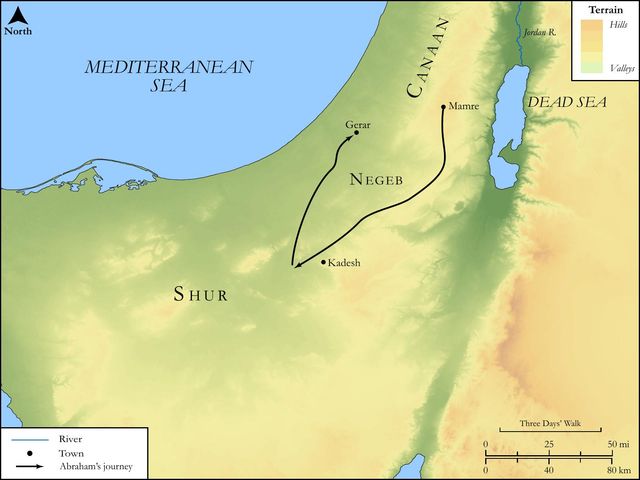
See on the biblical-era maps


Study this verse
Public-domain commentary
Matthew Henry
From his Commentary on the Whole Bible. Henry comments on passages, not single verses — this entry covers Genesis 20:3–7. His three-level outline is real structure in the source text, so it is rendered as structure.
It appears by this that God revealed himself by dreams (which evidenced themselves to be divine and supernatural) not only to his servants the prophets, but even to those who were out of the pale of the church and covenant; but then, usually, it was with some regard to God's own people as in Pharaoh's dream, to Joseph, in Nebuchadnezzar's, to Daniel, and here, in Abimelech's, to Abraham and Sarah, for he reproved this king for their sake, Psa 105:14, Psa 105:15.
I.God gives him notice of his danger (Gen 20:3), his danger of sin, telling him that the woman is a man's wife, so that if he take her he will wrong her husband; his danger of death for this sin: Thou art a dead man; and God's saying so of a man makes him so. Note, Every wilful sinner ought to be told that he is a dead man, as the condemned malefactor, and the patient whose disease is mortal, are said to be so. If thou art a bad man, certainly thou art a dead man.
II.He pleads ignorance that Abraham and Sarah had agreed to impose upon him, and not to let him know that they were any more than brother and sister, Gen 20:6. See what confidence a man may have towards God when his heart condemns him not, Jo1 3:21. If our consciences witness to our integrity, and that, however we may have been cheated into a snare, we have not knowingly and wittingly sinned against God, it will be our rejoicing in the day of evil. He pleads with God as Abraham had done, Gen 18:23. Wilt thou slay a righteous nation? Gen 20:4. Not such a nation as Sodom, which was indeed justly destroyed, but a nation which, in this matter, was innocent.
III.God gives a very full answer to what he had said.
1.He allows his plea, and admits that what he did he did in the integrity of his heart: Yea, I know it, Gen 20:6. Note, It is matter of comfort to those that are honest that God knows their honesty, and will acknowledge it, though perhaps men that are prejudiced against them either cannot be convinced of it or will not own that they are.
2.He lets him know that he was kept from proceeding in the sin merely by the good hand of God upon him: I withheld thee from sinning against me. Abimelech was hereby kept from doing wrong, Abraham from suffering wrong, and Sarah from both. Note,
(1.)There is a great deal of sin devised and designed that is never executed. As bad as things are in the world, they are not so bad as the devil and wicked men would have them.
(2.)It is God that restrains men from doing the ill they would do. It is not from him that there is sin, but it is from him that there is not more sin, either by his influence upon men's minds, checking their inclination to sin, or by his providence, taking away the opportunity to sin.
(3.)It is a great mercy to be hindered from committing sin; of this God must have the glory, whoever is the instrument, Sa1 25:32, Sa1 25:33.
3.He charges him to make restitution: Now therefore, not that thou art better informed, restore the man his wife, Gen 20:7. Note, Ignorance will excuse no longer than it continues. If we have entered upon a wrong course through ignorance this will not excuse our knowingly persisting in it, Lev 5:3-5. The reasons why he must be just and kind to Abraham are,
(1.)Because he is a prophet, near and dear to God, for whom God does in a particular manner concern himself. God highly resents the injuries done to his prophets, and takes them as done to himself.
(2.)Being a prophet, he shall pray for thee; this is a prophet's reward, and a good reward it is. It is intimated that there was great efficacy in the prayers of a prophet, and that good men should be ready to help those with their prayers that stand in need of them, and should make, at least, this return for the kindnesses that are done them. Abraham was accessory to Abimelech's trouble, and therefore was obliged in justice to pray for him.
(3.)It is at thy peril if thou do not restore her: Know thou that thou shalt surely die. Note, He that does wrong, whoever he is, prince or peasant, shall certainly receive for the wrong which he has done, unless he repent and make restitution, Col 3:25. No injustice can be made passable with God, no, not by Caesar's image stamped upon it.
Historical interpretation
Five Centuries of Reception
2 surviving comments on this verse. Each one is dated, so this reads as a timeline rather than a list.
Select a marker to jump to its quote. Markers stagger vertically where authors wrote within a few decades of each other.
But what is the meaning of that which Scripture adds: “And the Lord did not permit him to touch her”? If Sarah represents virtue and Abimelech wished to receive virtue “with a pure heart,” why is it said that “the Lord did not permit him to touch her”?Abimelech means “my father is king.” It seems to me therefore that this Abimelech represents the studious and wise men of the world, who by giving attention to philosophy, although they do not reach the complete and perfect rule of piety, nevertheless perceive that God is the Father and King of all things. Those, therefore, so far as it pertains to ethics (that is, moral philosophy), are acknowledged also to have given attention in some respects to purity of heart and to have sought the inspiration of divine virtue with all their mind and zeal. But “God did not permit” them “to touch” her. For this grace was designed to be delivered to the Gentiles not by Abraham, who, although he was great was nevertheless a servant, but by Christ.… Abraham was eager that what was said to him be fulfilled through and in himself, that “all the nations shall be blessed in you.” Nevertheless the promise to him is established in Isaac, that is, in Christ, as the apostle says: “He did not say, And to his seeds, as of many, but as of one, and to your seed, which is Christ.”26
Nevertheless “the Lord heals Abimelech and his wife and his handmaids.”
And I know that you have done this with a simple heart; therefore I have kept you from sinning against me. But also that he immediately rose in the night, called all his servants, and narrated to them what had happened to him; and that they, having heard the danger of the offense into which the king had fallen, were all greatly afraid, demonstrates how devoted to justice both the king and his servants were: For the king himself, when he said to Abraham: What have you done to us? What did we sin against you, that you have brought upon me and my kingdom a great sin? clearly implies that he did not consider the sin of ignorance to be trivial, which he confessed was harmful not only to himself but also to his kingdom. Hence, he did not believe it sufficient for him that he had obtained pardon from God, or had deserved to be kept from sinning by God’s favor, unless he also gave money abundantly along with the returned wife to the man against whom he had unknowingly sinned, so that he might be appeased, as it is read in the following passages. Nor is it to be wondered that uncircumcised men at that time could have been worshippers of truth, since the blessed Job and his royal friends are believed to have faithfully served the Lord with all that they had after the times of the given circumcision, without the sacrament of circumcision: but also, it is evident that the patriarch Shem, along with Arphaxad, Salah, Heber, his sons or grandchildren, were still alive in the flesh at that time and led a life pleasing to God without the law of circumcision. From this, it seems likely that the sign in the circumcision of Abraham was given only to him and his seed and family, but among other nations, there could still have been some who naturally served God devotedly according to the law; whether by the offerings of sacrifices or certainly by the profession of true faith alone, cleansed from the stain of the first transgression, especially those who still survived and remembered the destruction of the human race in the flood, the building of the tower and the division of tongues, or the ruin of Sodom. For the very history of Genesis testifies that Shem himself endured in the body up until the fiftieth year of Jacob’s birth; to which opinion the blessed Pope Gregory agrees, saying it should by no means be believed that the lifespan of men in those times was as short as the few records of his writers seem to comprehend in Moses’ law. And when Abraham replied to the king who persistently questioned him why he had said his wife was his sister, and answered among other things: Besides, she is indeed my sister, the daughter of my father, but not the daughter of my mother; the ancient translation has more fittingly: Indeed, she is my sister by my father, but not by my mother; that is, the daughter of his brother, not his sister; for brothers or sisters are sometimes called kin in the Scriptures, who are of one family, that is, from the fatherland, which the Latins interpret as fatherhoods, when many branches of the family spread from one root; otherwise, how is it that Abraham, a just man, took his father’s daughter as his wife, when in the first men for the sake of the ears’ health the Scripture does not name it, preferring to be understood rather than openly stated? And that the king said to Sarah:
Continue studying Genesis 20:6 across the web’s major study libraries — every link below opens this exact verse, chapter, or book on the destination site.
Read & Compare
 BibleGatewayThis verse in more than 200 translations and 70 languages.
 Bible.comThe YouVersion reader — hundreds of translations, reading plans, and highlights.
 ESV.orgCrossway's official English Standard Version reader.
 NET BibleThe NET translation with 60,000+ translators' notes on every rendering decision.
 STEP BibleTyndale House's free study tool — original text, vocabulary, and scholarly resources.
 BibliaLogos Bible Software's free web reader.
 USCCBThe New American Bible (Revised Edition) with the U.S. bishops' study notes.
Commentaries
 BibleHub CommentariesDozens of classic commentaries on this verse, gathered on one page.
 StudyLightMore than 100 commentary sets — the largest collection on the web.
 BibleRefPlain-English commentary on what this verse means, verse by verse.
 Enduring WordDavid Guzik's free commentary on this chapter, widely used by Bible teachers.
 Bible Study ToolsVerse commentary alongside Greek and Hebrew study aids.
Original Language & Research
- BibleHub InterlinearThe verse word by word — original language, transliteration, and English.
- BibleHub LexiconEvery word's original-language definition and Strong's entry.
 Blue Letter BibleDeep-study tools — Strong's numbers, concordance, and word studies.
 SefariaThe Hebrew text with Rashi and centuries of Jewish commentary.
Sermons, Hymns & Audio


TrulyRandomVerse is not affiliated with these sites and doesn’t control their content. They’re linked because they’re genuinely useful.
Summary
Genesis 20:6 profoundly illustrates God's active and sovereign involvement in human affairs, specifically His direct communication with King Abimelech through a dream. In this divine encounter, God affirms Abimelech's innocent intentions regarding Sarah, Abraham's wife, and explicitly declares His own supernatural intervention in preventing Abimelech from committing a grave sin against Him by touching her. This intervention highlights God's omniscience, His commitment to protecting the purity of the promised covenant lineage, and His broader justice and mercy.
Context
ShowHideLiterary Context
This incident in Gerar follows Abraham's earlier deception in Egypt (Genesis 12:10-20), where he also presented Sarah as his sister out of fear for his life. The repetition of this narrative motif underscores Abraham's recurring lack of faith and God's unwavering faithfulness despite human failings. In Genesis 20, Abimelech, unaware of Sarah's true marital status, takes her into his household with the intention of marriage. God's dramatic intervention, striking Abimelech's household with barrenness and appearing to the king in a dream, prevents the consummation of the marriage and the defilement of the covenant line. This divine action directly precedes the birth of Isaac in Genesis 21, emphasizing the critical importance of Sarah's purity for the fulfillment of God's covenant promises.
Historical & Cultural Context
Among the kings of that day, a king's household was central to his power and legacy, and the ability to produce heirs was paramount. Taking a woman into a royal harem was a common practice. However, unknowingly taking a married woman, especially one belonging to a prominent figure like Abraham (who was perceived as a prophet, Genesis 20:7), carried significant moral and social implications. The concept of "integrity of heart" was valued in ancient wisdom traditions, signifying an upright character and pure intentions before the gods. God's judgment on Abimelech's household, causing barrenness, reflects a common understanding of divine displeasure manifesting in physical consequences, particularly concerning fertility, which was seen as a divine blessing.
Key Themes
ShowHideGenesis 20:6 contributes significantly to several overarching themes in the book of Genesis and biblical theology. It powerfully demonstrates Divine Sovereignty, showing God's active control over human events and His ability to restrain evil for His purposes. The verse also highlights God's Omniscience, as He knows the true intentions of Abimelech's heart, reinforcing that God sees beyond outward actions (1 Samuel 16:7). Furthermore, it underscores the Nature of Sin, revealing that even unintentional actions can be an offense against God's holiness. Most crucially, God's intervention serves as a testament to His Covenant Faithfulness, as He meticulously protects the purity of the lineage through which the promised Messiah would come, ensuring the fulfillment of His promises to Abraham found in passages like Genesis 12:1-3.
Exposition and Analysis
ShowHideKey Word Analysis
ShowHideThis adverb, often translated as "also" or "even," here functions as an emphatic affirmation, akin to "Indeed" or "Certainly." God is not merely acknowledging, but confirming with certainty His knowledge of Abimelech's state of heart. It adds weight and divine authority to the subsequent declaration.
This primitive root signifies "to know" in a comprehensive sense, encompassing not just intellectual understanding but also experiential, intimate, and often personal knowledge. When God uses yâdaʻ, it implies His perfect omniscience, His deep insight into the innermost thoughts, motives, and intentions of Abimelech's heart, far beyond what any human could discern.
Derived from a root meaning "to be complete" or "blameless," tôm here denotes moral completeness, sincerity, or uprightness. It describes Abimelech's state of heart as being without malicious intent, guile, or conscious wrongdoing regarding Sarah. He acted in ignorance of her marital status, and thus, his intentions were pure in that specific context.
This root means "to restrain" or "refrain," implying active prevention or holding back. God explicitly states that He was the agent who actively prevented Abimelech from completing the act. This is a powerful demonstration of divine sovereignty and intervention, not merely allowing, but directly hindering a potential sin.
This primary root means "to miss the mark," and by extension, "to sin." It encompasses both intentional and unintentional transgressions. Here, even though Abimelech was ignorant of Sarah's true status, the act of taking a married woman would still have been a "missing of the mark" against God's moral order and holiness, ultimately an offense against Him.
Verse Breakdown
ShowHide"And God said unto him in a dream"
This opening phrase establishes the divine origin and authority of the message. God's communication through a dream signifies a direct, supernatural intervention into human consciousness, bypassing normal means of revelation. It highlights God's active involvement in the unfolding narrative and His sovereign ability to communicate His will and warnings.
"Yea, I know that thou didst this in the integrity of thy heart"
This clause reveals God's omniscience and His just assessment of human motives. God affirms Abimelech's sincerity and lack of malicious intent. Abimelech was morally innocent in his intentions because he was unaware of Sarah's true status. This divine acknowledgment distinguishes Abimelech's potential action from a willful, defiant sin, even though the action itself would still have been a violation of God's moral order.
"for I also withheld thee from sinning against me"
This is the pivotal declaration of divine intervention. God explicitly states that He was the one who actively restrained Abimelech, demonstrating His sovereign power to prevent evil. This act of divine grace protected Abimelech from unknowingly committing a grave sin, which God defines as being "against me." This underscores the theological truth that all sin, regardless of its immediate target or the perpetrator's intent, is ultimately an offense against God's holiness and His law.
"therefore suffered I thee not to touch her."
This concluding phrase specifies the exact nature of God's preventative action. The word "touch" here is a euphemism for sexual intimacy. God's direct intervention prevented the physical defilement of Sarah, which was crucial for the continuation of the covenant lineage through which the promised Messiah would come. This demonstrates God's meticulous care for His covenant promises and His plan of redemption.
Literary Devices
ShowHideThe passage employs several significant literary devices. Divine Dialogue is central, as God directly speaks to Abimelech, emphasizing His personal involvement and authority. The use of Anthropomorphism is evident in God's declaration, "I also withheld thee," portraying God as actively intervening in human affairs with a physical-like action, though understood spiritually. There is also a clear Euphemism in the phrase "to touch her," which delicately refers to sexual relations, common in biblical narrative to avoid explicit language. Finally, the entire episode functions as Foreshadowing, subtly pointing to God's ongoing commitment to protect the purity of the Abrahamic line, which is essential for the eventual birth of Isaac and, ultimately, the coming of the Messiah.
Theological and Thematic Connections
ShowHideGenesis 20:6 offers profound theological insights into the character of God and the nature of sin. It powerfully demonstrates God's omniscience, as He perfectly discerns the intentions of the human heart, ensuring His judgments are always just and perfectly aligned with truth. More strikingly, it illustrates God's sovereign power to intervene directly in human affairs, even preventing individuals from committing sin. This highlights that God can and does restrain evil for His purposes, even when humans are unaware of His hand or the danger they face. The declaration "sinning against me" underscores the fundamental truth that all sin, regardless of its immediate target or the perpetrator's intent, is ultimately an offense against a holy God. God's active protection of Sarah's purity, despite Abraham's deception, further emphasizes His unwavering covenant faithfulness and His meticulous preservation of the lineage through which the Messiah would come. This divine intervention for Abimelech, a non-covenant king, also showcases an aspect of God's common grace—His general goodness and mercy extended to all humanity, even those who do not explicitly know Him.
Reflection and Application
ShowHideGenesis 20:6 provides both immense comfort and a challenging call to introspection for believers today. It reminds us that God is intimately involved in our lives, often intervening in unseen ways to protect us from ourselves or from unknowingly falling into sin. This highlights God's immense grace, extended even to those outside His direct covenant, when their intentions are pure. We can find comfort in knowing that God's sovereign hand is at work, guiding and protecting, even when we are unaware of the dangers we might face or the ways He is shielding us. Furthermore, this passage teaches us the critical importance of cultivating an "integrity of heart" before God, knowing that He sees our true motives, not just our outward actions. While we are accountable for our deeds, God also considers the sincerity of our intentions. This calls us to a deeper level of spiritual honesty, striving for purity of motive in all we do. Finally, it reinforces the sobering truth that all sin, whether intentional or not, is ultimately an offense against God's holiness, and His perfect standard is one that only He can perfectly uphold.
Questions for Reflection
ShowHideFAQ
ShowHideWhat does "integrity of thy heart" mean in a practical sense for a person today?
ShowHide"Integrity of thy heart" (Hebrew: tôm lêbâb) refers to sincerity, blamelessness, and a lack of malicious intent. For a person today, it means striving for genuine purity of motive before God, acting with honesty and uprightness, even when others are unaware of your true intentions. It acknowledges that God sees beyond outward appearances to our deepest desires and motives, as highlighted in passages like 1 Samuel 16:7. Practically, it means seeking to please God in your inner being, not just conforming to external rules, and acting with a clear conscience, even if you make mistakes out of ignorance.
Why did God intervene for Abimelech but allow Abraham's deception?
ShowHideGod's actions are sovereign and multifaceted, often serving His greater redemptive purposes. In this instance, God directly intervened to prevent Abimelech from unknowingly committing a sin that would have defiled the covenant lineage through Sarah, which was critical for the birth of Isaac and the continuation of the Messianic line. While God allows sin to occur (as with Abraham's repeated deception, seen in Genesis 12), He also actively restrains it for His specific purposes, particularly when it directly impacts His overarching redemptive plan. Abraham's sin, though serious and deserving of rebuke, did not result in the defilement of the covenant lineage in the same way Abimelech's completed action would have. God's intervention here demonstrates His meticulous care for His covenant promises.
How does this passage relate to the concept of "common grace"?
ShowHideThis passage provides a clear illustration of God's common grace. Common grace refers to God's general goodness and mercy extended to all humanity, regardless of their spiritual standing or covenant relationship with Him. In Genesis 20:6, God actively protects Abimelech, a non-covenant king, from unknowingly committing a grave sin. This divine restraint and warning, extended to someone outside the direct covenant line, demonstrates God's broader justice, His concern for human well-being, and His desire to prevent evil, even for those who do not explicitly know Him. It shows that God's benevolent hand is at work in the world, preserving order and restraining human depravity, even among the unrighteous.
Christ-Centered Fulfillment
ShowHideGenesis 20:6, with its depiction of God's active protection of Sarah's purity and His prevention of Abimelech's sin, finds its ultimate and glorious fulfillment in Jesus Christ. God's meticulous intervention to preserve the covenant lineage directly points to the coming of the Messiah, who would be born of a pure and undefiled line. Christ Himself embodies the ultimate "integrity of heart," living a life of perfect blamelessness and sincerity before God, fulfilling all righteousness (as seen in Matthew 3:15). Furthermore, just as God sovereignly withheld Abimelech from sinning, Christ, through His atoning sacrifice on the cross, ultimately deals with the problem of sin itself, offering forgiveness for our past transgressions and the power to live righteously in the present. He is the ultimate protector of His people, not merely from specific sins, but from the power and penalty of sin, securing the eternal covenant with His own blood (as explained in Hebrews 9:14). Through Christ, God's perfect justice and mercy converge, providing the means for humanity to be truly reconciled to a holy God, a reconciliation that no human integrity of heart could ever achieve on its own.