


Genesis 20:7
Bible text: King James Version (1769 Blayney text) · Public domain
Bible text: King James Version with Strong's numbers · Public domain
Bible text: Berean Standard Bible · Public domain
Bible text: American Standard Version (1901) · Public domain
Bible text: World English Bible, Messianic edition · Public domain
Bible text: Geneva Bible (1599) · Public domain
Bible text: Young's Literal Translation · Public domain
- וְעַתָּהve·'a·Tahand thereforeH6258Conj-w ¦ AdvAdverbוְandעַתָּהtherefore
- הָשֵׁבha·ShevreturnH7725V-Hiphil-Imp-2msVerb Hiphil Imperative 2nd Singular Masculine
- אֵשֶׁת'e·shet[the] wife ofH802N-fscNoun Singular Feminine Construct
- הָאִישׁha·'Ishthe manH376Art ¦ N-msNoun Singular Masculine Absoluteהָtheאִישׁman
- כִּיkiforH3588PrtParticle Conditional
- נָבִיאna·Vi'[is] a prophetH5030N-msNoun Singular Masculine Absolute
- הוּאHu'heH1931Pro-3msPronoun Personal 3rd Singular Masculine
- וְיִתְפַּלֵּלve·yit·pa·Lelso he may prayH6419Conj-w ¦ V-Hithpael-ConjImperf-3msVerb Hithpael Conjunction+Imperfect 3rd Singular Masculineוְsoיִתְפַּלֵּלhe may pray
- בַּעַדְךָba·'ad·Khafor youH1157Adj-csc ¦ 2msAdjective Numerical Singular common gender Constructבַּעַדְforךָyou
- וֶחְיֵהvech·Yehand liveH2421Conj-w ¦ V-Qal-Imp-2msVerb Qal Imperative 2nd Singular Masculineוֶandחְיֵהlive
- וְאִםve·'imand ifH518Conj-w ¦ PrtParticle Conditionalוְandאִםif
- אֵינְךָ'ei·ne·Khanot [are] youH369N-msc ¦ 2msNoun Singular Masculine Constructאֵינְnot [are]ךָyou
- מֵשִׁיבme·Shivreturning [her]H7725V-Hiphil-Prtcpl-msVerb Hiphil Participle Singular Masculine Absolute
- דַּעda'knowH3045V-Qal-Imp-2msVerb Qal Imperative 2nd Singular Masculine
- כִּיkithatH3588PrtParticle Conditional
- מוֹתMotcertainly <to die>H4191V-Qal-InfAbsVerb Qal Infinitive Absolute
- תָּמוּתta·Mutyou will dieH4191V-Qal-Imperf-2msVerb Qal Imperfect 2nd Singular Masculine
- אַתָּה'a·TahyouH859Pro-2msPronoun Personal 2nd Singular Masculine
- וְכָלve·kholand allH3605Conj-w ¦ N-msNoun Singular Masculine Absoluteוְandכָלall
- אֲשֶׁר'a·SherwhoH834RelParticle Relative
- לָךְLakh[belong] to <the> youPrep-l ¦ 2msSuffix Personal 2nd Singular Masculineלָ[belong] to <the>ךְyou
English is a literal word-by-word gloss of the Hebrew, not the KJV's wording. Why?
This is the original text the KJV's translators worked from — each Hebrew word with its own literal English meaning in this verse, prepared by scholars at Tyndale House, Cambridge. The KJV translates whole sentences, not word by word, so its wording differs: one Hebrew word can become several English words, and the KJV may choose “the LORD” where the gloss reads “Yahweh”. Both are faithful — they answer different questions. For the KJV's own rendering, switch to the KJV text.
Details
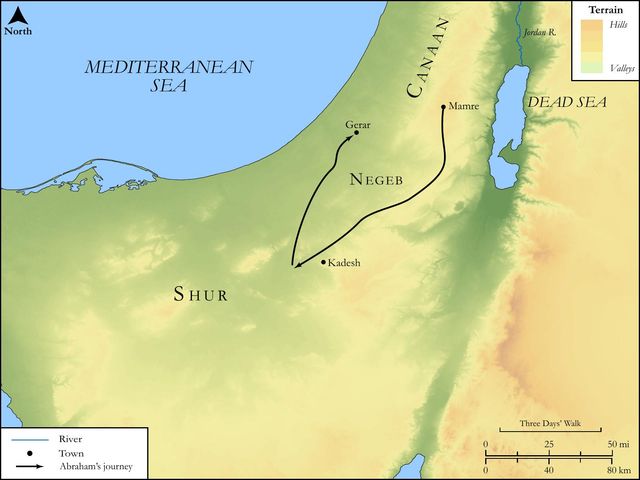
See on the biblical-era maps


Study this verse
Public-domain commentary
Matthew Henry
From his Commentary on the Whole Bible. Henry comments on passages, not single verses — this entry covers Genesis 20:3–7. His three-level outline is real structure in the source text, so it is rendered as structure.
It appears by this that God revealed himself by dreams (which evidenced themselves to be divine and supernatural) not only to his servants the prophets, but even to those who were out of the pale of the church and covenant; but then, usually, it was with some regard to God's own people as in Pharaoh's dream, to Joseph, in Nebuchadnezzar's, to Daniel, and here, in Abimelech's, to Abraham and Sarah, for he reproved this king for their sake, Psa 105:14, Psa 105:15.
I.God gives him notice of his danger (Gen 20:3), his danger of sin, telling him that the woman is a man's wife, so that if he take her he will wrong her husband; his danger of death for this sin: Thou art a dead man; and God's saying so of a man makes him so. Note, Every wilful sinner ought to be told that he is a dead man, as the condemned malefactor, and the patient whose disease is mortal, are said to be so. If thou art a bad man, certainly thou art a dead man.
II.He pleads ignorance that Abraham and Sarah had agreed to impose upon him, and not to let him know that they were any more than brother and sister, Gen 20:6. See what confidence a man may have towards God when his heart condemns him not, Jo1 3:21. If our consciences witness to our integrity, and that, however we may have been cheated into a snare, we have not knowingly and wittingly sinned against God, it will be our rejoicing in the day of evil. He pleads with God as Abraham had done, Gen 18:23. Wilt thou slay a righteous nation? Gen 20:4. Not such a nation as Sodom, which was indeed justly destroyed, but a nation which, in this matter, was innocent.
III.God gives a very full answer to what he had said.
1.He allows his plea, and admits that what he did he did in the integrity of his heart: Yea, I know it, Gen 20:6. Note, It is matter of comfort to those that are honest that God knows their honesty, and will acknowledge it, though perhaps men that are prejudiced against them either cannot be convinced of it or will not own that they are.
2.He lets him know that he was kept from proceeding in the sin merely by the good hand of God upon him: I withheld thee from sinning against me. Abimelech was hereby kept from doing wrong, Abraham from suffering wrong, and Sarah from both. Note,
(1.)There is a great deal of sin devised and designed that is never executed. As bad as things are in the world, they are not so bad as the devil and wicked men would have them.
(2.)It is God that restrains men from doing the ill they would do. It is not from him that there is sin, but it is from him that there is not more sin, either by his influence upon men's minds, checking their inclination to sin, or by his providence, taking away the opportunity to sin.
(3.)It is a great mercy to be hindered from committing sin; of this God must have the glory, whoever is the instrument, Sa1 25:32, Sa1 25:33.
3.He charges him to make restitution: Now therefore, not that thou art better informed, restore the man his wife, Gen 20:7. Note, Ignorance will excuse no longer than it continues. If we have entered upon a wrong course through ignorance this will not excuse our knowingly persisting in it, Lev 5:3-5. The reasons why he must be just and kind to Abraham are,
(1.)Because he is a prophet, near and dear to God, for whom God does in a particular manner concern himself. God highly resents the injuries done to his prophets, and takes them as done to himself.
(2.)Being a prophet, he shall pray for thee; this is a prophet's reward, and a good reward it is. It is intimated that there was great efficacy in the prayers of a prophet, and that good men should be ready to help those with their prayers that stand in need of them, and should make, at least, this return for the kindnesses that are done them. Abraham was accessory to Abimelech's trouble, and therefore was obliged in justice to pray for him.
(3.)It is at thy peril if thou do not restore her: Know thou that thou shalt surely die. Note, He that does wrong, whoever he is, prince or peasant, shall certainly receive for the wrong which he has done, unless he repent and make restitution, Col 3:25. No injustice can be made passable with God, no, not by Caesar's image stamped upon it.
Historical interpretation
Historical reception
1 surviving comment on this verse from the historical church.
The reason why the good Lord inflicted this penalty on the king, guiltless though he was of sin, was that he might accede to the just man’s prayers and thus resolve the problem, thereby rendering the just man more famous and well known. You see, all God’s planning and each arrangement he makes have the purpose of rendering conspicuous those who serve him, just like lamps, and making their virtue obvious in every way.
Continue studying Genesis 20:7 across the web’s major study libraries — every link below opens this exact verse, chapter, or book on the destination site.
Read & Compare
 BibleGatewayThis verse in more than 200 translations and 70 languages.
 Bible.comThe YouVersion reader — hundreds of translations, reading plans, and highlights.
 ESV.orgCrossway's official English Standard Version reader.
 NET BibleThe NET translation with 60,000+ translators' notes on every rendering decision.
 STEP BibleTyndale House's free study tool — original text, vocabulary, and scholarly resources.
 BibliaLogos Bible Software's free web reader.
 USCCBThe New American Bible (Revised Edition) with the U.S. bishops' study notes.
Commentaries
 BibleHub CommentariesDozens of classic commentaries on this verse, gathered on one page.
 StudyLightMore than 100 commentary sets — the largest collection on the web.
 BibleRefPlain-English commentary on what this verse means, verse by verse.
 Enduring WordDavid Guzik's free commentary on this chapter, widely used by Bible teachers.
 Bible Study ToolsVerse commentary alongside Greek and Hebrew study aids.
Original Language & Research
- BibleHub InterlinearThe verse word by word — original language, transliteration, and English.
- BibleHub LexiconEvery word's original-language definition and Strong's entry.
 Blue Letter BibleDeep-study tools — Strong's numbers, concordance, and word studies.
 SefariaThe Hebrew text with Rashi and centuries of Jewish commentary.
Sermons, Hymns & Audio


TrulyRandomVerse is not affiliated with these sites and doesn’t control their content. They’re linked because they’re genuinely useful.
Summary
Genesis 20:7 records God's direct and authoritative intervention in a dream to Abimelech, king of Gerar, who had unknowingly taken Sarah, Abraham's wife, into his household. This divine command demands the immediate restoration of Sarah, explicitly identifying Abraham as a prophet whose intercession is vital for Abimelech's survival. The verse underscores God's active protection of His covenant people and the sanctity of His promises, while simultaneously presenting a stark warning of certain death for Abimelech and his entire household should he fail to obey.
Context
ShowHideLiterary Context
This verse is a pivotal moment within a narrative that begins with Abraham's deceptive act of presenting Sarah as his sister to Abimelech, king of Gerar, out of fear for his own life (Genesis 20:1-2). This deception, though partially true (Sarah was Abraham's half-sister, as confirmed in Genesis 20:12), placed Sarah in a perilous position, threatening the integrity of the promised lineage through which God's covenant would be fulfilled. Before Abimelech could consummate a marriage with Sarah, God directly intervened in a dream (Genesis 20:3-6), revealing Sarah's true marital status and preventing Abimelech from committing a grave sin. Verse 7 then delivers God's explicit command for Sarah's restoration and the severe consequences of disobedience, setting the stage for Abimelech's subsequent actions and Abraham's intercession. This incident notably echoes a similar deception by Abraham concerning Sarah in Egypt earlier in his journey, highlighting a recurring pattern of human fear and divine faithfulness.
Historical & Cultural Context
The narrative is set during the patriarchal period, a time characterized by tribal societies and the authority of kings over their domains. The practice of a king taking women into his harem was common, and the protection of one's wife was paramount. The concept of a "prophet" (nâbîyʼ) in this early period, as applied to Abraham, signifies not merely a foreteller of future events, but primarily a divinely appointed spokesman, one who has direct communion with God and whose prayers carry unique efficacy. This understanding is crucial for appreciating God's declaration that Abraham "is a prophet, and he shall pray for thee." The severe consequences for disobedience, extending to the entire household, reflect Scripture's own understanding of corporate responsibility, where the actions of a leader could bring blessing or curse upon their entire family or community. The emphasis on the sanctity of marriage, even in a culture where polygamy was practiced, underscores God's foundational design for the marital covenant.
Key Themes
ShowHideGenesis 20:7 contributes significantly to several overarching themes within Genesis and the broader biblical narrative. Foremost is the theme of Divine Protection and Covenant Faithfulness: Despite Abraham's repeated failings and deceptions, God actively intervenes to protect His covenant people and ensure the fulfillment of His promises regarding Abraham's offspring and the land. This demonstrates God's unwavering commitment to His redemptive plan. Another key theme is Intercession and the Power of Prayer: God explicitly links Abimelech's life to Abraham's prayer, elevating Abraham's role as a mediator and highlighting the efficacy of prayer offered by God's chosen servants. This foreshadows the importance of intercession throughout biblical history. The verse also touches upon Divine Justice and Mercy: God, in His justice, holds Abimelech accountable for his actions once divine truth is revealed, yet in His mercy, He provides a clear path to avert judgment through obedience and intercession. Finally, the narrative underscores the Sanctity of Marriage and the Consequences of Disobedience to divine revelation, even if the initial transgression was unwitting.
Exposition and Analysis
ShowHideGod's words to Abimelech in Genesis 20:7 are a direct, unyielding command coupled with a clear explanation of its necessity and consequences. The divine imperative demands immediate and complete restitution, emphasizing the sanctity of marriage and God's unwavering protection of the covenant line.
Key Word Analysis
ShowHideFrom the root nâbâʼ, meaning "to bubble up, to gush forth," hence "to utter." A prophet is primarily one who is called by God to speak on His behalf, receiving and conveying divine messages. This designation for Abraham elevates his standing, indicating his unique relationship with God as a spokesperson and revealer of divine will, and crucially, as an intercessor.
A primitive root meaning "to judge (officially or mentally); by extension, to intercede, pray." In this context, it highlights Abraham's role as one who can effectively intercede with God on behalf of others. Abimelech's life is directly contingent upon Abraham's act of prayer, underscoring the power and necessity of intercession from God's chosen servant.
A primitive root meaning "to live, whether literally or figuratively; causatively, to revive." In this verse, it refers to physical survival and the preservation of life for Abimelech and his household. It stands in stark contrast to the "surely die" (H4191) and emphasizes the life-giving power of obedience to God's command and the efficacy of Abraham's intercession.
Verse Breakdown
ShowHide"Now therefore restore the man [his] wife"
This is a direct, imperative command from God to Abimelech. The verb "restore" (Hebrew: shûwb, H7725) implies turning back or returning something to its rightful owner. It demands immediate and complete restitution of Sarah to Abraham, emphasizing the sanctity of their marriage and God's absolute authority over human actions, even those performed in ignorance.
"for he [is] a prophet, and he shall pray for thee, and thou shalt live"
This clause provides the divine rationale and the path to life. God explicitly identifies Abraham as a "prophet" (nâbîyʼ), signifying his unique relationship with God and his role as a divine spokesman and intercessor. Abimelech's survival is directly linked to Abraham's prayer, highlighting the power of intercession offered by God's chosen servant and demonstrating God's mercy in providing a means for Abimelech to escape judgment.
"and if thou restore [her] not, know thou that thou shalt surely die, thou, and all that [are] thine"
This is a stark, absolute warning of judgment. The conditional clause ("if thou restore her not") sets up the dire consequence of disobedience. The phrase "surely die" (a Hebrew idiom emphasizing certainty, from mûwth, H4191) signifies an unavoidable, comprehensive judgment that extends beyond Abimelech to his entire household. This underscores the gravity of violating God's will once it has been clearly revealed, even if the initial transgression was unwitting.
Literary Devices
ShowHideThe passage employs several potent literary devices. Divine Command is central, as God directly issues an imperative to Abimelech, highlighting His sovereignty and authority. The use of a Conditional Clause ("and if thou restore [her] not") starkly contrasts the two possible outcomes—life through obedience versus death through disobedience—thereby emphasizing the gravity of the choice presented to Abimelech. There is also a powerful Contrast between Abraham's human failing (his deception) and God's unwavering faithfulness and protection of His covenant. Furthermore, the designation of Abraham as a "prophet" and the efficacy of his prayer serve as Foreshadowing for the later development of the prophetic office and the power of intercession in Israel's history. Finally, a subtle Irony exists in Abimelech, a powerful king, being entirely dependent on the prayer of Abraham, a seemingly vulnerable sojourner, for his very life.
Theological and Thematic Connections
ShowHideGenesis 20:7 powerfully illustrates God's active involvement in human affairs, particularly in protecting His covenant and ensuring His promises are fulfilled, even amidst human weakness and deception. It underscores the profound truth that God's plan will not be thwarted by human error. The verse also highlights the unique and vital role of God's chosen servants, like Abraham, as intercessors whose prayers carry divine weight and can avert judgment. God's justice is evident in the severe warning against disobedience once His will is revealed, yet His mercy is equally clear in providing a pathway to life through repentance and the intercession of His prophet. This balance of justice and mercy is a recurring theme throughout Scripture.
Reflection and Application
ShowHideGenesis 20:7 offers profound lessons for believers today, reminding us of God's unwavering faithfulness to His covenant and purposes, even when we falter or make mistakes. It assures us that God actively intervenes to protect His plans and His people, demonstrating His sovereign control over all circumstances. The passage powerfully underscores the vital importance and effectiveness of intercessory prayer, revealing that God honors the prayers of His righteous servants and can use them as instruments of His mercy and salvation. Furthermore, it emphasizes the necessity of immediate and complete obedience once God's will is made clear, warning that deliberate disobedience carries severe consequences, even if the initial transgression was unwitting. Finally, it teaches us to respect and honor those whom God has called and set apart, recognizing that God Himself defends His anointed and holds others accountable for how they treat them.
Questions for Reflection
ShowHideFAQ
ShowHideWhat does it mean that Abraham is called a "prophet" in this verse?
ShowHideIn this context, calling Abraham a "prophet" (Hebrew: nâbîyʼ, H5030) means he is a divinely appointed spokesman for God. He is someone to whom God reveals His will and who communicates God's messages to others. Crucially, it also signifies his unique access to God through prayer, as evidenced by God stating that Abraham "shall pray for thee, and thou shalt live." This highlights his role as an intercessor, a key function of a prophet. This is one of the earliest explicit designations of a prophet in the Bible, establishing a pattern for future divine-human communication.
Why was Abimelech threatened with death if he was innocent of intentional wrongdoing?
ShowHideWhile Abimelech acted in ignorance initially, God's intervention in the dream (Genesis 20:3-6) revealed the truth of Sarah's marital status and His divine command. The threat of death was not for his initial unwitting act, which God Himself prevented from becoming a sin against Him (Genesis 20:6), but for potential disobedience after receiving clear divine revelation. Once God's will is known, even if the initial sin was unintentional, immediate and complete obedience is required to avoid severe consequences. God, in His mercy, provided a way out (restoring Sarah and seeking Abraham's prayer), but failure to follow that path would incur His just judgment. This demonstrates that ignorance does not perpetually excuse, especially once divine truth is revealed.
Christ-Centered Fulfillment
ShowHideGenesis 20:7, with its profound themes of divine protection, intercession, and the consequences of sin, finds its ultimate and perfect fulfillment in Jesus Christ. Abraham, designated as a "prophet" and intercessor whose prayer brought life, foreshadows Christ as the supreme Prophet, who perfectly reveals God's will and truth to humanity (Deuteronomy 18:15 and John 1:18). More significantly, Christ is our ultimate Intercessor, who not only offered Himself as the perfect sacrifice for sin but also continually intercedes for His people before the Father (Romans 8:34 and Hebrews 7:25). Just as Abimelech's life depended on Abraham's prayer, our eternal life and salvation depend entirely on Christ's atoning work and ongoing intercession. He is the faithful Son who perfectly protects His bride, the Church (Ephesians 5:25-27), ensuring that the covenant promises are fulfilled through His own perfect obedience and sacrifice. The stark warning of death for disobedience in the Old Testament points to the spiritual death and eternal judgment that await those who reject God's revealed will in Christ (John 3:36). Conversely, Christ offers abundant life and salvation to all who believe and obey Him, fulfilling the promise of life through divine intervention and grace.