


Numbers 16:33
- וַיֵּרְדוּvai·Ye·re·Duand they went downH3381Conj-w ¦ V-Qal-ConsecImperf-3mpVerb Qal Consecutive Imperfect 3rd Plural Masculineוַandיֵּרְדוּthey went down
- הֵםhemtheyH1992Pro-3mpPronoun Personal 3rd Plural Masculine
- וְכָלve·kholand allH3605Conj-w ¦ N-msNoun Singular Masculine Absoluteוְandכָלall
- אֲשֶׁר'a·SherthatH834RelParticle Relative
- לָהֶםla·Hem[belonged] to <the> themPrep-l ¦ 3mpSuffix Personal 3rd Plural Masculineלָ[belonged] to <the>הֶםthem
- חַיִּיםchai·YimaliveH2416Adj-mpAdjective Plural Masculine Absolute
- שְׁאֹלָהshe·'O·lahSheol towardsH7585N-cs ¦ SfxNoun Singular common gender AbsoluteשְׁאֹלָSheolהtowards
- וַתְּכַסva·te·Khasand it coveredH3680Conj-w ¦ V-Piel-ConsecImperf-3fsVerb Piel Consecutive Imperfect 3rd Singular Feminineוַandתְּכַסit covered
- עֲלֵיהֶם'a·lei·Hemover themH5921Prep ¦ 3mpPreposition Definiteעֲלֵיoverהֶםthem
- הָאָרֶץha·'A·retzthe earthH776Art ¦ N-fsNoun Singular Feminine Absoluteהָtheאָרֶץearth
- וַיֹּאבְדוּvai·yoe·Duand they perishedH6Conj-w ¦ V-Qal-ConsecImperf-3mpVerb Qal Consecutive Imperfect 3rd Plural Masculineוַandיֹּאבְדוּthey perished
- מִתּוֹךְmi·Tokhfrom amongH8432Prep-m ¦ N-mscNoun Singular Masculine Constructמִfromתּוֹךְamong
- הַקָּהָלha·ka·Halthe assemblyH6951Art ¦ N-msNoun Singular Masculine Absoluteהַtheקָּהָלassembly
English is a literal word-by-word gloss of the Hebrew, not the KJV's wording. Why?
This is the original text the KJV's translators worked from — each Hebrew word with its own literal English meaning in this verse, prepared by scholars at Tyndale House, Cambridge. The KJV translates whole sentences, not word by word, so its wording differs: one Hebrew word can become several English words, and the KJV may choose “the LORD” where the gloss reads “Yahweh”. Both are faithful — they answer different questions. For the KJV's own rendering, switch to the KJV text.
Details
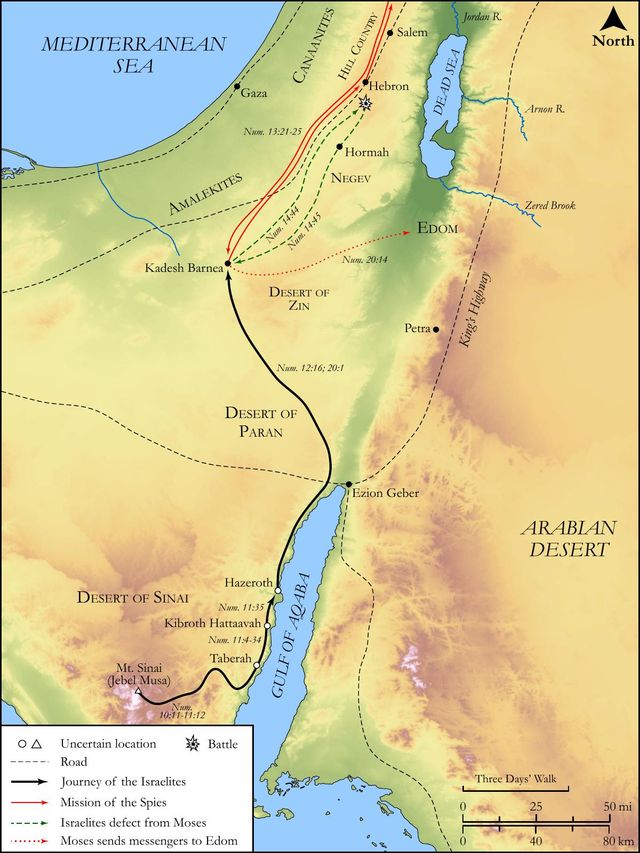
See on the biblical-era map
Study this verse
Public-domain commentary
Matthew Henry
From his Commentary on the Whole Bible. Henry comments on passages, not single verses — this entry covers Numbers 16:23–34. His two-level outline is real structure in the source text, so it is rendered as structure.
We have here the determining of the controversy with Dathan and Abiram, who rebelled against Moses, as in the next paragraph the determining of the controversy with Korah and his company, who would be rivals with Aaron. It should seem that Dathan and Abiram had set up a spacious tabernacle in the midst of the tents of their families, where they kept court, met in council, and hung out their flag of defiance against Moses; it is here called the tabernacle of Korah, Dathan, and Abiram, Num 16:24, Num 16:27. There, as in the place of rendezvous, Dathan and Abiram staid, when Korah and his friends went up to the tabernacle of the Lord, waiting the issue of their trial; but here we are told how they had their business done, before that trial was over. For God will take what method he pleases in his judgments.
I.Public warning is given to the congregation to withdraw immediately from the tents of the rebels.
1.God bids Moses speak to this purport, Num 16:24. This was in answer to Moses's prayer. He had begged that God would not destroy the whole congregation. "Well," says God, "I will not, provided they be so wise as to shift for their own safety, and get out of the way of danger. If they will quit the rebels, well and good, they shall not perish with them; otherwise, let them take what follows." Note, We cannot expect to reap benefit by the prayers of our friends for our salvation, unless we ourselves be diligent and faithful in making use of the means of salvation; for God never promised to save by miracles those that would not save themselves by means. Moses that had prayed for them must preach this to them, and warn them to flee from this wrath to come.
2.Moses accordingly repairs to the head-quarters of the rebels, leaving Aaron at the door of the tabernacle, Num 16:25. Dathan and Abiram had contumaciously refused to come up to him (Num 16:12), yet he humbly condescends to go down to them, to try if he could yet convince and reclaim them. Ministers must thus with meekness instruct those that oppose themselves, and not think it below them to stoop to those that are most stubborn, for their good. Christ himself stretches out his hand to a rebellious and gainsaying people. The seventy elders of Israel attend Moses and his guard, to secure him from the insolence of the rabble, and by their presence to put an honour upon him, and if possible to strike an awe upon the rebels. It is our duty to contribute all we can to the countenance and support of injured innocency and honour.
3.Proclamation is made that all manner of persons, as they tendered their own safety, should forthwith depart from the tents of these wicked men (Num 16:26), and thus should signify that they deserted their cause and interest, detested their crimes and counsels, and dreaded the punishment coming upon them. Note, Those that would not perish with sinners must come out from among them, and be separate. In vain do we pray, Gather not our souls with sinners, if we save not ourselves from the untoward generation. God's people are called out of Babylon, lest they share both in her sins and in her plagues, Rev 18:4.
II.The congregation takes the warning, but the rebels themselves continue obstinate, Num 16:27.
1.God, in mercy, inclined the people to forsake the rebels: They got up from the tabernacle of Korah, Dathan, and Abiram, both those whose lot it was to pitch near them (who doubtless with themselves removed their families, and all their effects) and those also who had come from all parts of their camp to see the issue. It was in answer to the prayer of Moses that God thus stirred up the hearts of the congregation to shift for their own preservation. Note, To those whom God will save he gives repentance, that they may recover themselves out of the snare of the devil. Grace to separate from evil doers is one of the things that accompany salvation.
2.God, in justice, left the rebels to the obstinacy and hardness of their own hearts. Though they saw themselves abandoned by all their neighbours, and set up as a mark to the arrows of God's justice, yet instead of falling down and humbling themselves before God and Moses, owning their crime and begging pardon, instead of fleeing and dispersing themselves to seek for shelter in the crowd, they impudently stood in the doors of their tents, as if they would out-face God himself, and dare him to his worst. Thus were their hearts hardened to their own destruction, and they were fearless when their case was most fearful. But what a pity was it that their little children, who were not capable of guilt or fear, should by the presumption of their parents be put in this audacious posture! Happy they who are taught betimes to bow before God, and not as those unhappy little ones to stand it out against him!
III.Sentence is solemnly pronounced upon them by Moses in the name of the Lord, and the decision of the controversy is put upon the execution of that sentence by the almighty power of God. Moses, by divine instinct and direction, when the eyes of all Israel were fastened upon him, waiting the event, moved with a just and holy indignation at the impudence of the rebels, boldly puts the whole matter to a surprising issue, Num 16:28-30. 1. If the rebels die a common death, he will be content to be called and counted an impostor; not only if they die a natural death, but if they die by any sort of judgment that has formerly been executed on other malefactors. "If they die by the plague, or by fire from heaven, or by the sword, then say, God has disowned Moses;" but, 2. "If the earth open and swallow them up" (a punishment without precedent), "then let all the house of Israel know assuredly that I am God's servant, sent by him, and employed for him, and that those that fight against me fight against him." The judgment itself would have been proof enough of God's displeasure against the rebels, and would have given all men to understand that they had provoked the Lord; but when it was thus solemnly foretold and appealed to by Moses beforehand, when there was not the least previous indication of it from without, the convincing evidence of it was much the stronger, and it was put beyond dispute that he was not only a servant but a favourite of Heaven, who was so intimately acquainted with the divine counsels, and could obtain such extraordinary appearances of the divine power in his vindication.
IV.Execution is immediately done.
It appeared that God and his servant Moses understood one another very well; for, as soon as ever Moses had spoken the word, God did the work, the earth clave asunder (Num 16:31), opened her mouth, and swallowed them all up, them and theirs (Num 16:32), and then closed upon them, Num 16:33. This judgment was,
1.Unparalleled. God, in it, created a new thing, did what he never did before; for he has many arrows in his quiver; and there are diversities of operations in wrath as well as mercy. Dathan and Abiram thought themselves safe because they were at a distance from the shechinah, whence the fire of the Lord had sometimes issued, qui procul Jove (they say) procul fulmine - he who is far from Jove is far from the thunderbolt. But God made them to know that he was not tied up to one way of punishing; the earth, when he pleases, shall serve his justice as effectually as the fire.
2.It was very terrible to the sinners themselves to go down alive into their own graves, to be dead and buried in an instant, to go down thus to the bars of the pit when they were in their full strength wholly at ease and quiet.
3.It was severe upon their poor children, who, for the greater terror of the judgment, and fuller indication of the divine wrath, perished as parts of their parents, in which, though we cannot particularly tell how bad they might be to deserve it or how good God might be otherwise to them to compensate it, yet of this we are sure in the general, that Infinite Justice did them no wrong. Far be it from God that he should do iniquity.
4.It was altogether miraculous. The cleaving of the earth was as wonderful, and as much above the power of nature, as the cleaving of the sea, and the closing of the earth again more so than the closing of the waters. God has all the creatures at his command, and can make any of them, when he pleases, instruments of his justice; nor will any of them be our friends if he be our enemy. God now confirmed to Israel what Moses had lately taught them in that prayer of his, Psa 90:11, Who knows the power of thy anger? He has, when he pleases, strange punishments for the workers of iniquity, Job 31:3. Let us therefore conclude, Who is able to stand before this holy Lord God?
5.It was very significant. They set their mouths against the heavens, and their throat was an open sepulchre; justly therefore does the earth open her mouth upon them and swallow them up. They made a rent in the congregation; justly therefore is the earth rent under them. Presumptuous sinners, that hate to be reformed, are a burden to the earth, the whole creation groans under them, which here was signified by this, that the earth sunk under these rebels, as weary of bearing them and being under them. And, considering how the earth is still in like manner loaded with the weight of iniquity, we have reason to wonder that this was the only time it ever sunk under its load.
6.It was typical of the eternal ruin of sinners who die impenitent, who, perhaps in allusion to this, are said to sink down into the pit (Psa 9:15) and to go down quickly into hell, Psa 55:15. But David, even when he sinks in deep mire, yet prays in faith, Let not the pit shut her mouth upon me, as it does on the damned, between whom and life there is a gulf fixed, Psa 69:2-15. His case was bad, but not, like this, desperate.
V.All Israel is alarmed at the judgment:
They fled at the cry of them, Num 16:34. They cried for help when it was too late. Their doleful shrieks, instead of fetching their neighbours in to their relief, drove them so much the further off; for knowing their own guilt, and one another's, they hastened one another, saying, Lest the earth swallow us up also. Note, Others' ruins should be our warnings. Could we by faith hear the outcries of those that have gone down to the bottomless pit, we should give more diligence than we do to escape for our lives, lest we also come into that condemnation.
Historical interpretation
Five Centuries of Reception
2 surviving comments on this verse. Each one is dated, so this reads as a timeline rather than a list.
Select a marker to jump to its quote. Markers stagger vertically where authors wrote within a few decades of each other.
Every kind of honour and happiness was bestowed upon you, and then was fulfilled that which is written, "My beloved ate and drank, and was enlarged and became fat, and kicked." [Deuteronomy 32:15] Hence flowed emulation and envy, strife and sedition, persecution and disorder, war and captivity. So the worthless rose up against the honoured, those of no reputation against such as were renowned, the foolish against the wise, the young against those advanced in years. For this reason righteousness and peace are now far departed from you, inasmuch as every one abandons the fear of God, and has become blind in His faith, neither walks in the ordinances of His appointment, nor acts a part becoming a Christian, but walks after his own wicked lusts, resuming the practice of an unrighteous and ungodly envy, by which death itself entered into the world. [Wisdom 2:24]
For thus it is written: "And it came to pass after certain days, that Cain brought of the fruits of the earth a sacrifice unto God; and Abel also brought of the firstlings of his sheep, and of the fat thereof. And God had respect to Abel and to his offerings, but Cain and his sacrifices He did not regard. And Cain was deeply grieved, and his countenance fell. And God said to Cain, Why are you grieved, and why is your countenance fallen? If you offer rightly, but do not divide rightly, have you not sinned? Be at peace: your offering returns to yourself, and you shall again possess it. And Cain said to Abel his brother, Let us go into the field. And it came to pass, while they were in the field, that Cain rose up against Abel his brother, and slew him." [Genesis 4:3-8] You see, brethren, how envy and jealousy led to the murder of a brother. Through envy, also, our father Jacob fled from the face of Esau his brother [Genesis 27:41-45]. Envy made Joseph be persecuted unto death, and to come into bondage. [Genesis 37:18-28] Envy compelled Moses to flee from the face of Pharaoh king of Egypt, when he heard these words from his fellow-countryman, "Who made you a judge or a ruler over us? Will you kill me, as you killed the Egyptian yesterday?" [Exodus 2:14] On account of envy, Aaron and Miriam had to make their abode without the camp. [Numbers 12:14-15] Envy brought down Dathan and Abiram alive to Hades, through the sedition which they excited against God's servant Moses. [Numbers 16:33] Through envy, David not only underwent the hatred of foreigners, but was also persecuted by Saul king of Israel. [1 Samuel 21:10-15]
It is evident that those who are alive know and feel what is done to them, but the dead feel nothing. People would be dead in going down to hell if they did evil out of ignorance; but if they have knowledge of evil and yet commit it, they go down alive—wretched and conscious—to the hell of iniquity.
Continue studying Numbers 16:33 across the web’s major study libraries — every link below opens this exact verse, chapter, or book on the destination site.
Read & Compare
 BibleGatewayThis verse in more than 200 translations and 70 languages.
 Bible.comThe YouVersion reader — hundreds of translations, reading plans, and highlights.
 ESV.orgCrossway's official English Standard Version reader.
 NET BibleThe NET translation with 60,000+ translators' notes on every rendering decision.
 STEP BibleTyndale House's free study tool — original text, vocabulary, and scholarly resources.
 BibliaLogos Bible Software's free web reader.
 USCCBThe New American Bible (Revised Edition) with the U.S. bishops' study notes.
Commentaries
 BibleHub CommentariesDozens of classic commentaries on this verse, gathered on one page.
 StudyLightMore than 100 commentary sets — the largest collection on the web.
 BibleRefPlain-English commentary on what this verse means, verse by verse.
 Enduring WordDavid Guzik's free commentary on this chapter, widely used by Bible teachers.
 Bible Study ToolsVerse commentary alongside Greek and Hebrew study aids.
Original Language & Research
- BibleHub InterlinearThe verse word by word — original language, transliteration, and English.
- BibleHub LexiconEvery word's original-language definition and Strong's entry.
 Blue Letter BibleDeep-study tools — Strong's numbers, concordance, and word studies.
 SefariaThe Hebrew text with Rashi and centuries of Jewish commentary.
Sermons, Hymns & Audio


TrulyRandomVerse is not affiliated with these sites and doesn’t control their content. They’re linked because they’re genuinely useful.
Summary
Numbers 16:33 vividly recounts the terrifying and immediate execution of God's judgment upon Korah, Dathan, Abiram, and all who had aligned with them in their brazen rebellion against Moses and Aaron. As Moses had explicitly prophesied, the ground miraculously split open, swallowing them alive along with their families and possessions, thereby demonstrating God's absolute sovereignty and His severe intolerance for any challenge to His divinely established order and authority within the Israelite community. This unprecedented act of divine intervention served as an indelible and stark lesson to the entire congregation regarding the profound holiness of God and the dire, comprehensive consequences of rebellion.
Context
ShowHideLiterary Context
This verse marks the dramatic and horrifying climax of the rebellion detailed throughout Numbers 16. The narrative initiates with Korah, a Levite, joined by Dathan and Abiram from the tribe of Reuben, mounting a direct challenge to the unique leadership of Moses and the exclusive Aaronic priesthood. Their central grievance, articulated in Numbers 16:3, was an accusation that Moses and Aaron had presumptuously elevated themselves above the rest of the congregation, whom they asserted were "all holy." Moses, in response, proposed a divine test to unequivocally distinguish between those genuinely chosen by God and the rebellious faction. He specifically declared in Numbers 16:28-30 that if these men were to die by an extraordinary, supernatural means—namely, the earth opening its mouth to consume them—it would serve as undeniable proof that they had indeed provoked the Lord. Numbers 16:33 immediately follows this prophecy, recording its precise, terrifying, and public fulfillment, thereby validating Moses' divine commission and God's absolute authority over His people and creation.
Historical & Cultural Context
The events of Numbers 16 are situated within Israel's forty-year wilderness wandering, a period frequently punctuated by murmuring, outright rebellion, and subsequent divine judgment, as evidenced by episodes such as the complaints about manna in Numbers 11 or the fateful refusal to enter Canaan in Numbers 14. This particular rebellion was especially egregious because it struck at the very core of Israel's divinely ordained social and religious structure. Moses was unequivocally God's chosen leader, and Aaron's lineage was exclusively appointed for the priesthood, a role essential for mediating between God and His people through the elaborate Tabernacle rituals. In ancient Near Eastern cultures, challenges to established leadership, particularly leadership believed to be divinely appointed, were routinely met with severe and often public consequences to maintain societal and religious order. The unique and unprecedented method of judgment—the earth swallowing them whole—would have been perceived not merely as a punitive measure but as a direct, undeniable, and terrifying act of the deity, far exceeding any human capacity for retribution, thereby profoundly underscoring the immense gravity of their affront to God's established covenant order.
Key Themes
ShowHideNumbers 16:33 powerfully contributes to several overarching themes woven throughout the book of Numbers and the broader Pentateuch. It serves as a profound and stark illustration of Divine Judgment and Justice, demonstrating God's active, immediate, and comprehensive wrath against blatant rebellion, sacrilege, and the usurpation of His authority. It vividly highlights the Consequences of Rebellion, showing that defying God's appointed authority and established order has devastating, far-reaching effects, extending beyond the instigators to their entire households, thereby underscoring the corporate nature of sin and judgment prevalent in ancient Israel. Furthermore, this miraculous and terrifying event unequivocally affirms God's Sovereignty and Holiness, solidifying His unique covenant relationship with Israel and His unyielding demand for reverence, obedience, and submission. It powerfully reinforces the sanctity of the Aaronic priesthood and the divinely appointed leadership of Moses, distinguishing with terrifying clarity between the faithful and the rebellious within the congregation and reminding Israel of the absolute necessity of submission to God's will, a foundational theme echoed throughout the wilderness narrative, such as in Deuteronomy 8:2-5.
Exposition and Analysis
ShowHideKey Word Analysis
ShowHideDerived from the root meaning "to live," this word emphasizes that the rebels were not dead when they descended into the pit. This detail is crucial, as it highlights the extraordinary and supernatural nature of their demise. It was not a natural death followed by burial, but a direct, instantaneous, and terrifying act of divine judgment that consumed them while they were still in the state of living, underscoring the unprecedented nature of God's wrath and the fulfillment of Moses' prophecy that a "new thing" would occur.
While sheol typically refers to the grave or the general realm of the dead in the Old Testament, its usage here is highly specific and literal. In Numbers 16:33, it describes a physical, unprecedented opening in the earth that literally swallowed the rebels. This immediate, visible, and physical consumption by the earth emphasizes the supernatural and extraordinary nature of God's judgment, distinguishing it from any natural death and highlighting the direct, undeniable hand of God in their demise. It signifies a complete and utter removal from the land of the living, a descent into a literal chasm of divine wrath and separation.
This verb signifies not merely death, but a complete destruction, removal, or cessation of existence within a particular context. In this verse, it emphasizes that Korah, Dathan, Abiram, and their households were not simply killed, but utterly obliterated and cut off from the community of Israel. Their memory and presence were to be erased, serving as a permanent and terrifying warning against similar rebellion. This term underscores the finality and severity of God's judgment, signifying a total loss of life, status, and connection to the covenant people.
Verse Breakdown
ShowHide"They, and all that appertained to them"
This initial clause underscores the comprehensive and corporate nature of the divine judgment. It clarifies that the punishment was not confined solely to the primary instigators (Korah, Dathan, and Abiram) but extended to their entire households, including their families and all their possessions. This corporate responsibility, though challenging to modern individualistic sensibilities, was a common understanding in ancient Israel, where the family unit was viewed as an extension of the individual, and the grave sin of the head could bring devastating consequences upon the entire household, thereby reinforcing the gravity of the offense and serving as a potent deterrent to the wider community.
"went down alive into the pit"
This is the core of the miraculous and terrifying judgment. It explicitly states that they did not die first and then were buried, but were swallowed while still living. This unprecedented manner of death unequivocally underscores the supernatural intervention of God, making it abundantly clear that this was not a natural disaster but a direct, divine execution of judgment, precisely fulfilling Moses' specific prophecy in Numbers 16:30. The "pit" here is a literal chasm, a gaping maw of the earth that opened to consume them.
"and the earth closed upon them"
This phrase signifies the finality, irrevocability, and completeness of the judgment. Once swallowed, the earth sealed itself, leaving no trace, no possibility of escape, or any hope of recovery. It was a definitive divine act of closure, a permanent end to their rebellion and their lives, emphasizing the absolute power of God to execute His will and to permanently remove those who defy His established order.
"and they perished from among the congregation"
This concluding clause powerfully reiterates the complete removal of the rebels from the community of Israel. It emphasizes their utter destruction and their permanent severance from the covenant people. This served as a stark, visible, and unforgettable warning to the remaining congregation, reinforcing the sanctity of God's appointed leadership and the severe, existential consequences of challenging His authority and the divinely ordained order.
Literary Devices
ShowHideNumbers 16:33 employs several powerful literary devices to convey the gravity, impact, and divine nature of the judgment. The most prominent is Divine Intervention, where God directly and miraculously acts upon the natural world to execute His judgment, manifesting His absolute power and sovereignty in an undeniable way. The sudden opening and closing of the earth beneath the rebels is a clear Miracle, an event that utterly defies natural laws, specifically designed to authenticate Moses' prophetic word and God's supreme authority. The scene is imbued with Dramatic Climax, serving as the immediate, terrifying, and decisive culmination of the escalating conflict between God's chosen leaders and the rebellious faction. There is also strong Symbolism in the earth swallowing them whole; it symbolizes God's power to consume and erase those who stand against Him, and the "pit" becomes a potent symbol of divine wrath, complete obliteration, and eternal separation. Finally, the narrative employs a profound form of Poetic Justice, where those who sought to elevate themselves above God's appointed order are instead brought to the lowest possible state, swallowed by the very ground beneath their feet, their ambition consumed by the very creation God controls.
Theological and Thematic Connections
ShowHideNumbers 16:33 stands as a monumental and terrifying testament to God's unwavering holiness, His absolute sovereignty, and the profound seriousness with which He regards rebellion against His divine order. This event unequivocally underscores that God is not merely a benevolent deity but also a righteous and active judge who will not tolerate defiance of His authority or the desecration of His sacred institutions, particularly the priesthood and leadership He has established. It reveals a God who actively intervenes in human history to uphold His covenant, to protect His chosen servants, and to maintain the purity of His people, demonstrating that all true and legitimate authority flows from Him alone. The judgment serves as a perpetual, chilling warning against presumption, pride, and the inherent dangers of challenging divinely appointed structures, reminding believers across all generations that obedience, humility, and reverence are paramount in their relationship with a holy God.
Reflection and Application
ShowHideThe terrifying account in Numbers 16:33, while a specific historical event of divine judgment, carries profound and enduring lessons for believers today, transcending its ancient context. It serves as a powerful and sobering reminder of the solemnity of God's holiness and the immense gravity of rebellion against His established order, whether that order manifests in the church, in civil society, or in the intimate sphere of our personal lives. We are called to cultivate a spirit of profound humility and willing submission, recognizing that all true authority, whether spiritual or temporal, ultimately derives from and is sustained by God Himself. This passage challenges us to engage in honest self-examination, searching our own hearts for any subtle seeds of pride, discontent, or a desire to usurp roles, responsibilities, or positions not explicitly given to us by God. It urges us to actively respect those whom God has placed in leadership, to pray fervently for them, and to support their God-given ministries with integrity, rather than engaging in divisive, undermining, or rebellious actions. Ultimately, this verse calls us to cultivate a deeper and more profound reverence for God, acknowledging His absolute power, His righteous judgment, and His unwavering commitment to upholding His truth and protecting His people.
Questions for Reflection
ShowHideFAQ
ShowHideWas this judgment fair to the families of Korah, Dathan, and Abiram who were swallowed with them?
ShowHideThis question often arises due to modern individualistic perspectives on justice. However, in ancient Israel, the family or household (Hebrew: bet 'av) was considered a corporate unit, and the head of the household represented the entire unit. When the head of the household sinned grievously, particularly in a public and defiant act of rebellion against God's established order, the consequences could, and often did, extend to the entire household. This corporate responsibility was not uncommon in the Old Testament, as seen in the judgment on Achan's family in Joshua 7:24-25. While seemingly harsh to contemporary sensibilities, this corporate responsibility served several crucial purposes: it underscored the extreme gravity and far-reaching implications of the sin, acted as a powerful deterrent to the wider community, and reinforced the profound theological idea that sin against a holy God could have devastating, comprehensive, and far-reaching consequences. It also suggests that the families, by their association and perhaps even participation or failure to separate, were implicated in the rebellion, as Moses specifically warned the people to "depart from the tents of these wicked men" in Numbers 16:26.
Why did God use such a dramatic and unprecedented method of judgment?
ShowHideGod chose this extraordinary and unique method for several critical reasons, each designed to convey a profound message to Israel and future generations. First, it served as an undeniable divine authentication of Moses' leadership and God's direct, exclusive appointment of Aaron's priesthood. Moses had specifically prophesied this unique death as the irrefutable sign that the rebels had "provoked the Lord" (Numbers 16:28-30). Second, its unprecedented and miraculous nature profoundly underscored the extreme gravity of their sin. This was not merely a challenge to human authority, but a direct, blasphemous affront to God's holiness, His divine order, and His covenant with Israel. Third, the public, terrifying, and immediate nature of the judgment served as a stark warning and powerful deterrent to the entire congregation of Israel, ensuring that such a rebellion against God's chosen leaders and His established order would not be repeated lightly. It instilled a profound fear of the Lord, reminding them of His absolute sovereignty, His righteous judgment, and His utter intolerance for unholy defiance, a lesson that resonated throughout Israel's history, as referenced in Psalm 106:17-18.
Christ-Centered Fulfillment
ShowHideThe dramatic and terrifying judgment of Korah and his company in Numbers 16:33, where the earth swallowed them alive, serves as a powerful Old Testament type that both foreshadows and contrasts with the ultimate judgment and salvation found in Jesus Christ. While Korah and his followers defiantly challenged God's appointed leadership and priesthood, leading to their immediate descent into a literal "pit" of divine wrath and obliteration, Christ is the true, ultimate, and eternally appointed High Priest, chosen and consecrated by God Himself, whose authority is beyond any dispute or challenge (Hebrews 5:5-6). Unlike Korah, who sought to elevate himself and consequently perished, Jesus "humbled himself by becoming obedient to the point of death, even death on a cross" (Philippians 2:8). He willingly descended into the "pit" of death and the grave, not as one judged for His own rebellion, but as the sinless Lamb of God, bearing the full weight of humanity's rebellion and the divine judgment it deserved (1 Peter 3:18). His glorious resurrection from the dead demonstrates His decisive victory over the grave and death itself, proving His supreme authority and establishing Him as the one through whom all who believe can escape the ultimate "pit" of eternal judgment and separation from God (Revelation 1:18). Thus, Numbers 16:33 stands as a terrifying preview of God's righteous judgment against sin, which finds its ultimate expression and resolution in Christ: either through His atoning sacrifice for those who humbly submit to His divine authority, or through His final, just condemnation for those who, like Korah, persist in defiant rebellion against the divine order He has established.