


1 Samuel 25:34
Bible text: King James Version (1769 Blayney text) · Public domain
Bible text: King James Version with Strong's numbers · Public domain
Bible text: Berean Standard Bible · Public domain
Bible text: American Standard Version (1901) · Public domain
Bible text: World English Bible, Messianic edition · Public domain
Bible text: Geneva Bible (1599) · Public domain
Bible text: Young's Literal Translation · Public domain
- וְאוּלָםve·'u·Lamand butH199Conj-w ¦ AdvAdverbוְandאוּלָםbut
- חַיchai[by] [the] lifeH2416Adj-msAdjective Singular Masculine Absolute
- יְהוָהYah·wehof YahwehH3068N-properNoun Proper Title
- אֱלֹהֵי'e·lo·Hei[the] God ofH430N-mpcNoun Plural Masculine Construct
- יִשְׂרָאֵלYis·ra·'ElIsraelH3478N-properNoun Proper Location
- אֲשֶׁר'a·SherwhoH834RelParticle Relative
- מְנָעַנִיme·na·'A·nihe has restrained meH4513V-Qal-Perf-3ms ¦ 1csVerb Qal Perfect 3rd Singular Masculineמְנָעַhe has restrainedנִיme
- מֵהָרַעme·ha·Ra'from doing harm toH7489Prep-m ¦ V-Hiphil-InfVerb Hiphil Infinitive Constructמֵfromהָרַעdoing harm to
- אֹתָךְ'o·Takh<obj.> youH853DirObjM ¦ 2fsParticle Object Indicatorאֹתָ<obj.>ךְyou
- כִּיkiifH3588PrtParticle Conditional
- לוּלֵיlu·Leiif notH3884PrtParticle Conditional
- מִהַרְתְּmi·Hartyou had made hasteH4116V-Piel-Perf-2fsVerb Piel Perfect 2nd Singular Feminine
- וַתָּבֹאתva·ta·vo·tiand you had comeH935Conj-w ¦ V-Qal-ConsecImperf-2fsVerb Qal Consecutive Imperfect 2nd Singular Feminineוַandתָּבֹאתyou had come
- לִקְרָאתִיlik·ra·Tito meet meH7122Prep-l ¦ V-Qal-Inf ¦ 1csVerb Qal Infinitive Constructלִtoקְרָאתִmeetיme
- כִּיkithatH3588PrtParticle Conditional
- אִם'imexceptH518PrtParticle Conditional
- נוֹתַרno·Tarhe has been leftH3498V-Niphal-Perf-3msVerb Niphal Perfect 3rd Singular Masculine
- לְנָבָלle·na·Valto NabalH5037Prep-l ¦ N-proper-mNoun Proper MasculineלְtoנָבָלNabal
- עַד'aduntilH5704PrepPreposition
- אוֹר'or[the] light ofH216V-Qal-InfVerb Qal Infinitive Construct
- הַבֹּקֶרha·Bo·kerthe morningH1242Art ¦ N-msNoun Singular Masculine Absoluteהַtheבֹּקֶרmorning
- מַשְׁתִּיןmash·Tin[one who] urinatesH8366V-Hiphil-Prtcpl-msVerb Hiphil Participle Singular Masculine Absolute
- בְּקִירbe·Kiron a wallH7023Prep-b ¦ N-msNoun Singular Masculine Absoluteבְּonקִירa wall
English is a literal word-by-word gloss of the Hebrew, not the KJV's wording. Why?
This is the original text the KJV's translators worked from — each Hebrew word with its own literal English meaning in this verse, prepared by scholars at Tyndale House, Cambridge. The KJV translates whole sentences, not word by word, so its wording differs: one Hebrew word can become several English words, and the KJV may choose “the LORD” where the gloss reads “Yahweh”. Both are faithful — they answer different questions. For the KJV's own rendering, switch to the KJV text.
Details
See on the biblical-era map
Study this verse
Public-domain commentary
Matthew Henry
From his Commentary on the Whole Bible. Henry comments on passages, not single verses — this entry covers 1 Samuel 25:32–35. His two-level outline is real structure in the source text, so it is rendered as structure.
As an ear-ring of gold, and an ornament of fine gold, so is a wise reprover upon an obedient ear, Pro 25:12. Abigail was a wise reprover of David's passion, and he gave an obedient ear to the reproof, according to his own principle (Psa 141:5): Let the righteous smite me, it shall be a kindness. Never was such an admonition either better given or better taken.
I.David gives God thanks for sending him this happy check to a sinful way (Sa1 25:32): Blessed be the Lord God of Israel, who sent thee this day to meet me. Note,
1.God is to be acknowledged in all the kindnesses that our friends do us either for soul or body. Whoever meet us with counsel, direction, comfort, caution, or seasonable reproof, we must see God sending them.
2.We ought to be very thankful for those happy providences which are means of preventing sin.
II.He gives Abigail thanks for interposing so opportunely between him and the mischief he was about to do:
Blessed be thy advice, and blessed be thou, Sa1 25:33. Most people think it enough if they take a reproof patiently, but we meet with few that will take it thankfully and will commend those that give it to them and accept it as a favour. Abigail did not rejoice more that she had been instrumental to save her husband and family from death than David did that Abigail had been instrumental to save him and his men from sin.
III.He seems very apprehensive of the great danger he was in, which magnified the mercy of his deliverance.
1.He speaks of the sin as very great. He was coming to shed blood, a sin of which when in his right mind he had a great horror, witness his prayer, Deliver me from blood-guiltiness. He was coming to avenge himself with his own hand, and that would be stepping into the throne of God, who has said, Vengeance is mine; I will repay. The more heinous any sin is the greater mercy it is to be kept from it. He seems to aggravate the evil of his design with this, that it would have been an injury to so wise and good a woman as Abigail: God has kept me back from hurting thee, Sa1 25:34. Or perhaps, at the first sight of Abigail, he was conscious of a thought to do her a mischief for offering to oppose him, and therefore reckons it a great mercy that God gave him patience to hear her speak.
2.He speaks of the danger of his falling into it as very imminent: "Except thou hadst hasted, the bloody execution had been done." The nearer we were to the commission of sin the greater was the mercy of a seasonable restraint - Almost gone (Psa 73:2) and yet upheld.
IV.He dismissed her with an answer of peace, Sa1 25:35.
He does, in effect, own himself overcome by her eloquence: "I have hearkened to thy voice, and will not prosecute the intended revenge, for I have accepted thy person, am well pleased with thee and what thou hast said." Note,
1.Wise and good men will hear reason, and let that rule them, though it come from those that are every way their inferiors, and though their passions are up and their spirits provoked.
2.Oaths cannot, bind us to that which is sinful. David had solemnly vowed the death of Nabal. He did evil to make such a vow, but he would have done worse if he had performed it.
3.A wise and faithful reproof is often better taken, and speeds better, than we expected, such is the hold God has of men's consciences. See Pro 28:23.
Historical interpretation
Historical reception
1 surviving comment on this verse from the historical church.
Further, we are taught at considerable length by other texts of Scripture, too, that we neither should nor can fulfill everything that we decide upon whether with tranquil or upset mind. In them we frequently read that holy men or angels or even almighty God himself altered the things that they had promised. For blessed David determined with the promise of an oath and said, “May God do this and add more to the enemies of David if, of all that belongs to Nabal, I leave one male until morning.” But when his wife, Abigail, interceded and entreated on his behalf, David immediately ceased his threats, softened his words, and preferred to be considered a transgressor of his own intention than to be true to his oath by cruelly carrying it out. And he said, “As the Lord lives, unless you had come quickly to meet me, there would not have been left to Nabal one male until the morning light.” As we do not at all consider the promptness of his rash vow, which proceeded from an upset and disturbed mind, as something to be imitated, so likewise we judge that the cessation and correction of the thing that was decided on is to be pursued.
Continue studying 1 Samuel 25:34 across the web’s major study libraries — every link below opens this exact verse, chapter, or book on the destination site.
Read & Compare
 BibleGatewayThis verse in more than 200 translations and 70 languages.
 Bible.comThe YouVersion reader — hundreds of translations, reading plans, and highlights.
 ESV.orgCrossway's official English Standard Version reader.
 NET BibleThe NET translation with 60,000+ translators' notes on every rendering decision.
 STEP BibleTyndale House's free study tool — original text, vocabulary, and scholarly resources.
 BibliaLogos Bible Software's free web reader.
 USCCBThe New American Bible (Revised Edition) with the U.S. bishops' study notes.
Commentaries
 BibleHub CommentariesDozens of classic commentaries on this verse, gathered on one page.
 StudyLightMore than 100 commentary sets — the largest collection on the web.
 BibleRefPlain-English commentary on what this verse means, verse by verse.
 Enduring WordDavid Guzik's free commentary on this chapter, widely used by Bible teachers.
 Bible Study ToolsVerse commentary alongside Greek and Hebrew study aids.
Original Language & Research
- BibleHub InterlinearThe verse word by word — original language, transliteration, and English.
- BibleHub LexiconEvery word's original-language definition and Strong's entry.
 Blue Letter BibleDeep-study tools — Strong's numbers, concordance, and word studies.
 SefariaThe Hebrew text with Rashi and centuries of Jewish commentary.
Sermons, Hymns & Audio


TrulyRandomVerse is not affiliated with these sites and doesn’t control their content. They’re linked because they’re genuinely useful.
Summary
1 Samuel 25:34 captures David's profound declaration of divine intervention, expressing immense relief and gratitude to Abigail. He unequivocally attributes his restraint from a vengeful act, which would have resulted in the complete annihilation of Nabal's household, to the Lord God of Israel. This pivotal moment underscores God's sovereign control over human anger and His providential care in preserving His anointed, preventing David from shedding innocent blood and incurring a grievous sin that would have marred his character and jeopardized his future kingship.
Context
ShowHideLiterary Context
This verse serves as the dramatic climax of the intense encounter between David and Abigail, immediately following her eloquent and humble appeal. David, consumed by rage due to Nabal's contemptuous refusal to provide provisions for his men, had sworn a solemn oath to destroy every male in Nabal's household by morning, as recorded in 1 Samuel 25:22. Abigail, acting without her foolish husband's knowledge, swiftly intervened with a generous offering and a wise, prophetic plea, detailed in 1 Samuel 25:23-31. Her appeal skillfully addressed David's character, his future as Israel's king, and the potential stain of bloodguilt. David's words in verse 34 are his direct, emotional, and divinely-attuned response to her intervention, signifying his acceptance of her counsel and his profound recognition of God's hand in averting his destructive wrath. The narrative then swiftly transitions to Nabal's death and David's subsequent marriage to Abigail in 1 Samuel 25:36-42, powerfully underscoring the dramatic turning point this verse represents in David's life and the unfolding divine plan.
Historical & Cultural Context
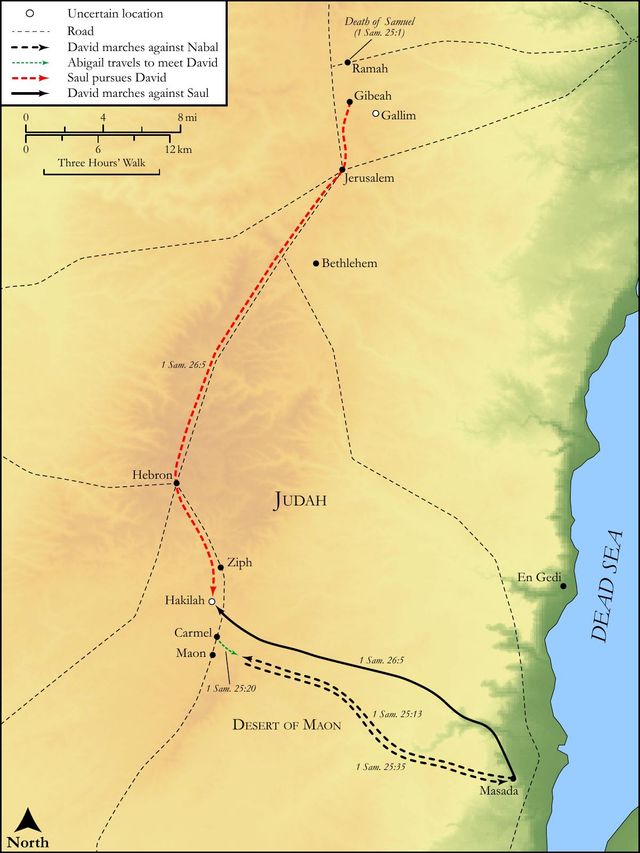
The narrative unfolds in the rugged wilderness of Paran, a region where David and his 600 men operated as outlaws, having fled from King Saul's relentless pursuit. During this tumultuous period, powerful figures like David often extended protection to local shepherds and landowners in exchange for provisions, a common and understood practice in a society lacking a robust central government or established law enforcement. Nabal, a wealthy but notoriously "surly and mean" man from Maon, near Carmel, as described in 1 Samuel 25:3, exemplified the grave dangers of dishonoring such agreements. The severe oath David took—to "not leave to Nabal by morning light any that pisseth against the wall"—was a common, albeit crude, idiom for total male annihilation, reflecting the cultural understanding of familial honor, shame, and the extreme lengths of vengeance in that day. Abigail's actions, though defying her husband, were culturally justified by the imminent existential threat to her entire household, and her wisdom reflected the ideal of a virtuous and discerning woman, akin to the description in Proverbs 31.
Key Themes
ShowHideThis verse powerfully illustrates the theme of Divine Restraint, showcasing God's active, purposeful intervention to prevent human sin and preserve His chosen instruments. David explicitly attributes his change of heart and the averting of bloodshed to the Lord, demonstrating God's sovereign control even over intense human emotions and vengeful intentions, as seen in Proverbs 21:1. It also highlights the Power of Wise Intervention, as Abigail's courage, humility, and profound discernment serve as the human means through which God's restraint is exercised, underscoring how one individual's righteous and timely action can avert catastrophe and bring about divine blessing, as also exemplified in Proverbs 15:1. Furthermore, the narrative starkly contrasts the Consequences of Folly and Wisdom, with Nabal's arrogance and foolishness leading directly to his destruction, while Abigail's prudence and spiritual insight save her household and prevent David from incurring grievous sin. Finally, it speaks to the Preservation of God's Anointed, as God safeguards David from bloodguilt, which would have marred his character and potentially hindered his future kingship, aligning with God's long-term redemptive plan for him, a theme echoed in Psalm 18:30.
Exposition and Analysis
ShowHideKey Word Analysis
ShowHideThis verb (H4513) signifies "to restrain," "to withhold," or "to hold back." In this context, it emphasizes God's active, intentional intervention to prevent David from carrying out his destructive vow. It implies a divine hand directly intervening in David's emotional state and actions, not merely a passive external circumstance. This word often denotes God's providential care or His withholding of judgment or blessing, highlighting His sovereign control over human impulses.
Meaning "to hurry," "to be quick," or "to act with speed" (H4116). This highlights the urgency and timeliness of Abigail's intervention. Her swift action was crucial; had she delayed, David's vengeful plan would have been executed. This word underscores the critical nature of her immediate response as the human instrument of God's restraint, demonstrating that divine providence often works through prompt human obedience.
This verb (H8366) means "to make water" or "to urinate." While crude, it forms part of a vivid idiom, "any that pisseth against the wall," which is a hyperbolic expression for "any male," signifying total male annihilation from the youngest to the oldest. Its graphic nature emphasizes the severity and completeness of the threatened judgment, indicating that no male heir or descendant of Nabal's household would have survived. This idiom appears elsewhere in the Old Testament, such as in 1 Kings 14:10 and 1 Kings 16:11, always denoting utter destruction of a male lineage.
Verse Breakdown
ShowHide"For in very deed, [as] the LORD God of Israel liveth"
David begins this declaration with a solemn and weighty oath, invoking the living God of Israel. This phrase, "as the LORD God of Israel liveth," is a profound affirmation of truth and certainty, elevating his subsequent statement beyond mere human sentiment to a divinely affirmed reality. It underscores the gravity of the situation and the depth of David's conviction that God was truly at work.
"which hath kept me back from hurting thee"
This is the core declaration of divine intervention. David explicitly states that God, not merely Abigail's persuasive words, was the ultimate agent preventing him from executing his violent intent. This highlights God's sovereign hand in restraining human wrath and preventing sin, even in the heart of His anointed, demonstrating His active involvement in the lives of His servants.
"except thou hadst hasted and come to meet me"
This clause acknowledges Abigail's indispensable role as the human instrument of God's restraint. David recognizes that her timely, courageous, and proactive intervention was the specific means through which God's providential plan unfolded. Her swift action was not merely helpful but indispensable in averting the impending catastrophe and preventing David from incurring bloodguilt.
"surely there had not been left unto Nabal by the morning light any that pisseth against the wall"
This final, graphic statement reiterates David's original vengeful vow and emphasizes the complete and utter destruction that would have befallen Nabal's household had God not intervened through Abigail. It underscores the severity of the wrath David harbored and the profound magnitude of the deliverance, both for Nabal's household and for David himself, who was spared from a terrible sin.
Literary Devices
ShowHideThe verse employs several powerful literary devices that amplify its dramatic impact and theological depth. Hyperbole is strikingly evident in the phrase "any that pisseth against the wall," which is a vivid and extreme idiom used to convey the completeness of the threatened destruction, signifying total male annihilation. This idiom functions as a form of dysphemism, using a crude and harsh term to describe a brutal reality without explicitly detailing violence, yet its raw nature makes the threat palpable and visceral. The entire declaration is framed as a solemn oath, commencing with "as the LORD God of Israel liveth," which lends immense weight, solemnity, and divine authority to David's words, underscoring the absolute certainty of his claim regarding God's intervention. Furthermore, the narrative subtly employs foreshadowing by revealing David's capacity for impulsive anger and the crucial need for divine restraint in his life—a recurring theme that will manifest in future episodes, highlighting the ongoing importance of God's guidance for his future kingship and personal integrity.
Theological and Thematic Connections
ShowHide1 Samuel 25:34 is a profound testament to God's active providence and His unwavering commitment to preserving His people from sin, even when their own passions threaten to overwhelm them. David's explicit acknowledgment of God's hand in restraining his vengeful anger underscores the biblical truth that God is sovereign over human will and can intervene to guide individuals away from destructive paths. This divine restraint is not a passive observation but an active, purposeful intervention, often mediated through human instruments like Abigail. The passage serves as a powerful reminder that true wisdom lies not only in discerning God's will but also in recognizing His hand in unexpected circumstances, leading to humility and gratitude for His protective grace and a deeper reliance on His perfect timing and justice.
Reflection and Application
ShowHideDavid's near-catastrophic lapse in judgment, miraculously averted by divine intervention through Abigail, offers profound and timeless lessons for contemporary believers. It compels us to honestly examine our own capacity for destructive anger and the terrifying swiftness with which we can be tempted to seek disproportionate vengeance when wronged or insulted. The passage encourages a posture of profound humility, recognizing that even those deeply devoted to God can be swayed by powerful, raw emotions. It challenges us to cultivate spiritual discernment, actively seeking God's hand in the "Abigails" of our lives – those wise counselors, timely circumstances, or even quiet promptings of the Holy Spirit that graciously steer us away from sin and self-destruction. Ultimately, it calls us to trust implicitly in God's perfect justice and ultimate sovereignty, allowing Him to be our avenger, as exhorted in Romans 12:19, rather than taking matters into our own fallible hands, thereby preserving our integrity, honoring His name, and aligning our lives with His righteous character.
Questions for Reflection
ShowHideFAQ
ShowHideWhat does "any that pisseth against the wall" mean?
ShowHideThis is an ancient Israelite idiom that refers to "any male." It is a crude but vivid expression signifying the complete annihilation of all males in a household or lineage, from the youngest to the oldest. It emphasizes the total destruction of a family line, leaving no male heir or descendant. The phrase is used to convey the severity and totality of the threatened judgment, as seen in other Old Testament passages like 1 Kings 14:10 and 1 Kings 16:11, highlighting the brutal reality of ancient warfare and vengeance.
Was David justified in his initial anger towards Nabal?
ShowHideWhile Nabal's refusal to provide provisions and his insulting words were indeed contemptuous and a serious affront to David's honor, provoking understandable anger, David's subsequent vow to annihilate all males in Nabal's household went far beyond justified anger to a sinful, disproportionate act of vengeance. David had provided valuable protection to Nabal's shepherds and property, and Nabal's ingratitude was a grave breach of customary hospitality and respect. However, David's oath to kill innocent people (including servants and potentially children) was a rash and sinful response. This is precisely why God intervened through Abigail to prevent David from committing this grievous sin, which would have stained his character, incurred bloodguilt, and potentially jeopardized his future as king. The narrative powerfully highlights that even righteous indignation can quickly devolve into destructive sin if not restrained by God's grace and wisdom.
How does Abigail's intervention demonstrate wisdom?
ShowHideAbigail's wisdom is multi-faceted and exemplary. First, she acted with extraordinary discernment by immediately understanding the gravity of the situation and the existential danger Nabal's foolishness had invited upon their household, as she articulates in 1 Samuel 25:25. Second, she displayed remarkable courage by directly confronting an enraged David, risking her own safety to save her entire household. Third, her approach was characterized by profound humility and respect, as she bowed before David and humbly took responsibility for Nabal's actions, as seen in 1 Samuel 25:23-28. Fourth, she offered a practical and generous solution by bringing ample provisions to appease David and his men. Fifth, and most importantly, her appeal was theologically astute and prophetic, reminding David of his future as Israel's king and the critical importance of not having "bloodguilt" on his conscience, as detailed in 1 Samuel 25:28-31. She appealed to his higher calling and God's divine plan for him, demonstrating a profound understanding of divine providence and David's destiny.
Christ-Centered Fulfillment
ShowHide1 Samuel 25:34, with its powerful portrayal of divine restraint in the life of David, beautifully foreshadows the ultimate and perfect restraint found in Jesus Christ. David, though God's anointed and a man after God's own heart, was prone to human wrath and required external, providential intervention to prevent him from succumbing to sin. In stark contrast, Jesus, the true Son of David and the perfect Lamb of God, never needed such restraint because He was utterly without sin (see Hebrews 4:15). He perfectly embodied self-control, patience, and submitted His will entirely to the Father, even in the face of immense provocation, injustice, and suffering (e.g., 1 Peter 2:23). Where David nearly succumbed to vengeance for a personal slight, Christ willingly endured the cross, not to annihilate His enemies, but to offer Himself as a perfect sacrifice for them, taking away the sin of the world (as profoundly prophesied in Isaiah 53:7 and gloriously fulfilled in John 1:29). This narrative highlights humanity's desperate need for a Savior who not only restrains us from sin but also redeems us from its power and dominion, a role perfectly fulfilled by Christ, who offers us His indwelling Spirit to empower us to walk in self-control, love, and forgiveness, rather than destructive anger and vengeance (compare Galatians 5:22-23).