


1 Samuel 25:3
Bible text: King James Version (1769 Blayney text) · Public domain
Bible text: King James Version with Strong's numbers · Public domain
Bible text: Berean Standard Bible · Public domain
Bible text: American Standard Version (1901) · Public domain
Bible text: World English Bible, Messianic edition · Public domain
Bible text: Geneva Bible (1599) · Public domain
Bible text: Young's Literal Translation · Public domain
- וְשֵׁםve·Shemand [the] name ofH8034Conj-w ¦ N-mscNoun Singular Masculine Constructוְandשֵׁם[the] name of
- הָאִישׁha·'Ishthe manH376Art ¦ N-msNoun Singular Masculine Absoluteהָtheאִישׁman
- נָבָלna·Val[was] NabalH5037N-proper-mNoun Proper Masculine
- וְשֵׁםve·Shemand [the] name ofH8034Conj-w ¦ N-mscNoun Singular Masculine Constructוְandשֵׁם[the] name of
- אִשְׁתּוֹ'ish·Tohis wifeH802N-fsc ¦ 3msNoun Singular Feminine Constructאִשְׁתּwifeוֹhis
- אֲבִגָיִל'a·vi·Ga·yil[was] AbigailH26N-proper-fNoun Proper Feminine
- וְהָאִשָּׁהve·ha·'i·Shahand the womanH802Conj-w ¦ Art ¦ N-fsNoun Singular Feminine Absoluteוְandהָtheאִשָּׁהwoman
- טוֹבַתtoat[was] good ofH2896Adj-fscAdjective Singular Feminine Construct
- שֶׂכֶלse·khelinsightH7922N-msNoun Singular Masculine Absolute
- וִיפַתVi·fatand beautiful ofH3303Conj-w ¦ Adj-fscAdjective Singular Feminine Constructוִandיפַתbeautiful of
- תֹּאַרTo·'arappearanceH8389N-msNoun Singular Masculine Absolute
- וְהָאִישׁve·ha·'Ishand the manH376Conj-w ¦ Art ¦ N-msNoun Singular Masculine Absoluteוְandהָtheאִישׁman
- קָשֶׁהka·Sheh[was] hardH7186Adj-msAdjective Singular Masculine Absolute
- וְרַעve·Ra'and evil ofH7451Conj-w ¦ Adj-mscAdjective Singular Masculine Constructוְandרַעevil of
- מַעֲלָלִיםma·'a·la·LimdeedsH4611N-mpNoun Plural Masculine Absolute
- וְהוּאve·Hu'and heH1931Conj-w ¦ Pro-3msPronoun Personal 3rd Singular Masculineוְandהוּאhe
- כָלִבִּיkhal·vov[was] a CalebiteH3614N-msNoun Gentilic Singular Masculine Absolute
English is a literal word-by-word gloss of the Hebrew, not the KJV's wording. Why?
This is the original text the KJV's translators worked from — each Hebrew word with its own literal English meaning in this verse, prepared by scholars at Tyndale House, Cambridge. The KJV translates whole sentences, not word by word, so its wording differs: one Hebrew word can become several English words, and the KJV may choose “the LORD” where the gloss reads “Yahweh”. Both are faithful — they answer different questions. For the KJV's own rendering, switch to the KJV text.
Details
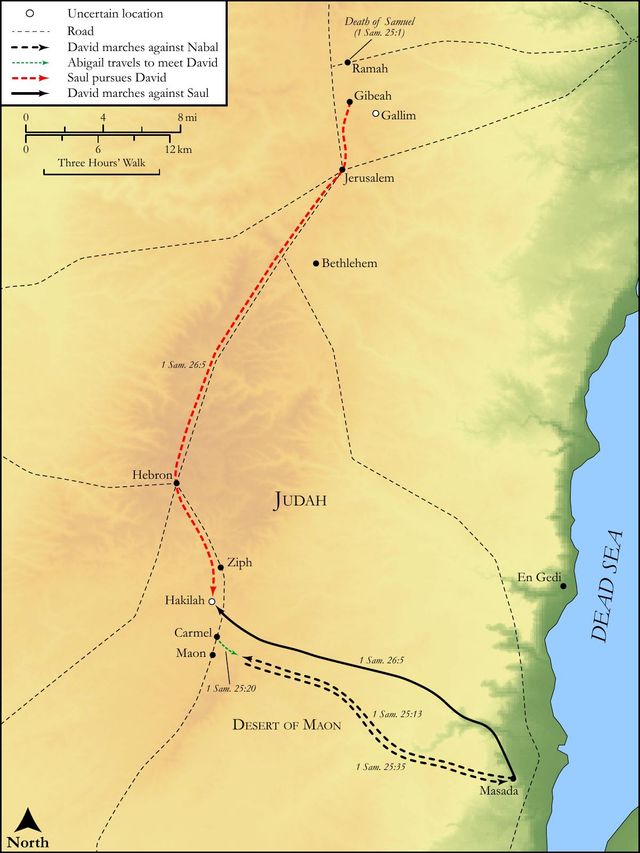
See on the biblical-era map
Study this verse
Public-domain commentary
Matthew Henry
From his Commentary on the Whole Bible. Henry comments on passages, not single verses — this entry covers 1 Samuel 25:2–11. His three-level outline is real structure in the source text, so it is rendered as structure.
Here begins the story of Nabal.
I.A short account of him, who and what he was (Sa1 25:2, Sa1 25:3), a man wee should never have heard of if there had not happened some communication between him and David. Observe,
1.His name: Nabal - a fool; so it signifies. It was a wonder that his parents would give him that name and an ill omen of what proved to be this character. Yet indeed we all of us deserve to be so called when we come into the world, for man is born like the wild ass's colt and foolishness is bound up in our hearts.
2.His family: He was of the house of Caleb, but was indeed of another spirit. He inherited Caleb's estate; for Maon and Carmel lay near Hebron, which was given to Caleb (Jos 15:54, Jos 15:55; Jos 14:14), but he was far from inheriting his virtues. He was a disgrace to his family, and then it was no honour to him. Degeneranti genus opprobrium - A Good extraction is a reproach to him who degenerates from it. The Septuagint, and some other ancient versions, read it appellatively, not, He was a Calebite, but He was a dogged man, of a currish disposition, surly and snappish, and always snarling. He was anthrōpos kunikos - a man that was a cynic.
3.His wealth: He was very great, that is, very rich (for riches make men look great in the eye of the world), otherwise, to one that takes his measures aright, he really looked very mean. Riches are common blessings, which God often gives to Nabals, to whom he gives neither wisdom nor grace.
4.His wife - Abigail, a woman of great understanding. Her name signifies, the joy of her father; yet he could not promise himself much joy of her when he married her to such a husband, enquiring more after his wealth than after his wisdom. Many a child is thrown away upon a great heap of the dirt of worldly wealth, married to that, and to nothing else that is desirable. Wisdom is good with an inheritance, but an inheritance is good for little without wisdom. Many an Abigail is tied to a Nabal; and if it be so, be her understanding, like Abigail's, ever so great, it will be little enough for her exercises.
5.His character. He had no sense either of honour or honesty; not of honour, for he was churlish, cross, and ill-humoured; not of honesty, for he was evil in his doings, hard and oppressive, and a man that cared not what fraud and violence he used in getting and saving, so he could but get and save. This is the character given of Nabal by him who knows what every man is.
II.David's humble request to him, that he would send him some victuals for himself and his men.
1.David, it seems, was in such distress that he would be glad to be beholden to him, and did in effect come a begging to his door. What little reason have we to value the wealth of this world when so great a churl as Nabal abounds and so great a saint as David suffers want! Once before we had David begging his bread, but then it was of Ahimelech the high priest, to whom one would not grudge to stoop. But to send a begging to Napal was what such a spirit as David had could not admit without some reluctancy; yet, if Providence bring him to these straits, he will not say that to beg he is ashamed. Yet see Psa 37:25.
2.He chose a good time to send to Nabal, when he had many hands employed about him in shearing his sheep, for whom he was to make a plentiful entertainment, so that good cheer was stirring. Had he sent at another time, Nabal would have pretended he had nothing to spare, but now he could not have that excuse. It was usual to make feasts at their sheep-shearings, as appears by Absalom's feast on that occasion (Sa2 13:24), for wool was one of the staple commodities of Canaan.
3.David ordered his men to deliver their message to him with a great deal of courtesy and respect: "Go to Nabal, and greet him in my name. Tell him I sent you to present my service to him, and to enquire how he does and his family," Sa1 25:5. He puts words in their mouths (Sa1 25:6): Thus shall you say to him that liveth; our translators add, in prosperity, as if those live indeed that live as Nabal did, with abundance of the wealth of this world about them; whereas, in truth, those that live in pleasure are dead while they live, Ti1 5:6. This was, methinks too high a compliment to pass upon Nabal, to call him the man that liveth. David knew better things, that in God's favour is life, not in the world's smiles; and by the rough answer he was well enough served, for this too smooth address to such a muck-worm. Yet his good wishes were very commendable. "Peace be to thee, all good both to soul and body. Peace be to thy house and to all that thou hast." Tell him I am a hearty well-wisher to his health and prosperity. He bids them call him his son David (Sa1 25:8), intimating that, for his age and estate, David honoured him as a father, and therefore hoped to receive some fatherly kindness from him.
4.He pleaded the kindness which Nabal's shepherds had received from David and his men; and one good turn requires another. He appeals to Nabal's own servants, and shows that when David's soldiers were quartered among Nabal's shepherds,
(1.)They did not hurt them themselves, did them no injury, gave them no disturbance, were not a terror to them, nor took any of the lambs out of the flock. Yet, considering the character of David's men, men in distress, and debt, and discontented, and the scarcity of provisions in his camp, it was not without a great deal of care and good management that they were kept from plundering.
(2.)They protected them from being hurt by others. David himself does but intimate this, for he would not boast of his good offices: Neither was there aught missing to them, Sa1 25:7. But Nabal's servants, to whom he appealed, went further (Sa1 25:16): They were a wall unto us, both by night and day. David's soldiers were a guard to Nabal's shepherds when the bands of the Philistines robbed the threshing-floors (Sa1 23:1) and would have robbed the sheep-folds. From those plunderers Nabal's flocks were protected by David's care, and therefore he says, Let us find favour in thy eyes. Those that have shown kindness may justly expect to receive kindness.
5.He was very modest in his request. Though David was anointed king, he insisted not upon royal dainties, but, "Give whatsoever comes to thy hand, and we will be thankful for it." Beggars must not be choosers. Those that deserved to have been served first will now be glad of what is left. They plead, We come in a good day, a festival, when not only the provision is more plentiful, but the heart and hand are usually more open and free than at other times, when much may be spared and yet not be missed. David demands not what he wanted as a debt, either by way of tribute as he was a king, or by way of contribution as he was a general, but asks it as a boon to a friend, that was his humble servant. David's servants delivered their message faithfully and very handsomely, not doubting but to go back well laden with provisions.
III.Nabal's churlish answer to this modest petition, Sa1 25:10, Sa1 25:11.
One could not have imagined it possible that any man should be so very rude and ill-conditioned as Nabal was. David called himself his son, and asked bread and a fish, but, instead thereof, Nabal gave him a stone and a scorpion; not only denied him, but abused him. If he had not thought fit to send him any supplies for fear of Ahimelech's fate, who paid dearly for his kindness to David; yet he might have given a civil answer, and made the denial as modest as the request was. But, instead of that, he falls into a passion, as covetous men are apt to do when they are asked for any thing, thinking thus to cover one sin with another, and by abusing the poor to excuse themselves from relieving them. But God will not thus be mocked.
1.He speaks scornfully of David as an insignificant man, not worth taking notice of. The Philistines could say of him, This is David the king of the land, that slew his ten thousands (Sa1 21:11), yet Nabal his near neighbour, and one of the same tribe, affects not to know him, or not to know him to be a man of any merit or distinction: Who is David? And who is the son of Jesse? He could not be ignorant how much the country was obliged to David for his public services, but his narrow soul thinks not of paying any part of that debt, nor so much as of acknowledging it; he speaks of David as an inconsiderable man, obscure, and not to be regarded. Think it not strange if great men and great merits be thus disgraced.
2.He upbraids him with his present distress, and takes occasion from it to represent him as a bad man, that was fitter to be set in the stocks for a vagrant than to have any kindness shown him. How naturally does he speak the churlish clownish language of those that hate to give alms! There are many servants now-a-days (as if there had been none such in former days) that break every man from his master, suggesting that David was one of them himself ("He might have kept his place with his master Saul, and then he needed not have sent to me for provisions"), and also that he entertained and harboured those that were fugitives like himself. It would make one's blood rise to hear so great and good a man as David thus vilified and reproached by such a base churl as Nabal. But the vile person will speak villany, Isa 32:5-7. If men bring themselves into straits by their own folly, yet they are to be pitied and helped, and not trampled upon and starved. But David was reduced to this distress, not by any fault, no, nor any indiscretion, of his own, but purely by the good services he had done to his country and the honours which his God had put upon him; and yet he was represented as a fugitive and runagate. Let this help us to bear such reproaches and misrepresentations of us with patience and cheerfulness, and make us easy under them, that it has often been the lot of the excellent ones of the earth. Some of the best men that ever the world was blest with were counted as the off-scouring of all things, Co1 4:13.
3.He insists much upon the property he had in the provisions of his table, and will by no means admit any body to share in them. "It is my bread and my flesh, yes, and my water too (though usus communis aquarum - water is every one's property), and it is prepared for my shearers," priding himself in it that it was all his own; and who denied it? Who offered to dispute his title? But this, he thinks, will justify him in keeping it all to himself, and giving David none; for may he not do what he will with his own? Whereas we mistake if we think we are absolute lords of what we have and may do what we please with it. No, we are but stewards, and must use it as we are directed, remembering it is not our own, but his that entrusted us with it. Riches are ta allotria (Luk 16:12); they are another's, and we ought not to talk too much of their being our own.
Historical interpretation
Historical reception
1 surviving comment on this verse from the historical church.
The name of that man was Nabal, etc. Nabal means foolish, Abigail is called the father's joy: and the foolish man was a legal expert who, having the key of knowledge, neither entered himself, nor allowed those who wished to enter. The father's joy, however, is rightly called the synagogue among those to whom it is said: But rejoice that your names are written in heaven (Luke X). For she was most prudent in such matters, understanding the word of faith; and beautiful in doing what she could understand. Meanwhile, her masters were hardened in unbelief, wicked in living badly, and malicious in plotting against the Lord.
Continue studying 1 Samuel 25:3 across the web’s major study libraries — every link below opens this exact verse, chapter, or book on the destination site.
Read & Compare
 BibleGatewayThis verse in more than 200 translations and 70 languages.
 Bible.comThe YouVersion reader — hundreds of translations, reading plans, and highlights.
 ESV.orgCrossway's official English Standard Version reader.
 NET BibleThe NET translation with 60,000+ translators' notes on every rendering decision.
 STEP BibleTyndale House's free study tool — original text, vocabulary, and scholarly resources.
 BibliaLogos Bible Software's free web reader.
 USCCBThe New American Bible (Revised Edition) with the U.S. bishops' study notes.
Commentaries
 BibleHub CommentariesDozens of classic commentaries on this verse, gathered on one page.
 StudyLightMore than 100 commentary sets — the largest collection on the web.
 BibleRefPlain-English commentary on what this verse means, verse by verse.
 Enduring WordDavid Guzik's free commentary on this chapter, widely used by Bible teachers.
 Bible Study ToolsVerse commentary alongside Greek and Hebrew study aids.
Original Language & Research
- BibleHub InterlinearThe verse word by word — original language, transliteration, and English.
- BibleHub LexiconEvery word's original-language definition and Strong's entry.
 Blue Letter BibleDeep-study tools — Strong's numbers, concordance, and word studies.
 SefariaThe Hebrew text with Rashi and centuries of Jewish commentary.
Sermons, Hymns & Audio


TrulyRandomVerse is not affiliated with these sites and doesn’t control their content. They’re linked because they’re genuinely useful.
Summary
1 Samuel 25:3 masterfully introduces the two central figures of an unfolding drama: Nabal and Abigail. This pivotal verse immediately establishes a stark and intentional contrast between the characters, portraying Abigail as a woman of profound wisdom and striking beauty, while Nabal is depicted as a man whose very name signifies foolishness, characterized by a harsh disposition and evil actions, despite his prestigious lineage. This concise characterization sets the narrative trajectory, foreshadowing the conflict that will arise from Nabal's folly and Abigail's discerning intervention.
Context
ShowHideLiterary Context
This verse appears at a critical juncture in David's life as a fugitive from King Saul, immediately following the death of the prophet Samuel. David and his approximately 600 men were operating in the wilderness of Paran, often providing protection to shepherds and flocks in exchange for provisions. Chapter 25 opens with David hearing that Nabal, an exceptionally wealthy sheep owner in Maon, was shearing his sheep—a time traditionally associated with feasting and generosity. David, recognizing the mutual benefit of their past interactions, dispatched ten young men to Nabal to request provisions. Verse 3 immediately precedes Nabal's churlish and insulting refusal, which sets the stage for David's enraged response and Abigail's subsequent, life-saving intervention. The detailed character descriptions here are not incidental but are crucial for understanding the motivations and outcomes of the entire chapter's dramatic events, particularly how Abigail's wisdom averts David's potential sin and Nabal's inevitable demise.
Historical & Cultural Context
The practice of sheep shearing was a major annual event in ancient Israel, akin to a harvest festival, often marked by feasting, celebration, and generosity. Wealthy landowners like Nabal would host large gatherings, and it was customary to share provisions with those who had provided services or protection, especially in remote areas. David's request was thus not a mere beggar's plea but a customary expectation within the patron-client relationships of the time, where his men had acted as a protective force against raiders for Nabal's flocks. Nabal's refusal was therefore a grave insult and a breach of established social protocol, not merely a lack of generosity. Furthermore, Nabal being "of the house of Caleb" is highly significant. Caleb was a prominent figure from the tribe of Judah, known for his unwavering faithfulness and courage, as seen in Numbers 14:24. This lineage would have afforded Nabal a certain social standing and expectation of noble character, making his "churlish and evil" disposition all the more shocking and ironic within the cultural framework.
Key Themes
ShowHideThe primary theme immediately established by this verse is the profound contrast between wisdom and foolishness. Nabal, whose name literally means "fool," embodies a destructive, self-serving folly that leads to his downfall, while Abigail represents practical wisdom, discernment, and foresight, which enables her to avert catastrophe and secure a blessed future. This highlights the biblical emphasis on wisdom as a vital attribute for navigating life, contrasting sharply with the destructive nature of foolishness, as seen throughout the book of Proverbs. Another significant theme is the disparity between outward appearance/status and inner character. Nabal possesses great wealth and a noble lineage, yet his character is despicable. Abigail, while beautiful, is primarily lauded for her "good understanding," underscoring that true worth is found in moral and spiritual qualities rather than material possessions or social standing. The narrative also subtly introduces the theme of divine providence, as Abigail's wisdom is ultimately used by God to restrain David's vengeful impulses and guide him towards a righteous path, preventing him from shedding innocent blood, as David himself acknowledges in 1 Samuel 25:33.
Exposition and Analysis
ShowHideKey Word Analysis
ShowHideThis Hebrew word (H5037) directly translates to "fool," "senseless," or "worthless." It is not merely descriptive of Nabal's actions but is his very name, serving as a powerful example of a biblical character whose name perfectly encapsulates his nature and destiny. Throughout the Old Testament, a "fool" (נָבָל) is not simply someone lacking intelligence, but often one who is morally corrupt, rejects God's wisdom, and behaves impiously, leading to self-destruction. Nabal's subsequent actions in the chapter fully validate this pejorative naming, making him a living embodiment of folly.
The Hebrew term qasheh (H7186) literally means "hard," "harsh," "difficult," or "severe." When applied to a person, it conveys a stubborn, unyielding, ill-tempered, and unpleasant disposition. It suggests an ungenerous and ungracious character, someone who is rigid and unbending in their interactions, leading to conflict and alienation. This word perfectly describes Nabal's unyielding refusal and insulting response to David's men, highlighting his abrasive and confrontational nature.
This term (H7922), often translated as "intelligence," "prudence," "discernment," or "insight," describes Abigail's exceptional intellectual and moral capacity. When coupled with "good" (H2896, ṭôwb), it denotes a profound capacity for wise judgment, practical wisdom, and sound decision-making, far beyond mere intellectual acuity. It implies a discerning heart that can assess situations, foresee consequences, and act appropriately, which Abigail demonstrates remarkably in her swift and strategic intervention.
Verse Breakdown
ShowHide"Now the name of the man [was] Nabal; and the name of his wife Abigail:"
This opening clause immediately introduces the two main characters who will drive the narrative of the chapter. By stating their names upfront, the author prepares the reader for the dramatic contrast that is about to be presented, signaling that their individual identities and characteristics will be central to the story's development and the unfolding drama.
"and [she was] a woman of good understanding, and of a beautiful countenance:"
This part of the verse focuses exclusively on Abigail, highlighting two key attributes. Her "good understanding" (wisdom, discernment, prudence) is listed first, emphasizing its primary importance over her "beautiful countenance" (physical beauty). This prioritization of inner character and intellectual capacity sets up a clear moral and spiritual standard against which Nabal will be sharply contrasted.
"but the man [was] churlish and evil in his doings;"
The conjunction "but" serves as a sharp adversative, directly contrasting Nabal with Abigail. Nabal is characterized by his "churlish" (harsh, difficult) disposition and his "evil in his doings" (wicked actions). This description paints him as morally corrupt and unpleasant, indicating that his character is defined not just by his temperament but by the unrighteousness and harmful nature of his conduct.
"and he [was] of the house of Caleb."
This final clause adds a layer of profound ironic significance. Nabal's lineage connects him to Caleb, a revered and faithful figure in Israel's history. This detail underscores that noble ancestry does not guarantee noble character, making Nabal's foolishness and wickedness even more striking and inexcusable given his prestigious heritage. It emphasizes that character is a matter of personal choice and conduct, not inherited status or social standing.
Literary Devices
ShowHideThe author of 1 Samuel employs several powerful literary devices in 1 Samuel 25:3 to convey profound meaning. The most prominent is Juxtaposition, where the contrasting characters of Nabal and Abigail are placed side-by-side. Abigail is described with positive attributes—"good understanding" and "beautiful countenance"—while Nabal is immediately branded as "churlish and evil in his doings." This sharp contrast immediately establishes the central conflict and the moral poles of the narrative. Irony is also heavily at play, particularly with Nabal's name, which literally means "fool." This nominative determinism (where a name reflects destiny or character) is ironic because despite his wealth and noble lineage ("of the house of Caleb"), Nabal lives up to his foolish name. The mention of his lineage adds a layer of situational irony, as one would expect a descendant of the valiant and faithful Caleb to exhibit better character. Finally, the verse employs direct Characterization, explicitly telling the reader about the inner and outer qualities of both individuals, rather than leaving it to inference. This direct portrayal serves to foreshadow the events of the chapter, indicating that Nabal's character will lead to his downfall, and Abigail's wisdom will be the key to resolution.
Theological and Thematic Connections
ShowHide1 Samuel 25:3 serves as a profound theological statement on the nature of true worth and the consequences of character. It challenges the common human tendency to equate value with wealth, social standing, or outward appearance. Nabal, despite his significant material possessions and prestigious lineage from the house of Caleb, is condemned by his inner character—his foolishness, harshness, and evil deeds. Conversely, Abigail, while beautiful, is primarily commended for her "good understanding," demonstrating that true wisdom and discernment are the most valuable attributes. This highlights a consistent biblical theme: God values the heart and righteous conduct above all else, and folly, particularly that which rejects wisdom and acts unjustly, inevitably leads to destruction. The narrative thus underscores the importance of cultivating a heart of wisdom and righteousness, which brings life and blessing, in contrast to the path of the fool, which leads to ruin.
Reflection and Application
ShowHide1 Samuel 25:3 offers a timeless and piercing reflection on the enduring importance of character over superficial attributes. In a world often preoccupied with external markers of success—wealth, social media presence, physical attractiveness—this verse powerfully reminds us that true worth and lasting impact stem from our inner disposition and moral choices. Nabal's story is a cautionary tale: his riches and heritage could not save him from the consequences of his churlishness and evil. Abigail's narrative, however, is an inspiring example: her wisdom, discernment, and gracious actions not only preserved her household but also elevated her status and brought blessing. We are called to embody Abigail's "good understanding," seeking wisdom from God to navigate complex situations, to speak truth with grace, and to act justly. This means prioritizing kindness, integrity, and spiritual discernment in our interactions, recognizing that our character, not our possessions or appearance, is what truly defines us in the eyes of God and ultimately determines our legacy.
Questions for Reflection
ShowHideFAQ
ShowHideWhy is Nabal's lineage (House of Caleb) mentioned?
ShowHideThe mention of Nabal being "of the house of Caleb" is highly significant and adds a layer of profound irony to his character. Caleb was a revered figure in Israel's history, known for his unwavering faithfulness, courage, and wholehearted devotion to God, as recorded in Numbers 14:24. By stating Nabal's descent from such a noble and respected lineage, the author highlights the stark contrast between Nabal's churlish and evil character and the expected virtues of his heritage. It underscores that noble ancestry or rank does not automatically confer noble character or wisdom; rather, character is forged through personal choices and actions. Nabal's failure is thus emphasized as a personal moral failing, made all the more striking given the legacy he inherited.
What does "churlish" mean in this context?
ShowHideIn the context of 1 Samuel 25:3, "churlish" (from the Hebrew qasheh) describes Nabal's disposition as "hard," "harsh," "difficult," or "severe." It signifies an unyielding, ill-tempered, and ungracious personality. A churlish person is characterized by their rudeness, stubbornness, and lack of generosity, often leading to conflict and offense. Nabal's churlishness is immediately demonstrated in his insulting and dismissive response to David's respectful request for provisions in 1 Samuel 25:10-11, which directly precipitates David's wrath and the ensuing crisis. It is a character trait that reflects a deep-seated meanness and a disregard for social norms and the well-being of others.
Christ-Centered Fulfillment
ShowHideThe sharp contrast between Nabal's folly and Abigail's wisdom in 1 Samuel 25:3 finds its ultimate fulfillment and resolution in the person and work of Jesus Christ. Nabal, whose name means "fool," embodies humanity's inherent folly and rebellion against God, a foolishness that leads to death and destruction, as described in Romans 1:21-22. His "churlish and evil doings" represent the sinful nature that separates humanity from God. In stark contrast, Abigail's "good understanding" and saving intervention foreshadow the perfect wisdom and redemptive action of Christ. Jesus is revealed as the very "wisdom of God" (1 Corinthians 1:24), in whom "are hidden all the treasures of wisdom and knowledge" (Colossians 2:3). While Nabal's folly brought a curse upon his household, Christ's divine wisdom and perfect obedience brought salvation to all who believe. He is the ultimate "good understanding" who, out of love, intervened on behalf of a foolish and rebellious humanity, bearing the consequences of our "evil doings" on the cross (Romans 5:8). Through His sacrifice, He provides the true wisdom that leads to life, transforming hearts of folly into hearts of understanding, enabling us to "walk in wisdom" (Ephesians 5:15-16) and escape the judgment our own Nabal-like tendencies deserve.