


1 Samuel 21:11
- וַיֹּאמְרוּvai·Yo·me·Ruand they saidH559Conj-w ¦ V-Qal-ConsecImperf-3mpVerb Qal Consecutive Imperfect 3rd Plural Masculineוַandיֹּאמְרוּthey said
- עַבְדֵי'av·Dei[the] servants ofH5650N-mpcNoun Plural Masculine Construct
- אָכִישׁ'a·KhishAchishH397N-proper-mNoun Proper Masculine
- אֵלָיו'e·Lavto himH413Prep ¦ 3msPreposition Definiteאֵלָיtoוhim
- הֲלוֹאha·lo'¿ notH3808Interrog ¦ NegParticle Negativeהֲ¿לוֹאnot
- זֶהzeh[is] thisH2088PrtParticle Demonstrative
- דָוִדda·VidDavidH1732N-proper-mNoun Proper Masculine
- מֶלֶךְMe·lekh[the] king ofH4428N-mscNoun Singular Masculine Construct
- הָאָרֶץha·'A·retzthe landH776Art ¦ N-fsNoun Singular Feminine Absoluteהָtheאָרֶץland
- הֲלוֹאha·Lo'¿ notH3808Interrog ¦ NegParticle Negativeהֲ¿לוֹאnot
- לָזֶהla·Zehof this [one]H2088Prep-l ¦ PrtParticle Demonstrativeלָofזֶהthis [one]
- יַעֲנוּya·'a·Nudo people singH6030V-Qal-Imperf-3mpVerb Qal Imperfect 3rd Plural Masculine
- בַמְּחֹלוֹתva·me·cho·lOtwith <the> dancesH4246Prep-b ¦ N-fpNoun Plural Feminine Absoluteבַwith <the>מְּחֹלוֹתdances
- לֵאמֹרle·Mor<to> sayingH559Prep-l ¦ V-Qal-InfVerb Qal Infinitive Constructלֵ<to>אמֹרsaying
- הִכָּהhi·Kahhe has struck downH5221V-Hiphil-Perf-3msVerb Hiphil Perfect 3rd Singular Masculine
- שָׁאוּלsha·'UlSaulH7586N-proper-mNoun Proper Masculine
- בַּאֲלָפָיוba·'a·la·fov<on> his thousandsH505Prep-b ¦ N-cpc ¦ 3msNoun Plural common gender Constructבַּ<on>אֲלָפָיthousandsוhis
- וְדָוִדve·da·Vidand DavidH1732Conj-w ¦ N-proper-mNoun Proper MasculineוְandדָוִדDavid
- בְּרִבְבֹתָיוbe·ri·vo·Tav<on> his ten thousandsH7233Prep-b ¦ N-fpc ¦ 3msNoun Plural Feminine Constructבְּ<on>רִבְבֹתָיten thousandsוhis
English is a literal word-by-word gloss of the Hebrew, not the KJV's wording. Why?
This is the original text the KJV's translators worked from — each Hebrew word with its own literal English meaning in this verse, prepared by scholars at Tyndale House, Cambridge. The KJV translates whole sentences, not word by word, so its wording differs: one Hebrew word can become several English words, and the KJV may choose “the LORD” where the gloss reads “Yahweh”. Both are faithful — they answer different questions. For the KJV's own rendering, switch to the KJV text.
Details
See on the biblical-era map
Study this verse
Public-domain commentary
Matthew Henry
From his Commentary on the Whole Bible. Henry comments on passages, not single verses — this entry covers 1 Samuel 21:10–15.
David, though king elect, is here an exile - designed to be master of vast treasures, yet just now begging his bread - anointed to the crown, and yet here forced to flee from his country. Thus do God's providences sometimes seem to run counter to his promises, for the trial of his people's faith, and the glorifying of his name, in the accomplishment of his counsels, notwithstanding the difficulties that lay in the way. Here is, 1. David's flight into the land of the Philistines, where he hoped to be hid, and to remain undiscovered in the court or camp of Achish king of Gath, Sa1 21:10. Israel's darling is necessitated to quit the land of Israel, and he that was the Philistine's great enemy (upon I know not what inducements) goes to seek for shelter among them. It should seem that as, though the Israelites loved him, yet the king of Israel had a personal enmity to him, which obliged him to leave his own country, so, though the Philistines hated him, yet the king of Gath had a personal kindness for him, valuing his merit, and perhaps the more for his killing Goliath of Gath, who, it may be, had been no friend to Achish. To him David now went directly, as to one he could confide in, as afterwards (Sa1 27:2, Sa1 27:3), and Achish would not have protected him but that he was afraid of disobliging his own people. God's persecuted people have often found better usage from Philistines than from Israelites, in the Gentile theatres than in the Jewish synagogues. The king of Judah imprisoned Jeremiah, and the king of Babylon set him at liberty. 2. The disgust which the servants of Achish took at his being there, and their complaint of it to Achish (Sa1 21:11): "Is not this David? Is not this he that has triumphed over the Philistines? witness that burden of the song which was so much talked of, Saul has slain his thousands, but David, this very man, his ten thousands. Nay, Is not this he that (if our intelligence from the land of Israel be true) is, or is to be, king of the land?" As such, "he must be an enemy to our country; and is it safe or honourable for us to protect or entertain such a man?" Achish perhaps had intimated to them that it would be policy to entertain David, because he was now an enemy to Saul, and he might be hereafter a friend to them. It is common for the outlaws of a nation to be sheltered by the enemies of that nation. But the servants of Achish objected to his politics, and thought it not at all fit that he should stay among them. 3. The fright which this put David into. Though he had some reason to put confidence in Achish, yet, when he perceived the servants of Achish jealous of him, he began to be afraid that Achish would be obliged to deliver him up to them, and he was sorely afraid (Sa1 21:12), and perhaps he was the more apprehensive of his own danger, when he was thus discovered, because he wore Goliath's sword, which, we may suppose, was well known in Gath, and with which he had reason to expect they would cut off his head, as he had cut off Goliath's with it. David now learned by experience what he has taught us (Psa 118:9), that it is better to trust in the Lord than to put confidence in princes. Men of high degree are a lie, and, if we make them our hope, they may prove our fear. It was at this time that David penned Psalm 55 (Michtam, a golden psalm), when the Philistines took him in Gath, where having shown before God his distresses, he resolves (Psa 55:3), "What time I am afraid I will trust in thee; and therefore (Psa 55:11) will not be afraid what man can do unto me, no, not the sons of giants." 4. The course he took to get out of their hands: He feigned himself mad, Sa1 21:13. He used the gestures and fashions of a natural fool, or one that had gone out of his wits, supposing they would be ready enough to believe that the disgrace he had fallen into, and the troubles he was now in, had driven him distracted. This dissimulation of his cannot be justified (it was a mean thing thus to disparage himself, and inconsistent with truth thus to misrepresent himself, and therefore not becoming the honour and sincerity of such a man as David); yet it may in some degree be excused, for it was not a downright lie and it was like a stratagem in war, by which he imposed upon his enemies for the preservation of his own life. What David did here in pretence and for his own safety, which made it partly excusable, drunkards do really, and only to gratify a base lust: they made fools of themselves and change their behaviour; their words and actions commonly are either as silly and ridiculous as an idiot's or as furious and outrageous as a madman's, which has often made me wonder that ever men of sense and honour should allow themselves in it. 5. His escape by this means, Sa1 21:14, Sa1 21:15. I am apt to think Achish was aware that the delirium was but counterfeit, but, being desirous to protect David (as we find afterwards he was very kind to him, even when the lord of the Philistines favoured him not, Sa1 28:1, Sa1 28:2; Sa1 29:6), he pretended to his servants that he really thought he was mad, and therefore had reason to question whether it was David or no; or, if it were, they need not fear him, what harm could he do them now that his reason had departed from him? They suspected that Achish was inclined to entertain him: "Not I," says he. "He is a madman. I'll have nothing to do with him. You need not fear that I should employ him, or give him any countenance." He humours the thing well enough when he asks, "Have I need of madmen? Shall this fool come into my house? I will show him no kindness, but then you shall do him no hurt, for, if he be a madmen, he is to be pitied." He therefore drove him away, as it is in the title of Ps. 34, which David penned upon this occasion, and an excellent psalm it is, and shows that he did not change his spirit when he changed his behaviour, but even in the greatest difficulties and hurries his heart was fixed, trusting in the Lord; and he concludes that psalm with this assurance, that none of those that trust in God shall be desolate, though they may be, as he now was, solitary and distressed, persecuted, but not forsaken.
Historical interpretation
Six Centuries of Reception
2 surviving comments on this verse. Each one is dated, so this reads as a timeline rather than a list.
Select a marker to jump to its quote. Markers stagger vertically where authors wrote within a few decades of each other.
Every kind of honour and happiness was bestowed upon you, and then was fulfilled that which is written, "My beloved ate and drank, and was enlarged and became fat, and kicked." [Deuteronomy 32:15] Hence flowed emulation and envy, strife and sedition, persecution and disorder, war and captivity. So the worthless rose up against the honoured, those of no reputation against such as were renowned, the foolish against the wise, the young against those advanced in years. For this reason righteousness and peace are now far departed from you, inasmuch as every one abandons the fear of God, and has become blind in His faith, neither walks in the ordinances of His appointment, nor acts a part becoming a Christian, but walks after his own wicked lusts, resuming the practice of an unrighteous and ungodly envy, by which death itself entered into the world. [Wisdom 2:24]
For thus it is written: "And it came to pass after certain days, that Cain brought of the fruits of the earth a sacrifice unto God; and Abel also brought of the firstlings of his sheep, and of the fat thereof. And God had respect to Abel and to his offerings, but Cain and his sacrifices He did not regard. And Cain was deeply grieved, and his countenance fell. And God said to Cain, Why are you grieved, and why is your countenance fallen? If you offer rightly, but do not divide rightly, have you not sinned? Be at peace: your offering returns to yourself, and you shall again possess it. And Cain said to Abel his brother, Let us go into the field. And it came to pass, while they were in the field, that Cain rose up against Abel his brother, and slew him." [Genesis 4:3-8] You see, brethren, how envy and jealousy led to the murder of a brother. Through envy, also, our father Jacob fled from the face of Esau his brother [Genesis 27:41-45]. Envy made Joseph be persecuted unto death, and to come into bondage. [Genesis 37:18-28] Envy compelled Moses to flee from the face of Pharaoh king of Egypt, when he heard these words from his fellow-countryman, "Who made you a judge or a ruler over us? Will you kill me, as you killed the Egyptian yesterday?" [Exodus 2:14] On account of envy, Aaron and Miriam had to make their abode without the camp. [Numbers 12:14-15] Envy brought down Dathan and Abiram alive to Hades, through the sedition which they excited against God's servant Moses. [Numbers 16:33] Through envy, David not only underwent the hatred of foreigners, but was also persecuted by Saul king of Israel. [1 Samuel 21:10-15]
Is this not David, the king of the land? etc. The scribes and Pharisees of the Jewish kingdom, serving wickedness badly, said: “See that we gain nothing; behold, the whole world has gone after him” (John XII), to whom they sang in choirs, saying: “Hosanna, blessed is he who comes in the name of the Lord! Blessed is the coming kingdom of our father David, Hosanna in the highest!” (Matt. XXI; Mark XI). Whom his faithful ones glorify with harmonious exultation, bearing him on high, because more are called to merit the denarius of heavenly life through his teaching than through ours are summoned to observe the commands of the law.
Continue studying 1 Samuel 21:11 across the web’s major study libraries — every link below opens this exact verse, chapter, or book on the destination site.
Read & Compare
 BibleGatewayThis verse in more than 200 translations and 70 languages.
 Bible.comThe YouVersion reader — hundreds of translations, reading plans, and highlights.
 ESV.orgCrossway's official English Standard Version reader.
 NET BibleThe NET translation with 60,000+ translators' notes on every rendering decision.
 STEP BibleTyndale House's free study tool — original text, vocabulary, and scholarly resources.
 BibliaLogos Bible Software's free web reader.
 USCCBThe New American Bible (Revised Edition) with the U.S. bishops' study notes.
Commentaries
 BibleHub CommentariesDozens of classic commentaries on this verse, gathered on one page.
 StudyLightMore than 100 commentary sets — the largest collection on the web.
 BibleRefPlain-English commentary on what this verse means, verse by verse.
 Enduring WordDavid Guzik's free commentary on this chapter, widely used by Bible teachers.
 Bible Study ToolsVerse commentary alongside Greek and Hebrew study aids.
Original Language & Research
- BibleHub InterlinearThe verse word by word — original language, transliteration, and English.
- BibleHub LexiconEvery word's original-language definition and Strong's entry.
 Blue Letter BibleDeep-study tools — Strong's numbers, concordance, and word studies.
 SefariaThe Hebrew text with Rashi and centuries of Jewish commentary.
Sermons, Hymns & Audio


TrulyRandomVerse is not affiliated with these sites and doesn’t control their content. They’re linked because they’re genuinely useful.
Summary
1 Samuel 21:11 marks a critical and dangerous turning point in David's desperate flight from King Saul, as the servants of King Achish in the Philistine city of Gath recognize him. This recognition is not merely based on his appearance but on the widespread fame of a popular song celebrating his unparalleled military victories over Saul. This moment immediately highlights David's extreme peril, as his renown, which once brought him honor and acclaim in Israel, now becomes a profound liability in the heart of enemy territory, exposing his precarious and vulnerable position.
Context
ShowHideLiterary Context
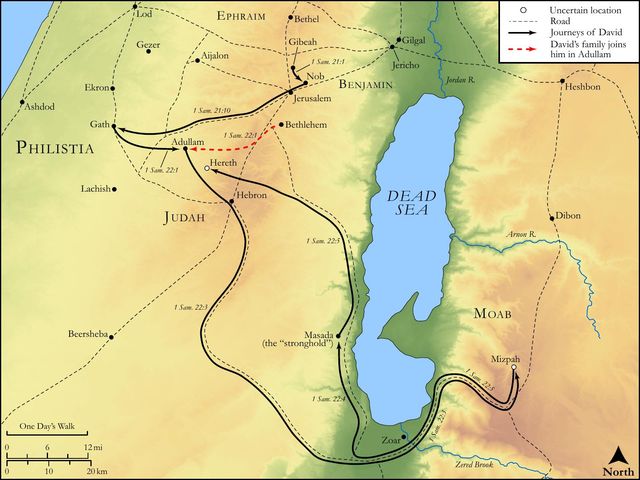
This verse is strategically placed within a harrowing period of David's life, immediately following his abrupt flight from King Saul's escalating and irrational jealousy. Having narrowly escaped Saul's murderous attempts (David's escape from Saul) and relying on the steadfast loyalty of Jonathan (Jonathan's covenant with David), David is forced into a life of a fugitive. His journey leads him first to Nob, where, through a deceptive plea born of desperation, he obtains consecrated bread and Goliath's sword from Ahimelech the priest (David at Nob). His subsequent, even more desperate, act is to seek refuge in Gath, a major Philistine city. The servants' recognition of David in this verse directly precipitates David's extraordinary and humiliating act of feigning madness (David feigns madness), a desperate ruse to escape the immediate threat to his life, showcasing his profound fear and his reliance on cunning in the absence of obvious divine intervention.
Historical & Cultural Context
Gath was one of the five primary Philistine city-states, historically and culturally antagonistic to Israel. It was famously the hometown of Goliath, the giant whom David had heroically slain (Goliath of Gath). For David, the anointed future king of Israel, to seek asylum in such a hostile place underscores the dire severity of his plight and the relentless nature of Saul's persecution. Culturally, the practice of celebrating military victories through communal song and dance was deeply ingrained in ancient Near Eastern societies, serving as a powerful form of public record and popular acclaim. The specific song referenced, "Saul has slain his thousands, and David his ten thousands," originated after David's decisive victory over Goliath and his subsequent military successes against the Philistines (The women's song). This anthem quickly became a pervasive and popular expression of national pride. Its widespread recognition, even among the Philistines, attests to David's legendary status and the profound impact of Israel's military success, making his presence in Gath particularly perilous.
Key Themes
ShowHideThis verse powerfully illustrates the double-edged sword of fame. David's heroic deeds, celebrated in song throughout Israel, brought him immense honor and popularity among his people, but simultaneously ignited Saul's intense and pathological jealousy, which rapidly escalated into a relentless and murderous pursuit (Saul's jealousy ignites). This destructive jealousy, now driving David to seek asylum in enemy territory, underscores the profound theme of peril and desperation. David's very identity and past actions have become a direct threat to his life. Yet, even in this dire and seemingly hopeless situation, the narrative subtly hints at divine providence; David's eventual escape from Gath, though achieved through human cunning and abasement, ultimately demonstrates God's continued, albeit unseen, protection over His anointed. This foreshadows the eventual fulfillment of God's promises to David, despite overwhelming odds and his own human frailty.
Exposition and Analysis
ShowHideKey Word Analysis
ShowHideFrom עָבַד; a servant; [idiom] bondage, bondman, (bond-) servant, (man-) servant. The term "servants of Achish" highlights the hierarchical structure of the Philistine court and the fact that David's recognition came from those intimately connected to the king, making his peril immediate and official. Their role as observers and reporters of critical information underscores the pervasive nature of David's fame and the extent to which his reputation had spread even into enemy lands.
From מָלָךְ; a king; king, royal. The Philistine servants' question, "Is not this David the king of the land?" is profoundly significant. While David was not yet formally crowned king of Israel, his anointing by Samuel (David anointed king) and his unparalleled military victories had already established him as a de facto leader and a popular figure with royal potential in the eyes of the people. The Philistines, astute observers of their enemy, likely recognized David's rising influence and the threat he posed to Saul's throne, viewing him as a potential rival king. This perception elevates David's danger from merely a famous warrior to a political threat in Gath, implying he is a figure of such national importance that he could be considered a king even before his formal ascension.
From רָבָב; abundance (in number), i.e. (specifically) a myriad (whether definite or indefinite); many, million, [idiom] multiply, ten thousand. This term, contrasted with "thousands" (Hebrew, ʼeleph'), is a powerful numerical hyperbole. While "thousands" signifies a large, impressive number, "ten thousands" implies an overwhelming, almost incomparable superiority in military success. The use of rᵉbâbâh in the women's song (The celebratory song) was meant to exalt David's victories far above Saul's, creating the very comparison that so infuriated Saul and ultimately led to David's flight. Its repetition by the Philistine servants emphasizes the universal recognition of David's extraordinary military prowess and the deep impact of his deeds.
Verse Breakdown
ShowHide"And the servants of Achish said unto him, Is not this David the king of the land?"
This opening clause immediately establishes the profound tension and danger of David's situation. The servants' question is not merely an inquiry but a statement of recognition and accusation, revealing that David's identity is known, and his fame has preceded him even into the heart of enemy territory. Their reference to him as "the king of the land" indicates their understanding of his significant status and potential threat, either as a rival to Saul or as a powerful figure in Israel. This recognition underscores the complete failure of David's desperate attempt to blend in or remain unnoticed in Gath.
"did they not sing one to another of him in dances, saying, Saul hath slain his thousands, and David his ten thousands?"
This segment of the verse explicitly recalls the celebratory song that marked David's meteoric rise to prominence and simultaneously ignited Saul's destructive jealousy. The mention of "dances" indicates the widespread, communal, and joyful nature of the song's original context, highlighting its deep integration into the popular culture of Israel. The Philistine servants' precise knowledge of this specific lyric confirms its pervasive popularity and the extent of David's renown, even across national borders. The direct comparison drawn between Saul's "thousands" and David's "ten thousands" is the core of the song's impact, underscoring David's superior military achievements and serving as the direct catalyst for Saul's murderous obsession, which ultimately drove David to this desperate refuge.
Literary Devices
ShowHideThe passage employs several potent literary devices. Foremost is irony, as David, fleeing the irrational jealousy of his own king, seeks refuge in the very city of his greatest Philistine enemy, only to be recognized and endangered by the very fame he gained from defeating that enemy. His past triumph, a source of national pride and divine favor, now becomes a present peril. The phrase "ten thousands" is a clear example of hyperbole, emphasizing David's overwhelming military success in a way that is intentionally exaggerated for dramatic effect, highlighting his unparalleled victories over Saul's. Furthermore, the scene functions as a form of foreshadowing, setting the stage for David's desperate act of feigning madness to escape, a moment that will further test his faith and ingenuity, ultimately demonstrating God's providential care in preserving His anointed despite the most dire circumstances.
Theological and Thematic Connections
ShowHideThis episode profoundly illustrates the precariousness of human fame and the pervasive, destructive nature of sin's consequences, particularly jealousy. David's renown, a gift from God through his victories, paradoxically becomes a source of extreme danger due to Saul's unholy envy. Yet, even in this moment of profound desperation and human scheming (David's feigned madness), God's sovereign hand is evident. He allows David to be pushed to the brink, not to abandon him, but to refine his trust and demonstrate His faithfulness in impossible circumstances. This narrative teaches that God's protection of His anointed is not always through overt miracles but can also manifest through human ingenuity and the unexpected turns of providence, even when one is hiding in the heart of enemy territory. It highlights that God's purposes for His chosen ones will prevail, regardless of the opposition or the desperate measures they may have to take, ultimately bringing glory to His name.
Reflection and Application
ShowHideDavid's recognition in Gath serves as a powerful and sobering reminder that our past achievements, while often celebrated and divinely enabled, can also create unforeseen challenges and dangers, particularly when we are operating out of fear rather than faith, or when we are out of alignment with God's immediate will. David's desperate flight to Gath, an enemy city, was a move born of terror and human calculation, not divine instruction. It highlights the human tendency to seek refuge in our own schemes or in places that seem logically safe, even if they are spiritually compromised or inherently hostile. This passage challenges us to examine where we run when fear grips us. Do we, like David in this moment, resort to desperate measures and human cunning, or do we, in our desperation, turn directly to God, trusting Him to provide a way out that glorifies Him and aligns with His perfect will? David's subsequent feigned madness and eventual escape, often linked to the writing of Psalm 34, reveal that even in our flawed and fearful responses, God's grace and protection can still be at work, guiding us through perilous times and teaching us deeper reliance on His sovereign care.
Questions for Reflection
ShowHideFAQ
ShowHideWhy did David flee to Gath, a Philistine city, given his history with them?
ShowHideDavid's decision to flee to Gath, the very hometown of Goliath whom he had famously killed, was an act of extreme desperation born out of profound fear and the relentless, murderous pursuit by King Saul. He was literally running for his life, and Saul's escalating jealousy had made him feel unsafe anywhere within Israelite territory. Gath, being a major Philistine city, was outside of Saul's immediate jurisdiction and sphere of influence. David likely calculated that the Philistines, being enemies of Saul, might offer him asylum, or at least a temporary respite, due to the ancient principle of "the enemy of my enemy is my friend." It was a risky, almost counter-intuitive move that underscores the dire straits David found himself in, highlighting that he was willing to take extraordinary risks to escape Saul's murderous intent, even if it meant placing himself in the hands of his traditional adversaries.
What was the significance of the song "Saul has slain his thousands, and David his ten thousands"?
ShowHideThis song, first mentioned in 1 Samuel 18:7, was a popular celebratory anthem sung by the women of Israel after David's victory over Goliath and his subsequent military successes against the Philistines. Its significance is multi-faceted. Firstly, it publicly acknowledged David's extraordinary military prowess, elevating him above Saul in the eyes of the people by using the hyperbole of "ten thousands" versus "thousands." Secondly, and most critically, it ignited Saul's intense and pathological jealousy (Saul's jealousy and envy). This song became the direct catalyst for Saul's deep-seated envy and his subsequent attempts to kill David, driving the narrative forward. Finally, its widespread popularity, so much so that even Philistine servants knew it, speaks to David's immense fame and the cultural impact of his victories, turning his renown into a dangerous liability in enemy territory.
Christ-Centered Fulfillment
ShowHideThe narrative of David, the anointed king of Israel, being driven from his land and forced to seek refuge among his enemies, all because of the jealousy of the reigning king, powerfully foreshadows the ultimate experience of Jesus Christ. David, though flawed and acting out of fear, stands as a type of Christ—a divinely appointed king rejected and persecuted by his own people. Just as David's fame and identity as "the king of the land" brought him into peril, so too did the true identity of Jesus as the Son of God and King of Israel provoke the intense hostility of the religious and political authorities (Jesus' claim to be Son of God). David's desperate flight and his reliance on God's providence, even through human cunning and abasement, point to Christ's journey of self-emptying (Christ's humiliation) and His perfect trust in the Father's will, even unto death on a cross (Jesus' prayer in Gethsemane). Unlike David, who feigned madness to escape, Christ truly embraced weakness and suffering, disarming the spiritual principalities and powers through His apparent defeat on the cross, making a public spectacle of them (Christ's triumph over powers). Ultimately, David's story of being recognized and facing peril in enemy territory, yet being preserved, serves as a shadow of Christ's ultimate triumph over the true enemy, Satan, and His establishment as the true and eternal King, not just of a land, but of all creation, reigning as King of Kings and Lord of Lords.