


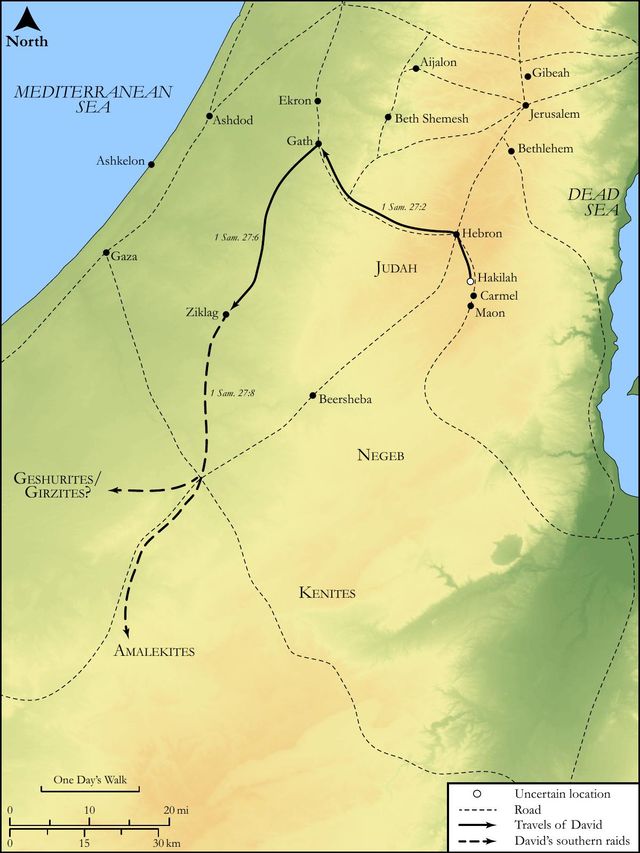
1 Samuel 27:2
Bible text: King James Version (1769 Blayney text) · Public domain
Bible text: Berean Standard Bible · Public domain
Bible text: American Standard Version (1901) · Public domain
Bible text: World English Bible, Messianic edition · Public domain
Bible text: Geneva Bible (1599) · Public domain
Bible text: Young's Literal Translation · Public domain
- וַיָּקָםvai·Ya·komand he aroseH6965Conj-w ¦ V-Qal-ConsecImperf-3msVerb Qal Consecutive Imperfect 3rd Singular Masculineוַandיָּקָםhe arose
- דָּוִדda·VidDavidH1732N-proper-mNoun Proper Masculine
- וַיַּעֲבֹרvai·ya·'a·Vorand he passed overH5674Conj-w ¦ V-Qal-ConsecImperf-3msVerb Qal Consecutive Imperfect 3rd Singular Masculineוַandיַּעֲבֹרhe passed over
- הוּאHu'heH1931Pro-3msPronoun Personal 3rd Singular Masculine
- וְשֵׁשׁve·sheshand sixH8337Conj-w ¦ N-csNoun Singular common gender Absoluteוְandשֵׁשׁsix
- מֵאוֹתme·'othundred<s>H3967N-fpNoun Plural Feminine Absolute
- אִישׁ'ishmanH376N-msNoun Singular Masculine Absolute
- אֲשֶׁר'a·SherwhoH834RelParticle Relative
- עִמּוֹi·Mo[were] with himH5973Prep ¦ 3msPreposition Definiteעִמּ[were] withוֹhim
- אֶל'eltoH413PrepPreposition
- אָכִישׁ'a·KhishAchishH397N-proper-mNoun Proper Masculine
- בֶּןben[the] son ofH1121N-mscNoun Singular Masculine Construct
- מָעוֹךְma·'okhMaochH4582N-proper-mNoun Proper Masculine
- מֶלֶךְMe·lekh[the] king ofH4428N-mscNoun Singular Masculine Construct
- גַּתGatGathH1661N-properNoun Proper Location
English is a literal word-by-word gloss of the Hebrew, not the KJV's wording. Why?
This is the original text the KJV's translators worked from — each Hebrew word with its own literal English meaning in this verse, prepared by scholars at Tyndale House, Cambridge. The KJV translates whole sentences, not word by word, so its wording differs: one Hebrew word can become several English words, and the KJV may choose “the LORD” where the gloss reads “Yahweh”. Both are faithful — they answer different questions. For the KJV's own rendering, switch to the KJV text.
Details
See on the biblical-era map
Study this verse
Public-domain commentary
Matthew Henry
From his Commentary on the Whole Bible. Henry comments on passages, not single verses — this entry covers 1 Samuel 27:1–7. His three-level outline is real structure in the source text, so it is rendered as structure.
Here is, I. The prevalency of David's fear, which was the effect of the weakness of his faith (Sa1 27:1): He said to his heart (so it may be read), in his communings with it concerning his present condition, I shall now perish one day by the hand of Saul. He represented to himself the restless rage and malice of Saul (who could not be wrought into a reconciliation) and the treachery of his own countrymen, witness that of the Ziphites, once and again; he looked upon his own forces, and observed how few they were, and that no recruits had come in to him for a great while, nor could he perceive that he got any ground; and hence, in a melancholy mood, he draws this dark conclusion: I shall one day perish by the hand of Saul. But, O thou of little faith! wherefore dost thou doubt? Was he not anointed to be king? Did not that imply an assurance that he should be preserved to the kingdom? Though he had no reason to trust Saul's promises, had he not all the reason in the world to trust the promises of God? His experience of the particular care Providence took of him ought to have encouraged him. He that has delivered does and will. But unbelief is a sin that easily besets even good men. When without are fightings, within are fears, and it is a hard matter to get over them. Lord, increase our faith!
II.The resolution he came to hereupon.
Now that Saul had, for this time, returned to his place, he determined to take this opportunity of retiring into the Philistines' country. Consulting his own heart only, and not the ephod or the prophet, he concludes, There is nothing better for me than that I should speedily escape into the land of the Philistines. Long trials are in danger of tiring the faith and patience even of very good men. Now,
1.Saul was an enemy to himself and his kingdom in driving David to this extremity. He weakened his own interest when he expelled from his service, and forced into the service of his enemies, so great a general as David was, and so brave a regiment as he had the command of.
2.David was no friend to himself in taking this course. God had appointed him to set up his standard in the land of Judah, Sa1 22:5. There God had wonderfully preserved him, and employed him sometimes for the good of his country; why then should he think of deserting his post? How could he expect the protection of the God of Israel if he went out of the borders of the land of Israel? Could he expect to be safe among the Philistines, out of whose hands he had lately escaped so narrowly by feigning himself mad? Would he receive obligations from those now whom he knew he must not return kindness to when he should come to be king, but be under an obligation to make war upon? Hereby he would gratify his enemies, who bade him go and serve other gods that they might have wherewith to reproach him, and very much weaken the hands of his friends, who would not have wherewith to answer that reproach. See what need we have to pray, Lord, lead us not into temptation.
III.The kind reception he had at Gath.
Achish bade him welcome, partly out of generosity, being proud of entertaining so brave a man, partly out of policy, hoping to engage him for ever to his service, and that his example would invite many more to desert and come over to him. No doubt he gave David a solemn promise of protection, which he could rely upon when he could not trust Saul's promises. We may blush to think that the word of a Philistine should go further than the word of an Israelite, who, if an Israelite indeed, would be without guile, and that the city of Gath should be a place of refuge for a good man when the cities of Israel refuse him a safe abode. David,
1.Brought his men with him (Sa1 27:2) that they might guard him, and might themselves be safe where he was, and to recommend himself the more to Achish, who hoped to have service out of him.
2.He brought his family with him, his wives and his household, so did all his men, Sa1 27:2, Sa1 27:3. Masters of families ought to take care of those that are committed to them, to protect and provide for those of their own house, and to dwell with them as men of knowledge.
IV.Saul's desisting from the further prosecution of him (Sa1 27:4):
He sought no more again for him; this intimates that notwithstanding the professions of repentance he had lately made, if he had had David in his reach, he would have aimed another blow. But, because he dares not come where he is, he resolves to let him alone. Thus many seem to leave their sins, but really their sins leave them; they would persist in them if they could. Saul sought no more for him, contenting himself with his banishment, since he could not have his blood, and hoping, it may be (as he had done, Sa1 18:25), that he would, some time or other, fall by the hand of the Philistines; and, though he would rather have the pleasure of destroying him himself, yet, if they do it, he will be satisfied, so that it be done effectually.
V.David's removal from Gath to Ziklag.
1.David's request for leave to remove was prudent and very modest, Sa1 27:5.
(1.)It was really prudent. David knew what it was to be envied in the court of Saul, and had much more reason to fear in the court of Achish, and therefore declines preferment there, and wishes for a settlement in the country, where he might be private, more within himself, and less in other people's way. In a town of his own he might have the more free exercise of his religion, and keep his men better to it, and not have his righteous soul vexed, as it was at Gath, with the idolatries of the Philistines.
(2.)As it was presented to Achish it was very modest. He does not prescribe to him what place he should assign him, only begs it may be in some town in the country, where he pleased (beggars must not be choosers); but he gives this for a reason, "Why should thy servant dwell in the royal city, to crowd thee, and disoblige those about thee?" Note, Those that would stand fast must not covet to stand high; and humble souls aim not to dwell in royal cities.
2.The grant which Achish made to him, upon that request, was very generous and kind (Sa1 27:6, Sa1 27:7): Achish gave him Ziklag. Hereby,
(1.)Israel recovered their ancient right; for Ziklag was in the lot of the tribe of Judah (Jos 15:31), and afterwards, out of that lot, was assigned, with some other cities, to Simeon, Jos 19:5. But either it was never subdued, or the Philistines had, in some struggle with Israel, made themselves masters of it. Perhaps they had got it unjustly, and Achish, being a man of sense and honour, took this occasion to restore it. The righteous God judgeth righteously.
(2.)David gained a commodious settlement, not only at a distance from Gath, but bordering upon Israel, where he might keep up a correspondence with his own countrymen, and whither they might resort to him at the revolution that was now approaching. Though we do not find that he augmented his forces at all while Saul lived (for, Sa1 30:10, he had but his six hundred men), yet, immediately after Saul's death, that was the rendezvous of his friends. Nay, it should seem, while he kept himself close because of Saul, multitudes resorted to him, at least to assure him of their sincere intentions, 1 Chr. 12:1-22. And this further advantage David gained, that Ziklag was annexed to the crown, at least the royalty of it pertained to the kings of Judah, ever after, Sa1 27:6. Note, There is nothing lost by humility and modesty, and a willingness to retire. Real advantages follow those that flee from imaginary honours. Here David continued for some days, even four months, as it may very well be read (Sa1 27:7), or some days above four months: the Septuagint reads it, some months; so long he waited for the set time of his accession to the throne; for he that believeth shall not make haste.
Historical interpretation
Three Centuries of Reception
3 surviving comments on this verse. Each one is dated, so this reads as a timeline rather than a list.
Select a marker to jump to its quote. Markers stagger vertically where authors wrote within a few decades of each other.
“What,” you say, “have you to do with the kings of this world, in whom Christianity has never found anything save envy toward it?” Having said this, you endeavored to reckon up what kings the righteous had found to be their enemies, and [you] did not consider how many more might be enumerated who have proved their friends. The patriarch Abraham was both most friendly treated, and presented with a token of friendship, by a king who had been warned from heaven not to defile his wife. Isaac his son likewise found a king most friendly to him. Jacob, being received with honor by a king in Egypt, went so far as to bless him. What shall I say of his son Joseph, who, after the tribulation of a prison, in which his chastity was tried as gold is tried in the fire, being raised by Pharaoh to great honors, even swore by the life of Pharaoh4—not as though puffed up with vain conceit but being not unmindful of his kindness. The daughter of a king adopted Moses. David took refuge with a king of another race, compelled thereto by the unrighteousness of the king of Israel.
“When the Philistines held him in Gath”; this is recounted in the text of the book of Kings [Samuel]. David was terrorized by attacks of Saul and thought that he would be hidden in the city of Gath among the Philistines. But we have said that all this is to be explained as mystical allegory. Gath denotes “winepress,” the squeezing which every Christian endures, but then he makes the harvest most abundant when he has been pressed by the rods of afflictions. So the church reasonably and appropriately speaks in this heading. Though weighed down by the persecutions of the Philistines, that is, by outsiders, [the church] pours forth the deserving merits of its saints with abundant freedom as though they were liquid nectar.
And David arose, and he went himself, etc. The Lord leaves the seat which He used to hold in the hearts of the Jews from ancient times and went to acquire the Gentiles for His faith, He himself and the ministers of His word, notable by their multiplicity, that is, intent on perfect work in this present time, and suspended in their mind by the undoubted hope of heavenly things in the future.
Continue studying 1 Samuel 27:2 across the web’s major study libraries — every link below opens this exact verse, chapter, or book on the destination site.
Read & Compare
 BibleGatewayThis verse in more than 200 translations and 70 languages.
 Bible.comThe YouVersion reader — hundreds of translations, reading plans, and highlights.
 ESV.orgCrossway's official English Standard Version reader.
 NET BibleThe NET translation with 60,000+ translators' notes on every rendering decision.
 STEP BibleTyndale House's free study tool — original text, vocabulary, and scholarly resources.
 BibliaLogos Bible Software's free web reader.
 USCCBThe New American Bible (Revised Edition) with the U.S. bishops' study notes.
Commentaries
 BibleHub CommentariesDozens of classic commentaries on this verse, gathered on one page.
 StudyLightMore than 100 commentary sets — the largest collection on the web.
 BibleRefPlain-English commentary on what this verse means, verse by verse.
 Enduring WordDavid Guzik's free commentary on this chapter, widely used by Bible teachers.
 Bible Study ToolsVerse commentary alongside Greek and Hebrew study aids.
Original Language & Research
- BibleHub InterlinearThe verse word by word — original language, transliteration, and English.
- BibleHub LexiconEvery word's original-language definition and Strong's entry.
 Blue Letter BibleDeep-study tools — Strong's numbers, concordance, and word studies.
 SefariaThe Hebrew text with Rashi and centuries of Jewish commentary.
Sermons, Hymns & Audio


TrulyRandomVerse is not affiliated with these sites and doesn’t control their content. They’re linked because they’re genuinely useful.
Summary
1 Samuel 27:2 chronicles a pivotal and desperate decision in David's life, as he, accompanied by his six hundred loyal men, seeks refuge from King Saul's relentless pursuit by defecting to the Philistine city of Gath, ruled by King Achish. This strategic, yet humanly driven, move reflects David's weariness and fear, momentarily overshadowing his reliance on divine protection, and initiates a complex period of exile among Israel's traditional enemies, setting the stage for significant developments in his journey toward kingship.
CONTEXT
ShowHideExposition and Analysis
ShowHideKey Word Analysis
ShowHideFrom the same root as dôd (meaning "loving" or "beloved"), David is identified as the youngest son of Jesse. Here, the name signifies not just an individual but the divinely chosen, anointed king-in-waiting, whose actions, even when driven by fear, are central to God's unfolding plan. His identity as "loving" or "beloved" here stands in ironic tension with his desperate flight to an enemy.
A Philistine king, specifically of Gath, whose derivation is uncertain but who serves as a significant non-Israelite figure in David's exile. Achish represents the foreign power to whom David appeals for refuge, highlighting the extreme nature of David's circumstances and his willingness to compromise by aligning himself with Israel's enemies for self-preservation.
One of the five major Philistine city-states, and notoriously the hometown of Goliath. David's choice of Gath as a refuge is laden with dramatic irony, as it is the very place from which he delivered Israel by slaying its most famous champion. His return here underscores the depth of his desperation and the perceived safety from Saul's relentless pursuit, despite the inherent dangers of living among his arch-enemies.
Verse Breakdown
ShowHide"And David arose, and he passed over"
This opening phrase signifies a decisive and intentional act of departure. The verb "passed over" (עָבַר, ʿāḇar) denotes crossing a significant boundary, moving from the familiar, albeit hostile, Israelite territory into foreign, enemy land. It emphasizes the gravity and perceived finality of David's choice to leave Judah and seek asylum, highlighting his commitment to this drastic measure born of desperation.
"with the six hundred men that [were] with him"
This clause underscores David's established leadership and the unwavering loyalty of his growing contingent of followers. These men, who had joined him in his wilderness wanderings, along with their families (implied by the subsequent need for a settled refuge like Ziklag), were entirely dependent on David for their safety and provision. Their substantial number highlights the significant political and military implications of David's defection to Achish, representing a considerable force leaving Saul's sphere of influence.
"unto Achish, the son of Maoch, king of Gath"
This specifies David's precise destination and the specific ruler he sought protection from. Achish is formally identified by his lineage ("the son of Maoch") and his royal title ("king of Gath"), emphasizing his authority and the formal, political nature of David's appeal for asylum. The choice of Gath, a stronghold of Israel's enemies and the infamous home of Goliath, is deeply ironic given David's past, further emphasizing the desperate, unconventional, and morally complex nature of his decision.
Literary Devices
ShowHideIrony is a profoundly prominent literary device in this verse. David, the very hero who famously slew Goliath of Gath and delivered Israel from Philistine oppression, now seeks refuge in Goliath's hometown, under the protection of its king, Achish. This stark reversal of roles and expectations underscores the depth of David's desperation and the precariousness of his situation, highlighting the unexpected and often paradoxical turns in his journey towards kingship. The narrative also employs Foreshadowing, as David's extended period among the Philistines will prove to be a crucial, albeit ethically ambiguous, period of preparation for his eventual reign, allowing him to consolidate his power, gain valuable experience in strategic maneuvering, and remain safe from Saul's direct pursuit. Furthermore, there is a subtle Juxtaposition between David's previous unwavering reliance on divine protection during his wilderness wanderings and his current reliance on a human, pragmatic, and fear-driven strategy, illustrating the ongoing tension between faith and fear in the life of a divinely appointed leader.
Theological and Thematic Connections
ShowHideThis verse, while detailing a pragmatic decision by David, carries significant theological weight. It profoundly illustrates the human tendency to rely on personal ingenuity and fear-driven strategies when faith falters, even for a man famously described as "after God's own heart." David's flight to Gath, an enemy land, represents a moment of spiritual weariness and a perceived abandonment of God's direct and immediate protection. Yet, the broader narrative of 1 Samuel and the subsequent books reveals God's sovereign hand at work, using even David's imperfect choices and moral compromises to further His ultimate redemptive plan. This period in Gath (and later Ziklag) allowed David to consolidate his forces, gain invaluable experience in leadership and warfare, and remain safe from Saul's pursuit, all while being prepared for his eventual kingship. It powerfully demonstrates that God's providence extends even to our detours and missteps, weaving them into His larger tapestry of redemption, reminding us that His purposes are often achieved through unconventional paths and that His faithfulness transcends our human shortcomings.
Reflection and Application
ShowHideDavid's journey to Gath serves as a powerful and sobering reminder of human frailty, even among the most devout and divinely chosen. It teaches us that faith is not a constant, unwavering state devoid of struggle, but a dynamic process that includes moments of profound doubt, overwhelming fear, and strategic missteps. In our own lives, when faced with relentless pressure, prolonged adversity, or seemingly insurmountable challenges, we too might be tempted to devise our own solutions, even if they lead us into uncomfortable, compromised, or seemingly contradictory positions. This narrative encourages us to acknowledge our fears honestly before God, but then to intentionally redirect our trust back to His unwavering character, remembering His past faithfulness and His unfailing promises. It also highlights God's incredible, persistent grace: He does not abandon us in our moments of weakness or condemn us for our imperfections, but continues to work through and despite our flaws, guiding us toward His ultimate purpose. Our detours, when eventually surrendered to His will, can become integral parts of His divine design, shaping us in ways we might not anticipate for His greater glory and our ultimate good.
Questions for Reflection
ShowHideFAQ
ShowHideWhy did David go to Gath, of all places, given his history with Goliath?
ShowHideDavid's decision to go to Gath, the very hometown of Goliath whom he had famously slain (1 Samuel 17:4), was born out of extreme and prolonged desperation. He had been relentlessly pursued by King Saul for years, living as a fugitive despite twice sparing Saul's life (1 Samuel 24 and 1 Samuel 26). In 1 Samuel 27:1, David expresses his conviction that he would eventually "perish one day by the hand of Saul" if he remained in Israelite territory. Seeking asylum with a foreign king was a common, albeit risky, practice among the nations for those fleeing persecution. David likely calculated that Saul would not pursue him into Philistine territory, and that Achish, recognizing David's military prowess and his genuine defection from Israel, might see him as a valuable mercenary asset or at least a neutral party who could be used against Saul. This desperate, strategic move highlights David's human fear and pragmatic thinking, even if it momentarily overshadowed his full trust in God's immediate and miraculous protection.
How did Achish, the king of Gath, react to David's arrival?
ShowHideAchish's reaction to David's arrival was one of pragmatic acceptance and even hospitality, as detailed in 1 Samuel 27:3-7. He granted David and his men a place to live, specifically the town of Ziklag, after David requested it. This decision was a calculated risk on Achish's part; he likely saw David as a valuable mercenary who could be used against Israel, or at least as a destabilizing force against his enemy, King Saul. This was not David's first encounter with Achish; he had previously feigned madness to escape Achish's court in 1 Samuel 21:10-15. The fact that Achish accepted him again, despite their past, suggests that Achish believed David was genuinely defecting from Saul and could be a useful ally, even if he was ultimately deceived by David's actions during this period (1 Samuel 27:8-12).
Christ-Centered Fulfillment
ShowHideDavid's flight to Gath, born of human fear and a temporary lapse in faith, paradoxically foreshadows profound aspects of Christ's journey and God's sovereign plan. While David sought refuge in an enemy land due to desperation and a perceived threat to his life, Christ, the true Son of David, willingly "passed over" from the ineffable glory of heaven to dwell among humanity, a world inherently hostile to God, not out of fear but out of divine love, perfect obedience, and a predetermined mission (Philippians 2:6-8). David's period in Gath, though imperfect and marked by moral compromise, served to prepare him for his kingship, allowing him to gather a loyal following and gain invaluable experience in leadership and warfare. Similarly, Christ's earthly sojourn, including His experiences of rejection, suffering, and ultimately the cross, was essential to His ultimate coronation as King of kings and Lord of lords, perfecting Him through suffering for the salvation of many (Hebrews 2:10). David's reliance on human strategy in Gath contrasts sharply with Christ's unwavering trust in His Father, even unto death on the cross, submitting completely to the divine will (Luke 22:42). Ultimately, while David's journey was marked by human weakness and a need for earthly refuge, it points to the perfect Lamb of God who, through His sacrifice, truly delivers His people from their ultimate enemies—sin and death—and establishes an eternal kingdom, providing perfect and secure refuge for all who trust in Him, a refuge far greater than any earthly city (John 1:29 and Colossians 1:13-14).