


1 Samuel 30:8
Bible text: King James Version (1769 Blayney text) · Public domain
Bible text: King James Version with Strong's numbers · Public domain
Bible text: Berean Standard Bible · Public domain
Bible text: American Standard Version (1901) · Public domain
Bible text: World English Bible, Messianic edition · Public domain
Bible text: Geneva Bible (1599) · Public domain
Bible text: Young's Literal Translation · Public domain
- וַיִּשְׁאַלvai·yish·'Aland he enquiredH7592Conj-w ¦ V-Qal-ConsecImperf-3msVerb Qal Consecutive Imperfect 3rd Singular Masculineוַandיִּשְׁאַלhe enquired
- דָּוִדda·VidDavidH1732N-proper-mNoun Proper Masculine
- בַּיהוָהba·Yah·wehby YahwehH3068Prep-b ¦ N-properNoun Proper TitleבַּbyיהוָהYahweh
- לֵאמֹרle·Mor<to> sayingH559Prep-l ¦ V-Qal-InfVerb Qal Infinitive Constructלֵ<to>אמֹרsaying
- אֶרְדֹּף'er·Dofwill I pursue?H7291V-Qal-Imperf-1csVerb Qal Imperfect 1st Singular common gender
- אַחֲרֵי'a·cha·ReiafterH310Adj-mpcAdjective Numerical Plural Masculine Construct
- הַגְּדוּדha·ge·dudthe marauding bandH1416Art ¦ N-msNoun Singular Masculine Absoluteהַtheגְּדוּדmarauding band
- הַזֶּהha·Zeh<the> thisH2088Art ¦ PrtParticle Demonstrativeהַ<the>זֶּהthis
- הַאַשִּׂגֶנּוּha·'as·si·Ge·nu¿ will I overtake itH5381Interrog ¦ V-Hiphil-Imperf-1cs ¦ 3msVerb Hiphil Imperfect 1st Singular common genderהַ¿אַשִּׂגֶwill I overtakeנּוּit
- וַיֹּאמֶרvai·Yo·merand he saidH559Conj-w ¦ V-Qal-ConsecImperf-3msVerb Qal Consecutive Imperfect 3rd Singular Masculineוַandיֹּאמֶרhe said
- לוֹloto <the> himPrep-l ¦ 3msSuffix Personal 3rd Singular Masculineלto <the>וֹhim
- רְדֹףre·DofpursueH7291V-Qal-Imp-2msVerb Qal Imperative 2nd Singular Masculine
- כִּיkiforH3588PrtParticle Conditional
- הַשֵּׂגha·Segcertainly <to overtake>H5381V-Hiphil-InfAbsVerb Hiphil Infinitive Absolute
- תַּשִּׂיגta·Sigyou will overtake [it]H5381V-Hiphil-Imperf-2msVerb Hiphil Imperfect 2nd Singular Masculine
- וְהַצֵּלve·ha·Tzeland certainly <to rescue>H5337Conj-w ¦ V-Hiphil-InfAbsVerb Hiphil Infinitive Absoluteוְandהַצֵּלcertainly <to rescue>
- תַּצִּילta·Tzilyou will rescue [them]H5337V-Hiphil-Imperf-2msVerb Hiphil Imperfect 2nd Singular Masculine
English is a literal word-by-word gloss of the Hebrew, not the KJV's wording. Why?
This is the original text the KJV's translators worked from — each Hebrew word with its own literal English meaning in this verse, prepared by scholars at Tyndale House, Cambridge. The KJV translates whole sentences, not word by word, so its wording differs: one Hebrew word can become several English words, and the KJV may choose “the LORD” where the gloss reads “Yahweh”. Both are faithful — they answer different questions. For the KJV's own rendering, switch to the KJV text.
Details
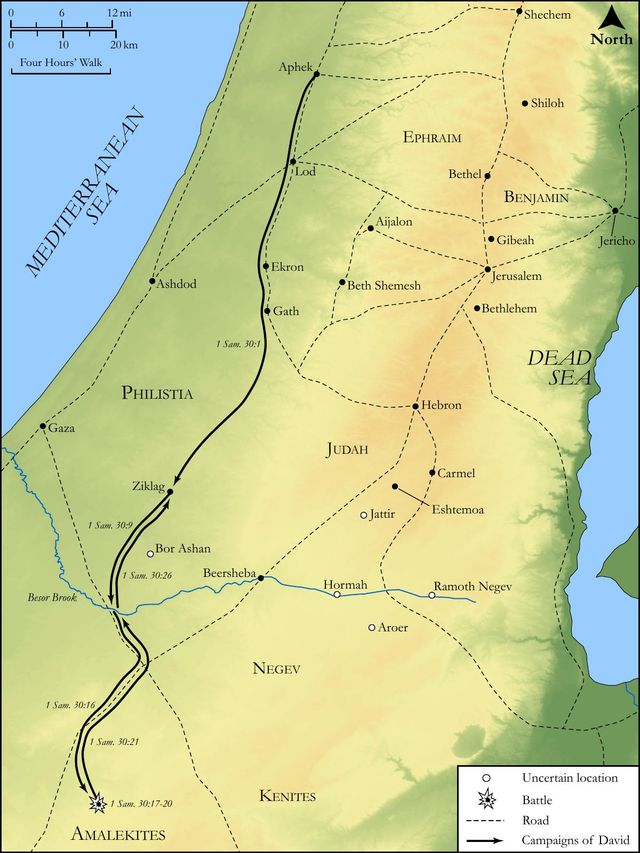
See on the biblical-era map
Study this verse
Public-domain commentary
Matthew Henry
From his Commentary on the Whole Bible. Henry comments on passages, not single verses — this entry covers 1 Samuel 30:7–20. His three-level outline is real structure in the source text, so it is rendered as structure.
Solomon observes that the righteous is delivered out of trouble and the wicked cometh in his stead, that the just falleth seven times a-day and riseth again; so it was with David. Many were his troubles, but the Lord delivered him out of them all, and particularly out of this of which we have here an account.
I.He enquired of the Lord both concerning his duty - Shall I pursue after this troop? and concerning the event - Shall I overtake them? Sa1 30:8. It was a great advantage to David that he had the high priest with him and the breast-plate of judgment, which, as a public person, he might consult in all his affairs, Num 27:21. We cannot think that he left Abiathar and the ephod at Ziklag, for then he and it would have been carried away by the Amalekites, unless we may suppose them hidden by a special providence, that they might be ready for David to consult at his return. If we conclude that David had his priest and ephod with him in the camp of the Philistines, it was certainly a great neglect in him that he did not enquire of the Lord by them concerning his engagement to Achish. Perhaps he was ashamed to own his religion so far among the uncircumcised; but now he begins to apprehend that this trouble is brought upon him to correct him for that oversight, and therefore the first thing he does is to call for the ephod. It is well if we get this good by our afflictions, to be reminded by them of neglected duties, and particularly to be quickened by them to enquire of the Lord. See Ch1 15:13. David had no room to doubt but that his war against these Amalekites was just, and he had an inclination strong enough to set upon them when it was for the recovery of that which was dearest to him in this world; and yet he would not go about it without asking counsel of God, thereby owning his dependence upon God and submission to him. If we thus, in all our ways, acknowledge God, we may expect that he will direct our steps, as he did David's here, answering him above what he asked, with an assurance that he should recover all.
II.He went himself in person, and took with him all the force he had, in pursuit of the Amalekites, Sa1 30:9, Sa1 30:10.
See how quickly, how easily, how effectually the mutiny among the soldiers was quelled by his patience and faith. When they spoke of stoning him (Sa1 30:6), if he had spoken of hanging them, or had ordered that the ringleaders of the faction should immediately have their heads struck off, though it would have been just, yet it might have been of pernicious consequence to his interest in this critical juncture; and, while he and his men were contending, the Amalekites would have clearly carried off their spoil. But when he, as a deaf man, heard not, smothered his resentments, and encouraged himself in the Lord his God, the tumult of the people was stilled by his gentleness and the power of God on their hearts; and, being thus mildly treated, they are now as ready to follow his foot as they were but a little before to fly in his face. Meekness is the security of any government. All his men were willing to go along with him in pursuit of the Amalekites, and he needed them all; but he was forced to drop a third part of them by the way; 200 out of 600 were so fatigued with their long march, and so sunk under the load of their grief, that they could not pass the brook Besor, but staid behind there. This was,
1.A great trial of David's faith, whether he could go on, in a dependence upon the word of God, when so many of his men failed him. When we are disappointed and discouraged in our expectations from second causes, then to go on with cheerfulness, confiding in the divine power, this is giving glory to God, by believing against hope, in hope.
2.A great instance of David's tenderness to his men, that he would by no means urge them beyond their strength, though the case itself was so very urgent. The Son of David thus considers the frame of his followers, who are not all alike strong and vigorous in their spiritual pursuits and conflicts; but, where we are weak, there he is kind; nay, more there he is strong, Co2 12:9, Co2 12:10.
III.Providence threw one in their way that gave them intelligence of the enemy's motions, and guided theirs; a poor Egyptian lad, scarcely alive, is made instrumental of a great deal of good to David. God chooses the foolish things of the world, with them to confound the wise. Observe,
1.His master's cruelty to him. He had got out of him all the service he could, and when the lad fell sick, probably being over-toiled with his work, he barbarously left him to perish in the field, when he was in no such haste but he might have put him into some of the carriages, and brought him home, or, at least, have left him wherewithal to support himself. That master has the spirit of an Amalekite, not of an Israelite, that can thus use a servant worse than one would use a beast. The tender mercies of the wicked are cruel. This Amalekite thought he should now have servants enough of the Israelite-captives, and therefore cared not what became of his Egyptian slave, but could willingly let him die in a ditch for want of necessaries, while he himself was eating and drinking, Sa1 30:16. Justly did Providence make this poor servant, that was thus basely abused, instrumental towards the destruction of a whole army of Amalekites and his master among the rest; for God hears the cry of oppressed servants.
2.David's compassion to him. Though he had reason to think he was one of those that had helped to destroy Ziklag, yet, finding him in distress, he generously relieved him, not only with bread and water (Sa1 30:11), but with figs and raisins, Sa1 30:12. Though the Israelites were in haste, and had no great plenty for themselves, yet they would not forbear to deliver one that was drawn unto death, nor say, Behold, we knew it not, Pro 24:11, Pro 24:12. Those are unworthy the name of Israelites who shut up the bowels of their compassion from persons in distress. It was also prudently done to relieve this Egyptian; for, though despicable, he was capable of doing them service: so it proved, though they were not certain of this when they relieved him. It is a good reason why we should neither do an injury nor deny a kindness to any man that we know not but, some time or other, it may be in his power to return either a kindness or an injury.
3.The intelligence David received from this poor Egyptian when he had come to himself. He gave him an account concerning his party.
(1.)What they had done (Sa1 30:14): We made an invasion, etc. The countries which David had pretended to Achish to have made an incursion upon (Sa1 27:10) they really had invaded and laid waste. What was then false now proved too true.
(2.)Whither they had gone, Sa1 30:15. This he promised David to inform him of upon condition he would spare his life and protect him from his master, who, if he could hear of him again (he thought), would add cruelty to cruelty. Such an opinion this poor Egyptian had of the obligation of an oath that he desired no greater security for his life than this: Swear unto me by God, not by the gods of Egypt or Amalek, but by the one supreme God.
IV.David, being directed to the place where they lay, securely celebrating their triumphs, fell upon them, and, as he used to pray, saw his desire upon his enemies.
1.The spoilers were cut off. The Amalekites, finding the booty was rich, and having got with it (as they thought) out of the reach of danger, were making themselves very merry with it, Sa1 30:16. All thoughts of war were laid aside, nor were they in any haste to house their prey, but spread themselves abroad on the earth in the most careless manner that could be, and there they were found eating, and drinking, and dancing, probably in honour of their idol-gods, to whom they gave the praise of their success. In this posture David surprised them, which made the conquest of them, and the blow he gave them, the more easy to him and the more dismal to them. Then are sinners nearest to ruin when they cry, Peace and safety, and put the evil day far from them. Nor does any thing give our spiritual enemies more advantage against us than sensuality and the indulgence of the flesh. Eating, and drinking, and dancing, have been the soft and pleasant way in which many have gone down to the congregation of the dead. Finding them thus off their guard, and from their arms (many of them, it may be, drunk, and unable to make any resistance), he put them all to the sword, and only 400 escaped, Sa1 30:17. Thus is the triumphing of the wicked short, and wrath comes on them, as on Belshazzar, when they are in the midst of their jollity.
2.The spoil was recovered and brought off, and nothing was lost, but a great deal gotten.
(1.)They retrieved all their own (Sa1 30:18, Sa1 30:19): David rescued his two wives; this is mentioned particularly, because this pleased David more than all the rest of his achievements. Providence had so ordered it that the Amalekites carefully preserved all that they had taken, concluding that they kept it for themselves, though really they preserved it for the right owners, so that there was nothing lacking to them; so it proved, when they concluded all was gone: so much better is God oftentimes to us than our own fears. Our Lord Jesus was indeed the Son of David and the Son of Abraham, in this resembling them both (Abraham, Gen 14:16, and David here), that he took the prey from the mighty, and led captivity captive. But this was not all.
(2.)They took all that belonged to the Amalekites besides (Sa1 30:20): Flocks and herds, either such as were taken from the Philistines and others, which David had the disposal of by the law of war; or perhaps he made a sally into the enemy's country, and fetched off these flocks and herds thence, as interest for his own. This drove was put in the van of the triumph, with this proclamation, "This is David's spoil. This we may thank him for." Those who lately spoke of stoning him now caressed him and cried him up, because they got by him more than they had then lost. Thus are the world and its sentiments governed by interest.
Continue studying 1 Samuel 30:8 across the web’s major study libraries — every link below opens this exact verse, chapter, or book on the destination site.
Read & Compare
 BibleGatewayThis verse in more than 200 translations and 70 languages.
 Bible.comThe YouVersion reader — hundreds of translations, reading plans, and highlights.
 ESV.orgCrossway's official English Standard Version reader.
 NET BibleThe NET translation with 60,000+ translators' notes on every rendering decision.
 STEP BibleTyndale House's free study tool — original text, vocabulary, and scholarly resources.
 BibliaLogos Bible Software's free web reader.
 USCCBThe New American Bible (Revised Edition) with the U.S. bishops' study notes.
Commentaries
 BibleHub CommentariesDozens of classic commentaries on this verse, gathered on one page.
 StudyLightMore than 100 commentary sets — the largest collection on the web.
 BibleRefPlain-English commentary on what this verse means, verse by verse.
 Enduring WordDavid Guzik's free commentary on this chapter, widely used by Bible teachers.
 Bible Study ToolsVerse commentary alongside Greek and Hebrew study aids.
Original Language & Research
- BibleHub InterlinearThe verse word by word — original language, transliteration, and English.
- BibleHub LexiconEvery word's original-language definition and Strong's entry.
 Blue Letter BibleDeep-study tools — Strong's numbers, concordance, and word studies.
 SefariaThe Hebrew text with Rashi and centuries of Jewish commentary.
Sermons, Hymns & Audio


TrulyRandomVerse is not affiliated with these sites and doesn’t control their content. They’re linked because they’re genuinely useful.
Summary
1 Samuel 30:8 encapsulates a pivotal moment in David's life, showcasing his profound dependence on God amidst an overwhelming personal and communal crisis. After returning to Ziklag to find it utterly destroyed by Amalekite raiders and his family, along with the families of his men, taken captive, David faced not only deep despair but also the threat of mutiny from his grieving and enraged followers. In this desperate hour, David turned to the Lord for guidance, receiving a clear, unequivocal divine command to pursue the raiders, coupled with a sure promise of complete victory and restoration of all that was lost. This verse powerfully illustrates God's active involvement in the affairs of His people and His readiness to provide precise direction and unwavering assurance in the face of overwhelming adversity.
Context
ShowHideLiterary Context
The narrative immediately preceding 1 Samuel 30 places David and his men in a precarious alliance with the Philistines, serving as mercenaries under Achish, king of Gath. Providentially, they were dismissed from joining the Philistine forces in their battle against Israel, sparing David from the unthinkable act of fighting against his own people. Upon their return to Ziklag, their base of operations, they discovered it had been raided and burned by the Amalekites, and their wives and children taken captive. This catastrophe plunged David and his men into profound grief, leading to a desperate emotional state where David's own followers, in their bitterness, considered stoning him, as recorded in 1 Samuel 30:1-6. It is against this backdrop of utter despair, personal threat, and communal breakdown that David "encouraged himself in the LORD his God" (1 Samuel 30:6), and his first decisive action was to seek divine counsel, setting the stage for the crucial inquiry presented in 1 Samuel 30:8.
Historical & Cultural Context
The Amalekites were a nomadic, predatory people, long-standing and bitter enemies of Israel, whose hostility dated back to the Exodus (Exodus 17:8-16). God had previously commanded Saul to utterly destroy them (1 Samuel 15:2-3), a command Saul famously failed to fully obey, leading to his rejection as king. Their continued existence and predatory actions, as evidenced by the Ziklag raid, underscore their persistent threat to Israelite security. David's inquiry "at the LORD" was a culturally established and sacred practice for seeking divine guidance, typically performed through a priest (in this case, Abiathar, who brought the ephod) using the Urim and Thummim (1 Samuel 23:9-12). This method provided a direct, authoritative oracle from God, essential for leaders in ancient Israel facing critical decisions, especially in military matters.
Key Themes
ShowHideThis passage powerfully illustrates several core themes prevalent in the book of 1 Samuel. First, it highlights the importance of seeking divine guidance, especially in moments of extreme crisis and uncertainty. David, despite his military prowess and leadership experience, did not rely on human counsel or his own strength but immediately turned to God, a stark contrast to Saul's later desperate and unauthorized attempts to consult the dead (1 Samuel 28:6-7). Second, the Lord's clear and immediate response demonstrates God's active involvement and faithfulness in the affairs of His people, providing hope and direction where all human hope had vanished. This divine assurance underscores God's sovereignty over seemingly insurmountable circumstances. Finally, the promise to "recover all" emphasizes the theme of divine restoration, showcasing God's power to not only deliver but to fully restore what was lost, symbolizing His covenant faithfulness and redemptive power, a theme echoed in Joel 2:25.
Exposition and Analysis
ShowHideKey Word Analysis
ShowHideThis verb signifies a formal, deliberate act of seeking counsel or information, often from a divine source. When used with the preposition "at" (Hebrew, ba'YHWH), it specifically denotes consulting the Lord, typically through the high priest and the ephod with the Urim and Thummim. It implies a direct, divinely sanctioned method of receiving an oracle, distinguishing it from casual prayer or personal reflection. David's consistent practice of "enquiring at the LORD" throughout his life (1 Samuel 23:2, 1 Samuel 23:4, 2 Samuel 5:19) underscores his deep dependence on God's revealed will for his leadership and actions.
This primitive root means to reach, attain, or get. In the context of pursuit, it carries the strong implication of catching up with and apprehending the target. The divine promise that David "shalt surely overtake" uses an intensive Hebrew construction, emphasizing the absolute certainty of success in closing the distance with the Amalekite raiders. It's not a mere possibility but a divinely guaranteed outcome that David will indeed come upon his enemies.
This primitive root means to snatch away, deliver, rescue, or save. In this context, it implies not merely finding the captives but actively liberating them from their captors. The accompanying phrase "without fail" (literally, "you will not miss/fail") intensifies the promise, guaranteeing a complete and successful recovery, leaving nothing behind. It speaks to God's power to fully restore what was lost, not just partially, but entirely, signifying a comprehensive act of divine intervention and restoration.
Verse Breakdown
ShowHide"And David enquired at the LORD, saying, Shall I pursue after this troop? shall I overtake them?"
This opening clause establishes David's posture of humble dependence. Despite the immense pressure from his men and the urgency of the situation, David's first action is to seek divine counsel. He poses two distinct, yet related, questions: "Shall I pursue after this troop?" (a question of permission, direction, and the legitimacy of the endeavor) and "shall I overtake them?" (a question of success and the outcome of the pursuit). This demonstrates a leader who understands that even the most logical human strategies require divine sanction and assurance for true success.
"And he answered him, Pursue:"
The Lord's response is immediate, direct, and unequivocally affirmative. The single imperative word "Pursue" serves as a clear divine command, removing all doubt about the course of action. This directness provides David with the authoritative marching orders he desperately needed, transforming a moment of despair into a mission of divine purpose and absolute certainty.
"for thou shalt surely overtake [them],"
This clause provides the first part of God's comprehensive assurance, directly answering David's second question. The Hebrew construction here includes an infinitive absolute, "surely overtake" (literally, "overtaking, you shall overtake"), which serves to intensify the verb, guaranteeing the certainty of the pursuit's success. It's not a mere possibility but a divine certainty that David will indeed catch up with the Amalekite raiders.
"and without fail recover [all]."
This final clause delivers the ultimate promise of complete restoration. The phrase "without fail" (literally, "and you will not miss/fail" or "and you will not leave anything behind") reinforces the absolute certainty of the outcome. The promise to "recover all" is comprehensive, encompassing every person and possession taken, signifying God's power to reverse the catastrophe entirely. This assurance transforms David's desperate pursuit into a divinely guaranteed mission of rescue and restoration, leaving no room for partial success or lingering loss.
Literary Devices
ShowHideThe passage makes effective use of several literary devices to convey its powerful message. The primary device is Dialogue, presenting a direct, unmediated conversation between David and the Lord. This immediate exchange highlights the personal and accessible nature of God's communication with His chosen leader, contrasting sharply with Saul's later inability to receive divine counsel. The Lord's response functions as a Divine Oracle, an authoritative and unambiguous pronouncement from God, providing clear direction and absolute assurance. This oracle is characterized by Repetition and Emphasis, particularly in the Hebrew original, where the verbs "overtake" and "recover" are intensified through the use of infinitive absolutes, conveying absolute certainty ("surely overtake," "without fail recover"). This emphatic language serves to bolster David's faith and provide unwavering confidence in the face of overwhelming odds. Finally, there is a clear Contrast between the human despair and mutiny David faced from his men and the unwavering divine assurance he received, underscoring the transformative power of God's word to turn hopeless situations into divinely ordained victories.
Theological and Thematic Connections
ShowHideThe narrative in 1 Samuel 30:8 profoundly illustrates God's sovereignty and His active, compassionate involvement in the lives of His faithful servants. It teaches that even in the darkest valleys of despair and the most pressing crises, God is not silent but ready to provide clear direction and powerful assurance. David's example underscores the theological principle that true leadership, especially in God's kingdom, is characterized by humble dependence on divine counsel rather than self-reliance or human wisdom. God's promise to "recover all" speaks to His redemptive nature, His power to restore what is lost, and His faithfulness to His covenant people, even when their circumstances seem utterly hopeless. This passage serves as a timeless reminder that divine guidance is the bedrock of victorious living and that God's promises are absolutely trustworthy, offering an anchor for the soul in times of storm.
Reflection and Application
ShowHide1 Samuel 30:8 offers a powerful blueprint for navigating personal and communal crises in our own lives. When faced with overwhelming loss, despair, or uncertainty, our natural inclination might be to panic, blame others, or rely solely on our own limited resources and strategies. David's response, however, provides a profound alternative: to "encourage himself in the LORD his God" and immediately seek divine counsel. This teaches us that the first and most crucial step in any crisis is to turn to God, bringing our questions, fears, and desperate needs before Him in prayer and through His Word. Just as God provided clear direction and an unequivocal promise of restoration to David, He remains faithful to guide and sustain us today. This passage invites us to cultivate a habit of humble dependence on God, trusting that He is not only willing but able to provide clarity, strength, and complete restoration, even when all seems lost and human solutions prove inadequate. It calls us to remember that God's power is made perfect in our weakness, and His promises are our sure hope.
Questions for Reflection
ShowHideFAQ
ShowHideWhat does "enquired at the LORD" mean in practical terms for David?
ShowHideFor David, "enquired at the LORD" meant a formal and sacred consultation with God, mediated through the high priest Abiathar, who was with David at Ziklag. This involved Abiathar bringing the ephod, a priestly garment that contained the Urim and Thummim (sacred lots or stones). These were used as a divinely appointed means of discerning God's will, often by casting them to receive a "yes" or "no" answer, or a specific divine oracle. This method was a legitimate and established way for leaders in ancient Israel to receive direct guidance from God on matters of national importance, especially military decisions, as seen throughout David's life in 1 Samuel and 2 Samuel. It underscored David's reliance on divine authority and revealed truth rather than human strategy or intuition alone.
Why was it so important for David to seek God's guidance at this specific moment?
ShowHideIt was critically important for several reasons. First, David and his men were in a state of extreme emotional and psychological distress, having lost everything and facing potential mutiny (1 Samuel 30:4-6). Human judgment in such circumstances is often clouded by despair, anger, or fear. Second, the enemy, the Amalekites, were a formidable and long-standing foe of Israel, requiring not just military strategy but divine sanction and power for victory. Third, David's leadership was under severe threat; seeking God's clear direction not only provided the right course of action but also re-established his spiritual authority and credibility among his men, demonstrating his unwavering faith even when they faltered. This act of seeking God's will transformed a desperate situation into a divinely ordained mission, ensuring both success and the restoration of hope and morale.
Christ-Centered Fulfillment
ShowHide1 Samuel 30:8, with its narrative of David's desperate inquiry and God's powerful promise of pursuit, overtake, and complete recovery, finds its ultimate and most profound fulfillment in Jesus Christ. David, as a type of Christ, demonstrates a leader who, though flawed, depends utterly on God for victory and restoration. Yet, Jesus is the perfect embodiment of this principle. He is the ultimate Deliverer who consistently "enquired at the LORD" (His Father), living in perfect obedience and communion, always doing the will of the One who sent Him (John 5:19 and John 6:38). When humanity was held captive by the "troop" of sin, death, and the devil, Jesus, the true Son of David, pursued us not with a sword but with self-sacrificial love on the cross. Through His death and glorious resurrection, He "surely overtook" our spiritual enemies, triumphing over them decisively and making a public spectacle of their defeat (Colossians 2:15). More gloriously, He did "without fail recover all" – not just material possessions, but our very souls, our relationship with God, and the hope of eternal life. He is the one who restores what was lost in Eden, bringing us into a new creation and making all things new (Revelation 21:5). Thus, 1 Samuel 30:8 foreshadows the comprehensive and eternal victory of Christ, who perfectly executes the Father's will to rescue and restore His people from every form of spiritual captivity.