


Old Testament · History · Book 10 of 66
2 Samuel
David reigns over Judah, then all Israel, receives the LORD’s promise of a house for ever, and after his sin with Bathsheba is chastened within his own house.
- 24 chapters
- 695 verses
- About 1.6 hours to read
- The Reign of David, c. 1010–970 BC
Second Samuel is the reign of David, from the news of Saul’s death to an altar on Araunah’s threshing floor. The first ten chapters establish the kingdom. David is anointed over Judah at Hebron and then over all Israel, takes Zion, and brings up the ark. At the centre stands the LORD’s answer to David’s wish to build him a house: the LORD will build David a house, and “thy throne shall be established for ever” (2 Samuel 7:16).
Then the king who would not lift his hand against Saul takes Uriah’s wife and has Uriah killed. Nathan’s “Thou art the man” (12:7) turns the book. David is forgiven, but the sword does not leave his house: Amnon wrongs Tamar, Absalom kills Amnon, then rises against his father and dies in the wood of Ephraim. The book hides none of this, and none of it cancels the promise. Near its end David calls the LORD “my rock, and my fortress, and my deliverer” (22:2), and rests on “an everlasting covenant, ordered in all things, and sure” (23:5).
And thine house and thy kingdom shall be established for ever before thee: thy throne shall be established for ever.
2 Samuel 7:16 KJV
Before you read
- Who wrote it
- Not named in the book. Samuel had died before it opens (1 Samuel 25:1). David’s acts were written “in the book of Nathan the prophet, and in the book of Gad the seer” (1 Chronicles 29:29), both prophets at his court (2 Samuel 7:2; 24:11), and traditionally they are its writers.
- When it happens
- David’s reign of forty years: “In Hebron he reigned over Judah seven years and six months: and in Jerusalem he reigned thirty and three years over all Israel and Judah” (2 Samuel 5:5). It runs from the news of Saul’s death (1:1) to the altar on Araunah’s threshing floor (24:25); his death follows in 1 Kings.
- Where
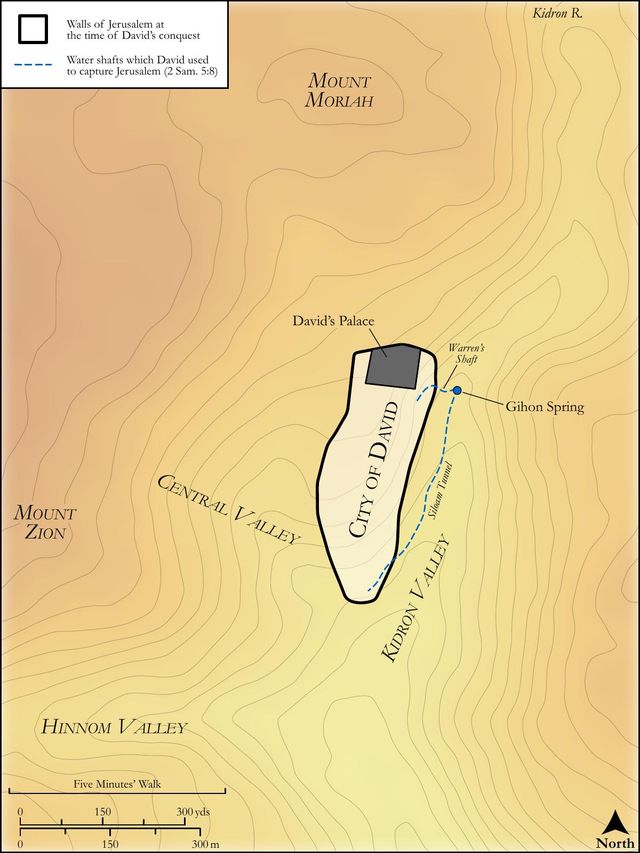
- Hebron, then Jerusalem, where David takes “the strong hold of Zion: the same is the city of David” (2 Samuel 5:7). Absalom’s revolt drives him over Jordan to Mahanaim (17:24). His wars reach Moab, Syria, Edom and Ammon (8:2–14; 10:1–19).
How 2 Samuel is laid out
8 movements · 105 passages · 695 verses
King over Judah at Hebron
Chapters 1–4 · 110 verses
An Amalekite brings Saul’s crown to Ziklag, claiming to have slain him, and David has him put to death on his own testimony. David laments Saul and Jonathan: “how are the mighty fallen!” Judah anoints him at Hebron, while Abner makes Ishbosheth king over Israel. After long war Abner turns to David and is murdered by Joab, and Ishbosheth is killed on his bed.
17 passages
- 1:1–10 David Hears of Saul’s Death
- 1:11–16 David Executes the Amalekite Messenger
- 1:17–27 David’s Lament Over Saul and Jonathan (The Song of the Bow)
- 2:1–7 David Anointed King in Hebron
- 2:8–11 Ishbosheth Established as Rival King
- 2:12–23 War Breaks Out at Gibeon
- 2:24–32 Abner Calls for a Truce
- 3:1–5 The War Continues; David's Strength Grows
- 3:6–11 Abner and Ishbosheth Quarrel
- 3:12–16 Abner Negotiates Peace with David
- 3:17–21 Abner Persuades Israel's Elders
- 3:22–27 Joab Murders Abner
- 3:28–30 David Denounces the Murder
- 3:31–39 David Mourns Abner Publicly
- 4:1–4 Collapse of Saul's Dynasty
- 4:5–8 The Assassination of Ishbosheth
- 4:9–12 David Executes the Murderers
Jerusalem and the ark
Chapters 5–6 · 48 verses
The elders of all Israel anoint David king at Hebron. He takes the strong hold of Zion from the Jebusites and calls it the city of David, and twice defeats the Philistines after enquiring of the LORD. The ark sets out on a new cart; Uzzah takes hold of it, and God smites him. Three months later David brings it up with sacrifice and dancing, and Michal despises him.
The LORD’s covenant with David
Chapter 7 · 29 verses
Settled in his house of cedar, David wants to build a house for the ark. Nathan approves, but that night the word of the LORD comes: David will not build the LORD a house; the LORD will make David one. His son will build a house for the LORD’s name, and David’s throne will be established for ever. David answers in prayer: “Who am I, O Lord GOD?”
Victories and kindness
Chapters 8–10 · 50 verses
David subdues the Philistines, Moab, Zobah, Syria and Edom, and dedicates the spoil to the LORD, who “preserved David whithersoever he went.” He seeks out Jonathan’s lame son Mephibosheth, restores Saul’s land to him, and seats him at the king’s table. When Hanun of Ammon shames David’s servants, Joab defeats Ammon and its Syrian allies, and David scatters the Syrians at Helam.
9 passages
- 8:1–8 David Subdues Neighboring Nations
- 8:9–14 Tribute and Dedication of Spoils
- 8:15–18 David’s Administration and Officials
- 9:1–5 David Seeks Saul's Descendant
- 9:6–8 David Shows Covenant Kindness
- 9:9–13 Land Restoration and Ziba's Appointment
- 10:1–5 Ammon Insults David's Envoys
- 10:6–14 The First Battle Against Ammon and Syria
- 10:15–19 David Leads the Decisive Victory Over Syria
Bathsheba, Uriah and Nathan
Chapters 11–12 · 58 verses
While Joab besieges Rabbah, David stays in Jerusalem and takes Bathsheba, the wife of Uriah; she conceives. Uriah will not go down to his house, so David has him left to die in the hottest battle. Nathan’s parable of the ewe lamb draws the king’s sentence on himself: “Thou art the man.” David confesses and is forgiven, but the child dies. Solomon is born, and Rabbah falls.
10 passages
- 11:1–5 David Commits Adultery with Bathsheba
- 11:6–13 The Attempted Cover-Up
- 11:14–25 David Arranges Uriah’s Murder
- 11:26–27 The Aftermath and God's Displeasure
- 12:1–6 Nathan Confronts David with a Parable
- 12:7–12 God Pronounces Judgment on David
- 12:13–14 David Confesses His Sin
- 12:15–23 The Lord Strikes the Child
- 12:24–25 Birth of Solomon (Jedidiah)
- 12:26–31 The Capture of Rabbah
Amnon, Tamar and Absalom
Chapters 13–14 · 72 verses
Amnon forces his half-sister Tamar, then hates her. King David is very wroth; Absalom says nothing for two years, then has Amnon killed at his sheepshearing and flees to his mother’s father at Geshur. After three years Joab sends a wise woman with a feigned case to move the king. Absalom comes home, but sees the king’s face only after two more years.
10 passages
- 13:1–20 Amnon Desires Tamar
- 13:21–22 David's Wrath and Absalom's Silent Hatred
- 13:23–29 Absalom Murders Amnon
- 13:30–39 Absalom Flees to Geshur
- 14:1–3 Joab Schemes to Bring Absalom Home
- 14:4–11 The Wise Woman’s Parable
- 14:12–20 The Parable Applied to Absalom
- 14:21–24 Absalom Returns to Jerusalem
- 14:25–27 Absalom’s Appearance and Family
- 14:28–33 Absalom Forces Full Reconciliation
Absalom’s revolt
Chapters 15–20 · 191 verses
Absalom steals the hearts of Israel and is proclaimed king in Hebron. David leaves Jerusalem weeping, barefoot up mount Olivet, sends the ark back, and bears Shimei’s curses. The LORD defeats Ahithophel’s counsel through Hushai. In the wood of Ephraim Joab thrusts three darts through Absalom, caught by his head in an oak. David mourns his son, returns over Jordan, and Sheba’s revolt is put down.
Last words and the altar
Chapters 21–24 · 137 verses
Pieces from across David’s life close the book: a famine for Saul’s slaughter of the Gibeonites, and Rizpah’s vigil over the slain; wars with the giants of Gath; David’s song of deliverance; his last words; his mighty men. Last comes the census, the plague stayed at Araunah’s threshing floor, and the altar David builds there, refusing to offer the LORD what costs him nothing.
18 passages
- 21:1–9 The Famine and Saul's Bloodguilt
- 21:10–14 Rizpah’s Vigil and Honorable Burial
- 21:15–22 Battles Against Philistine Giants
- 22:1–4 David's Song of Deliverance
- 22:5–7 The Crisis and the Cry for Help
- 22:8–20 The Theophany: God's Powerful Intervention
- 22:21–25 God Rewards David's Integrity
- 22:26–30 The Principle of Divine Justice
- 22:31–46 The Perfection of God and His Strength
- 22:47–51 Concluding Doxology and Covenant Promise
- 23:1–7 David's Final Prophetic Words
- 23:8–12 The Names of David's Mighty Men
- 23:13–17 An Act of Valor and Sacrifice
- 23:18–23 Abishai and Benaiah: Leaders of the Thirty
- 23:24–39 The Full List of the Thirty
- 24:1–9 David Orders a Census
- 24:10–17 David Repents and Chooses Punishment
- 24:18–25 The Altar at Araunah's Threshing Floor
The words 2 Samuel turns on
House and for ever gather in chapter 7; kindness runs from 2:5 to 22:51; counsel fills Absalom’s revolt; sinned is confessed in chapters 12, 19 and 24.
What 2 Samuel teaches
bayith · house
A house for ever
David, at rest in “an house of cedar,” sees that “the ark of God dwelleth within curtains” (7:2). The LORD replies that he never asked any tribe, “Why build ye not me an house of cedar?” (7:7), and turns the word round: “the LORD telleth thee that he will make thee an house” (7:11). The Hebrew bayith is both a building and a household, and the chapter uses both. David’s son “shall build an house for my name, and I will stablish the throne of his kingdom for ever” (7:13). David’s prayer asks the LORD to keep his word: “establish it for ever, and do as thou hast said” (7:25). Augustine read the two houses as one, the house of David becoming the house of God, a temple to God made not of stones but of people
.
chêçêd · kindness
Kindness for Jonathan’s sake
The word is chesed, loyal love kept to a bond. David’s first message as king blesses the men of Jabeshgilead, who “have shewed this kindness unto your lord, even unto Saul, and have buried him” (2:5). Later he asks, “Is there yet any that is left of the house of Saul, that I may shew him kindness for Jonathan’s sake?” (9:1). He is keeping his oath to Jonathan: “thou shalt not cut off thy kindness from my house for ever” (1 Samuel 20:15). So the lame grandson of the king who hunted David eats at David’s table, “as one of the king’s sons” (9:11). David calls this “the kindness of God” (9:3), and God’s own kindness stands behind it, promised to David’s seed in the same word: “my mercy shall not depart away from him, as I took it from Saul” (7:15).
châṭâʼ · sin
Forgiven, and chastened
Nathan’s parable lets the king pass sentence before he knows the case is his own: “the man that hath done this thing shall surely die” (12:5). “Thou art the man” (12:7). David offers no defence: “I have sinned against the LORD.” Nathan answers at once, “The LORD also hath put away thy sin; thou shalt not die” (12:13). The chastening remains: “the sword shall never depart from thine house” (12:10). The covenant had set that pattern for David’s house: “If he commit iniquity, I will chasten him with the rod of men … But my mercy shall not depart away from him” (7:14–15). Isaac of Nineveh notes the troubles came even after he had repented with many tears
. At the census David confesses again, “I have sinned greatly” (24:10), and asks that the stroke fall on him, not on “these sheep” (24:17).
ʻêtsâh · counsel
Counsel turned to foolishness
Ahithophel’s counsel “was as if a man had enquired at the oracle of God” (16:23). Told that Ahithophel is with Absalom, David prays, “O LORD, I pray thee, turn the counsel of Ahithophel into foolishness” (15:31), and sends Hushai back to defeat it (15:34). The narrator gives the cause: “the LORD had appointed to defeat the good counsel of Ahithophel, to the intent that the LORD might bring evil upon Absalom” (17:14). Augustine says it was frustrated by influencing the heart of Absalom to reject this counsel
. The census is told the same way. The LORD “moved David against them” (24:1), and Chronicles says “Satan stood up against Israel, and provoked David” (1 Chronicles 21:1). Both are true: Satan tempted, the LORD in anger with Israel gave him room, and the sin was David’s own: “David’s heart smote him” (24:10).
Christ in 2 Samuel
Gabriel announces Jesus in the words of chapter 7: “the Lord God shall give unto him the throne of his father David: And he shall reign over the house of Jacob for ever; and of his kingdom there shall be no end” (Luke 1:32–33). At Pentecost Peter said David spoke of the resurrection, “knowing that God had sworn with an oath to him, that of the fruit of his loins, according to the flesh, he would raise up Christ to sit on his throne” (Acts 2:30). Hebrews hears in 7:14 the Father speaking to the Son: “I will be to him a Father, and he shall be to me a Son” (Hebrews 1:5).
Solomon built the house, but he and every king after him died, and many were chastened as 7:14 warned. A throne “for ever” waited for a Son of David “without sin” (Hebrews 4:15). David’s last words lean on this “everlasting covenant” (23:5), and Paul preaches it fulfilled in the resurrection: God raised Jesus “now no more to return to corruption,” saying, “I will give you the sure mercies of David” (Acts 13:34).
- Jesse
- David given the covenant
- Solomon son of Bathsheba
- … Matthew 1:7–16
- Jesus, given “the throne of his father David”
People
By how many verses name them
- DavidSon of Jesse226
- JoabHis mother was Zeruiah; a brother of Abishai and Asahel84
- AbsalomA son of David and Maacah83
- AbnerA son of Ner; father of Jaasiel40
- SaulA son of Kish; husband of Ahinoam and Rizpah23
- AmnonA son of David and Ahinoam20
- UriahHusband of Bathsheba19
- JonathanSon of Saul and Ahinoam; a brother of Abinadab, Malchi-shua, Merab and Michal17
158 more are named.
Places
84 named
- JerusalemTaken from the Jebusites; David’s city, where he brings the ark30
- HebronWhere David is anointed twice, and Absalom proclaims himself king21
- JordanCrossed by David fleeing Absalom, and again on his return13
- GeshurKingdom of Absalom’s grandfather, where he flees after killing Amnon6
- GibeonWhere war with Ishbosheth’s men begins, and Amasa is killed6
- MahanaimIshbosheth’s seat, and David’s refuge from Absalom6
- Zobah6
- BahurimWhere Shimei curses David, and two messengers hide in a well5
Where 2 Samuel reaches
The passages it leans on, and the ones that lean on it
2 Samuel 7:12–16 Luke 1:32–33 Hebrews 1:5
Nathan’s promise to David’s seed: the throne Gabriel announces to Mary, and the sonship Hebrews gives to Christ.
David’s confession to Nathan, and the psalm headed “when Nathan the prophet came unto him”.
The song’s thanks “among the heathen”, also in Psalm 18, which Paul reads of the Gentiles glorifying God.
Ahithophel forsakes David for Absalom and hangs himself; Judas, who betrayed Christ, ends the same way.
2 Samuel 24:18–25 2 Chronicles 3:1
The threshing floor David buys for the altar becomes the site of Solomon’s temple, on mount Moriah.
Books 2 Samuel links to most
The Church Fathers on 2 Samuel
134 quotations from 28 writers before AD 800 · the ten most quoted, in date order
- Tertullian220
- Origen253
- Ambrose397
- Chrysostom407
- Jerome420
- Augustine430
- John Cassian435
- Salvian500
- Gregory604
- Bede735
Augustine would rather learn from Scripture that a great prophet sinned than doubt its truth.
I will read the holy Scripture with complete certainty and confidence in its truth, founded as it is on the highest summit of divine authority; and I would rather learn from it that people were truly approved or corrected or condemned than allow my trust in the divine Word to be everywhere undermined because I fear to believe that the human conduct of certain excellent and praiseworthy persons is sometimes worthy of blame.
Salvian on the king who fled from his own son.
He fled in fear, disgrace and sorrow, “walking,” says Scripture, “with head covered and barefoot.” He was a witness of his former estate, an exile from his former self, almost one who lives after his own death.
Ambrose on why David wept for Absalom, but not for the infant who died.
But that same David … who had not wept for the innocent infant, wept for the parricide when dead. … He wept for those who were dead, but did not think that he ought to weep for the dead infant, for he thought that they were lost to him, but hoped that the latter would rise again.
Aphrahat on David at the plague, offering himself for the people as a shepherd for his sheep.
He is a most diligent pastor who delivered over himself on behalf of his sheep. … Then David delivered himself over on behalf of his sheep, when he prayed, saying, “O Lord God, I have sinned in that I have numbered Israel. Let your hand be on me and on my father’s house. These innocent sheep, how have they sinned?”
Keep studying
Articles