


2 Samuel 9:7
Bible text: King James Version (1769 Blayney text) · Public domain
Bible text: King James Version with Strong's numbers · Public domain
Bible text: Berean Standard Bible · Public domain
Bible text: American Standard Version (1901) · Public domain
Bible text: World English Bible, Messianic edition · Public domain
Bible text: Geneva Bible (1599) · Public domain
Bible text: Young's Literal Translation · Public domain
- וַיֹּאמֶרvai·yo·Merand he saidH559Conj-w ¦ V-Qal-ConsecImperf-3msVerb Qal Consecutive Imperfect 3rd Singular Masculineוַandיֹּאמֶרhe said
- לוֹloto <the> himPrep-l ¦ 3msSuffix Personal 3rd Singular Masculineלto <the>וֹhim
- דָוִדda·VidDavidH1732N-proper-mNoun Proper Masculine
- אַל'almay notH408NegParticle Negative
- תִּירָאti·Ra'you be afraidH3372V-Qal-Imperf-2msVerb Qal Imperfect 2nd Singular Masculine
- כִּיkiforH3588PrtParticle Conditional
- עָשֹׂה'a·Sohcertainly <to do>H6213V-Qal-InfAbsVerb Qal Infinitive Absolute
- אֶעֱשֶׂה'e·'e·SehI will doH6213V-Qal-Imperf-1csVerb Qal Imperfect 1st Singular common gender
- עִמְּךָ'i·me·Khawith youH5973Prep ¦ 2msPreposition Definiteעִמְּwithךָyou
- חֶסֶדche·sedcovenant loyaltyH2617N-msNoun Singular Masculine Absolute
- בַּעֲבוּרba·'a·Vurfor sake ofH5668Prep-b ¦ N-mscNoun Singular Masculine Constructבַּforעֲבוּרsake of
- יְהוֹנָתָןye·ho·na·TanJonathanH3083N-proper-mNoun Proper Masculine
- אָבִיךָ'a·Vi·khayour fatherH1N-msc ¦ 2msNoun Singular Masculine Constructאָבִיfatherךָyour
- וַהֲשִׁבֹתִיva·ha·shi·vo·Tiand I will restoreH7725Conj-w ¦ V-Hiphil-ConsecPerf-1csVerb Hiphil Consecutive Perfect 1st Singular common genderוַandהֲשִׁבֹתִיI will restore
- לְךָle·Khato <the> youPrep-l ¦ 2msSuffix Personal 2nd Singular Masculineלְto <the>ךָyou
- אֶת'et<obj.>H853DirObjMParticle Object Indicator
- כָּלkolallH3605N-mscNoun Singular Masculine Construct
- שְׂדֵהse·Deh[the] land ofH7704N-mscNoun Singular Masculine Construct
- שָׁאוּלsha·'UlSaulH7586N-proper-mNoun Proper Masculine
- אָבִיךָ'a·Vi·khayour fatherH1N-msc ¦ 2msNoun Singular Masculine Constructאָבִיfatherךָyour
- וְאַתָּהve·'a·Tahand youH859Conj-w ¦ Pro-2msPronoun Personal 2nd Singular Masculineוְandאַתָּהyou
- תֹּאכַלTo·khalyou will eatH398V-Qal-Imperf-2msVerb Qal Imperfect 2nd Singular Masculine
- לֶחֶםLe·chemfoodH3899N-msNoun Singular Masculine Absolute
- עַל'alonH5921PrepPreposition
- שֻׁלְחָנִיshul·cha·Nimy tableH7979N-msc ¦ 1csNoun Singular Masculine Constructשֻׁלְחָנִtableיmy
- תָּמִידta·MidcontinuallyH8548N-msNoun Singular Masculine Absolute
English is a literal word-by-word gloss of the Hebrew, not the KJV's wording. Why?
This is the original text the KJV's translators worked from — each Hebrew word with its own literal English meaning in this verse, prepared by scholars at Tyndale House, Cambridge. The KJV translates whole sentences, not word by word, so its wording differs: one Hebrew word can become several English words, and the KJV may choose “the LORD” where the gloss reads “Yahweh”. Both are faithful — they answer different questions. For the KJV's own rendering, switch to the KJV text.
Details
See on the biblical-era maps
Study this verse
Public-domain commentary
Matthew Henry
From his Commentary on the Whole Bible. Henry comments on passages, not single verses — this entry covers 2 Samuel 9:1–8. His three-level outline is real structure in the source text, so it is rendered as structure.
Here is, I. David's enquiry after the remains of the ruined house of Saul, Sa2 9:1. This was a great while after his accession to the throne, for it should seem that Mephibosheth, who was but five years old when Saul died, had now a son born, Sa2 9:12. David had too long forgotten his obligations to Jonathan, but now, at length, they are brought to his mind. It is good sometimes to bethink ourselves whether there be any promises or engagements that we have neglected to make good; better do it late than never. The compendium which Paul gives us of the life of David is this (Act 13:36), that he served his generation according to the will of God, that is, he was a man that made it his business to do good; witness this instance, where we may observe,
1.That he sought an opportunity to do good. He might perhaps have satisfied his conscience with the performance of his promise to Jonathan if he had been only ready, upon request or application made to him by any of his seed, to help and succour them. But he does more, he enquires of those about him first (Sa2 9:1), and, when he met with a person that was likely to inform him, asked him particularly, Is there any yet left of the house of Saul, that I may show him kindness? Sa2 9:3. "Is there any, not only to whom I may do justice (Num 5:8), but to whom I may show kindness?" Note, Good men should seek opportunities of doing good. The liberal deviseth liberal things, Isa 32:8. For, the most proper objects of our kindness and charity are such as will not be frequently met with without enquiry. The most necessitous are the least clamorous.
2.Those he enquired after were the remains of the house of Saul, to whom he would show kindness for Jonathan's sake: Is there any left of the house of Saul? Saul had a very numerous family (Ch1 8:33), enough to replenish a country, and was yet so emptied that none of it appeared; but it was a matter of enquiry, Is there any left? See how the providence of God can empty full families; see how the sin of man will do it. Saul's was a bloody house, no marvel it was thus reduced, Sa2 21:1. But, though God visited the iniquity of the father upon the children, David would not. "Is there any left that I can show kindness to, not for Saul's own sake, but for Jonathan's?" (1.) Saul was David's sworn enemy, and yet he would show kindness to his house with all his heart and was forward to do it. He does not say, "Is there any left of the house of Saul, that I may find some way to take them off, and prevent their giving disturbance to me or my successor?" It was against Abimelech's mind that any one was left of the house of Gideon (Jdg 9:5), and against Athaliah's mind that any one was left of the seed royal, Ch2 22:10, Ch2 22:11. Those were usurped governments. David's needed no such vile supports. He was desirous to show kindness to the house of Saul, not only because he trusted in God and feared not what they could do unto him, but because he was of a charitable disposition and forgave what they had done to him. Note, We must evince the sincerity of our forgiving those that have been any way unjust or injurious to us by being ready, as we have opportunity, to show kindness both to them and theirs. We must not only not avenge ourselves upon them, but we must love them, and do them good (Mat 5:44), and not be backward to do any office of love and good-will to those that have done us many an injury. Pe1 3:9, - but, contrari-wise, blessing. This is the way to overcome evil, and to find mercy for ourselves and ours, when we or they need it. (2.) Jonathan was David's sworn friend, and therefore he would show kindness to his house. This teaches us, [1.] To be mindful of our covenant. The kindness we have promised we must conscientiously perform, though it should not be claimed. God is faithful to us; let us not be unfaithful to one another. [2.] To be mindful of our friendships, our old friendships. Note, Kindness to our friends, even to them and theirs, is one of the laws of our holy religion. He that has friends must show himself friendly, Pro 18:24. If Providence has raised us, and our friends and their families are brought low, yet we must not forget former acquaintance, but rather look upon that as giving us so much the fairer opportunity of being kind to them: then our friends have most need of us and we are in the best capacity to help them. Though there be not a solemn league of friendship tying us to this constancy of love, yet there is a sacred law of friendship no less obliging, that to him that is in misery pity should be shown by his friend, Job 6:14. A brother is born for adversity. Friendship obliges us to take cognizance of the families and surviving relations of those we have loved, who, when they left us, left behind them their bodies, their names, and their posterity, to be kind to.
3.The kindness he promised to show them he calls the kindness of God; not only great kindness, but,
(1.)Kindness in pursuance of the covenant that was between him and Jonathan, to which God was a witness. See Sa1 20:42.
(2.)Kindness after God's example; for we must be merciful as he is. He spares those whom he has advantage against, and so must we. Jonathan's request to David was (Sa1 20:14, Sa1 20:15), "Show me the kindness of the Lord, that I die not, and the same to my seed." The kindness of God is some greater instance of kindness than one can ordinarily expect from men.
(3.)It is kindness done after a godly sort, and with an eye to God, and his honour and favour.
II.Information given him concerning Mephibosheth, the son of Jonathan.
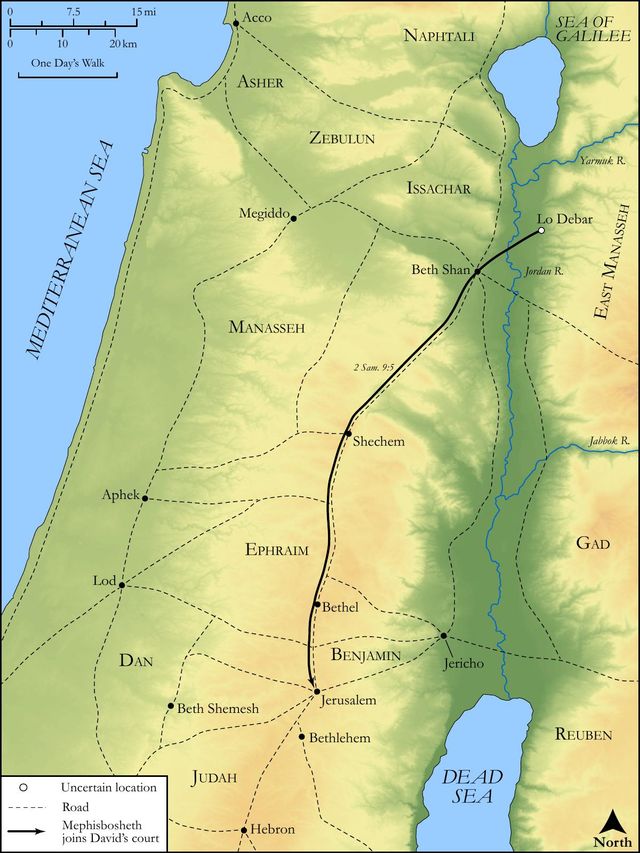
Ziba was an old retainer to Saul's family, and knew the state of it. He was sent for and examined, and informed the king that Jonathan's son was living, but lame (how he came to be so we read before, Sa2 4:4), and that he lived in obscurity, probably among his mother's relations in Lo-debar in Gilead, on the other side Jordan, where he was forgotten, as a dead man out of mind, but bore this obscurity the more easily because he could remember little of the honour he fell from.
III.The bringing of him to court.
The king sent (Ziba, it is likely) to bring him up to Jerusalem with all convenient speed, Sa2 9:5. Thus he eased Machir of his trouble, and perhaps recompensed him for what he had laid out on Mephibosheth's account. This Machir appears to have been a very generous free-hearted man, and to have entertained Mephibosheth, not out of any disaffection to David or his government, but in compassion to the reduced son of a prince, for afterwards we find him kind to David himself when he fled from Absalom. He is named (Sa2 17:27) among those that furnished the king with what he wanted at Mahanaim, though David, when he sent for Mephibosheth from him, little thought that the time would come when he himself would gladly be beholden to him: and perhaps Machir was then the more ready to help David in recompence for his kindness to Mephibosheth. Therefore we should be forward to give, because we know not but we ourselves may some time be in want, Ecc 11:2. And he that watereth shall be watered also himself, Pro 11:25. Now,
1.Mephibosheth presented himself to David with all the respect that was due to his character. Lame as he was, he fell on his face, and did homage, Sa2 9:6. David had thus made his honours to Mephibosheth's father, Jonathan, when he was next to the throne (Sa1 20:41, he bowed himself to him three times), and now Mephibosheth, in like manner, addresses him, when affairs are so completely reversed. Those who, when they are in inferior relations, show respect, shall, when they come to be advanced, have respect shown to them.
2.David received him with all the kindness that could be.
(1.)He spoke to him as one surprised, but pleased to see him. "Mephibosheth! Why, is there such a man living?" He remembered his name, for it is probable that he was born about the time of the intimacy between him and Jonathan.
(2.)He bade him not be afraid: Fear not, Sa2 9:7. It is probable that the sight of David put him into some confusion, to free him from which he assures him that he sent for him, not out of any jealousy he had of him, nor with any bad design upon him, but to show him kindness. Great men should not take a pleasure in the timorous approaches of their inferiors (for the great God does not), but should encourage them.
(3.)He gives him, by grant from the crown, all the land of Saul his father, that is, his paternal estate, which was forfeited by Ishbosheth's rebellion and added to his own revenue. This was a real favour, and more than giving him a kind word. True friendship will be generous.
(4.)Though he had thus given him a good estate, sufficient to maintain him, yet for Jonathan's sake (whom perhaps he saw some resemblance of in Mephibosheth's face), he will take him to be a constant guest at his own table, where he will not only be comfortably fed, but have company and attendance suitable to his birth and quality. Though Mephibosheth was lame and unsightly, and does not appear to have had any great fitness for business, yet, for his good father's sake, David took him to be one of his family.
3.Mephibosheth accepts this kindness with great humility and self-abasement. He was not one of those that take every favour as a debt, and think every thing too little that their friends do for them; but, on the contrary, speaks as one amazed at the grants David made him (Sa2 9:8): What is thy servant, that thou shouldst look upon such a dead dog as I am? How does he vilify himself! Though the son of a prince, and the grandson of a king, yet his family being under guilt and wrath, and himself poor and lame, he calls himself a dead dog before David. Note, It is good to have the heart humble under humbling providences. If, when divine Providence brings our condition down, divine grace brings our spirits down with it, we shall be easy. And those who thus humble themselves shall be exalted. How does he magnify David's kindness! It would have been easy to lessen it if he had been so disposed. Had David restored him his father's estate? It was but giving him his own. Did he take him to his table? This was policy, that he might have an eye upon him. But Mephibosheth considered all that David said and did as very kind, and himself as less than the least of all his favours. See Sa1 18:18.
Continue studying 2 Samuel 9:7 across the web’s major study libraries — every link below opens this exact verse, chapter, or book on the destination site.
Read & Compare
 BibleGatewayThis verse in more than 200 translations and 70 languages.
 Bible.comThe YouVersion reader — hundreds of translations, reading plans, and highlights.
 ESV.orgCrossway's official English Standard Version reader.
 NET BibleThe NET translation with 60,000+ translators' notes on every rendering decision.
 STEP BibleTyndale House's free study tool — original text, vocabulary, and scholarly resources.
 BibliaLogos Bible Software's free web reader.
 USCCBThe New American Bible (Revised Edition) with the U.S. bishops' study notes.
Commentaries
 BibleHub CommentariesDozens of classic commentaries on this verse, gathered on one page.
 StudyLightMore than 100 commentary sets — the largest collection on the web.
 BibleRefPlain-English commentary on what this verse means, verse by verse.
 Enduring WordDavid Guzik's free commentary on this chapter, widely used by Bible teachers.
 Bible Study ToolsVerse commentary alongside Greek and Hebrew study aids.
Original Language & Research
- BibleHub InterlinearThe verse word by word — original language, transliteration, and English.
- BibleHub LexiconEvery word's original-language definition and Strong's entry.
 Blue Letter BibleDeep-study tools — Strong's numbers, concordance, and word studies.
 SefariaThe Hebrew text with Rashi and centuries of Jewish commentary.
Sermons, Hymns & Audio


TrulyRandomVerse is not affiliated with these sites and doesn’t control their content. They’re linked because they’re genuinely useful.
Summary
2 Samuel 9:7 stands as a profound testament to King David's unwavering covenant loyalty and unmerited kindness towards Mephibosheth, the son of his beloved friend Jonathan and grandson of the late King Saul. Despite Mephibosheth's physical lameness and his familial ties to the deposed dynasty, David pledges to restore all of Saul's ancestral land to him and grant him a permanent place at the royal table. This pivotal verse highlights David's faithfulness to his solemn oath, his compassionate character, and establishes a powerful precedent for grace, restoration, and inclusion within the burgeoning Davidic kingdom.
Context
ShowHideLiterary Context
This verse serves as the emotional and theological climax of 2 Samuel 9, a chapter that deliberately interrupts the broader narrative of David's military conquests and consolidation of power (chapters 8 and 10). Following David's decisive victories over surrounding nations and the establishment of Jerusalem as his capital, the text shifts focus from external triumph to an internal act of profound mercy and covenant faithfulness. The chapter opens with David's poignant question, "Is there still anyone left of the house of Saul, to whom I may show kindness for Jonathan's sake?" 2 Samuel 9:1. This inquiry sets the stage for the discovery of Mephibosheth, living in obscurity and fear, and culminates in David's gracious pronouncements in verse 7. This striking juxtaposition emphasizes that David's reign is not solely defined by power and conquest, but equally by righteousness, compassion, and adherence to divine principles.
Historical & Cultural Context
Among the kings of that day, it was a common and often brutal practice for a new monarch or dynasty to eliminate all potential rivals from the previous ruling house to secure their position and prevent future challenges. Descendants of a deposed king, especially male heirs, were typically executed or imprisoned. Mephibosheth, having been crippled in a panicked flight after the news of Saul and Jonathan's deaths 2 Samuel 4:4, would have lived in constant fear for his life, expecting David to seek him out for execution. David's actions in 2 Samuel 9:7 directly contradict this prevailing cultural norm, demonstrating a radical departure from expected royal behavior. His commitment to the covenant made with Jonathan 1 Samuel 20:14 transcends political expediency, showcasing a king whose rule is grounded in loyalty and divine principles rather than mere human power. The restoration of land was also immensely significant, as land represented identity, inheritance, economic security, and a connection to one's lineage in Israelite society.
Key Themes
ShowHide2 Samuel 9:7 profoundly contributes to several overarching themes in the broader narrative of David's reign and the book of Samuel. It vividly illustrates covenant faithfulness, as David meticulously honors his solemn oath to Jonathan, even years after his friend's death. This unwavering act of loyalty echoes God's own steadfast covenant faithfulness to Israel. The verse also powerfully showcases unmerited kindness or grace (ḥesed), as Mephibosheth, a descendant of a rival house and physically disabled, receives favor not based on his merit or ability, but solely on the basis of another's righteousness (Jonathan's). This act serves as a profound foreshadowing of God's unmerited grace to humanity. Furthermore, the verse highlights restoration and inheritance, as Mephibosheth's ancestral lands are returned, symbolizing a reversal of fortune and the re-establishment of dignity and status. Finally, the theme of table fellowship and security is prominent, signifying Mephibosheth's permanent inclusion in the king's inner circle, protected and provided for, much like the promise of God's provision and intimate presence for His people, as seen in passages like Psalm 23:5.
Exposition and Analysis
ShowHideKey Word Analysis
ShowHideThis is a profound theological term, often translated as "loyal love," "mercy," "steadfast love," or "covenant faithfulness." Derived from a root implying active devotion, it describes a deep, enduring commitment that goes beyond mere pity or charity, reflecting an active, unwavering loyalty within a relationship, particularly a covenantal one. David's use of chêçêd here is not a casual offer but a deliberate act rooted in his unbreakable oath to Jonathan, mirroring the very nature of God's own covenantal love for His people, which is steadfast and enduring.
While often meaning "to turn back" or "to return," in this context, shûwb carries the strong connotation of "to give back," "to restore," or "to cause to return." It implies a reversal of a previous state, bringing back what was lost or taken away. For Mephibosheth, this meant the return of the ancestral lands of Saul's house, which would have been confiscated by the new regime. This act of restoration was not just economic but also profoundly symbolic, restoring his status, dignity, and connection to his heritage.
This word refers to a flat surface used for eating, and by implication, signifies a meal or feast. In the context of a king's table, it symbolizes intimate fellowship, provision, protection, and acceptance within the king's household. For Mephibosheth, to eat at David's table continually meant permanent security, honor, and inclusion, treating him as one of the king's own sons, a powerful symbol of intimate communion and unshakeable belonging.
Verse Breakdown
ShowHide"And David said unto him, Fear not:"
Mephibosheth, as a surviving descendant of the deposed King Saul, would have naturally approached David with profound trepidation, expecting judgment, imprisonment, or even execution, as was customary for new monarchs securing their reign. David's immediate opening words directly address and dispel this deep-seated fear, establishing a tone of reassurance and benevolence that sets the stage for his subsequent radical acts of grace. This phrase underscores the unexpected and counter-cultural nature of David's intentions.
"for I will surely shew thee kindness for Jonathan thy father's sake,"
This clause is the core declaration of David's motivation and the basis of his actions. The "kindness" (Hebrew: ḥesed) is explicitly stated to be "for Jonathan thy father's sake," not for any merit, status, or action on Mephibosheth's part. This highlights the solemn covenant David made with Jonathan, demonstrating David's unwavering faithfulness to his oath and his deep, enduring affection for his deceased friend. It establishes that the profound grace Mephibosheth is about to receive is entirely unmerited and rooted in a prior commitment.
"and will restore thee all the land of Saul thy father;"
This is a concrete and immensely significant act of restoration. The land of Saul, likely confiscated by the new regime upon his death, represented not only wealth and economic security but also status, identity, and ancestral inheritance. By returning it, David not only provides for Mephibosheth's material well-being but also symbolically reinstates his position and dignity within the kingdom, reversing the expected outcome for a member of a deposed dynasty and demonstrating a generous reconciliation.
"and thou shalt eat bread at my table continually."
This promise signifies the highest level of favor, security, and intimate inclusion. To "eat bread at the king's table continually" meant permanent provision, unwavering protection, and honor, effectively treating Mephibosheth as one of the king's own sons. It removed him from obscurity and constant fear, placing him directly within the king's inner circle, a powerful symbol of intimate fellowship, unshakeable security, and a complete reversal of his previous lowly status.
Literary Devices
ShowHide2 Samuel 9:7 is rich in Symbolism, particularly with the imagery of "eating bread at my table continually." The table symbolizes intimate fellowship, provision, protection, and acceptance within the king's family. For Mephibosheth, a lame and fearful descendant of a rival house, this was the ultimate sign of unmerited favor and secure belonging. The phrase "continually" emphasizes the permanence and unwavering nature of this provision, signifying an enduring relationship rather than a temporary reprieve. The narrative also employs profound Irony, as Mephibosheth, who expected punishment or death due to his lineage and disability, receives instead radical grace, land restoration, and royal fellowship. This dramatic subversion of expectations highlights David's unique character and the divine nature of his kingdom, which operates on principles of ḥesed rather than mere political expediency. Furthermore, the entire chapter, culminating in this verse, functions as a Type or foreshadowing of God's grace towards humanity, bringing the "lame" and undeserving into His royal family through a covenant of loyal love.
Theological and Thematic Connections
ShowHide2 Samuel 9:7 stands as a powerful testament to the biblical concept of grace, demonstrating how a king, through covenant faithfulness, extends unmerited favor to one who could reasonably expect judgment. David's actions toward Mephibosheth mirror God's own ḥesed (loyal love) towards humanity. Just as Mephibosheth's lameness and lineage made him an unlikely recipient of royal favor, so too are humanity's sin and brokenness the very conditions under which God extends His saving grace. This narrative underscores that true kindness is not earned but freely given, rooted in a prior commitment or relationship, and leads to profound restoration, security, and intimate fellowship. It challenges believers to reflect this divine attribute in their own interactions, extending grace and mercy to the "unworthy" or those among the outcasts, thereby participating in God's redemptive work in the world.
Reflection and Application
ShowHideThe story of David and Mephibosheth in 2 Samuel 9:7 offers a profound mirror for our own spiritual condition and God's boundless grace. Like Mephibosheth, we are often spiritually "lame" and alienated from the King due to our sin and brokenness, deserving of judgment rather than favor. Yet, through His covenant of grace, God, like David, actively seeks us out, dispels our fears, restores our lost inheritance (our relationship with Him and our purpose), and invites us to a permanent place at His table. This narrative calls us to embrace the radical nature of God's unmerited favor, recognizing that our standing before Him is not based on our merit but on His steadfast love and the covenant established through Christ. Furthermore, it challenges us to embody this ḥesed in our daily lives, extending radical kindness, forgiveness, and inclusion to those who are overlooked, broken, or considered "unworthy" by societal standards, thereby reflecting the very heart of God to a hurting world and becoming agents of His restorative grace.
Questions for Reflection
ShowHideFAQ
ShowHideWhat was the significance of Mephibosheth's lameness?
ShowHideMephibosheth's lameness, resulting from a childhood accident during a panicked flight after news of Saul and Jonathan's deaths 2 Samuel 4:4, was significant on multiple levels. Physically, it rendered him dependent and vulnerable in a society where physical wholeness was often associated with strength and capability. Symbolically, his disability underscored his weakness and inability to pose any real threat to David's throne, making David's act of kindness even more remarkable as it was clearly not for any perceived strength or merit on Mephibosheth's part. Theologically, his lameness serves as a powerful metaphor for humanity's spiritual brokenness, our inability to approach God on our own terms, and highlights the truth that God's grace is extended precisely to the weak, the vulnerable, and the undeserving.
Why was David so determined to show kindness to Saul's household?
ShowHideDavid's determination stemmed primarily from a solemn covenant (an oath sworn before God) he made with Jonathan, Saul's beloved son, years earlier. Jonathan, recognizing David's destined kingship, asked David to "show me the kindness of the Lord, that I may not die; and you shall not cut off your kindness from my house forever" 1 Samuel 20:14. David, described as a "man after God's own heart," meticulously honored this sacred oath, demonstrating his profound integrity, faithfulness, and deep personal loyalty to his deceased friend. This act reflects God's own unwavering covenant faithfulness, as David embodies the divine attribute of ḥesed in his reign.
Christ-Centered Fulfillment
ShowHide2 Samuel 9:7 is a beautiful and profound prefigurement of the ultimate grace offered by the King of Kings, Jesus Christ. Just as Mephibosheth, a lame descendant of a rival house, was sought out by David and brought into royal favor not by his own merit but "for Jonathan thy father's sake," so too are fallen humanity—spiritually lame, alienated by sin, and deserving of judgment—sought out by God. We are brought into His eternal family and given an eternal inheritance not by our works or worthiness, but "for Jesus our Lord's sake," through the new covenant established by His atoning sacrifice Romans 8:32. Jesus, the true Davidic King, fulfills this promise of radical grace, restoring our lost spiritual inheritance and reconciling us to God through His shed blood Ephesians 1:7. He invites us, the utterly undeserving, to perpetual fellowship at His table, symbolizing intimate communion and eternal security in the Kingdom of God. This promise of table fellowship is beautifully depicted in the Lord's Supper 1 Corinthians 11:23 and finds its glorious consummation in the ultimate marriage supper of the Lamb Revelation 19:9. Through Christ, our deepest fears are dispelled, our brokenness is redeemed, and we are adopted as beloved sons and daughters, seated with Him in heavenly places Ephesians 2:6, forever secure in His unmerited favor.