


2 Samuel 4:4
Bible text: King James Version (1769 Blayney text) · Public domain
Bible text: King James Version with Strong's numbers · Public domain
Bible text: Berean Standard Bible · Public domain
Bible text: American Standard Version (1901) · Public domain
Bible text: World English Bible, Messianic edition · Public domain
Bible text: Geneva Bible (1599) · Public domain
Bible text: Young's Literal Translation · Public domain
- וְלִיהוֹנָתָןve·li·ho·na·Tanand [belonged] to JonathanH3083Conj-w ¦ Prep-l ¦ N-proper-mNoun Proper Masculineוְandלִ[belonged] toיהוֹנָתָןJonathan
- בֶּןben[the] son ofH1121N-mscNoun Singular Masculine Construct
- שָׁאוּלsha·'UlSaulH7586N-proper-mNoun Proper Masculine
- בֵּןbena sonH1121N-msNoun Singular Masculine Absolute
- נְכֵהne·Khehstricken ofH5223Adj-mscAdjective Singular Masculine Construct
- רַגְלָיִםrag·La·yimfeetH7272N-fdNoun Dual Feminine Absolute
- בֶּןbena son ofH1121N-mscNoun Singular Masculine Construct
- חָמֵשׁcha·MeshfiveH2568N-csNoun Singular common gender Absolute
- שָׁנִיםsha·NimyearsH8141N-mpNoun Plural Masculine Absolute
- הָיָהha·Yahhe wasH1961V-Qal-Perf-3msVerb Qal Perfect 3rd Singular Masculine
- בְּבֹאbe·Vo'when cameH935Prep-b ¦ V-Qal-InfVerb Qal Infinitive Constructבְּwhenבֹאcame
- שְׁמֻעַתshe·mu·'At[the] report ofH8052N-fscNoun Singular Feminine Construct
- שָׁאוּלsha·'UlSaulH7586N-proper-mNoun Proper Masculine
- וִיהוֹנָתָןvi·ho·na·Tanand JonathanH3083Conj-w ¦ N-proper-mNoun Proper MasculineוִandיהוֹנָתָןJonathan
- מִיִּזְרְעֶאלmi·yiz·re·'Elfrom JezreelH3157Prep-m ¦ N-properNoun Proper LocationמִfromיִּזְרְעֶאלJezreel
- וַתִּשָּׂאֵהוּva·ti·sa·'E·huand she lifted himH5375Conj-w ¦ V-Qal-ConsecImperf-3fs ¦ 3msVerb Qal Consecutive Imperfect 3rd Singular Feminineוַandתִּשָּׂאֵshe liftedהוּhim
- אֹמַנְתּוֹ'o·man·Tohis nurseH539V-Qal-Prtcpl-fs ¦ 3msVerb Qal Participle Singular Feminine Constructאֹמַנְתּnurseוֹhis
- וַתָּנֹסva·ta·Nosand she fledH5127Conj-w ¦ V-Qal-ConsecImperf-3fsVerb Qal Consecutive Imperfect 3rd Singular Feminineוַandתָּנֹסshe fled
- וַיְהִיvay·Hiand it wasH1961Conj-w ¦ V-Qal-ConsecImperf-3msVerb Qal Consecutive Imperfect 3rd Singular Masculineוַandיְהִיit was
- בְּחָפְזָהּbe·cha·fe·Zahwhen she hurriedH2648Prep-b ¦ V-Qal-Inf ¦ 3fsVerb Qal Infinitive Constructבְּwhenחָפְזָhurriedהּshe
- לָנוּסla·Nusto fleeH5127Prep-l ¦ V-Qal-InfVerb Qal Infinitive Constructלָtoנוּסflee
- וַיִּפֹּלvai·yi·Poland he fellH5307Conj-w ¦ V-Qal-ConsecImperf-3msVerb Qal Consecutive Imperfect 3rd Singular Masculineוַandיִּפֹּלhe fell
- וַיִּפָּסֵחַvai·yi·pa·Se·achand he became lameH6452Conj-w ¦ V-Niphal-ConsecImperf-3msVerb Niphal Consecutive Imperfect 3rd Singular Masculineוַandיִּפָּסֵחַhe became lame
- וּשְׁמוֹu·she·Moand his nameH8034Conj-w ¦ N-msc ¦ 3msNoun Singular Masculine Constructוּandשְׁמnameוֹhis
- מְפִיבֹשֶׁתme·fi·Vo·shet[was] MephiboshethH4648N-proper-mNoun Proper Masculine
English is a literal word-by-word gloss of the Hebrew, not the KJV's wording. Why?
This is the original text the KJV's translators worked from — each Hebrew word with its own literal English meaning in this verse, prepared by scholars at Tyndale House, Cambridge. The KJV translates whole sentences, not word by word, so its wording differs: one Hebrew word can become several English words, and the KJV may choose “the LORD” where the gloss reads “Yahweh”. Both are faithful — they answer different questions. For the KJV's own rendering, switch to the KJV text.
Details
See on the biblical-era maps

Study this verse
Public-domain commentary
Matthew Henry
From his Commentary on the Whole Bible. Henry comments on passages, not single verses — this entry covers 2 Samuel 4:1–8. His three-level outline is real structure in the source text, so it is rendered as structure.
Here is, I. The weakness of Saul's house. Still it grew weaker and weaker. 1. As for Ishbosheth, who was in possession of the throne, his hands were feeble, Sa2 4:1. All the strength they ever had was from Abner's support, and now that he was dead he had no spirit left in him. Though Abner had, in a passion, deserted his interest, yet he hoped, by his means, to make good terms with David; but now even this hope fails him, and he sees himself forsaken by his friends and at the mercy of his enemies. All the Israelites that adhered to him were troubled and at a loss what to do, whether to proceed in their treaty with David or no. 2. As for Mephibosheth, who in the right of his father Jonathan had a prior title, his feet were lame, and he was unfit for any service, Sa2 4:4. He was but five years old when his father and grandfather were killed. His nurse, hearing of the Philistines' victory, was apprehensive that, in pursuit of it, they would immediately send a party to Saul's house, to cut off all that pertained to it, and would especially aim at her young master, who was now next heir to the crown. Under the apprehension of this, she fled with the child in her arms, to secure it either in some secret place where he could not be found, or in some strong place where he could not be got at; and, making more haste than good speed, she fell with the child, and by the fall some bone was broken or put out, and not well set, so that he was lame of it as long as he lived, and unfit either for court or camp. See what sad accidents children are liable to in their infancy, the effect of which may be felt by them, to their great uneasiness, all their days. Even the children of princes and great men, the children of good men, for such a one Jonathan was, children that are well tended, and have nurses of their own to take care of them, yet are not always safe. What reason have we to be thankful to God for the preservation of our limbs and senses to us, through the many perils of the weak and helpless state of infancy, and to own his goodness in giving his angels a charge concerning us, to bear us up in their arms, out of which there is no danger of falling, Psa 91:12.
II.The murder of Saul's son. We are here told,
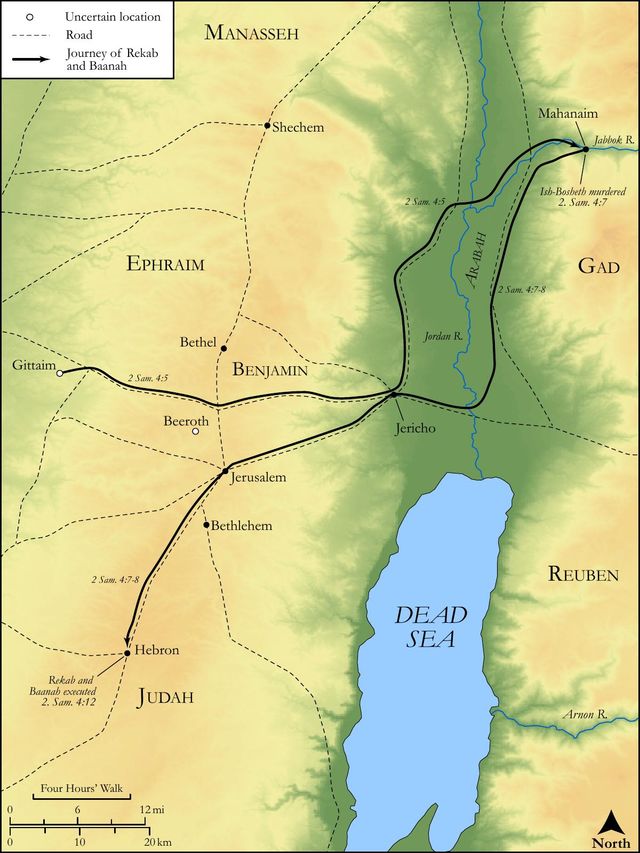
1.Who were the murderers: Baanah and Rechab, Sa2 4:2, Sa2 4:3. They were own brothers, as Simeon and Levi, and partners in iniquity. They were or had been Ish-bosheth's own servants, employed under him, so much the more base and treacherous was it in them to do him a mischief. They were Benjamites, of his own tribe. They were of the city of Beeroth; for some reason which we cannot now account for care is here taken to let us know (in a parenthesis) that that city belonged to the lot of Benjamin, so we find (Jos 18:25), but that the inhabitants, upon some occasion or other, perhaps upon the death of Saul, retired to Gittaim, another city which lay not far off in the same tribe, and was better fortified by nature, being situate (if we may depend upon Mr. Fuller's map) between the two rocks Bozez and Seneh. There the Beerothites were when this was written, and probably took root there, and never returned to Beeroth again, which made Beeroth, that had been one of the cities of the Gibeonites (Jos 9:17), to be forgotten, and Gittaim to be famous long after, as we find, Neh 11:33.
2.How the murder was committed, Sa2 4:5-7. See here,
(1.)The slothfulness of Ish-bosheth. He lay upon his bed at noon. It does not appear that the country was at any time of the year so hot as to oblige the inhabitants to retire at noon, as we are told they do in Spain in the heat of summer; but Ishbosheth was a sluggish man, loved his ease and hated business: and when he should have been, at this critical juncture, at the head of his forces in the field, or at the head of his counsels in a treaty with David, he was lying upon his bed and sleeping, for his hands were feeble (Sa2 4:1), and so were his head and heart. When those difficulties dispirit us which should rather invigorate us and sharpen our endeavours we betray both our crowns and lives. Love not sleep, lest thou come to poverty and ruin. The idle soul is an easy prey to the destroyer.
(2.)The treachery of Baanah and Rechab. They came into the house, under pretence of fetching wheat for the victualling of their regiments; and such was the plainness of those times that the king's corn-chamber and his bed-chamber lay near together, which gave them an opportunity, when they were fetching wheat, to murder him as he lay on the bed. We know not when and where death will meet us. When we lie down to sleep we are not sure but that we may sleep the sleep of death before we awake; nor do we know from what unsuspected hand a fatal stroke may come. Ish-bosheth's own men, who should have protected his life, took it away.
3.The murderers triumphed in what they had done. As if they had performed some very glorious action, and the doing of it for David's advantage was enough not only to justify it, but to sanctify it, they made a present of Ish-bosheth's head to David (Sa2 4:8): Behold the head of thy enemy, than which they thought nothing could be more acceptable to him; yea, and they made themselves instruments of God's justice, ministers to bear his sword, though they had no commission: The Lord hath avenged thee this day of Saul and of his seed. Not that they had any regard either to God or to David's honour; they aimed at nothing but to make their own fortunes (as we say) and to get preferment in David's court; but, to ingratiate themselves with him, they pretended a concern for his life, a conviction of his title, and a zealous desire to see him in full possession of the throne. Jehu pretended zeal for the Lord of hosts when an ambition to set up himself and his own family was the spring of his actions.
Continue studying 2 Samuel 4:4 across the web’s major study libraries — every link below opens this exact verse, chapter, or book on the destination site.
Read & Compare
 BibleGatewayThis verse in more than 200 translations and 70 languages.
 Bible.comThe YouVersion reader — hundreds of translations, reading plans, and highlights.
 ESV.orgCrossway's official English Standard Version reader.
 NET BibleThe NET translation with 60,000+ translators' notes on every rendering decision.
 STEP BibleTyndale House's free study tool — original text, vocabulary, and scholarly resources.
 BibliaLogos Bible Software's free web reader.
 USCCBThe New American Bible (Revised Edition) with the U.S. bishops' study notes.
Commentaries
 BibleHub CommentariesDozens of classic commentaries on this verse, gathered on one page.
 StudyLightMore than 100 commentary sets — the largest collection on the web.
 BibleRefPlain-English commentary on what this verse means, verse by verse.
 Enduring WordDavid Guzik's free commentary on this chapter, widely used by Bible teachers.
 Bible Study ToolsVerse commentary alongside Greek and Hebrew study aids.
Original Language & Research
- BibleHub InterlinearThe verse word by word — original language, transliteration, and English.
- BibleHub LexiconEvery word's original-language definition and Strong's entry.
 Blue Letter BibleDeep-study tools — Strong's numbers, concordance, and word studies.
 SefariaThe Hebrew text with Rashi and centuries of Jewish commentary.
Sermons, Hymns & Audio


TrulyRandomVerse is not affiliated with these sites and doesn’t control their content. They’re linked because they’re genuinely useful.
Summary
Second Samuel 4:4 introduces Mephibosheth, the son of Jonathan and grandson of King Saul, whose life was tragically and permanently altered by a crippling injury at the tender age of five. This pivotal verse recounts the precise circumstances of his lameness, which occurred during the chaotic and desperate flight of his nurse upon receiving the devastating news of Saul and Jonathan's deaths in battle at Jezreel. This personal tragedy, born out of the violent dynastic upheaval and the collapse of Saul's kingdom, sets the profound stage for Mephibosheth's later re-emergence in the narrative, highlighting crucial themes of vulnerability, divine providence, and the enduring power of covenant faithfulness in the unfolding story of David's reign.
Context
ShowHideLiterary Context
This verse is strategically positioned immediately following the detailed account of the assassination of Ish-bosheth, Saul's last surviving son and nominal king over the northern tribes, and the subsequent execution of his murderers by David. The death of Ish-bosheth (recounted in 2 Samuel 4:1-3) effectively extinguishes the direct male line of Saul's house, paving the way for David to assume full kingship over all Israel, a pivotal moment detailed in 2 Samuel 5. The introduction of Mephibosheth at this precise moment serves as a crucial narrative device, reminding the reader that while Saul's reign is over, his line is not entirely eradicated, specifically through Jonathan, David's beloved covenant partner. This seemingly minor detail is, in fact, a profound piece of foreshadowing, setting the stage for the significant role Mephibosheth will play in David's demonstration of covenant loyalty and grace in 2 Samuel 9.
Historical & Cultural Context
Among the kingdoms of that day, the transition of power from one dynasty to another was frequently accompanied by the ruthless extermination of the former ruling family. This brutal practice, often referred to as damnatio memoriae or the "purge of the royal house," was a common and accepted reality designed to prevent future claims to the throne and consolidate the new king's power. The news of Saul and Jonathan's deaths at Mount Gilboa would have immediately triggered intense fears of such a purge among any remaining members of Saul's household. The nurse's frantic flight with Mephibosheth was, therefore, a desperate and understandable attempt to preserve the child's life from what she perceived as an imminent and existential threat. Furthermore, lameness, in this cultural context, was often viewed as a significant physical imperfection that could disqualify one from certain roles, including priestly service (Leviticus 21:18) and, by extension, potentially kingship or high office, sometimes carrying social stigma. This makes Mephibosheth's condition particularly poignant and emphasizes his vulnerability in a world where physical wholeness was often equated with favor and status.
Key Themes
ShowHideThis verse introduces several profound and interconnected themes that resonate throughout the broader narrative of 2 Samuel. Firstly, it highlights Tragedy and Vulnerability, illustrating in a deeply personal way how political upheaval and sudden misfortune can have devastating and lasting consequences, especially for the innocent and defenseless. Mephibosheth's lameness, acquired at such a tender age, powerfully symbolizes the fragility of life and the collateral damage inflicted by societal chaos and the fall of a dynasty. Secondly, it subtly introduces the theme of Divine Preservation, as Mephibosheth's life, though physically marred, is miraculously spared amidst the systematic destruction of his family line. This preservation is crucial for the later narrative, setting the stage for David's extraordinary act of Covenant Faithfulness to Jonathan, as promised in their solemn oath recorded in 1 Samuel 20:14-17. The survival of Jonathan's son ensures that David has an object for his loyalty, transforming a potential vulnerability (a surviving member of the former dynasty) into a profound opportunity for the display of grace and the fulfillment of sacred vows, reflecting a deeper divine purpose at work.
Exposition and Analysis
ShowHideKey Word Analysis
ShowHideThis term (H5223, נָכֶה) describes someone who is "smitten," "maimed," or "dejected," encompassing the physical state of being crippled or unable to walk properly. In ancient Israel, physical blemishes, particularly those affecting mobility, often carried social stigma and could disqualify individuals from certain roles, such as priestly service (Leviticus 21:18). Mephibosheth's lameness is not merely a physical description but a potent symbol of his vulnerability, his lowly status, and the profound brokenness that resulted from the catastrophic fall of Saul's house. It highlights his complete dependence on others, a condition that will later be dramatically reversed by David's unexpected grace.
The word (H8052, שְׁמוּעָה) refers to "something heard," specifically an "announcement," "report," or "news." Here, it signifies the sudden, catastrophic news of the deaths of King Saul and Prince Jonathan at Jezreel. The immediacy and profound impact of these "tidings" are emphasized, triggering a panic that directly leads to Mephibosheth's accident. This highlights the disruptive and often devastating effect of major political and military events on individual lives, turning a moment of national defeat into a deeply personal tragedy for the royal household.
The name (H4648, מְפִיבֹשֶׁת) is highly significant. While its precise etymology is debated, it is often interpreted as "dispeller of shame" or "from the mouth of shame." Notably, in parallel genealogies (1 Chronicles 8:34 and 1 Chronicles 9:40), he is called Merib-baal (מְרִיב בַּעַל), meaning "contender of Baal" or "Baal strives." The change to "bosheth" (בֹּשֶׁת), meaning "shame," is widely understood as a deliberate scribal alteration to avoid pronouncing the name of the Canaanite deity Baal, reflecting a theological aversion to pagan associations. This name change itself signifies a desire to distance from paganism, but "shame" also ironically connects to his physical condition and lowly status, which David's future actions will powerfully redeem and reverse.
Verse Breakdown
ShowHide"And Jonathan, Saul's son, had a son [that was] lame of [his] feet."
This opening clause immediately establishes Mephibosheth's identity through his lineage, linking him directly to Jonathan, David's beloved covenant friend. This connection is crucial for setting up the later dramatic encounter in 2 Samuel 9, where David will remember his solemn oath. The clause also immediately introduces his defining characteristic: his physical disability, presented as a fundamental aspect of his being from the outset, signaling its profound importance to his story and future role.
"He was five years old when the tidings came of Saul and Jonathan out of Jezreel,"
This clause provides the crucial temporal and geographical context for the tragic accident. Mephibosheth's young age (five years old) highlights his innocence and extreme vulnerability, making the subsequent injury even more poignant and unjust. "Jezreel" refers to the strategic location from which the devastating news of Saul and Jonathan's defeat and deaths at Mount Gilboa reached the royal household. This news ignited widespread panic and fear, as the fall of a dynasty often led to the systematic extermination of its remaining members to prevent future claims to the throne.
"and his nurse took him up, and fled:"
In a desperate, instinctive act to preserve the royal lineage and the child's life, the nurse, a trusted and devoted caregiver, takes immediate action. Her frantic response to flee underscores the extreme and immediate danger perceived by those associated with the fallen dynasty. This flight is not merely a change of location but a frantic dash for survival, driven by the very real threat of execution or imprisonment for any potential rival to the new king. It highlights the chaos and terror that engulfed Saul's household.
"and it came to pass, as she made haste to flee, that he fell, and became lame."
This is the pivotal and tragic moment. The nurse's urgent haste, born of fear and desperation to save the child, inadvertently leads to the very misfortune she was trying to avoid. The fall is presented as a direct, almost ironic, consequence of the chaotic flight, permanently crippling Mephibosheth. This detail is crucial because it explains the origin of his lifelong lameness, which will become a key motif throughout his story, symbolizing his brokenness, dependence, and the lasting scars of dynastic transition.
"And his name [was] Mephibosheth."
The verse concludes by formally introducing the child by name, solidifying his identity for the reader. This naming ensures that the reader connects this tragic figure, marked by disability and the chaos of his family's fall, to the one who will later receive extraordinary and unexpected grace from David, thereby fulfilling the sacred covenant made with Jonathan. The name itself, potentially linked to "shame" (as discussed in Key Word Analysis), adds another layer of pathos to his condition, setting the stage for a powerful reversal of fortune and a profound display of redemptive grace.
Literary Devices
ShowHideThe verse employs several significant literary devices that enrich its meaning and foreshadow future events. Foreshadowing is prominently evident in the introduction of Mephibosheth and the detailed account of his injury. His survival, despite the purge of Saul's house, and his permanent lameness, set the profound stage for David's later act of covenant loyalty and grace in 2 Samuel 9. The emphasis on his vulnerability makes David's subsequent kindness and restoration even more remarkable and profound. There is also a subtle but powerful Irony in the nurse's actions: her desperate attempt to save Mephibosheth's life from the perceived threat inadvertently causes his lifelong disability. This highlights the unpredictable and often tragic consequences of human fear, panic, and the chaotic nature of political upheaval. Furthermore, Mephibosheth's Lameness functions as a potent Symbolism. It represents not only his physical brokenness but also the "brokenness" and collapse of Saul's fallen dynasty, and the inherent vulnerability of those caught in the maelstrom of violent political transition. His condition becomes a tangible mark of the chaos and tragedy that befell his family, yet it also becomes the very condition through which God's sovereign preservation and David's extraordinary faithfulness are most strikingly displayed.
Theological and Thematic Connections
ShowHideThe account of Mephibosheth's injury, though seemingly a minor detail in the grand narrative of David's ascent to the throne, carries profound theological weight. It serves as a stark reminder that even in moments of profound human chaos, tragedy, and political upheaval, God's sovereign hand is at work, often preserving individuals for His greater purposes. Mephibosheth's survival, despite the brutal purge of Saul's house, is an act of divine preservation, setting the stage for David to demonstrate the enduring power of covenant faithfulness—not merely as a human promise, but as a reflection of God's own steadfast love and unwavering commitment to His promises. His lameness, a symbol of brokenness, weakness, and neglect, becomes the very canvas upon which extraordinary grace is painted, illustrating that God often works through the weak and the vulnerable to display His power, mercy, and redemptive purposes. This narrative underscores that even in the midst of human failure and suffering, divine providence is meticulously weaving a tapestry of grace.
Reflection and Application
ShowHideMephibosheth's story begins with an unexpected fall that leaves him permanently disabled, a poignant reminder that life's most challenging circumstances can arise suddenly and without warning, often as collateral damage from larger events beyond our control. Yet, this initial tragedy sets the stage for a remarkable display of grace and covenant keeping. His lameness, a symbol of his brokenness, inability to stand on his own, and neglect, becomes the very condition through which God's providence and David's faithfulness are most clearly seen. Just as David, years later, sought out Mephibosheth to show him kindness for Jonathan's sake (2 Samuel 9:1), this narrative powerfully foreshadows God's own initiative to extend grace to us, even in our spiritual "lameness" or brokenness, bringing us into His presence and providing for us beyond anything we could earn or deserve. It encourages us to look beyond immediate misfortune and apparent chaos to the greater plan of divine providence and the enduring power of faithfulness, knowing that our weaknesses and vulnerabilities can become the very avenues through which God's strength and mercy are most gloriously revealed. We are called to trust that even in our most helpless and vulnerable states, God sees us, remembers His covenant, and desires to bring us to His table, not because of who we are, but because of who He is.
Questions for Reflection
ShowHideFAQ
ShowHideWhy is Mephibosheth's lameness emphasized so early in the narrative?
ShowHideMephibosheth's lameness is emphasized early because it is central to his identity and future role in the narrative, serving multiple crucial purposes. Firstly, it highlights his extreme vulnerability and the tragic, lasting consequences of the political upheaval surrounding Saul's death. Secondly, it sets him apart as someone who is physically dependent and socially overlooked, making David's later act of kindness and restoration in 2 Samuel 9 all the more profound and remarkable. His condition underscores the theme of God's unexpected grace working through human brokenness and weakness. By portraying him as an unlikely recipient of royal favor, his lameness ultimately magnifies David's covenant faithfulness and God's sovereign hand in preserving a remnant of Saul's line for His purposes.
What was the significance of "Jezreel" in this verse?
ShowHideJezreel was a strategically important royal city and a prominent location in ancient Israel. In this context, it is the precise place from which the devastating "tidings" of Saul and Jonathan's deaths at Mount Gilboa reached the royal household. It signifies the immediate aftermath of the catastrophic battle and serves as the epicenter of the panic and fear that ensued among Saul's remaining family and servants. The news from Jezreel directly triggered the nurse's frantic flight, which, in a tragic twist of fate, led to Mephibosheth's fall and subsequent lifelong lameness.
Why did Mephibosheth's nurse flee with him?
ShowHideThe nurse fled with Mephibosheth out of an immediate and desperate fear for his life. Among the kingdoms of that day, it was a common and brutal practice for a new king ascending to the throne to eliminate all potential rivals from the previous dynasty to secure his claim and prevent future rebellions. As the grandson of King Saul and the son of Jonathan, Mephibosheth, even at the tender age of five, represented a direct threat to David's burgeoning reign. The nurse's flight was a desperate, albeit tragically flawed, attempt to save the last male descendant of Saul's direct line from what she perceived as an inevitable and ruthless purge by the incoming monarch, highlighting the extreme danger and chaos of the dynastic transition.
Christ-Centered Fulfillment
ShowHideThe tragic account of Mephibosheth's lameness, born of chaos, fear, and a desperate fall, beautifully foreshadows the spiritual condition of fallen humanity and the radical, unmerited grace found exclusively in Jesus Christ. Just as Mephibosheth was crippled, overlooked, and utterly unable to approach the king on his own terms, so too are we, by nature, spiritually "lame" and helpless, alienated from a holy God due to our sin (Ephesians 2:1-3). We are descendants of a fallen lineage, marked by the "fall" of Adam, and are utterly incapable of bridging the chasm between ourselves and a righteous God through our own efforts. Yet, the story of David's unwavering covenant faithfulness to Jonathan, leading him to actively seek out and restore Mephibosheth to a place of honor at his own table (2 Samuel 9:7), powerfully illustrates God's divine initiative in Christ. Our Heavenly King, out of His boundless love and eternal covenant commitment, sought us out in our brokenness and brought us into His presence, not because of our merit or worthiness, but solely because of His sovereign grace (Romans 5:8). Through Jesus, the true Son of David, we who were once far off and spiritually crippled are now brought near, adopted into God's family, and invited to feast at the King's table forever, partaking in the abundance of His kingdom (Ephesians 2:13; Luke 14:15-24). Mephibosheth's restoration, eating at the king's table as one of the king's own sons, is a vivid and compelling picture of our own redemption, adoption, and eternal fellowship with God through the finished, perfect work of Christ.