


1 Samuel 31:10
- וַיָּשִׂמוּvai·ya·Si·muand they putH7760Conj-w ¦ V-Qal-ConsecImperf-3mpVerb Qal Consecutive Imperfect 3rd Plural Masculineוַandיָּשִׂמוּthey put
- אֶת'et<obj.>H853DirObjMParticle Object Indicator
- כֵּלָיוke·Lavhis armorH3627N-mpc ¦ 3msNoun Plural Masculine Constructכֵּלָיarmorוhis
- בֵּיתbeit[the] house ofH1004N-mscNoun Singular Masculine Construct
- עַשְׁתָּרוֹתash·ta·RotAshtarothH6252N-fpNoun Plural Feminine Absolute
- וְאֶתve·'Etand <obj.>H853Conj-w ¦ DirObjMParticle Object Indicatorוְandאֶת<obj.>
- גְּוִיָּתוֹge·vi·ya·Tohis corpseH1472N-fsc ¦ 3msNoun Singular Feminine Constructגְּוִיָּתcorpseוֹhis
- תָּקְעוּta·ke·'Uthey fixedH8628V-Qal-Perf-3cpVerb Qal Perfect 3rd Plural common gender
- בְּחוֹמַתbe·cho·Maton [the] wall ofH2346Prep-b ¦ N-fscNoun Singular Feminine Constructבְּonחוֹמַת[the] wall of
- בֵּיתbeitBethH1052N-properNoun Proper Location
- שָׁןShanShanH1052N-properNoun Proper Location
English is a literal word-by-word gloss of the Hebrew, not the KJV's wording. Why?
This is the original text the KJV's translators worked from — each Hebrew word with its own literal English meaning in this verse, prepared by scholars at Tyndale House, Cambridge. The KJV translates whole sentences, not word by word, so its wording differs: one Hebrew word can become several English words, and the KJV may choose “the LORD” where the gloss reads “Yahweh”. Both are faithful — they answer different questions. For the KJV's own rendering, switch to the KJV text.
Details
See on the biblical-era map
Study this verse
Public-domain commentary
Matthew Henry
From his Commentary on the Whole Bible. Henry comments on passages, not single verses — this entry covers 1 Samuel 31:8–13. His three-level outline is real structure in the source text, so it is rendered as structure.
The scripture makes no mention of the souls of Saul and his sons, what became of them after they were dead (secret things belong not to us), but of their bodies only.
I.How they were basely abused by the Philistines.
The day after the battle, when they had recovered their fatigue, they came to strip the slain, and, among the rest, found the bodies of Saul and his three sons, Sa1 31:8. Saul's armour-bearer perhaps intended to honour his master by following the example of his self-murder, and to show thereby how well he loved him; but, if he had consulted his reason more than his passions, he would have spared that foolish compliment, not only in justice to his own life, but in kindness to his master, to whom, by the opportunity of survivorship, he might have done all the service that could be done him by any man after he was dead; for he might, in the night, have conveyed away his body, and those of his sons, and buried them decently. But such false and foolish notions these vain men have (though they would be wise) of giving and receiving honour. Nay, it should seem, Saul might have saved himself the fatal thrust and have made his escape: for the pursuers (in fear of whom he slew himself) came not to the place where he was till the next day. But whom God will destroy he infatuates and utterly consumes with his terrors. See Job 18:5, etc. Finding Saul's body (which now that it lay extended on the bloody turf was distinguishable from the rest by its length, as it was, while erect, by its height, when he proudly overlooked the surrounding crowd), they will, in that, triumph over Israel's crown, and meanly gratify a barbarous and brutish revenge by insulting the deserted corpse, which, when alive, they had stood in awe of.
1.They cut off his head. Had they designed in this to revenge the cutting off of Goliath's head they would rather have cut off the head of David, who did that execution, when he was in their country. They intended it, in general, for a reproach to Israel, who promised themselves that a crowned and an anointed head would save them from the Philistines, and a particular reproach to Saul, who was taller by the head than other men (which perhaps he was wont to boast of), but was now shorter by the head.
2.They stripped him of his armour (Sa1 31:9), and sent that to be set up as a trophy of their victory, in the house of Ashtaroth their goddess (Sa1 31:10); and we are told, Ch1 10:10 (though it is omitted here), that they fastened his head in the temple of Dagon. Thus did they ascribe the honour of their victory, not as they ought to have done to the real justice of the true God, but to the imaginary power of their false gods, and by this respect paid to pretended deities shame those who give not the praise of their achievements to the living God. Ashtaroth, the idol that Israel had many a time gone a whoring after, now triumphs over them.
3.They sent expresses throughout their country, and ordered public notice to be given in the houses of their gods of the victory they had obtained (Sa1 31:9), that public rejoicings might be made and thanks given to their gods. This David regretted sorely, Sa2 1:20. Tell it not in Gath.
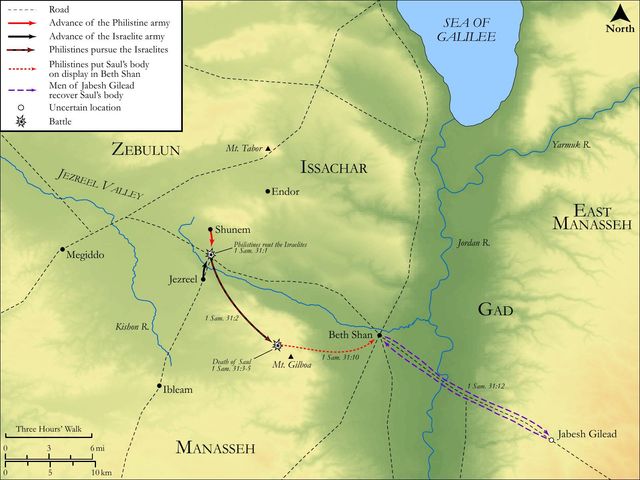
4.They fastened his body and the bodies of his sons (as appears, Sa1 31:12) to the wall of Bethshan, a city that lay not far from Gilboa and very near to the river Jordan. Hither the dead bodies were dragged and here hung up in chains, to be devoured by the birds of prey. Saul slew himself to avoid being abused by the Philistines, and never was royal corpse so abused as his was, perhaps the more if they understood that he slew himself for that reason. He that thinks to save his honour by sin will certainly lose it. See to what a height of insolence the Philistines had arrived just before David was raised up, who perfectly subdued them. Now that they had slain Saul and his sons they thought the land of Israel was their own for ever, but they soon found themselves deceived. When God has accomplished his whole work by them he will accomplish it upon them. See Isa 10:6, Isa 10:7.
II.How they were bravely rescued by the men of Jabesh-Gilead.
Little more than the river Jordan lay between Beth-shan and Jabesh-Gilead, and Jordan was in that place passable by its fords; a bold adventure was therefore made by the valiant men of that city, who in the night passed the river, took down the dead bodies, and gave them decent burial, Sa1 31:11, Sa1 31:13. This they did,
1.Out of a common concern for the honour of Israel, or the land of Israel, which ought not to be defiled by the exposing of any dead bodies, and especially of the crown of Israel, which was thus profaned by the uncircumcised.
2.Out of a particular sense of gratitude to Saul, for his zeal and forwardness to rescue them from the Ammonites when he first came to the throne, Sa1 11:1-15. It is an evidence of a generous spirit and an encouragement to beneficence when the remembrance of kindnesses is thus retained, and they are thus returned in an extremity. The men of Jabesh-Gilead would have done Saul better service if they had sent their valiant men to him sooner, to strengthen him against the Philistines. But his day had come to fall, and now this is all the service they can do him, in honour to his memory. We find not that any general mourning was made for the death of Saul, as was for the death of Samuel (Sa1 25:1), only those Gileadites of Jabesh did him honour at his death; for,
(1.)They made a burning for the bodies, to perfume them. So some understand the burning of them. They burnt spices over them, Sa1 11:12. And that it was usual thus to do honour to their deceased friends, at least their princes, appears by the account of Asa's funeral (Ch2 16:14), that they made a very great burning for him. Or (as some think) they burnt the flesh, because it began to putrefy.
(2.)They buried the bodies, when, by burning over them, they had sweetened them (or, if they burnt them, they buried the bones and ashes), under a tree, which served for a grave-stone and monument. And,
(3.)They fasted seven days, that is, each day of the seven they fasted till the evening; thus they lamented the death of Saul and the present distracted state of Israel, and perhaps joined prayers with their fasting for the re-establishment of their shattered state. Though, when the wicked perish there is shouting (that is, it is to be hoped a better state of things will ensue, which will be matter of joy), yet humanity obliges us to show a decent respect to dead bodies, especially those of princes.
This book began with the birth of Samuel, but now it ends with the burial of Saul, the comparing of which two together will teach us to prefer the honour that comes from God before any of the honours which this world pretends to have the disposal of.
Continue studying 1 Samuel 31:10 across the web’s major study libraries — every link below opens this exact verse, chapter, or book on the destination site.
Read & Compare
 BibleGatewayThis verse in more than 200 translations and 70 languages.
 Bible.comThe YouVersion reader — hundreds of translations, reading plans, and highlights.
 ESV.orgCrossway's official English Standard Version reader.
 NET BibleThe NET translation with 60,000+ translators' notes on every rendering decision.
 STEP BibleTyndale House's free study tool — original text, vocabulary, and scholarly resources.
 BibliaLogos Bible Software's free web reader.
 USCCBThe New American Bible (Revised Edition) with the U.S. bishops' study notes.
Commentaries
 BibleHub CommentariesDozens of classic commentaries on this verse, gathered on one page.
 StudyLightMore than 100 commentary sets — the largest collection on the web.
 BibleRefPlain-English commentary on what this verse means, verse by verse.
 Enduring WordDavid Guzik's free commentary on this chapter, widely used by Bible teachers.
 Bible Study ToolsVerse commentary alongside Greek and Hebrew study aids.
Original Language & Research
- BibleHub InterlinearThe verse word by word — original language, transliteration, and English.
- BibleHub LexiconEvery word's original-language definition and Strong's entry.
 Blue Letter BibleDeep-study tools — Strong's numbers, concordance, and word studies.
 SefariaThe Hebrew text with Rashi and centuries of Jewish commentary.
Sermons, Hymns & Audio


TrulyRandomVerse is not affiliated with these sites and doesn’t control their content. They’re linked because they’re genuinely useful.
Summary
1 Samuel 31:10 vividly recounts the Philistines' desecration of King Saul's body and armor following Israel's devastating defeat on Mount Gilboa. This grim act served as a public display of Philistine triumph, an offering to their pagan deity Ashtaroth, and a profound humiliation for the fallen Israelite king, marking the tragic and ignominious end of Saul's reign and paving the way for the rise of David.
Context
ShowHideLiterary Context
This verse immediately follows the catastrophic account of King Saul's death on Mount Gilboa, where he fell in battle alongside his three sons, Jonathan, Abinadab, and Malchishua, at the hands of the Philistines. The preceding verses detail the overwhelming Philistine victory and Saul's desperate, self-inflicted end to avoid capture and torture (1 Samuel 31:1-6). The Philistines, discovering the bodies of Saul and his sons the following day, proceed to desecrate them. This act of public humiliation and display of war spoils represents the grim climax of Saul's tragic narrative arc, emphasizing the complete collapse of his kingship and the fulfillment of divine judgment against his persistent disobedience. It sets the stage for the subsequent courageous retrieval of the bodies by the men of Jabesh-Gilead (1 Samuel 31:11-13) and the eventual establishment of David's reign, which begins in the subsequent book of 2 Samuel.
Historical & Cultural Context
In the ancient Near East, the public display and desecration of a defeated enemy king's body, along with the dedication of his armor or other spoils to the victor's gods, were common and highly symbolic practices. These acts served multiple purposes: to assert absolute dominance, to demoralize the enemy's surviving forces, to celebrate the "divine" favor of one's own deities, and to warn potential rebels. Bethshan, a strategically important city located at the eastern end of the Jezreel Valley, controlled key trade routes and access points between the Jordan Valley and the coastal plains. Its formidable walls provided a prominent and highly visible location for such a gruesome display, ensuring maximum public impact and widespread demoralization. The "house of Ashtaroth" refers to a temple dedicated to Astarte (or Ashtoreth), a prominent Canaanite and Philistine goddess of fertility, war, and sexual love, often associated with the planet Venus. Dedicating Saul's armor to her was a direct theological challenge to Yahweh, Israel's God, implying that Ashtaroth had granted the Philistines victory over Him and His anointed king.
Key Themes
ShowHideThis verse powerfully encapsulates several profound themes that resonate throughout the narrative of 1 Samuel. Firstly, it highlights the humiliation and desecration of a divinely appointed king, illustrating the severe consequences of disobedience and the loss of God's favor, as seen in Saul's earlier rejection by God due to his rebellion (1 Samuel 15:23). Secondly, it underscores the theme of pagan triumph and challenge to Yahweh's sovereignty. The Philistines' actions were not merely military but deeply theological, asserting the perceived supremacy of their gods over the God of Israel. Thirdly, it marks the definitive end of an era—the tragic culmination of Saul's troubled kingship, which began with promise and divine anointing (1 Samuel 10:1) but ended in despair, national defeat, and personal ignominy. This grim scene serves as a stark contrast to the divine promise and anointing of David, who was chosen by God to succeed Saul and establish a righteous dynasty (1 Samuel 16:13).
Exposition and Analysis
ShowHideKey Word Analysis
ShowHideThis term (H3627) refers to any apparatus, implement, utensil, or weapon. In this context, it specifically denotes Saul's military equipment, including his shield, sword, and possibly helmet or breastplate. The dedication of Saul's armor to Ashtaroth was a potent symbolic act. Armor represented a warrior's identity, strength, and success in battle. By seizing Saul's armor and placing it in their deity's temple, the Philistines were not only claiming a valuable trophy but also symbolically stripping Israel's king of his power and attributing their victory directly to the superior might of their goddess, thereby attempting to diminish Yahweh's authority.
This word (H6252), a plural form of Ashtoreth, refers to the chief Sidonian deity, also known as Astarte, a prominent Canaanite and Philistine goddess of fertility, war, and sexual love. The "house of Ashtaroth" (H1045, Bêyth ʻAshtârôwth, "house of Ashtoreths") was a temple dedicated to this goddess. The Philistines' act of placing Saul's armor here was a deliberate and public declaration of religious triumph, asserting that their victory over Israel was granted by their patron deity, Ashtaroth, and served as a direct challenge to the supremacy of Yahweh, the God of Israel. This practice was common in the ancient Near East, where war spoils were dedicated to the patron deity believed to have granted victory.
This place name (H1052), meaning "house of ease," identifies a strategically vital city located in the Jezreel Valley, near the Jordan River. Its commanding position made it a significant Philistine stronghold. Fastening Saul's body (H1472, gᵉvîyâh, "a body, whether alive or dead") to its wall (H2346, chôwmâh, "a wall of protection") was a public and highly visible act of humiliation and demoralization. This gruesome display was designed to send a clear message of Philistine dominance and to crush the morale of any remaining Israelite resistance. The choice of Bethshan underscored the Philistines' complete control over a key region of Israelite territory and amplified the shame inflicted upon the fallen king.
Verse Breakdown
ShowHide"And they put his armour in the house of Ashtaroth"
This clause describes the Philistines' ritualistic dedication of Saul's armor. In ancient warfare, the armor of a defeated king was a highly prized trophy, representing the vanquished warrior's strength and the victor's prowess. Placing it in the temple of their goddess Ashtaroth signified that the victory was not merely a military one, but a religious triumph, demonstrating the perceived superiority of Ashtaroth over Yahweh. This act was meant to reinforce Philistine religious and political hegemony, celebrating their gods' perceived role in their military success.
"and they fastened his body to the wall of Bethshan"
This clause details the ultimate act of desecration and public humiliation. The Philistines did not merely leave Saul's body on the battlefield; they transported it to a prominent city wall for public display. This was intended to serve as a stark warning, a symbol of Israel's utter defeat, and a profound act of disrespect to the fallen king, aiming to demoralize the Israelites, crush their spirit, and deter any further resistance. The public nature of this act maximized its psychological impact.
Literary Devices
ShowHideThe verse employs several potent literary devices to convey its stark and tragic message. Symbolism is paramount: Saul's armor, once a symbol of his royal authority and military might, is now a trophy in a pagan temple, symbolizing the complete collapse of his kingship and the perceived triumph of pagan deities over Yahweh. His body, once anointed as king, is now publicly displayed in disgrace, symbolizing the ultimate consequences of his disobedience and the tragic end of his reign. There is also a strong sense of Irony in Saul's ignominious end; the king chosen by God, who began with such promise and was endowed with the Spirit of the Lord, meets a humiliating death and desecration, a stark contrast to the glorious beginning of his rule. The verse also serves as a form of Foreshadowing, as this definitive, tragic end of Saul's line clears the path for the long-awaited establishment of David's righteous reign, signaling a new chapter for Israel under a king after God's own heart. The vivid imagery of the "wall of Bethshan" also functions as Pathos, evoking a strong sense of pity and sorrow for Saul's tragic fate, despite his failings.
Theological and Thematic Connections
ShowHide1 Samuel 31:10 is a grim testament to the devastating consequences of disobedience and the fragility of human power when separated from divine favor. The Philistines' actions, while intended to glorify their pagan gods and humiliate Israel's God, ultimately serve to underscore Yahweh's sovereignty even in apparent defeat. The desecration of Saul's body and armor, though horrific, aligns with the prophetic pronouncements of judgment against Saul for his rebellion against God's commands. It reminds us that God's plan will prevail, even through tragic circumstances, and that He raises up and brings down kings according to His perfect will. This moment of national despair for Israel highlights the desperate need for a king who would truly honor Yahweh and lead His people in faithfulness, a role that David, God's chosen, would soon fulfill, demonstrating God's faithfulness to His covenant promises despite human failure.
Reflection and Application
ShowHideThe stark reality depicted in 1 Samuel 31:10 offers profound lessons for believers today. It serves as a powerful reminder that even those in positions of great authority are not exempt from the consequences of their choices, particularly when they deviate from divine commands. Saul's tragic end, marked by public humiliation and desecration, underscores the futility of human pride and self-reliance when God's favor has been withdrawn. For the Israelites, this event was a national trauma, a visible sign of their broken covenant and the vulnerability that resulted from their king's spiritual decline. For us, it highlights the paramount importance of spiritual integrity, humility, and unwavering obedience to God. It challenges us to examine where our trust truly lies—in human strength, worldly achievements, or in the sovereign power and unfailing faithfulness of God. The scene also contrasts the temporary triumph of paganism with the ultimate, enduring sovereignty of the one true God, who would soon raise up David as a king after His own heart, demonstrating that even in moments of profound despair, God is working out His redemptive purposes.
Questions for Reflection
ShowHideFAQ
ShowHideWhy did the Philistines place Saul's armor in the house of Ashtaroth instead of Dagon, who is often mentioned as their chief god?
ShowHideWhile Dagon was indeed a prominent Philistine deity, particularly in cities like Ashdod and Gaza, as evidenced by the account of the Ark of the Covenant in his temple (1 Samuel 5:2-7), the worship of Ashtaroth (Astarte) was also widespread among the Philistines and Canaanites. Ashtaroth was a goddess associated with fertility, war, and hunting, making her a fitting deity to receive war spoils. The specific temple mentioned in 1 Samuel 31:10 was likely a prominent shrine in the region where the battle took place or in one of the Philistine cities that had a strong cult of Ashtaroth. The choice of deity for dedicating spoils often depended on regional prominence, the specific nature of the victory (e.g., a battle victory might be attributed to a war deity), or the particular patron deity of the victorious Philistine contingent. This act was a clear theological statement, regardless of which specific deity was honored, asserting the supremacy of their god over Yahweh.
What was the significance of fastening Saul's body to the wall of Bethshan?
ShowHideFastening Saul's body to the wall of Bethshan was a deliberate and highly symbolic act of public humiliation and demoralization, common in ancient Near Eastern warfare. Firstly, it was a display of absolute victory by the Philistines, showcasing their dominance over Israel and its king. This act served as a powerful visual declaration of their triumph. Secondly, it functioned as a psychological weapon to demoralize any remaining Israelite resistance and to instill fear in the populace. The sight of their fallen king's desecrated body would have been a profound shock and a sign of utter defeat, crushing morale. Thirdly, Bethshan was a strategically important city controlling key routes, making its walls a highly visible location for such a gruesome spectacle, ensuring maximum exposure to anyone traveling through the region. This act was intended to be the ultimate indignity, denying Saul a proper burial and further cementing the Philistines' triumph over Israel (1 Samuel 31:7).
Christ-Centered Fulfillment
ShowHideThe tragic end of King Saul, marked by disobedience, rejection, and ultimately, a humiliating death and desecration, powerfully foreshadows the need for a perfect King, one who would not fail. Saul's body, displayed in shame on the walls of Bethshan, stands in stark contrast to the body of Christ. While Jesus, the true King, was also publicly displayed on a cross, a symbol of shame and defeat in the eyes of the world (Galatians 3:13), His body was not desecrated by His enemies. Instead, after His death, He was laid in a tomb and gloriously raised to life on the third day, conquering sin and death once and for all (Luke 24:6). Saul's armor, taken as a trophy by a pagan god, symbolizes the futility of human strength and the triumph of evil in a fallen world. Yet, Christ's victory on the cross disarmed the spiritual powers and authorities, making a public spectacle of them in triumph (Colossians 2:15). Where Saul's reign ended in despair and death, Jesus' reign brings eternal life and hope, for He is the King of kings and Lord of lords (Revelation 19:16), whose ultimate triumph ensures that death has no sting and the grave no victory (1 Corinthians 15:55-57). His perfect obedience and ultimate sacrifice fulfilled the need for a righteous King, establishing an eternal kingdom that will never be defeated (Daniel 7:14).