


1 Samuel 31:9
- וַיִּכְרְתוּvai·yikh·re·Tuand they cut offH3772Conj-w ¦ V-Qal-ConsecImperf-3mpVerb Qal Consecutive Imperfect 3rd Plural Masculineוַandיִּכְרְתוּthey cut off
- אֶת'et<obj.>H853DirObjMParticle Object Indicator
- רֹאשׁוֹro·Shohis headH7218N-msc ¦ 3msNoun Singular Masculine Constructרֹאשׁheadוֹhis
- וַיַּפְשִׁיטוּvai·yaf·Shi·tuand they stripped offH6584Conj-w ¦ V-Hiphil-ConsecImperf-3mpVerb Hiphil Consecutive Imperfect 3rd Plural Masculineוַandיַּפְשִׁיטוּthey stripped off
- אֶת'et<obj.>H853DirObjMParticle Object Indicator
- כֵּלָיוke·Lavhis armorH3627N-mpc ¦ 3msNoun Plural Masculine Constructכֵּלָיarmorוhis
- וַיְשַׁלְּחוּvay·sha·le·Chuand they sentH7971Conj-w ¦ V-Piel-ConsecImperf-3mpVerb Piel Consecutive Imperfect 3rd Plural Masculineוַandיְשַׁלְּחוּthey sent
- בְאֶרֶץve·'e·retzin [the] land ofH776Prep-b ¦ N-fscNoun Singular Feminine Constructבְinאֶרֶץ[the] land of
- פְּלִשְׁתִּיםpe·lish·Tim[the] PhilistinesH6430N-mpNoun Gentilic Plural Masculine Absolute
- סָבִיבsa·Vivall aroundH5439N-csNoun Singular common gender Absolute
- לְבַשֵּׂרle·va·Serto bear [the] newsH1319Prep-l ¦ V-Piel-InfVerb Piel Infinitive Constructלְtoבַשֵּׂרbear [the] news
- בֵּיתbeit[the] house ofH1004N-mscNoun Singular Masculine Construct
- עֲצַבֵּיהֶם'a·tza·bei·Hemtheir idolsH6091N-mpc ¦ 3mpNoun Plural Masculine Constructעֲצַבֵּיidolsהֶםtheir
- וְאֶתve·'Etand <obj.>H853Conj-w ¦ DirObjMParticle Object Indicatorוְandאֶת<obj.>
- הָעָםha·'Amthe peopleH5971Art ¦ N-msNoun Singular Masculine Absoluteהָtheעָםpeople
English is a literal word-by-word gloss of the Hebrew, not the KJV's wording. Why?
This is the original text the KJV's translators worked from — each Hebrew word with its own literal English meaning in this verse, prepared by scholars at Tyndale House, Cambridge. The KJV translates whole sentences, not word by word, so its wording differs: one Hebrew word can become several English words, and the KJV may choose “the LORD” where the gloss reads “Yahweh”. Both are faithful — they answer different questions. For the KJV's own rendering, switch to the KJV text.
Details
See on the biblical-era map
Study this verse
Public-domain commentary
Matthew Henry
From his Commentary on the Whole Bible. Henry comments on passages, not single verses — this entry covers 1 Samuel 31:8–13. His three-level outline is real structure in the source text, so it is rendered as structure.
The scripture makes no mention of the souls of Saul and his sons, what became of them after they were dead (secret things belong not to us), but of their bodies only.
I.How they were basely abused by the Philistines.
The day after the battle, when they had recovered their fatigue, they came to strip the slain, and, among the rest, found the bodies of Saul and his three sons, Sa1 31:8. Saul's armour-bearer perhaps intended to honour his master by following the example of his self-murder, and to show thereby how well he loved him; but, if he had consulted his reason more than his passions, he would have spared that foolish compliment, not only in justice to his own life, but in kindness to his master, to whom, by the opportunity of survivorship, he might have done all the service that could be done him by any man after he was dead; for he might, in the night, have conveyed away his body, and those of his sons, and buried them decently. But such false and foolish notions these vain men have (though they would be wise) of giving and receiving honour. Nay, it should seem, Saul might have saved himself the fatal thrust and have made his escape: for the pursuers (in fear of whom he slew himself) came not to the place where he was till the next day. But whom God will destroy he infatuates and utterly consumes with his terrors. See Job 18:5, etc. Finding Saul's body (which now that it lay extended on the bloody turf was distinguishable from the rest by its length, as it was, while erect, by its height, when he proudly overlooked the surrounding crowd), they will, in that, triumph over Israel's crown, and meanly gratify a barbarous and brutish revenge by insulting the deserted corpse, which, when alive, they had stood in awe of.
1.They cut off his head. Had they designed in this to revenge the cutting off of Goliath's head they would rather have cut off the head of David, who did that execution, when he was in their country. They intended it, in general, for a reproach to Israel, who promised themselves that a crowned and an anointed head would save them from the Philistines, and a particular reproach to Saul, who was taller by the head than other men (which perhaps he was wont to boast of), but was now shorter by the head.
2.They stripped him of his armour (Sa1 31:9), and sent that to be set up as a trophy of their victory, in the house of Ashtaroth their goddess (Sa1 31:10); and we are told, Ch1 10:10 (though it is omitted here), that they fastened his head in the temple of Dagon. Thus did they ascribe the honour of their victory, not as they ought to have done to the real justice of the true God, but to the imaginary power of their false gods, and by this respect paid to pretended deities shame those who give not the praise of their achievements to the living God. Ashtaroth, the idol that Israel had many a time gone a whoring after, now triumphs over them.
3.They sent expresses throughout their country, and ordered public notice to be given in the houses of their gods of the victory they had obtained (Sa1 31:9), that public rejoicings might be made and thanks given to their gods. This David regretted sorely, Sa2 1:20. Tell it not in Gath.
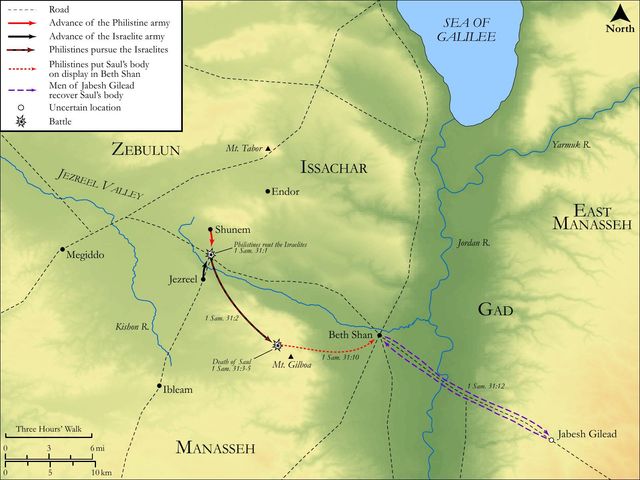
4.They fastened his body and the bodies of his sons (as appears, Sa1 31:12) to the wall of Bethshan, a city that lay not far from Gilboa and very near to the river Jordan. Hither the dead bodies were dragged and here hung up in chains, to be devoured by the birds of prey. Saul slew himself to avoid being abused by the Philistines, and never was royal corpse so abused as his was, perhaps the more if they understood that he slew himself for that reason. He that thinks to save his honour by sin will certainly lose it. See to what a height of insolence the Philistines had arrived just before David was raised up, who perfectly subdued them. Now that they had slain Saul and his sons they thought the land of Israel was their own for ever, but they soon found themselves deceived. When God has accomplished his whole work by them he will accomplish it upon them. See Isa 10:6, Isa 10:7.
II.How they were bravely rescued by the men of Jabesh-Gilead.
Little more than the river Jordan lay between Beth-shan and Jabesh-Gilead, and Jordan was in that place passable by its fords; a bold adventure was therefore made by the valiant men of that city, who in the night passed the river, took down the dead bodies, and gave them decent burial, Sa1 31:11, Sa1 31:13. This they did,
1.Out of a common concern for the honour of Israel, or the land of Israel, which ought not to be defiled by the exposing of any dead bodies, and especially of the crown of Israel, which was thus profaned by the uncircumcised.
2.Out of a particular sense of gratitude to Saul, for his zeal and forwardness to rescue them from the Ammonites when he first came to the throne, Sa1 11:1-15. It is an evidence of a generous spirit and an encouragement to beneficence when the remembrance of kindnesses is thus retained, and they are thus returned in an extremity. The men of Jabesh-Gilead would have done Saul better service if they had sent their valiant men to him sooner, to strengthen him against the Philistines. But his day had come to fall, and now this is all the service they can do him, in honour to his memory. We find not that any general mourning was made for the death of Saul, as was for the death of Samuel (Sa1 25:1), only those Gileadites of Jabesh did him honour at his death; for,
(1.)They made a burning for the bodies, to perfume them. So some understand the burning of them. They burnt spices over them, Sa1 11:12. And that it was usual thus to do honour to their deceased friends, at least their princes, appears by the account of Asa's funeral (Ch2 16:14), that they made a very great burning for him. Or (as some think) they burnt the flesh, because it began to putrefy.
(2.)They buried the bodies, when, by burning over them, they had sweetened them (or, if they burnt them, they buried the bones and ashes), under a tree, which served for a grave-stone and monument. And,
(3.)They fasted seven days, that is, each day of the seven they fasted till the evening; thus they lamented the death of Saul and the present distracted state of Israel, and perhaps joined prayers with their fasting for the re-establishment of their shattered state. Though, when the wicked perish there is shouting (that is, it is to be hoped a better state of things will ensue, which will be matter of joy), yet humanity obliges us to show a decent respect to dead bodies, especially those of princes.
This book began with the birth of Samuel, but now it ends with the burial of Saul, the comparing of which two together will teach us to prefer the honour that comes from God before any of the honours which this world pretends to have the disposal of.
Historical interpretation
Historical reception
1 surviving comment on this verse from the historical church.
And they cut off the head of Saul, etc. The corruptors or demons persecuted Judea with the weapons of impiety to such an extent that they completely deprived it of the principal kingdom itself and snatched away the defenses of the sacred law, by which they prevailed against all adversities. Their downfall was soon spread widely by heralding to their accomplices as a sign of their own triumph and a cause of joy; and the increase of wickedness in the armor of God, which the blessed apostle Paul commanded us, who are to fight against the spiritual wickedness in the heavenly places (Ephesians VI), and who first put it on, fought the good fight, finished the race, kept the faith, receiving from the Lord the crown of righteousness (II Timothy IV); this, I say, the armor of heavenly warfare. The Jews, deceived and deceiving, tried to carry the divine words into infernal places, that is, to equate the doctrines of demons. It is evident that they did this and are doing this in two ways; either by carnally interpreting spiritual words perversely, or by treating the same divine letters, as common and not supported by any divine authority, according to their wishes. Indeed, the very nation deprived of the stronghold of the kingdom of Judea, reduced to nothing, and handed over to the power of enemies, the deceivers publicly displayed as a joke and a common proverb; which figuratively is the body of Saul, truncated on the wall of Bethshan, that is, displayed as an enemy’s house, suspended by impious hands. But even heretics, struck down by the arrows of preceding sins, deprive themselves of the protection of charity, which is the fortress of all virtues. Just as the impure spirit cuts off the head of Saul when they persuade to follow their own sense rather than that of the Scripture. They strip them of arms when they pervert the divine words to their own, that is, diabolical sense. They place the arms of Saul in the temple of Ashtaroth. Ashtaroth indeed, not only because it is an idol, but also because it means the creation of spies, signifies the doctrine of malignant spirits, who, wandering around the folds of the faithful daily, explore if they can devour someone. When they perversely change the works with which they had served God to the service of their own wickedness, they hang the members, truly devoid of light and life, on the wall of the enemy’s house.
Continue studying 1 Samuel 31:9 across the web’s major study libraries — every link below opens this exact verse, chapter, or book on the destination site.
Read & Compare
 BibleGatewayThis verse in more than 200 translations and 70 languages.
 Bible.comThe YouVersion reader — hundreds of translations, reading plans, and highlights.
 ESV.orgCrossway's official English Standard Version reader.
 NET BibleThe NET translation with 60,000+ translators' notes on every rendering decision.
 STEP BibleTyndale House's free study tool — original text, vocabulary, and scholarly resources.
 BibliaLogos Bible Software's free web reader.
 USCCBThe New American Bible (Revised Edition) with the U.S. bishops' study notes.
Commentaries
 BibleHub CommentariesDozens of classic commentaries on this verse, gathered on one page.
 StudyLightMore than 100 commentary sets — the largest collection on the web.
 BibleRefPlain-English commentary on what this verse means, verse by verse.
 Enduring WordDavid Guzik's free commentary on this chapter, widely used by Bible teachers.
 Bible Study ToolsVerse commentary alongside Greek and Hebrew study aids.
Original Language & Research
- BibleHub InterlinearThe verse word by word — original language, transliteration, and English.
- BibleHub LexiconEvery word's original-language definition and Strong's entry.
 Blue Letter BibleDeep-study tools — Strong's numbers, concordance, and word studies.
 SefariaThe Hebrew text with Rashi and centuries of Jewish commentary.
Sermons, Hymns & Audio


TrulyRandomVerse is not affiliated with these sites and doesn’t control their content. They’re linked because they’re genuinely useful.
Summary
1 Samuel 31:9 powerfully narrates the Philistines' actions following their decisive victory over Israel at Mount Gilboa, where King Saul and his sons met their tragic end. To maximize their triumph and publicly humiliate their defeated enemies, the Philistines decapitated Saul, stripped him of his royal armor as spoils of war, and then disseminated the news throughout their entire territory. This grim proclamation of victory was specifically made in the temples of their idols and among the general populace, serving as a stark declaration of their gods' perceived supremacy over the God of Israel and marking the ignominious and definitive end of Saul's tumultuous reign.
Context
ShowHideLiterary Context
This verse serves as the grim climax of the narrative detailing the Battle of Gilboa, immediately following the account of Saul's desperate, self-inflicted death and the demise of his three sons, including Jonathan, in battle (1 Samuel 31:1-8). The Philistines' actions in 1 Samuel 31:9-10 represent the ultimate act of desecration and humiliation against Israel's first king, symbolizing the complete collapse of his kingdom. This devastating scene not only concludes the book of 1 Samuel but also meticulously sets the stage for the book of 2 Samuel, which opens with David's poignant lament over Saul and Jonathan, and subsequently chronicles the complex process of establishing David's kingship. The narrative arc thus transitions from the tragic failure of human-initiated monarchy under Saul to the divinely appointed reign of David, contrasting the ignominious end of one dynasty with the promise of a new, God-ordained era.
Historical & Cultural Context
Ancient Near Eastern warfare was characterized by extreme brutality, aiming not only for military victory but also for the psychological subjugation and public humiliation of the defeated enemy. Decapitation was a common practice, serving as irrefutable proof of death and a potent trophy, while the stripping of armor was both practical (for valuable spoils) and symbolic (divesting the vanquished of power). Public display of a defeated king's body parts or armor in temples was a widespread custom, intended to attribute victory to the conquering nation's gods and assert their deities' superiority over the vanquished. The Philistines, a powerful maritime people who had settled in the southwestern coastal plain of Canaan, were long-standing and formidable rivals of Israel. Their prominent deities included Dagon, often depicted as a fish-god, whose temple is notably mentioned in earlier narratives (the account of the Ark in Dagon's temple), and Ashtoreth, a fertility goddess. The battle's location on Mount Gilboa, an eastern extension of the Jezreel Valley, was strategically vital, controlling access routes across the central land.
Key Themes
ShowHide1 Samuel 31:9 powerfully encapsulates several key themes prevalent throughout the book of 1 Samuel. Firstly, it starkly underscores the consequences of disobedience and rejection of God's word, portraying Saul's tragic and humiliating end as the culmination of his persistent rebellion against the Lord's commands (as seen in Saul's rejection for disobedience). Secondly, the verse highlights the pervasive theme of spiritual warfare and the clash of deities, as the Philistines' celebratory act in their idol temples asserts the perceived triumph of their gods over Yahweh, reminiscent of the earlier capture of the Ark of the Covenant and its placement in Dagon's temple, a narrative detailed in 1 Samuel 5. Thirdly, this moment marks the ignominious end of Saul's reign and the providential transition of power, setting the stage for the divinely chosen David to assume the throne. This emphasizes God's ultimate sovereignty and His ability to work His purposes even through human failure and national defeat, demonstrating that even in apparent chaos, God's plan for His people unfolds.
Exposition and Analysis
ShowHideKey Word Analysis
ShowHideThe KJV translates the Hebrew verb בָּשַׂר ( bâsar ) as "to publish." Derived from a primitive root meaning "to be fresh" or "full (rosy, figuratively cheerful)," this word primarily signifies "to announce (glad news)," "to bring good tidings," or "to proclaim joyfully." Its use here carries profound and tragic irony. What was "good news" and a cause for exuberant celebration for the Philistines—a declaration of their decisive military and spiritual triumph—was devastating news for Israel, signifying national defeat, profound humiliation, and the death of their king. This highlights the subjective nature of "news" and underscores the Philistines' exultation at Israel's calamity, contrasting sharply with the sorrow of God's people.
The term עֲצַבִּים ( ‘âtsâb ), used in its plural form, refers to "idols" or "images." The root word often implies something that causes pain or grief, or something carved. In this context, it specifically denotes the Philistine deities, likely Dagon and Ashtoreth (mentioned in 1 Samuel 31:10), to whom they attributed their victory. The act of publishing the news and displaying the spoils in the "house of their idols" was a direct challenge to the sovereignty of Yahweh, implying that the Philistine gods had proven themselves superior in battle and had delivered Israel's king into their hands. This was a theological statement intended to validate their idolatry through military success.
Verse Breakdown
ShowHide"And they cut off his head"
This act was the ultimate desecration and humiliation for a defeated king in the ancient world. Decapitation served as irrefutable proof of death and was a common practice in ancient warfare to display absolute victory and terrorize the enemy. For a king, whose head bore the crown and symbolized his authority, dignity, and even his very identity, this was an act of profound disrespect, stripping him of all honor even in death and signifying the complete overthrow of his reign.
"and stripped off his armour"
Stripping the armor was both practical and deeply symbolic. Practically, the armor was valuable spoil of war, representing the material gains of victory. Symbolically, it was an act of public humiliation, divesting the king of the very symbols of his power, protection, and royal status. It represented the complete disarming, emasculation, and utter defeat of the monarch, leaving him vulnerable and exposed even in death.
"and sent into the land of the Philistines round about"
This phrase describes the broad dissemination of the news of victory and the accompanying trophies (Saul's head and armor) throughout all the Philistine territories. This was not merely a local celebration but a widespread declaration of their triumph, ensuring that every corner of their society knew of the decisive victory over their long-standing enemy, Israel. It was a national proclamation of dominance and success.
"to publish [it in] the house of their idols"
This was the most significant and, from an Israelite perspective, blasphemous act. By bringing the spoils and the news of victory into the temples of their gods, the Philistines were directly attributing their success to their deities. This was a profound religious declaration, asserting that Dagon and other Philistine gods had triumphed over Yahweh, the God of Israel. It was a moment of intense spiritual warfare, where the Philistines sought to validate their idolatry and mock the God of Israel through military conquest.
"and among the people"
Beyond the sacred space of the religious temples, the news and trophies were also publicly displayed among the general populace. This ensured that the entire Philistine society could participate in the celebration and witness the humiliation of Israel's king, reinforcing their national pride and the perceived power of their gods. It served as a stark warning to any who might consider resisting Philistine dominance, solidifying their control and psychological superiority.
Literary Devices
ShowHideThe text of 1 Samuel 31:9 employs several powerful literary devices to convey the depth of Israel's defeat and the Philistines' triumph. The most prominent is Irony, particularly in the use of the Hebrew verb bāśar ("to publish" or "bring good tidings"). What is "good news" for the Philistines—a cause for national celebration and religious validation—is catastrophic news for Israel, creating a stark and tragic contrast that underscores the profound sorrow and humiliation of the moment. There is also strong Symbolism at play: Saul's head and armor are not merely physical objects but potent symbols of his royal authority, military might, and personal dignity. Their desecration symbolizes the complete collapse of Saul's kingdom, the utter humiliation of Israel, and the perceived victory of false gods over Yahweh. The scene also functions as a form of grim Foreshadowing. The complete destruction of Saul's house and the public display of his defeat irrevocably close the chapter of his reign, setting the stage for the rise of David and the establishment of a new, God-ordained dynasty, even though the immediate future for Israel appears bleak. The vivid, almost brutal imagery creates a powerful sense of Pathos for the fallen king and his nation, evoking sorrow and pity for their plight.
Theological and Thematic Connections
ShowHideThe grim scene in 1 Samuel 31:9 serves as a stark theological commentary on the profound consequences of disobedience and the ongoing spiritual battle between the true God and false idols. Saul's ignominious end, while directly caused by the Philistines, is presented in the broader biblical narrative as the culmination of his persistent rebellion against God's commands and his reliance on human strength and wisdom rather than divine guidance. This tragic outcome underscores the timeless principle that human choices, especially those of leaders, have far-reaching consequences, not only for the individual but for the entire nation. The Philistines' act of attributing their victory to their idols highlights the constant spiritual conflict, where human events are often interpreted through a theological lens, challenging the sovereignty of Yahweh. Yet, even in this moment of apparent defeat for God's people, the narrative implicitly asserts God's ultimate control, subtly preparing the way for His chosen king, David, to eventually establish a unified and stronger kingdom, demonstrating that God's purposes unfold even through human failure, suffering, and national humiliation.
Reflection and Application
ShowHideThe scene of Saul's desecration is a powerful, albeit uncomfortable, reminder of the gravity of human choices and the pervasive reality of spiritual warfare. It compels us to confront the severe consequences of living apart from God's will, even for those in positions of power and rank. Saul's reign, which began with immense promise and divine anointing, ended in utter humiliation because he consistently chose self-reliance, partial obedience, and fear of man over complete surrender to God's explicit commands. This narrative challenges us to deeply examine our own lives: are we truly submitting to God's authority in all areas, or are we, like Saul, prone to making excuses, rationalizing our compromises, and following our own counsel or the dictates of culture? Furthermore, the Philistines' celebration in the house of their idols serves as a vivid illustration of the ongoing spiritual battle for allegiance in every age. In a world that constantly offers alternative sources of security, identity, and meaning—be it wealth, power, popularity, or self-sufficiency—this passage calls us to reaffirm our exclusive devotion to the one true God, acknowledging His ultimate sovereignty over all circumstances, even those that appear to be crushing defeats. It reminds us that true victory and lasting peace are found not in human strength or worldly success, but in faithful, unwavering obedience to God.
Questions for Reflection
ShowHideFAQ
ShowHideWhy was Saul's body treated with such extreme disrespect by the Philistines?
ShowHideThe Philistines' actions—decapitation, stripping of armor, and public display in idol temples—were deliberate acts of profound humiliation and desecration, common practices in ancient warfare. These actions served multiple purposes: to confirm the death of the enemy king, to seize valuable spoils of war (armor), to psychologically terrorize the defeated nation, and most importantly, to attribute their victory to their own gods. By displaying Saul's head and armor in the temples of their idols (like Dagon and Ashtoreth, as mentioned in 1 Samuel 31:10), they were making a public, religious, and political statement, declaring the supremacy of their deities over Yahweh, the God of Israel. This was a calculated act of dominance and spiritual mockery.
Christ-Centered Fulfillment
ShowHideWhile 1 Samuel 31:9 describes a moment of profound humiliation and defeat for God's anointed king, Saul, it paradoxically points forward to the ultimate triumph and vindication found in Christ. Saul's body was desecrated, stripped of its kingly dignity, and displayed as a trophy by the enemies of God's people, symbolizing the tragic consequences of disobedience and the temporary triumph of evil. Yet, in the fullness of time, God's true Anointed One, Jesus Christ, would also suffer ultimate humiliation, being stripped, beaten, and crucified outside the city gates, a public spectacle of shame and apparent defeat (Matthew 27:27-31). However, unlike Saul, whose death marked the ignominious end of a failed human dynasty, Christ's death was a redemptive act, a voluntary sacrifice that decisively defeated sin and death itself (Colossians 2:15). The "good news" (bāśar) for the Philistines in 1 Samuel 31:9 was devastating for Israel, but the ultimate "good news" of the gospel is universal and eternal: Christ's glorious resurrection from the dead, His body not desecrated but glorified, proves His triumph over all spiritual enemies and establishes His eternal, unbreakable kingdom (Romans 1:4). Thus, Saul's ignominious end, which led to the rise of David, foreshadows the greater King who, through His suffering and death, secured an eternal victory for all who believe, turning apparent defeat into ultimate spiritual triumph and ushering in an everlasting reign.