


Judges 16:23
Bible text: King James Version (1769 Blayney text) · Public domain
Bible text: King James Version with Strong's numbers · Public domain
Bible text: Berean Standard Bible · Public domain
Bible text: American Standard Version (1901) · Public domain
Bible text: World English Bible, Messianic edition · Public domain
Bible text: Geneva Bible (1599) · Public domain
Bible text: Young's Literal Translation · Public domain
- וְסַרְנֵיve·sar·Neiand [the] rulers ofH5633Conj-w ¦ N-mpcNoun Plural Masculine Constructוְandסַרְנֵי[the] rulers of
- פְלִשְׁתִּיםfe·lish·Tim[the] PhilistinesH6430N-mpNoun Gentilic Plural Masculine Absolute
- נֶאֱסְפוּne·'es·Futhey gatheredH622V-Niphal-Perf-3cpVerb Niphal Perfect 3rd Plural common gender
- לִזְבֹּחַliz·Bo·achto sacrificeH2076Prep-l ¦ V-Qal-InfVerb Qal Infinitive Constructלִtoזְבֹּחַsacrifice
- זֶבַחze·vacha sacrificeH2077N-msNoun Singular Masculine Absolute
- גָּדוֹלga·DolgreatH1419Adj-msAdjective Singular Masculine Absolute
- לְדָגוֹןle·da·Gonto DagonH1712Prep-l ¦ N-properNoun Proper TitleלְtoדָגוֹןDagon
- אֱלֹהֵיהֶם'e·lo·hei·Hemtheir godH430N-mpc ¦ 3mpNoun Plural Masculine Constructאֱלֹהֵיgodהֶםtheir
- וּלְשִׂמְחָהu·le·sim·Chahand for joyH8057Conj-w ¦ Prep-l ¦ N-fsNoun Singular Feminine Absoluteוּandלְforשִׂמְחָהjoy
- וַיֹּאמְרוּvai·Yo·me·Ruand they saidH559Conj-w ¦ V-Qal-ConsecImperf-3mpVerb Qal Consecutive Imperfect 3rd Plural Masculineוַandיֹּאמְרוּthey said
- נָתַןna·Tanhe has givenH5414V-Qal-Perf-3msVerb Qal Perfect 3rd Singular Masculine
- אֱלֹהֵינוּ'e·lo·Hei·nuour godH430N-mpc ¦ 1cpNoun Plural Masculine Constructאֱלֹהֵיgodנוּour
- בְּיָדֵנוּbe·ya·De·nuin our handH3027Prep-b ¦ N-csc ¦ 1cpNoun Singular common gender Constructבְּinיָדֵhandנוּour
- אֵת'et<obj.>H853DirObjMParticle Object Indicator
- שִׁמְשׁוֹןshim·ShonSamsonH8123N-proper-mNoun Proper Masculine
- אוֹיְבֵינוּ'oy·Vei·nuour enemiesH341V-Qal-Prtcpl-mp ¦ 1cpVerb Qal Participle Plural Masculine Constructאוֹיְבֵיenemiesנוּour
English is a literal word-by-word gloss of the Hebrew, not the KJV's wording. Why?
This is the original text the KJV's translators worked from — each Hebrew word with its own literal English meaning in this verse, prepared by scholars at Tyndale House, Cambridge. The KJV translates whole sentences, not word by word, so its wording differs: one Hebrew word can become several English words, and the KJV may choose “the LORD” where the gloss reads “Yahweh”. Both are faithful — they answer different questions. For the KJV's own rendering, switch to the KJV text.
Details
See on the biblical-era maps
Study this verse
Public-domain commentary
Matthew Henry
From his Commentary on the Whole Bible. Henry comments on passages, not single verses — this entry covers Judges 16:22–31. His four-level outline is real structure in the source text, so it is rendered as structure.
Though the last stage of Samson's life was inglorious, and one could wish there were a veil drawn over it, yet this account here given of his death may be allowed to lessen, though it does not quite roll away, the reproach of it; for there was honour in his death. No doubt he greatly repented of his sin, the dishonour he had by it done to God and his forfeiture of the honour God had put upon him; for that God was reconciled to him appears, 1. By the return of the sign of his Nazariteship (Jdg 16:22): His hair began to grow again, as when he was shaven, that is, to be as thick and as long as when it was cut off. It is probable that their general thanksgiving to Dagon was not long deferred, before which Samson's hair had thus grown, by which, and the particular notice taken of it, it seems to have been extraordinary, and designed for a special indication of the return of God's favour to him upon his repentance. For the growth of his hair was neither the cause nor the sign of the return of his strength further than as it was the badge of his consecration, and a token that God accepted him as a Nazarite again, after the interruption, without those ceremonies which were appointed for the restoration of a lapsed Nazarite, which he had not now the opportunity of performing, Num 6:9. It is strange that the Philistines in whose hands he was were not jealous of the growth of his hair again, and did not cut it; but perhaps they were willing his great strength should return to him, that they might have so much the more work out of him, and now that he was blind they were in no fear of any hurt from him. 2. By the use God made of him for the destruction of the enemies of his people, and that at a time when it would be most for the vindication of the honour of God, and not immediately for the defence and deliverance of Israel. Observe,
I.How insolently the Philistines affronted the God of Israel,
1.By the sacrifices they offered to Dagon, his rival. This Dagon they call their god, a god of their own making, represented by an image, the upper part of which was in the shape of a man, the lower part of a fish, purely the creature of fancy; yet it served them to set up in opposition to the true and living God. To this pretended deity they ascribe their success (Jdg 16:23, Jdg 16:24): Our god has delivered Samson our enemy, and the destroyer of our country, into our hands. So they dreamed, though he could do neither good nor evil. They knew Delilah had betrayed him, and they had paid her for doing it, yet they attribute it to their god, and are confirmed by it in their belief of his power to protect them. All people will thus walk in the name of their gods: they will give them the praise of their achievements; and shall not we pay this tribute to our God whose kingdom ruleth over all? Yet, considering what wicked arts they used to get Samson into their hands, it must be confessed it was only such a dunghill-deity as Dagon that was fit to be made a patron of the villany. Sacrifices were offered, and songs of praise sung, on the general thanksgiving day, for this victory obtained over one man; there were great expressions of joy, and all to the honour of Dagon. Much more reason have we to give the praise of all our successes to our God. Thanks be to him who causeth us to triumph in Christ Jesus!
2.By the sport they made with Samson, God's champion, they reflected on God himself. When they were merry with wine, to make them more merry Samson must be fetched to make sport for them (Jdg 16:25, Jdg 16:27), that is, for them to make sport with. Having sacrificed to their god, and eaten and drunk upon the sacrifice, they rose up to play, according to the usage of idolaters (Co1 10:7), and Samson must be the fool in the play. They made themselves and one another laugh to see how, being blind, he stumbled and blundered. It is likely they smote this judge of Israel upon the cheek (Mic 5:1), and said, Prophesy who smote thee. It was an instance of their barbarity to trample thus upon a man in misery, at the sight of whom awhile ago they would have trembled. It put Samson into the depth of misery, and as a sword in his bones were their reproaches, when they said, Where is now they God? Nothing could be more grievous to so great a spirit; yet, being a penitent, his godly sorrow makes him patient, and he accepts the indignity as the punishment of his iniquity. How unrighteous soever the Philistines were, he could not but own that God was righteous. He had sported himself in his own deceivings and with his own deceivers, and justly are the Philistines let loose upon him to make sport with him. Uncleanness is a sin that makes men vile, and exposes them to contempt. A wound and dishonour shall he get whose heart is deceived by a woman, and his reproach shall not be wiped away. Everlasting shame and contempt will be the portion of those that are blinded and bound by their own lusts. The devil that deceived them will insult over them.
II.How justly the God of Israel brought sudden destruction upon them by the hands of Samson.
Thousands of the Philistines had got together, to attend their lords in the sacrifices and joys of this day, and to be the spectators of this comedy; but it proved to them a fatal tragedy, for they were all slain, and buried in the ruins of the house: whether it was a temple or a theatre, or whether it was some slight building run up for the purpose, is uncertain. Observe,
1.Who were destroyed: All the lords of the Philistines (Jdg 16:27), who had by bribes corrupted Delilah to betray Samson to them. Evil pursued those sinners. Many of the people likewise, to the number of 3000, and among them a great many women, one of whom, it is likely, was that harlot of Gaza mentioned, Jdg 16:1. Samson had been drawn into sin by the Philistine women, and now a great slaughter is made among them, as was by Moses's order among the women of Midian, because it was they that caused the children of Israel to trespass against the Lord in the matter of Peor, Num 31:16.
2.When they were destroyed.
(1.)When they were merry, secure, and jovial, and far from apprehending themselves in any danger. When they saw Samson lay hold of the pillars, we may suppose, his doing so served them for a jest, and they made sport with that too: What will this feeble Jew do? How are sinners brought to desolation in a moment! They are lifted up in pride and mirth, that their fall may be the more dreadful. Let us never envy the mirth of wicked people, but infer from this instance that their triumphing is short and their joy but for a moment.
(2.)It was when they were praising Dagon their god, and giving that honour to him which is due to God only, which is no less than treason against the King of kings, his crown and dignity. Justly therefore is the blood of these traitors mingled with their sacrifices. Belshazzar was cut off when he was praising his man-made gods, Dan 5:4.
(3.)It was when they were making sport with an Israelite, a Nazarite, and insulting over him, persecuting him whom God had smitten. Nothing fills the measure of the iniquity of any person or people faster than mocking and misusing the servants of God, yea, though it is by their own folly that they are brought low. Those know not what they do, nor whom they affront, that make sport with a good man.
3.How they were destroyed. Samson pulled the house down upon them, God no doubt putting it into his heart, as a public person, thus to avenge God's quarrel with them, Israel's, and his own.
(1.)He gained strength to do it by prayer, Jdg 16:28. That strength which he had lost by sin he, like a true penitent, recovers by prayer; as David, who, when he had provoked the Spirit of grace to withdraw, prayed (Psa 51:12), Restore unto me the joy of thy salvation, and uphold me with thy free Spirit. We may suppose that this was only a mental prayer, and that his voice was not heard (for it was made in a noisy clamorous crowd of Philistines); but, though his voice was not heard of men, yet his prayer was heard of God and graciously answered, and though he lived not to give an account himself of this his prayer, as Nehemiah did of his, yet God not only accepted it in heaven, but, by revealing it to the inspired penmen, provided for the registering of it in his church. He prayed to God to remember him and strengthen him this once, thereby owning that his strength for what he had already done he had from God, and begged it might be afforded to him once more, to give them a parting blow. That it was not from a principle of passion or personal revenge, but from a holy zeal for the glory of God and Israel, that he desired to do this, appears from God's accepting and answering the prayer. Samson died praying, so did our blessed Saviour; but Samson prayed for vengeance, Christ for forgiveness.
(2.)He gained opportunity to do it by leaning on the two pillars which were the chief supports of the building, and were, it seems, so near together that he could take hold of them both at one time, v. 26, 29. Having hold of them, he bore them down with all his might, crying aloud, Let me die with the Philistines, v. 30. Animamque in vulnere ponit - While inflicting the wound he dies. The vast concourse of people that were upon the roof looking down through it to see the sport, we may suppose, contributed to the fall of it. A weight so much greater than ever it was designed to carry might perhaps have sunk of itself, at least it made the fall more fatal to those within: and indeed few of either could escape being either stifled or crushed to death. This was done, not by any natural strength of Samson, but by the almighty power of God, and is not only marvellous, but miraculous, in our eyes. Now in this,
[1.]The Philistines were greatly mortified. All their lords and great men were killed, and abundance of their people, and this in the midst of their triumph; the temple of Dagon (as many think the house was) was pulled down, and Dagon buried in it. This would give a great check to the insolence of the survivors, and, if Israel had but had so much sense and spirit left them as to improve the advantages of this juncture, they might now have thrown off the Philistines' yoke.
[2.]Samson may very well be justified, and brought in not guilty of any sinful murder either of himself or the Philistines. He was a public person, a declared enemy to the Philistines, against whom he might therefore take all advantages. They were now in the most barbarous manner making war upon him; all present were aiding and abetting, and justly die with him. Nor was he felo de se, or a self-murderer, in it; for it was not his own life that he aimed at, though he had too much reason to be weary of it, but the lives of Israel's enemies, for the reaching of which he bravely resigned his own, not counting it dear to him, so that he might finish his course with honour.
[3.]God was very much glorified in pardoning Samson's great transgressions, of which this was an evidence. It has been said that the prince's giving a commission to one convicted amounts to a pardon. Yet, though he was a God that forgave him, he took vengeance of his inventions (Psa 99:8), and, by suffering his champion to die in fetters, warned all to take heed of those lusts which war against the soul. However, we have good reason to hope that though Samson died with the Philistines he had not his everlasting portion with them. The Lord knows those that are his.
[4.]Christ was plainly typified. He pulled down the devil's kingdom, as Samson did Dagon's temple; and, when he died, he obtained the most glorious victory over the powers of darkness. Then when his arms were stretched out upon the cross, as Samson's to the two pillars, he gave a fatal shake to the gates of hell, and, through death, destroyed him that had the power of death, that is, the devil (Heb 2:14, Heb 2:15), and herein exceeded Samson, that he not only died with the Philistines, but rose again to triumph over them.
Lastly, The story of Samson concludes, 1. With an account of his burial. His own relations, animated by the glories that attended his death, came and found out his body among the slain, brought it honourably to his own country, and buried it in the place of his fathers' sepulchres, the Philistines being in such a consternation that they durst not oppose it. 2. With the repetition of the account we had before of the continuance of his government: He judged Israel twenty years; and, if they had not been as mean and sneaking as he was brave and daring, he would have left them clear of the Philistines' yoke. They might have been easy, safe, and happy, if they would but have given God and their judges leave to make them so.
Historical interpretation
Historical reception
4 surviving comments on this verse. Each one is dated, so this reads as a timeline rather than a list.
Select a marker to jump to its quote. Markers stagger vertically where authors wrote within a few decades of each other.
But in process of time his hair began to grow again; and on the occasion of a great feast Samson is brought out of prison to the assembly of the Philistines, and set in sight of the people. There were nearly three thousand in number, men and women; and they insulted him with bitter reproaches, and carried him about in mockery, a trial harder to be borne than the very reality of captivity by a man conscious of innate power. For to live and die is natural, to be a laughing stock is counted a disgrace. Desirous therefore either of consoling himself by avenging so great an indignity, or of forestalling it for the future by death, he pretended that from the weakness of his limbs and the weight of his fetters he could not support himself, and desired the boy who guided his steps to bring him to the nearest pillars by which the whole house was supported. Being brought near, he grasped with both hands the props of the building, and while the Philistines were intent on the sacrificial feast which they were offering to Dagon their god, by whose help they deemed their adversary had been delivered into their power, reckoning a woman's perfidy as a gift from above, he called unto the Lord, and said, "O Lord God, remember me I pray Thee this once, that I may be avenged of the heathen for my two eyes, and that they give not glory to their gods as if by their help they had gotten me into their power. Let me die with the Philistines, that they may find my weakness to have been no less fatal to them than my strength."
Then he shook the columns with great force, and broke them in pieces, whereon followed the downfall of the upper roof, crushing Samson himself and casting down all those who were looking on from above. Thus were a great number of men and women slain together, and by an end not unworthy or disgraceful, but excelling all his former victories, the dying Samson obtained a triumph. For although to that point and thenceforward he was invincible, and incomparable during life among men versed in war, yet in death he conquered himself, and shewed an unconquerable soul, so as to despise and count for nothing that end of life which all men fear.
Thus it was through his valour that the last day of his life was also the sum of his victories, and that he met not a captive but a triumphant end. But to have been entrapped by a woman is to be ascribed to nature rather than to the man, because it was by the condition of his humanity more than through his own fault that he fell; for this is wont to be overcome, and yield to the allurements of wickedness. Wherefore, since Scripture bears witness that he slew more in his death than while in the light of life, it would seem that his captivity happened rather for the destruction of his adversaries than for his own fall and humiliation. For he whose burial was more efficacious than his living strength cannot be said to have found himself inferior. Lastly, he was overwhelmed and buried not by the weapons but by the bodies of his enemies, and thus, covered by his own triumph, he left a glorious memorial to posterity. For he judged his countrymen, whom he found enslaved, twenty years, and buried in his native soil, left them inheritors of liberty.
By this example then it is plain that alliances with strangers should be avoided, lest through love for our wife the snares of treachery should be successful.
Furthermore, the fact that after Samson’s hair grew again he recovered his former strength and seizing the pillars destroyed the house of his enemies together with its builders, is also seen today in the case of some sinners. If they destroy their vices by repentance and provide a place for virtue, the likeness and figure of Samson is fulfilled in them. Then is accomplished in them what is written concerning Samson: “Those he killed at his death were more than those he had killed during his lifetime.” It is true, brothers. A greater number of sins is destroyed by repentance than is known to be overcome at a time when one seems to be free from offenses. Now we should not notice with indifference that at the death of Samson all his enemies were killed. Thus, may our adversaries also be destroyed at our death. Brothers, the apostle says, “Mortify your members, which are on earth: lust, evil desire and covetousness (which is a form of idol worship).” Let drunkenness and pride die in us, envy be extinguished, anger appeased and malice rejected. If we endeavor to kill all these things with God’s help, like Samson we can destroy our adversaries by dying to sins and vices.
“Therefore his enemies brought him to play the buffoon before them.” Notice here an image of the cross. Samson extends his hands spread out to the two columns as to the two beams of the cross. Moreover, by his death he overcame his adversaries, because his sufferings became the death of his persecutors. For this reason Scripture concludes as follows: “Those he killed at his death were more than those he had killed during his lifetime.” This mystery was clearly fulfilled in our Lord Jesus Christ, for at his death he completed our redemption which he had by no means publicly announced during his life: who lives and reigns forever and ever. Amen.
Now that splendor which was restored in Samson and was covered at his death I think fits every servant of Christ. If someone is overtaken by some sin and in a salutary manner has recourse to the remedies of repentance, with the restoration of grace there returns the face of a good conscience, like the hair which grew again. Thus, it becomes possible for the merits of faith like very strong muscles of courage to attack and overthrow the enemy’s pillars which support the hostile house. What are these pillars of the enemy’s house except our sins upon which the house of the devil rests, where he feasts as victor and mocks our minds if they have been captivated? Therefore, we eject this enemy from his house by the destruction and death of our flesh. Our enemy is enclosed within us; he daily wages an internal war inside. As long as we sometimes assent to him, in accord with the evil agreement of our will he gains power over us. With our vices against us as his accomplices within, he attacks our exterior ministry, so that when we hand over to him our members for works of iniquity we are killed by our own sword, as is usually said. However, we ought to remember the agreement which we promised in return for the grace of baptism, when we were buried together with Christ in the mystery of the cross: that we would renounce the devil, his ostentatious displays and his works. Let us no longer live in this world as we have been; in fact, let us no longer live to ourselves but let Christ live in us. When he has been restored to the honor of the head, the house of the devil will fall, and all our enemies will die with our sins in eternal destruction.
Continue studying Judges 16:23 across the web’s major study libraries — every link below opens this exact verse, chapter, or book on the destination site.
Read & Compare
 BibleGatewayThis verse in more than 200 translations and 70 languages.
 Bible.comThe YouVersion reader — hundreds of translations, reading plans, and highlights.
 ESV.orgCrossway's official English Standard Version reader.
 NET BibleThe NET translation with 60,000+ translators' notes on every rendering decision.
 STEP BibleTyndale House's free study tool — original text, vocabulary, and scholarly resources.
 BibliaLogos Bible Software's free web reader.
 USCCBThe New American Bible (Revised Edition) with the U.S. bishops' study notes.
Commentaries
 BibleHub CommentariesDozens of classic commentaries on this verse, gathered on one page.
 StudyLightMore than 100 commentary sets — the largest collection on the web.
 BibleRefPlain-English commentary on what this verse means, verse by verse.
 Enduring WordDavid Guzik's free commentary on this chapter, widely used by Bible teachers.
 Bible Study ToolsVerse commentary alongside Greek and Hebrew study aids.
Original Language & Research
- BibleHub InterlinearThe verse word by word — original language, transliteration, and English.
- BibleHub LexiconEvery word's original-language definition and Strong's entry.
 Blue Letter BibleDeep-study tools — Strong's numbers, concordance, and word studies.
 SefariaThe Hebrew text with Rashi and centuries of Jewish commentary.
Sermons, Hymns & Audio


TrulyRandomVerse is not affiliated with these sites and doesn’t control their content. They’re linked because they’re genuinely useful.
Summary
Judges 16:23 portrays a moment of profound, albeit misguided, triumph for the Philistines. Their assembled lords convene to offer a magnificent sacrifice and hold a jubilant celebration in honor of Dagon, their primary deity. They confidently declare that their god has delivered Samson, their formidable Israelite adversary, into their hands. This public display of worship and revelry not only underscores the deep-seated idolatry prevalent among Israel's enemies but also dramatically sets the stage for the divinely orchestrated climax of Samson's narrative, where their perceived victory will be tragically overturned.
Context
ShowHideLiterary Context
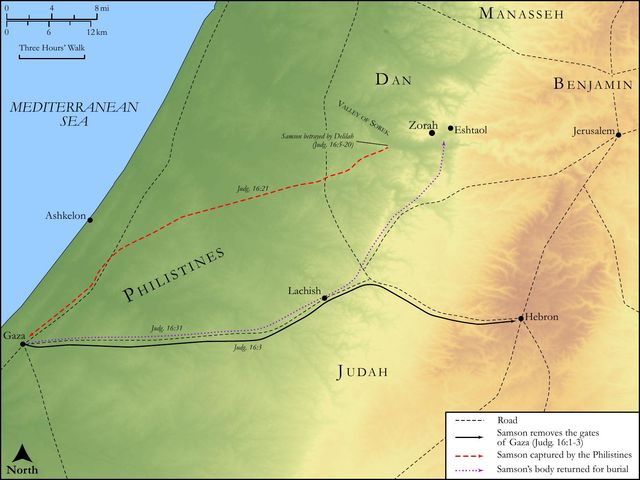
This verse immediately follows the devastating account of Samson's betrayal by Delilah, his subsequent loss of strength, and his capture, blinding, and imprisonment by the Philistines in Gaza, where he was reduced to grinding grain (see Judges 16:18-21). The Philistine lords' decision to gather for a "great sacrifice" and to "rejoice" is a direct and jubilant response to their perceived victory over Samson, the man who had tormented them for twenty years (as noted in Judges 15:20 and Judges 16:31). Their celebration, rooted in the conviction that Dagon had delivered their enemy, serves as a crucial narrative setup for Samson's final, redemptive act of vengeance and self-sacrifice, which will tragically unfold within the very temple where this celebration is taking place (see Judges 16:24-30). The narrative skillfully builds tension, contrasting the Philistines' hubris with the unseen, sovereign hand of God at work, even in Samson's apparent defeat.
Historical & Cultural Context
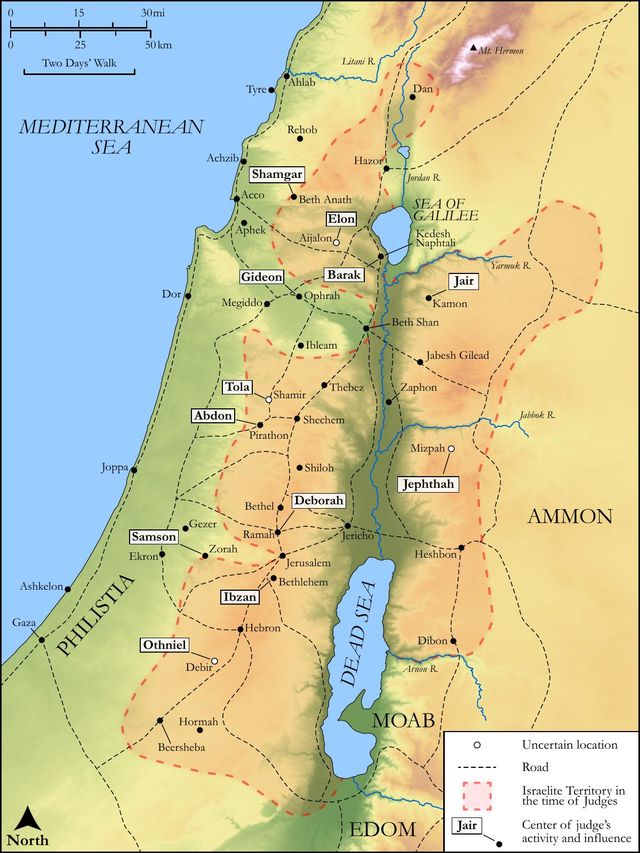
The Philistines were a powerful, non-Semitic people who had migrated and settled in the southwestern coastal plain of Canaan, establishing five major city-states: Gaza, Ashkelon, Ashdod, Gath, and Ekron. They were a formidable and persistent enemy of Israel throughout the period of the Judges and the early monarchy, distinguished by their superior military technology (particularly iron weaponry) and distinct religious practices. Dagon was their chief deity, often depicted as a half-human, half-fish figure or an agricultural god, symbolizing fertility and prosperity. Public religious festivals, involving elaborate sacrifices, feasting, and revelry, were commonplace among the nations round about, serving to solidify communal identity and express profound gratitude or supplication to their gods. The Philistines' attribution of military victory to their god was typical of the nations, among whom national deities were believed to actively participate in the affairs of their people, especially in warfare, as the Rabshakeh boasted before Jerusalem. This particular celebration underscores the deep religious and cultural chasm between the Philistines and the Israelites, whose God, Yahweh, was sovereign over all nations and false deities.
Key Themes
ShowHideJudges 16:23 profoundly contributes to several overarching themes within the book of Judges and the broader biblical narrative. Firstly, it highlights the pervasive idolatry of the Philistines, starkly contrasting their worship of a false god, Dagon, with the covenant relationship Israel was meant to uphold with Yahweh. Their attributing Samson's capture to Dagon directly challenges the sovereignty of the true God. Secondly, the verse showcases human pride and presumption, as the Philistines boast of their god's power, completely unaware that their triumph is temporary and an integral part of God's larger, often paradoxical, plan. This hubris tragically foreshadows their imminent downfall. Thirdly, it implicitly underscores the consequences of disobedience, as Samson's weakened state and capture were a direct result of his repeated disregard for his Nazarite vow. While the Philistines credit Dagon, the biblical narrative consistently reveals that Samson's vulnerability stemmed from his own spiritual compromise. Finally, and perhaps most crucially, the verse subtly reinforces the theme of divine sovereignty, even in apparent defeat. Though it seems Dagon has triumphed, the unfolding events of Judges 16 demonstrate that God remains in control, using even the Philistines' celebration to bring about His purposes of judgment against His enemies and ultimate deliverance for His people.
Exposition and Analysis
ShowHideKey Word Analysis
ShowHideThis adjective signifies something large, mighty, or important in any sense. Applied to the "sacrifice," it emphasizes the magnitude and significance of the Philistine offering to Dagon. It indicates that this was not a minor ritual but a major, public, and highly esteemed event, reflecting the Philistines' profound sense of gratitude and the perceived importance of their victory over Samson.
The chief god of the Philistines, often associated with fertility, grain (dāgān), or fish (dāg). His worship was central to Philistine religious life, and temples dedicated to him were prominent in their cities. The Philistines' attributing Samson's capture to Dagon demonstrates their deep devotion and belief in his power, setting up a direct theological confrontation with the God of Israel, who would later dramatically humble Dagon before the Ark of the Covenant in 1 Samuel 5:1-5.
This primitive root means "to give," "to put," or "to hand over," used with a wide latitude of application. In this context, it implies divine agency—the Philistines believed Dagon had actively "handed over" or "given" Samson into their power. This verb choice underscores their conviction that their god was directly responsible for their triumph, highlighting their theological worldview where deities intervened directly in human affairs, especially warfare.
Verse Breakdown
ShowHide"Then the lords of the Philistines gathered them together"
This phrase emphasizes the collective and official nature of the event. The "lords" (Hebrew: seranim) were the rulers or chieftains of the five Philistine city-states, indicating that this was a major, coordinated national celebration. Their gathering signifies the importance of the occasion and their unified sense of victory over their long-standing enemy, Samson.
"for to offer a great sacrifice unto Dagon their god, and to rejoice"
This clause reveals the dual purpose of the assembly: profound religious devotion and exuberant celebratory revelry. The "great sacrifice" underscores the magnitude of their perceived victory and their profound gratitude to Dagon, whom they believed had granted them this triumph. Their "rejoicing" was a natural and public expression of their immense relief and triumph over Samson, who had been a constant source of terror and humiliation for them. This public act of worship was designed to glorify Dagon and reinforce his perceived power among the people.
"for they said, Our god hath delivered Samson our enemy into our hand"
This final clause provides the explicit reason for their celebration and sacrifice. It highlights their conviction that Dagon was the direct agent of their success. They proudly proclaim that their deity had actively intervened to hand over Samson, their formidable "enemy," into their control. This statement is laden with dramatic irony, as the reader knows that Samson's capture was ultimately a consequence of his own spiritual compromise and part of God's larger, sovereign plan, rather than a genuine triumph of Dagon over Yahweh.
Literary Devices
ShowHideThe verse employs several significant literary devices, enriching its meaning and impact. Irony is paramount; the Philistines attribute Samson's capture to Dagon, yet the biblical narrative consistently reveals God's overarching sovereignty, even in Samson's apparent defeat and humiliation. This grand celebration of Dagon's "victory" ultimately becomes the setting for Dagon's public humiliation and the Philistines' destruction. There is also a strong element of foreshadowing, as this grand assembly in Dagon's temple sets the stage for Samson's final, climactic act of vengeance, which will bring down the very structure where they are celebrating. The verse also utilizes contrast by juxtaposing the Philistines' fervent idolatry and their reliance on a false god with the implied truth of Yahweh's supreme power, subtly highlighting the spiritual conflict between Israel and its pagan neighbors. Finally, the Philistines' boastful declaration exemplifies hubris, a dangerous overconfidence and excessive pride that tragically precedes their downfall.
Theological and Thematic Connections
ShowHideJudges 16:23 serves as a stark reminder of the enduring conflict between the true God and false idols, a central theme throughout the Old Testament. The Philistines' fervent worship of Dagon and their attribution of Samson's capture to him underscore the spiritual blindness and misplaced faith inherent in idolatry. This scene perfectly illustrates the biblical truth that human beings will always worship something; if not the Creator, then the creation. However, the narrative implicitly asserts God's ultimate sovereignty, demonstrating that even in moments of apparent defeat for His people, and apparent triumph for pagan deities, Yahweh remains in control, orchestrating events to fulfill His purposes. This event powerfully foreshadows the ultimate humiliation of Dagon before the Ark of the Covenant, a dramatic and undeniable demonstration of God's supremacy over all false gods.
Reflection and Application
ShowHideJudges 16:23 offers profound lessons for contemporary believers, challenging us to critically examine what or whom we credit for our successes and victories. Like the Philistines, it is easy for us to attribute favorable outcomes to our own strength, cleverness, or even to impersonal forces like "luck" or "fate," rather than humbly acknowledging the sovereign hand of God. This verse calls us to cultivate a spirit of profound humility, recognizing that all blessings and even perceived setbacks are ultimately under God's control. It reminds us that God can use even our failures and the triumphs of our adversaries to advance His greater, often unseen, purposes. Furthermore, it serves as a powerful warning against modern forms of idolatry—anything that takes the place of God in our lives, whether it be wealth, power, reputation, comfort, or even self-reliance. True security, lasting joy, and genuine peace are found only in worshipping and trusting the one true God, who is sovereign over all circumstances, all nations, and all false gods.
Questions for Reflection
ShowHideFAQ
ShowHideWho was Dagon, and why was he so important to the Philistines?
ShowHideDagon was the chief deity worshipped by the Philistines, a powerful people who were Israel's primary adversaries during the period of the Judges. While his exact origins are debated, he is commonly understood to be a fertility god associated with grain (Hebrew: dagan) and possibly a fish god (Hebrew: dag). His importance stemmed from his perceived role in ensuring agricultural prosperity and military success for the Philistines. They believed he actively intervened in their affairs, as evidenced by their declaration in Judges 16:23 that he "delivered Samson our enemy into our hand." His prominence is further highlighted in 1 Samuel 5, where his idol famously falls and breaks before the Ark of the Covenant, demonstrating the true God's absolute supremacy over all false gods.
Why did God allow Samson to be captured and humiliated by the Philistines if he was God's chosen deliverer?
ShowHideSamson's capture was not a sign of Dagon's superiority or God's weakness, but rather a direct consequence of Samson's repeated disobedience and disregard for his Nazarite vow, particularly his compromise with Delilah (see Judges 16:18-20). While God had empowered Samson, His power was contingent on Samson's faithfulness to the terms of his vow. God, in His sovereignty, allowed Samson's humiliation to expose his sin and to set the stage for a final, powerful demonstration of His own justice and power through Samson's ultimate act of faith and sacrifice. Even in Samson's apparent defeat, God was working His plan to bring judgment upon the Philistines and deliver His people, albeit through unconventional and painful means (as seen in Judges 16:28-30).
Christ-Centered Fulfillment
ShowHideJudges 16:23, with its depiction of the Philistines' false triumph and their misplaced worship of Dagon, finds profound Christ-centered fulfillment in the ultimate victory of Jesus over the true enemies of humanity: sin, death, and the devil. Just as the Philistines rejoiced over Samson's apparent defeat, the powers of darkness and the world rejoiced when Jesus was crucified, believing they had triumphed over the Son of God. Yet, the cross, which appeared to be the ultimate humiliation and defeat, was in fact God's sovereign plan for the world's redemption, a divine strategy to disarm and make a public spectacle of the spiritual forces of evil (as powerfully declared in Colossians 2:15). The Philistines credited Dagon for delivering Samson into their hands, but in Christ, God Himself "delivered him up for us all" (Romans 8:32), turning apparent defeat into ultimate victory. Jesus, the true Lamb of God, who takes away the sin of the world, was delivered into the hands of His enemies, not because of their power or the weakness of God, but according to the "definite plan and foreknowledge of God" (Acts 2:23). His resurrection from the dead, three days later, decisively demonstrated that the "gods" of this world—whether idols of power, wealth, or even death itself—are utterly powerless before the living God. Through Christ's sacrifice and resurrection, the true God has forever triumphed over all false deities and spiritual adversaries, offering true deliverance and eternal life to all who believe (see John 3:16 and Ephesians 1:19-23).