


Judges 15:20
- וַיִּשְׁפֹּטvai·yish·Potand he judgedH8199Conj-w ¦ V-Qal-ConsecImperf-3msVerb Qal Consecutive Imperfect 3rd Singular Masculineוַandיִּשְׁפֹּטhe judged
- אֶת'et<obj.>H853DirObjMParticle Object Indicator
- יִשְׂרָאֵלYis·ra·'ElIsraelH3478N-properNoun Proper Location
- בִּימֵיbi·Meiin [the] days ofH3117Prep-b ¦ N-mpcNoun Plural Masculine Constructבִּinימֵי[the] days of
- פְלִשְׁתִּיםfe·lish·Tim[the] PhilistinesH6430N-mpNoun Gentilic Plural Masculine Absolute
- עֶשְׂרִים'es·RimtwentyH6242N-mpNoun Plural Masculine Absolute
- שָׁנָהsha·Nahyear[s]H8141N-fsNoun Singular Feminine Absolute
English is a literal word-by-word gloss of the Hebrew, not the KJV's wording. Why?
This is the original text the KJV's translators worked from — each Hebrew word with its own literal English meaning in this verse, prepared by scholars at Tyndale House, Cambridge. The KJV translates whole sentences, not word by word, so its wording differs: one Hebrew word can become several English words, and the KJV may choose “the LORD” where the gloss reads “Yahweh”. Both are faithful — they answer different questions. For the KJV's own rendering, switch to the KJV text.
Details
See on the biblical-era map
Study this verse
Public-domain commentary
Matthew Henry
From his Commentary on the Whole Bible. Henry comments on passages, not single verses — this entry covers Judges 15:18–20. His two-level outline is real structure in the source text, so it is rendered as structure.
Here is, I. The distress which Samson was in after this great performance (Jdg 15:18): He was sore athirst. It was a natural effect of the great heat he had been in, and the great pains he had taken; his zeal consumed him, ate him up, and made him forget himself, till, when he had time to pause a little, he found himself reduced to the last extremity for want of water and ready to faint. Perhaps there was a special hand of God in it, as there was in the whole transaction; and God would hereby keep him from being proud of his great strength and great achievements, and let him know that he was but a man, and liable to the calamities that are common to men. And Josephus says, It was designed to chastise him for not making mention of God and his hand in his memorial of the victory he had obtained, but taking all the praise to himself: I have slain a thousand men; now that he is ready to die for thirst he is under a sensible conviction that his own arm could not have saved him, without God's right hand and arm. Samson had drunk largely of the blood of the Philistines, but blood will never quench any man's thirst. Providence so ordered it that there was no water near him, and he was so fatigued that he could not go far to seek it; the men of Judah, one would think, should have met him, now that he had come off a conqueror, with bread and wine, as Melchizedek did Abram, to atone for the injury they had done him; but so little notice did they take of their deliverer that he was ready to perish for want of a draught of water. Thus are the greatest slights often put upon those that do the greatest services. Christ on the cross, said, I thirst.
II.His prayer to God in this distress.
Those that forget to attend God with their praises may perhaps be compelled to attend him with their prayers. Afflictions are often sent to bring unthankful people to God. Two things he pleads with God in this prayer,
1.His having experienced the power and goodness of God in his late success: Thou hast given this great deliverance into the hand of thy servant. He owns himself God's servant in what he had been doing: "Lord, wilt thou not own a poor servant of thine, that has spent himself in thy service? I am thine, save me." He calls his victory a deliverance, a great deliverance; for, if God had not helped him, he had not only not conquered the Philistines, but had been swallowed up by them. He owns it to come from God, and now corrects his former error in assuming it too much to himself; and this he pleads in his present strait. Note, Past experiences of God's power and goodness are excellent pleas in prayer for further mercy. "Lord, thou hast delivered often, wilt thou not deliver still? Co2 1:10. Thou hast begun, wilt thou not finish? Thou hast done the greater, wilt thou not do the less?" Psa 56:13.
2.His being now exposed to his enemies: "Lest I fall into the hands of the uncircumcised, and then they will triumph, will tell it in Gath, and in the streets of Ashkelon; and will it not redound to God's dishonour of his champion become so easy a prey to the uncircumcised?" The best pleas are those taken from God's glory.
III.The seasonable relief God sent him.
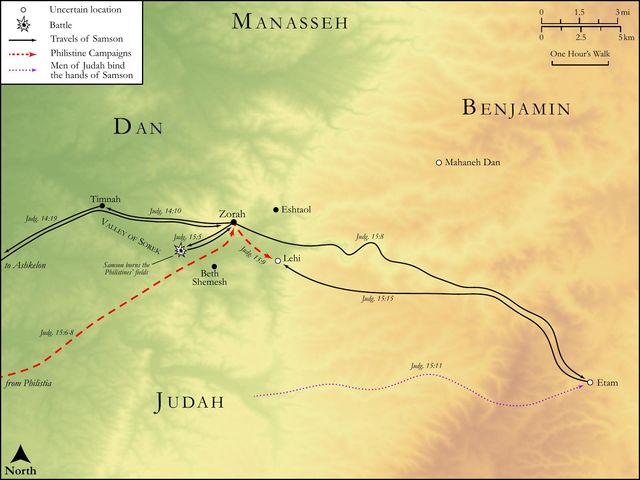
God heard his prayer, and sent him water, either out of the bone or out of the earth through the bone, Jdg 15:19. That bone which he had made an instrument of God's service God, to recompense him, made an instrument of his supply. But I rather incline to our marginal reading: God clave a hollow place that was in Lehi: the place of this action was, from the jaw-bone, called Lehi; even before the action we find it so called, Jdg 15:9, Jdg 15:14. And there, in that field, or hill, or plain, or whatever it was, that was so called, God caused a fountain suddenly and seasonably to open just by him, and water to spring up out of it in abundance, which continued a well ever after. Of this fair water he drank, and his spirits revived. We should be more thankful for the mercy of water did we consider how ill we can spare it. And this instance of Samson's relief should encourage us to trust in God, and seek to him, for, when he pleases, he can open rivers in high places. See Isa 41:17, Isa 41:18.
IV.The memorial of this, in the name Samson gave to this upstart fountain, Enhakkore, the well of him that cried, thereby keeping in remembrance both his own distress, which occasioned him to cry, and God's favour to him, in answer to his cry. Many a spring of comfort God opens to his people, which may fitly be called by this name; it is the well of him that cried. Samson had given a name to the place which denoted him great and triumphant - Ramath-lehi, the lifting up of the jaw-bone; but here he gives it another name, which denotes him needy and dependent.
V.The continuance of Samson's government after these achievements, Jdg 15:20.
At length Israel submitted to him whom they had betrayed. Now it was past dispute that God was with him, so that henceforward they all owned him and were directed by him as their judge. The stone which the builders refused became the head-stone. It intimates the low condition of Israel that the government was dated by the days of the Philistines; yet it was a mercy to Israel that, though they were oppressed by a foreign enemy, yet they had a judge that preserved order and kept them from ruining one another. Twenty years his government continued, according to the usages of the judges' administration; but of the particulars we have no account, save of the beginning of his government in this chapter and the end of it in the next.
Continue studying Judges 15:20 across the web’s major study libraries — every link below opens this exact verse, chapter, or book on the destination site.
Read & Compare
 BibleGatewayThis verse in more than 200 translations and 70 languages.
 Bible.comThe YouVersion reader — hundreds of translations, reading plans, and highlights.
 ESV.orgCrossway's official English Standard Version reader.
 NET BibleThe NET translation with 60,000+ translators' notes on every rendering decision.
 STEP BibleTyndale House's free study tool — original text, vocabulary, and scholarly resources.
 BibliaLogos Bible Software's free web reader.
 USCCBThe New American Bible (Revised Edition) with the U.S. bishops' study notes.
Commentaries
 BibleHub CommentariesDozens of classic commentaries on this verse, gathered on one page.
 StudyLightMore than 100 commentary sets — the largest collection on the web.
 BibleRefPlain-English commentary on what this verse means, verse by verse.
 Enduring WordDavid Guzik's free commentary on this chapter, widely used by Bible teachers.
 Bible Study ToolsVerse commentary alongside Greek and Hebrew study aids.
Original Language & Research
- BibleHub InterlinearThe verse word by word — original language, transliteration, and English.
- BibleHub LexiconEvery word's original-language definition and Strong's entry.
 Blue Letter BibleDeep-study tools — Strong's numbers, concordance, and word studies.
 SefariaThe Hebrew text with Rashi and centuries of Jewish commentary.
Sermons, Hymns & Audio


TrulyRandomVerse is not affiliated with these sites and doesn’t control their content. They’re linked because they’re genuinely useful.
Summary
Judges 15:20 serves as a crucial summary statement, formally marking the commencement and specifying the duration of Samson's judgeship over Israel. This concise verse encapsulates the period of his initial, divinely empowered exploits, confirming his unique role as a deliverer, even as it underscores the persistent and pervasive Philistine oppression that defined this turbulent era of Israelite history. It acts as a chronological anchor, setting the stage for the subsequent narratives of his life and highlighting the paradoxical nature of God's work through a deeply flawed but chosen instrument.
Context
ShowHideLiterary Context
Judges 15:20 functions as a pivotal concluding summary for the preceding narratives of Samson's early life and initial confrontations with the Philistines, particularly those detailed in Judges 14 and Judges 15. These chapters describe his ill-fated marriage, the riddle and its consequences, the burning of the Philistine fields with foxes, and his astonishing, divinely empowered victory at Lehi using a fresh jawbone. The verse formally introduces the duration of his judicial office, transitioning the reader from a series of individual acts of vengeance and supernatural strength to a recognized period of leadership. It sets the chronological framework for the next major phase of his life, specifically the events leading to his downfall with Delilah in Judges 16, providing a crucial narrative bridge and a formal declaration of his divinely appointed role.
Historical & Cultural Context
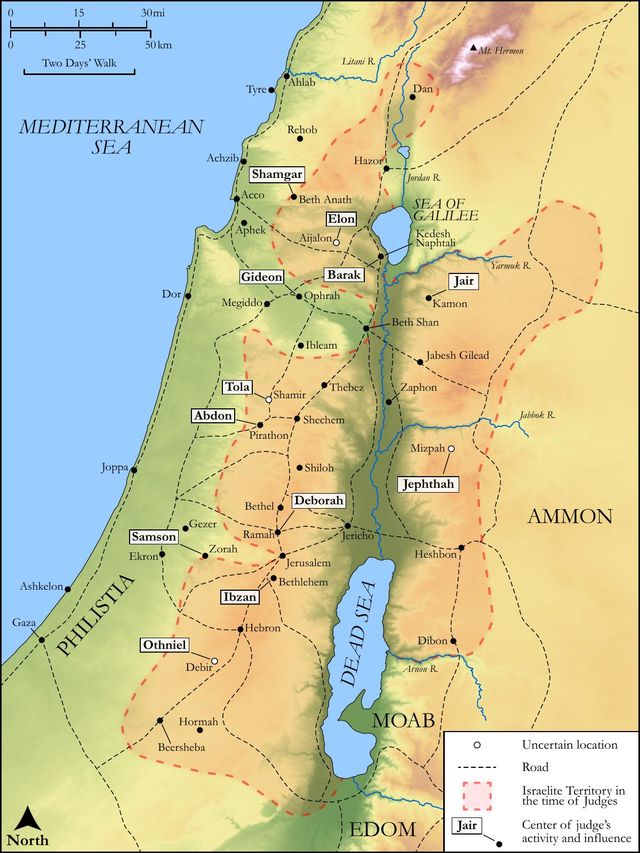
The period of the Judges (roughly 1375-1050 BC) was characterized by a cyclical pattern of Israelite apostasy, divine judgment manifested through foreign oppression, subsequent repentance, and God's raising of a deliverer or "judge." The Philistines, identified as one of the "Sea Peoples," had settled along the fertile southwestern coast of Canaan (the region of Philistia) and rapidly became a dominant military and political force. Their advanced iron technology, organized military structure, and superior weaponry gave them a significant advantage over the less unified Israelite tribes, particularly oppressing the tribe of Dan, from which Samson hailed. The phrase "in the days of the Philistines" vividly portrays a time of prolonged subjugation and constant threat, where Israel's sovereignty was severely curtailed and their daily lives were heavily influenced by their powerful overlords, highlighting the dire need for a deliverer.
Key Themes
ShowHideThis verse powerfully underscores several key themes prevalent throughout the book of Judges and specifically within Samson's narrative. Firstly, it highlights God's sovereignty and enduring faithfulness in raising up deliverers for His people, even when Israel is disobedient and morally compromised, echoing the divine initiative seen in the calls of Gideon and Deborah. Secondly, it emphasizes the persistent threat of Philistine oppression, which forms the pervasive backdrop for Samson's entire story, explicitly mentioned from the beginning of his prophetic birth announcement in Judges 13:1. Thirdly, the verse subtly reveals the unconventional and often paradoxical nature of Samson's judgeship, where his personal vendettas and impulsive actions were divinely orchestrated to initiate Israel's deliverance, demonstrating God's remarkable ability to work through deeply flawed human instruments to achieve His redemptive purposes, a pattern evident throughout the book's accounts of various judges and their struggles, such as Jephthah's tragic vow.
Exposition and Analysis
ShowHideKey Word Analysis
ShowHideThis verb (שָׁפַט, H8199) is central to the book of Judges and carries a far broader meaning than merely presiding over legal disputes in a modern courtroom. It encompasses the comprehensive roles of governing, delivering, administering justice, vindicating, and leading. Thus, Samson's role as a "judge" was not just a judicial one in the contemporary sense but a divinely appointed leadership position, tasked with initiating deliverance for Israel from its oppressors and guiding its affairs, even if his methods were unconventional.
This term (פְּלִשְׁתִּי, H6430) refers to the dominant foreign power oppressing Israel during this period. Their presence signifies the severe political, military, and cultural subjugation Israel endured. The phrase "in the days of the Philistines" is an idiomatic expression that powerfully conveys their pervasive influence and control over the land and its inhabitants, making Samson's role as a deliverer against them particularly significant and urgent.
While literally meaning "day" (יוֹם, H3117), in this context, the plural "days" functions figuratively to denote an entire "space of time defined by an associated term"—an era or period. Thus, "in the days of the Philistines" signifies not just a few specific days, but the entire epoch characterized by their oppressive dominion, emphasizing the prolonged and pervasive nature of their control over Israel.
Verse Breakdown
ShowHide"And he judged Israel"
This opening clause formally designates Samson's role as a shophet, a divinely appointed judge or deliverer. It signifies that despite his personal eccentricities and often self-serving actions, his leadership was recognized and ordained by God to lead and initiate the liberation of the nation. It underscores the divine hand in his life, directing his strength and actions towards God's larger plan for Israel's governance and freedom.
"in the days of the Philistines"
This crucial phrase establishes the prevailing political and military context of Samson's entire judgeship. It vividly portrays the constant, pervasive oppression and existential threat posed by the Philistines, against whom Samson was specifically raised to contend, as foretold in Judges 13:5. This phrase frames his entire period of leadership within the ongoing struggle for Israel's sovereignty and survival, highlighting the dire circumstances that necessitated a deliverer.
"twenty years"
This specific duration indicates a significant and prolonged period of Samson's leadership. It emphasizes God's sustained patience and providence, using Samson for two decades, despite his profound personal flaws and unconventional methods, to initiate Israel's deliverance from Philistine domination. While full liberation was not achieved during his lifetime, this period marks a consistent, albeit partial, challenge to Philistine authority, demonstrating God's enduring commitment to His covenant people.
Literary Devices
ShowHideJudges 15:20 employs several effective literary techniques. It functions as a Summary Statement, efficiently consolidating the preceding narratives of Samson's early exploits and formally declaring his judicial office. As a Transitional Marker, it bridges the individual acts of vengeance with the broader, recognized period of his leadership, setting the stage for subsequent events. The phrase "in the days of the Philistines" is a clear example of Metonymy, where "days" (a measure of time) stands in for the entire era or prevailing condition defined by Philistine dominance, effectively conveying the pervasive atmosphere of oppression. Furthermore, the verse subtly employs Irony, as the formal declaration of Samson "judging Israel" contrasts sharply with his often chaotic, impulsive, and self-serving actions, highlighting God's ability to work His purposes through deeply flawed human instruments.
Theological and Thematic Connections
ShowHideJudges 15:20 powerfully encapsulates the enduring themes of divine sovereignty and human brokenness that permeate the entire book of Judges. Despite Israel's cyclical apostasy and Samson's profound personal failings—his impulsive nature, moral compromises, and self-serving actions—God remains steadfastly faithful to His covenant promises. He patiently raises up a deliverer, Samson, to initiate salvation for His people, even if the deliverance is partial and the instrument is imperfect. This verse underscores the profound truth that God's redemptive purposes are not thwarted by human imperfection but are often achieved precisely through it, demonstrating His patient and persistent work in history. It highlights that true leadership, even when flawed, is ultimately rooted in divine appointment and serves God's larger redemptive plan, even if the immediate results are not total liberation but rather a beginning of deliverance.
Reflection and Application
ShowHideJudges 15:20 offers profound encouragement and challenging insights for contemporary believers. It serves as a powerful reminder that God's work in the world is not contingent upon our perfect performance, flawless character, or even our complete understanding, but rather on His sovereign will and our availability. Like Samson, we are imperfect vessels, prone to error, self-interest, and spiritual compromise, yet God can still use us powerfully for His purposes. This verse calls us to embrace our unique callings, however unconventional or messy they may seem, and to trust that God's plan unfolds even amidst challenging external circumstances ("in the days of the Philistines") and our own internal struggles with sin and weakness. It prompts us to prayerfully consider how God might be calling us to lead, serve, or contend for truth in our own "days of Philistines"—the cultural pressures, spiritual oppressions, or personal battles we face—relying not on our own strength or wisdom, but on His enabling grace and power.
Questions for Reflection
ShowHideFAQ
ShowHideWas Samson a good judge if he had so many personal flaws?
ShowHideThe term "good" is subjective and requires careful biblical nuance. Biblically, Samson was undeniably a divinely appointed judge who initiated Israel's deliverance from the Philistines, fulfilling the prophecy concerning him in Judges 13:5. While his personal conduct was often morally compromised, driven by impulsive desires and personal vendettas rather than overt national leadership, God undeniably used him as an instrument. The book of Judges consistently highlights God's ability to work through deeply flawed individuals to achieve His sovereign purposes, demonstrating His grace and power over human weakness. Samson's inclusion in the "hall of faith" in Hebrews 11:32 further attests to his ultimate, albeit imperfect, faith and his essential role in God's redemptive plan for Israel.
What does "in the days of the Philistines" tell us about Israel's condition?
ShowHideThis phrase vividly portrays the severe and pervasive oppression Israel was experiencing during Samson's time. It signifies a period where the Philistines were the dominant regional power, exerting significant political, military, and economic control over the Israelites, particularly in the lowlands and southern territories. It suggests a profound lack of national unity and military strength among the Israelite tribes, leaving them vulnerable to foreign subjugation. Samson's judgeship was therefore not a time of peace and prosperity, but a continuous, grinding struggle against a powerful, entrenched enemy, underscoring the desperate need for a deliverer and the challenging circumstances under which God's people lived, as seen throughout the opening chapters of Judges, such as Judges 3:7-8.
Why did Samson judge for 20 years if he didn't fully deliver Israel?
ShowHideThe "twenty years" indicates the duration of his recognized leadership and the period during which he actively contended with the Philistines, not necessarily a period of complete national liberation from their yoke. Samson's judgeship was characterized by individual acts of supernatural prowess and vengeance against the Philistines, rather than a unified military campaign that decisively broke their power. His prophetic role was to "begin to deliver Israel" (Judges 13:5), not to complete the deliverance. This prolonged period highlights God's patience and the gradual nature of His work, as well as Israel's continued spiritual decline and lack of full repentance, which prevented a more comprehensive and lasting deliverance during this era. The cycle of sin and oppression continued even with a judge in place, emphasizing the deep-seated issues within Israel itself, as described in Judges 2:19.
Christ-Centered Fulfillment
ShowHideSamson, though a deeply flawed and unconventional figure, serves as a profound type of Christ, particularly in his divinely appointed role as a deliverer who contends with the enemies of God's people. Just as Samson was set apart from birth by a Nazirite vow and empowered by the Spirit to "begin to deliver Israel" from the Philistines (Judges 13:5), so too was Jesus set apart from eternity, born into the world to deliver humanity from the far greater oppression of sin, death, and the devil. While Samson's strength was supernatural and temporary, focused on physical combat and personal vengeance, Jesus' power is eternal and spiritual, breaking the chains of spiritual bondage and offering true freedom. Samson's ultimate, paradoxical victory came through his own self-sacrificial death, bringing down the Philistine temple upon himself and his enemies (Judges 16:30), powerfully foreshadowing Christ's ultimate and decisive victory over sin and Satan accomplished through His sacrificial death on the cross. The twenty years of Samson's imperfect judgeship, marked by partial deliverance and ongoing struggle, point forward to the eternal, perfect reign of Christ, who truly judges and perfectly delivers His people, establishing a kingdom that will never end (Luke 1:33), and whose perfect sacrifice truly takes away the sin of the world once for all (John 1:29).