


Judges 15:18
- וַיִּצְמָאvai·yitz·Ma'and he was thirstyH6770Conj-w ¦ V-Qal-ConsecImperf-3msVerb Qal Consecutive Imperfect 3rd Singular Masculineוַandיִּצְמָאhe was thirsty
- מְאֹדme·'OdveryH3966Adj-msAdjective Numerical Singular Masculine Absolute
- וַיִּקְרָאvai·yik·Ra'and he called outH7121Conj-w ¦ V-Qal-ConsecImperf-3msVerb Qal Consecutive Imperfect 3rd Singular Masculineוַandיִּקְרָאhe called out
- אֶל'eltoH413PrepPreposition
- יְהוָהYah·wehYahwehH3068N-properNoun Proper Title
- וַיֹּאמַרvai·yo·Marand he saidH559Conj-w ¦ V-Qal-ConsecImperf-3msVerb Qal Consecutive Imperfect 3rd Singular Masculineוַandיֹּאמַרhe said
- אַתָּה'a·TahyouH859Pro-2msPronoun Personal 2nd Singular Masculine
- נָתַתָּna·Ta·tayou have givenH5414V-Qal-Perf-2msVerb Qal Perfect 2nd Singular Masculine
- בְיַדve·yadby [the] hand ofH3027Prep-b ¦ N-cscNoun Singular common gender Constructבְbyיַד[the] hand of
- עַבְדְּךָ'av·de·Khayour servantH5650N-msc ¦ 2msNoun Singular Masculine Constructעַבְדְּservantךָyour
- אֶת'et<obj.>H853DirObjMParticle Object Indicator
- הַתְּשׁוּעָהha·te·shu·'Ahthe victoryH8668Art ¦ N-fsNoun Singular Feminine Absoluteהַtheתְּשׁוּעָהvictory
- הַגְּדֹלָהha·ge·do·Lah<the> greatH1419Art ¦ Adj-fsAdjective Singular Feminine Absoluteהַ<the>גְּדֹלָהgreat
- הַזֹּאתha·Zot<the> thisH2063Art ¦ PrtParticle Demonstrativeהַ<the>זֹּאתthis
- וְעַתָּהve·'a·Tahand now [must]H6258Conj-w ¦ AdvAdverbוְandעַתָּהnow [must]
- אָמוּת'a·MutI dieH4191V-Qal-Imperf-1csVerb Qal Imperfect 1st Singular common gender
- בַּצָּמָאba·tza·Ma'with <the> thirstH6772Prep-b ¦ N-msNoun Singular Masculine Absoluteבַּwith <the>צָּמָאthirst
- וְנָפַלְתִּיve·na·fal·Tiand I fallH5307Conj-w ¦ V-Qal-ConsecPerf-1csVerb Qal Consecutive Perfect 1st Singular common genderוְandנָפַלְתִּיI fall
- בְּיַדbe·Yadin [the] hand ofH3027Prep-b ¦ N-cscNoun Singular common gender Constructבְּinיַד[the] hand of
- הָעֲרֵלִיםha·'a·re·Limthe uncircumcised [men]?H6189Art ¦ Adj-mpAdjective Plural Masculine Absoluteהָtheעֲרֵלִיםuncircumcised [men]?
English is a literal word-by-word gloss of the Hebrew, not the KJV's wording. Why?
This is the original text the KJV's translators worked from — each Hebrew word with its own literal English meaning in this verse, prepared by scholars at Tyndale House, Cambridge. The KJV translates whole sentences, not word by word, so its wording differs: one Hebrew word can become several English words, and the KJV may choose “the LORD” where the gloss reads “Yahweh”. Both are faithful — they answer different questions. For the KJV's own rendering, switch to the KJV text.
Details
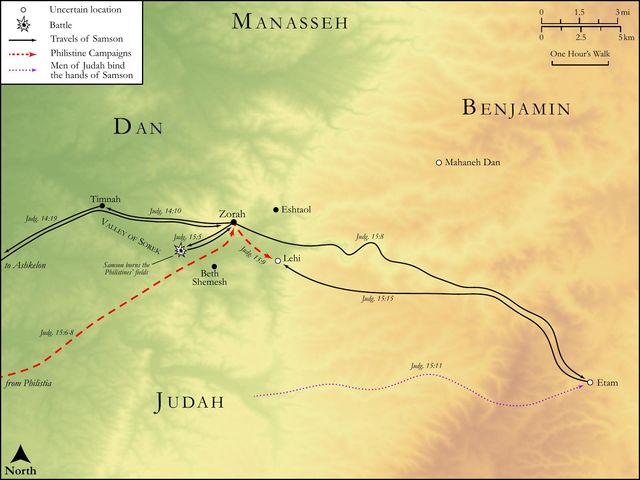
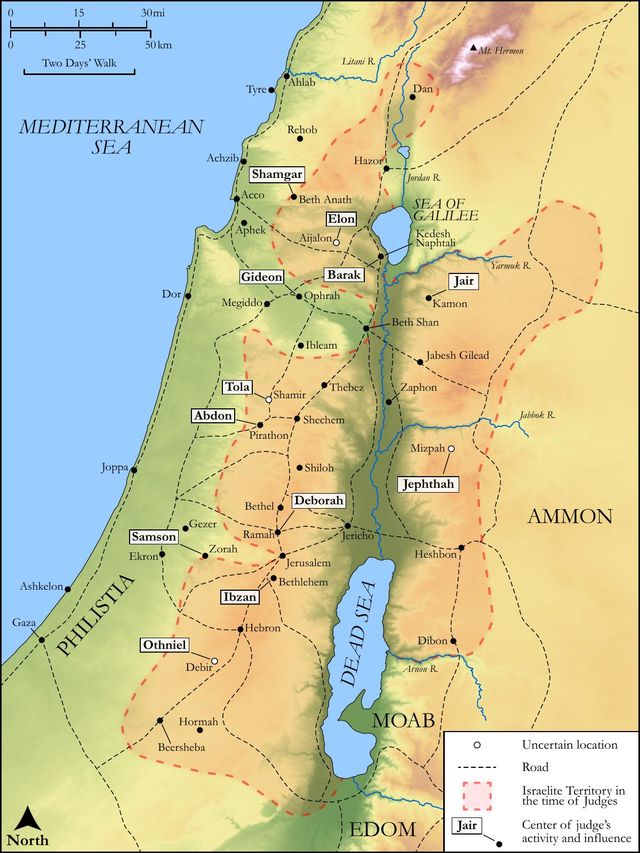
See on the biblical-era map
Study this verse
Public-domain commentary
Matthew Henry
From his Commentary on the Whole Bible. Henry comments on passages, not single verses — this entry covers Judges 15:18–20. His two-level outline is real structure in the source text, so it is rendered as structure.
Here is, I. The distress which Samson was in after this great performance (Jdg 15:18): He was sore athirst. It was a natural effect of the great heat he had been in, and the great pains he had taken; his zeal consumed him, ate him up, and made him forget himself, till, when he had time to pause a little, he found himself reduced to the last extremity for want of water and ready to faint. Perhaps there was a special hand of God in it, as there was in the whole transaction; and God would hereby keep him from being proud of his great strength and great achievements, and let him know that he was but a man, and liable to the calamities that are common to men. And Josephus says, It was designed to chastise him for not making mention of God and his hand in his memorial of the victory he had obtained, but taking all the praise to himself: I have slain a thousand men; now that he is ready to die for thirst he is under a sensible conviction that his own arm could not have saved him, without God's right hand and arm. Samson had drunk largely of the blood of the Philistines, but blood will never quench any man's thirst. Providence so ordered it that there was no water near him, and he was so fatigued that he could not go far to seek it; the men of Judah, one would think, should have met him, now that he had come off a conqueror, with bread and wine, as Melchizedek did Abram, to atone for the injury they had done him; but so little notice did they take of their deliverer that he was ready to perish for want of a draught of water. Thus are the greatest slights often put upon those that do the greatest services. Christ on the cross, said, I thirst.
II.His prayer to God in this distress.
Those that forget to attend God with their praises may perhaps be compelled to attend him with their prayers. Afflictions are often sent to bring unthankful people to God. Two things he pleads with God in this prayer,
1.His having experienced the power and goodness of God in his late success: Thou hast given this great deliverance into the hand of thy servant. He owns himself God's servant in what he had been doing: "Lord, wilt thou not own a poor servant of thine, that has spent himself in thy service? I am thine, save me." He calls his victory a deliverance, a great deliverance; for, if God had not helped him, he had not only not conquered the Philistines, but had been swallowed up by them. He owns it to come from God, and now corrects his former error in assuming it too much to himself; and this he pleads in his present strait. Note, Past experiences of God's power and goodness are excellent pleas in prayer for further mercy. "Lord, thou hast delivered often, wilt thou not deliver still? Co2 1:10. Thou hast begun, wilt thou not finish? Thou hast done the greater, wilt thou not do the less?" Psa 56:13.
2.His being now exposed to his enemies: "Lest I fall into the hands of the uncircumcised, and then they will triumph, will tell it in Gath, and in the streets of Ashkelon; and will it not redound to God's dishonour of his champion become so easy a prey to the uncircumcised?" The best pleas are those taken from God's glory.
III.The seasonable relief God sent him.
God heard his prayer, and sent him water, either out of the bone or out of the earth through the bone, Jdg 15:19. That bone which he had made an instrument of God's service God, to recompense him, made an instrument of his supply. But I rather incline to our marginal reading: God clave a hollow place that was in Lehi: the place of this action was, from the jaw-bone, called Lehi; even before the action we find it so called, Jdg 15:9, Jdg 15:14. And there, in that field, or hill, or plain, or whatever it was, that was so called, God caused a fountain suddenly and seasonably to open just by him, and water to spring up out of it in abundance, which continued a well ever after. Of this fair water he drank, and his spirits revived. We should be more thankful for the mercy of water did we consider how ill we can spare it. And this instance of Samson's relief should encourage us to trust in God, and seek to him, for, when he pleases, he can open rivers in high places. See Isa 41:17, Isa 41:18.
IV.The memorial of this, in the name Samson gave to this upstart fountain, Enhakkore, the well of him that cried, thereby keeping in remembrance both his own distress, which occasioned him to cry, and God's favour to him, in answer to his cry. Many a spring of comfort God opens to his people, which may fitly be called by this name; it is the well of him that cried. Samson had given a name to the place which denoted him great and triumphant - Ramath-lehi, the lifting up of the jaw-bone; but here he gives it another name, which denotes him needy and dependent.
V.The continuance of Samson's government after these achievements, Jdg 15:20.
At length Israel submitted to him whom they had betrayed. Now it was past dispute that God was with him, so that henceforward they all owned him and were directed by him as their judge. The stone which the builders refused became the head-stone. It intimates the low condition of Israel that the government was dated by the days of the Philistines; yet it was a mercy to Israel that, though they were oppressed by a foreign enemy, yet they had a judge that preserved order and kept them from ruining one another. Twenty years his government continued, according to the usages of the judges' administration; but of the particulars we have no account, save of the beginning of his government in this chapter and the end of it in the next.
Historical interpretation
Four Centuries of Reception
3 surviving comments on this verse. Each one is dated, so this reads as a timeline rather than a list.
Select a marker to jump to its quote. Markers stagger vertically where authors wrote within a few decades of each other.
And now he began to burn with thirst, and there was no water, and yet he had great need of it. Wherefore perceiving that there is nothing so easy for human strength, as not to be rendered difficult by the absence of Divine aid, he besought God not to lay to his charge that he had ascribed ought to himself, giving Him all the glory of the victory, by the words, "Thou hast given this great deliverance into the hand of Thy servant," and now help me, for lo, "I die of thirst", and thirst gives me over into the hand of those over whom Thou hast given me so great a triumph. Wherefore God in His mercy clave a hollow place in the jaw bone which Samson had cast aside, and a stream of water flowed from it, and Samson drank, and his spirit revived, and he called the place 'the invoking of the spring,' because by his suppliant prayers he made amends for his boast of victory, and thus two judgements were opportunely declared, the one that arrogance soon incurs offence, the other that without any offence humility gains reconciliation.
Although we had been dried up because of lack of the dew of God’s grace, we merited to be changed into fountains and rivers. At that time Samson prayed and a fountain issued from the jawbone. This fact is clearly fulfilled in us, for the Lord himself said, “He who believes in me, from within him there shall flow rivers of living water.”
In the relics of the saints the Lord Christ has provided us with saving fountains which in many ways pour out benefactions and gush with fragrant ointment. And let no one disbelieve. For, if by the will of God water poured out of the precipitous living rock in the desert, and for the thirsty Samson from the jawbone of an ass, is it unbelievable that fragrant ointment should flow from the relics of the martyrs? Certainly not, at least for such as know the power of God and the honor which the saints have from him.
Continue studying Judges 15:18 across the web’s major study libraries — every link below opens this exact verse, chapter, or book on the destination site.
Read & Compare
 BibleGatewayThis verse in more than 200 translations and 70 languages.
 Bible.comThe YouVersion reader — hundreds of translations, reading plans, and highlights.
 ESV.orgCrossway's official English Standard Version reader.
 NET BibleThe NET translation with 60,000+ translators' notes on every rendering decision.
 STEP BibleTyndale House's free study tool — original text, vocabulary, and scholarly resources.
 BibliaLogos Bible Software's free web reader.
 USCCBThe New American Bible (Revised Edition) with the U.S. bishops' study notes.
Commentaries
 BibleHub CommentariesDozens of classic commentaries on this verse, gathered on one page.
 StudyLightMore than 100 commentary sets — the largest collection on the web.
 BibleRefPlain-English commentary on what this verse means, verse by verse.
 Enduring WordDavid Guzik's free commentary on this chapter, widely used by Bible teachers.
 Bible Study ToolsVerse commentary alongside Greek and Hebrew study aids.
Original Language & Research
- BibleHub InterlinearThe verse word by word — original language, transliteration, and English.
- BibleHub LexiconEvery word's original-language definition and Strong's entry.
 Blue Letter BibleDeep-study tools — Strong's numbers, concordance, and word studies.
 SefariaThe Hebrew text with Rashi and centuries of Jewish commentary.
Sermons, Hymns & Audio


TrulyRandomVerse is not affiliated with these sites and doesn’t control their content. They’re linked because they’re genuinely useful.
Summary
Judges 15:18 presents a stark and profound moment of human vulnerability for Samson, immediately following his miraculous, divinely empowered victory over a thousand Philistines. Despite his recent display of supernatural strength, he is overcome by extreme thirst and exhaustion, prompting a desperate, humble prayer to the LORD. This verse dramatically contrasts his triumph with his immediate physical fragility, highlighting his absolute dependence on God for basic survival and setting the stage for divine provision.
Context
ShowHideLiterary Context
Judges 15:18 directly follows Samson's astonishing and bloody victory over the Philistines, detailed in Judges 15:14-17. Empowered by the Spirit of the LORD, Samson used the fresh jawbone of a donkey to slay a thousand men, culminating in his triumphant, albeit gruesome, poetic declaration in Judges 15:16. The narrative then immediately pivots from this peak of physical prowess and victory to a sudden, life-threatening physical weakness. His overwhelming thirst is not merely discomfort but a genuine threat to his life, creating a dramatic tension that underscores the reality of his human limitations despite divine enablement. This moment of extreme need precedes God's miraculous provision of water from a hollow place in Judges 15:19, completing the cycle of divine empowerment, human vulnerability, and divine sustenance.
Historical & Cultural Context
Samson operated during a period of intense Philistine oppression over Israel, as detailed throughout the book of Judges. The Philistines, a powerful seafaring people, had settled along the coastal plain and frequently dominated the Israelites, who were often in a state of spiritual apostasy. The term "uncircumcised" (Hebrew: ʿārēl) used by Samson for the Philistines was a deeply pejorative and contemptuous epithet, emphasizing their paganism and their exclusion from God's covenant people. For a Nazirite like Samson, consecrated to the LORD, the thought of dying at the hands of such ritually impure and idolatrous enemies, especially after such a decisive victory, would have been a profound spiritual and personal disgrace. Furthermore, the arid climate of the region meant that water was a precious and often scarce commodity, making Samson's thirst a very real and immediate danger, highlighting the desperate nature of his plea.
Key Themes
ShowHideThis verse powerfully illustrates the theme of human vulnerability and dependence on God, even for those divinely gifted with extraordinary strength. Samson, the seemingly invincible warrior, is brought to his knees by a basic physical need, demonstrating that true power ultimately resides with God, not in human might. It also highlights God's faithful provision, showing that His care extends beyond grand battles to the most intimate and desperate needs of His servants, often in unexpected ways. The irony of victory leading to immediate peril is also prominent; Samson's greatest triumph is immediately followed by a life-threatening crisis, underscoring the precariousness of life and the constant need for divine intervention. His fear of falling into the hands of the "uncircumcised" further emphasizes the theme of honor and disgrace within the covenant community, contrasting Israel's identity with that of their pagan oppressors. This episode serves as a microcosm of Israel's own cyclical dependence on God throughout the period of the Judges, where their deliverance always came from the LORD, not from their own strength, as seen in the broader narrative of Judges.
Exposition and Analysis
ShowHideKey Word Analysis
ShowHideThe KJV translates the combination of H3966 (mᵉʼôd, "very" or "sore") and H6770 (tsâmêʾ, "athirst"). This phrase describes a state of intense, painful thirst, indicating extreme dehydration and physical distress. It goes beyond mere dryness of mouth to convey a life-threatening condition. The word emphasizes Samson's utter physical depletion after his Herculean effort, highlighting the stark contrast between his recent supernatural strength and his immediate human fragility.
This noun (H8668) signifies "salvation," "rescue," or "victory." Samson's use of this term acknowledges that his recent triumph over the Philistines was not by his own power but was a direct act of God's saving intervention. It is an admission of divine agency in his success, setting the stage for his plea for continued divine help. This word often carries a strong theological connotation, pointing to God as the ultimate source of salvation.
This term (H6189) is a derogatory and contemptuous designation for the Philistines, emphasizing their paganism and their lack of covenant relationship with the God of Israel. For Samson, a Nazirite dedicated to the LORD, the thought of dying of thirst and falling into the hands of these "uncircumcised" enemies was not only a physical threat but a profound spiritual indignity and a source of deep shame, implying a defeat of Israel's God by pagan deities.
Verse Breakdown
ShowHide"And he was sore athirst"
This opening clause immediately establishes Samson's dire physical condition. After the adrenaline and divine empowerment of battle, his human body succumbs to the extreme demands placed upon it. This detail is crucial for understanding the depth of his subsequent prayer, revealing his profound physical exhaustion and vulnerability.
"and called on the LORD"
This marks a significant shift for Samson, who often acted with impulsive self-reliance. In this moment of utter desperation, his natural instinct is to turn to God. This "calling on the LORD" (a common biblical phrase for prayer in distress, using H7121, qârâʾ, "to call out to") signifies his humble acknowledgment of his dependence on a higher power for survival, a rare moment of explicit reliance from Samson.
"and said, Thou hast given this great deliverance into the hand of thy servant"
Samson begins his prayer by acknowledging God's sovereignty and His direct involvement in his recent victory. He attributes the "great deliverance"—the slaying of a thousand Philistines—entirely to the LORD, recognizing himself merely as God's "servant" (H5650, ʻebed) and instrument. This confession of faith and gratitude precedes his petition, demonstrating a theological understanding of divine agency in his success.
"and now shall I die for thirst, and fall into the hand of the uncircumcised?"
This is Samson's desperate plea, framed as a rhetorical question expressing his fear and desperation. The irony is palpable: after a glorious victory (H1419, gâdôwl, "great"), he faces an inglorious death by thirst (H4191, mûwth, "to die"). His concern is twofold: dying from a basic physical need (H6772, tsâmâʾ, "thirst") and, perhaps more importantly, the dishonor of falling (H5307, nâphal, "to fall") into the hand (H3027, yâd, "hand" or "power") of his pagan enemies (H6189, ʻârêl, "uncircumcised") without a fight, thus nullifying the impact of his recent triumph and bringing shame upon the LORD's name.
Literary Devices
ShowHideThe verse employs several powerful literary devices to convey its message. Irony is central, as the mighty warrior who single-handedly defeated a thousand men is immediately reduced to a state of extreme weakness by a basic human need—thirst. This creates a striking Contrast between Samson's supernatural strength in battle and his profound human vulnerability post-victory. The narrative also utilizes Prayer or Supplication as a key plot device, demonstrating a moment of humble dependence from a character often characterized by self-reliance. Samson's rhetorical question, "and now shall I die for thirst, and fall into the hand of the uncircumcised?", functions as a vivid expression of his desperation and fear of Disgrace, effectively conveying the stakes of his situation. This moment also serves as a subtle Foreshadowing of God's immediate and miraculous provision, reinforcing the theme of divine care even in the most unexpected circumstances.
Theological and Thematic Connections
ShowHideJudges 15:18 powerfully illustrates that even those divinely empowered for extraordinary feats are ultimately dependent on God for their most basic needs. Samson's cry of desperation, immediately following his greatest triumph, underscores the theological truth that God's power is often made perfect in human weakness. This episode reminds believers that spiritual victories do not exempt us from physical or emotional vulnerabilities, but rather, these moments of weakness become opportunities to experience God's faithful provision. His prayer acknowledges God's past deliverance, creating a foundation of trust for present and future needs, demonstrating that true strength is found not in self-sufficiency, but in humble reliance on the Almighty.
Reflection and Application
ShowHideSamson's desperate plea in Judges 15:18 offers a profound lesson for every believer. It reminds us that even after experiencing significant spiritual breakthroughs or achieving great things for God, we remain fully human, susceptible to exhaustion, fear, and basic physical needs. This vulnerability is not a sign of failure but an invitation to deeper dependence on God. Samson, who had just witnessed God's mighty hand deliver a thousand Philistines through him, immediately turns to the same God for a drink of water. This teaches us to bring all our needs—great and small, spiritual and physical—to the Lord, acknowledging His sovereignty and provision in every aspect of our lives. His fear of falling into the hands of the "uncircumcised" can be a metaphor for our own fear of succumbing to spiritual enemies or disgracing God's name through our weaknesses. The passage encourages us to humbly confess our limitations, trust in God's past faithfulness, and confidently appeal to Him for every present and future need, knowing that He is attentive to the cries of His servants and delights in manifesting His power through our acknowledged frailty.
Questions for Reflection
ShowHideFAQ
ShowHideWhy does Samson, so strong, suddenly become so weak?
ShowHideSamson's sudden and extreme weakness after his great victory is a powerful illustration of human physical limitations, even when divinely empowered for specific tasks. While God granted him supernatural strength for battle, that power was for a specific purpose and did not negate his fundamental human physiology. The immense exertion of slaying a thousand men, combined with the hot, arid climate of the region, would naturally lead to severe dehydration and exhaustion. God allowed this moment of extreme vulnerability to bring Samson to a point of humble dependence, reminding him—and us—that his strength was ultimately derived from the LORD, not inherent in himself. It underscores the biblical principle that God often uses our weakness to manifest His perfect strength, ensuring that the glory belongs to Him alone, as echoed in 2 Corinthians 12:9.
What is the significance of "uncircumcised" here?
ShowHideThe term "uncircumcised" (Hebrew: ʿārêl) is highly significant in this context. It was a deeply pejorative and contemptuous epithet used by Israelites to refer to the Philistines and other pagan nations who did not practice circumcision, which was the sign of God's covenant with Abraham and his descendants (Genesis 17:9-14). For Samson, a Nazirite dedicated to the LORD, the thought of dying of thirst and falling into the hands of these "uncircumcised" enemies was not merely a physical threat but a profound spiritual and cultural disgrace. It would have been a humiliating end for a judge of Israel, especially after such a decisive victory, as it would imply that the God of Israel was unable to protect His champion from His pagan adversaries. This fear highlights the deep theological and nationalistic divide between Israel and the Philistines, emphasizing the importance of covenant identity and the honor of God's name.
Christ-Centered Fulfillment
ShowHideSamson's desperate cry for water in his moment of extreme vulnerability, following a great deliverance, finds profound Christ-centered fulfillment. While Samson's victory was physical and his thirst literal, his experience foreshadows the ultimate human weakness and divine provision found in Jesus Christ. Jesus, though fully God, fully embraced human weakness, experiencing hunger, weariness, and even thirst on the cross, crying out, "I thirst" (John 19:28). Yet, it is through His ultimate weakness and death that He accomplished the "great deliverance" for humanity—salvation from sin and death. Unlike Samson, whose strength was temporary and whose thirst was physical, Jesus is the source of eternal spiritual sustenance. He declared, "If anyone thirsts, let him come to me and drink" (John 7:37), promising that those who believe in Him will never thirst again, for He offers "living water" that wells up to eternal life (John 4:10-14). Thus, Samson's physical deliverance from thirst points to Christ, who delivers us from the spiritual thirst of sin and provides everlasting life, ensuring that we never "fall into the hand of the uncircumcised" (spiritual enemies) but are eternally secure in His victorious hand, having been redeemed by His ultimate sacrifice.